The Constant Velocity Accordion
- robcat2075
- Posts: 1867
- Joined: Sep 03, 2018
This Mars landing is pretty bonkers stuff.
<YOUTUBE id="4czjS9h4Fpg">[media]https://youtu.be/4czjS9h4Fpg</YOUTUBE>
The voice-over mentions the "constant velocity accordion"
It seems to be called that because, unlike other portions of the descent that are of precise duration, this one is variable in length, to negate up to 100m of slop in all that came before it.
After traveling 300 million km, they have room for 100m of uncertainty
NASA:
<YOUTUBE id="4czjS9h4Fpg">
The voice-over mentions the "constant velocity accordion"
It seems to be called that because, unlike other portions of the descent that are of precise duration, this one is variable in length, to negate up to 100m of slop in all that came before it.
After traveling 300 million km, they have room for 100m of uncertainty
NASA:
Constant Velocity Accordion
When the altitude is computed for BSS [Back Shell Separation], the spacecraft is
still traveling horizontally and the [terminal descent sensor] may not be
illuminating the exact point on the surface where landing
will occur. This, as well as inherent system errors, will
contribute to an error of up to 50 m in knowledge of altitude
at BSS. To accommodate this, a period of constant vertical
velocity is used to fly out the altitude error. This is termed
the Constant Velocity Accordion.
Since the next sub-segment (Constant Deceleration) begins
at an altitude of 50 m, the target altitude for the beginning
of the Constant Velocity sub-segment is set to 100 m. This
will allow for the case where the surface is 50 m closer than
initially calculated. In this case, the length of the Constant
Velocity Accordion is zero. In addition, enough fuel must
be allocated for the Constant Velocity phase for the case
where the surface is 50 m further away than initially
calculated, in which case 100 m of altitude will need to be
traversed.
The Constant Velocity sub-segment ends when the 50 m
Constant Deceleration altitude is achieved.
- harrisonreed
- Posts: 6479
- Joined: Aug 17, 2018
I do this in kerbal space program all the time. NASA thinks they are so smart, but I won't be impressed until they are able to make the ground traverse the final 50m and land on the ship.
Now, I will say, I have NEVER seen video from mars. How did they do that? Also, the staff are watching like a 2.5 minute delayed feed, at least, due to the limitation of the speed of light. I don't think we have a strong enough commo satellite and relay system around mars to get video like this, even with the two minute delay. So... What are we watching? Video that took 9 hours to transmit, pasted over the NASA crew analyzing the 20kbps signal from the probe?
Now, I will say, I have NEVER seen video from mars. How did they do that? Also, the staff are watching like a 2.5 minute delayed feed, at least, due to the limitation of the speed of light. I don't think we have a strong enough commo satellite and relay system around mars to get video like this, even with the two minute delay. So... What are we watching? Video that took 9 hours to transmit, pasted over the NASA crew analyzing the 20kbps signal from the probe?
- Peacemate
- Posts: 125
- Joined: Apr 07, 2020
[quote="harrisonreed"]Now, I will say, I have NEVER seen video from mars. How did they do that? Also, the staff are watching like a 2.5 minute delayed feed, at least, due to the limitation of the speed of light. I don't think we have a strong enough commo satellite and relay system around mars to get video like this, even with the two minute delay. So... What are we watching? Video that took 9 hours to transmit, pasted over the NASA crew analyzing the 20kbps signal from the probe?[/quote]
We're watching the video sent long after the landing overlaid with the control rooms reaction to the small amount of data delayed by quite a bit. At no point do they really have any control over what happens. When earth was informed that the parachute was open the lander was probably already on the ground.
Light speed, baby.
We're watching the video sent long after the landing overlaid with the control rooms reaction to the small amount of data delayed by quite a bit. At no point do they really have any control over what happens. When earth was informed that the parachute was open the lander was probably already on the ground.
Light speed, baby.
- hyperbolica
- Posts: 3990
- Joined: Mar 23, 2018
The delay is 11-12 minutes.
I thought a constant velocity accordion was when the accordion reaches terminal velocity when thrown from a 12 story building.
I thought a constant velocity accordion was when the accordion reaches terminal velocity when thrown from a 12 story building.
- JohnL
- Posts: 2529
- Joined: Mar 23, 2018
[quote="hyperbolica"]The delay is 11-12 minutes.
I thought a constant velocity accordion was when the accordion reaches terminal velocity when thrown from a 12 story building.[/quote]
No, terminal velocity is when you throw a DEC VT-100 off the roof of the Comp Sci building.
Do not ask how I know this.
I thought a constant velocity accordion was when the accordion reaches terminal velocity when thrown from a 12 story building.[/quote]
No, terminal velocity is when you throw a DEC VT-100 off the roof of the Comp Sci building.
Do not ask how I know this.
- harrisonreed
- Posts: 6479
- Joined: Aug 17, 2018
Ah, yes Mars must be on the other side of the sun. I think the delay can be as low as 2-3 minutes if we are both on the same side of the sun.
It is pretty incredible to see real video from mars, and ridiculously better quality than from the moon. I think I did see some quasi "video" of dust devils on Mars, but nothing like that.
Light is so slow. Some people took a video of how slow it is:
<YOUTUBE id="EtsXgODHMWk">[media]https://youtu.be/EtsXgODHMWk</YOUTUBE>
It is pretty incredible to see real video from mars, and ridiculously better quality than from the moon. I think I did see some quasi "video" of dust devils on Mars, but nothing like that.
Light is so slow. Some people took a video of how slow it is:
<YOUTUBE id="EtsXgODHMWk">
- robcat2075
- Posts: 1867
- Joined: Sep 03, 2018
So... What are we watching?
Part of the magic of this is that it is a completely autonomous landing, because it is impossible to manage in real-time from Earth.
The first Mars landers, the Vikings in the 70s, had to be dropped into the safest, flattest areas possible and a good result merely hoped for. Since then the ability to program a computer to interpret images and radar in real time have made for landings probably as good as any on-board human could do.
The current craft is programmed and equipped to guide itself to a very specific target on Mars and even at the 100 meter level identify a safe landing spot amongst obstacles too small to have been seen from orbit.
What you are seeing is video recorded by the rover during that descent, later slowly uploaded to Earth, and now synced up with the voice of mission controllers reading off status reports received from the rover as they arrived on Earth... 10 or so minutes after they were sent from Mars.
- harrisonreed
- Posts: 6479
- Joined: Aug 17, 2018
When the sky crane takes off, that is unbelievable.
- robcat2075
- Posts: 1867
- Joined: Sep 03, 2018
NASA:
Implementation of the Sky Crane architecture presents
many advantages over historical touchdown methods,
namely airbags and legged landers. The two body
architecture keeps the engines and thrusters away from the
surface, mitigating surface interactions like dust excavation
and trenching, while enabling closed looped control
throughout the touchdown event. The bridle decouples the
touchdown event and associated disturbances from the DS
controller. Additionally, rather than using a traditional
touchdown sensor, touchdown is detected though a
persistence of reduced throttle commands necessary to
maintain the constant descent rate.
Due to the persistence of tethering during touchdown and
low touchdown velocities, the system has greater
touchdown stability and experiences lower impact loads
than other landing systems. High stability and low loading,
on par with rover driving loads, means that a separate
touchdown system is not required and the egress phase can
be eliminated. Rather, the rover’s rocker-bogey suspension,
which is specifically designed for surface interaction, is the
touchdown system and it is properly positioned to begin
operations immediately after touchdown.
- VJOFan
- Posts: 529
- Joined: Apr 06, 2018
My son was on a First Robotics team in high school. Following what it took for his team to build and code a robot to toss a ball through a hole in the wall makes me absolutely in awe of the math and engineering involved in something like this.
It was amazing to watch.
It was amazing to watch.
- robcat2075
- Posts: 1867
- Joined: Sep 03, 2018
.

.
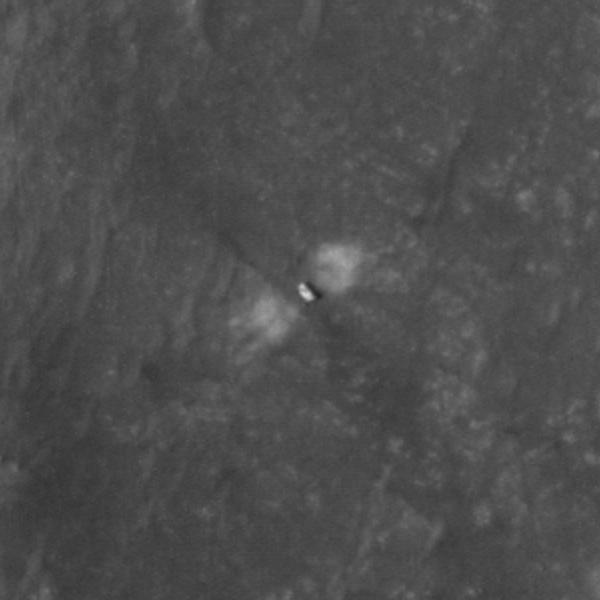
Rover, between the two larger scuff marks...
.