Vintage horns - Bach vs Conn F attachment design
- contemporacorner
- Posts: 14
- Joined: Feb 05, 2022
Been looking at a lot of old horns (c.1940s) recently and comparing the Bach and Conn F attachment designs -- specifically how rounded the Conn attachment is vs. Bach's design that seems to more closely follow the lines of the main bell tuning crook. Both designs allow for the F tuning slide to be pulled to E (to get the low B). In my context, I'm comparing the original Reynolds bass trombones to what existed at the time (c.1948-49) and noting that they seem to follow the Bach pattern. What is the conventional wisdom on these different wrap approaches in terms of blow, sound, etc.?
Thanks!
contemporacorner
Thanks!
contemporacorner
- ithinknot
- Posts: 1339
- Joined: Jul 24, 2020
Vincent Bach's eye/house style seems to have leaned towards tighter dual radius curves in general - look at the small bore crooks, trumpets, etc - but I think the logic of the Bach closed wrap works backwards from the bracing concept, with the 'flat' top of the wrap tubing allowing the use of diamond braces which remain in the vertical plane of the bell.
In the Conn/Holton pattern, the rearmost bell bracing has to be diagonal from the horizontally displaced F tuning slide outers, which reduces the overall number of braces but makes parallelling the bell section relative to the main tuning slide slightly more complicated... though you're dealing with pocket braces, which are more flexible than the Bach diamonds. The slightly shorter wide crook also marginally increases the potential length/pull distance of the F tuning slide.
Blow/sound etc?
The different bracing patterns will have more effect than the precise wrap radii, but you're talking about factors indivisible from far more significant apple vs orange differences between the companies.
[quote="contemporacorner"]Both designs allow for the F tuning slide to be pulled to E (to get the low B).[/quote]
The former is true, certainly (but the latter doesn't necessarily work out that way in practice). It's a numbers game, and you need to be considerably flat of E for B to safely remain on the slide, but it depends on pull length, slide length and 2nd partial intonation, all of which vary, even within individual models (various stages of the 70H being good examples).
In the Conn/Holton pattern, the rearmost bell bracing has to be diagonal from the horizontally displaced F tuning slide outers, which reduces the overall number of braces but makes parallelling the bell section relative to the main tuning slide slightly more complicated... though you're dealing with pocket braces, which are more flexible than the Bach diamonds. The slightly shorter wide crook also marginally increases the potential length/pull distance of the F tuning slide.
Blow/sound etc?
The different bracing patterns will have more effect than the precise wrap radii, but you're talking about factors indivisible from far more significant apple vs orange differences between the companies.
[quote="contemporacorner"]Both designs allow for the F tuning slide to be pulled to E (to get the low B).[/quote]
The former is true, certainly (but the latter doesn't necessarily work out that way in practice). It's a numbers game, and you need to be considerably flat of E for B to safely remain on the slide, but it depends on pull length, slide length and 2nd partial intonation, all of which vary, even within individual models (various stages of the 70H being good examples).
- contemporacorner
- Posts: 14
- Joined: Feb 05, 2022
[quote="ithinknot"]Vincent Bach's eye/house style seems to have leaned towards tighter dual radius curves in general - look at the small bore crooks, trumpets, etc - but I think the logic of the Bach closed wrap works backwards from the bracing concept, with the 'flat' top of the wrap tubing allowing the use of diamond braces which remain in the vertical plane of the bell.
In the Conn/Holton pattern, the rearmost bell bracing has to be diagonal from the horizontally displaced F tuning slide outers, which reduces the overall number of braces but makes parallelling the bell section relative to the main tuning slide slightly more complicated... though you're dealing with pocket braces, which are more flexible than the Bach diamonds. The slightly shorter wide crook also marginally increases the potential length/pull distance of the F tuning slide.[/quote]
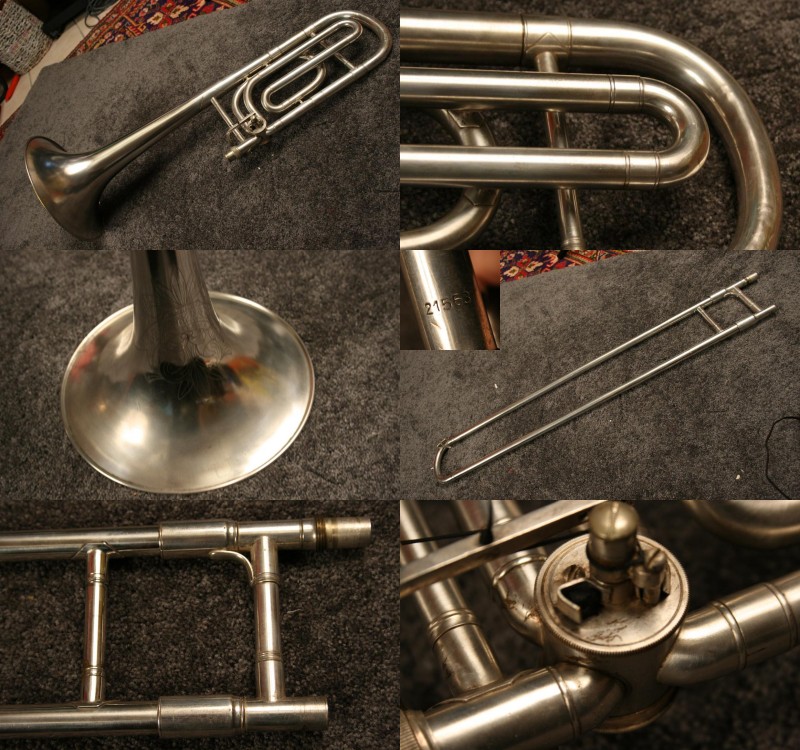
Thanks for the reply! That makes sense -- if I look at the early Reynolds example again, it might be more accurate to say that it has a Conn-style single radius turn on the wide crook, but Bach-style bracing between the F attachment and bell/gooseneck?
In the Conn/Holton pattern, the rearmost bell bracing has to be diagonal from the horizontally displaced F tuning slide outers, which reduces the overall number of braces but makes parallelling the bell section relative to the main tuning slide slightly more complicated... though you're dealing with pocket braces, which are more flexible than the Bach diamonds. The slightly shorter wide crook also marginally increases the potential length/pull distance of the F tuning slide.[/quote]
Thanks for the reply! That makes sense -- if I look at the early Reynolds example again, it might be more accurate to say that it has a Conn-style single radius turn on the wide crook, but Bach-style bracing between the F attachment and bell/gooseneck?
- ithinknot
- Posts: 1339
- Joined: Jul 24, 2020
[quote="contemporacorner"]... if I look at the early Reynolds example again, it might be more accurate to say that it has a Conn-style single radius turn on the wide crook, but Bach-style bracing between the F attachment and bell/gooseneck?[/quote]
Sure. The overall design looks superficially much more C than B - valve string linkage/lever, and the handslide details (with the exception of the hex flanges on the outer slide brace sockets) are very Conn.
With the wrap parts specifically (and design in general), you'd need company catalog history to know what's Big Idea and what's parts bin pragmatism. They might have tooled up especially for a ~4" wide .585" crook, or it might have been a tuning slide from a baritone, or...
Sure. The overall design looks superficially much more C than B - valve string linkage/lever, and the handslide details (with the exception of the hex flanges on the outer slide brace sockets) are very Conn.
With the wrap parts specifically (and design in general), you'd need company catalog history to know what's Big Idea and what's parts bin pragmatism. They might have tooled up especially for a ~4" wide .585" crook, or it might have been a tuning slide from a baritone, or...