Conn "LP"?
- Zorkomatic
- Posts: 54
- Joined: Mar 20, 2022
Hello! :hi:
I am a rank amateur when it comes to brass, but I like to restore vintage instruments with a history. I currently have a 1962 EK Blessing trumpet, and a rare German Einheits bandoneon with three sets of reeds instead of two.
I recently picked up a Conn trombone at a flea market in restorable condition with a very interesting background. It says it is a Carl Fischer's American Model, New York, has a serial number under the model info. on the bell it says that it was given to the USS Leviathan's Engineering Department by the Consolidated Iron Works. This is the Hoboken company owned by Andrew Fletcher that worked on the huge vessel's boilers after it was confiscated from the Germans in 1917 (they called it the SS Vaterland) by the US government when war was declared at the beginning of WW1. The vessel then became the USS Leviathan troop carrier and ferried some 100k doughboys to and from Europe. It had a band that was pretty good and recorded music for Victor Records, mostly fox trot tunes. Later on United States Lines bought it and turned it back into a luxurious transatlantic ship.
This instrument has a serial number, 27197, just below the engraved model info, where the bell joins the pipe. I thought the instrument was contemporary to the date the ship made its first voyage after being refurbished into a troop carrier, but that serial number puts it around 1893 (!!). Is this accurate?
I have a picture of the trombone player with the band from an old sheet music for a song they played, but I would love to have a name if anyone knows where to find it.
I am a rank amateur when it comes to brass, but I like to restore vintage instruments with a history. I currently have a 1962 EK Blessing trumpet, and a rare German Einheits bandoneon with three sets of reeds instead of two.
I recently picked up a Conn trombone at a flea market in restorable condition with a very interesting background. It says it is a Carl Fischer's American Model, New York, has a serial number under the model info. on the bell it says that it was given to the USS Leviathan's Engineering Department by the Consolidated Iron Works. This is the Hoboken company owned by Andrew Fletcher that worked on the huge vessel's boilers after it was confiscated from the Germans in 1917 (they called it the SS Vaterland) by the US government when war was declared at the beginning of WW1. The vessel then became the USS Leviathan troop carrier and ferried some 100k doughboys to and from Europe. It had a band that was pretty good and recorded music for Victor Records, mostly fox trot tunes. Later on United States Lines bought it and turned it back into a luxurious transatlantic ship.
This instrument has a serial number, 27197, just below the engraved model info, where the bell joins the pipe. I thought the instrument was contemporary to the date the ship made its first voyage after being refurbished into a troop carrier, but that serial number puts it around 1893 (!!). Is this accurate?
I have a picture of the trombone player with the band from an old sheet music for a song they played, but I would love to have a name if anyone knows where to find it.
- Doug_Elliott
- Posts: 4155
- Joined: Mar 22, 2018
LP means low pitch. There used to be two pitch standards, low pitch and high pitch and they were not compatible with each other so companies made both. LP is compatible with current pitch, so that's good.
The serial number lists online are as accurate as you're going to find.
The serial number lists online are as accurate as you're going to find.
- Zorkomatic
- Posts: 54
- Joined: Mar 20, 2022
Wow. This floors me, to find such a historical 19th century instrument in relatively good condition at a flea market. I am going to send it out to a specialist for restoration. Thanks!
- Digidog
- Posts: 483
- Joined: Dec 13, 2018
[quote="Zorkomatic"]Wow. This floors me, to find such a historical 19th century instrument in relatively good condition at a flea market. I am going to send it out to a specialist for restoration. Thanks![/quote]
Please let us see pictures of the final result!
This is a cool story, and the instrument too - so I'm eager to see and hear more about where the story ends.
Please let us see pictures of the final result!
This is a cool story, and the instrument too - so I'm eager to see and hear more about where the story ends.
- Zorkomatic
- Posts: 54
- Joined: Mar 20, 2022
I am going to try to link pics of its current state.
Hmm. There's no upload feature. I'll try as urls. Ah, that works. Here you go. Enjoy


The case on the floor to the left is the original case of the EK Blessing trumpet. Not sure it is worth restoring, but I will try.
Hmm. There's no upload feature. I'll try as urls. Ah, that works. Here you go. Enjoy
The case on the floor to the left is the original case of the EK Blessing trumpet. Not sure it is worth restoring, but I will try.
- Posaunus
- Posts: 5018
- Joined: Mar 23, 2018
I think that the only thing "Conn" about this trombone is the modern counterweight, which is certainly not original to the instrument. The bell is clearly engraved Carl Fischer, for whom I think it is unlikely that Conn made trombones. Is there any other engraving which could identify it as a Conn product? If not, a Conn serial number list is probably irrelevant.
In any case, it would be great to know more about the history of this instrument. Good luck on the restoration.
In any case, it would be great to know more about the history of this instrument. Good luck on the restoration.
- Zorkomatic
- Posts: 54
- Joined: Mar 20, 2022
Could be, I am not a recognized expert on these instruments. However, I have done my homework. You can be the judge of my findings.
I do know that Carl Fischer was a contemporary of Conn who opened a musical instrument repair shop in 1872 in New York's East Village. Charles Conn started making his rubber covered mouthpieces in 1873. In 1929, six years after Carl passed away, C.G. Conn Ltd. acquired the musical instrument department of the company from his son Walter, maintaining the Carl Fischer retail operations as a consortium between Conn and the music publisher under the Carl Fischer name. Instruments from various leading manufacturers of the period were sold under the Carl Fischer house brand. That implies that they already had a business relationship that ended up in an acquisition.[url]<LINK_TEXT text="https://en.wikipedia.org/wiki/Carl_Fisc ... th_century">https://en.wikipedia.org/wiki/Carl_Fischer_Music#1870s_into_the_20th_century</LINK_TEXT>
So, Carl Fischer was not an instrument manufacturer, he just did the same smart thing that happened with my German bandoneon, which has a house brand name on the outside but on the inside is clearly marked "ELA" for Ernest Louis Arnold, the brother of Albert Arnold of "AA" bandoneon worldwide fame, who took over the factory after Albert retired. Nothing new under the sun when it comes to these business arrangements.
Fischer had the trombones made by Conn (as well as likely other horns) and then sold them under his house brand name from his store in New York. That makes it a Conn instrument in my book. I doubt very much that there would be any attempt to deceive by installing a counterweight that did not belong to the instrument. The counterweights have not changed much over time, you can still get them in chrome with raised lettering, and changing it because of deterioration with another of the same design is no different than replacing other parts with period parts (known as NOS or New Old Stock) on instruments that need repair. Ockham's Razor applies here, IMO.
In addition, it makes sense for Andrew Fletcher to have picked an 1893 Conn trombone to give to the ship's band. By 1893 Conn's instruments were awarded the highest honors in the World’s Columbia Exposition in Chicago. The contract for the refurbishing and rebuilding of the USS Leviathan's German boilers, which had significant design problems and caused the engineers no end of grief, was very, very lucrative for Mr. Fletcher, and it would have been a huge insult for him to gift a cheap, no-name instrument. Such an insult would eventually come back to bite him if just one newspaper got wind of it.
Why a Carl Fischer-branded instrument? Because the Consolidated Iron Works was located in Hoboken. I attended college at Stevens Institute of Technology, when Hoboken was free of the yuppie infestation. Hoboken is right across the Hudson, and you could scream and someone would hear you in Manhattan. The PATH train, opened in 1908, could take you there in a few minutes, and it was an easy 15 minute, five-and-a-half block stroll from the station on 9th Street to Fischer's store on Cooper Square. Again, Ockham's Razor.
I rest my case, your honor. :)
I do know that Carl Fischer was a contemporary of Conn who opened a musical instrument repair shop in 1872 in New York's East Village. Charles Conn started making his rubber covered mouthpieces in 1873. In 1929, six years after Carl passed away, C.G. Conn Ltd. acquired the musical instrument department of the company from his son Walter, maintaining the Carl Fischer retail operations as a consortium between Conn and the music publisher under the Carl Fischer name. Instruments from various leading manufacturers of the period were sold under the Carl Fischer house brand. That implies that they already had a business relationship that ended up in an acquisition.
So, Carl Fischer was not an instrument manufacturer, he just did the same smart thing that happened with my German bandoneon, which has a house brand name on the outside but on the inside is clearly marked "ELA" for Ernest Louis Arnold, the brother of Albert Arnold of "AA" bandoneon worldwide fame, who took over the factory after Albert retired. Nothing new under the sun when it comes to these business arrangements.
Fischer had the trombones made by Conn (as well as likely other horns) and then sold them under his house brand name from his store in New York. That makes it a Conn instrument in my book. I doubt very much that there would be any attempt to deceive by installing a counterweight that did not belong to the instrument. The counterweights have not changed much over time, you can still get them in chrome with raised lettering, and changing it because of deterioration with another of the same design is no different than replacing other parts with period parts (known as NOS or New Old Stock) on instruments that need repair. Ockham's Razor applies here, IMO.
In addition, it makes sense for Andrew Fletcher to have picked an 1893 Conn trombone to give to the ship's band. By 1893 Conn's instruments were awarded the highest honors in the World’s Columbia Exposition in Chicago. The contract for the refurbishing and rebuilding of the USS Leviathan's German boilers, which had significant design problems and caused the engineers no end of grief, was very, very lucrative for Mr. Fletcher, and it would have been a huge insult for him to gift a cheap, no-name instrument. Such an insult would eventually come back to bite him if just one newspaper got wind of it.
Why a Carl Fischer-branded instrument? Because the Consolidated Iron Works was located in Hoboken. I attended college at Stevens Institute of Technology, when Hoboken was free of the yuppie infestation. Hoboken is right across the Hudson, and you could scream and someone would hear you in Manhattan. The PATH train, opened in 1908, could take you there in a few minutes, and it was an easy 15 minute, five-and-a-half block stroll from the station on 9th Street to Fischer's store on Cooper Square. Again, Ockham's Razor.
I rest my case, your honor. :)
- Posaunus
- Posts: 5018
- Joined: Mar 23, 2018
Thanks for that great history lesson. :good: I stand corrected. :oops:
Is there any marking on the trombone itself that links it to Conn? :idk:
The counterweight is NOT authentic to that era, though. In fact, I believe trombones of that time were not generally equipped with counterweights. Early Conn counterweights looked nothing like the more modern one attached to this antique instrument.
Please post photos of this interesting trombone after its restoration.
Is there any marking on the trombone itself that links it to Conn? :idk:
The counterweight is NOT authentic to that era, though. In fact, I believe trombones of that time were not generally equipped with counterweights. Early Conn counterweights looked nothing like the more modern one attached to this antique instrument.
Please post photos of this interesting trombone after its restoration.
- Zorkomatic
- Posts: 54
- Joined: Mar 20, 2022
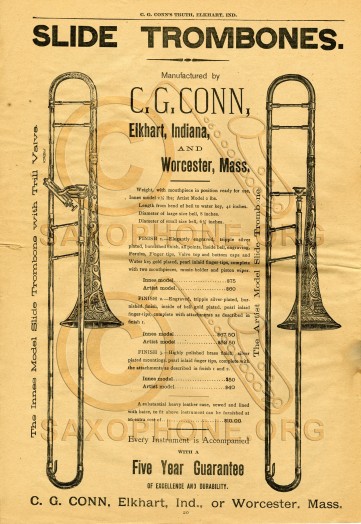
You got me thinking about the counterweight, so I decided to find out if Conn sold the 1893 trombones with counterweights. I tried finding a vintage counterweight of around that time and there seem to be none for sale. Then I put myself to finding documentation for this, and I found Conn's catalog from 1893. It turns out they were not sold with counterweights. Someone put that on there for convenience.
- Burgerbob
- Posts: 6327
- Joined: Apr 23, 2018
That's a relatively "modern" Conn weight, Elkhart or later.
- Zorkomatic
- Posts: 54
- Joined: Mar 20, 2022
[quote="Posaunus"]Thanks for that great history lesson. :good: I stand corrected. :oops:
Is there any marking on the trombone itself that links it to Conn? :idk:
The counterweight is NOT authentic to that era, though. In fact, I believe trombones of that time were not generally equipped with counterweights. Early Conn counterweights looked nothing like the more modern one attached to this antique instrument.
Please post photos of this interesting trombone after its restoration.[/quote]
Looks we crossposted. You are correct, they were not originally sold with counterweights at that time. :) I may remove the counterweight for historical accuracy but keep it in case in case it does need it from a functional point of view. At least whomever put it on there was careful enough to pick one with the correct name!
As to markings, I'm still looking. My eyes are not what they used to be but I broke out a magnifying class and it's being put to good use (other than for elimination of pest crawling insects, that is...) :lol:
Is there any marking on the trombone itself that links it to Conn? :idk:
The counterweight is NOT authentic to that era, though. In fact, I believe trombones of that time were not generally equipped with counterweights. Early Conn counterweights looked nothing like the more modern one attached to this antique instrument.
Please post photos of this interesting trombone after its restoration.[/quote]
Looks we crossposted. You are correct, they were not originally sold with counterweights at that time. :) I may remove the counterweight for historical accuracy but keep it in case in case it does need it from a functional point of view. At least whomever put it on there was careful enough to pick one with the correct name!
As to markings, I'm still looking. My eyes are not what they used to be but I broke out a magnifying class and it's being put to good use (other than for elimination of pest crawling insects, that is...) :lol:
- Zorkomatic
- Posts: 54
- Joined: Mar 20, 2022
[quote="Burgerbob"]That's a relatively "modern" Conn weight, Elkhart or later.[/quote]
It sure is. :)
It sure is. :)
- imsevimse
- Posts: 1765
- Joined: Apr 29, 2018
This looks like it is a stencil. How do you know it's made in 1893? How can you be sure the serial number is a Conn serial number? I'm not saying you are wrong but stencils can be a bit of a mystery. The close connection between Carl Fisher and Conn might explain that but it is news to me. Interesting!
I thought of writing what's been written here already from memory, because I know I have read about Carl Fisher instruments before (probably at the old forum) and it was nice to have all that information to read again, but the connection with Conn was a new thing to me.
The typical way of identifying who can have made a stencil is to look for characteristic parts that can be identified as typical Conn or Martin parts for example. You can not really brand a stencil usually. It stops with likely to be made of them or that. I have a very interesting stencil myself with the name "Commadore" which was the brand of a shop own by William Tonk. Some parts of that horn really looks like Martin. Good .500 horn but not worth more than the metal-value I guess.
/Tom
I thought of writing what's been written here already from memory, because I know I have read about Carl Fisher instruments before (probably at the old forum) and it was nice to have all that information to read again, but the connection with Conn was a new thing to me.
The typical way of identifying who can have made a stencil is to look for characteristic parts that can be identified as typical Conn or Martin parts for example. You can not really brand a stencil usually. It stops with likely to be made of them or that. I have a very interesting stencil myself with the name "Commadore" which was the brand of a shop own by William Tonk. Some parts of that horn really looks like Martin. Good .500 horn but not worth more than the metal-value I guess.
/Tom
- Zorkomatic
- Posts: 54
- Joined: Mar 20, 2022
[quote="imsevimse"]This looks like it is a stencil. How do you know it's made in 1893? How can you be sure the serial number is a Conn serial number? I'm not saying you are wrong but stencils can be a bit of a mystery. The close connection between Carl Fisher and Conn might explain that but it is news to me. Interesting![/quote]
The evidence i have strongly supports that it is authentic. You can see the pictures. If you can see something on it that supports your theory, I am all ears, but so far, I don't buy this theory.
The evidence i have strongly supports that it is authentic. You can see the pictures. If you can see something on it that supports your theory, I am all ears, but so far, I don't buy this theory.
- LeTromboniste
- Posts: 1634
- Joined: Apr 11, 2018
I don't mean to burst your bubble, but I don't really see any reason to assume it's a Conn. It's not at all unlikely that it is, but even with the relationship with Conn, which is much later on, or if we assume they already had one at the time, they could have had their instruments made by any number of maker (and likely more than one). For whatever it's worth, the same Wikipedia article you quote also says that Carl Fischer imported stencil instruments from various European makers (you may want to look at the cited source, that book might have more detailed information on which makers' brass instruments they sold under their name and when), and even after the Conn acquisition of the instruments department, still sold instruments from various makers under their own brand name...Even if it was made by Conn, there is no reason to assume they used the same serial number series for stencil instruments as they did for "proper" Conn, so the serial can't be reliably used for dating the instrument using Conn lists. Most likely, Fisher had their own serial number sequence that they engraved themselves on stencil instruments.
For instance, I haven't seen a Conn with a serial number engraved on the bell like that (but it's very typical for Carl Fischer-branded instruments). On Conn trombones it's usually stamped near the slide receiver. Does your instrument have a union labeled stamped on it? That can also help date it. What are the bore and bell size?
Like Tom said, with stencil instruments, one usually can only say "possibly made by", there is rarely any certainty, unless we know the retailer in question bought instruments only from one particular maker (which is not the case here, and rarely is).
For instance, I haven't seen a Conn with a serial number engraved on the bell like that (but it's very typical for Carl Fischer-branded instruments). On Conn trombones it's usually stamped near the slide receiver. Does your instrument have a union labeled stamped on it? That can also help date it. What are the bore and bell size?
Like Tom said, with stencil instruments, one usually can only say "possibly made by", there is rarely any certainty, unless we know the retailer in question bought instruments only from one particular maker (which is not the case here, and rarely is).
- Zorkomatic
- Posts: 54
- Joined: Mar 20, 2022
Another piece of the puzzle. The "American Model" designation on the engraving was likely not a Carl Fischer thing. Conn used that designation across his entire model line in 1893 to distinguish himself from his European competition. You can see that across several items the 1893 catalog. [url]https://www.saxophone.org/museum/publications/id/414 The dimensions also match, 41" from bend of bell to the water key, 6.25' diameter horn. The location of the water key matches as well. There is one small feature that I don't know if it's unique to Conn trombones or common in others. The end of the slide tube has a little fin on it, to give the bend more strength. Is this common in trombones?
The only difference I see if that the catalog drawing has fancy engraving on it. It would have made sense for Fischer to order them without that to save money and maximize profit margins.
Carl was a pretty prolific dude. This is an example of a beautiful horn that he sold out of his New York store, engraved with his name as the sole agent for the manufacturer in "Amerika" and Canada.[url]http://www.rjmartz.com/horns/Schmidt_060/
What was copied was Conn's cushioned mouthpieces, but that was long after Conn's patent had expired.[url]https://www.brasshistory.net/MuckMpc.html
The only difference I see if that the catalog drawing has fancy engraving on it. It would have made sense for Fischer to order them without that to save money and maximize profit margins.
Carl was a pretty prolific dude. This is an example of a beautiful horn that he sold out of his New York store, engraved with his name as the sole agent for the manufacturer in "Amerika" and Canada.
What was copied was Conn's cushioned mouthpieces, but that was long after Conn's patent had expired.
- Zorkomatic
- Posts: 54
- Joined: Mar 20, 2022
[quote="LeTromboniste"]I don't mean to burst your bubble, but I don't really see any reason to assume it's a Conn. It's not at all unlikely that it is, but even with the relationship with Conn, which is much later on, or if we assume they already had one at the time, they could have had their instruments made by any number of maker (and likely more than one). For whatever it's worth, the same Wikipedia article you quote also says that Carl Fischer imported stencil instruments from various European makers (you may want to look at the cited source, that book might have more detailed information on which makers' brass instruments they sold under their name and when), and even after the Conn acquisition of the instruments department, still sold instruments from various makers under their own brand name...Even if it was made by Conn, there is no reason to assume they used the same serial number series for stencil instruments as they did for "proper" Conn, so the serial can't be reliably used for dating the instrument using Conn lists. Most likely, Fisher had their own serial number sequence that they engraved themselves on stencil instruments.
For instance, I haven't seen a Conn with a serial number engraved on the bell like that (but it's very typical for Carl Fischer-branded instruments). On Conn trombones it's usually stamped near the slide receiver. Does your instrument have a union labeled stamped on it? That can also help date it. What are the bore and bell size?
Like Tom said, with stencil instruments, one usually can only say "possibly made by", there is rarely any certainty, unless we know the retailer in question bought instruments only from one particular maker (which is not the case here, and rarely is).[/quote]
Like I said, if there is evidence that this instrument is a stencil, I'm all ears. So far there's theories, but nothing concrete to base them on when it comes to this instrument. I am very skeptical that Fischer would risk the wrath of Fletcher by selling him an instrument that says "American Model" but was actually made by a European company. There's no logic in that and IMO is a huge stretch.
As to the serial number, several people who own vintage Conn trombones have already confirmed to me that the location is correct. Bell size is correct, 6.25" for Conn's small bell. The outer slide bore is 0.505". The inner slide bore is 0.425".
For instance, I haven't seen a Conn with a serial number engraved on the bell like that (but it's very typical for Carl Fischer-branded instruments). On Conn trombones it's usually stamped near the slide receiver. Does your instrument have a union labeled stamped on it? That can also help date it. What are the bore and bell size?
Like Tom said, with stencil instruments, one usually can only say "possibly made by", there is rarely any certainty, unless we know the retailer in question bought instruments only from one particular maker (which is not the case here, and rarely is).[/quote]
Like I said, if there is evidence that this instrument is a stencil, I'm all ears. So far there's theories, but nothing concrete to base them on when it comes to this instrument. I am very skeptical that Fischer would risk the wrath of Fletcher by selling him an instrument that says "American Model" but was actually made by a European company. There's no logic in that and IMO is a huge stretch.
As to the serial number, several people who own vintage Conn trombones have already confirmed to me that the location is correct. Bell size is correct, 6.25" for Conn's small bell. The outer slide bore is 0.505". The inner slide bore is 0.425".
- BGuttman
- Posts: 7368
- Joined: Mar 22, 2018
You might want to check out the Conn Loyalist pages (https://cderksen.home.xs4all.nl/index.html) where there is a lot of information about Conn instruments. Note that the Conn serial numbers include Pan American and Wurlitzer but I don't see any reference to Carl Fischer. You could check out Margaret Downey Banks' excellent history of the Conn company (also referenced on that site).
There is a nice history of Carl Fischer as an instrument manufacturer in a book by Richard Dundas called something like "American Brass Instrument Manufacturers".
Incidentally, I went to college across the street from Carl Fischer. At that time they weren't making or selling musical instruments; just sheet music. But they had an enormous tuba (BBBb) in the window of the building.
If you go to Horn-U-Copia there is a picture of a Carl Fischer American Model on this page: <LINK_TEXT text="https://www.horn-u-copia.net/show.php?s ... Fischer%22">https://www.horn-u-copia.net/show.php?selby=+where+instrument%3D%22Trombone%22+and+maker%3D%22Fischer%22</LINK_TEXT> . There is actually a "Reliable" model that looks more like yours than their American model. The Reliable serial number is similar to yours. Too bad there is no year on it.
There is a nice history of Carl Fischer as an instrument manufacturer in a book by Richard Dundas called something like "American Brass Instrument Manufacturers".
Incidentally, I went to college across the street from Carl Fischer. At that time they weren't making or selling musical instruments; just sheet music. But they had an enormous tuba (BBBb) in the window of the building.
If you go to Horn-U-Copia there is a picture of a Carl Fischer American Model on this page: <LINK_TEXT text="https://www.horn-u-copia.net/show.php?s ... Fischer%22">https://www.horn-u-copia.net/show.php?selby=+where+instrument%3D%22Trombone%22+and+maker%3D%22Fischer%22</LINK_TEXT> . There is actually a "Reliable" model that looks more like yours than their American model. The Reliable serial number is similar to yours. Too bad there is no year on it.
- Zorkomatic
- Posts: 54
- Joined: Mar 20, 2022
I checked the Conn Loyalist site but I can't find any mention of Fischer selling stencil trombones in the late 19th or very early 20th century. Other kinds of brass instruments, yes, but not trombones. Anybody got any links to examples of stencil trombones from 1890's to 1917?
- LeTromboniste
- Posts: 1634
- Joined: Apr 11, 2018
[quote="Zorkomatic"]<QUOTE author="LeTromboniste" post_id="174158" time="1647811990" user_id="3038">
I don't mean to burst your bubble, but I don't really see any reason to assume it's a Conn. It's not at all unlikely that it is, but even with the relationship with Conn, which is much later on, or if we assume they already had one at the time, they could have had their instruments made by any number of maker (and likely more than one). For whatever it's worth, the same Wikipedia article you quote also says that Carl Fischer imported stencil instruments from various European makers (you may want to look at the cited source, that book might have more detailed information on which makers' brass instruments they sold under their name and when), and even after the Conn acquisition of the instruments department, still sold instruments from various makers under their own brand name...Even if it was made by Conn, there is no reason to assume they used the same serial number series for stencil instruments as they did for "proper" Conn, so the serial can't be reliably used for dating the instrument using Conn lists. Most likely, Fisher had their own serial number sequence that they engraved themselves on stencil instruments.
For instance, I haven't seen a Conn with a serial number engraved on the bell like that (but it's very typical for Carl Fischer-branded instruments). On Conn trombones it's usually stamped near the slide receiver. Does your instrument have a union labeled stamped on it? That can also help date it. What are the bore and bell size?
Like Tom said, with stencil instruments, one usually can only say "possibly made by", there is rarely any certainty, unless we know the retailer in question bought instruments only from one particular maker (which is not the case here, and rarely is).[/quote]
Like I said, if there is evidence that this instrument is a stencil, I'm all ears. So far there's theories, but nothing concrete to base them on when it comes to this instrument. I am very skeptical that Fischer would risk the wrath of Fletcher by selling him an instrument that says "American Model" but was actually made by a European company. There's no logic in that and IMO is a huge stretch.
As to the serial number, several people who own vintage Conn trombones have already confirmed to me that the location is correct. Bell size is correct, 6.25" for Conn's small bell. The outer slide bore is 0.505". The inner slide bore is 0.425".
</QUOTE>
Well by definition, if the instrument is built by a different, unmarked maker, and marked with the seller's brand, it IS a stencil instrument. If it's made by Conn (which as I said, might very well be the case), it's still a stencil.
Those dimensions were very standard at the time, so it's not saying that much. I own and have played a number of vintage Conns, none of which had a serial hand-engraved on the bell flare (granted, those were somewhat later, 1910s and 20s instruments, but I did see and try a Conn from the 1880s that was the earlier, very different more Germanic style, and I don't remember it having a serial on the bell flare). On the other end Carl Fisher instruments seem to often have that serial number placement.
A quick look on Horn-U-Copia yields several Carl Fisher instruments with stamps from European countries, by the way, including some of the "American Model" ones.
I don't mean to burst your bubble, but I don't really see any reason to assume it's a Conn. It's not at all unlikely that it is, but even with the relationship with Conn, which is much later on, or if we assume they already had one at the time, they could have had their instruments made by any number of maker (and likely more than one). For whatever it's worth, the same Wikipedia article you quote also says that Carl Fischer imported stencil instruments from various European makers (you may want to look at the cited source, that book might have more detailed information on which makers' brass instruments they sold under their name and when), and even after the Conn acquisition of the instruments department, still sold instruments from various makers under their own brand name...Even if it was made by Conn, there is no reason to assume they used the same serial number series for stencil instruments as they did for "proper" Conn, so the serial can't be reliably used for dating the instrument using Conn lists. Most likely, Fisher had their own serial number sequence that they engraved themselves on stencil instruments.
For instance, I haven't seen a Conn with a serial number engraved on the bell like that (but it's very typical for Carl Fischer-branded instruments). On Conn trombones it's usually stamped near the slide receiver. Does your instrument have a union labeled stamped on it? That can also help date it. What are the bore and bell size?
Like Tom said, with stencil instruments, one usually can only say "possibly made by", there is rarely any certainty, unless we know the retailer in question bought instruments only from one particular maker (which is not the case here, and rarely is).[/quote]
Like I said, if there is evidence that this instrument is a stencil, I'm all ears. So far there's theories, but nothing concrete to base them on when it comes to this instrument. I am very skeptical that Fischer would risk the wrath of Fletcher by selling him an instrument that says "American Model" but was actually made by a European company. There's no logic in that and IMO is a huge stretch.
As to the serial number, several people who own vintage Conn trombones have already confirmed to me that the location is correct. Bell size is correct, 6.25" for Conn's small bell. The outer slide bore is 0.505". The inner slide bore is 0.425".
</QUOTE>
Well by definition, if the instrument is built by a different, unmarked maker, and marked with the seller's brand, it IS a stencil instrument. If it's made by Conn (which as I said, might very well be the case), it's still a stencil.
Those dimensions were very standard at the time, so it's not saying that much. I own and have played a number of vintage Conns, none of which had a serial hand-engraved on the bell flare (granted, those were somewhat later, 1910s and 20s instruments, but I did see and try a Conn from the 1880s that was the earlier, very different more Germanic style, and I don't remember it having a serial on the bell flare). On the other end Carl Fisher instruments seem to often have that serial number placement.
A quick look on Horn-U-Copia yields several Carl Fisher instruments with stamps from European countries, by the way, including some of the "American Model" ones.
- Zorkomatic
- Posts: 54
- Joined: Mar 20, 2022
[quote="BGuttman"]If you go to Horn-U-Copia there is a picture of a Carl Fischer American Model on this page: <LINK_TEXT text="https://www.horn-u-copia.net/show.php?s ... Fischer%22">https://www.horn-u-copia.net/show.php?selby=+where+instrument%3D%22Trombone%22+and+maker%3D%22Fischer%22</LINK_TEXT> . There is actually a "Reliable" model that looks more like yours than their American model. The Reliable serial number is similar to yours. Too bad there is no year on it.[/quote]
Hmm. The serial number for the Reliable entry places it three years later than the American Model. And the pictures are awful, I really wish they had more detail. I am intrigued by the different placements of the water valve on the slide. It's almost as if someone was experimenting with how to place them.
Hmm. The serial number for the Reliable entry places it three years later than the American Model. And the pictures are awful, I really wish they had more detail. I am intrigued by the different placements of the water valve on the slide. It's almost as if someone was experimenting with how to place them.
- LeTromboniste
- Posts: 1634
- Joined: Apr 11, 2018
Where's the water key on yours?
I suspect water key placement is indicative of different vintages of the Fisher instruments being supplied by different makers, more than of variation within a single maker's output.
Your trombone doesn't match the bracing style depicted in the 1893 catalog, but it is after all a drawing some I'm wary of giving too much importance to details.
I suspect water key placement is indicative of different vintages of the Fisher instruments being supplied by different makers, more than of variation within a single maker's output.
Your trombone doesn't match the bracing style depicted in the 1893 catalog, but it is after all a drawing some I'm wary of giving too much importance to details.
- LeTromboniste
- Posts: 1634
- Joined: Apr 11, 2018
[quote="Zorkomatic"]<QUOTE author="BGuttman" post_id="174163" time="1647813894" user_id="53">
If you go to Horn-U-Copia there is a picture of a Carl Fischer American Model on this page: <LINK_TEXT text="https://www.horn-u-copia.net/show.php?s ... Fischer%22">https://www.horn-u-copia.net/show.php?selby=+where+instrument%3D%22Trombone%22+and+maker%3D%22Fischer%22</LINK_TEXT> . There is actually a "Reliable" model that looks more like yours than their American model. The Reliable serial number is similar to yours. Too bad there is no year on it.[/quote]
The serial number for the Reliable entry places it three years later than the American Model.
</QUOTE>
Which again is assuming all the instruments were made by Conn AND that the serial numbers follow Conn's own sequence, which is far from a given.
If you go to Horn-U-Copia there is a picture of a Carl Fischer American Model on this page: <LINK_TEXT text="https://www.horn-u-copia.net/show.php?s ... Fischer%22">https://www.horn-u-copia.net/show.php?selby=+where+instrument%3D%22Trombone%22+and+maker%3D%22Fischer%22</LINK_TEXT> . There is actually a "Reliable" model that looks more like yours than their American model. The Reliable serial number is similar to yours. Too bad there is no year on it.[/quote]
The serial number for the Reliable entry places it three years later than the American Model.
</QUOTE>
Which again is assuming all the instruments were made by Conn AND that the serial numbers follow Conn's own sequence, which is far from a given.
- Zorkomatic
- Posts: 54
- Joined: Mar 20, 2022
[quote="LeTromboniste"]Well by definition, if the instrument is built by a different, unmarked maker, and marked with the seller's brand, it IS a stencil instrument. If it's made by Conn (which as I said, might very well be the case), it's still a stencil.
Those dimensions were very standard at the time, so it's not saying that much. I own and have played a number of vintage Conns, none of which had a serial hand-engraved on the bell flare (granted, those were somewhat later, 1910s and 20s instruments, but I did see and try a Conn from the 1880s that was the earlier, very different more Germanic style, and I don't remember it having a serial on the bell flare). On the other end Carl Fisher instruments seem to often have that serial number placement.
A quick look on Horn-U-Copia yields several Carl Fisher instruments with stamps from European countries, by the way, including some of the "American Model" ones.[/quote]
So you are saying that "house brand" is the same as "stencil" Not sure about that either. Stencil implies that someone copied the designs. Why would Fischer order copies made all the way in Europe, when Conn had factories in Elkhart IN and Worcester MA? My family has been in the international trading business for some 50 years, and it would only make sense if the overseas manufacturer could make them of the same quality but much cheaper to compensate for the additional logistics and import expenses. European manufacturers were not so much in the business of doing that back then as the Chinese knockoff companies are now.
In 1880 Conn was still using one or two European workers to make their instruments and there would have been inconsistencies in design. Quality was of more interest than placement of information. It wasn't until he built his larger factory that he was able to attract more specialists from Europe. He also acquired Isaac Fiske's brass instrument manufactory in Worcester, Massachusetts in 1887. Fiske's operation was actually considered to be the best in its time. I wonder if Fischer was purchasing the trombones from the Fiske facility. That might also explain the variation in serial number locations.
I'd like to see the info you found that shows Carl Fischer American Model instruments with stamps from European countries. Links?
Those dimensions were very standard at the time, so it's not saying that much. I own and have played a number of vintage Conns, none of which had a serial hand-engraved on the bell flare (granted, those were somewhat later, 1910s and 20s instruments, but I did see and try a Conn from the 1880s that was the earlier, very different more Germanic style, and I don't remember it having a serial on the bell flare). On the other end Carl Fisher instruments seem to often have that serial number placement.
A quick look on Horn-U-Copia yields several Carl Fisher instruments with stamps from European countries, by the way, including some of the "American Model" ones.[/quote]
So you are saying that "house brand" is the same as "stencil" Not sure about that either. Stencil implies that someone copied the designs. Why would Fischer order copies made all the way in Europe, when Conn had factories in Elkhart IN and Worcester MA? My family has been in the international trading business for some 50 years, and it would only make sense if the overseas manufacturer could make them of the same quality but much cheaper to compensate for the additional logistics and import expenses. European manufacturers were not so much in the business of doing that back then as the Chinese knockoff companies are now.
In 1880 Conn was still using one or two European workers to make their instruments and there would have been inconsistencies in design. Quality was of more interest than placement of information. It wasn't until he built his larger factory that he was able to attract more specialists from Europe. He also acquired Isaac Fiske's brass instrument manufactory in Worcester, Massachusetts in 1887. Fiske's operation was actually considered to be the best in its time. I wonder if Fischer was purchasing the trombones from the Fiske facility. That might also explain the variation in serial number locations.
I'd like to see the info you found that shows Carl Fischer American Model instruments with stamps from European countries. Links?
- Zorkomatic
- Posts: 54
- Joined: Mar 20, 2022
[quote="LeTromboniste"]Where's the water key on yours?
I suspect water key placement is indicative of different vintages of the Fisher instruments being supplied by different makers, more than of variation within a single maker's output.
Your trombone doesn't match the bracing style depicted in the 1893 catalog, but it is after all a drawing some I'm wary of giving too much importance to details.[/quote]
The engraving is totally different too, but remember that Conn was making trombones in Elkhart as well as in Worcester by that time, and there is no reason to believe the instruments from both factories would be identical.
I suspect water key placement is indicative of different vintages of the Fisher instruments being supplied by different makers, more than of variation within a single maker's output.
Your trombone doesn't match the bracing style depicted in the 1893 catalog, but it is after all a drawing some I'm wary of giving too much importance to details.[/quote]
The engraving is totally different too, but remember that Conn was making trombones in Elkhart as well as in Worcester by that time, and there is no reason to believe the instruments from both factories would be identical.
- Zorkomatic
- Posts: 54
- Joined: Mar 20, 2022
[quote="LeTromboniste"]Which again is assuming all the instruments were made by Conn AND that the serial numbers follow Conn's own sequence, which is far from a given.[/quote]
True, but the alternate explanations are theories that require a lot more explanations than assuming Fischer was at the time ordering the instruments already engraved and serial-numbered. I'm still a fan of Ockham. :) The simplest explanation is usually the correct one.
True, but the alternate explanations are theories that require a lot more explanations than assuming Fischer was at the time ordering the instruments already engraved and serial-numbered. I'm still a fan of Ockham. :) The simplest explanation is usually the correct one.
- LeTromboniste
- Posts: 1634
- Joined: Apr 11, 2018
The term "stencil instrument" comes from the concept that retailers would buy instruments without the maker's brand on them, and would "stencil" their own brand and model numbers onto them. The engraving or stamping may or may not have been made by the retailer or a third party hired by them, rather than by the manufacturer. Depends on the maker and retailer. An instrument made by Conn for a retailer to market under their own name would be called a stencil.
Nothing to do with copying. Nothing to do with them coming from cheaper makers in areas with lower labour costs either. It's just that nowadays many stencil instruments happen to also be clones, and to be from Asia. Yet, many of today's stencil horns are indeed Asian but not copies, some are neither cheap, Asian nor copies (e.g. B&S and Courtois used to provide stencil instruments for some American shops), and some instruments are copies but not stencils. Those are unrelated.
Nothing to do with copying. Nothing to do with them coming from cheaper makers in areas with lower labour costs either. It's just that nowadays many stencil instruments happen to also be clones, and to be from Asia. Yet, many of today's stencil horns are indeed Asian but not copies, some are neither cheap, Asian nor copies (e.g. B&S and Courtois used to provide stencil instruments for some American shops), and some instruments are copies but not stencils. Those are unrelated.
- LeTromboniste
- Posts: 1634
- Joined: Apr 11, 2018
The point being, this is 100% a stencil instrument. It's made by an unknown maker, and marketed by CF using their own brand and model names. You assume that Conn made this, and start from there, and it's not impossible or unlikely, but there is hardly proof. It could just as well be any other American or European maker (although unlikely German), a number of which we know CF dealt with. That there are instruments of theirs stamped "Bohemia" is pretty clear indication of that.
Most likely is that the instruments were left without any engravings, or with just the background swirls, and CF would then have either an in-house or contracted engraver add their brand, model name and serial number to the instrument.
Most likely is that the instruments were left without any engravings, or with just the background swirls, and CF would then have either an in-house or contracted engraver add their brand, model name and serial number to the instrument.
- Zorkomatic
- Posts: 54
- Joined: Mar 20, 2022
[quote="LeTromboniste"]The term "stencil instrument" comes from the concept that retailers would buy instruments without the maker's brand on them, and would "stencil" their own brand and model numbers onto them. The engraving or stamping may or may not have been made by the retailer or a third party hired by them, rather than by the manufacturer. Depends on the maker and retailer. An instrument made by Conn for a retailer to market under their own name would be called a stencil.
Nothing to do with copying. Nothing to do with them coming from cheaper makers in areas with lower labour costs either. It's just that nowadays many stencil instruments happen to also be clones, and to be from Asia. Yet, many of today's stencil horns are indeed Asian but not copies, some are neither cheap, Asian nor copies (e.g. B&S and Courtois used to provide stencil instruments for some American shops), and some instruments are copies but not stencils. Those are unrelated.[/quote]
Aha. Thanks for the explanation. So it means "house brand". Got it. Thanks. :) So now I have to see if I can figure out who applied the engraving on Carl Fischer trombones.
I was also intrigued by the mention of Fischer applying his own serial numbers, but so far I have not found any evidence that he did that. I would have thought that if he had, someone would in all this time develop a database of Fischer serial numbers, not there are none that I can find. Same can be said for Fiske in Worcester. They were making instruments before Conn acquired them, but there is no record I can find of their serial numbers.
However, I have found clear evidence that Fischer's American Model trombones were made at the Fiske facility in Worcester, here:[url]<LINK_TEXT text="https://1drv.ms/b/s!AoULBt5YVpLHhP12lHn ... Q?e=g5BuHd">https://1drv.ms/b/s!AoULBt5YVpLHhP12lHnDyXz4U2u3iQ?e=g5BuHd</LINK_TEXT> CG Conn bought out Fiske in 1887, so anything they made for Fischer after that was officially a Conn product. So far, the evidence continues to strongly suggest this is a Conn trombone, sold to Fischer under a house-brand dealer agreement.
Nothing to do with copying. Nothing to do with them coming from cheaper makers in areas with lower labour costs either. It's just that nowadays many stencil instruments happen to also be clones, and to be from Asia. Yet, many of today's stencil horns are indeed Asian but not copies, some are neither cheap, Asian nor copies (e.g. B&S and Courtois used to provide stencil instruments for some American shops), and some instruments are copies but not stencils. Those are unrelated.[/quote]
Aha. Thanks for the explanation. So it means "house brand". Got it. Thanks. :) So now I have to see if I can figure out who applied the engraving on Carl Fischer trombones.
I was also intrigued by the mention of Fischer applying his own serial numbers, but so far I have not found any evidence that he did that. I would have thought that if he had, someone would in all this time develop a database of Fischer serial numbers, not there are none that I can find. Same can be said for Fiske in Worcester. They were making instruments before Conn acquired them, but there is no record I can find of their serial numbers.
However, I have found clear evidence that Fischer's American Model trombones were made at the Fiske facility in Worcester, here:
- Zorkomatic
- Posts: 54
- Joined: Mar 20, 2022
[quote="LeTromboniste"]It's made by an unknown maker, and marketed by CF using their own brand and model names. You assume that Conn made this, and start from there, and it's not impossible or unlikely, but there is hardly proof. It could just as well be any other American or European maker (although unlikely German), a number of which we know CF dealt with. That there are instruments of theirs stamped "Bohemia" is pretty clear indication of that.
Most likely is that the instruments were left without any engravings, or with just the background swirls, and CF would then have either an in-house or contracted engraver add their brand, model name and serial number to the instrument.[/quote]
I just posted the proof that Fischer's American Models were made by the Conn factory in Worcester MA, which used to be called the Fiske factory.
<I>1887 Fiske has sold out (to Conn) (MTR, Feb); Conn opened its Worcester branch in January, 1887 (A Hundred Years of Music in America, 1889) “I take great pleasure in announcing that I have purchased the Isaac Fiske Band Instrument Manufactory at Worcester, Mass, including all of its tools and machinery, which will enable me to fill all future orders of band instruments.” C. G. Conn, May 1, 1887 </I>
Now I wonder where did the Fiske staff traditionally put the serial numbers on the instruments they manufactured?
Holmes, I need a clue! :lol:
Most likely is that the instruments were left without any engravings, or with just the background swirls, and CF would then have either an in-house or contracted engraver add their brand, model name and serial number to the instrument.[/quote]
I just posted the proof that Fischer's American Models were made by the Conn factory in Worcester MA, which used to be called the Fiske factory.
<I>1887 Fiske has sold out (to Conn) (MTR, Feb); Conn opened its Worcester branch in January, 1887 (A Hundred Years of Music in America, 1889) “I take great pleasure in announcing that I have purchased the Isaac Fiske Band Instrument Manufactory at Worcester, Mass, including all of its tools and machinery, which will enable me to fill all future orders of band instruments.” C. G. Conn, May 1, 1887 </I>
Now I wonder where did the Fiske staff traditionally put the serial numbers on the instruments they manufactured?
Holmes, I need a clue! :lol:
- LeTromboniste
- Posts: 1634
- Joined: Apr 11, 2018
What's the evidence that the Fischer instrument were made by Fiske?
It's worth noting that apparently Fiske made valved instruments, not trombones.
It's worth noting that apparently Fiske made valved instruments, not trombones.
- Zorkomatic
- Posts: 54
- Joined: Mar 20, 2022
Aw, shucks. I saw Fischer Catalog #15 and I thought I read FIscke Catalog #15. That's because there's a Fiske catalog entry right below that. Damn my eyes (apologies to Marty Feldman).
Back to the chase. :)
Back to the chase. :)
- BGuttman
- Posts: 7368
- Joined: Mar 22, 2018
I have an 1893 Eb tuba labeled "CG Conn, Elkhart Ind. and Worcester, Mass". It clearly comes from the Fiske plant. It corresponds to the Conn serial listing. If your trombone was indeed made in Worcester, then the serial is a Conn serial. We need to have some of the experts here on construction determine who is the stencil maker.
- Zorkomatic
- Posts: 54
- Joined: Mar 20, 2022
[quote="BGuttman"]I have an 1893 Eb tuba labeled "CG Conn, Elkhart Ind. and Worcester, Mass". It clearly comes from the Fiske plant. It corresponds to the Conn serial listing. If your trombone was indeed made in Worcester, then the serial is a Conn serial. We need to have some of the experts here on construction determine who is the stencil maker.[/quote]
That would certainly be a great idea. I also emailed Conn-Selmer to see if they still have the 19th century archives and could tell me to whom instrument # 27197 was originally sold (private party or dealer). It's a hail-mary, but you never know. :)
Somebody just asked me if I am going to learn to play this thing on another web site. I'd have to go on another bug hunt to figure out what mouthpiece would be right to me, and learn to make buzzing sounds. :lol:
That would certainly be a great idea. I also emailed Conn-Selmer to see if they still have the 19th century archives and could tell me to whom instrument # 27197 was originally sold (private party or dealer). It's a hail-mary, but you never know. :)
Somebody just asked me if I am going to learn to play this thing on another web site. I'd have to go on another bug hunt to figure out what mouthpiece would be right to me, and learn to make buzzing sounds. :lol:
- Zorkomatic
- Posts: 54
- Joined: Mar 20, 2022
Heeeeyyyy... this showed up on a search out of the blue...
At the same time, he had a desire to expand operations beyond Elkhart. When Isaac Fiske, an instrument maker in Worcester, Massachusetts, decided to retire, Conn bought him out and operated this second factory for eleven years. <B>He also opened a retail shop in New York City.</B>
That is completely new to me. Anyone have more info about this retail store???
At the same time, he had a desire to expand operations beyond Elkhart. When Isaac Fiske, an instrument maker in Worcester, Massachusetts, decided to retire, Conn bought him out and operated this second factory for eleven years. <B>He also opened a retail shop in New York City.</B>
That is completely new to me. Anyone have more info about this retail store???
- Zorkomatic
- Posts: 54
- Joined: Mar 20, 2022
More evidence the Fiske facility was building Conn designs... [url]https://www.trumpet-history.com/Conn%20History.htm
Conn expanded further in December of 1886 buying the Isaac Fiske Instrument Works in Worchester Massachusetts. The factory continued to produce some of the same instruments but over time transitioned to building Conn designs. This venture was shut-down at the same time that the New York retail operation was launched in 1898.
I can't find any details about this retail operation...
Conn expanded further in December of 1886 buying the Isaac Fiske Instrument Works in Worchester Massachusetts. The factory continued to produce some of the same instruments but over time transitioned to building Conn designs. This venture was shut-down at the same time that the New York retail operation was launched in 1898.
I can't find any details about this retail operation...
- BGuttman
- Posts: 7368
- Joined: Mar 22, 2018
If you read the "History of the Conn Company" on the site I linked (Conn Loyalist) they explain the acquisition of the Fiske plant in 1887 (closed in 1896). Note that I never found in that history that Conn was making anything for Carl Fischer -- but that doesn't mean that they didn't. The bracework on your horn will mean a lot to the guys here who know construction. I can't claim to be one :(
- Zorkomatic
- Posts: 54
- Joined: Mar 20, 2022
It took a while but I found the address where CG Conn opened a retail store in NYC in 1897. It was located at 34 E 14th St, about a 12 minute walk from Carl Fischer's store on Cooper Square.
- imsevimse
- Posts: 1765
- Joined: Apr 29, 2018
[quote="LeTromboniste"]The term "stencil instrument" comes from the concept that retailers would buy instruments without the maker's brand on them, and would "stencil" their own brand and model numbers onto them. The engraving or stamping may or may not have been made by the retailer or a third party hired by them, rather than by the manufacturer. Depends on the maker and retailer. An instrument made by Conn for a retailer to market under their own name would be called a stencil.
Nothing to do with copying. Nothing to do with them coming from cheaper makers in areas with lower labour costs either. It's just that nowadays many stencil instruments happen to also be clones, and to be from Asia. Yet, many of today's stencil horns are indeed Asian but not copies, some are neither cheap, Asian nor copies (e.g. B&S and Courtois used to provide stencil instruments for some American shops), and some instruments are copies but not stencils. Those are unrelated.[/quote]
I want to thank Maximillian for the great explanations of what "stencils" are. It correlates very well with the information I've picked up over the years. I started to read the last forum somewhere around 2004 and from there my own interest grow and since 15 years I've become a collector and investigated many strange brands listed at ebay, many that I've traced to be stencils.
A tangent:
I remember when seeking information about my Wunderlich Chicago tenor that it was once forbidden to import whole instruments from Europe to US but it would be okay to order pieces of metal, therefore one Wunderlich brother who was a maker in Europe shipped trombone-parts made in the Europe shop to Chicago and there it was put together and sold. The brother in Chicago put his name on it and also the name of the city "Chicago". Carl Geyer who later become a very known french horn builder worked in the Chicago shop about that time so it may have been put together by him, but as usual with stencils there are a lot of unknowns and uncertainty (guesses). I would LIKE to be the owner of a trombone made by Carl Geyer but I can not say for sure if he made the horn or not even if he was the only craftsman in the shop to handle the brass instruments listed. It is a possibly made by Carl Geyer trombone. Stencils may be very good instruments but in this case the instrument is rather useless. It is very sharp, very close to a B in first position, besides that it looks nice. Nice engraving. Very German design.
/Tom
Nothing to do with copying. Nothing to do with them coming from cheaper makers in areas with lower labour costs either. It's just that nowadays many stencil instruments happen to also be clones, and to be from Asia. Yet, many of today's stencil horns are indeed Asian but not copies, some are neither cheap, Asian nor copies (e.g. B&S and Courtois used to provide stencil instruments for some American shops), and some instruments are copies but not stencils. Those are unrelated.[/quote]
I want to thank Maximillian for the great explanations of what "stencils" are. It correlates very well with the information I've picked up over the years. I started to read the last forum somewhere around 2004 and from there my own interest grow and since 15 years I've become a collector and investigated many strange brands listed at ebay, many that I've traced to be stencils.
A tangent:
I remember when seeking information about my Wunderlich Chicago tenor that it was once forbidden to import whole instruments from Europe to US but it would be okay to order pieces of metal, therefore one Wunderlich brother who was a maker in Europe shipped trombone-parts made in the Europe shop to Chicago and there it was put together and sold. The brother in Chicago put his name on it and also the name of the city "Chicago". Carl Geyer who later become a very known french horn builder worked in the Chicago shop about that time so it may have been put together by him, but as usual with stencils there are a lot of unknowns and uncertainty (guesses). I would LIKE to be the owner of a trombone made by Carl Geyer but I can not say for sure if he made the horn or not even if he was the only craftsman in the shop to handle the brass instruments listed. It is a possibly made by Carl Geyer trombone. Stencils may be very good instruments but in this case the instrument is rather useless. It is very sharp, very close to a B in first position, besides that it looks nice. Nice engraving. Very German design.
/Tom
- Brent
- Posts: 9
- Joined: Feb 08, 2022
Afaik, Conn (and other makers?) didn't start labelling any of their instruments "LP" until around 1906/7. So, if this one is stencilled with "LP" (I couldn't see from the pics) then I submit that it is NOT a 19th Century Instrument.
Interesting historical Trombone nonetheless. Cheers...
Interesting historical Trombone nonetheless. Cheers...
- afugate
- Posts: 671
- Joined: Mar 23, 2018
Tangential info.
The USS Leviathan was apparently commissioned in 1917.
Source: Wikipedia (so, perhaps questionable :idk: )
[url]https://en.wikipedia.org/wiki/SS_Leviathan
--Andy in OKC
The USS Leviathan was apparently commissioned in 1917.
Source: Wikipedia (so, perhaps questionable :idk: )
--Andy in OKC
- Zorkomatic
- Posts: 54
- Joined: Mar 20, 2022
[quote="Brent"]Afaik, Conn (and other makers?) didn't start labelling any of their instruments "LP" until around 1906/7. So, if this one is stencilled with "LP" (I couldn't see from the pics) then I submit that it is NOT a 19th Century Instrument.
Interesting historical Trombone nonetheless. Cheers...[/quote]
This one is not stenciled LP, the letters are stamped, not engraved.
Interesting historical Trombone nonetheless. Cheers...[/quote]
This one is not stenciled LP, the letters are stamped, not engraved.
- Zorkomatic
- Posts: 54
- Joined: Mar 20, 2022
[quote="afugate"]Tangential info.
The USS Leviathan was apparently commissioned in 1917.
Source: Wikipedia (so, perhaps questionable :idk: )
[url]https://en.wikipedia.org/wiki/SS_Leviathan
--Andy in OKC[/quote]
That is correct, but doesn't mean the instrument itself was from 1917. Still waiting for an answer from Conn.
The USS Leviathan was apparently commissioned in 1917.
Source: Wikipedia (so, perhaps questionable :idk: )
--Andy in OKC[/quote]
That is correct, but doesn't mean the instrument itself was from 1917. Still waiting for an answer from Conn.
- afugate
- Posts: 671
- Joined: Mar 23, 2018
[quote="Zorkomatic"]<QUOTE author="afugate" post_id="174232" time="1647869492" user_id="86">
Tangential info.
The USS Leviathan was apparently commissioned in 1917.
Source: Wikipedia (so, perhaps questionable :idk: )
[url]https://en.wikipedia.org/wiki/SS_Leviathan
--Andy in OKC[/quote]
That is correct, but doesn't mean the instrument itself was from 1917. Still waiting for an answer from Conn.
</QUOTE>
Apologies. I see this info in your original post. :shuffle:
--Andy in OKC
Tangential info.
The USS Leviathan was apparently commissioned in 1917.
Source: Wikipedia (so, perhaps questionable :idk: )
--Andy in OKC[/quote]
That is correct, but doesn't mean the instrument itself was from 1917. Still waiting for an answer from Conn.
</QUOTE>
Apologies. I see this info in your original post. :shuffle:
--Andy in OKC
- Brent
- Posts: 9
- Joined: Feb 08, 2022
[quote="Zorkomatic"]<QUOTE author="Brent" post_id="174228" time="1647863542" user_id="14908">
Afaik, Conn (and other makers?) didn't start labelling any of their instruments "LP" until around 1906/7. So, if this one is stencilled with "LP" (I couldn't see from the pics) then I submit that it is NOT a 19th Century Instrument.
Interesting historical Trombone nonetheless. Cheers...[/quote]
This one is not stenciled LP, the letters are stamped, not engraved.
</QUOTE>
Yep (I used the wrong word). "LP" (or "HP") was invariably stamped - not engraved - from 1906/7 onwards until "HP" horns finally bit the dust. Cheers...
Afaik, Conn (and other makers?) didn't start labelling any of their instruments "LP" until around 1906/7. So, if this one is stencilled with "LP" (I couldn't see from the pics) then I submit that it is NOT a 19th Century Instrument.
Interesting historical Trombone nonetheless. Cheers...[/quote]
This one is not stenciled LP, the letters are stamped, not engraved.
</QUOTE>
Yep (I used the wrong word). "LP" (or "HP") was invariably stamped - not engraved - from 1906/7 onwards until "HP" horns finally bit the dust. Cheers...
- Zorkomatic
- Posts: 54
- Joined: Mar 20, 2022
[quote="Brent"]<QUOTE author="Zorkomatic" post_id="174233" time="1647869926" user_id="15030">
This one is not stenciled LP, the letters are stamped, not engraved.[/quote]
Yep (I used the wrong word). "LP" (or "HP") was invariably stamped - not engraved - from 1906/7 onwards until "HP" horns finally bit the dust. Cheers...
</QUOTE>
I have read that trombones made in the 19th century were also stamped LP and HP. Something about bands in the US driving on the right and British ones driving on the left. :lol:
This one is not stenciled LP, the letters are stamped, not engraved.[/quote]
Yep (I used the wrong word). "LP" (or "HP") was invariably stamped - not engraved - from 1906/7 onwards until "HP" horns finally bit the dust. Cheers...
</QUOTE>
I have read that trombones made in the 19th century were also stamped LP and HP. Something about bands in the US driving on the right and British ones driving on the left. :lol:
- Zorkomatic
- Posts: 54
- Joined: Mar 20, 2022
Conn replied that they have no historical archives. Seems a pity that they may have discarded all those records. I wonder if a library or archive in Elkhart may still have them...
- BGuttman
- Posts: 7368
- Joined: Mar 22, 2018
High Pitch was standard Band tuning in the mid 19th Century. During the last quarter of the 19th Century and going into the 1st quarter of the 20th Century the standard pitch became A=440 Hz (close to Low Pitch). The use of HP and LP "stamps" helped make sure the instruments were appropriate for the ensemble tuning.
Note that the issue is that we don't know for sure whether your Carl Fischer trombone was a stencil from Conn or somewhere else. And you estimation of date is based on Conn serial numbers. We can be pretty sure it was presented to the Leviathan Ship's Band in 1917.
Note that the issue is that we don't know for sure whether your Carl Fischer trombone was a stencil from Conn or somewhere else. And you estimation of date is based on Conn serial numbers. We can be pretty sure it was presented to the Leviathan Ship's Band in 1917.
- Zorkomatic
- Posts: 54
- Joined: Mar 20, 2022
Yes, that's all correct. I'm still working on dating it against proper documentation, but there's no reason to believe Fletcher would not buy an 1893 instrument and gift it in 1917, especially given that's when Conn won the awards at the World's Fair. It could have been that it was what the store had in stock for such an occasion, to fit Fletcher's taste, from an instrument they had bought and put up for sale. How many 20 yr old horns can you find in stores these days? :)
- elmsandr
- Posts: 1373
- Joined: Mar 23, 2018
[quote="Zorkomatic"]Conn replied that they have no historical archives. Seems a pity that they may have discarded all those records. I wonder if a library or archive in Elkhart may still have them...[/quote]
Read up on that Conn Loyalist page.
Last gasp for it all was the move to Abilene. What had not been lost at that point was destroyed.
Cheers,
Andy
Read up on that Conn Loyalist page.
Last gasp for it all was the move to Abilene. What had not been lost at that point was destroyed.
Cheers,
Andy
- Zorkomatic
- Posts: 54
- Joined: Mar 20, 2022
[quote="elmsandr"]<QUOTE author="Zorkomatic" post_id="174257" time="1647882159" user_id="15030">
Conn replied that they have no historical archives. Seems a pity that they may have discarded all those records. I wonder if a library or archive in Elkhart may still have them...[/quote]
Read up on that Conn Loyalist page.
Last gasp for it all was the move to Abilene. What had not been lost at that point was destroyed.
Cheers,
Andy
</QUOTE>
Argh. :eek: I'm trying other angles too, checking with museums in New England that may hold the records of Consolidated Iron Works and checking with the current Carl Fischer company to see if they keep historical archives or maybe donated them to a museum.
I found a local restorer who, when I told him what I have, said he does know about these as Conn trombones stenciled by Carl Fischer and has seen them before, but he has not seen one as early as this one and didn't know Conn had bought Fisker's factory in Worcester. Since the restorer is in MA that really got his attention and I think I will be giving it to him for restoration. He's a 2nd generation music instrument restoration and repair expert. I think he will be the right one.
Conn replied that they have no historical archives. Seems a pity that they may have discarded all those records. I wonder if a library or archive in Elkhart may still have them...[/quote]
Read up on that Conn Loyalist page.
Last gasp for it all was the move to Abilene. What had not been lost at that point was destroyed.
Cheers,
Andy
</QUOTE>
Argh. :eek: I'm trying other angles too, checking with museums in New England that may hold the records of Consolidated Iron Works and checking with the current Carl Fischer company to see if they keep historical archives or maybe donated them to a museum.
I found a local restorer who, when I told him what I have, said he does know about these as Conn trombones stenciled by Carl Fischer and has seen them before, but he has not seen one as early as this one and didn't know Conn had bought Fisker's factory in Worcester. Since the restorer is in MA that really got his attention and I think I will be giving it to him for restoration. He's a 2nd generation music instrument restoration and repair expert. I think he will be the right one.
- jthomas105
- Posts: 148
- Joined: Apr 08, 2018
I am going to throw a wrench into your serial number theory. I have never seen a serial put on a bell in that location. They are generally on the slide cork barrel or the bell neckpiece. I am going to say that is a military inventory number that was added because we know the military (school district) doesn't care where they put an inventory number on something, they just want to see it and keep track of it.
- Zorkomatic
- Posts: 54
- Joined: Mar 20, 2022
[quote="jthomas105"]I am going to throw a wrench into your serial number theory. I have never seen a serial put on a bell in that location. They are generally on the slide cork barrel or the bell neckpiece. I am going to say that is a military inventory number that was added because we know the military (school district) doesn't care where they put an inventory number on something, they just want to see it and keep track of it.[/quote]
I'm going to throw it right back. :lol:
Isaac Fiske didn't use serial numbers on his cornets and other products prior to Conn purchasing the company, and there is no database to track any serial numbers on instruments made prior to the purchase, that I have been able to find. They wouldn't have started doing that until the Fiske plant started making some of the Conn designs; until then they just continued making the same instruments they were making before.
I have found that it was not uncommon to put serial numbers closer to the bell. You can find them that way in some French instruments. Here's another Carl Fischer trombone from the 1800's -- 1887 to be precise. The serial number is also near the bell, and it jives with the Conn database.[url]https://www.ebay.com/itm/321131390226 In addition, The Salvation Army also put the serial numbers near the bell on their early 1900's instruments. [url]<LINK_TEXT text="https://www.galpinsociety.org/index_htm ... s%20LR.pdf">https://www.galpinsociety.org/index_htm_files/GSJ-73%20Myers%20LR.pdf</LINK_TEXT>
If the folks at the Fiske facility were making instruments for stencil sales, there's no reason why the plant would put the serial numbers wherever they either found it convenient to do so, or wherever they were told to do so by the buyer. Volume purchases always give buyers some say over those things.
I'm going to throw it right back. :lol:
Isaac Fiske didn't use serial numbers on his cornets and other products prior to Conn purchasing the company, and there is no database to track any serial numbers on instruments made prior to the purchase, that I have been able to find. They wouldn't have started doing that until the Fiske plant started making some of the Conn designs; until then they just continued making the same instruments they were making before.
I have found that it was not uncommon to put serial numbers closer to the bell. You can find them that way in some French instruments. Here's another Carl Fischer trombone from the 1800's -- 1887 to be precise. The serial number is also near the bell, and it jives with the Conn database.
If the folks at the Fiske facility were making instruments for stencil sales, there's no reason why the plant would put the serial numbers wherever they either found it convenient to do so, or wherever they were told to do so by the buyer. Volume purchases always give buyers some say over those things.
- BGuttman
- Posts: 7368
- Joined: Mar 22, 2018
You miss the point. CONN didn't put serial numbers on the bell of the instrument. Generally it was on a brace, the cork barrel, the water key lever, and near the joint on the bell side where the slide meets the bell (and sometimes all of the above). On valved instruments it was generally on the 2nd valve barrel (where it is on my Fiske made tuba).
Sure, other makers put serials on the bell; sometimes even within the engraving. Just not Conn.
Sure, other makers put serials on the bell; sometimes even within the engraving. Just not Conn.
- Zorkomatic
- Posts: 54
- Joined: Mar 20, 2022
[quote="BGuttman"]You miss the point. CONN didn't put serial numbers on the bell of the instrument. Generally it was on a brace, the cork barrel, the water key lever, and near the joint on the bell side where the slide meets the bell (and sometimes all of the above). On valved instruments it was generally on the 2nd valve barrel (where it is on my Fiske made tuba).
Sure, other makers put serials on the bell; sometimes even within the engraving. Just not Conn.[/quote]
You're missing <U>my</U> point. It doesn't take a genius to see this trombone was not made <U>for retail sale as a Conn</U>, which means all bets are off on serial number placement arguments.
Sure, other makers put serials on the bell; sometimes even within the engraving. Just not Conn.[/quote]
You're missing <U>my</U> point. It doesn't take a genius to see this trombone was not made <U>for retail sale as a Conn</U>, which means all bets are off on serial number placement arguments.
- BGuttman
- Posts: 7368
- Joined: Mar 22, 2018
[quote="Zorkomatic"]<QUOTE author="BGuttman" post_id="174295" time="1647902505" user_id="53">
You miss the point. CONN didn't put serial numbers on the bell of the instrument. Generally it was on a brace, the cork barrel, the water key lever, and near the joint on the bell side where the slide meets the bell (and sometimes all of the above). On valved instruments it was generally on the 2nd valve barrel (where it is on my Fiske made tuba).
Sure, other makers put serials on the bell; sometimes even within the engraving. Just not Conn.[/quote]
You're missing <U>my</U> point. It doesn't take a genius to see this trombone was not made <U>for retail sale as a Conn</U>, which means all bets are off on serial number placement arguments.
</QUOTE>
And all bets are off regarding whether the serial number is Conn. All we know is that this instrument was engraved and presented in around 1917 (no earlier, but maybe a year later). The only thing you have on that trombone that is certifiably Conn is the counterweight, which is no older than 1960.
Unfortunately, Carl Fischer Music has been bought by another publisher, and Fischer hasn't sold band instruments for over 60 years so it's very likely that any records related to this aspect of the business are long gone.
You miss the point. CONN didn't put serial numbers on the bell of the instrument. Generally it was on a brace, the cork barrel, the water key lever, and near the joint on the bell side where the slide meets the bell (and sometimes all of the above). On valved instruments it was generally on the 2nd valve barrel (where it is on my Fiske made tuba).
Sure, other makers put serials on the bell; sometimes even within the engraving. Just not Conn.[/quote]
You're missing <U>my</U> point. It doesn't take a genius to see this trombone was not made <U>for retail sale as a Conn</U>, which means all bets are off on serial number placement arguments.
</QUOTE>
And all bets are off regarding whether the serial number is Conn. All we know is that this instrument was engraved and presented in around 1917 (no earlier, but maybe a year later). The only thing you have on that trombone that is certifiably Conn is the counterweight, which is no older than 1960.
Unfortunately, Carl Fischer Music has been bought by another publisher, and Fischer hasn't sold band instruments for over 60 years so it's very likely that any records related to this aspect of the business are long gone.
- jthomas105
- Posts: 148
- Joined: Apr 08, 2018
Ok---I'm going to throw this at you. Read way below 2nd paragraph from Wikipedia link and paste excerpt- .
From the article - "During this early period Carl Fisher was also the sole U.S. agent for Besson instruments, but also imported stenciled brass instruments from Courtois, Alexander, and Bohland & Fuchs"
And from you - "I have found that it was not uncommon to put serial numbers closer to the bell. You can find them that way in some French instruments. Here's another Carl Fischer trombone from the 1800's -- 1887 to be precise."
With that I would say it is probably a Courtois stencil from France. It may of even been made by Besson.
You started this whole thing with "I am a rank amateur when it come to brass" and then made the assumption that because the trombone has a mid 20th century counterweight that you found some antique Conn trombone that is collectible and valuable. As pointed out, not a period counterweight, a stencil because Carl Fischer never built their own instruments, they contracted with other manufacturers. Others pointed out the Fiske company built only valve instruments but you won't let that go. Also, let go of the serial number issue, different companies serial numbers do overlap.
You have taken several random bits of information to try to fit a narrative that you want to be true to make this instrument something valuable and won't listen to the "knowledgeable professionals". Anybody can put a Lexus medallion on a Toyota but it doesn't make it a Lexus and more valuable. Still a Toyota.
Yamaha built stencils for Holton/LeBlanc back in the early/mid 80's. The Holton 4 valve euphonium was exactly the same as the Yamaha 321. The Holton shepherds crook cornet was exactly the same as the Yamaha shepherds crook cornet. Finally the LeBlanc student alto sax was exactly the same as the Yamaha student alto sax. Even though these were all made by Yamaha the original sales price and resale price was more for the Yamaha's versus the Holton's.
I say let this rank amateur troll go and not respond to him anymore
Probably even better just delete this whole thing.
https://en.wikipedia.org/wiki/Carl_Fischer_Music
History
1870s into the 20th century[edit]
In 1872, Carl Fischer opened his musical instrument repair shop in the East Village neighborhood of New York City. Noticing that many of his customers were searching for instrumental arrangements of well-known works that didn't exist, Fischer began creating and reproducing arrangements, which led him into the music publishing business. Carl Fischer became the pre-eminent publisher of music for concert band composers such as Percy Grainger, John Philip Sousa and the famous transcriptions of Erik W. G. Leidzén and Mayhew Lake.
Carl Fischer also was a musical instrument dealer, and imported wooden flutes made by Emil Rittershausen, Berlin Germany, from the 1890s to 1914. During this early period Carl Fisher was also the sole U.S. agent for Besson instruments, but also imported stenciled brass instruments from Courtois, Alexander, and Bohland & Fuchs.[1] In 1910 Fischer won the importation rights for woodwinds manufactured by Buffet-Crampon of France. In 1929 the C.G. Conn Ltd. corporation acquired the musical instrument department from the company, maintaining the Carl Fischer retail operations as a consortium between Conn and the music publisher under the Carl Fischer name. Instruments from various leading manufacturers of the period were sold under the Carl Fischer house brand.
Walter S. Fischer, son of the founder and President from 1923 to 1946, sits at his desk in the 1940s.
As the company grew and diversified, Fischer's three sons joined the team: Carl, Jr., Walter S. and George. In 1924, Carl Fischer Music was invited to be a member of ASCAP, adding the company's publications to a respected network of artists and composers. The company continued to grow, necessitating the building of Carl Fischer's new headquarters in 1926, located in Cooper Square, Manhattan. This building housed administrative offices and a sprawling retail store.
From the article - "During this early period Carl Fisher was also the sole U.S. agent for Besson instruments, but also imported stenciled brass instruments from Courtois, Alexander, and Bohland & Fuchs"
And from you - "I have found that it was not uncommon to put serial numbers closer to the bell. You can find them that way in some French instruments. Here's another Carl Fischer trombone from the 1800's -- 1887 to be precise."
With that I would say it is probably a Courtois stencil from France. It may of even been made by Besson.
You started this whole thing with "I am a rank amateur when it come to brass" and then made the assumption that because the trombone has a mid 20th century counterweight that you found some antique Conn trombone that is collectible and valuable. As pointed out, not a period counterweight, a stencil because Carl Fischer never built their own instruments, they contracted with other manufacturers. Others pointed out the Fiske company built only valve instruments but you won't let that go. Also, let go of the serial number issue, different companies serial numbers do overlap.
You have taken several random bits of information to try to fit a narrative that you want to be true to make this instrument something valuable and won't listen to the "knowledgeable professionals". Anybody can put a Lexus medallion on a Toyota but it doesn't make it a Lexus and more valuable. Still a Toyota.
Yamaha built stencils for Holton/LeBlanc back in the early/mid 80's. The Holton 4 valve euphonium was exactly the same as the Yamaha 321. The Holton shepherds crook cornet was exactly the same as the Yamaha shepherds crook cornet. Finally the LeBlanc student alto sax was exactly the same as the Yamaha student alto sax. Even though these were all made by Yamaha the original sales price and resale price was more for the Yamaha's versus the Holton's.
I say let this rank amateur troll go and not respond to him anymore
Probably even better just delete this whole thing.
https://en.wikipedia.org/wiki/Carl_Fischer_Music
History
1870s into the 20th century[edit]
In 1872, Carl Fischer opened his musical instrument repair shop in the East Village neighborhood of New York City. Noticing that many of his customers were searching for instrumental arrangements of well-known works that didn't exist, Fischer began creating and reproducing arrangements, which led him into the music publishing business. Carl Fischer became the pre-eminent publisher of music for concert band composers such as Percy Grainger, John Philip Sousa and the famous transcriptions of Erik W. G. Leidzén and Mayhew Lake.
Carl Fischer also was a musical instrument dealer, and imported wooden flutes made by Emil Rittershausen, Berlin Germany, from the 1890s to 1914. During this early period Carl Fisher was also the sole U.S. agent for Besson instruments, but also imported stenciled brass instruments from Courtois, Alexander, and Bohland & Fuchs.[1] In 1910 Fischer won the importation rights for woodwinds manufactured by Buffet-Crampon of France. In 1929 the C.G. Conn Ltd. corporation acquired the musical instrument department from the company, maintaining the Carl Fischer retail operations as a consortium between Conn and the music publisher under the Carl Fischer name. Instruments from various leading manufacturers of the period were sold under the Carl Fischer house brand.
Walter S. Fischer, son of the founder and President from 1923 to 1946, sits at his desk in the 1940s.
As the company grew and diversified, Fischer's three sons joined the team: Carl, Jr., Walter S. and George. In 1924, Carl Fischer Music was invited to be a member of ASCAP, adding the company's publications to a respected network of artists and composers. The company continued to grow, necessitating the building of Carl Fischer's new headquarters in 1926, located in Cooper Square, Manhattan. This building housed administrative offices and a sprawling retail store.
- Zorkomatic
- Posts: 54
- Joined: Mar 20, 2022
[quote="BGuttman"]And all bets are off regarding whether the serial number is Conn.[/quote]
Based on what, your opinion and nothing else? Right. Good luck with that. I prefer to deal on facts and data.
Based on what, your opinion and nothing else? Right. Good luck with that. I prefer to deal on facts and data.
- Zorkomatic
- Posts: 54
- Joined: Mar 20, 2022
[quote="jthomas105"]Ok---I'm going to throw this at you. Read way below 2nd paragraph from Wikipedia link and paste excerpt- .
From the article - "During this early period Carl Fisher was also the sole U.S. agent for Besson instruments, but also imported stenciled brass instruments from Courtois, Alexander, and Bohland & Fuchs"[/quote]
And right before that it says "Notable additions to the catalog during the 1950s, 1960s and 1970s" because the section you took that from is from the 1950's to the 1970's. Really? That's it? Swatted right back at ya. The rest of your post is not worth a response.
From the article - "During this early period Carl Fisher was also the sole U.S. agent for Besson instruments, but also imported stenciled brass instruments from Courtois, Alexander, and Bohland & Fuchs"[/quote]
And right before that it says "Notable additions to the catalog during the 1950s, 1960s and 1970s" because the section you took that from is from the 1950's to the 1970's. Really? That's it? Swatted right back at ya. The rest of your post is not worth a response.
- Zorkomatic
- Posts: 54
- Joined: Mar 20, 2022
[quote="jthomas105"]Ok---I'm going to throw this at you. Read way below 2nd paragraph from Wikipedia link and paste excerpt- .
From the article - "During this early period Carl Fisher was also the sole U.S. agent for Besson instruments, but also imported stenciled brass instruments from Courtois, Alexander, and Bohland & Fuchs"[/quote]
From military engraving of property to the French. Got any more theories? :)
From the article - "During this early period Carl Fisher was also the sole U.S. agent for Besson instruments, but also imported stenciled brass instruments from Courtois, Alexander, and Bohland & Fuchs"[/quote]
From military engraving of property to the French. Got any more theories? :)
- jthomas105
- Posts: 148
- Joined: Apr 08, 2018
Please get rid of this guy. He is not a trombone player.
- Zorkomatic
- Posts: 54
- Joined: Mar 20, 2022
Please get rid of this fool. If this were a Besson the serial number would put it well past the 1940's.
Put some thought into your arguments and they won't get thrown back at you.
Put some thought into your arguments and they won't get thrown back at you.
- BGuttman
- Posts: 7368
- Joined: Mar 22, 2018
[quote="Zorkomatic"]<QUOTE author="BGuttman" post_id="174298" time="1647904604" user_id="53">
And all bets are off regarding whether the serial number is Conn.[/quote]
Based on what, your opinion and nothing else? Right. Good luck with that. I prefer to deal on facts and data.
</QUOTE>
You yourself suggested that you prefer Occam's explanation for things. Let go of the Conn serial number. This instrument is sold by Carl Fischer. We really don't know who made it, but it's likely not Conn since Conn only started making instruments for Fischer for sure in 1929 and this instrument was delivered in 1917.
There is no Carl Fischer instrument serial list that I have been able to find. And I know of several places to look.
The engraving on the bell clearly indicates a date of around 1917, since the ship was christened as Leviathan in 1917 and this was presented to the Ship's Band. We know that after World War I the ship was sold to another company, refitted, and rechristened. World War I ended (practically) in November, 1918.
Occam's Razor would indicate that the trombone was made around 1917 and presented to the ship on commission as a troop transport. The Conn counterweight you found on it was added later by somebody to make it easier to play.
And all bets are off regarding whether the serial number is Conn.[/quote]
Based on what, your opinion and nothing else? Right. Good luck with that. I prefer to deal on facts and data.
</QUOTE>
You yourself suggested that you prefer Occam's explanation for things. Let go of the Conn serial number. This instrument is sold by Carl Fischer. We really don't know who made it, but it's likely not Conn since Conn only started making instruments for Fischer for sure in 1929 and this instrument was delivered in 1917.
There is no Carl Fischer instrument serial list that I have been able to find. And I know of several places to look.
The engraving on the bell clearly indicates a date of around 1917, since the ship was christened as Leviathan in 1917 and this was presented to the Ship's Band. We know that after World War I the ship was sold to another company, refitted, and rechristened. World War I ended (practically) in November, 1918.
Occam's Razor would indicate that the trombone was made around 1917 and presented to the ship on commission as a troop transport. The Conn counterweight you found on it was added later by somebody to make it easier to play.
- Zorkomatic
- Posts: 54
- Joined: Mar 20, 2022
[quote="BGuttman"]You yourself suggested that you prefer Occam's explanation for things. Let go of the Conn serial number. This instrument is sold by Carl Fischer. We really don't know who made it, but it's likely not Conn since Conn only started making instruments for Fischer for sure in 1929 and this instrument was delivered in 1917.[/quote]
You're confused. 1929 is the year when Conn acquired the music repair business from Fischer, not when Conn started making trombones for them.
I know, I put that in one of my posts.
Except you have nothing to suggest that that's the manufacture date, you're just assuming that from the presentation info on the engraving.
And I already acknowledged that as well. Conn did not put counterweights on their 1893 trombones.
I'm meeting with the restorer soon. I will find out more then.
You're confused. 1929 is the year when Conn acquired the music repair business from Fischer, not when Conn started making trombones for them.
There is no Carl Fischer instrument serial list that I have been able to find. And I know of several places to look.
I know, I put that in one of my posts.
Occam's Razor would indicate that the trombone was made around 1917 and presented to the ship on commission as a troop transport.
Except you have nothing to suggest that that's the manufacture date, you're just assuming that from the presentation info on the engraving.
The Conn counterweight you found on it was added later by somebody to make it easier to play.
And I already acknowledged that as well. Conn did not put counterweights on their 1893 trombones.
I'm meeting with the restorer soon. I will find out more then.
- Zorkomatic
- Posts: 54
- Joined: Mar 20, 2022
This is what an early 1900's Besson trombone made for Carl Fischer looked like. Nothing like what I have, and it clearly shows who made it. [url]https://www.ebay.com/itm/203805209851
The sole agent for Courtois in the US? J. Howard Foote in Chicago.[url]https://www.ebay.com/itm/203835560629
Alexander made totally different designs. The Bohland & Fuchs had a totally different reinforcement piece on the tuning slide.[url]<LINK_TEXT text="http://www.horn-u-copia.net/instruments ... ne-784.jpg">http://www.horn-u-copia.net/instruments/Bohland/Bohland-trombone-784.jpg</LINK_TEXT> This one does have a reinforcement piece on the tuning slide that is similar to the one on mine, but the design is different, it is a scalloped piece, the one on mine is much smaller and a simple arc.
Look, I get it that some people like to play the party-poopers, it's part of their nature, but if you don't base your arguments on facts, well, they won't go nowhere. Don't blame me for that. Meeting the restorer tomorrow.
The sole agent for Courtois in the US? J. Howard Foote in Chicago.
Alexander made totally different designs. The Bohland & Fuchs had a totally different reinforcement piece on the tuning slide.
![[url]<LINK_TEXT text="http://www.horn-u-copia.net/instruments ... ne-784.jpg">http://www.horn-u-copia.net/instruments/Bohland/Bohland-trombone-784.jpg</LINK_TEXT>](http://www.horn-u-copia.net/instruments/Bohland/Bohland-trombone-784.jpg)
Look, I get it that some people like to play the party-poopers, it's part of their nature, but if you don't base your arguments on facts, well, they won't go nowhere. Don't blame me for that. Meeting the restorer tomorrow.
- Doug_Elliott
- Posts: 4155
- Joined: Mar 22, 2018
The "serial number" on the bell doesn't match any other engraving or look like anything a manufacturer would have put on an instrument, so I would suspect it has no relation to the manufacturer.
The best bets for identification are going to be the style of the braces, bell construction details, and the engraving style. There weren't many people who did engraving on instruments and they each had their own style. Once I met a guy who owned a music store on Long Island who collected Conn instruments especially, who was very knowledgeable about the engravers. I don't remember who it was, maybe somebody else knows who I'm talking about.
I have a Conn valve trombone from the very early 1900's and it's not similar at all.
The best bets for identification are going to be the style of the braces, bell construction details, and the engraving style. There weren't many people who did engraving on instruments and they each had their own style. Once I met a guy who owned a music store on Long Island who collected Conn instruments especially, who was very knowledgeable about the engravers. I don't remember who it was, maybe somebody else knows who I'm talking about.
I have a Conn valve trombone from the very early 1900's and it's not similar at all.
- Zorkomatic
- Posts: 54
- Joined: Mar 20, 2022
[quote="Doug Elliott"]The "serial number" on the bell doesn't match any other engraving or look like anything a manufacturer would have put on an instrument, so I would suspect it has no relation to the manufacturer.
The best bets for identification are going to be the style of the braces, bell construction details, and the engraving style. There weren't many people who did engraving on instruments and they each had their own style. Once I met a guy who owned a music store on Long Island who collected Conn instruments especially, who was very knowledgeable about the engravers. I don't remember who it was, maybe somebody else knows who I'm talking about.
I have a Conn valve trombone from the very early 1900's and it's not similar at all.[/quote]
Thank you for the constructive comments. I will certainly keep this in mind when I meet with the restorer, and I will see if I can find this Conn collector in Long Island.
The best bets for identification are going to be the style of the braces, bell construction details, and the engraving style. There weren't many people who did engraving on instruments and they each had their own style. Once I met a guy who owned a music store on Long Island who collected Conn instruments especially, who was very knowledgeable about the engravers. I don't remember who it was, maybe somebody else knows who I'm talking about.
I have a Conn valve trombone from the very early 1900's and it's not similar at all.[/quote]
Thank you for the constructive comments. I will certainly keep this in mind when I meet with the restorer, and I will see if I can find this Conn collector in Long Island.
- Doug_Elliott
- Posts: 4155
- Joined: Mar 22, 2018
I found the info.
Laconia Music on Long Island. Ray Noguera
See their Facebook page for lots of historical pictures
Laconia Music on Long Island. Ray Noguera
See their Facebook page for lots of historical pictures
- Zorkomatic
- Posts: 54
- Joined: Mar 20, 2022
[quote="Doug Elliott"]I found the info.
Laconia Music on Long Island. Ray Noguera
See their Facebook page for lots of historical pictures[/quote]
Thank you! Very kind of you. I just sent him an email with a query and pics. We'll see what he says. :)
Laconia Music on Long Island. Ray Noguera
See their Facebook page for lots of historical pictures[/quote]
Thank you! Very kind of you. I just sent him an email with a query and pics. We'll see what he says. :)
- Posaunus
- Posts: 5018
- Joined: Mar 23, 2018
This is the craziest thread to hit the trombone community since the demise of The Trombone Forum in March 2018. Sorry to burst your bubble, but you are on a fantasy adventure. Think about it:
• Guy (let’s call him Zork) who likes “vintage instruments with a history” finds an old trombone in a flea market.
• Old trombone certainly has a history – it’s engraved right on the bell.
PRESENTED TO
ENGINEERS DEPARTMENT
USS LEVIATHAN
BY THE CONSOLIDATED IRON WORKS
• Aha, says Zork. That means this trombone was “presented” in 1917, when the Leviathan was repurposed in Hoboken by Consolidated Iron Works. Now I’m really interested.
• I don’t know anything else about this (or any other) trombone … but it has a counterweight that says Conn, the letters LP stamped somewhere on the bell, and the number 27197 that is scratched into the bell.
• However the trombone is pretty clearly engraved as an “AMERICAN MODEL,” sold (but not necessarily manufactured) by Carl Fischer in New York.
• Let’s take a wild leap, Zork says to himself, and conclude that this is a “Conn LP” trombone (though the name Conn never appears on the instrument) with a Conn serial number of 27197. It matters not that this trombone doesn’t really look too much like Conn trombones of the early 1900s.
• Zork finds a dubious Serial Number list and concludes that the 27197 is a Conn serial number indicating the trombone was manufactured in 1893 (24 years before the Leviathan commissioning). It matters little that this trombone doesn’t look much like Conn trombones from either 1893 or 1917. Zork’s never seen one anyway.
• Zork discovers TromboneChat, and knows that these trombone nerds can help him authenticate its provenance and justify its value and its restoration.
• Unfortunately, the trombone nerds are a bit skeptical, driving Zork farther and farther into speculative (and evidence-free) fantasies about who made this trombone and where and when.
• Backed into a corner, Zork gets more and more defensive, relying on his keen legal skills to build a house-of-cards case that this is clearly a Conn trombone of great value, and worth restoring to its former glory.
Is it time for this thread to quietly and humanely be terminated?
• Guy (let’s call him Zork) who likes “vintage instruments with a history” finds an old trombone in a flea market.
• Old trombone certainly has a history – it’s engraved right on the bell.
PRESENTED TO
ENGINEERS DEPARTMENT
USS LEVIATHAN
BY THE CONSOLIDATED IRON WORKS
• Aha, says Zork. That means this trombone was “presented” in 1917, when the Leviathan was repurposed in Hoboken by Consolidated Iron Works. Now I’m really interested.
• I don’t know anything else about this (or any other) trombone … but it has a counterweight that says Conn, the letters LP stamped somewhere on the bell, and the number 27197 that is scratched into the bell.
• However the trombone is pretty clearly engraved as an “AMERICAN MODEL,” sold (but not necessarily manufactured) by Carl Fischer in New York.
• Let’s take a wild leap, Zork says to himself, and conclude that this is a “Conn LP” trombone (though the name Conn never appears on the instrument) with a Conn serial number of 27197. It matters not that this trombone doesn’t really look too much like Conn trombones of the early 1900s.
• Zork finds a dubious Serial Number list and concludes that the 27197 is a Conn serial number indicating the trombone was manufactured in 1893 (24 years before the Leviathan commissioning). It matters little that this trombone doesn’t look much like Conn trombones from either 1893 or 1917. Zork’s never seen one anyway.
• Zork discovers TromboneChat, and knows that these trombone nerds can help him authenticate its provenance and justify its value and its restoration.
• Unfortunately, the trombone nerds are a bit skeptical, driving Zork farther and farther into speculative (and evidence-free) fantasies about who made this trombone and where and when.
• Backed into a corner, Zork gets more and more defensive, relying on his keen legal skills to build a house-of-cards case that this is clearly a Conn trombone of great value, and worth restoring to its former glory.
Is it time for this thread to quietly and humanely be terminated?
- Zorkomatic
- Posts: 54
- Joined: Mar 20, 2022
[quote="Posaunus"]Is it time for this thread to quietly and humanely be terminated?[/quote]
Only if you are terrified of being proven wrong. :lol: That "dubious" serial number list? It's on the Conn-Selmer web site, kiddo.
Only if you are terrified of being proven wrong. :lol: That "dubious" serial number list? It's on the Conn-Selmer web site, kiddo.
- CharlieB
- Posts: 434
- Joined: Mar 29, 2018
We might consider that it doesn't matter when, or where, or by whom this trombone was made. What Zorkomatic has here is a piece of history.
The trombone was not presented to the ship's band. It was presented to the engineering group employed by the company that retrofitted the Leviathan (ship) in the U.S. after its confiscation from the Germans.
I have been trying to wrap my mind around why an old trombone would be presented to an engineering group as an award. "Good job boys. You deserve an award. Here's an old trombone instead of a silver plaque or a trophy." ??????
O.K., so maybe it was a brand new 1917 trombone. Nah. A trombone as an engineering award still makes no sense.
What does sound feasible is that those who refitted the ship in the U.S. after its confiscation from the Germans would be presented by their employer with a memento from the ship's past. The Leviathan was an important "hero ship" during WW-1. It was a U.S. seized German luxury cruiser that was repurposed by the U.S. as a troop ship. When the Leviathan was a luxury cruiser, the she had an onboard orchestra. It seems probable that a trombone was left on the ship when she was seized. That would make the trombone much more interesting as a collectable than knowing who made the horn. Any memorabilia that can be associated with the Leviathan is an important piece of history. It's probably impossible to prove that the trombone was actually on the ship, but the fact that "Leviathan" is engraved on the bell proves a connection.
Read about the Leviathan here:
<LINK_TEXT text="https://www.gutenberg.org/files/59699/5 ... 9699-h.htm">https://www.gutenberg.org/files/59699/59699-h/59699-h.htm</LINK_TEXT>
The trombone was not presented to the ship's band. It was presented to the engineering group employed by the company that retrofitted the Leviathan (ship) in the U.S. after its confiscation from the Germans.
I have been trying to wrap my mind around why an old trombone would be presented to an engineering group as an award. "Good job boys. You deserve an award. Here's an old trombone instead of a silver plaque or a trophy." ??????
O.K., so maybe it was a brand new 1917 trombone. Nah. A trombone as an engineering award still makes no sense.
What does sound feasible is that those who refitted the ship in the U.S. after its confiscation from the Germans would be presented by their employer with a memento from the ship's past. The Leviathan was an important "hero ship" during WW-1. It was a U.S. seized German luxury cruiser that was repurposed by the U.S. as a troop ship. When the Leviathan was a luxury cruiser, the she had an onboard orchestra. It seems probable that a trombone was left on the ship when she was seized. That would make the trombone much more interesting as a collectable than knowing who made the horn. Any memorabilia that can be associated with the Leviathan is an important piece of history. It's probably impossible to prove that the trombone was actually on the ship, but the fact that "Leviathan" is engraved on the bell proves a connection.
Read about the Leviathan here:
<LINK_TEXT text="https://www.gutenberg.org/files/59699/5 ... 9699-h.htm">https://www.gutenberg.org/files/59699/59699-h/59699-h.htm</LINK_TEXT>
- Zorkomatic
- Posts: 54
- Joined: Mar 20, 2022
[quote="CharlieB"]We might consider that it doesn't matter when, or where, or by whom this trombone was made. What Zorkomatic has here is a piece of history.
The trombone was not presented to the ship's band. It was presented to the engineering group employed by the company that retrofitted the Leviathan (ship) in the U.S. after its confiscation from the Germans.
I have been trying to wrap my mind around why an old trombone would be presented to an engineering group as an award. "Good job boys. You deserve an award. Here's an old trombone instead of a silver plaque or a trophy." ??????
O.K., so maybe it was a brand new 1917 trombone. Nah. A trombone as an engineering award still makes no sense.
What does sound feasible is that those who refitted the ship in the U.S. after its confiscation from the Germans would be presented by their employer with a memento from the ship's past. The Leviathan was an important "hero ship" during WW-1. It was a U.S. seized German luxury cruiser that was repurposed by the U.S. as a troop ship. When the Leviathan was a luxury cruiser, the she had an onboard orchestra. It seems probable that a trombone was left on the ship when she was seized. That would make the trombone much more interesting as a collectable than knowing who made the horn. Any memorabilia that can be associated with the Leviathan is an important piece of history. It's probably impossible to prove that the trombone was actually on the ship, but the fact that "Leviathan" is engraved on the bell proves a connection.
Read about the Leviathan here:
<LINK_TEXT text="https://www.gutenberg.org/files/59699/5 ... 9699-h.htm">https://www.gutenberg.org/files/59699/59699-h/59699-h.htm</LINK_TEXT>[/quote]
Interesting ideas!
I think Andrew Fletcher presented them with the trombone because the engineering department staff worked very hard to help Consolidated finish the repair and upgrade work on the Leviathan. When it was the SS Vaterland, the existing boilers were a nightmare to operate and maintain. Consolidated put in the winning bid to do the work, but if it hadn't been for the engineering staff assigned to the ship, it might have taken a lot longer than it did.
But then I have to admit I am faced with the same question as you. Why a trombone?? I think it wasn't just one trombone, I think it was two, and I think they were gifted because the engineering department wanted to form a ship's band to entertain the doughboys during the voyages to/from Europe, and the management at Consolidated got wind of it and decide to gift them some of the instruments. That link to Project Gutenberg actually has a picture of the band about 3/4's of the way down, on page 201. It shows two trombones and they look similar to what I have, but the picture is not nearly of good enough quality to attempt a match.
However, I am not so sure about the theory that the instrument belonged to the German band on the Vaterland before it was seized. The crew was allowed to take their personal belongings after the seizure and I would be surprised if the musicians had left their instruments behind. I also read that the US govt stripped the ship bare of literally everything but one very large painting that wound up in a hotel. Everything else, down to the last schnitzel plate, was carted off for destruction. The Germans were pissed about that. It's in that book too. There was also a congressional hearing where folks in the ship refitting and repair industry, including Fletcher, discussed the challenges of bidding on the contract, and that they were going to have to hire many contractors to do specialized work for the interior of the ship.
Yes, I agree with you that the history of all this is fascinating, and that is my primary motivation for the restoration and establishment of provenance.
The trombone was not presented to the ship's band. It was presented to the engineering group employed by the company that retrofitted the Leviathan (ship) in the U.S. after its confiscation from the Germans.
I have been trying to wrap my mind around why an old trombone would be presented to an engineering group as an award. "Good job boys. You deserve an award. Here's an old trombone instead of a silver plaque or a trophy." ??????
O.K., so maybe it was a brand new 1917 trombone. Nah. A trombone as an engineering award still makes no sense.
What does sound feasible is that those who refitted the ship in the U.S. after its confiscation from the Germans would be presented by their employer with a memento from the ship's past. The Leviathan was an important "hero ship" during WW-1. It was a U.S. seized German luxury cruiser that was repurposed by the U.S. as a troop ship. When the Leviathan was a luxury cruiser, the she had an onboard orchestra. It seems probable that a trombone was left on the ship when she was seized. That would make the trombone much more interesting as a collectable than knowing who made the horn. Any memorabilia that can be associated with the Leviathan is an important piece of history. It's probably impossible to prove that the trombone was actually on the ship, but the fact that "Leviathan" is engraved on the bell proves a connection.
Read about the Leviathan here:
<LINK_TEXT text="https://www.gutenberg.org/files/59699/5 ... 9699-h.htm">https://www.gutenberg.org/files/59699/59699-h/59699-h.htm</LINK_TEXT>[/quote]
Interesting ideas!
I think Andrew Fletcher presented them with the trombone because the engineering department staff worked very hard to help Consolidated finish the repair and upgrade work on the Leviathan. When it was the SS Vaterland, the existing boilers were a nightmare to operate and maintain. Consolidated put in the winning bid to do the work, but if it hadn't been for the engineering staff assigned to the ship, it might have taken a lot longer than it did.
But then I have to admit I am faced with the same question as you. Why a trombone?? I think it wasn't just one trombone, I think it was two, and I think they were gifted because the engineering department wanted to form a ship's band to entertain the doughboys during the voyages to/from Europe, and the management at Consolidated got wind of it and decide to gift them some of the instruments. That link to Project Gutenberg actually has a picture of the band about 3/4's of the way down, on page 201. It shows two trombones and they look similar to what I have, but the picture is not nearly of good enough quality to attempt a match.
However, I am not so sure about the theory that the instrument belonged to the German band on the Vaterland before it was seized. The crew was allowed to take their personal belongings after the seizure and I would be surprised if the musicians had left their instruments behind. I also read that the US govt stripped the ship bare of literally everything but one very large painting that wound up in a hotel. Everything else, down to the last schnitzel plate, was carted off for destruction. The Germans were pissed about that. It's in that book too. There was also a congressional hearing where folks in the ship refitting and repair industry, including Fletcher, discussed the challenges of bidding on the contract, and that they were going to have to hire many contractors to do specialized work for the interior of the ship.
Yes, I agree with you that the history of all this is fascinating, and that is my primary motivation for the restoration and establishment of provenance.
- Posaunus
- Posts: 5018
- Joined: Mar 23, 2018
[quote="Zorkomatic"]<QUOTE author="Posaunus" post_id="174333" time="1647920207" user_id="158">Is it time for this thread to quietly and humanely be terminated?[/quote]
Only if you are terrified of being proven wrong. :lol: That "dubious" serial number list? It's on the Conn-Selmer web site, kiddo.
</QUOTE>
Kiddo here. :???: The "official" Conn serial number list is irrelevant, since the 27197 is almost surely not a serial number but some sort of inventory number. It's very unlikely that this trombone was made in 1893. And the trombone was probably not made by Conn or its subsidiaries. The only thing Conn about this trombone was the unrelated modern counterweight added decades after its manufacture, which was what got you off onto the Conn track.
And by the way, it's a pretty interesting fantasy to imagine that the German orchestra members were playing Carl Fisher "American Model" trombones at the beginning of World War I.
At any rate, why just a single gift trombone? Perhaps we can speculate (Who needs evidence?) that Consolidated Iron Works went shopping at Carl Fischer in 1917, and had them custom-engrave an entire orchestra's worth of instruments as gifts for the Leviathan's orchestra to entertain the troops being ferried to Europe. We should search the flea markets for all those other instruments. Hollywood could make a movie out of that idea!
Only if you are terrified of being proven wrong. :lol: That "dubious" serial number list? It's on the Conn-Selmer web site, kiddo.
</QUOTE>
Kiddo here. :???: The "official" Conn serial number list is irrelevant, since the 27197 is almost surely not a serial number but some sort of inventory number. It's very unlikely that this trombone was made in 1893. And the trombone was probably not made by Conn or its subsidiaries. The only thing Conn about this trombone was the unrelated modern counterweight added decades after its manufacture, which was what got you off onto the Conn track.
And by the way, it's a pretty interesting fantasy to imagine that the German orchestra members were playing Carl Fisher "American Model" trombones at the beginning of World War I.
At any rate, why just a single gift trombone? Perhaps we can speculate (Who needs evidence?) that Consolidated Iron Works went shopping at Carl Fischer in 1917, and had them custom-engrave an entire orchestra's worth of instruments as gifts for the Leviathan's orchestra to entertain the troops being ferried to Europe. We should search the flea markets for all those other instruments. Hollywood could make a movie out of that idea!
- Doug_Elliott
- Posts: 4155
- Joined: Mar 22, 2018
Maybe giving them a trombone was somebody's idea of a joke...
In that article there's an interesting accounting of the Influenza epidemic of 1918 onboard the ship.
In that article there's an interesting accounting of the Influenza epidemic of 1918 onboard the ship.
- LeTromboniste
- Posts: 1634
- Joined: Apr 11, 2018
[quote="Zorkomatic"]<QUOTE author="Posaunus" post_id="174333" time="1647920207" user_id="158">Is it time for this thread to quietly and humanely be terminated?[/quote]
Only if you are terrified of being proven wrong. :lol: That "dubious" serial number list? It's on the Conn-Selmer web site, kiddo.
</QUOTE>
I know this will probably fall on deaf ears but in the odd chance you might still be able to question your assumptions and biases:
Your list is of course good... for Conn instruments!!. The point is you have no evidence whatsoever that Conn made it, nothing on the instrument even hints at that. And even if Conn did make it, you have no way to know that the serial number on it is from Conn and not from Carl Fischer. So why should the Conn list help you date the instrument? Before you even begin to care about serial numbers you need to know the maker, and with stencil instruments like this, there is generally no way of knowing for sure, if at all.
As others point out, we can't even say for sure that it is a serial number. That is a common placement for inventory numbers to be engraved on service instruments. I'm leaning towards it is a serial number, but applied by or for Carl Fischer, because looking through Horn-U-Copia one does see quite a few Carl Fischer instruments with a number engraved there (then again some seem not to have the number). And then you see this
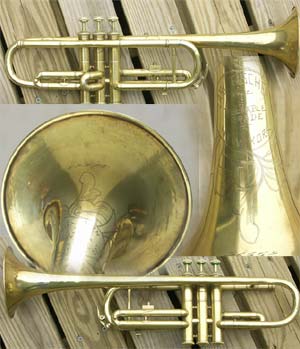
Same basic engraving, same serial number placement, but certainly not made by Conn. According to the entry, this horn is stamped "Czechoslovakia". There is also a cornet, with similar engraving, "American Model", stamped "Austria". Probably several more examples if you go through the collection there.
My opinion, as someone who has played several, and owns a Conn trombone from that era (and a number of other antique trombones, two of them from the 1890s) is that there is no way this is a Conn serial number, and you should not rely on the Conn list to date the instruments. That Conn made this instrument is not impossible, but it is not very probable. Most likely, given what we know about the stencil instrument industry of the time, this was made in central/eastern Europe, or assembled in the US from imported parts. It may also have been made by a US maker entirely. Several details are wrong for it to be a Conn though. The turnings (or lack thereof) on the ferrules and braces don't match, and neither does the water key style or placement.
So you have a Carl Fischer instrument made by an unknown maker, most likely early-20th century. I doubt you'll ever be able to narrow it down much further.
Note that even restored, its resale value will be minimal as instruments that size and from that time just are not in demand at all, even when made by an identifiable and reputable maker and in very good condition (which this is not). You'll spend more restoring it than you could sell it for. As a comparison point, I have a Courtois from between 1889 and 1894, which I bought for about $140, with a likely original or contemporary case and mouthpiece. I have a 1913 Conn, in very good condition, silver plated with gold trim and wash, and with elaborate two-tone bell engraving, got it for about 250$. The history of your instrument is somewhat interesting but a bit too trivial to really add any value.
Only if you are terrified of being proven wrong. :lol: That "dubious" serial number list? It's on the Conn-Selmer web site, kiddo.
</QUOTE>
I know this will probably fall on deaf ears but in the odd chance you might still be able to question your assumptions and biases:
Your list is of course good... for Conn instruments!!. The point is you have no evidence whatsoever that Conn made it, nothing on the instrument even hints at that. And even if Conn did make it, you have no way to know that the serial number on it is from Conn and not from Carl Fischer. So why should the Conn list help you date the instrument? Before you even begin to care about serial numbers you need to know the maker, and with stencil instruments like this, there is generally no way of knowing for sure, if at all.
As others point out, we can't even say for sure that it is a serial number. That is a common placement for inventory numbers to be engraved on service instruments. I'm leaning towards it is a serial number, but applied by or for Carl Fischer, because looking through Horn-U-Copia one does see quite a few Carl Fischer instruments with a number engraved there (then again some seem not to have the number). And then you see this
Same basic engraving, same serial number placement, but certainly not made by Conn. According to the entry, this horn is stamped "Czechoslovakia". There is also a cornet, with similar engraving, "American Model", stamped "Austria". Probably several more examples if you go through the collection there.
My opinion, as someone who has played several, and owns a Conn trombone from that era (and a number of other antique trombones, two of them from the 1890s) is that there is no way this is a Conn serial number, and you should not rely on the Conn list to date the instruments. That Conn made this instrument is not impossible, but it is not very probable. Most likely, given what we know about the stencil instrument industry of the time, this was made in central/eastern Europe, or assembled in the US from imported parts. It may also have been made by a US maker entirely. Several details are wrong for it to be a Conn though. The turnings (or lack thereof) on the ferrules and braces don't match, and neither does the water key style or placement.
So you have a Carl Fischer instrument made by an unknown maker, most likely early-20th century. I doubt you'll ever be able to narrow it down much further.
Note that even restored, its resale value will be minimal as instruments that size and from that time just are not in demand at all, even when made by an identifiable and reputable maker and in very good condition (which this is not). You'll spend more restoring it than you could sell it for. As a comparison point, I have a Courtois from between 1889 and 1894, which I bought for about $140, with a likely original or contemporary case and mouthpiece. I have a 1913 Conn, in very good condition, silver plated with gold trim and wash, and with elaborate two-tone bell engraving, got it for about 250$. The history of your instrument is somewhat interesting but a bit too trivial to really add any value.
- Zorkomatic
- Posts: 54
- Joined: Mar 20, 2022
[quote="Posaunus"]<QUOTE author="Zorkomatic" post_id="174334" time="1647920365" user_id="15030">
Only if you are terrified of being proven wrong. :lol: That "dubious" serial number list? It's on the Conn-Selmer web site, kiddo.[/quote]
Kiddo here. :???: The "official" Conn serial number list is irrelevant, since the 27197 is almost surely not a serial number but some sort of inventory number. It's very unlikely that this trombone was made in 1893. And the trombone was probably not made by Conn or its subsidiaries. The only thing Conn about this trombone was the unrelated modern counterweight added decades after its manufacture, which was what got you off onto the Conn track.
And by the way, it's a pretty interesting fantasy to imagine that the German orchestra members were playing Carl Fisher "American Model" trombones at the beginning of World War I.
At any rate, why just a single gift trombone? Perhaps we can speculate (Who needs evidence?) that Consolidated Iron Works went shopping at Carl Fischer in 1917, and had them custom-engrave an entire orchestra's worth of instruments as gifts for the Leviathan's orchestra to entertain the troops being ferried to Europe. We should search the flea markets for all those other instruments. Hollywood could make a movie out of that idea!
</QUOTE>
We've got ourselves a two-bit confused comedian.
Only if you are terrified of being proven wrong. :lol: That "dubious" serial number list? It's on the Conn-Selmer web site, kiddo.[/quote]
Kiddo here. :???: The "official" Conn serial number list is irrelevant, since the 27197 is almost surely not a serial number but some sort of inventory number. It's very unlikely that this trombone was made in 1893. And the trombone was probably not made by Conn or its subsidiaries. The only thing Conn about this trombone was the unrelated modern counterweight added decades after its manufacture, which was what got you off onto the Conn track.
And by the way, it's a pretty interesting fantasy to imagine that the German orchestra members were playing Carl Fisher "American Model" trombones at the beginning of World War I.
At any rate, why just a single gift trombone? Perhaps we can speculate (Who needs evidence?) that Consolidated Iron Works went shopping at Carl Fischer in 1917, and had them custom-engrave an entire orchestra's worth of instruments as gifts for the Leviathan's orchestra to entertain the troops being ferried to Europe. We should search the flea markets for all those other instruments. Hollywood could make a movie out of that idea!
</QUOTE>
We've got ourselves a two-bit confused comedian.
- Zorkomatic
- Posts: 54
- Joined: Mar 20, 2022
[quote="Doug Elliott"]Maybe giving them a trombone was somebody's idea of a joke...
In that article there's an interesting accounting of the Influenza epidemic of 1918 onboard the ship.[/quote]
Yes. They called it the Death Ship.
In that article there's an interesting accounting of the Influenza epidemic of 1918 onboard the ship.[/quote]
Yes. They called it the Death Ship.
- Bart
- Posts: 51
- Joined: Apr 18, 2018
[quote="Zorkomatic"]Carl was a pretty prolific dude. This is an example of a beautiful horn that he sold out of his New York store, engraved with his name as the sole agent for the manufacturer in "Amerika" and Canada. [url]http://www.rjmartz.com/horns/Schmidt_060/[/quote]
I think you answered your own question about the serial number in the link you provided (and in a link in that article).
"The U.S. importer, Carl Fischer, assigned serial numbers to the musical instruments it sold."
Looking at the serial numbers on this page, linked in the above article:[url]http://www.rjmartz.com/horns/schmidt/cfschmidt.html
Nr. 29366 is estimated around 1916, which makes it very likely your trombone was manufactured around that time as well. Makes sense to me. Also look at the style of engraving, looks quite similar to the engraving of the number on your trombone.
As a sidenote: I'm no expert, but the trombone does not look like a Conn to me. Sorry.
I think you answered your own question about the serial number in the link you provided (and in a link in that article).
"The U.S. importer, Carl Fischer, assigned serial numbers to the musical instruments it sold."
Looking at the serial numbers on this page, linked in the above article:
Nr. 29366 is estimated around 1916, which makes it very likely your trombone was manufactured around that time as well. Makes sense to me. Also look at the style of engraving, looks quite similar to the engraving of the number on your trombone.
As a sidenote: I'm no expert, but the trombone does not look like a Conn to me. Sorry.
- Zorkomatic
- Posts: 54
- Joined: Mar 20, 2022
[quote="Bart"]<QUOTE author="Zorkomatic" post_id="174159" time="1647812146" user_id="15030">
Carl was a pretty prolific dude. This is an example of a beautiful horn that he sold out of his New York store, engraved with his name as the sole agent for the manufacturer in "Amerika" and Canada.[url]http://www.rjmartz.com/horns/Schmidt_060/[/quote]
I think you answered your own question about the serial number in the link you provided (and in a link in that article).
"The U.S. importer, Carl Fischer, assigned serial numbers to the musical instruments it sold."
Looking at the serial numbers on this page, linked in the above article:[url]http://www.rjmartz.com/horns/schmidt/cfschmidt.html
Nr. 29366 is estimated around 1916, which makes it very likely your trombone was manufactured around that time as well. Makes sense to me. Also look at the style of engraving, looks quite similar to the engraving of the number on your trombone.
As a sidenote: I'm no expert, but the trombone does not look like a Conn to me. Sorry.
</QUOTE>
Interesting. Did CF Schmidt produce trombones? That article is about his double horns. I looked again on mine and there is no "Amerika" on it.
Carl was a pretty prolific dude. This is an example of a beautiful horn that he sold out of his New York store, engraved with his name as the sole agent for the manufacturer in "Amerika" and Canada.
I think you answered your own question about the serial number in the link you provided (and in a link in that article).
"The U.S. importer, Carl Fischer, assigned serial numbers to the musical instruments it sold."
Looking at the serial numbers on this page, linked in the above article:
Nr. 29366 is estimated around 1916, which makes it very likely your trombone was manufactured around that time as well. Makes sense to me. Also look at the style of engraving, looks quite similar to the engraving of the number on your trombone.
As a sidenote: I'm no expert, but the trombone does not look like a Conn to me. Sorry.
</QUOTE>
Interesting. Did CF Schmidt produce trombones? That article is about his double horns. I looked again on mine and there is no "Amerika" on it.
- Bart
- Posts: 51
- Joined: Apr 18, 2018
The article lists serial numbers added by Carl Fischer to the instruments. And judging by the numbers, those serial numbers weren't only used on double horns. That would be a lot of double horns.
"Amerika", the German variant of America, was not added by Carl Fischer and doesn't need to be on your trombone. I was only talking about the serial numbers that were added later, as you can clearly see from the style of engraving. Compare that to the pictures on horn-u-copia (and your own trombone) and you can see that they're very similar and very likely the serial numbers that Carl Fischer engraved on the instruments.
Do with it what you like, but this seems the most reasonable and easy explanation about the serial number: added by Carl Fischer, engraved by his company around 1916 (and most likely manufactured around that time as well). I know that's not the answer you want to hear, but I see enough evidence that this is however the most likely scenario.
"Amerika", the German variant of America, was not added by Carl Fischer and doesn't need to be on your trombone. I was only talking about the serial numbers that were added later, as you can clearly see from the style of engraving. Compare that to the pictures on horn-u-copia (and your own trombone) and you can see that they're very similar and very likely the serial numbers that Carl Fischer engraved on the instruments.
Do with it what you like, but this seems the most reasonable and easy explanation about the serial number: added by Carl Fischer, engraved by his company around 1916 (and most likely manufactured around that time as well). I know that's not the answer you want to hear, but I see enough evidence that this is however the most likely scenario.
- Zorkomatic
- Posts: 54
- Joined: Mar 20, 2022
I agree that it could be an explanation, but there is sufficient divergence to suggest the opposite as well. What answer you think i want to hear is not relevant. Off to the restorer.
- LeTromboniste
- Posts: 1634
- Joined: Apr 11, 2018
[quote="Zorkomatic"]I agree that it could be an explanation, but there is sufficient divergence to suggest the opposite as well. What answer you think i want to hear is not relevant. Off to the restorer.[/quote]
There is absolutely nothing to suggest that the serial number was added by the manufacturer, nor that it is a Conn serial number.
There is absolutely nothing to suggest that the serial number was added by the manufacturer, nor that it is a Conn serial number.
- Zorkomatic
- Posts: 54
- Joined: Mar 20, 2022
[quote="LeTromboniste"]<QUOTE author="Zorkomatic" post_id="174387" time="1647964163" user_id="15030">
I agree that it could be an explanation, but there is sufficient divergence to suggest the opposite as well. What answer you think i want to hear is not relevant. Off to the restorer.[/quote]
There is absolutely nothing to suggest that the serial number was added by the manufacturer, nor that it is a Conn serial number.
</QUOTE>
There is no documented evidence it is a Carl Fischer or military inventory number either, they're just theories as well. Give it a rest.
I'm still working on additional research.
And I think someone mentioned money. The simple truth is that I don't give two bowel movements what this might be worth, before or after restoration. This is just one of many things I have restored over a period of decades, from documents to a wooden sailplane I shipped to Germany and back and flew several times from an old Soviet emergency field in eastern Germany, and I never, ever get back even close to what I put into these projects. That is simply not the point. The pleasure of seeing history come back to life is.
I agree that it could be an explanation, but there is sufficient divergence to suggest the opposite as well. What answer you think i want to hear is not relevant. Off to the restorer.[/quote]
There is absolutely nothing to suggest that the serial number was added by the manufacturer, nor that it is a Conn serial number.
</QUOTE>
There is no documented evidence it is a Carl Fischer or military inventory number either, they're just theories as well. Give it a rest.
I'm still working on additional research.
- Carl Fischer company has no records of <U>anything</U> related to individual sales or purchases that far back in time.
- Hagley Museum in Rhode Island has no records of anything that far back in time in any of the Fletcher archives.
- South Street Seaport Museum in NY has no records of anything related to Carl Fischer in the W.A. Fletcher Co. archives.
- Conn doesn't keep <B>any</B> historical archives that far back either for <B>anything</B> Conn made back then, other than the serial number databases and some small pieces of info, and I think they just destroyed everything else. Pity. Sales records before 1910 would have likely gone up in smoke in the 1910 second factory fire.
- I'm still looking for the Fiske factory records, but cannot find a museum or history archive in Worcester that might have them. It's possible Conn took them back to Elkhart when he closed the plant.
- The restorer I hired to fix the major problems on the piece is not a trombone expert, he's more of a saxophone expert. He has no opinion on the manufacturer but recommended I leave the patina as is; no re-plating or replacement of the lacquer because it might obscure the engraving, which constitutes the bulk of any historical value of the piece.
And I think someone mentioned money. The simple truth is that I don't give two bowel movements what this might be worth, before or after restoration. This is just one of many things I have restored over a period of decades, from documents to a wooden sailplane I shipped to Germany and back and flew several times from an old Soviet emergency field in eastern Germany, and I never, ever get back even close to what I put into these projects. That is simply not the point. The pleasure of seeing history come back to life is.
- BGuttman
- Posts: 7368
- Joined: Mar 22, 2018
Note: It is very unlikely that there ever was lacquer on this instrument. Lacquer coating dates back to the development of the spray coater in the late 1920s or early 1930s -- well after the build date of this trombone.
Most likely surface treatment is called "chromating", which will act as an oxidation preventative. That is the surface on my 1892 tuba and it shows no evidence of oxidation, even though I never polished it. Chromating uses something called hexavalent chromium to create a new surface on the brass. Given the toxicity of hexavalent chromium and the severe pollution regulation, chromating is now out of the question as a surface treatment. Now we use either a lacquer coat or plated silver (or both).
I like the 1916 build date estimate. It's logical given the 1917 donation implied by the engraving.
Most likely surface treatment is called "chromating", which will act as an oxidation preventative. That is the surface on my 1892 tuba and it shows no evidence of oxidation, even though I never polished it. Chromating uses something called hexavalent chromium to create a new surface on the brass. Given the toxicity of hexavalent chromium and the severe pollution regulation, chromating is now out of the question as a surface treatment. Now we use either a lacquer coat or plated silver (or both).
I like the 1916 build date estimate. It's logical given the 1917 donation implied by the engraving.
- Zorkomatic
- Posts: 54
- Joined: Mar 20, 2022
[quote="BGuttman"]Note: It is very unlikely that there ever was lacquer on this instrument. Lacquer coating dates back to the development of the spray coater in the late 1920s or early 1930s -- well after the build date of this trombone.
Most likely surface treatment is called "chromating", which will act as an oxidation preventative. That is the surface on my 1892 tuba and it shows no evidence of oxidation, even though I never polished it. Chromating uses something called hexavalent chromium to create a new surface on the brass. Given the toxicity of hexavalent chromium and the severe pollution regulation, chromating is now out of the question as a surface treatment. Now we use either a lacquer coat or plated silver (or both).
I like the 1916 build date estimate. It's logical given the 1917 donation implied by the engraving.[/quote]
I'm just repeating what the restorer told me, that it is definitely lacquered. :idk:
Most likely surface treatment is called "chromating", which will act as an oxidation preventative. That is the surface on my 1892 tuba and it shows no evidence of oxidation, even though I never polished it. Chromating uses something called hexavalent chromium to create a new surface on the brass. Given the toxicity of hexavalent chromium and the severe pollution regulation, chromating is now out of the question as a surface treatment. Now we use either a lacquer coat or plated silver (or both).
I like the 1916 build date estimate. It's logical given the 1917 donation implied by the engraving.[/quote]
I'm just repeating what the restorer told me, that it is definitely lacquered. :idk:
- mrpillow
- Posts: 89
- Joined: Mar 23, 2018
For what it's worth, the largest repository of surviving Conn archives and records, and historic instruments, are housed at the National Music Museum in Vermillion, South Dakota :clever: Based on the years I've spent working with this material, I can guesstimate with a fairly comfortable 99.8% certainty that the instrument was not made by Conn, nor is the serial number a Conn serial number.
For what it's also worth, we're unfortunately far too occupied at the moment to address a research inquiry of this nature.
Maybe a back-burner visit for your future?
For what it's also worth, we're unfortunately far too occupied at the moment to address a research inquiry of this nature.
Maybe a back-burner visit for your future?
- Zorkomatic
- Posts: 54
- Joined: Mar 20, 2022
[quote="mrpillow"]For what it's worth, the largest repository of surviving Conn archives and records, and historic instruments, are housed at the National Music Museum in Vermillion, South Dakota :clever: Based on the years I've spent working with this material, I can guesstimate with a fairly comfortable 99.8% certainty that the instrument was not made by Conn, nor is the serial number a Conn serial number.
For what it's also worth, we're unfortunately far too occupied at the moment to address a research inquiry of this nature.
Maybe a back-burner visit for your future?[/quote]
I would love to come visit! I just finished chatting with a representative of Carl Fischer's. Apparently they destroyed all the old records. :roll: Doesn't make any sense, such shortsightedness.
Do the records in SD also include those of the Fiske facility?
For what it's also worth, we're unfortunately far too occupied at the moment to address a research inquiry of this nature.
Maybe a back-burner visit for your future?[/quote]
I would love to come visit! I just finished chatting with a representative of Carl Fischer's. Apparently they destroyed all the old records. :roll: Doesn't make any sense, such shortsightedness.
Do the records in SD also include those of the Fiske facility?
- Posaunus
- Posts: 5018
- Joined: Mar 23, 2018
Apparently still determined (in spite of evidence and expert testimony to the contrary) to prove that the trombone is a Conn - based <U>only</U> on a 1970s counterweight added decades after its manufacture. Now that's persistence! :amazed:
- Zorkomatic
- Posts: 54
- Joined: Mar 20, 2022
[quote="Posaunus"]Apparently still determined (in spite of evidence and expert testimony to the contrary) to prove that the trombone is a Conn - based <U>only</U> on a 1970s counterweight added decades after its manufacture. Now that's persistence! :amazed:[/quote]
Way to go, Captain Obvious.
Way to go, Captain Obvious.
- teachyteach
- Posts: 13
- Joined: Jun 19, 2020
I'm just repeating what the restorer told me, that it is definitely lacquered. :idk:
[/quote]
The trombone is clearly raw brass. Lacquered horns do not look like that.
If your restorer takes a look at that horn and says it is currently lacquered, well, I would not trust them to repair an old bundy.
FWIW, trombone does not look very conn-like to me, especially not for the era. Bracings do not look right and the engraving looks much to lightly applied and not-conn like. Even on very old conn stencils I have seen the engraving looks different. If you really want an old Conn, you can pick up a 4H for pretty cheap on ebay and compare the differences in person.
[/quote]
The trombone is clearly raw brass. Lacquered horns do not look like that.
If your restorer takes a look at that horn and says it is currently lacquered, well, I would not trust them to repair an old bundy.
FWIW, trombone does not look very conn-like to me, especially not for the era. Bracings do not look right and the engraving looks much to lightly applied and not-conn like. Even on very old conn stencils I have seen the engraving looks different. If you really want an old Conn, you can pick up a 4H for pretty cheap on ebay and compare the differences in person.
- Zorkomatic
- Posts: 54
- Joined: Mar 20, 2022
[quote="teachyteach"]
The trombone is clearly raw brass. Lacquered horns do not look like that.
If your restorer takes a look at that horn and says it is currently lacquered, well, I would not trust them to repair an old bundy.
FWIW, trombone does not look very conn-like to me, especially not for the era. Bracings do not look right and the engraving looks much to lightly applied and not-conn like. Even on very old conn stencils I have seen the engraving looks different. If you really want an old Conn, you can pick up a 4H for pretty cheap on ebay and compare the differences in person.[/quote]
But any old Conn would not be as historically valuable as this one. Except maybe the other one that was given to the band? It's so disappointing that so many of you simply don't get it.
The trombone is clearly raw brass. Lacquered horns do not look like that.
If your restorer takes a look at that horn and says it is currently lacquered, well, I would not trust them to repair an old bundy.
FWIW, trombone does not look very conn-like to me, especially not for the era. Bracings do not look right and the engraving looks much to lightly applied and not-conn like. Even on very old conn stencils I have seen the engraving looks different. If you really want an old Conn, you can pick up a 4H for pretty cheap on ebay and compare the differences in person.[/quote]
But any old Conn would not be as historically valuable as this one. Except maybe the other one that was given to the band? It's so disappointing that so many of you simply don't get it.
- BGuttman
- Posts: 7368
- Joined: Mar 22, 2018
We get it. The horn has a very interesting history. It's just probably not a Conn, and was not made in 1893. I still like the 1916 date somebody else figured out. It would have to be an American maker since Europe was heavily involved in World War I at the time and shipments from any of the instrument making areas might be difficult to receive.
There are a few other makers in the US that might be considered. Harry Pedlar was one. I'm not sure if Emil Blessing had started his shop by that time, but he made a lot of stencils. Also consider Buescher.
Another seller like Carl Fischer was J. W. Pepper in Philadelphia. Pepper is still in business, but as a sheet music seller. If you had a Pepper sold horn it would have been marked as such.
There are a few other makers in the US that might be considered. Harry Pedlar was one. I'm not sure if Emil Blessing had started his shop by that time, but he made a lot of stencils. Also consider Buescher.
Another seller like Carl Fischer was J. W. Pepper in Philadelphia. Pepper is still in business, but as a sheet music seller. If you had a Pepper sold horn it would have been marked as such.
- Zorkomatic
- Posts: 54
- Joined: Mar 20, 2022
[quote="BGuttman"]We get it. The horn has a very interesting history. It's just probably not a Conn, and was not made in 1893. I still like the 1916 date somebody else figured out. It would have to be an American maker since Europe was heavily involved in World War I at the time and shipments from any of the instrument making areas might be difficult to receive.
There are a few other makers in the US that might be considered. Harry Pedlar was one. I'm not sure if Emil Blessing had started his shop by that time, but he made a lot of stencils. Also consider Buescher.
Another seller like Carl Fischer was J. W. Pepper in Philadelphia. Pepper is still in business, but as a sheet music seller. If you had a Pepper sold horn it would have been marked as such.[/quote]
Nah, you seem to get it. Not "we." But it's ok, every forum has their share of wannabe party-poopers who pretend they know what they are talking about and... well, they really try to do a good job at whatever it is they think they do, but they just can't pull it off, bless their hearts. I've been doing forums since before there was an internet or Compuserve/GEnie, etc. and there was just something called Fido and a bunch of geeks running a network from their home PC's using dial-up. Some things just don't change. :lol:
There are a few other makers in the US that might be considered. Harry Pedlar was one. I'm not sure if Emil Blessing had started his shop by that time, but he made a lot of stencils. Also consider Buescher.
Another seller like Carl Fischer was J. W. Pepper in Philadelphia. Pepper is still in business, but as a sheet music seller. If you had a Pepper sold horn it would have been marked as such.[/quote]
Nah, you seem to get it. Not "we." But it's ok, every forum has their share of wannabe party-poopers who pretend they know what they are talking about and... well, they really try to do a good job at whatever it is they think they do, but they just can't pull it off, bless their hearts. I've been doing forums since before there was an internet or Compuserve/GEnie, etc. and there was just something called Fido and a bunch of geeks running a network from their home PC's using dial-up. Some things just don't change. :lol:
- elmsandr
- Posts: 1373
- Joined: Mar 23, 2018
So, what is your point here then?
To try to get us to agree with whatever genius theory you have? Or just to insult people that are actually trying to help you identify a fascinating, if not valuable, instrument?
Thank you for the nice pictures, feel free to upload some when you have it restored. Beyond that, you are acting more like a troll than a contributor to the community here.
Cheers,
Andy
To try to get us to agree with whatever genius theory you have? Or just to insult people that are actually trying to help you identify a fascinating, if not valuable, instrument?
Thank you for the nice pictures, feel free to upload some when you have it restored. Beyond that, you are acting more like a troll than a contributor to the community here.
Cheers,
Andy
- Zorkomatic
- Posts: 54
- Joined: Mar 20, 2022
[quote="elmsandr"]So, what is your point here then?[/quote]
LOL! I didn't think I'd get such a great example to make my point so quickly. Standard answer, Andy: You'll get over it. :cool:
LOL! I didn't think I'd get such a great example to make my point so quickly. Standard answer, Andy: You'll get over it. :cool:
- harrisonreed
- Posts: 6479
- Joined: Aug 17, 2018
I have Geschaltz's original trombone. Prove me wrong!
- Zorkomatic
- Posts: 54
- Joined: Mar 20, 2022
[quote="harrisonreed"]I have Geschaltz's original trombone. Prove me wrong![/quote]
He lived a stencil life. No proof he ever existed, but he was copied like a xerox. :clever:
He lived a stencil life. No proof he ever existed, but he was copied like a xerox. :clever:
- Burgerbob
- Posts: 6327
- Joined: Apr 23, 2018
[quote="Zorkomatic"]<QUOTE author="elmsandr" post_id="174459" time="1647998752" user_id="147">So, what is your point here then?[/quote]
LOL! I didn't think I'd get such a great example to make my point so quickly. Standard answer, Andy: You'll get over it. :cool:
</QUOTE>
This is a straight up troll answer. Again... what is your point? You have a pretty neat stencil horn with a Conn counterweight. It doesn't need to be a Conn. Even if it was, it wouldn't be worth much of anything.
LOL! I didn't think I'd get such a great example to make my point so quickly. Standard answer, Andy: You'll get over it. :cool:
</QUOTE>
This is a straight up troll answer. Again... what is your point? You have a pretty neat stencil horn with a Conn counterweight. It doesn't need to be a Conn. Even if it was, it wouldn't be worth much of anything.
- Zorkomatic
- Posts: 54
- Joined: Mar 20, 2022
[quote="Burgerbob"]<QUOTE author="Zorkomatic" post_id="174460" time="1647998942" user_id="15030">
LOL! I didn't think I'd get such a great example to make my point so quickly. Standard answer, Andy: You'll get over it. :cool:[/quote]
This is a straight up troll answer. Again... what is your point? You have a pretty neat stencil horn with a Conn counterweight. It doesn't need to be a Conn. Even if it was, it wouldn't be worth much of anything.
</QUOTE>
And this is what I call a nothing burger answer. You don't even know what a troll is, but if you're annoyed because you think I am trolling you, I have no objection to that. Isnt it past your bedtime?
LOL! I didn't think I'd get such a great example to make my point so quickly. Standard answer, Andy: You'll get over it. :cool:[/quote]
This is a straight up troll answer. Again... what is your point? You have a pretty neat stencil horn with a Conn counterweight. It doesn't need to be a Conn. Even if it was, it wouldn't be worth much of anything.
</QUOTE>
And this is what I call a nothing burger answer. You don't even know what a troll is, but if you're annoyed because you think I am trolling you, I have no objection to that. Isnt it past your bedtime?
- Burgerbob
- Posts: 6327
- Joined: Apr 23, 2018
[quote="Zorkomatic"]<QUOTE author="Burgerbob" post_id="174474" time="1648009362" user_id="3131">
This is a straight up troll answer. Again... what is your point? You have a pretty neat stencil horn with a Conn counterweight. It doesn't need to be a Conn. Even if it was, it wouldn't be worth much of anything.[/quote]
And this is what I call a nothing burger answer. You don't even know what a troll is, but if you're annoyed because you think I am trolling you, I have no objection to that. Isnt it past your bedtime?
</QUOTE>
Well, if the first one wasn't a troll answer, that one is. Come up with something solid or begone.
This is a straight up troll answer. Again... what is your point? You have a pretty neat stencil horn with a Conn counterweight. It doesn't need to be a Conn. Even if it was, it wouldn't be worth much of anything.[/quote]
And this is what I call a nothing burger answer. You don't even know what a troll is, but if you're annoyed because you think I am trolling you, I have no objection to that. Isnt it past your bedtime?
</QUOTE>
Well, if the first one wasn't a troll answer, that one is. Come up with something solid or begone.
- harrisonreed
- Posts: 6479
- Joined: Aug 17, 2018
He's too young to know what "Zork" is, I think, Aiden.
- Zorkomatic
- Posts: 54
- Joined: Mar 20, 2022
[quote="Burgerbob"]<QUOTE author="Zorkomatic" post_id="174475" time="1648009648" user_id="15030">
And this is what I call a nothing burger answer. You don't even know what a troll is, but if you're annoyed because you think I am trolling you, I have no objection to that. Isnt it past your bedtime?[/quote]
Well, if the first one wasn't a troll answer, that one is. Come up with something solid or begone.
</QUOTE>
Begone? LMAO! Sit back down and finish your lollipop. If you can't control your motormouth that's a personal problem. Priest or therapist, pick one, hopefully not in that order. Phone going on silent, so if you miss me, you'll have to wait at least 8 hours for your dose.
I was playing Infocom when you were still asking for ice cream money.
(This is too easy, like taking candy from midget trolls.)
And this is what I call a nothing burger answer. You don't even know what a troll is, but if you're annoyed because you think I am trolling you, I have no objection to that. Isnt it past your bedtime?[/quote]
Well, if the first one wasn't a troll answer, that one is. Come up with something solid or begone.
</QUOTE>
Begone? LMAO! Sit back down and finish your lollipop. If you can't control your motormouth that's a personal problem. Priest or therapist, pick one, hopefully not in that order. Phone going on silent, so if you miss me, you'll have to wait at least 8 hours for your dose.
He's too young to know what "Zork" is, I think, Aiden.
I was playing Infocom when you were still asking for ice cream money.
(This is too easy, like taking candy from midget trolls.)
- Posaunus
- Posts: 5018
- Joined: Mar 23, 2018
[quote="Burgerbob"]I'd say we've had enough.[/quote]
:good:
:good:
- LeTromboniste
- Posts: 1634
- Joined: Apr 11, 2018
[quote="Zorkomatic"]But it's ok, every forum has their share of wannabe party-poopers who pretend they know what they are talking about and... well, they really try to do a good job at whatever it is they think they do, but they just can't pull it off, bless their hearts.[/quote]
Says the guy who came here not knowing anything about trombones, but who in less than 48 hours of doing armchair-organology, became a leading expert in trombone history. Ladies and gentlemen, may I present to you, the Dunning-Kruger effect, embodied flesh and soul!
[quote="Zorkomatic"]There is no documented evidence it is a Carl Fischer or military inventory number either, they're just theories as well. Give it a rest.[/quote]
You mean hypotheses.
Yes they are. Some of them are based on actual knowledge of the subject matter, having seen and played many instruments, knowing what a Conn trombone looks like, and knowing the first thing about the stencil instruments market.
Some of them are based on absolutely nothing more than knowing so little that one thinks they found a big important mystery to solve, and that their instinct just must be right, and that anyone who doesn't agree with them, no matter how much more knowledgeable about this they are, doesn't know what they're talking about. It's neither important nor a particularly big mystery. Your mother may have told you you were special. Flash news, you're not.
[quote="Zorkomatic"]But any old Conn would not be as historically valuable as this one. Except maybe the other one that was given to the band? It's so disappointing that so many of you simply don't get it.[/quote]
If you knew anything about trombones, you'd know that, yes any old Conn is more historically valuable than whatever this is. Any instrument that old has history behind it. Any old Conn, even without such a dedication engraved on it, would at least be known to be a good instrument from a known, and famously good manufacturer. That's already more information (and more valuable information).
You have an old beat-up stencil instrument from an unknown maker that probably never was a particularly good horn, that just happens to have a bit of mildly interesting trivia sloppily engraved on it.
There are countless similar instruments with dedications to individual players or service bands of various kinds. It's cool, but it hardly makes them valuable. Nobody really cares about a trombone that may or may not have been played on board the SS Leviathan. That's trivia, not history. Of course that can be interesting and valuable trivia to you personally, but that doesn't make it objectively historically valuable for the rest of the world.
I agree with Aidan. I think it's time to close this thread
Says the guy who came here not knowing anything about trombones, but who in less than 48 hours of doing armchair-organology, became a leading expert in trombone history. Ladies and gentlemen, may I present to you, the Dunning-Kruger effect, embodied flesh and soul!
[quote="Zorkomatic"]There is no documented evidence it is a Carl Fischer or military inventory number either, they're just theories as well. Give it a rest.[/quote]
You mean hypotheses.
Yes they are. Some of them are based on actual knowledge of the subject matter, having seen and played many instruments, knowing what a Conn trombone looks like, and knowing the first thing about the stencil instruments market.
Some of them are based on absolutely nothing more than knowing so little that one thinks they found a big important mystery to solve, and that their instinct just must be right, and that anyone who doesn't agree with them, no matter how much more knowledgeable about this they are, doesn't know what they're talking about. It's neither important nor a particularly big mystery. Your mother may have told you you were special. Flash news, you're not.
[quote="Zorkomatic"]But any old Conn would not be as historically valuable as this one. Except maybe the other one that was given to the band? It's so disappointing that so many of you simply don't get it.[/quote]
If you knew anything about trombones, you'd know that, yes any old Conn is more historically valuable than whatever this is. Any instrument that old has history behind it. Any old Conn, even without such a dedication engraved on it, would at least be known to be a good instrument from a known, and famously good manufacturer. That's already more information (and more valuable information).
You have an old beat-up stencil instrument from an unknown maker that probably never was a particularly good horn, that just happens to have a bit of mildly interesting trivia sloppily engraved on it.
There are countless similar instruments with dedications to individual players or service bands of various kinds. It's cool, but it hardly makes them valuable. Nobody really cares about a trombone that may or may not have been played on board the SS Leviathan. That's trivia, not history. Of course that can be interesting and valuable trivia to you personally, but that doesn't make it objectively historically valuable for the rest of the world.
I agree with Aidan. I think it's time to close this thread
- mrpillow
- Posts: 89
- Joined: Mar 23, 2018
Alright, final warning it is...
Constructive conversation only or this one gets the slammer!
Constructive conversation only or this one gets the slammer!
- BGuttman
- Posts: 7368
- Joined: Mar 22, 2018
It appears that Zork has been given a "vacation" with a warning that if he continues the personal attacks he will be banned for good.
I am still interested in what people find out about his trombone, given its interesting engraving.
I am reminded of a King Gladiator cornet I bought a few years back. It was listed with a label that said "Played for the President, [month] 1948" (I don't remember the month). I discounted the authenticity of it and got it at what I thought was a reasonable price for an instrument of its age and status. When I got the thing I checked the label. It was printed on a dot matrix printer. Confirmed for me that the "provenance" was most likely false. Unfortunately I loaned the thing to somebody who never returned it. Wasn't a bad horn, too.
I am still interested in what people find out about his trombone, given its interesting engraving.
I am reminded of a King Gladiator cornet I bought a few years back. It was listed with a label that said "Played for the President, [month] 1948" (I don't remember the month). I discounted the authenticity of it and got it at what I thought was a reasonable price for an instrument of its age and status. When I got the thing I checked the label. It was printed on a dot matrix printer. Confirmed for me that the "provenance" was most likely false. Unfortunately I loaned the thing to somebody who never returned it. Wasn't a bad horn, too.
- JohnL
- Posts: 2529
- Joined: Mar 23, 2018
It's really too bad that the discussion got focused on the whole "Conn-or-not-Conn" issue. I'm far more interested in how it ended up being engraved and presented to the engineering department. I figure that's got to be a good story.
- Burgerbob
- Posts: 6327
- Joined: Apr 23, 2018
[quote="JohnL"]It's really too bad that the discussion got focused on the whole "Conn-or-not-Conn" issue. I'm far more interested in how it ended up being engraved and presented to the engineering department. I figure that's got to be a good story.[/quote]
Yup- it's still a very interesting horn!
Yup- it's still a very interesting horn!
- tjonz
- Posts: 54
- Joined: Apr 01, 2018
- atopper333
- Posts: 377
- Joined: Mar 09, 2022
In all honesty, the bracing and styling of the engraving look very similar to a York trombone. My memory and a little research at horn-u-copia for the York serial number list did jog my memory that Carl Fisher did take over York at some point. Maybe a possibility.
- JohnL
- Posts: 2529
- Joined: Mar 23, 2018
[quote="tjonz"]This looks to me like the same instrument:
<LINK_TEXT text="https://www.shoptoluv.site/product/Vint ... nkrnj.html">https://www.shoptoluv.site/product/Vintage-Conn-Carl-Fischers-American-Model-Slide-Trombone-Presented-To_a2ckqmkoljnkrnj.html</LINK_TEXT>[/quote]
Looks like.
That's a wicked split in the receiver.
<LINK_TEXT text="https://www.shoptoluv.site/product/Vint ... nkrnj.html">https://www.shoptoluv.site/product/Vintage-Conn-Carl-Fischers-American-Model-Slide-Trombone-Presented-To_a2ckqmkoljnkrnj.html</LINK_TEXT>[/quote]
Looks like.
That's a wicked split in the receiver.
- Doug_Elliott
- Posts: 4155
- Joined: Mar 22, 2018
"As with many companies during the 30's, the York company fell victim to the Great Depression and was purchased by Carl Fischer for $300,000 in December 1940"
That's much too late for this horn.
York both bought and sold stencil instruments, but no names that match this horn.
That's much too late for this horn.
York both bought and sold stencil instruments, but no names that match this horn.
- atopper333
- Posts: 377
- Joined: Mar 09, 2022
[quote="Doug Elliott"]"As with many companies during the 30's, the York company fell victim to the Great Depression and was purchased by Carl Fischer for $300,000 in December 1940"
York both bought and sold stencil instruments, but no names that match this horn.[/quote]
I had read that…just thinking maybe they had a relationship prior to that with the possibility of York providing stencil horns several years/decades prior to being bought out…again, purely a thought just based on a similar styling. Then again, many of the horns of this era tend to blend together to me and I am by no means an expert!
York both bought and sold stencil instruments, but no names that match this horn.[/quote]
I had read that…just thinking maybe they had a relationship prior to that with the possibility of York providing stencil horns several years/decades prior to being bought out…again, purely a thought just based on a similar styling. Then again, many of the horns of this era tend to blend together to me and I am by no means an expert!
- Bart
- Posts: 51
- Joined: Apr 18, 2018
I'm not an expert by any means, so I hope someone with more knowledge will comment on my findings. I've been searching for Carl Fischer instruments with the same decorative engraving. I might be completely wrong and I'd like to hear some feedback about it, but I always assumed that the decorative engraving was added by the manufacturer. The name of the reseller would be engraved later, same with the serial number. That's my assumption at this point.
My apologies for an image-heavy reply! I tried to find instruments with similar engravings and I'll try to add a picture of the instrument as well. Maybe they can be identified easier? Or they may prove me wrong about my assumption that all instruments with this similar engraving are made by the same manufacturer. Either way is fine for me :roll:
This is the engraving of the Mystery Trombone:
<ATTACHMENT filename="20220320-112132.jpg" index="9">[attachment=9]20220320-112132.jpg</ATTACHMENT>
I've been able to find a few that look very much alike to this one. I only compared the decorative engraving, not the model/type or anything like that.
Cornet, currently on ebay. Seller mentions that "Austria" is marked on the leadpipe.
<ATTACHMENT filename="s-l500.jpg" index="8">[attachment=8]s-l500.jpg</ATTACHMENT><ATTACHMENT filename="s-l500 (1).jpg" index="7">[attachment=7]s-l500 (1).jpg</ATTACHMENT>
Trumpet from horn-u-copia, where it is mentioned that "Czechoslovakia" is stamped on the mouthpiece receiver. Serial 36669.
<ATTACHMENT filename="Fischer-Trumpet-36669.jpg" index="6">[attachment=6]Fischer-Trumpet-36669.jpg</ATTACHMENT>
Tuba, no mention of further markings, but close in serial number with the mystery trombone.
<ATTACHMENT filename="699165805-c (1).jpg" index="5">[attachment=5]699165805-c (1).jpg</ATTACHMENT><ATTACHMENT filename="524516715-a.jpg" index="4">[attachment=4]524516715-a.jpg</ATTACHMENT>
Baritone, no mention of further markings, similar engraving, from horn-u-copia.
<ATTACHMENT filename="Fischer-baritone-American-4.jpg" index="3">[attachment=3]Fischer-baritone-American-4.jpg</ATTACHMENT>
Baritone, from the collection of Simonetti, marked B&F.
<ATTACHMENT filename="img_20190319_172910938_2.jpg" index="2">[attachment=2]img_20190319_172910938_2.jpg</ATTACHMENT><ATTACHMENT filename="img_20190319_172503832.jpg" index="1">[attachment=1]img_20190319_172503832.jpg</ATTACHMENT><ATTACHMENT filename="img_20190319_172535230.jpg" index="0">[attachment=0]img_20190319_172535230.jpg</ATTACHMENT>
B&F had their factory in Graslitz/Kraslice that was part of Austria prior to WWI and part of Czechoslovakia after WWI. And that's in Bohemia. So those places do make sense on an instrument from B&F, depending on the age of the instrument.
If the decorative engraving is indeed indicative of the manufacturer, I would be inclided to say those instruments are all B&F instruments. I would love to hear more from someone with more knowledge about stencil horns. I do understand they could've been ordered from any manufacturer specifically with this engraving pre-engraved.
My apologies for an image-heavy reply! I tried to find instruments with similar engravings and I'll try to add a picture of the instrument as well. Maybe they can be identified easier? Or they may prove me wrong about my assumption that all instruments with this similar engraving are made by the same manufacturer. Either way is fine for me :roll:
This is the engraving of the Mystery Trombone:
<ATTACHMENT filename="20220320-112132.jpg" index="9">
I've been able to find a few that look very much alike to this one. I only compared the decorative engraving, not the model/type or anything like that.
Cornet, currently on ebay. Seller mentions that "Austria" is marked on the leadpipe.
<ATTACHMENT filename="s-l500.jpg" index="8">
Trumpet from horn-u-copia, where it is mentioned that "Czechoslovakia" is stamped on the mouthpiece receiver. Serial 36669.
<ATTACHMENT filename="Fischer-Trumpet-36669.jpg" index="6">
Tuba, no mention of further markings, but close in serial number with the mystery trombone.
<ATTACHMENT filename="699165805-c (1).jpg" index="5">
Baritone, no mention of further markings, similar engraving, from horn-u-copia.
<ATTACHMENT filename="Fischer-baritone-American-4.jpg" index="3">
Baritone, from the collection of Simonetti, marked B&F.
<ATTACHMENT filename="img_20190319_172910938_2.jpg" index="2">
B&F had their factory in Graslitz/Kraslice that was part of Austria prior to WWI and part of Czechoslovakia after WWI. And that's in Bohemia. So those places do make sense on an instrument from B&F, depending on the age of the instrument.
If the decorative engraving is indeed indicative of the manufacturer, I would be inclided to say those instruments are all B&F instruments. I would love to hear more from someone with more knowledge about stencil horns. I do understand they could've been ordered from any manufacturer specifically with this engraving pre-engraved.
- LeTromboniste
- Posts: 1634
- Joined: Apr 11, 2018
[quote="Bart"]I'm not an expert by any means, so I hope someone with more knowledge will comment on my findings. I've been searching for Carl Fischer instruments with the same decorative engraving. I might be completely wrong and I'd like to hear some feedback about it, but I always assumed that the decorative engraving was added by the manufacturer. The name of the reseller would be engraved later, same with the serial number. That's my assumption at this point.
My apologies for an image-heavy reply! I tried to find instruments with similar engravings and I'll try to add a picture of the instrument as well. Maybe they can be identified easier? Or they may prove me wrong about my assumption that all instruments with this similar engraving are made by the same manufacturer. Either way is fine for me :roll:
This is the engraving of the Mystery Trombone:
20220320-112132.jpg
I've been able to find a few that look very much alike to this one. I only compared the decorative engraving, not the model/type or anything like that.
Cornet, currently on ebay. Seller mentions that "Austria" is marked on the leadpipe.
s-l500.jpgs-l500 (1).jpg
Trumpet from horn-u-copia, where it is mentioned that "Czechoslovakia" is stamped on the mouthpiece receiver. Serial 36669.
Fischer-Trumpet-36669.jpg
Tuba, no mention of further markings, but close in serial number with the mystery trombone.
699165805-c (1).jpg524516715-a.jpg
Baritone, no mention of further markings, similar engraving, from horn-u-copia.
Fischer-baritone-American-4.jpg
Baritone, from the collection of Simonetti, marked B&F.
img_20190319_172910938_2.jpgimg_20190319_172503832.jpgimg_20190319_172535230.jpg
B&F had their factory in Graslitz/Kraslice that was part of Austria prior to WWI and part of Czechoslovakia after WWI. And that's in Bohemia. So those places do make sense on an instrument from B&F, depending on the age of the instrument.
If the decorative engraving is indeed indicative of the manufacturer, I would be inclided to say those instruments are all B&F instruments. I would love to hear more from someone with more knowledge about stencil horns. I do understand they could've been ordered from any manufacturer specifically with this engraving pre-engraved.[/quote]
I think Bohland and Fuchs is indeed a likely candidate for making at least some of the Fischer instruments. They certainly were one of the major makers of stencil instruments, and they did use all three denominations "Austria", "Bohemia" and "Czechoslovakia" at different times in the late-19th and early-20th centuries. They might very well have put the engravings - you do find instruments (including B&F) that are pre-engraved without any brand or model, ready to be stenciled. But I can thing of two reasons why I'm not 100% convinced in this case that the engravings are B&F's:
1) If Fischer got stencils from different manufacturers, which wouldn't be surprising, they might have wanted the same style engraving on all (which seems to be the case, judging from the wide variety of different instruments, not only different specimens of the same instrument, that have that same style). If that is the case, it would make more sense for them to get the instruments with no engraving at all and then get whoever they hired to do the whole engraving, not just the brand and model, and thus getting a consistent visual identity across the brand and between different vintages.
2) Not all B&F instruments have large ornate engravings, but those that have them seem to have much more complex engraving than what we see on the Fischer instruments. The Fischer engraving is all wriggle engraving and basic cuts.
My apologies for an image-heavy reply! I tried to find instruments with similar engravings and I'll try to add a picture of the instrument as well. Maybe they can be identified easier? Or they may prove me wrong about my assumption that all instruments with this similar engraving are made by the same manufacturer. Either way is fine for me :roll:
This is the engraving of the Mystery Trombone:
20220320-112132.jpg
I've been able to find a few that look very much alike to this one. I only compared the decorative engraving, not the model/type or anything like that.
Cornet, currently on ebay. Seller mentions that "Austria" is marked on the leadpipe.
s-l500.jpgs-l500 (1).jpg
Trumpet from horn-u-copia, where it is mentioned that "Czechoslovakia" is stamped on the mouthpiece receiver. Serial 36669.
Fischer-Trumpet-36669.jpg
Tuba, no mention of further markings, but close in serial number with the mystery trombone.
699165805-c (1).jpg524516715-a.jpg
Baritone, no mention of further markings, similar engraving, from horn-u-copia.
Fischer-baritone-American-4.jpg
Baritone, from the collection of Simonetti, marked B&F.
img_20190319_172910938_2.jpgimg_20190319_172503832.jpgimg_20190319_172535230.jpg
B&F had their factory in Graslitz/Kraslice that was part of Austria prior to WWI and part of Czechoslovakia after WWI. And that's in Bohemia. So those places do make sense on an instrument from B&F, depending on the age of the instrument.
If the decorative engraving is indeed indicative of the manufacturer, I would be inclided to say those instruments are all B&F instruments. I would love to hear more from someone with more knowledge about stencil horns. I do understand they could've been ordered from any manufacturer specifically with this engraving pre-engraved.[/quote]
I think Bohland and Fuchs is indeed a likely candidate for making at least some of the Fischer instruments. They certainly were one of the major makers of stencil instruments, and they did use all three denominations "Austria", "Bohemia" and "Czechoslovakia" at different times in the late-19th and early-20th centuries. They might very well have put the engravings - you do find instruments (including B&F) that are pre-engraved without any brand or model, ready to be stenciled. But I can thing of two reasons why I'm not 100% convinced in this case that the engravings are B&F's:
1) If Fischer got stencils from different manufacturers, which wouldn't be surprising, they might have wanted the same style engraving on all (which seems to be the case, judging from the wide variety of different instruments, not only different specimens of the same instrument, that have that same style). If that is the case, it would make more sense for them to get the instruments with no engraving at all and then get whoever they hired to do the whole engraving, not just the brand and model, and thus getting a consistent visual identity across the brand and between different vintages.
2) Not all B&F instruments have large ornate engravings, but those that have them seem to have much more complex engraving than what we see on the Fischer instruments. The Fischer engraving is all wriggle engraving and basic cuts.
- Bart
- Posts: 51
- Joined: Apr 18, 2018
Thanks for your input, Maximilien! Those are the doubts I have as well. I'm nowhere near knowledgeable enough to recognize the different styles of the instruments and possible trace them back to their manufacturer.
Just an addition: I did look specifically for that style of engraving in my previous post. There are a lot of different engravings on Carl Fischer's instruments as well, within a wide range of serial numbers. Some examples, just to add to the confusion :roll:
<ATTACHMENT filename="Fischer-Trumpet-40634.jpg" index="0">[attachment=0]Fischer-Trumpet-40634.jpg</ATTACHMENT>
<ATTACHMENT filename="1075538512-Engraving.jpg" index="9">[attachment=9]1075538512-Engraving.jpg</ATTACHMENT>
<ATTACHMENT filename="1100055850-image.jpg" index="8">[attachment=8]1100055850-image.jpg</ATTACHMENT>
<ATTACHMENT filename="1292353747-c2.jpg" index="7">[attachment=7]1292353747-c2.jpg</ATTACHMENT>
<ATTACHMENT filename="Fischer-cornet-Am-Perf.jpg" index="6">[attachment=6]Fischer-cornet-Am-Perf.jpg</ATTACHMENT>
<ATTACHMENT filename="Fischer-cornet-perfected.jpg" index="5">[attachment=5]Fischer-cornet-perfected.jpg</ATTACHMENT>
<ATTACHMENT filename="Fischer-Orsi-Trumpet.jpg" index="4">[attachment=4]Fischer-Orsi-Trumpet.jpg</ATTACHMENT>
<ATTACHMENT filename="Fischer-trumpet-970.jpg" index="3">[attachment=3]Fischer-trumpet-970.jpg</ATTACHMENT>
<ATTACHMENT filename="Fischer-Trumpet-junior.jpg" index="2">[attachment=2]Fischer-Trumpet-junior.jpg</ATTACHMENT>
<ATTACHMENT filename="Fischer-tuba-artist.jpg" index="1">[attachment=1]Fischer-tuba-artist.jpg</ATTACHMENT>
Just an addition: I did look specifically for that style of engraving in my previous post. There are a lot of different engravings on Carl Fischer's instruments as well, within a wide range of serial numbers. Some examples, just to add to the confusion :roll:
<ATTACHMENT filename="Fischer-Trumpet-40634.jpg" index="0">
<ATTACHMENT filename="1075538512-Engraving.jpg" index="9">
<ATTACHMENT filename="1100055850-image.jpg" index="8">
<ATTACHMENT filename="1292353747-c2.jpg" index="7">
<ATTACHMENT filename="Fischer-cornet-Am-Perf.jpg" index="6">
<ATTACHMENT filename="Fischer-cornet-perfected.jpg" index="5">
<ATTACHMENT filename="Fischer-Orsi-Trumpet.jpg" index="4">
<ATTACHMENT filename="Fischer-trumpet-970.jpg" index="3">
<ATTACHMENT filename="Fischer-Trumpet-junior.jpg" index="2">
<ATTACHMENT filename="Fischer-tuba-artist.jpg" index="1">
- BGuttman
- Posts: 7368
- Joined: Mar 22, 2018
Bart, thanks for all your diligent research. Only thing I wonder: the dedication on Zorkomatic's horn puts it in 1917, so it probably was new within a couple of years of that. At that time Europe was deeply involved in World War I. How would instruments made in Graslitz (then a part of Austria-Hungary) make it across the Atlantic to New York?
- Bart
- Posts: 51
- Joined: Apr 18, 2018
Thanks, Bruce! No problem, I'm curious about the origins as well, so I spent a little time looking at old horns :) That's not a punishment at all!
Very good question. I have absolutely no idea...
Very good question. I have absolutely no idea...
- Brent
- Posts: 9
- Joined: Feb 08, 2022
[quote="tjonz"]This looks to me like the same instrument:
<LINK_TEXT text="https://www.shoptoluv.site/product/Vint ... nkrnj.html">https://www.shoptoluv.site/product/Vintage-Conn-Carl-Fischers-American-Model-Slide-Trombone-Presented-To_a2ckqmkoljnkrnj.html</LINK_TEXT>[/quote]
Definitely the same one. Perhaps some of the other Trombones on the same site should be more tempting?
eg. 'Olds Special' for $137.50; 'Selmer London Sterling' (nice Deco engraving and 'snakeskin' case) $140; 'Conn Director' including 'Vincent Bach' Mouthpiece $30; Holton (very nice engraving) $219.50...
[Warning: Only buy from random websites if you can view it in person first, THEN pay/take it].
<LINK_TEXT text="https://www.shoptoluv.site/product/Vint ... nkrnj.html">https://www.shoptoluv.site/product/Vintage-Conn-Carl-Fischers-American-Model-Slide-Trombone-Presented-To_a2ckqmkoljnkrnj.html</LINK_TEXT>[/quote]
Definitely the same one. Perhaps some of the other Trombones on the same site should be more tempting?
eg. 'Olds Special' for $137.50; 'Selmer London Sterling' (nice Deco engraving and 'snakeskin' case) $140; 'Conn Director' including 'Vincent Bach' Mouthpiece $30; Holton (very nice engraving) $219.50...
[Warning: Only buy from random websites if you can view it in person first, THEN pay/take it].
- BGuttman
- Posts: 7368
- Joined: Mar 22, 2018
[quote="JohnL"]<QUOTE author="tjonz" post_id="174544" time="1648079633" user_id="2919">
This looks to me like the same instrument:
<LINK_TEXT text="https://www.shoptoluv.site/product/Vint ... nkrnj.html">https://www.shoptoluv.site/product/Vintage-Conn-Carl-Fischers-American-Model-Slide-Trombone-Presented-To_a2ckqmkoljnkrnj.html</LINK_TEXT>[/quote]
Looks like.
That's a wicked split in the receiver.
</QUOTE>
Interesting site. Seems to have a specialty in trombones and banjos. Trombone prices are all over the place -- some too high and some too low. A Holton TR-150 for $250 is a steal, even if it needs a ton of work. A Getzen Dude at $400 is way overpriced. And check out the $0.99 specials!
This looks to me like the same instrument:
<LINK_TEXT text="https://www.shoptoluv.site/product/Vint ... nkrnj.html">https://www.shoptoluv.site/product/Vintage-Conn-Carl-Fischers-American-Model-Slide-Trombone-Presented-To_a2ckqmkoljnkrnj.html</LINK_TEXT>[/quote]
Looks like.
That's a wicked split in the receiver.
</QUOTE>
Interesting site. Seems to have a specialty in trombones and banjos. Trombone prices are all over the place -- some too high and some too low. A Holton TR-150 for $250 is a steal, even if it needs a ton of work. A Getzen Dude at $400 is way overpriced. And check out the $0.99 specials!
- DougHulme
- Posts: 558
- Joined: Apr 27, 2018
I thought the OP said he got it from a flea market - does this site constitute a flea market?
- ithinknot
- Posts: 1339
- Joined: Jul 24, 2020
[quote="BGuttman"]<QUOTE author="JohnL" post_id="174551" time="1648082145" user_id="119">
Looks like.
That's a wicked split in the receiver.[/quote]
Interesting site. Seems to have a specialty in trombones and banjos. Trombone prices are all over the place -- some too high and some too low. A Holton TR-150 for $250 is a steal, even if it needs a ton of work. A Getzen Dude at $400 is way overpriced. And check out the $0.99 specials!
</QUOTE>
It's not a real site. Photos and descriptions are harvested from recent eBay listings and similar.
(Seriously, don't get taken in by this kind of thing.)
Looks like.
That's a wicked split in the receiver.[/quote]
Interesting site. Seems to have a specialty in trombones and banjos. Trombone prices are all over the place -- some too high and some too low. A Holton TR-150 for $250 is a steal, even if it needs a ton of work. A Getzen Dude at $400 is way overpriced. And check out the $0.99 specials!
</QUOTE>
It's not a real site. Photos and descriptions are harvested from recent eBay listings and similar.
(Seriously, don't get taken in by this kind of thing.)
- jthomas105
- Posts: 148
- Joined: Apr 08, 2018
https://www.ebay.com/itm/153581880058
We have been looking for another instrument that has some of the same build parts. This is a stencil that I think was imported by the Wurlitzer music company. Check the ferules that connect the slide tubes to the slide crook, they look to be the same unusual length compared to any other trombone I have ever seen. Also, the water key on both of these is on the side of the slide crook instead the outer curve on the bottom.
<LINK_TEXT text="https://americanbusinesshistory.org/mus ... zer-story/">https://americanbusinesshistory.org/music-for-the-millions-the-wurlitzer-story/</LINK_TEXT>
This link gives the history of the Wurlitzer music company. Short version---Rudolph Wurlitzer came to America in the 1850’s from Germany. He sent money to father, Rembert Wurlitzer, in Germany to import music instruments and sold to another store. It was so successful that he opened his own company and imported and sold music instruments from Germany. In 1868 he married a woman named Leonie Farny who had immigrated from France to America with her family, also in the 1850’s. Leonie had a brother named Henry Farny that was a renowned artist that painted scenes and the American West and native American. At some point in the late 19th century or early 20th century Wurlizter began to import “Henri Farny” labeled/stenciled clarinets and violins that were made in France. It looks like Wurlitzer took his brother-in-laws name and used the French spelling “Henry to Henri” to import stenciled instruments. He was still importing from Germany too. What I think might have happened is that when World War I started in 1914 is that they could not import instruments from Germany any more so they turned to French makers for their instruments and they branded some of the brass "Henri Farny" like the clarinets and violins they imported.
As Bart and Maxmillien have found Carl Fischer instruments imported from Austria, Czechoslovakia and other places it made me think that Carl Fischer may have had the same problem with imports from those countries during World War I. In other documentation it has been recognized that at some point CF did import from France. Because the two slides look to be built the same my thought is that CF and Wurlizter happened to contract with the same French company (Courtois, Couesnon, ???) to build some of their brass instruments during World War I.
Call me a fool if you want for these thoughts and musings – it has already happened once. Although not by a trombone player, just a rank amateur.
We have been looking for another instrument that has some of the same build parts. This is a stencil that I think was imported by the Wurlitzer music company. Check the ferules that connect the slide tubes to the slide crook, they look to be the same unusual length compared to any other trombone I have ever seen. Also, the water key on both of these is on the side of the slide crook instead the outer curve on the bottom.
<LINK_TEXT text="https://americanbusinesshistory.org/mus ... zer-story/">https://americanbusinesshistory.org/music-for-the-millions-the-wurlitzer-story/</LINK_TEXT>
This link gives the history of the Wurlitzer music company. Short version---Rudolph Wurlitzer came to America in the 1850’s from Germany. He sent money to father, Rembert Wurlitzer, in Germany to import music instruments and sold to another store. It was so successful that he opened his own company and imported and sold music instruments from Germany. In 1868 he married a woman named Leonie Farny who had immigrated from France to America with her family, also in the 1850’s. Leonie had a brother named Henry Farny that was a renowned artist that painted scenes and the American West and native American. At some point in the late 19th century or early 20th century Wurlizter began to import “Henri Farny” labeled/stenciled clarinets and violins that were made in France. It looks like Wurlitzer took his brother-in-laws name and used the French spelling “Henry to Henri” to import stenciled instruments. He was still importing from Germany too. What I think might have happened is that when World War I started in 1914 is that they could not import instruments from Germany any more so they turned to French makers for their instruments and they branded some of the brass "Henri Farny" like the clarinets and violins they imported.
As Bart and Maxmillien have found Carl Fischer instruments imported from Austria, Czechoslovakia and other places it made me think that Carl Fischer may have had the same problem with imports from those countries during World War I. In other documentation it has been recognized that at some point CF did import from France. Because the two slides look to be built the same my thought is that CF and Wurlizter happened to contract with the same French company (Courtois, Couesnon, ???) to build some of their brass instruments during World War I.
Call me a fool if you want for these thoughts and musings – it has already happened once. Although not by a trombone player, just a rank amateur.
- BGuttman
- Posts: 7368
- Joined: Mar 22, 2018
Note that Conn made a number of instruments for Wurlitzer, although it seems they are post World War I since they have H model numbers (started in 1919). The appearance of the mystery trombone doesn't look Conn, but Conn did make instruments for others. I just don't think this particular instrument is one of them.
- Posaunus
- Posts: 5018
- Joined: Mar 23, 2018
But don't you all understand? It had a CONN counterweight, which surely attests to its authenticity as a true Conn trombone!
[Or was this an early Frankenhorn?]
- atopper333
- Posts: 377
- Joined: Mar 09, 2022
[quote="jthomas105"]
Call me a fool if you want for these thoughts and musings – it has already happened once. Although not by a trombone player, just a rank amateur.[/quote]
I wouldn’t think there would be any need for that! If anything, this type of discussion may jog someone’s memory or lead down a different path of research. It’s constructive and thought out, sadly unlike some of the previous posts…
I’m rather new here, but do have strong opinions and believe in respectful behavior/differences in opinion. The fact that someone would be stubborn enough to lack the ability to be open minded and listen to several people on this forum with a vast amount of experience is…disconcerting. And also to focus in on a part as identifiable and easy to date as a branded counterweight from a well documented company from a completely different era further illustrates a closed mindedness that makes no sense for someone coming to a forum to seek information from people more knowledgeable concerning the subject matter.
[quote="Posaunus"]
But don't you all understand? It had a CONN counterweight, which surely attests to its authenticity as a true Conn trombone!
[Or was this an early Frankenhorn?][/quote]
(Just shaking my head concerning the OPs comments…)
Anyway…enough of that. Another thought…I’m unaware of how the markets worked back in that day. Could it be a possibility that this horn was imported prior to World War One as a stencil, and just sat on a shelf or in a storeroom and was sold as new old stock a few years later?
Call me a fool if you want for these thoughts and musings – it has already happened once. Although not by a trombone player, just a rank amateur.[/quote]
I wouldn’t think there would be any need for that! If anything, this type of discussion may jog someone’s memory or lead down a different path of research. It’s constructive and thought out, sadly unlike some of the previous posts…
I’m rather new here, but do have strong opinions and believe in respectful behavior/differences in opinion. The fact that someone would be stubborn enough to lack the ability to be open minded and listen to several people on this forum with a vast amount of experience is…disconcerting. And also to focus in on a part as identifiable and easy to date as a branded counterweight from a well documented company from a completely different era further illustrates a closed mindedness that makes no sense for someone coming to a forum to seek information from people more knowledgeable concerning the subject matter.
[quote="Posaunus"]
But don't you all understand? It had a CONN counterweight, which surely attests to its authenticity as a true Conn trombone!
[Or was this an early Frankenhorn?][/quote]
(Just shaking my head concerning the OPs comments…)
Anyway…enough of that. Another thought…I’m unaware of how the markets worked back in that day. Could it be a possibility that this horn was imported prior to World War One as a stencil, and just sat on a shelf or in a storeroom and was sold as new old stock a few years later?
- BGuttman
- Posts: 7368
- Joined: Mar 22, 2018
[quote="atopper333"]...
Anyway…enough of that. Another thought…I’m unaware of how the markets worked back in that day. Could it be a possibility that this horn was imported prior to World War One as a stencil, and just sat on a shelf or in a storeroom and was sold as new old stock a few years later?[/quote]
That's probably as valid a scenario as any of the others presented so far. Without a serial - date list for Carl Fischer instruments we really have no idea when this was made. I hope when Zorkomatic returns from his "vacation" he reads your post and thinks about how he's been acting. This started as an interesting quest and I hope it continues that way.
Anyway…enough of that. Another thought…I’m unaware of how the markets worked back in that day. Could it be a possibility that this horn was imported prior to World War One as a stencil, and just sat on a shelf or in a storeroom and was sold as new old stock a few years later?[/quote]
That's probably as valid a scenario as any of the others presented so far. Without a serial - date list for Carl Fischer instruments we really have no idea when this was made. I hope when Zorkomatic returns from his "vacation" he reads your post and thinks about how he's been acting. This started as an interesting quest and I hope it continues that way.
- DonQLo
- Posts: 1
- Joined: May 11, 2022
I’m far from an expert on this matter but in my opinion, the mystery trombone could be a Besson stencil.
Carl Fisher distributed Besson brass instruments back in the day as a Sole Agent and the long ferrules of the outer slide look like Besson to me, but I might be wrong. Also the waterkey. This observation is based solely in design.
Carl Fisher distributed Besson brass instruments back in the day as a Sole Agent and the long ferrules of the outer slide look like Besson to me, but I might be wrong. Also the waterkey. This observation is based solely in design.