Help me identify an old Conn
- teburke007
- Posts: 5
- Joined: Jul 20, 2022
I have an old Conn trombone and I'd like some help learning more about it. It's silver. The bell has some fancy scroll work and "Made by C.G. Conn Elkhart, Ind Worcester, Mass" on it. I could find no numbers on it anywhere. The inner slide stockings are separate pieces of tubing, not just flared out, the bell is simply friction fit to the hand slide, and there's a an odd tuning slide in the bell section right where it attaches to the hand slide - something I haven't yet seen in any images on the web.
I'm new to this forum and haven't figured out how to attach images yet.
As soon as I do, I'll some photos...
I'm new to this forum and haven't figured out how to attach images yet.
As soon as I do, I'll some photos...
- hyperbolica
- Posts: 3990
- Joined: Mar 23, 2018
It sounds pre-1920s for sure. Maybe pre-1900. Need pix. Conn bought a company called Fiske in 1887 in Massachusetts, so it could have been made there.
- BGuttman
- Posts: 7368
- Joined: Mar 22, 2018
You have an unusual (though not valuable) instrument. Instruments labeled "Elkhart Ind and Worcester MA" were made in the Isaac Fiske plant between 1886 and 1898 (when Conn closed the plant). These instruments predate the "H" trombones, which started in 1919. I have a Fiske plant tuba from 1892. It plays very nicely.
You can find a lot of information on the Conn company in Margaret Downey Banks' "History of the Conn Instrument Company" here: <LINK_TEXT text="https://web.archive.org/web/20120425015 ... ONN25.html">https://web.archive.org/web/20120425015615/http://people.usd.edu/~mbanks/CONN25.html</LINK_TEXT>
Also a very nice article in Wikipedia: https://en.wikipedia.org/wiki/C.G._Co
Good luck.
You can find a lot of information on the Conn company in Margaret Downey Banks' "History of the Conn Instrument Company" here: <LINK_TEXT text="https://web.archive.org/web/20120425015 ... ONN25.html">https://web.archive.org/web/20120425015615/http://people.usd.edu/~mbanks/CONN25.html</LINK_TEXT>
Also a very nice article in Wikipedia: https://en.wikipedia.org/wiki/C.G._Co
Good luck.
- Dennis
- Posts: 404
- Joined: Mar 24, 2018
Conn closed the (former Fiske) Worcester factory in 1898, so the instrument is clearly 19th Century.
The construction features you describe (friction fit slide tenon, separate slide stockings) are typical for the era. (These didn't come into use until the 1930s or so.)
It would be interesting to know what the instrument's pitch is. During that period of time, the frequency of A was...flexible and local would be an apt description. It's possible that the added tuning bit is to shift between high and low pitch standards. Pictures would be very helpful.
The construction features you describe (friction fit slide tenon, separate slide stockings) are typical for the era. (These didn't come into use until the 1930s or so.)
It would be interesting to know what the instrument's pitch is. During that period of time, the frequency of A was...flexible and local would be an apt description. It's possible that the added tuning bit is to shift between high and low pitch standards. Pictures would be very helpful.
- teburke007
- Posts: 5
- Joined: Jul 20, 2022
I have some photos but can't seem to get them attached. Clicking the "Insert Image" button adds "<IMG src="">[img]</IMG>" but I don't know how to get that to point to my jpg files. Anyone have some insight?
- BGuttman
- Posts: 7368
- Joined: Mar 22, 2018
If you have images located online, you can use the IMG tags to point to the image address.
If you want to upload images, use the tab at the bottom of the Full Editor labeled Attachments.
If you want to upload images, use the tab at the bottom of the Full Editor labeled Attachments.
- teburke007
- Posts: 5
- Joined: Jul 20, 2022
<ATTACHMENT filename="20220905_144858.jpg" index="0">[attachment=0]20220905_144858.jpg</ATTACHMENT><ATTACHMENT filename="20220905_145032.jpg" index="1">[attachment=1]20220905_145032.jpg</ATTACHMENT><ATTACHMENT filename="20220905_145047.jpg" index="2">[attachment=2]20220905_145047.jpg</ATTACHMENT><ATTACHMENT filename="20220905_145054.jpg" index="3">[attachment=3]20220905_145054.jpg</ATTACHMENT><ATTACHMENT filename="20220905_145120.jpg" index="4">[attachment=4]20220905_145120.jpg</ATTACHMENT>
- BGuttman
- Posts: 7368
- Joined: Mar 22, 2018
According to www.horn-u-copia.net you have a Conn Wonder trombone. The two parts are held together with the lock screw which serves as the tuning mechanism. There is a picture of one from 1888 here: 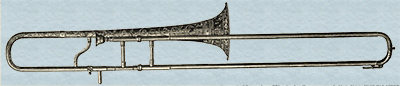
- teburke007
- Posts: 5
- Joined: Jul 20, 2022
Thanks Bruce! It's good to know the history. The slide is a little stiff, maybe a bit sprung, but it sounds quite nice.
- BGuttman
- Posts: 7368
- Joined: Mar 22, 2018
You can make the slide work much better with a treatment Steve Shires did to my 1925 Olds:
Clean, deoxidize, and polish outside of inner slide and inside of outer slide.
Apply some Pledge polish on the inner slide and dry thoroughly.
Apply normal lube to the slide. I found Trombotine to work best (but I come from the cold cream days). You may need to apply the lube a couple of times before things work well.
I noticed that in the picture I posted they put the "rest bar" in the wrong orientation. You assembled yours correctly. The stub is to wrap your thumb around to hold it.
What Dennis was talking about is that there were two tuning standards in use in the late 19th and early 20th centuries, which are usually referred to as "High Pitch" and "Low Pitch". High pitch has A at about 452 Hz and a High Pitch instrument almost sounds like a trombone in B natural. Low Pitch was a bit under standard at A=435 Hz. A properly made Low Pitch instrument will tune to A=440Hz with the tuning slide fully in. Most High Pitch instruments won't have long enough tuning slides to make Low Pitch. Some instruments came with two tuning slides; one for High Pitch and one for Low Pitch.
I also notice that you have a relatively modern Conn mouthpiece. The instrument would have been supplied with a mouthpiece with a slightly smaller shank and about 1/2 inch shorter.
Clean, deoxidize, and polish outside of inner slide and inside of outer slide.
Apply some Pledge polish on the inner slide and dry thoroughly.
Apply normal lube to the slide. I found Trombotine to work best (but I come from the cold cream days). You may need to apply the lube a couple of times before things work well.
I noticed that in the picture I posted they put the "rest bar" in the wrong orientation. You assembled yours correctly. The stub is to wrap your thumb around to hold it.
What Dennis was talking about is that there were two tuning standards in use in the late 19th and early 20th centuries, which are usually referred to as "High Pitch" and "Low Pitch". High pitch has A at about 452 Hz and a High Pitch instrument almost sounds like a trombone in B natural. Low Pitch was a bit under standard at A=435 Hz. A properly made Low Pitch instrument will tune to A=440Hz with the tuning slide fully in. Most High Pitch instruments won't have long enough tuning slides to make Low Pitch. Some instruments came with two tuning slides; one for High Pitch and one for Low Pitch.
I also notice that you have a relatively modern Conn mouthpiece. The instrument would have been supplied with a mouthpiece with a slightly smaller shank and about 1/2 inch shorter.