Trombone Materials
Sticky
- Matt_K
- Posts: 4809
- Joined: Mar 21, 2018
As suggested, this thread will be an aggregation of all sorts of information about instrument materials.
[size=150]Metals
<TABLE>[table]
<TR>[tr]
<TH>[th]Material Name</TH>
<TH>[th]Copper Content</TH>
<TH>[th]Zinc Content</TH>
<TH>[th]Other Materials</TH>
<TH>[th]Notes</TH>
</TR>
<TR>[tr]
<TD>[td]Yellow Brass</TD>
<TD>[td]70%</TD>
<TD>[td]30%</TD>
<TD>[td]</TD>
<TD>[td]</TD>
</TR>
<TR>[tr]
<TD>[td]Gold Brass/Rose Brass</TD>
<TD>[td]80%/85%</TD>
<TD>[td]20%/15%</TD>
<TD>[td]</TD>
<TD>[td]These terms have been applied differently by various manufacturers over time. </TD>
</TR>
<TR>[tr]
<TD>[td]Red Brass (or "Commercial Bronze")</TD>
<TD>[td]90%</TD>
<TD>[td]10%</TD>
<TD>[td]</TD>
<TD>[td]Sometimes referred to as "Commercial Bronze"</TD>
</TR>
<TR>[tr]
<TD>[td]Coprion</TD>
<TD>[td]100%</TD>
<TD>[td]</TD>
<TD>[td]</TD>
<TD>[td]Electroformed, pure copper</TD>
</TR>
<TR>[tr]
<TD>[td]Sterling Silver (Silver Sonic)</TD>
<TD>[td]7.5%</TD>
<TD>[td]</TD>
<TD>[td]92.5% Silver</TD>
<TD>[td]Alloy used for King Silver Sonic instruments, which were incidentally also commonly lacquered over.</TD>
</TR>
<TR>[tr]
<TD>[td]Bronze</TD>
<TD>[td]90%</TD>
<TD>[td]</TD>
<TD>[td]10% Tin</TD>
<TD>[td]</TD>
</TR>
<TR>[tr]
<TD>[td]Nickel (also "Nickel Silver" or "German Silver")</TD>
<TD>[td]60%</TD>
<TD>[td]20%</TD>
<TD>[td]20% nickel</TD>
<TD>[td]This combination makes it sort-of a brass. There's actually no "silver", strictly speaking, in nickel silver.</TD>
</TR>
<TR>[tr]
<TD>[td]Silver (electroformed)</TD>
<TD>[td]</TD>
<TD>[td]</TD>
<TD>[td]100% Silver</TD>
<TD>[td]</TD>
</TR>
</TABLE>
Can someone remind me the differences between the various types of silver? I recall Bach having silver bells that were electroformed but also seem to recall there being a difference between king bells (silver sonic) but I might be mistaken about that.
I know Rath has bronze stuff... something like 80% copper, 10% zinc, 10% tin or something to that effect?
Ditto with nickel. Rath has nickel bells and if I recall the King Tempo as well?
Did I miss something? I could include non metal materials too like carbon fiber and plastic but thought it better just to leave it at this for the moment.
Working on adding lines to the tables in phpbb now.
<TABLE>
<TR>
<TH>
<TH>
<TH>
<TH>
<TH>
</TR>
<TR>
<TD>
<TD>
<TD>
<TD>
<TD>
</TR>
<TR>
<TD>
<TD>
<TD>
<TD>
<TD>
</TR>
<TR>
<TD>
<TD>
<TD>
<TD>
<TD>
</TR>
<TR>
<TD>
<TD>
<TD>
<TD>
<TD>
</TR>
<TR>
<TD>
<TD>
<TD>
<TD>
<TD>
</TR>
<TR>
<TD>
<TD>
<TD>
<TD>
<TD>
</TR>
<TR>
<TD>
<TD>
<TD>
<TD>
<TD>
</TR>
<TR>
<TD>
<TD>
<TD>
<TD>
<TD>
</TR>
</TABLE>
Can someone remind me the differences between the various types of silver? I recall Bach having silver bells that were electroformed but also seem to recall there being a difference between king bells (silver sonic) but I might be mistaken about that.
I know Rath has bronze stuff... something like 80% copper, 10% zinc, 10% tin or something to that effect?
Ditto with nickel. Rath has nickel bells and if I recall the King Tempo as well?
Did I miss something? I could include non metal materials too like carbon fiber and plastic but thought it better just to leave it at this for the moment.
Working on adding lines to the tables in phpbb now.
- StevenC
- Posts: 128
- Joined: Mar 23, 2018
[quote="Matt K"]
I know Rath has bronze stuff... something like 80% copper, 10% zinc, 10% tin or something to that effect?
[/quote]
Olds Supers had bronze bells, and Reynolds, of course, had their "Bronze-o-lyte". I never knew the numbers, but if it is bronze, it should be copper alloyed with tin.
I know Rath has bronze stuff... something like 80% copper, 10% zinc, 10% tin or something to that effect?
[/quote]
Olds Supers had bronze bells, and Reynolds, of course, had their "Bronze-o-lyte". I never knew the numbers, but if it is bronze, it should be copper alloyed with tin.
- BGuttman
- Posts: 7368
- Joined: Mar 22, 2018
There is something called "commercial bronze" that is actually a red brass (don't remember if it's 85/15 or 90/10). I think Bronz-O-Lyte was actually this.
King used Sterling Silver, which is an alloy of 92.5% silver, with the balance being something like copper.
Bach used an electroformed silver that is pure and is called SGX.
King used Sterling Silver, which is an alloy of 92.5% silver, with the balance being something like copper.
Bach used an electroformed silver that is pure and is called SGX.
- baileyman
- Posts: 1169
- Joined: Mar 24, 2018
I have a couple NY Bachs with something different for the bells, a less yellow more green or brown darker overall brass, i guess. Is this German brass? Dunno. I struggle to describe the color.
- BGuttman
- Posts: 7368
- Joined: Mar 22, 2018
I should point out that Shires uses Sterling Silver for silver parts (leadpipes, bells).
I believe silver belled Conns were SGX. I don't know if King silver bells were ever SGX.
Note that nickel silver is generally 60% copper, 20% nickel, and 20% zinc, which makes it a sort-of brass. No silver in Nickel Silver (also called German Silver). Olds made some trombones from this alloy, notably the Opera O23.
Checked out the formula for Commercial Bronze (Alloy 220) which is 90% copper, 10% zinc (making it really a brass).
I believe silver belled Conns were SGX. I don't know if King silver bells were ever SGX.
Note that nickel silver is generally 60% copper, 20% nickel, and 20% zinc, which makes it a sort-of brass. No silver in Nickel Silver (also called German Silver). Olds made some trombones from this alloy, notably the Opera O23.
Checked out the formula for Commercial Bronze (Alloy 220) which is 90% copper, 10% zinc (making it really a brass).
- Neo_Bri
- Posts: 1342
- Joined: Mar 21, 2018
[quote="BGuttman"]No silver in Nickel Silver (also called German Silver).[/quote]
Also known as mythril!
Also known as mythril!
- Matt_K
- Posts: 4809
- Joined: Mar 21, 2018
[quote="baileyman"]I have a couple NY Bachs with something different for the bells, a less yellow more green or brown darker overall brass, i guess. Is this German brass? Dunno. I struggle to describe the color.[/quote]
It's possible they have a patina or in the case of them having lacquer, that it had a goldish tint to it. I had a Bach 42 from the 60s that had a very nice lacquer on it that was similar to that.
Thanks for the ratios bruce; I did a very short search earlier today before running errands and couldn't remember all the various sources I'd used in the past to find it!
Now I want a mythril leadpipe now that I've made that association! :pant:
It's possible they have a patina or in the case of them having lacquer, that it had a goldish tint to it. I had a Bach 42 from the 60s that had a very nice lacquer on it that was similar to that.
Thanks for the ratios bruce; I did a very short search earlier today before running errands and couldn't remember all the various sources I'd used in the past to find it!
Now I want a mythril leadpipe now that I've made that association! :pant:
- Matt_K
- Posts: 4809
- Joined: Mar 21, 2018
[quote="BGuttman"]Checked out the formula for Commercial Bronze (Alloy 220) which is 90% copper, 10% zinc (making it really a brass).[/quote]
So "Commercial Bronze" is basically just red brass then. Interesting!
So "Commercial Bronze" is basically just red brass then. Interesting!
- BGuttman
- Posts: 7368
- Joined: Mar 22, 2018
Note that real bronze (as used in cannons or marine applications) is a mixture of primarily copper ant tin (mostly copper). There are a variety of bronze alloys but I can't verify that any were ever used for trombones. Bronze is a lot more brittle than brass and that makes it much harder to work the way we fabricate trombones. Most bronze items I know of are generally cast from a melt.
- Matt_K
- Posts: 4809
- Joined: Mar 21, 2018
[quote="BGuttman"]Note that real bronze (as used in cannons or marine applications) is a mixture of primarily copper ant tin (mostly copper). There are a variety of bronze alloys but I can't verify that any were ever used for trombones. Bronze is a lot more brittle than brass and that makes it much harder to work the way we fabricate trombones. Most bronze items I know of are generally cast from a melt.[/quote]
Maybe I'll reach out to Mick and see what he says about it. It's the only material on his site that he doesn't list the exact content of, as far as I can tell!
Maybe I'll reach out to Mick and see what he says about it. It's the only material on his site that he doesn't list the exact content of, as far as I can tell!
- blast
- Posts: 671
- Joined: Mar 22, 2018
Many years ago I gave Mick Rath some engineering books I had been donated that contained pages of brass formulations used commercially... yes, pages.
His slide bronze is I think, some kind of phosphor bronze... it is much heavier than the red brass he used in the early days. It is only used for slides.
Chris
His slide bronze is I think, some kind of phosphor bronze... it is much heavier than the red brass he used in the early days. It is only used for slides.
Chris
- JohnL
- Posts: 2529
- Joined: Mar 23, 2018
Not speaking to any particular manufacturer's product, just a general observation...
While "historical" bronzes were alloys of copper and tin, the term has become something of a "catch-all" for a bunch of different copper-based alloys. There's aluminum bronze (copper plus aluminum), phosphor bronze (copper plus tin and phosphorous), manganese bronze (copper plus zinc, manganese, aluminum, iron, and maybe tin), plus some others.
IMHO, there's no up side to trying to keep an alloy composition a secret when someone can just spend a few bucks (or euros or whatever) and reverse engineer it. As I pointed out on the old place several times, it's not just the composition, it's also the <I>process</I> that determines the alloy's properties. Process is really, really, hard to reverse engineer without some inside knowledge. Yet we have this long tradition of using "trade names" for everything (Re-O-Loy, anyone?).
While "historical" bronzes were alloys of copper and tin, the term has become something of a "catch-all" for a bunch of different copper-based alloys. There's aluminum bronze (copper plus aluminum), phosphor bronze (copper plus tin and phosphorous), manganese bronze (copper plus zinc, manganese, aluminum, iron, and maybe tin), plus some others.
IMHO, there's no up side to trying to keep an alloy composition a secret when someone can just spend a few bucks (or euros or whatever) and reverse engineer it. As I pointed out on the old place several times, it's not just the composition, it's also the <I>process</I> that determines the alloy's properties. Process is really, really, hard to reverse engineer without some inside knowledge. Yet we have this long tradition of using "trade names" for everything (Re-O-Loy, anyone?).
- whitbey
- Posts: 654
- Joined: Mar 23, 2018
I have an Edwards bell that is sterling silver. I think the Conn 88 sterling silver bells are similar as opposed to the Bach silver bells that are different. I think the King Sterling silver bells are different from my Edwards. They do not ring the same or play the same compared to a brass bell.
So what do you think the 92.5% is?
So what do you think the 92.5% is?
- BGuttman
- Posts: 7368
- Joined: Mar 22, 2018
It's 92.5% silver and 7.5% copper.
Note that the metal content is only one factor in how a bell responds. The design can matter a lot more.
King identifies sterling bells with a Sterling hallmark (looks like an L with a line through it). Does your Edwards have a similar hallmark?
Note that the metal content is only one factor in how a bell responds. The design can matter a lot more.
King identifies sterling bells with a Sterling hallmark (looks like an L with a line through it). Does your Edwards have a similar hallmark?
- Matt_K
- Posts: 4809
- Joined: Mar 21, 2018
Exactly what Bruce said. That's one reason I left out from the table something like generalized playing characteristics. There are so many differences in just the nominal differences like bell gauge, flare, relative thickness at certain points that can potentially make a difference. E.g. Bach gold brass bells are a different weight than yellow brass bells. What makes the yellow brass bell play like it does then? The yellow brass or the lighter gauge bell material? Then you get into more drastic differences like would a Shires "7LW" bell share characteristics between a yellow and sterling silver bell? etc. So difficult to quantify! And beyond that, then there is the interaction between the other parts of the horn. Yikes!
It's interesting because the King Tempo actually have fairly heavy bells but seem to be well regarded as good horns for playing commercial stuff (especially rock). My thoughts are that they get recommended in part because of the nickel, partly because of the smaller bore size, among other reasons that I'm likely not thinking of. E.g. if the same person were to play a yellow 2B would they be more or less inclined to say it was good for the same application? What about if they were blindfolded?
It's interesting because the King Tempo actually have fairly heavy bells but seem to be well regarded as good horns for playing commercial stuff (especially rock). My thoughts are that they get recommended in part because of the nickel, partly because of the smaller bore size, among other reasons that I'm likely not thinking of. E.g. if the same person were to play a yellow 2B would they be more or less inclined to say it was good for the same application? What about if they were blindfolded?
- whitbey
- Posts: 654
- Joined: Mar 23, 2018
[quote="BGuttman"]It's 92.5% silver and 7.5% copper.
Note that the metal content is only one factor in how a bell responds. The design can matter a lot more.
King identifies sterling bells with a Sterling hallmark (looks like an L with a line through it). Does your Edwards have a similar hallmark?[/quote]
More silver and less copper makes sense. Thanks.
Edwards did not mark the bell any different then there regular logo engraving. Except that there is not a code designation of the bell type.
Note that the metal content is only one factor in how a bell responds. The design can matter a lot more.
King identifies sterling bells with a Sterling hallmark (looks like an L with a line through it). Does your Edwards have a similar hallmark?[/quote]
More silver and less copper makes sense. Thanks.
Edwards did not mark the bell any different then there regular logo engraving. Except that there is not a code designation of the bell type.
- Reedman1
- Posts: 310
- Joined: Apr 14, 2018
I’ve heard some rumors that Chinese and Taiwanese horns are made from “bad brass”. Personally I would take this with a large grain of salt, as other factors come into play, such as xenophobia, or distrusting the new kids on the block, or resentment at their lower prices. But is there honestly anything to such a rumor - has anyone found “Chinese” brass to be inferior - say, brittle, unresonant, uneven, too soft...? I don’t want any flame wars about this, just a rational discussion of the quality of the material. Any thoughts?
- BGuttman
- Posts: 7368
- Joined: Mar 22, 2018
The Chinese seem to have a liking for an alloy called CuproNickel, which is an alloy of copper and nickel. It's white in color and thus won't readily substitute for brass but instead replace nickel silver. Big problem with cupronickel is that it is much more difficult to solder than brass, bronze, or nickel silver. Probably the reason why Chinese instruments seem to have a predilection for solder joint breaks.
- Neo_Bri
- Posts: 1342
- Joined: Mar 21, 2018
[quote="BGuttman"]The Chinese seem to have a liking for an alloy called CuproNickel, which is an alloy of copper and nickel. It's white in color and thus won't readily substitute for brass but instead replace nickel silver. Big problem with cupronickel is that it is much more difficult to solder than brass, bronze, or nickel silver. Probably the reason why Chinese instruments seem to have a predilection for solder joint breaks.[/quote]
That is interesting.
That is interesting.
- Reedman1
- Posts: 310
- Joined: Apr 14, 2018
[quote="BGuttman"]The Chinese seem to have a liking for an alloy called CuproNickel, which is an alloy of copper and nickel. It's white in color and thus won't readily substitute for brass but instead replace nickel silver. Big problem with cupronickel is that it is much more difficult to solder than brass, bronze, or nickel silver. Probably the reason why Chinese instruments seem to have a predilection for solder joint breaks.[/quote]
Thank you. That's helpful info.
Thank you. That's helpful info.
- blast
- Posts: 671
- Joined: Mar 22, 2018
I would be interested to know which makers use such materials. I have yet to come across any odd materials or joints that come apart and are then hard to solder. Who are the guilty ones Bruce ?
Chris
Chris
- doctortrombone
- Posts: 146
- Joined: Apr 21, 2018
[quote="Reedman1"]I’ve heard some rumors that Chinese and Taiwanese horns are made from “bad brass”. Personally I would take this with a large grain of salt, as other factors come into play, such as xenophobia, or distrusting the new kids on the block, or resentment at their lower prices. But is there honestly anything to such a rumor - has anyone found “Chinese” brass to be inferior - say, brittle, unresonant, uneven, too soft...? I don’t want any flame wars about this, just a rational discussion of the quality of the material. Any thoughts?[/quote]
Bach's Chinese-made student horns had problems with the brass formulation. They had a tendency to rot out from the inside. In extreme cases, this led to red-rot. It others, it led to pitting on the inside of the outer slide, seriously compromising the slide action. I've worked on two which required actual honing (not a normal process for an outer slide) and other techs have reported the same. I don't know what was wrong with the alloy. Only that it rotted far more quickly than the alloy used on classic American horns.
Bach's Chinese-made student horns had problems with the brass formulation. They had a tendency to rot out from the inside. In extreme cases, this led to red-rot. It others, it led to pitting on the inside of the outer slide, seriously compromising the slide action. I've worked on two which required actual honing (not a normal process for an outer slide) and other techs have reported the same. I don't know what was wrong with the alloy. Only that it rotted far more quickly than the alloy used on classic American horns.
- BGuttman
- Posts: 7368
- Joined: Mar 22, 2018
It's possible that American brass horns are passivated to control corrosion while the Chinese were unaware of this.
Another problem is shipping in a container over the ocean. The salt air can sometimes wreak havoc with many metals.
Another problem is shipping in a container over the ocean. The salt air can sometimes wreak havoc with many metals.
- Reedman1
- Posts: 310
- Joined: Apr 14, 2018
[quote="BGuttman"]It's possible that American brass horns are passivated to control corrosion while the Chinese were unaware of this.
Another problem is shipping in a container over the ocean. The salt air can sometimes wreak havoc with many metals.[/quote]
Pardon my ignorance - what is “passivated”?
Another problem is shipping in a container over the ocean. The salt air can sometimes wreak havoc with many metals.[/quote]
Pardon my ignorance - what is “passivated”?
- elmsandr
- Posts: 1373
- Joined: Mar 23, 2018
[quote="Reedman1"]I’ve heard some rumors that Chinese and Taiwanese horns are made from “bad brass”. Personally I would take this with a large grain of salt, as other factors come into play, such as xenophobia, or distrusting the new kids on the block, or resentment at their lower prices. But is there honestly anything to such a rumor - has anyone found “Chinese” brass to be inferior - say, brittle, unresonant, uneven, too soft...? I don’t want any flame wars about this, just a rational discussion of the quality of the material. Any thoughts?[/quote]
One fun part here.. the processing of the material changes some of the characteristics you mention. Brass work hardens, meaning that it will get harder and more brittle the more you work it. There are billions of ways you can order it from the mill, and then another billion ways to work it in your shop. If neither you nor the mill know what you want, the material will not have the expected characteristics by the time you force it into a trombone shaped object. Ten years ago, I would have advised to run screaming from anything from there. Now, with some help from knowledgeable makers, I’d happily play a horn from many of the makers, even without testing in person.
Cheers,
Andy
One fun part here.. the processing of the material changes some of the characteristics you mention. Brass work hardens, meaning that it will get harder and more brittle the more you work it. There are billions of ways you can order it from the mill, and then another billion ways to work it in your shop. If neither you nor the mill know what you want, the material will not have the expected characteristics by the time you force it into a trombone shaped object. Ten years ago, I would have advised to run screaming from anything from there. Now, with some help from knowledgeable makers, I’d happily play a horn from many of the makers, even without testing in person.
Cheers,
Andy
- BGuttman
- Posts: 7368
- Joined: Mar 22, 2018
[quote="Reedman1"]
Pardon my ignorance - what is “passivated”?[/quote]
Look here: https://en.wikipedia.org/wiki/Passivation_(chemistry)
Pardon my ignorance - what is “passivated”?[/quote]
Look here: https://en.wikipedia.org/wiki/Passivation_(chemistry)
- Reedman1
- Posts: 310
- Joined: Apr 14, 2018
[quote="BGuttman"]<QUOTE author="Reedman1" post_id="58530" time="1524352477" user_id="3067">
Pardon my ignorance - what is “passivated”?[/quote]
Look here: https://en.wikipedia.org/wiki/Passivation_(chemistry)
</QUOTE>
OK - thanks.
Pardon my ignorance - what is “passivated”?[/quote]
Look here: https://en.wikipedia.org/wiki/Passivation_(chemistry)
</QUOTE>
OK - thanks.
- blast
- Posts: 671
- Joined: Mar 22, 2018
So Bach's cheap student horns are suspect..... The horns that cost a little more.... Wessex, Mackbrass etc seem fine.... Chinese Rath, Eastman and others are fine. Perhaps the buyers at Bach are a bunch of cheapskates who paid too little and were rewarded with cra...sub-standard product.
I've taken apart New York Bachs and found shoddy workmanship and found serious build flaws in modern custom horns..... life ain't simple.....
Chris
I've taken apart New York Bachs and found shoddy workmanship and found serious build flaws in modern custom horns..... life ain't simple.....
Chris
- BillO
- Posts: 116
- Joined: Mar 23, 2018
:clever:
The Chinese are master metallurgists and had been for centuries before the Europeans figured it out. They can make alloys of arbitrary quality ... as good or as poor as you are willing to pay for. That leads to another thing the Chinese have a long history of being masters at, and that is supplying goods to a market. Any market. If you want to pay $200 for a trombone, they will make a $200 trombone for you. Just don't expect them to use the best materials in making it. If you want to pay more, they will make it with better materials and use more care. The choice is yours. So when you get a cheap Chinese trombone, it's a piece of junk because it's cheap, not because it is Chinese. :good:
Cupronickle refers to all alloys of copper an nickel. What we call nickel-silver is a cupronickel alloy. It just so happens that the Chinese were the first to alloy copper and nickel, and they did it without zinc. The Germans invented nickel-silver (or German silver) in an attempt to duplicate the Chinese alloy. I don't know what actual alloy goes into $200 trombones made with "cupronickel", but I do know the best Chinese cupronickel alloys and formulations are prized throughout the world for their ability to resist corrosion. They are used extensively in marine applications and making US currency. If you want to see what cupronickel looks like and how tough it is, look no further than a US quarter. :good:
The worst brass I have seen in my life was in Stanley light fixtures that were made in the good 'ol US of A. They literately crumbled apart after 5 years. :horror:
Jus' sayin'
The Chinese are master metallurgists and had been for centuries before the Europeans figured it out. They can make alloys of arbitrary quality ... as good or as poor as you are willing to pay for. That leads to another thing the Chinese have a long history of being masters at, and that is supplying goods to a market. Any market. If you want to pay $200 for a trombone, they will make a $200 trombone for you. Just don't expect them to use the best materials in making it. If you want to pay more, they will make it with better materials and use more care. The choice is yours. So when you get a cheap Chinese trombone, it's a piece of junk because it's cheap, not because it is Chinese. :good:
Cupronickle refers to all alloys of copper an nickel. What we call nickel-silver is a cupronickel alloy. It just so happens that the Chinese were the first to alloy copper and nickel, and they did it without zinc. The Germans invented nickel-silver (or German silver) in an attempt to duplicate the Chinese alloy. I don't know what actual alloy goes into $200 trombones made with "cupronickel", but I do know the best Chinese cupronickel alloys and formulations are prized throughout the world for their ability to resist corrosion. They are used extensively in marine applications and making US currency. If you want to see what cupronickel looks like and how tough it is, look no further than a US quarter. :good:
The worst brass I have seen in my life was in Stanley light fixtures that were made in the good 'ol US of A. They literately crumbled apart after 5 years. :horror:
Jus' sayin'
- Slidemo
- Posts: 144
- Joined: Apr 11, 2018
Regarding Elkhart era 88H's....
What brass in the above table is used for:
1. Bell, red/gold in colour?
2. Slide, red/bronze in colour?
3. Slide, yellow in colour... I assume this is standard yellow brass?
Cheers,
Hamo
What brass in the above table is used for:
1. Bell, red/gold in colour?
2. Slide, red/bronze in colour?
3. Slide, yellow in colour... I assume this is standard yellow brass?
Cheers,
Hamo
- BGuttman
- Posts: 7368
- Joined: Mar 22, 2018
Color is only one facet of how an alloy responds. There is also the hardness. Brass is currently sold in three hardnesses, but the amount of metalworking will change it to something else.
So we have alloy, thicness, and work hardening. All are part of the equation.
So we have alloy, thicness, and work hardening. All are part of the equation.
- bimmerman
- Posts: 188
- Joined: Apr 04, 2018
I came across this video and thought it'd be helpful to hear the differences between the bells. Christopher Bill posted a video not too long ago where he went to BAC and tested nickel silver, yellow, rose/gold, and red brass smallbore bells, and you can definitely hear some differences in the sound. He plays a variety of excerpts and styles too.
I'm not sure I agree with all of his thoughts regarding use cases for the bells, but the video captures some of the sound and articulation differences between bell metals with a consistent slide/mpc/player combination. Check it out!
<YOUTUBE id="iP1xumFxakc">https://www.youtube.com/watch?v=iP1xumFxakc</YOUTUBE>
I'm not sure I agree with all of his thoughts regarding use cases for the bells, but the video captures some of the sound and articulation differences between bell metals with a consistent slide/mpc/player combination. Check it out!
<YOUTUBE id="iP1xumFxakc">https://www.youtube.com/watch?v=iP1xumFxakc</YOUTUBE>
- peteedwards
- Posts: 105
- Joined: Apr 09, 2018
Saw this on FB, not sure of the origin
<ATTACHMENT filename="Brass alloys.png" index="1">[attachment=1]Brass alloys.png</ATTACHMENT>
<ATTACHMENT filename="Brass alloys.png" index="1">
- bassbone
- Posts: 173
- Joined: May 04, 2018
I have no idea what the numbers are for copper content, zinc content, etc but I'll suggest an addition: Beryllium
Not as common as what is listed here but they are around (I play a Minick Beryllium bell on my Bass)
Not as common as what is listed here but they are around (I play a Minick Beryllium bell on my Bass)
- JohnL
- Posts: 2529
- Joined: Mar 23, 2018
[quote="bassbone"]I have no idea what the numbers are for copper content, zinc content, etc but I'll suggest an addition: Beryllium
Not as common as what is listed here but they are around (I play a Minick Beryllium bell on my Bass)[/quote]
That would be beryllium copper (also sometimes called beryllium bronze). It's one of those secret alloy things. The most common BeCu alloys are C17200 (copper with 1.8-2% beryllium) or C17300 (copper with 1.8-2% beryllium and .2-.6% lead).
Not as common as what is listed here but they are around (I play a Minick Beryllium bell on my Bass)[/quote]
That would be beryllium copper (also sometimes called beryllium bronze). It's one of those secret alloy things. The most common BeCu alloys are C17200 (copper with 1.8-2% beryllium) or C17300 (copper with 1.8-2% beryllium and .2-.6% lead).
- BGuttman
- Posts: 7368
- Joined: Mar 22, 2018
Schilke used to offer beryllium copper bells on some of their trumpets. Don't know what properties it supposedly imparted. By the time they were playing with trombones they had abandoned the beryllium. I should point out that beryllium is VERY poisonous and you should be careful if you create dust from the alloy.
Also, those nice lists of alloys are interesting but availability of some of them in suitable form for inclusion in a trombone may be very limited. Some are intended to be cast from melt. Others may have properties that are not ideal for musical instruments. I'd doubt anybody has tested every single alloy, and doubt anybody ever will. Unless you happen to be independently wealthy enough to buy your own stock and have somebody make them for you.
To add to the problems, the new ROHS regulations in Europe limit the amount of lead in a musical instrument to less than 0.1%, meaning some of the high lead machinable alloys cannot be used.
Also, those nice lists of alloys are interesting but availability of some of them in suitable form for inclusion in a trombone may be very limited. Some are intended to be cast from melt. Others may have properties that are not ideal for musical instruments. I'd doubt anybody has tested every single alloy, and doubt anybody ever will. Unless you happen to be independently wealthy enough to buy your own stock and have somebody make them for you.
To add to the problems, the new ROHS regulations in Europe limit the amount of lead in a musical instrument to less than 0.1%, meaning some of the high lead machinable alloys cannot be used.
- JohnL
- Posts: 2529
- Joined: Mar 23, 2018
[quote="BGuttman"]Schilke used to offer beryllium copper bells on some of their trumpets. Don't know what properties it supposedly imparted.[/quote]
As I understand it, the relative high strength of beryllium copper made it possible for them to make the bells very thin (i.e., light and responsive) while still being reasonably durable. Schilke still offers "beryllium" bells, but word on the interwebs is that the newer ones are actually pure copper. Since they still make them quite thin, they tend to be a bit dent-prone.
Even though beryllium is toxic, a beryllium copper bell wouldn't be dangerous to the player. For someone involved in some of the processes that go into making that bell (notably any process that produces fine particulates, such as buffing), appropriate precautions would be necessary.
There's some evidence that beryllium is a carcinogen - once again, primarily related in inhalation of fine particles. My father worked with beryllium (actual beryllium rather than BeCu). He also died of lung cancer, though a lifetime of smoking was probably the primary contributing factor.
Let's get back to trombones.
As I understand it, the relative high strength of beryllium copper made it possible for them to make the bells very thin (i.e., light and responsive) while still being reasonably durable. Schilke still offers "beryllium" bells, but word on the interwebs is that the newer ones are actually pure copper. Since they still make them quite thin, they tend to be a bit dent-prone.
Even though beryllium is toxic, a beryllium copper bell wouldn't be dangerous to the player. For someone involved in some of the processes that go into making that bell (notably any process that produces fine particulates, such as buffing), appropriate precautions would be necessary.
There's some evidence that beryllium is a carcinogen - once again, primarily related in inhalation of fine particles. My father worked with beryllium (actual beryllium rather than BeCu). He also died of lung cancer, though a lifetime of smoking was probably the primary contributing factor.
Let's get back to trombones.
- LarryPrestonRoberson
- Posts: 201
- Joined: Mar 23, 2018
What is the material used for the main tuning slide of an original Elkhart Conn 88H?
- hyperbolica
- Posts: 3990
- Joined: Mar 23, 2018
[quote="LarryPrestonRoberson"]What is the material used for the main tuning slide of an original Elkhart Conn 88H?[/quote]
yellow brass.
yellow brass.
- LarryPrestonRoberson
- Posts: 201
- Joined: Mar 23, 2018
[quote="hyperbolica"]<QUOTE author="LarryPrestonRoberson" post_id="65576" time="1534360286" user_id="106">
What is the material used for the main tuning slide of an original Elkhart Conn 88H?[/quote]
yellow brass.
</QUOTE>
Thanks!
What is the material used for the main tuning slide of an original Elkhart Conn 88H?[/quote]
yellow brass.
</QUOTE>
Thanks!
- TheBoneRanger
- Posts: 225
- Joined: Apr 04, 2018
Of late, I've been pondering about the use of nickel in valve section tubing and bracing. The main bell braces on my Edwards, for example, are brass, whereas my Bach with an Ed Thayer valve is nickel in those places.
The most curious one, for me, is the legs of the tuning slides of Bach trombones. The tuning slides of the big horns (50/42/36) all have brass legs, whereas the small bores are nickel. I've wondered why Bach would decided to make a difference in that place in particular, and what difference it would make? Do any other brands use nickel on the male parts of their tuning slides?
Andrew
The most curious one, for me, is the legs of the tuning slides of Bach trombones. The tuning slides of the big horns (50/42/36) all have brass legs, whereas the small bores are nickel. I've wondered why Bach would decided to make a difference in that place in particular, and what difference it would make? Do any other brands use nickel on the male parts of their tuning slides?
Andrew
- minemax03
- Posts: 9
- Joined: Feb 20, 2019
Never played on a silver bone before, is it as good as people make it out to be?
- BGuttman
- Posts: 7368
- Joined: Mar 22, 2018
Solid silver (generally bells only) is a quirky material. I hesitate to say it's better than any other because it's quirks my make your playing worse and not better. It certainly is nice looking!
Silver plate when not lacquer coated tends to be brighter since the coating is much thinner and not absorptive. Many silver plated instruments nowadays have a lacquer coating on them so it really doesn't make that much of a difference.
If you are a beginner, it makes almost no difference at all. You will sound lousy on anything until you develop some skills.
Silver plate when not lacquer coated tends to be brighter since the coating is much thinner and not absorptive. Many silver plated instruments nowadays have a lacquer coating on them so it really doesn't make that much of a difference.
If you are a beginner, it makes almost no difference at all. You will sound lousy on anything until you develop some skills.
- LeTromboniste
- Posts: 1634
- Joined: Apr 11, 2018
Graham Nicholson, who makes arguably the best historical trumpets, has described to me a first solid silver trumpet he was making, of a model he's made and tested dozens of before in brass, as having the same sound, except an extra warmth and resonance in the sound and responsiveness in the feel during the first 1/10th of a second of playing a note.
Of course it's a very steep difference in price between brass and silver!
Of course it's a very steep difference in price between brass and silver!
- havard
- Posts: 35
- Joined: Apr 01, 2018
Different alloys definately play different.
I have played two identisk conn 88 h. One with red bell, one with yellow.
It was a huge difference. For me the yellow did have a lot more projection, clarity and stability throughout the dynanic range. The red did offer a very mellow sound at soft dynanics but gives a really flashy edge When pushed, for my taste a little too flashy. .
I like both but really dont understand why so few conn 88 players dont use the yellow, as i see that bell as typical conn sound but with , as well, added qialities that f ex Bachs have. Is it just traditions?
I have played two identisk conn 88 h. One with red bell, one with yellow.
It was a huge difference. For me the yellow did have a lot more projection, clarity and stability throughout the dynanic range. The red did offer a very mellow sound at soft dynanics but gives a really flashy edge When pushed, for my taste a little too flashy. .
I like both but really dont understand why so few conn 88 players dont use the yellow, as i see that bell as typical conn sound but with , as well, added qialities that f ex Bachs have. Is it just traditions?
- Tbarh
- Posts: 505
- Joined: Aug 16, 2018
[quote="havard"]Different alloys definately play different.
I have played two identisk conn 88 h. One with red bell, one with yellow.
It was a huge difference. For me the yellow did have a lot more projection, clarity and stability throughout the dynanic range. The red did offer a very mellow sound at soft dynanics but gives a really flashy edge When pushed, for my taste a little too flashy. .
I like both but really dont understand why so few conn 88 players dont use the yellow, as i see that bell as typical conn sound but with , as well, added qialities that f ex Bachs have. Is it just traditions?[/quote]
Håvard!... The Yellow brass version are fairly New i suspect.. How about the red brass one?.. Old Elkhart and 88HT 's are thinner brass.. I have tried a really old Elkhart thin bell Yellow that behaved very much like You described the red brass... Weight trumps material! :good:
I have played two identisk conn 88 h. One with red bell, one with yellow.
It was a huge difference. For me the yellow did have a lot more projection, clarity and stability throughout the dynanic range. The red did offer a very mellow sound at soft dynanics but gives a really flashy edge When pushed, for my taste a little too flashy. .
I like both but really dont understand why so few conn 88 players dont use the yellow, as i see that bell as typical conn sound but with , as well, added qialities that f ex Bachs have. Is it just traditions?[/quote]
Håvard!... The Yellow brass version are fairly New i suspect.. How about the red brass one?.. Old Elkhart and 88HT 's are thinner brass.. I have tried a really old Elkhart thin bell Yellow that behaved very much like You described the red brass... Weight trumps material! :good:
- BillO
- Posts: 116
- Joined: Mar 23, 2018
I'm pretty sure the yellow brass bell has been available for a while on the 88H. I have a friend that has, what appears to be an early Gen II 88H with a yellow brass bell. He does not think it was a custom job (bought it used), but is not 100% sure. In any case, even if they were not sold new that way, the yellow bell was available.
- ExZacLee
- Posts: 153
- Joined: May 09, 2018
I played a BAC horn that one of my former students purchased recently. The bell stem was supposed to be gold brass I think, but it looks copper to my eyes.
The bell flare, however, was the most interesting part of the horn (it's a screw bell.) Steel flare, no rim wire or bead - you could put quite an edge on it if you wanted to (as it stands you could cut a steak with it.)
Good horn, good slide, good tuning, good high and low range. Pretty darn good horn. Makes me interested in getting a steel bell.
The bell flare, however, was the most interesting part of the horn (it's a screw bell.) Steel flare, no rim wire or bead - you could put quite an edge on it if you wanted to (as it stands you could cut a steak with it.)
Good horn, good slide, good tuning, good high and low range. Pretty darn good horn. Makes me interested in getting a steel bell.
- harrisonreed
- Posts: 6479
- Joined: Aug 17, 2018
Yellow 88H came out when Christian Lindberg became a Conn artist in the late 80s /early 90s as the Signature Lindberg model. Now it's called the 88HY. You can see why the 88H would help him so much in his early Trombone + Piano albums, and equally why the 88HY became his choice once he was mostly playing with big orchestras. Throw on some duct tape or leather or what he eventually designed as the "Resistance Balancer" and you can feel comfortable in any accoustic -- and he found himself in every sort of accoustic. I believe he moved over to the solid silver bell around 2000 or so, since that bell seems to project like crazy and still sound kind of dark. Who knows what he was thinking.
I think HOW the horn is built, rather than what it's made out of, has the biggest effect on how it plays. Not just the quality if build, but where the nodes are, how the bracing lets it vibrate, leadpipe, shape of the slides, and how thick the metal is.
I think HOW the horn is built, rather than what it's made out of, has the biggest effect on how it plays. Not just the quality if build, but where the nodes are, how the bracing lets it vibrate, leadpipe, shape of the slides, and how thick the metal is.
- timothy42b
- Posts: 1812
- Joined: Mar 27, 2018
[quote="ExZacLee"]Makes me interested in getting a steel bell.[/quote]
Steel, really? I was skeptical (how do they spin one?) but I checked the web site, and here are the options:
Nickel Silver
Yellow Brass
Gold Brass
Copper
Stainless Steel
Phosphor Bronze
Surprising, but there it is.
Steel, really? I was skeptical (how do they spin one?) but I checked the web site, and here are the options:
Nickel Silver
Yellow Brass
Gold Brass
Copper
Stainless Steel
Phosphor Bronze
Surprising, but there it is.
- ExZacLee
- Posts: 153
- Joined: May 09, 2018
[quote="timothy42b"]<QUOTE author="ExZacLee" post_id="80268" time="1552242482" user_id="3248">
Makes me interested in getting a steel bell.[/quote]
Steel, really? I was skeptical (how do they spin one?)
</QUOTE>
It was definitely steel... and this being a screw bell, I expected it to be front heavy, but it wasn't. Either the integrated balance weight or the lightness of the steel or both did a good job for making that not the case.
I reckon they make one the way other bells are made, it'd just wear down the tools a bit quicker.
Makes me interested in getting a steel bell.[/quote]
Steel, really? I was skeptical (how do they spin one?)
</QUOTE>
It was definitely steel... and this being a screw bell, I expected it to be front heavy, but it wasn't. Either the integrated balance weight or the lightness of the steel or both did a good job for making that not the case.
I reckon they make one the way other bells are made, it'd just wear down the tools a bit quicker.
- harrisonreed
- Posts: 6479
- Joined: Aug 17, 2018
If it was the Eliott Mason model, that horn is a goer. She's a rippah
- ExZacLee
- Posts: 153
- Joined: May 09, 2018
[quote="harrisonreed"]If it was the Eliott Mason model, that horn is a goer. She's a rippah[/quote]
It had that curved hand brace and a removable pipe (I think) - it was definitely a ripper. I was playing my Williams that night, and there wasn't a huge difference in blow between horns, if that means anything. It had some pop, that's for sure.
It had that curved hand brace and a removable pipe (I think) - it was definitely a ripper. I was playing my Williams that night, and there wasn't a huge difference in blow between horns, if that means anything. It had some pop, that's for sure.
- BGuttman
- Posts: 7368
- Joined: Mar 22, 2018
[quote="DougHulme"]Stainless steel is an alloy![/quote]
And so is Brass.
For that matter, steel is an alloy being iron with a bit of carbon in it. There are several forms of steel but stainless steel is an alloy of iron and several other metals so that it doesn't rust.
Note that there are a lot of different alloy compositions of brass, bronze, stainless steel, and other things we often think of as a single entity.
And so is Brass.
For that matter, steel is an alloy being iron with a bit of carbon in it. There are several forms of steel but stainless steel is an alloy of iron and several other metals so that it doesn't rust.
Note that there are a lot of different alloy compositions of brass, bronze, stainless steel, and other things we often think of as a single entity.
- MahlerMusic
- Posts: 158
- Joined: May 07, 2019
[quote="havard"]Different alloys definately play different.
I have played two identisk conn 88 h. One with red bell, one with yellow.
It was a huge difference. For me the yellow did have a lot more projection, clarity and stability throughout the dynanic range. The red did offer a very mellow sound at soft dynanics but gives a really flashy edge When pushed, for my taste a little too flashy. .
I like both but really dont understand why so few conn 88 players dont use the yellow, as i see that bell as typical conn sound but with , as well, added qialities that f ex Bachs have. Is it just traditions?[/quote]
I agree with you. When I was looking for a tenor, after doing too much research and looking at what most Symphonic players played, I saw that Yellow brass was used a lot more when it came to price does not matter and you could pick what ever you want new. I really liked what I was reading about the Conn but was too scared that the thin Red bell would be too light for heavy Orchestra work. After playing all three options I picked Yellow Brass with a F attachment for heavy Orchestra stuff and Thin Red Brass for everything else. I ended up loving the yellow brass as I could use it for everything. The Thin Red Brass has a great sound but I feel limited if that was the only model I had.
I find a lot of people love the 88h or 8h (vintage or thin red bell version) but most will have another horn to also play. If you could only play one horn today I would place the thin Red bell version low on the list.
I get lots of complements on my sound with the yellow brass but people just think it's a regular student trombone but every time I pull out the Red 8HT people will see it and say "hey is that an 8H... nice trombone". Red has more flash I guess.
I have played two identisk conn 88 h. One with red bell, one with yellow.
It was a huge difference. For me the yellow did have a lot more projection, clarity and stability throughout the dynanic range. The red did offer a very mellow sound at soft dynanics but gives a really flashy edge When pushed, for my taste a little too flashy. .
I like both but really dont understand why so few conn 88 players dont use the yellow, as i see that bell as typical conn sound but with , as well, added qialities that f ex Bachs have. Is it just traditions?[/quote]
I agree with you. When I was looking for a tenor, after doing too much research and looking at what most Symphonic players played, I saw that Yellow brass was used a lot more when it came to price does not matter and you could pick what ever you want new. I really liked what I was reading about the Conn but was too scared that the thin Red bell would be too light for heavy Orchestra work. After playing all three options I picked Yellow Brass with a F attachment for heavy Orchestra stuff and Thin Red Brass for everything else. I ended up loving the yellow brass as I could use it for everything. The Thin Red Brass has a great sound but I feel limited if that was the only model I had.
I find a lot of people love the 88h or 8h (vintage or thin red bell version) but most will have another horn to also play. If you could only play one horn today I would place the thin Red bell version low on the list.
I get lots of complements on my sound with the yellow brass but people just think it's a regular student trombone but every time I pull out the Red 8HT people will see it and say "hey is that an 8H... nice trombone". Red has more flash I guess.
- RichC
- Posts: 177
- Joined: Mar 23, 2018
ok, so how about slides? What are the effects of different materials on the slide? Rose vs. yellow outertubes and nickle vs. yellow end crooks?
- Mv2541
- Posts: 562
- Joined: Mar 29, 2018
[quote="RichC"]ok, so how about slides? What are the effects of different materials on the slide? Rose vs. yellow outertubes and nickle vs. yellow end crooks?[/quote]
Edwards, Rath, and Shires all have nickel crooks by default, and similarly all suggest pairing a rose (or red) bell with a yellow tuning slide and vice versa. Standard Bachs and Courtois have yellow bells and yellow tuning slides and do fine without the nickel crook, so perhaps the nickel crooks were introduced to offset the rose tuning slides? Actually on second thought were the really vintage Conns the first to start using nickel crooks, specifically in the era when the tubes were bronze? Bronze also has a pretty high copper content right (?), so maybe it is in the same theory. Just some thoughts.
The slide tubes really affect the sound and feel of the horn; I believe the rose tubes (in addition to the high overall amount on the bell section) are why the Alessi horns have SS leadpipes. I think anyone sensible would say it boils down to a game of balance.
Edwards, Rath, and Shires all have nickel crooks by default, and similarly all suggest pairing a rose (or red) bell with a yellow tuning slide and vice versa. Standard Bachs and Courtois have yellow bells and yellow tuning slides and do fine without the nickel crook, so perhaps the nickel crooks were introduced to offset the rose tuning slides? Actually on second thought were the really vintage Conns the first to start using nickel crooks, specifically in the era when the tubes were bronze? Bronze also has a pretty high copper content right (?), so maybe it is in the same theory. Just some thoughts.
The slide tubes really affect the sound and feel of the horn; I believe the rose tubes (in addition to the high overall amount on the bell section) are why the Alessi horns have SS leadpipes. I think anyone sensible would say it boils down to a game of balance.
- bimmerman
- Posts: 188
- Joined: Apr 04, 2018
Interestingly, back in the NY / Mt Vernon days red/gold tubes with yellow crooks, sometimes with nickel oversleeves, were available. My 9 has a sleeve-less red tubed/yellow crook slide, my 16 is the same with sleeves, and my dad's 36 is the same setup. All factory, but maybe special order? I dunno.
I have a suspicion that this old Bach construction may have inspired the Alessi horn's slide.
I have a suspicion that this old Bach construction may have inspired the Alessi horn's slide.
- harrisonreed
- Posts: 6479
- Joined: Aug 17, 2018
The Alessi slide was based on a Bach slide that doesn't seem to have been standard, that he really liked.
- smcgonigal
- Posts: 13
- Joined: Apr 02, 2019
Shires MD 220g
Besson 940 185g (do not know much about this horn)
Besson 940 185g (do not know much about this horn)
- jbeatenbough
- Posts: 338
- Joined: Dec 13, 2019
Have you seen the wooden bell flair that BAC is messing with? I think it is 100% wood/0% copper,zinc,silver & gold
- harrisonreed
- Posts: 6479
- Joined: Aug 17, 2018
[quote="jbeatenbough"]Have you seen the wooden bell flair that BAC is messing with? I think it is 100% wood/0% copper,zinc,silver & gold[/quote]
:roll:
:roll:
- jbeatenbough
- Posts: 338
- Joined: Dec 13, 2019
- harrisonreed
- Posts: 6479
- Joined: Aug 17, 2018
:roll:
My favorite is the "Elliott Mason Model" (rent to own!) that isn't even close to the same product as the Elliott Mason trombone that they made for the man himself.
<YOUTUBE id="bHf5RWtkeTg">[media]https://youtu.be/bHf5RWtkeTg</YOUTUBE>
Or the stained glass trombone.
Or the Multi-Track YouTube special model
Or the trombone they draped aluminum foil over and spray painted gold.
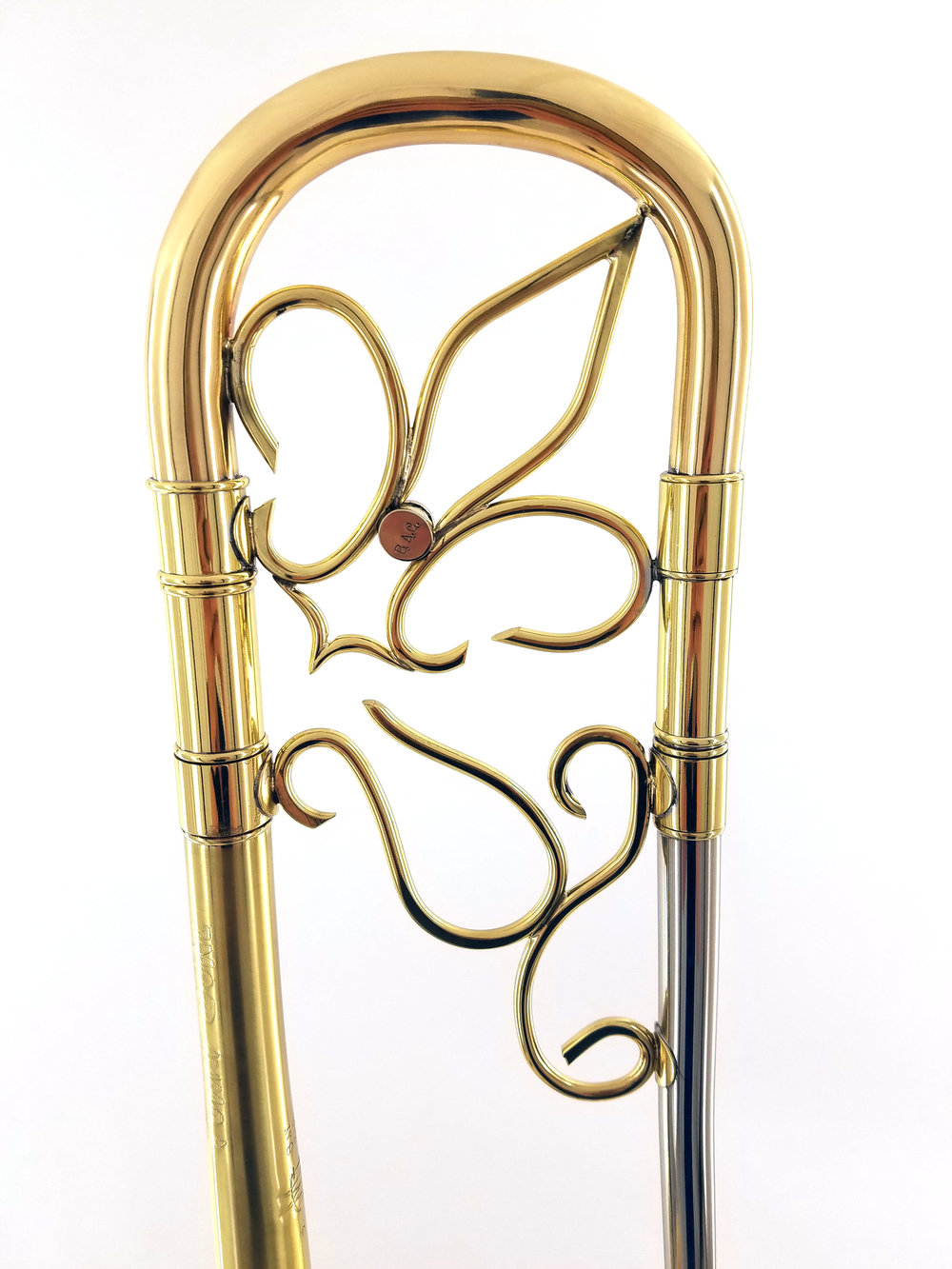
Or the trombone that they attached decorative vine shaped garden stakes to instead of bracing.
Or the world's first perfect slide that was perfectly in tune in all seven positions and every partial.
It's all a bunch of weird vanity projects.
My favorite is the "Elliott Mason Model" (rent to own!) that isn't even close to the same product as the Elliott Mason trombone that they made for the man himself.
<YOUTUBE id="bHf5RWtkeTg">
Or the stained glass trombone.
Or the Multi-Track YouTube special model
Or the trombone they draped aluminum foil over and spray painted gold.
Or the trombone that they attached decorative vine shaped garden stakes to instead of bracing.
Or the world's first perfect slide that was perfectly in tune in all seven positions and every partial.
It's all a bunch of weird vanity projects.
- jbeatenbough
- Posts: 338
- Joined: Dec 13, 2019
They do get a "little" creative, don't they? = )
- Matt_K
- Posts: 4809
- Joined: Mar 21, 2018
Or the trombone they draped aluminum foil over and spray painted gold.
Or the trombone that they attached decorative vine shaped garden stakes to instead of bracing.
I somehow missed those two... I need to see these lol
- timothy42b
- Posts: 1812
- Joined: Mar 27, 2018
Now that's a counterweight!
- AwesomeDad
- Posts: 38
- Joined: Mar 05, 2019
Late to the party but has anyone used a copper lead pipe? I love mine for my flugel and my 897z comes with two and thought about having one made in copper....
JJ
JJ
- bassbone721
- Posts: 45
- Joined: Jan 17, 2020
Nah, I believe the most common material use is the plutonium pipe.
- Posaunus
- Posts: 5018
- Joined: Mar 23, 2018
[quote="ihomi"]Hello Folks,
In the Trombone musical instrument, the most common material use is yellow brass pipe.[/quote]
Nah ... ... ... this is too easy.
I'll let others provide the appropriate flip responses. ;)
In the Trombone musical instrument, the most common material use is yellow brass pipe.[/quote]
Nah ... ... ... this is too easy.
I'll let others provide the appropriate flip responses. ;)
- Windmill
- Posts: 104
- Joined: Feb 14, 2021
I realize that the material, and the thickness of the slide matters for me more than the bell... I love heavy slides and just can't find my way with lightweight ones. Just from the playing feeling and the slotting.
- soseggnchips
- Posts: 92
- Joined: Jan 29, 2021
[quote="Windmill"]I realize that the material, and the thickness of the slide matters for me more than the bell... I love heavy slides and just can't find my way with lightweight ones. Just from the playing feeling and the slotting.[/quote]
I prefer a heavier slide as well. For me it's not about the sound or the blow, though - I just like the feel of the action on a heavier slide.
I prefer a heavier slide as well. For me it's not about the sound or the blow, though - I just like the feel of the action on a heavier slide.
- BGuttman
- Posts: 7368
- Joined: Mar 22, 2018
If you like heavy slides find an old TIS (Tuning in Slide) trombone. A Conn 40H (or the 38H or 42H) Ballroom, an original Olds (make sure you put on an aftermarket counterweight), etc.
Modern TIS horns have much lighter slides -- manufacturing has allowed a lighter weight tuning mechanism.
I have one old TIS horn that has a lighter slide -- a Holton Paul Whiteman.
Modern TIS horns have much lighter slides -- manufacturing has allowed a lighter weight tuning mechanism.
I have one old TIS horn that has a lighter slide -- a Holton Paul Whiteman.
- Elow
- Posts: 1924
- Joined: Mar 02, 2020
[quote="JohnL"]
Even though beryllium is toxic, a beryllium copper bell wouldn't be dangerous to the player. For someone involved in some of the processes that go into making that bell (notably any process that produces fine particulates, such as buffing), appropriate precautions would be necessary.
[/quote]
How should one go about buffing a beryllium bell? Should i be fine if im just cleaning up one solder joint?
Even though beryllium is toxic, a beryllium copper bell wouldn't be dangerous to the player. For someone involved in some of the processes that go into making that bell (notably any process that produces fine particulates, such as buffing), appropriate precautions would be necessary.
[/quote]
How should one go about buffing a beryllium bell? Should i be fine if im just cleaning up one solder joint?
- BGuttman
- Posts: 7368
- Joined: Mar 22, 2018
[quote="Elow"]<QUOTE author="JohnL" post_id="64188" time="1532731956" user_id="119">
Even though beryllium is toxic, a beryllium copper bell wouldn't be dangerous to the player. For someone involved in some of the processes that go into making that bell (notably any process that produces fine particulates, such as buffing), appropriate precautions would be necessary.
[/quote]
How should one go about buffing a beryllium bell? Should i be fine if im just cleaning up one solder joint?
</QUOTE>
A filter type respirator (like an N95) should be sufficient. Also, wet buffing or wet sanding will tend to reduce the dust. The big hazard is breathing in the dust.
Even though beryllium is toxic, a beryllium copper bell wouldn't be dangerous to the player. For someone involved in some of the processes that go into making that bell (notably any process that produces fine particulates, such as buffing), appropriate precautions would be necessary.
[/quote]
How should one go about buffing a beryllium bell? Should i be fine if im just cleaning up one solder joint?
</QUOTE>
A filter type respirator (like an N95) should be sufficient. Also, wet buffing or wet sanding will tend to reduce the dust. The big hazard is breathing in the dust.
- timothy42b
- Posts: 1812
- Joined: Mar 27, 2018
[quote="BGuttman"]
A filter type respirator (like an N95) should be sufficient. Also, wet buffing or wet sanding will tend to reduce the dust. The big hazard is breathing in the dust.[/quote]
In almost 30 years now as a working engineer, a beryllium dust contamination is the only time ever I've actually used calculus.
It was a dental operation that had a failure in the dust collection system, and to report the correct quantity to the EPA they needed to know the volume of material collected. The shape of the wastebasket they put it in (yeah! I wasn't there for that part! hope they used N95 or better, I'd have gone PAPR) was a truncated cone. They didn't know the formula for volume, and this was pre-Internet.
Neither did I, but it was simple enough to write equations for the shape and do a triple integration.
It would take me a lot longer now! but then a quick google would give the answer without the effort. Not sure if that's good or bad.
A filter type respirator (like an N95) should be sufficient. Also, wet buffing or wet sanding will tend to reduce the dust. The big hazard is breathing in the dust.[/quote]
In almost 30 years now as a working engineer, a beryllium dust contamination is the only time ever I've actually used calculus.
It was a dental operation that had a failure in the dust collection system, and to report the correct quantity to the EPA they needed to know the volume of material collected. The shape of the wastebasket they put it in (yeah! I wasn't there for that part! hope they used N95 or better, I'd have gone PAPR) was a truncated cone. They didn't know the formula for volume, and this was pre-Internet.
Neither did I, but it was simple enough to write equations for the shape and do a triple integration.
It would take me a lot longer now! but then a quick google would give the answer without the effort. Not sure if that's good or bad.
- BaritoneJack
- Posts: 78
- Joined: May 30, 2018
[quote="BillO"]The Chinese are master metallurgists and had been for centuries before the Europeans figured it out.[/quote]
The Chinese didn't start making cupro-nickel alloys until about 200-300 BC; people on the Iranian Plateau were using copper and arsenic to make the earliest form of bronze by about 5,000 BC. By 4,500 BC, people of the Vinča culture, in present-day Serbia, were making a superior bronze by alloying copper with tin instead of arsenic. By 1800 BC, steel was being made in Anatolia (present-day Turkey), and before the Chinese had worked out how to make cupro-nickel, Spanish blacksmiths were forging steel swords. By 600 BC, the real whizz-kids in the field of large-scale high-carbon crucible steel production were in South India and Sri-Lanka, and building an international reputation for their steel.
However advanced the Chinese were in some respects, the historical record proves that they were way behind other nations in the field of metallurgy.
With best regards,
Jack
The Chinese didn't start making cupro-nickel alloys until about 200-300 BC; people on the Iranian Plateau were using copper and arsenic to make the earliest form of bronze by about 5,000 BC. By 4,500 BC, people of the Vinča culture, in present-day Serbia, were making a superior bronze by alloying copper with tin instead of arsenic. By 1800 BC, steel was being made in Anatolia (present-day Turkey), and before the Chinese had worked out how to make cupro-nickel, Spanish blacksmiths were forging steel swords. By 600 BC, the real whizz-kids in the field of large-scale high-carbon crucible steel production were in South India and Sri-Lanka, and building an international reputation for their steel.
However advanced the Chinese were in some respects, the historical record proves that they were way behind other nations in the field of metallurgy.
With best regards,
Jack
- harrisonreed
- Posts: 6479
- Joined: Aug 17, 2018
At least some Chinese smiths had knowledge of advanced metallurgy at least 2700 years ago. This object is by all rights something that should not exist in this condition, today.
https://en.m.wikipedia.org/wiki/Sword_of_Goujian
The blade is so advanced for its time that it has tin alloyed into its edge at a different percentage than the rest of the blade, and sulphur alloyed into the pattern along the blade to prevent tarnishing. Not random or uniform, but a deliberate choice of materials for specific features at key areas on the blade.
Is it as good as forging steel during the bronze age? No. It's cool though! Cooler than the bronze age Greek swords from the same period that no longer exist.
https://en.m.wikipedia.org/wiki/Sword_of_Goujian
The blade is so advanced for its time that it has tin alloyed into its edge at a different percentage than the rest of the blade, and sulphur alloyed into the pattern along the blade to prevent tarnishing. Not random or uniform, but a deliberate choice of materials for specific features at key areas on the blade.
Is it as good as forging steel during the bronze age? No. It's cool though! Cooler than the bronze age Greek swords from the same period that no longer exist.
- greenbean
- Posts: 1958
- Joined: Mar 23, 2018
In the table, Nickel-Silver is referred to as "Nickel." Few people knowingly call it Nickel - mostly those who don't know the difference. Calling it "Nickel" might cause confusion because Nickel itself is also used in instrument making (usually in plating).
- Digidog
- Posts: 483
- Joined: Dec 13, 2018
I wonder what a titanium bell would be like. It seems to be a metal as good as any to make a nice bell from.
Also: Titanium valves and moving parts are common in the car industry, so it would definitely be possible to take off some weight from a horn by producing and fitting titanium valves.
I suspect titanium would be expensive, though, since it takes a lot of energy to manipulate and form it.
Also: Titanium valves and moving parts are common in the car industry, so it would definitely be possible to take off some weight from a horn by producing and fitting titanium valves.
I suspect titanium would be expensive, though, since it takes a lot of energy to manipulate and form it.
- BGuttman
- Posts: 7368
- Joined: Mar 22, 2018
I'm pretty sure that the reason brass has become the de-facto standard material for instruments was because it was the easiest metal to work in the past. And much like the 4 stroke internal combustion engine it has been under development for so long that the current designs are specifically made to work around its deficiencies and our expectations of sound are attuned to its responses. Developing an alternate material is a difficult process. Just look at how long it has taken to make a plastic trombone that sounds even close to a brass one (the first ones appeared over 50 years ago).
We have found some alternative materials that work almost like brass: nickel-silver (which is a copper alloy containing no silver), cupro-nickel (a copper-nickel alloy that works and looks like brass), sterling silver (mostly for bells and flutes).
I might expect that other metals could be made to work, but the final product may not look like today's trombone. And nobody's going to spend the R&D money on something new since there isn't much of a market for it. This becomes a project for a school to try.
We have found some alternative materials that work almost like brass: nickel-silver (which is a copper alloy containing no silver), cupro-nickel (a copper-nickel alloy that works and looks like brass), sterling silver (mostly for bells and flutes).
I might expect that other metals could be made to work, but the final product may not look like today's trombone. And nobody's going to spend the R&D money on something new since there isn't much of a market for it. This becomes a project for a school to try.
- BrianJohnston
- Posts: 1165
- Joined: Jul 11, 2020
[quote="Matt K"][/quote]
According to various websites, bronze is typically, but not exactly always:
90% Copper
10% Tin
According to various websites, bronze is typically, but not exactly always:
90% Copper
10% Tin
- Matt_K
- Posts: 4809
- Joined: Mar 21, 2018
Isn't there usually a little zinc in bronze? I could be off base. Blast from the past, been ages since I made this post :horror: But updated accordingly
- BGuttman
- Posts: 7368
- Joined: Mar 22, 2018
Coin metal is copper with 4% tin and 1% zinc. Traditional bronzes are primarily mixtures of copper and tin, sometimes with other elements.
Alloy 903 is 88%Cu, 8%Sn, and 4% Zn.
There are Manganese bronzes, Aluminum bronzes, Leaded bronzes, and Silicon bronzes. Wikipedia has a huge list of copper alloys.
Alloy 903 is 88%Cu, 8%Sn, and 4% Zn.
There are Manganese bronzes, Aluminum bronzes, Leaded bronzes, and Silicon bronzes. Wikipedia has a huge list of copper alloys.
- BrianJohnston
- Posts: 1165
- Joined: Jul 11, 2020
[quote="Matt K"]Isn't there usually a little zinc in bronze? I could be off base. Blast from the past, been ages since I made this post :horror: But updated accordingly[/quote]
There can be, but usually it's just a 2 metal alloy. If there is a 3rd metal involved it's usually zinc, but typically only between 1-7% if that.
There can be, but usually it's just a 2 metal alloy. If there is a 3rd metal involved it's usually zinc, but typically only between 1-7% if that.
- Posaunus
- Posts: 5018
- Joined: Mar 23, 2018
I doubt that they knew much about zinc in the Bronze Age!
- BGuttman
- Posts: 7368
- Joined: Mar 22, 2018
[quote="Posaunus"]I doubt that they knew much about zinc in the Bronze Age![/quote]
They also couldn't purify metals to the level we do today. Lord knows what tramp metals were included, if unintended, in ancient bronze. I'm sure some archeological metallurgist is doing X-ray Fluorescence Spectrometry to find out how pure Bronze Age bronze actually was.
They also couldn't purify metals to the level we do today. Lord knows what tramp metals were included, if unintended, in ancient bronze. I'm sure some archeological metallurgist is doing X-ray Fluorescence Spectrometry to find out how pure Bronze Age bronze actually was.
- JohnL
- Posts: 2529
- Joined: Mar 23, 2018
[quote="BGuttman"]I'm sure some archeological metallurgist is doing X-ray Fluorescence Spectrometry to find out how pure Bronze Age bronze actually was.[/quote]
Yup.
<LINK_TEXT text="https://www.getty.edu/publications/arti ... /36-tykot/">https://www.getty.edu/publications/artistryinbronze/conservation-and-analysis/36-tykot/</LINK_TEXT>
Yup.
<LINK_TEXT text="https://www.getty.edu/publications/arti ... /36-tykot/">https://www.getty.edu/publications/artistryinbronze/conservation-and-analysis/36-tykot/</LINK_TEXT>
- timothy42b
- Posts: 1812
- Joined: Mar 27, 2018
Interesting article.
In the early 90s when I started with a public works department, we had an XRF and used it to check for lead paint in housing. It was in a locked cabinet and we had to post a sign on the outside of the window on that room, in case of fire department needing to respond.
In the early 90s when I started with a public works department, we had an XRF and used it to check for lead paint in housing. It was in a locked cabinet and we had to post a sign on the outside of the window on that room, in case of fire department needing to respond.
- BGuttman
- Posts: 7368
- Joined: Mar 22, 2018
Very interesting article. I've used a pXRF made by Thermo Scientific. In fact, I did a mouthpiece metals study for the old TTF with a bunch of old mouthpieces supplied by Doug Elliott and DJ Kennedy. I can't point to the post right now. I remember doing a brass analysis for Benn Hanson on slide tubes, but I don't think I got conclusive results and never published it on TTF.
I used an older XRF machine to measure plating thicknesses, and this had to be isolated due to a lot of stray X-rays (I even had to wear a film badge), but the compact systems like the Bruker or the Thermo are safe to use, as long as you don't point it at somebody. X-rays are initiated by the press of a trigger and stop after the preset scan time. New software is very good at finding trace materials above the atomic number for Silicon. Things like aluminum, oxygen, and boron are very hard to find, but heavy metals like lead, silver, and gold show up pretty well.
I used an older XRF machine to measure plating thicknesses, and this had to be isolated due to a lot of stray X-rays (I even had to wear a film badge), but the compact systems like the Bruker or the Thermo are safe to use, as long as you don't point it at somebody. X-rays are initiated by the press of a trigger and stop after the preset scan time. New software is very good at finding trace materials above the atomic number for Silicon. Things like aluminum, oxygen, and boron are very hard to find, but heavy metals like lead, silver, and gold show up pretty well.
- dorutzzu92
- Posts: 49
- Joined: Jul 15, 2019
Anyone knows information about Kruspe material (Thein K-style material) ?
- TromboneSam
- Posts: 223
- Joined: Jul 30, 2018
For those curious, I heard back from Anderson Plating today and they no longer make electro-formed trombone bells.
Does this make BAC the only current manufacturer of electro-formed silver trombone bells?
Does this make BAC the only current manufacturer of electro-formed silver trombone bells?
- hornbuilder
- Posts: 1384
- Joined: May 02, 2018
[quote="dorutzzu92"]Anyone knows information about Kruspe material (Thein K-style material) ?[/quote]
90/10 copper/zinc. Red brass
90/10 copper/zinc. Red brass
- ROCHUT
- Posts: 3
- Joined: Mar 16, 2024
[quote="TromboneSam"]For those curious, I heard back from Anderson Plating today and they no longer make electro-formed trombone bells.
Does this make BAC the only current manufacturer of electro-formed silver trombone bells?[/quote]
I am not certain how Bach is currently doing it
Does this make BAC the only current manufacturer of electro-formed silver trombone bells?[/quote]
I am not certain how Bach is currently doing it
- BGuttman
- Posts: 7368
- Joined: Mar 22, 2018
[quote="ROCHUT"]<QUOTE author="TromboneSam" post_id="205435" time="1679440339" user_id="3584">
For those curious, I heard back from Anderson Plating today and they no longer make electro-formed trombone bells.
Does this make BAC the only current manufacturer of electro-formed silver trombone bells?[/quote]
I am not certain how Bach is currently doing it
</QUOTE>
Bach was using Anderson Plating for electroformed silver (SGX) bells.
For those curious, I heard back from Anderson Plating today and they no longer make electro-formed trombone bells.
Does this make BAC the only current manufacturer of electro-formed silver trombone bells?[/quote]
I am not certain how Bach is currently doing it
</QUOTE>
Bach was using Anderson Plating for electroformed silver (SGX) bells.
- elmsandr
- Posts: 1373
- Joined: Mar 23, 2018
Were the SGX bells electroformed? Thought those were sheet.
The Sterling plus bells were electroformed, haven’t seen those in a while.
Cheers,
Andy
The Sterling plus bells were electroformed, haven’t seen those in a while.
Cheers,
Andy
- BrianJohnston
- Posts: 1165
- Joined: Jul 11, 2020
Anyone compared or know the different between red brass (90% copper, 10% zinc) and pure copper?
I’m curious if there would be any differences at all between the 2 in terms of feel and sound.
I’m curious if there would be any differences at all between the 2 in terms of feel and sound.
- hornbuilder
- Posts: 1384
- Joined: May 02, 2018
Copper brings the same qualities as red brass, but more of it.
- Digidog
- Posts: 483
- Joined: Dec 13, 2018
[quote="hornbuilder"]Copper brings the same qualities as red brass, but more of it.[/quote]
When building an instrument - in this case a trombone - which material is the easiest, respective hardest, to work with? Does that differ depending on what trombone is built - like some materials are easier on altos, while others are easier on basses?
Which alloy (or metal) is the most adaptable and problem-free to work with? Which gives the most satisfying results?
Curious mind asks many questions. :idea:
When building an instrument - in this case a trombone - which material is the easiest, respective hardest, to work with? Does that differ depending on what trombone is built - like some materials are easier on altos, while others are easier on basses?
Which alloy (or metal) is the most adaptable and problem-free to work with? Which gives the most satisfying results?
Curious mind asks many questions. :idea: