Why did trombones develop rotary valves for F att. rather than pistons?
- aasavickas
- Posts: 202
- Joined: Sep 13, 2018
A trumpet player once asked me why trombones don't just use pistons for the F attachment since we are always trying new and different style rotaries. I think he was specifically questioning the wisdom of Thayer/Axial Flow valves.
I know some traditional European Trumpets use rotary valves and that just about all French Horns use rotarys and many orchestra Tubas as well.
I've never seen a trombone with a piston for the F attachment and I've also never seen a Thayer style valve on anything other than a trombone.
Any body have a clue on the history of the choice of trombone valve and why Thayers caught on for trombone and not for other brass instruments?
I know some traditional European Trumpets use rotary valves and that just about all French Horns use rotarys and many orchestra Tubas as well.
I've never seen a trombone with a piston for the F attachment and I've also never seen a Thayer style valve on anything other than a trombone.
Any body have a clue on the history of the choice of trombone valve and why Thayers caught on for trombone and not for other brass instruments?
- timothy42b
- Posts: 1812
- Joined: Mar 27, 2018
I've seen them with two piston valves - for the one attachment. Looks ingenious.
- ghmerrill
- Posts: 2193
- Joined: Apr 02, 2018
I think there's basically one response to this (aside from a somewhat minor consideration about the historical development of rotary vs. piston valves): Just try to design a trombone that uses a piston valve (or better, in the case of the bass trombone, two of them) instead of a rotary. Think a minute about how the actuating mechanism would work. Think about the relative weight and "length of throw" of the valve/mechanism combination. Then take a look at the piston valve and run away quick.
Pretty much the same story for the Thayer. Just try to design a tuba, euphonium, or trumpet using these. Think of the same size/weight/mechanism issues. Then look at the Thayer and run away quick. Even for something the size of a tuba, the use of Thayers would present a space/layout problem -- and for what gain?
Pretty much the same story for the Thayer. Just try to design a tuba, euphonium, or trumpet using these. Think of the same size/weight/mechanism issues. Then look at the Thayer and run away quick. Even for something the size of a tuba, the use of Thayers would present a space/layout problem -- and for what gain?
- ghmerrill
- Posts: 2193
- Joined: Apr 02, 2018
[quote="timothy42b"]Looks ingenious.[/quote]
:lol: Nice description. An interesting footnote in the history of brass instrument engineering.
:lol: Nice description. An interesting footnote in the history of brass instrument engineering.
- BGuttman
- Posts: 7368
- Joined: Mar 22, 2018
Note: There were several trombones made with piston valve "attachments". It was common to use a 1/2 step piston valve as a trill valve. There were also single piston attachments in F and E back around the turn of the 20th Century. As Gary points out, actuation is a bit of a problem.
FWIW, there was also a piston valve French Horn (and not the Mellophone) again from around the same time. For some reason it never caught on even though it was a true double. There were also double French Horns with 3 rotors and a piston valve "Change".
FWIW, there was also a piston valve French Horn (and not the Mellophone) again from around the same time. For some reason it never caught on even though it was a true double. There were also double French Horns with 3 rotors and a piston valve "Change".
- harrisonreed
- Posts: 6479
- Joined: Aug 17, 2018
The superbone
- JohnL
- Posts: 2529
- Joined: Mar 23, 2018
Unlike other brass instruments, the "default" configuration for a trombone is the open horn. Not just no valves down, but no valves at all. With the exception of buglers and natural horn specialists, other brass players never experience the feel of a true open horn. The resistance of valves is just part of the nature of their instrument. Trombonists, on the other hand, have long been on a quest for the "perfect" valve - one that performs the functions of a valve but is otherwise acoustically neutral. A piston valve isn't even in the running. Lots of tight turns.
That said, there have been trombones built with piston valve attachments. Douglas Yeo has pictures of a couple of piston-attachment trombones on his website:
<LINK_TEXT text="http://www.yeodoug.com/articles/trombon ... llery.html">http://www.yeodoug.com/articles/trombone_gallery/trombone_gallery.html</LINK_TEXT>
To be honest, they don't look they would be that comfortable to play.
That said, there have been trombones built with piston valve attachments. Douglas Yeo has pictures of a couple of piston-attachment trombones on his website:
<LINK_TEXT text="http://www.yeodoug.com/articles/trombon ... llery.html">http://www.yeodoug.com/articles/trombone_gallery/trombone_gallery.html</LINK_TEXT>
To be honest, they don't look they would be that comfortable to play.
- sf105
- Posts: 433
- Joined: Mar 24, 2018
Noah had a Conn (14H?) recently with a piston valve to F.
Also, traditional British (and French?) horns were piston until after the war (at the time when the trombones got bigger too).
Also, traditional British (and French?) horns were piston until after the war (at the time when the trombones got bigger too).
- Jimkinkella
- Posts: 286
- Joined: Mar 23, 2018
The Brassark has a Conn 12H right now, plays great, sounds great. And fantastic shape for it's age. The valve does actually work pretty well.
- sirisobhakya
- Posts: 445
- Joined: Jun 11, 2018
I think the fact that the one who invented it (Carl Friedrich Sattler) is German is at least some part of the reason why rotary valve is so dominant on trombone. Not only that, Carl Sattler also enlarge the bore and the bell flare. That should have made his horn innovative and popular in those years, and others copied him. I think this is the case for french (german) horn also.
- JohnL
- Posts: 2529
- Joined: Mar 23, 2018
[quote="sirisobhakya"]I think this is the case for french (german) horn also.[/quote]
I think the final nail in the coffin of piston valve "French" horns was the dominance of the double horn. Routing all of that tubing around a set of double-decker pistons would be a nightmare. I really can't imagine a piston-valve double unless you used a Lidl-style change valve.
I think the final nail in the coffin of piston valve "French" horns was the dominance of the double horn. Routing all of that tubing around a set of double-decker pistons would be a nightmare. I really can't imagine a piston-valve double unless you used a Lidl-style change valve.
- ghmerrill
- Posts: 2193
- Joined: Apr 02, 2018
[quote="harrisonreed"]The superbone[/quote]
Yeah, good one, ... but ... First, it remains a curiosity of real-world interest to a minority of jazz players.
But primarily, it's really a valve trombone with a slide attached to it rather than a slide trombone with valves used to extend the range or provide a few more convenient positions. And talk about consequences!! Getting slide positions right on a double valve bass is amusing enough. But to get all the positions right as you're using 3 valves plus combinations? :shock:
So ... not a good counter-example to the piston vs. rotary arguments.
I have, in fact, in my life actually SEEN French horns with piston valves (they weren't all that rare during a certain period) and heard and seen them played. I can't, right off hand, think of (or imagine) a French horn player who would swap his rotary horn for a piston one. You almost never see them (or superbones) in the orchestras, and I can't remember seeing one in a band since I was a kid. And how many people (aside from a relatively small group of fairly advanced trombonists) even know what a superbone is. There may be a reason for all that. :roll:
Also, along similar lines, put some thought into the construction of 5- and 6-valve tubas. The primary 4 valves may be either rotary or piston (both are very common), but I can think of only ONE that uses pistons for valves for 5 or 6. Again, it's a mechanical/layout/playability issue. And PLEASE don't trot out the French C tuba as a counterexample with its 6 piston valves. I don't want to go there. :(
Yeah, good one, ... but ... First, it remains a curiosity of real-world interest to a minority of jazz players.
But primarily, it's really a valve trombone with a slide attached to it rather than a slide trombone with valves used to extend the range or provide a few more convenient positions. And talk about consequences!! Getting slide positions right on a double valve bass is amusing enough. But to get all the positions right as you're using 3 valves plus combinations? :shock:
So ... not a good counter-example to the piston vs. rotary arguments.
I have, in fact, in my life actually SEEN French horns with piston valves (they weren't all that rare during a certain period) and heard and seen them played. I can't, right off hand, think of (or imagine) a French horn player who would swap his rotary horn for a piston one. You almost never see them (or superbones) in the orchestras, and I can't remember seeing one in a band since I was a kid. And how many people (aside from a relatively small group of fairly advanced trombonists) even know what a superbone is. There may be a reason for all that. :roll:
Also, along similar lines, put some thought into the construction of 5- and 6-valve tubas. The primary 4 valves may be either rotary or piston (both are very common), but I can think of only ONE that uses pistons for valves for 5 or 6. Again, it's a mechanical/layout/playability issue. And PLEASE don't trot out the French C tuba as a counterexample with its 6 piston valves. I don't want to go there. :(
- ghmerrill
- Posts: 2193
- Joined: Apr 02, 2018
[quote="ghmerrill"]<QUOTE author="harrisonreed" post_id="71035" time="1542125320" user_id="3642">
The superbone[/quote]
Yeah, good one, ... but ... First, it remains a curiosity of real-world interest to a minority of jazz players.
But primarily, it's really a valve trombone with a slide attached to it rather than a slide trombone with valves used to extend the range or provide a few more convenient positions. And talk about consequences!! Getting slide positions right on a double valve bass is amusing enough. But to get all the positions right as you're using 3 valves plus combinations? :shock:
So ... not a good counter-example to the piston vs. rotary arguments.
I have, in fact, in my life actually SEEN French horns with piston valves (they weren't all that rare during a certain period) and heard and seen them played. I can't, right off hand, think of (or imagine) a French horn player who would swap his rotary horn for a piston one. You almost never see them (or superbones) in the orchestras, and I can't remember seeing one in a band since I was a kid. And how many people (aside from a relatively small group of fairly advanced trombonists) even know what a superbone is. There may be a reason for all that. :roll:
Also, along similar lines, put some thought into the construction of 5- and 6-valve tubas. The primary 4 valves may be either rotary or piston (both are very common), but I can think of only ONE that uses pistons for valves 5 or 6. Again, it's a mechanical/layout/playability issue. And PLEASE don't trot out the French C tuba as a counterexample with its 6 piston valves. I don't want to go there. :(
</QUOTE>
The superbone[/quote]
Yeah, good one, ... but ... First, it remains a curiosity of real-world interest to a minority of jazz players.
But primarily, it's really a valve trombone with a slide attached to it rather than a slide trombone with valves used to extend the range or provide a few more convenient positions. And talk about consequences!! Getting slide positions right on a double valve bass is amusing enough. But to get all the positions right as you're using 3 valves plus combinations? :shock:
So ... not a good counter-example to the piston vs. rotary arguments.
I have, in fact, in my life actually SEEN French horns with piston valves (they weren't all that rare during a certain period) and heard and seen them played. I can't, right off hand, think of (or imagine) a French horn player who would swap his rotary horn for a piston one. You almost never see them (or superbones) in the orchestras, and I can't remember seeing one in a band since I was a kid. And how many people (aside from a relatively small group of fairly advanced trombonists) even know what a superbone is. There may be a reason for all that. :roll:
Also, along similar lines, put some thought into the construction of 5- and 6-valve tubas. The primary 4 valves may be either rotary or piston (both are very common), but I can think of only ONE that uses pistons for valves 5 or 6. Again, it's a mechanical/layout/playability issue. And PLEASE don't trot out the French C tuba as a counterexample with its 6 piston valves. I don't want to go there. :(
</QUOTE>
- greenbean
- Posts: 1958
- Joined: Mar 23, 2018
I think the best answer to the question would be attained if you tried to build a piston valve Bb/F trombone that rivals a current set-up in ergonomics. Then try building a double piston valve bass trombone! Have fun!
- elmsandr
- Posts: 1373
- Joined: Mar 23, 2018
Related, I am in the market for some inexpensive .562 and .590 bore pistons if anybody has some laying around.
There was a German company that was doing piston conversions. Required a weird handrest and a major modification to the main bell brace. Still think it would be interesting to try. I can’t find a picture right now, but they were out there.
Cheers,
Andy
There was a German company that was doing piston conversions. Required a weird handrest and a major modification to the main bell brace. Still think it would be interesting to try. I can’t find a picture right now, but they were out there.
Cheers,
Andy
- hyperbolica
- Posts: 3990
- Joined: Mar 23, 2018
[quote="JohnL"].... Routing all of that tubing around a set of double-decker pistons would be a nightmare. I really can't imagine a piston-valve double unless you used a Lidl-style change valve.[/quote]
The only compensating euphs and tubas use pistons. I always wanted a compensating rotary euph, but those double valves only seem to be made for french horns.
The only compensating euphs and tubas use pistons. I always wanted a compensating rotary euph, but those double valves only seem to be made for french horns.
- whitbey
- Posts: 654
- Joined: Mar 23, 2018
I have been told by tuba and trumpet players that a piston has more pop to the note when the valve changes then rotaries. I found when I double on euphonium pistons have too much pop. I prefer the rotary valve because it blows closer to a slide then a piston valve. My guess is that the piston valve on a bone is not so smooth and had too much pop.
- Jgittleson
- Posts: 255
- Joined: Jun 13, 2018
[quote="greenbean"]I think the best answer to the question would be attained if you tried to build a piston valve Bb/F trombone that rivals a current set-up in ergonomics. Then try building a double piston valve bass trombone! Have fun![/quote]
Hold my beer! :pant:
Hold my beer! :pant:
- timothy42b
- Posts: 1812
- Joined: Mar 27, 2018
[quote="ghmerrill"]<QUOTE author="harrisonreed" post_id="71035" time="1542125320" user_id="3642">
The superbone[/quote]
Yeah, good one, ... but ... First, it remains a curiosity of real-world interest to a minority of jazz players.
But primarily, it's really a valve trombone with a slide attached to it rather than a slide trombone with valves used to extend the range or provide a few more convenient positions. And talk about consequences!! Getting slide positions right on a double valve bass is amusing enough. But to get all the positions right as you're using 3 valves plus combinations? :shock:
</QUOTE>
Perhaps we're just using it incorrectly.
What if: instead of the slide being a full 6 or 7 positions, it had only 2. What do we have then?
A valve trombone with no compromise fingerings, that plays perfectly in tune. Our primary usage is with valves, with the slide serving only to touch up intonation as needed, like a trumpeter's 1st and 3rd valve slides, only more precise and efficient.
The superbone[/quote]
Yeah, good one, ... but ... First, it remains a curiosity of real-world interest to a minority of jazz players.
But primarily, it's really a valve trombone with a slide attached to it rather than a slide trombone with valves used to extend the range or provide a few more convenient positions. And talk about consequences!! Getting slide positions right on a double valve bass is amusing enough. But to get all the positions right as you're using 3 valves plus combinations? :shock:
</QUOTE>
Perhaps we're just using it incorrectly.
What if: instead of the slide being a full 6 or 7 positions, it had only 2. What do we have then?
A valve trombone with no compromise fingerings, that plays perfectly in tune. Our primary usage is with valves, with the slide serving only to touch up intonation as needed, like a trumpeter's 1st and 3rd valve slides, only more precise and efficient.
- ghmerrill
- Posts: 2193
- Joined: Apr 02, 2018
[quote="timothy42b"]
Perhaps we're just using it incorrectly.
What if: instead of the slide being a full 6 or 7 positions, it had only 2. What do we have then?
[/quote]
A valve trombone with a long tuning slide? A very large and funny looking bass trumpet? Take your pick. :lol:
Perhaps we're just using it incorrectly.
What if: instead of the slide being a full 6 or 7 positions, it had only 2. What do we have then?
[/quote]
A valve trombone with a long tuning slide? A very large and funny looking bass trumpet? Take your pick. :lol:
- ghmerrill
- Posts: 2193
- Joined: Apr 02, 2018
[quote="whitbey"]I have been told by tuba and trumpet players that a piston has more pop to the note when the valve changes then rotaries. I found when I double on euphonium pistons have too much pop. I prefer the rotary valve because it blows closer to a slide then a piston valve. My guess is that the piston valve on a bone is not so smooth and had too much pop.[/quote]
Well, not exactly. A tuba with good rotary valves will "pop" as well under certain circumstances. The real issue is how it behaves in slurs, and that has to do with the relative speed and progression of the valve opening and closing. However, in both cases (and also for the purpose of moving tuning slides without creating vacuum and resulting pops), it's very common to vent the valves. I had this done on my BBb (rotary) horn to the 1st valve (which is VERY common) since I used it for "dynamic intonation changes", much like a trombone hand slide (which again is VERY common among tuba players. With my compensating Eb, this of course doesn't make any sense. When I reconfigured my 1924 Buescher horn (changing the pitch from 435 to 440), I just went ahead and vented each of the three valves because it was easy and gained some facility in terms of adjusting the valve slides without vacuum.
Moral of the story: If you're getting valve "popping" that you find bothersome, vent the valves. Really simple on pistons. Trickier on rotaries -- but also less likely to be a real issue (except for the first valve dynamic tuning thing).
Well, not exactly. A tuba with good rotary valves will "pop" as well under certain circumstances. The real issue is how it behaves in slurs, and that has to do with the relative speed and progression of the valve opening and closing. However, in both cases (and also for the purpose of moving tuning slides without creating vacuum and resulting pops), it's very common to vent the valves. I had this done on my BBb (rotary) horn to the 1st valve (which is VERY common) since I used it for "dynamic intonation changes", much like a trombone hand slide (which again is VERY common among tuba players. With my compensating Eb, this of course doesn't make any sense. When I reconfigured my 1924 Buescher horn (changing the pitch from 435 to 440), I just went ahead and vented each of the three valves because it was easy and gained some facility in terms of adjusting the valve slides without vacuum.
Moral of the story: If you're getting valve "popping" that you find bothersome, vent the valves. Really simple on pistons. Trickier on rotaries -- but also less likely to be a real issue (except for the first valve dynamic tuning thing).
- timothy42b
- Posts: 1812
- Joined: Mar 27, 2018
[quote="ghmerrill"]I had this done on my BBb (rotary) horn to the 1st valve (which is VERY common) since I used it for "dynamic intonation changes", much like a trombone hand slide (which again is VERY common among tuba players.[/quote]
We had a tuba player in our small community band who played with very good intonation, but never moved slides. He insisted it wasn't necessary, and for him it didn't seem to be.
Then one night a sub came, and her slides were in constant motion. It looked like a lot of work, and I had never sat right next to a tuba player who did that.
To my ears it made the difference between very good and great. I'm not sure anyone else noticed, it wasn't a high level band.
That made me think the handslide might be useful on a valve trombone. Mine has some intonation challenges (plus ergonomic ones; I haven't yet figured how to hold it.)
We had a tuba player in our small community band who played with very good intonation, but never moved slides. He insisted it wasn't necessary, and for him it didn't seem to be.
Then one night a sub came, and her slides were in constant motion. It looked like a lot of work, and I had never sat right next to a tuba player who did that.
To my ears it made the difference between very good and great. I'm not sure anyone else noticed, it wasn't a high level band.
That made me think the handslide might be useful on a valve trombone. Mine has some intonation challenges (plus ergonomic ones; I haven't yet figured how to hold it.)
- JohnL
- Posts: 2529
- Joined: Mar 23, 2018
[quote="hyperbolica"]The only compensating euphs and tubas use pistons. I always wanted a compensating rotary euph, but those double valves only seem to be made for french horns.[/quote]
Lots more room in the body of a euphonium, which gives a lot more flexibility as far as where the tubing goes. Also, we're talking a full double horn here (there's compensating doubles, but they're not very popular in the US), so there's more tubing to deal with than on a compensating euph.
Lots more room in the body of a euphonium, which gives a lot more flexibility as far as where the tubing goes. Also, we're talking a full double horn here (there's compensating doubles, but they're not very popular in the US), so there's more tubing to deal with than on a compensating euph.
- greenbean
- Posts: 1958
- Joined: Mar 23, 2018
[quote="Jgittleson"]<QUOTE author="greenbean" post_id="71070" time="1542161146" user_id="150">
I think the best answer to the question would be attained if you tried to build a piston valve Bb/F trombone that rivals a current set-up in ergonomics. Then try building a double piston valve bass trombone! Have fun![/quote]
Hold my beer! :pant:
</QUOTE>
Dependent, please! With thumb and middle finger set-up. :mrgreen:
I think the best answer to the question would be attained if you tried to build a piston valve Bb/F trombone that rivals a current set-up in ergonomics. Then try building a double piston valve bass trombone! Have fun![/quote]
Hold my beer! :pant:
</QUOTE>
Dependent, please! With thumb and middle finger set-up. :mrgreen:
- greenbean
- Posts: 1958
- Joined: Mar 23, 2018
[quote="whitbey"]I have been told by tuba and trumpet players that a piston has more pop to the note when the valve changes then rotaries. I found when I double on euphonium pistons have too much pop. I prefer the rotary valve because it blows closer to a slide then a piston valve. My guess is that the piston valve on a bone is not so smooth and had too much pop.[/quote]
Is it possible you got this backwards?...
I (and most tuba players, I believe) have found that rotary valves have lots of pop (and many are vented to reduce this). And I have never encountered a piston tuba with an annoying amount of pop. And most tubists seem to think that piston tubas offer smoother slurring whereas rotary tubas give you more agility at the expense of less smooth slurring. No?
Is it possible you got this backwards?...
I (and most tuba players, I believe) have found that rotary valves have lots of pop (and many are vented to reduce this). And I have never encountered a piston tuba with an annoying amount of pop. And most tubists seem to think that piston tubas offer smoother slurring whereas rotary tubas give you more agility at the expense of less smooth slurring. No?
- Jgittleson
- Posts: 255
- Joined: Jun 13, 2018
[quote="greenbean"]<QUOTE author="Jgittleson" post_id="71082" time="1542187843" user_id="3393">
Hold my beer! :pant:[/quote]
Dependent, please! With thumb and middle finger set-up. :mrgreen:
</QUOTE>
Lol. I could actually make that.
Hold my beer! :pant:[/quote]
Dependent, please! With thumb and middle finger set-up. :mrgreen:
</QUOTE>
Lol. I could actually make that.
- JohnL
- Posts: 2529
- Joined: Mar 23, 2018
[quote="greenbean"]And most tubists seem to think that piston tubas offer smoother slurring whereas rotary tubas give you more agility at the expense of less smooth slurring.[/quote]
That's also the general school of thought among French horn players with regard to the Schmidt (not to be confused with "Schmid") pattern double horns with a piston change valve. Looks like it might be somewhat uncomfortable to hold/play, though.
That's also the general school of thought among French horn players with regard to the Schmidt (not to be confused with "Schmid") pattern double horns with a piston change valve. Looks like it might be somewhat uncomfortable to hold/play, though.
- sirisobhakya
- Posts: 445
- Joined: Jun 11, 2018
[quote="greenbean"]<QUOTE author="whitbey" post_id="71077" time="1542166370" user_id="125">
I have been told by tuba and trumpet players that a piston has more pop to the note when the valve changes then rotaries. I found when I double on euphonium pistons have too much pop. I prefer the rotary valve because it blows closer to a slide then a piston valve. My guess is that the piston valve on a bone is not so smooth and had too much pop.[/quote]
Is it possible you got this backwards?...
I (and most tuba players, I believe) have found that rotary valves have lots of pop (and many are vented to reduce this). And I have never encountered a piston tuba with an annoying amount of pop. And most tubists seem to think that piston tubas offer smoother slurring whereas rotary tubas give you more agility at the expense of less smooth slurring. No?
</QUOTE>
Maybe not all rotors are created equal...
I don’t play much tuba, and have yet a chance to try rotary-valved euphonium. But from my feelings, slur (say, Bb-A or Bb-C) on a trombone with rotor feels smoother and also more agile than on a standard euphonium. A rotary trumpet player sounds, to me, smoother with slurs than one playing piston as well.
But maybe it has nothing to do with the valve. I think many more aspects and factors affect the smoothness and the agility of slur. Lever travel distance (rotor generally less except maybe on tuba, so it feels more “snappy” because of less “half-valving” time), spring stiffness (rotor generally less), moving mass (rotor generally less), port design and direction of actuation (a rotor rotating away from the flow would feel more disruptive), etc.
Is it also possible that a rotary tuba also may have more pop compared to a compensating piston tuba because the player moves its slide constantly?
[quote="timothy42b"]That made me think the handslide might be useful on a valve trombone. Mine has some intonation challenges (plus ergonomic ones; I haven't yet figured how to hold it.)[/quote]
Maybe a main tuning slide (or aux tuning slide at the end of the front bow) kicker activated with a thumb trigger? Like on most German rotary trumpets.
I have been told by tuba and trumpet players that a piston has more pop to the note when the valve changes then rotaries. I found when I double on euphonium pistons have too much pop. I prefer the rotary valve because it blows closer to a slide then a piston valve. My guess is that the piston valve on a bone is not so smooth and had too much pop.[/quote]
Is it possible you got this backwards?...
I (and most tuba players, I believe) have found that rotary valves have lots of pop (and many are vented to reduce this). And I have never encountered a piston tuba with an annoying amount of pop. And most tubists seem to think that piston tubas offer smoother slurring whereas rotary tubas give you more agility at the expense of less smooth slurring. No?
</QUOTE>
Maybe not all rotors are created equal...
I don’t play much tuba, and have yet a chance to try rotary-valved euphonium. But from my feelings, slur (say, Bb-A or Bb-C) on a trombone with rotor feels smoother and also more agile than on a standard euphonium. A rotary trumpet player sounds, to me, smoother with slurs than one playing piston as well.
But maybe it has nothing to do with the valve. I think many more aspects and factors affect the smoothness and the agility of slur. Lever travel distance (rotor generally less except maybe on tuba, so it feels more “snappy” because of less “half-valving” time), spring stiffness (rotor generally less), moving mass (rotor generally less), port design and direction of actuation (a rotor rotating away from the flow would feel more disruptive), etc.
Is it also possible that a rotary tuba also may have more pop compared to a compensating piston tuba because the player moves its slide constantly?
[quote="timothy42b"]That made me think the handslide might be useful on a valve trombone. Mine has some intonation challenges (plus ergonomic ones; I haven't yet figured how to hold it.)[/quote]
Maybe a main tuning slide (or aux tuning slide at the end of the front bow) kicker activated with a thumb trigger? Like on most German rotary trumpets.
- LeTromboniste
- Posts: 1634
- Joined: Apr 11, 2018
Actually, none of Sattler's trombones with valves have survived, so unfortunately we don't know exactly what kind of valve he used. However, the valve he did invent was closer to a pumpenvalve, not a rotary. It might very well be that the first Bb/F didn't have rotary valves.
But yes, the trombone with F attachment is originally a German phenomenon that spread much later. Since rotary valve became the standard on most German brass instruments, it follows that it became the standard on the trombones as well, and that instruments that evolved out of them also kept that feature.
But yes, the trombone with F attachment is originally a German phenomenon that spread much later. Since rotary valve became the standard on most German brass instruments, it follows that it became the standard on the trombones as well, and that instruments that evolved out of them also kept that feature.
- sungfw
- Posts: 257
- Joined: Jul 17, 2018
[quote="hyperbolica"][The only compensating euphs and tubas use pistons. I always wanted a compensating rotary euph, but those double valves only seem to be made for french horns.[/quote]
You're in luck:
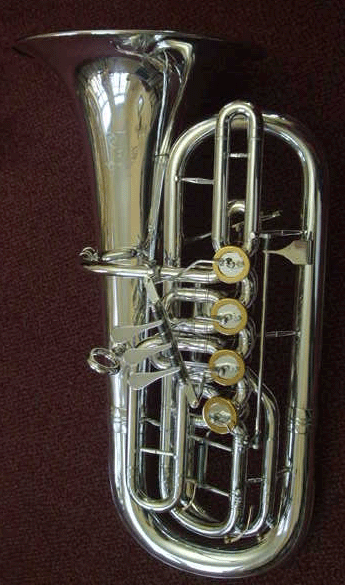
Lätzsch compensating rotary euphonium
You're in luck:
Lätzsch compensating rotary euphonium
- hyperbolica
- Posts: 3990
- Joined: Mar 23, 2018
[quote="sungfw"]
You're in luck:
Lätzsch compensating rotary euphonium[/quote]
Where did you find that? Nice catch!
You're in luck:
Lätzsch compensating rotary euphonium[/quote]
Where did you find that? Nice catch!
- sungfw
- Posts: 257
- Joined: Jul 17, 2018
[quote="hyperbolica"]Where did you find that? Nice catch![/quote]
The photo is from Eiichi Okayama's website,[url=http://euphstudy.seesaa.net/article/89486199.html]euphstudy.seessa.net.
Ran across the Lätzsch when I was shopping for a comper in 2008. Being partial to rotary valves AND distinctive gear, I made a few inquries, but the price—€8300: a little North of $13k at the time :eek:, exclusive of VAT and not including customs and shipping—was "just a bit" too rich for my blood. :weep: :weep: :weep: But if I ever win the lottery ....
The photo is from Eiichi Okayama's website,
Ran across the Lätzsch when I was shopping for a comper in 2008. Being partial to rotary valves AND distinctive gear, I made a few inquries, but the price—€8300: a little North of $13k at the time :eek:, exclusive of VAT and not including customs and shipping—was "just a bit" too rich for my blood. :weep: :weep: :weep: But if I ever win the lottery ....
- jacobgarchik
- Posts: 358
- Joined: Oct 27, 2018
You don't play a piston with your thumb. Even tubas with 5 valves have 4 pistons for the 4 fingers and 1 rotary for the thumb. Piston has to be more or less straight up and down motion, otherwise you are pushing the valve against the casing and it sticks.
Thumb curves and the movement is in an arc. Rotary can be mechanically linked with all different kinds of apparatus, translating many different types of movement to the valve, not just up and down. Rotary mechanisms are more forgiving for the arced movement of the thumb.
Thumb curves and the movement is in an arc. Rotary can be mechanically linked with all different kinds of apparatus, translating many different types of movement to the valve, not just up and down. Rotary mechanisms are more forgiving for the arced movement of the thumb.
- Bart
- Posts: 51
- Joined: Apr 18, 2018
[quote="sf105"]Also, traditional British (and French?) horns were piston until after the war (at the time when the trombones got bigger too).[/quote]
Yeah, there were French trombones as well with a piston valve. Attached are a few pictures of my late '20's Courtois. It's not nearly as uncomfortable as you'd think!
<ATTACHMENT filename="20181128_205404.jpg" index="0">[attachment=0]20181128_205404.jpg</ATTACHMENT>
<ATTACHMENT filename="20181128_205349.jpg" index="1">[attachment=1]20181128_205349.jpg</ATTACHMENT>
<ATTACHMENT filename="20181128_205340.jpg" index="2">[attachment=2]20181128_205340.jpg</ATTACHMENT>
Yeah, there were French trombones as well with a piston valve. Attached are a few pictures of my late '20's Courtois. It's not nearly as uncomfortable as you'd think!
<ATTACHMENT filename="20181128_205404.jpg" index="0">
<ATTACHMENT filename="20181128_205349.jpg" index="1">
<ATTACHMENT filename="20181128_205340.jpg" index="2">
- sf105
- Posts: 433
- Joined: Mar 24, 2018
@bart That's an interesting piece of kit. The British G basses with valves I've seen from that time used rotary.
- Bart
- Posts: 51
- Joined: Apr 18, 2018
[quote="sf105"]@bart That's an interesting piece of kit. The British G basses with valves I've seen from that time used rotary.[/quote]
It is! Unfortunately, the slide is damaged badly, so I'm not able to use it. Hard to find the really small bore inner tubes.
Just to avoid confusion with G basses: this Courtois is a regular Bb tenor trombone. The bell is a little under 6", so it looks a bit out of proportion! I have to play it again and check if the attachment is in F or E. I believe it is in F.
To stay on topic: I have to agree that a regular rotary valve on a trombone feels more comfortable than a piston valve. And as already mentioned: it is more forgiving in the action than the straight up and down of a piston valve.
It is! Unfortunately, the slide is damaged badly, so I'm not able to use it. Hard to find the really small bore inner tubes.
Just to avoid confusion with G basses: this Courtois is a regular Bb tenor trombone. The bell is a little under 6", so it looks a bit out of proportion! I have to play it again and check if the attachment is in F or E. I believe it is in F.
To stay on topic: I have to agree that a regular rotary valve on a trombone feels more comfortable than a piston valve. And as already mentioned: it is more forgiving in the action than the straight up and down of a piston valve.
- Splendour
- Posts: 36
- Joined: Jul 26, 2018
[quote="Bart"]It is! Unfortunately, the slide is damaged badly, so I'm not able to use it. Hard to find the really small bore inner tubes.[/quote]
I know that pain all too well, of the 8 pre war Hawkes, Gibson, and Boosey tenors I've bought over the years, only 1 has has a decent slide.
I have a couple of 1950's Imperials with .485 inch inners, something like that might make a suitable donor?
I know that pain all too well, of the 8 pre war Hawkes, Gibson, and Boosey tenors I've bought over the years, only 1 has has a decent slide.
I have a couple of 1950's Imperials with .485 inch inners, something like that might make a suitable donor?
- Finetales
- Posts: 1482
- Joined: Mar 23, 2018
Now that my TC account logs in again (yay!) I'd like to make a couple of necro-addendums (addendi?).
[quote="BGuttman"]FWIW, there was also a piston valve French Horn (and not the Mellophone) again from around the same time. For some reason it never caught on even though it was a true double. There were also double French Horns with 3 rotors and a piston valve "Change".[/quote]
[quote="JohnL"]<QUOTE author="sirisobhakya" post_id="71063" time="1542151940" user_id="3387"> I think this is the case for french (german) horn also.[/quote]
I think the final nail in the coffin of piston valve "French" horns was the dominance of the double horn. Routing all of that tubing around a set of double-decker pistons would be a nightmare. I really can't imagine a piston-valve double unless you used a Lidl-style change valve.
</QUOTE>
The double horn didn't cause piston horns to die. Piston valve double horns not only exist, but were regularly used for many years in France (I think I read that they've moved to the usual German rotary design nowadays, but I don't know that for sure). They also happen to be some of the most beautiful instruments ever manufactured![url=http://www.williampetit.com/17/cor-selmer/selmer-horn.htm]Here's one. These (and their single horn equivalents) are the only instruments you can correctly call French horns, as they are totally unique to France. There are a few players all over the world who still play the Selmer Thevet Ascendant, including in sections with German double horns. They have a unique sound and feel (partially due to the piston valves, partially due to the small bore/bell), but can still blend with other horns.
The Schmidt wrap horn with the piston change valve Bruce mentioned is also still around. It's obviously not as common as Kruspe or Geyer horns, but it is still played by some, including professionals.
[quote="BGuttman"]FWIW, there was also a piston valve French Horn (and not the Mellophone) again from around the same time. For some reason it never caught on even though it was a true double. There were also double French Horns with 3 rotors and a piston valve "Change".[/quote]
[quote="JohnL"]<QUOTE author="sirisobhakya" post_id="71063" time="1542151940" user_id="3387"> I think this is the case for french (german) horn also.[/quote]
I think the final nail in the coffin of piston valve "French" horns was the dominance of the double horn. Routing all of that tubing around a set of double-decker pistons would be a nightmare. I really can't imagine a piston-valve double unless you used a Lidl-style change valve.
</QUOTE>
The double horn didn't cause piston horns to die. Piston valve double horns not only exist, but were regularly used for many years in France (I think I read that they've moved to the usual German rotary design nowadays, but I don't know that for sure). They also happen to be some of the most beautiful instruments ever manufactured!
The Schmidt wrap horn with the piston change valve Bruce mentioned is also still around. It's obviously not as common as Kruspe or Geyer horns, but it is still played by some, including professionals.