Why do these identical bells mysteriously play so differently?
- tbdana
- Posts: 1928
- Joined: Apr 08, 2023
I want to solve this mystery!
I have a 1978 Bach 16M and a 2020 Bach 16. The bells are supposed to be identical, right? I had my repair guy examine them, and he found them nearly identical. He measured them and found that at the neck they have the same .509 bore, though they are slightly different at the tuning slide where the outer tuning slide bore on one is .533 and on the other it is .538. That's only 5/1000s of an inch; so close they should play identically.
In the photo, my 16 is on the left and my 16M is in the middle. Identical, right? (The right is a silver Lindberg 88H, not at issue here.)
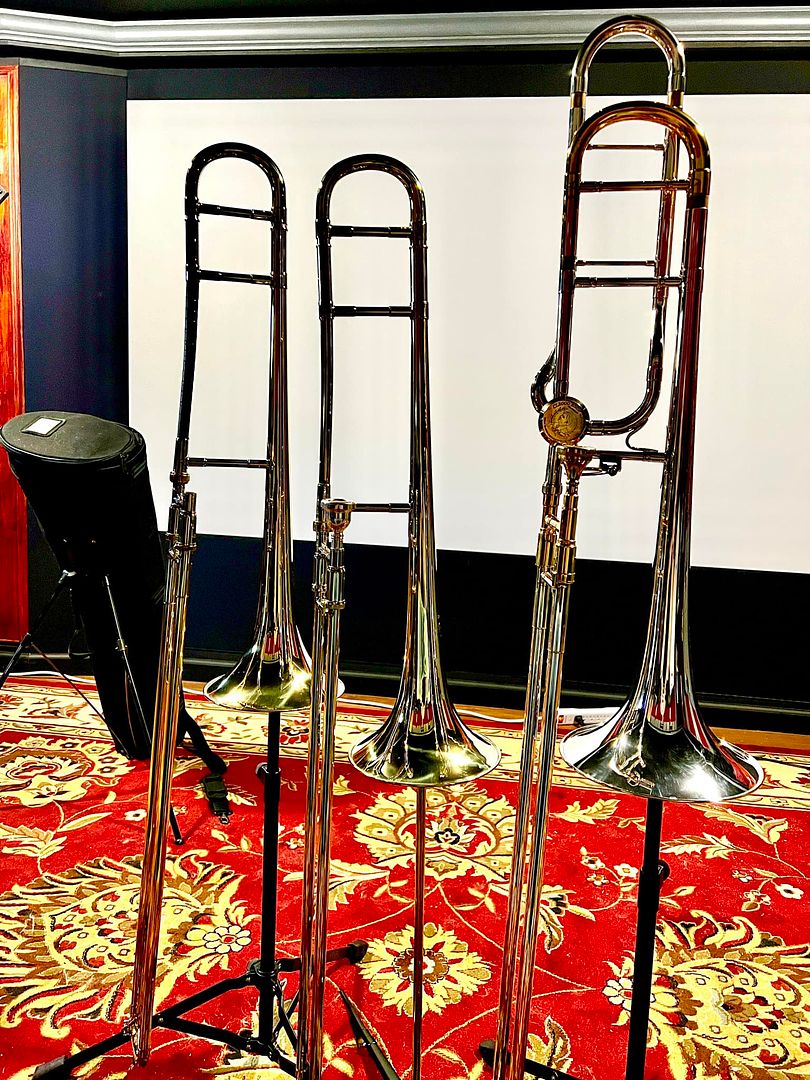
For some reason, the bell for the old 16M plays much more open and free than the newer 16 bell. It's a pretty obvious and dramatic difference, and I can't account for why that may be. I get that bells might have different tonal qualities, but it's not just the sound, it's the air stream. Much less resistance, much freer playing on the older 16M bell. The old bell blows completely free and open; the new bell feels like it's blowing back at me.
Anyone know if there are any differences between the 1978 and 2020 bells that would account for that?
I have a 1978 Bach 16M and a 2020 Bach 16. The bells are supposed to be identical, right? I had my repair guy examine them, and he found them nearly identical. He measured them and found that at the neck they have the same .509 bore, though they are slightly different at the tuning slide where the outer tuning slide bore on one is .533 and on the other it is .538. That's only 5/1000s of an inch; so close they should play identically.
In the photo, my 16 is on the left and my 16M is in the middle. Identical, right? (The right is a silver Lindberg 88H, not at issue here.)
For some reason, the bell for the old 16M plays much more open and free than the newer 16 bell. It's a pretty obvious and dramatic difference, and I can't account for why that may be. I get that bells might have different tonal qualities, but it's not just the sound, it's the air stream. Much less resistance, much freer playing on the older 16M bell. The old bell blows completely free and open; the new bell feels like it's blowing back at me.
Anyone know if there are any differences between the 1978 and 2020 bells that would account for that?
- ithinknot
- Posts: 1339
- Joined: Jul 24, 2020
Not a mystery. Nothing really plays the same.
Most likely? Assembly tension on the newer bell section, which can feel even more obvious and constricting than, say, adding a counterweight.
FWIW the .533/8 numbers can't be right - neither leg of a 16 TS is near that. Possibly .733/8 on the large leg IDs, but I get your point. Did your tech check for solder obstruction and leaks while measuring?
Also, watch a video of someone making a one-piece bell, and make a note of any process elements that might lead to variation. I'll give you a hint - it's all of them :pant:
Most likely? Assembly tension on the newer bell section, which can feel even more obvious and constricting than, say, adding a counterweight.
FWIW the .533/8 numbers can't be right - neither leg of a 16 TS is near that. Possibly .733/8 on the large leg IDs, but I get your point. Did your tech check for solder obstruction and leaks while measuring?
Also, watch a video of someone making a one-piece bell, and make a note of any process elements that might lead to variation. I'll give you a hint - it's all of them :pant:
- James
- Posts: 23
- Joined: Sep 11, 2022
Some years ago I watched a video about french horn players, and how they choose their instruments. It was weird - sitting in a shop with 20 or 30 "identical" instruments, they would try each one until they found the "right"one! Of course, the instruments should have all been the same! As @ithinknot says, the process elements may vary.
- spencercarran
- Posts: 689
- Joined: Oct 17, 2020
Because they're not identical. Especially a '78 bell compared to a 2020 - it was certainly not the same worker building both bells, and I wouldn't be surprised if the general techniques around bell manufacture at the Bach plant were different after the 2006 strike, when almost the entire workforce was replaced at once. Wouldn't even have clear continuity in training for the craftspeople involved.
- brassmedic
- Posts: 1447
- Joined: Dec 14, 2018
I bet the joints are stressed on the newer one. If you were to measure the distance between the tuning slide tubes at both ends, you would probably find they are not parallel. Also, the thickness of the metal in the bell tends to be considerably different in different decades of production.
- timothy42b
- Posts: 1812
- Joined: Mar 27, 2018
[quote="James"]Some years ago I watched a video about french horn players, and how they choose their instruments. It was weird - sitting in a shop with 20 or 30 "identical" instruments, they would try each one until they found the "right"one! Of course, the instruments should have all been the same! As @ithinknot says, the process elements may vary.[/quote]
There's a story about a student going to the famous french horn master and asking for help finding that one horn that was perfect for her. I thought it was on Sarah Willis's site but I couldn't find it.
Anyway, the master walks down the aisle full of french horns, grabs one at random, and hands it to her. She says how do you know, you haven't even heard my playing yet? He says this one will be right for you, when your playing learns to fit it.
There's a story about a student going to the famous french horn master and asking for help finding that one horn that was perfect for her. I thought it was on Sarah Willis's site but I couldn't find it.
Anyway, the master walks down the aisle full of french horns, grabs one at random, and hands it to her. She says how do you know, you haven't even heard my playing yet? He says this one will be right for you, when your playing learns to fit it.
- Doug_Elliott
- Posts: 4155
- Joined: Mar 22, 2018
The 16M does in fact have a bigger neckpipe than a 16.
And guess what, .005 is not a small difference.
And guess what, .005 is not a small difference.
- CharlieB
- Posts: 434
- Joined: Mar 29, 2018
You don't say if both bells were play tested using the same slide, then the other slide.
That would be necessary to eliminate the slides as creating the difference.
Bells vary, and leadpipes vary.
That would be necessary to eliminate the slides as creating the difference.
Bells vary, and leadpipes vary.
- Crazy4Tbone86
- Posts: 1654
- Joined: Jan 14, 2020
[quote="Burgerbob"]Anything handmade is non-repeatable.[/quote]
Exactly! The bells are hand-hammered and annealed repeatedly prior to being spun. Even if two bells were struck with a hammer the exact same number of times, there is no way to control that the hammer strikes the bells in the same exact locations. Also….when annealing (also done by hand by many instrument makers), the bells are moved constantly and no two bells could have the same amount of heat applied to the exact same locations for the exact same amount of time.
The handcrafting of our instruments is what makes them so unique. I hope that brass instruments are never made by complete automation.
Exactly! The bells are hand-hammered and annealed repeatedly prior to being spun. Even if two bells were struck with a hammer the exact same number of times, there is no way to control that the hammer strikes the bells in the same exact locations. Also….when annealing (also done by hand by many instrument makers), the bells are moved constantly and no two bells could have the same amount of heat applied to the exact same locations for the exact same amount of time.
The handcrafting of our instruments is what makes them so unique. I hope that brass instruments are never made by complete automation.
- ithinknot
- Posts: 1339
- Joined: Jul 24, 2020
[quote="Doug Elliott"]The 16M does in fact have a bigger neckpipe than a 16.[/quote]
Though 1978 might be a bit early for the neckpipe change. The other confusing thing is:
[quote="tbdana"]I had my repair guy examine them, and he found them nearly identical. He measured them and found that at the neck they have the same .509 bore[/quote]
... but the non-M neckpipe that you'd expect on a 16 (or 8, or 12) begins around .490 ...
:idk:
Though 1978 might be a bit early for the neckpipe change. The other confusing thing is:
[quote="tbdana"]I had my repair guy examine them, and he found them nearly identical. He measured them and found that at the neck they have the same .509 bore[/quote]
... but the non-M neckpipe that you'd expect on a 16 (or 8, or 12) begins around .490 ...
:idk:
- GabrielRice
- Posts: 1496
- Joined: Mar 23, 2018
Nothing is identical.
Nothing.
Nothing.
- elmsandr
- Posts: 1373
- Joined: Mar 23, 2018
[quote="spencercarran"]Because they're not identical. Especially a '78 bell compared to a 2020 - it was certainly not the same worker building both bells, and I wouldn't be surprised if the general techniques around bell manufacture at the Bach plant were different after the 2006 strike, when almost the entire workforce was replaced at once. Wouldn't even have clear continuity in training for the craftspeople involved.[/quote]
Just because the Union was removed does not mean that the workers were replaced. Nearly every worker that I met at the plant in 2018 or so worked there before the strike. The ones that had not were not replacements, they entered the workforce after that time.
Cheers,
Andy
Just because the Union was removed does not mean that the workers were replaced. Nearly every worker that I met at the plant in 2018 or so worked there before the strike. The ones that had not were not replacements, they entered the workforce after that time.
Cheers,
Andy
- BGuttman
- Posts: 7368
- Joined: Mar 22, 2018
The discussion here gets at the reason it's so difficult to say "doing this change to the horn does this". Also why it is so difficult to do comparison experiments. To do a fair comparison for the effect of any component you need to keep all else the same. Here are two nominally identical instruments that have big differences in play.
- Trombonic
- Posts: 39
- Joined: Mar 09, 2023
I once tried six Yamaha YSL 695 and they all played different.
- timothy42b
- Posts: 1812
- Joined: Mar 27, 2018
[quote="Trombonic"]I once tried six Yamaha YSL 695 and they all played different.[/quote]
Nothing is really identical, is it?
And then there's the other factor. I played the same Bach 42B on six different days, and I played all days different.
Nothing is really identical, is it?
And then there's the other factor. I played the same Bach 42B on six different days, and I played all days different.
- Crazy4Tbone86
- Posts: 1654
- Joined: Jan 14, 2020
[quote="BGuttman"]The discussion here gets at the reason it's so difficult to say "doing this change to the horn does this". Also why it is so difficult to do comparison experiments. To do a fair comparison for the effect of any component you need to keep all else the same. Here are two nominally identical instruments that have big differences in play.[/quote]
I do believe that there is one thing that is certain. The vast majority (I cannot put a percentage on it) come from the factory with some type of tension or misalignment in them.
Of this, I am am almost certain…..If you take an instrument that is built with tension or slides/tuning slides that are misaligned and rebuild it with no tension and absolutely parallel slides, it WILL play better.
I do believe that there is one thing that is certain. The vast majority (I cannot put a percentage on it) come from the factory with some type of tension or misalignment in them.
Of this, I am am almost certain…..If you take an instrument that is built with tension or slides/tuning slides that are misaligned and rebuild it with no tension and absolutely parallel slides, it WILL play better.
- blap73
- Posts: 127
- Joined: Dec 26, 2021
[quote="Crazy4Tbone86"]I do believe that there is one thing that is certain. The vast majority (I cannot put a percentage on it) come from the factory with some type of tension or misalignment in them.
Of this, I am am almost certain…..If you take an instrument that is built with tension or slides/tuning slides that are misaligned and rebuild it with no tension and absolutely parallel slides, it WILL play better.[/quote]
I'm very convinced that the sound perceived by the player (behind the bell) will change if there's a bunch of stress/tension built in. I'm not so sure that the sound out front will change as much. Perhaps the original poster could record both bells and upload the recordings. I'd be interested if we could hear the difference in a blind comparison test. And as noted above - use the same slide for both bells.
Of this, I am am almost certain…..If you take an instrument that is built with tension or slides/tuning slides that are misaligned and rebuild it with no tension and absolutely parallel slides, it WILL play better.[/quote]
I'm very convinced that the sound perceived by the player (behind the bell) will change if there's a bunch of stress/tension built in. I'm not so sure that the sound out front will change as much. Perhaps the original poster could record both bells and upload the recordings. I'd be interested if we could hear the difference in a blind comparison test. And as noted above - use the same slide for both bells.
- Crazy4Tbone86
- Posts: 1654
- Joined: Jan 14, 2020
Agreed! The first thing I notice when I play a horn that I have rebuilt with no stress is the ease of how it plays. The horn becomes more efficient and responsive.
If you get a REALLY good horn with no stress in it, the horn has almost a mystical quality to it. It is a unique thing that is hard to describe. A musician friend of mine described it this way……”I can almost feel the horn vibrating the pitch before I breathe and play it.”
If you get a REALLY good horn with no stress in it, the horn has almost a mystical quality to it. It is a unique thing that is hard to describe. A musician friend of mine described it this way……”I can almost feel the horn vibrating the pitch before I breathe and play it.”
- tbdana
- Posts: 1928
- Joined: Apr 08, 2023
[quote="blap73"]I'm very convinced that the sound perceived by the player (behind the bell) will change if there's a bunch of stress/tension built in. I'm not so sure that the sound out front will change as much. Perhaps the original poster could record both bells and upload the recordings. I'd be interested if we could hear the difference in a blind comparison test. And as noted above - use the same slide for both bells.[/quote]
The bells definitely sound different, but that's not really what I was asking about. They sound different mainly because the bell on the newer one is thicker than on the one from 1978. (Someone re-lacquered the old bell, and must have taken off some of the metal, or something.)
But my big question was why they FEEL so different. The 1978 bell blows very free. The 2020 bell feels like it is blowing back at me. And yet they are the same bell with the same bores and measurements. I don't understand why the newer one has such back-pressure compared to the older one. I really wish that the newer one blew as free, because I like its sound better. Not as bright as the old one that has been re-lacquered.
I frankly don't know or understand the concept of "stress/tension built in" to the bell, but my assumption is that any two pieces of metal tubing of the same measurements will have the same amount of air resistance. But these bells do not. Even just blowing air through them they are different.
I'm learning some things in this thread, so thanks to everyone who has contributed so far. Perhaps what I need to do is to sell both axes and go to a store that has 20 16Ms and play them all to find the one I really like. But I have a bias for older horns, and what I'd really like to do is find a used one that I love. The problem is that you can't go somewhere to play 20 used 16Ms.
The bells definitely sound different, but that's not really what I was asking about. They sound different mainly because the bell on the newer one is thicker than on the one from 1978. (Someone re-lacquered the old bell, and must have taken off some of the metal, or something.)
But my big question was why they FEEL so different. The 1978 bell blows very free. The 2020 bell feels like it is blowing back at me. And yet they are the same bell with the same bores and measurements. I don't understand why the newer one has such back-pressure compared to the older one. I really wish that the newer one blew as free, because I like its sound better. Not as bright as the old one that has been re-lacquered.
I frankly don't know or understand the concept of "stress/tension built in" to the bell, but my assumption is that any two pieces of metal tubing of the same measurements will have the same amount of air resistance. But these bells do not. Even just blowing air through them they are different.
I'm learning some things in this thread, so thanks to everyone who has contributed so far. Perhaps what I need to do is to sell both axes and go to a store that has 20 16Ms and play them all to find the one I really like. But I have a bias for older horns, and what I'd really like to do is find a used one that I love. The problem is that you can't go somewhere to play 20 used 16Ms.
- pbone3b
- Posts: 153
- Joined: Apr 08, 2018
[quote="blap73"]
But my big question was why they FEEL so different. The 1978 bell blows very free. The 2020 bell feels like it is blowing back at me.[/quote]
Is this a dual bore 16 VS a sIngle bore 16M?
But my big question was why they FEEL so different. The 1978 bell blows very free. The 2020 bell feels like it is blowing back at me.[/quote]
Is this a dual bore 16 VS a sIngle bore 16M?
- tbdana
- Posts: 1928
- Joined: Apr 08, 2023
[quote="pbone3b"]Is this a dual bore 16 VS a sIngle bore 16M?[/quote]
Yes, but the dual bore is only the slide. The bells for the 16 and the 16M are [supposed to be] exactly the same. Indeed, back when my 1978 horn was made, they didn't even stamp the "M" on the bells, they all just said "16."
Yes, but the dual bore is only the slide. The bells for the 16 and the 16M are [supposed to be] exactly the same. Indeed, back when my 1978 horn was made, they didn't even stamp the "M" on the bells, they all just said "16."
- ithinknot
- Posts: 1339
- Joined: Jul 24, 2020
[quote="tbdana"]I frankly don't know or understand the concept of "stress/tension built in" to the bell[/quote]
It's not "built into the bell", it's built into the whole bell section based on the alignment (or rather misalignment) of parts. The tuning slide bow may have been forced open or closed by the bracing span, the legs aren't parallel and flat, the receivers those legs go into aren't parallel either, the curve of the neckpipe doesn't exactly correspond to the angles established by the bell bracing - both sides of which may have been soldered under compression, or laterally misaligned, etc etc.
All of those things influence how it plays, but not how it behaves as plumbing, which leads us to...
[quote="tbdana"]my assumption is that any two pieces of metal tubing of the same measurements will have the same amount of air resistance. But these bells do not. Even just blowing air through them they are different.[/quote]
What you feel as playing "resistance" is a product of many factors, a lot of which aren't fluid dynamics. That's why you can have an "open-playing" small horn, or a "stuffy" bass... it's never a pure question of Fire Hose Diameter.
It's not "built into the bell", it's built into the whole bell section based on the alignment (or rather misalignment) of parts. The tuning slide bow may have been forced open or closed by the bracing span, the legs aren't parallel and flat, the receivers those legs go into aren't parallel either, the curve of the neckpipe doesn't exactly correspond to the angles established by the bell bracing - both sides of which may have been soldered under compression, or laterally misaligned, etc etc.
All of those things influence how it plays, but not how it behaves as plumbing, which leads us to...
[quote="tbdana"]my assumption is that any two pieces of metal tubing of the same measurements will have the same amount of air resistance. But these bells do not. Even just blowing air through them they are different.[/quote]
What you feel as playing "resistance" is a product of many factors, a lot of which aren't fluid dynamics. That's why you can have an "open-playing" small horn, or a "stuffy" bass... it's never a pure question of Fire Hose Diameter.
- Doug_Elliott
- Posts: 4155
- Joined: Mar 22, 2018
When you blow through it you're feeling fluid dynamics. When you play, you're feeling acoustical resistance. Two different things.
1978 was around the time when Bach was experimenting with the neckpipe on 16 vs 16M, and I don't think the design was settled yet. They are most likely NOT the same.
1978 was around the time when Bach was experimenting with the neckpipe on 16 vs 16M, and I don't think the design was settled yet. They are most likely NOT the same.
- CharlieB
- Posts: 434
- Joined: Mar 29, 2018
[quote="Doug Elliott"]1978 was around the time when Bach was experimenting with the neckpipe on 16 vs 16M, and I don't think the design was settled yet. They are most likely NOT the same.[/quote]
Thanks, Doug.
Always something new to learn here.
I went and measured some neckpipes, expecting that they were tubing of constant diameter.
Wrong I was !!
Similar to slide leadpipes, the neckpipe diameters vary along the length of the tube.
It's easy to understand that the shape of that short section of tubing can alter the sound wave.
Measurements of the subject horns have already shown that the neckpipes are are different.
Thanks, Doug.
Always something new to learn here.
I went and measured some neckpipes, expecting that they were tubing of constant diameter.
Wrong I was !!
Similar to slide leadpipes, the neckpipe diameters vary along the length of the tube.
It's easy to understand that the shape of that short section of tubing can alter the sound wave.
Measurements of the subject horns have already shown that the neckpipes are are different.
- CalgaryTbone
- Posts: 1460
- Joined: May 10, 2018
Before there were modular instruments with removable leadpipes and detachable bells, it used to be a common thing to go to a large music store and switch bells and slides of several horns of the same model to try to find the best combination for you. I did that as a young high school player to pick out my first 88H.
There are subtle differences between different slides and bells, even if they are actually identical models. I think that modern manufacturing techniques have made components more consistent, but not identical.
Jim Scott
There are subtle differences between different slides and bells, even if they are actually identical models. I think that modern manufacturing techniques have made components more consistent, but not identical.
Jim Scott
- Fidbone
- Posts: 383
- Joined: Apr 24, 2018
I think its also to do with which day they are made, for example perhaps Monday and Friday bells are slightly inferior to the rest of the week for obvious reasons....... <span class="emoji" title=":wink:">😉</span> :shuffle:
- Tromborn
- Posts: 1
- Joined: Aug 16, 2022
I once spoke with Heinrich Thein (Thein Brass, Bremen) who explained me the following:
Brass Sheets are rolled and therefore they have a specific rolling direction. At Thein, they just cut their cups exactly in rolling direction and process them accordingly. They have more waste as a result, but the sound qualities of a cup made in rolling direction are much better than those made across or against the rolling direction.
So, maybe the good cup is cut in rolling direction, but the other one is not?
Brass Sheets are rolled and therefore they have a specific rolling direction. At Thein, they just cut their cups exactly in rolling direction and process them accordingly. They have more waste as a result, but the sound qualities of a cup made in rolling direction are much better than those made across or against the rolling direction.
So, maybe the good cup is cut in rolling direction, but the other one is not?
- James
- Posts: 23
- Joined: Sep 11, 2022
[quote="Tromborn"]I once spoke with Heinrich Thein (Thein Brass, Bremen) who explained me the following:
Brass Sheets are rolled and therefore they have a specific rolling direction. At Thein, they just cut their cups exactly in rolling direction and process them accordingly. They have more waste as a result, but the sound qualities of a cup made in rolling direction are much better than those made across or against the rolling direction.
So, maybe the good cup is cut in rolling direction, but the other one is not?[/quote]
Did he say, "Vorsprung durch Teknik" by any chance?
Brass Sheets are rolled and therefore they have a specific rolling direction. At Thein, they just cut their cups exactly in rolling direction and process them accordingly. They have more waste as a result, but the sound qualities of a cup made in rolling direction are much better than those made across or against the rolling direction.
So, maybe the good cup is cut in rolling direction, but the other one is not?[/quote]
Did he say, "Vorsprung durch Teknik" by any chance?
- harrisonreed
- Posts: 6479
- Joined: Aug 17, 2018
Weird that you can't tell the difference between two very different leadpipes though. What a mystery. I'm the exact opposite. Bells barely make a difference to me.
- CalgaryTbone
- Posts: 1460
- Joined: May 10, 2018
Bach may be getting their supply of brass from a different place more that 40 years later. Also, some people feel that years of use can make a difference.
Jim Scott
Jim Scott
- hyperbolica
- Posts: 3990
- Joined: Mar 23, 2018
Well, i didn't read all the responses, but I do remember reading that the 16 and 16m have different neckpipes. Plus there are a couple metallurgical reasons. First, internal stress in metal works itself out over time, and second heat treat conditions can be different with no external indication. Heat treatment can result in huge differences in bell hardess. Plus if either bell has been repaired involving banging out dents or flame work, that could also have an effect.
- BGuttman
- Posts: 7368
- Joined: Mar 22, 2018
There is another factor. After initial hammering most bells are placed on a lathe and spun. This is a manual process, and while a good bell spinners are pretty consistent, it's still a manual process and there could be small differences in thickness in individual bells due to the spinner applying more or less pressure.
- dukesboneman
- Posts: 935
- Joined: Apr 02, 2018
Excluding the bells,
different neckpipes
different slide bores
Both with a light weight slide?
different leadpipes
different eras
All that factors in before the sound gets to the bell.
The best way to check that is to have both bells modular. Then you could play each bell on both horns and really compare the Bells only.
Now it`s like comparing a Granny Smith Apple with a Fugi Apple. They are both apples, why do they taste different?
Just my opinion
different neckpipes
different slide bores
Both with a light weight slide?
different leadpipes
different eras
All that factors in before the sound gets to the bell.
The best way to check that is to have both bells modular. Then you could play each bell on both horns and really compare the Bells only.
Now it`s like comparing a Granny Smith Apple with a Fugi Apple. They are both apples, why do they taste different?
Just my opinion
- LeTromboniste
- Posts: 1634
- Joined: Apr 11, 2018
[quote="Tromborn"]I once spoke with Heinrich Thein (Thein Brass, Bremen) who explained me the following:
Brass Sheets are rolled and therefore they have a specific rolling direction. At Thein, they just cut their cups exactly in rolling direction and process them accordingly. They have more waste as a result, but the sound qualities of a cup made in rolling direction are much better than those made across or against the rolling direction.
So, maybe the good cup is cut in rolling direction, but the other one is not?[/quote]
As far as I know, Thein doesn't make bells in-house anymore. Like many German makers, they buy bells from a specialized shop (that happens to also be one of the main makers of sackbuts).
[quote="CalgaryTbone"]Before there were modular instruments with removable leadpipes and detachable bells, it used to be a common thing to go to a large music store and switch bells and slides of several horns of the same model to try to find the best combination for you. I did that as a young high school player to pick out my first 88H.
There are subtle differences between different slides and bells, even if they are actually identical models. I think that modern manufacturing techniques have made components more consistent, but not identical.
Jim Scott[/quote]
I still do that quite regularly (3 times in the last year or so) at the Egger workshop, going with students to select their new instrument, or doing it for colleagues abroad who can't do it themselves. It's a fascinating and quite eye and ear-opening process. Also did a couple times with another maker who wants you to try and select individual components as they get ready (so first the bell flare, then a week later the Anstoß, then the neckpipe and back bow, etc.). He writes down your observation, and the next time he doesn't tell you which is which. It was very interesting that both times I went through the process with him, the final bell section I assembled didn't include the bell flare that was my favourite the first week when it was mounted on the prototype. As you introduce other components, it becomes not just about which individual example of each is the best, but how the different components interact with and balance each other.
On the main topic,
There is tension at a molecular level that is different in each and every otherwise identical bell. The metal hardens as it is worked, and the tension is released (and rigidity lost) when the metal is annealed again. Any part of a brass instrument repeatedly goes through several annealing cycles as it gets shaped into the instrument. It is impossible to finish two bells at exactly the same degree of work-hardening or annealing, let alone getting the same level of hardness everywhere within the bell the same every time you anneal or work the piece.
Add to that the fact that the shaping process is done/controlled at least partially by hand, and its also impossible to have two bells with exactly the same thickness overall, and even more impossible for them to have exactly the same thickness at every single point of the bell.
Add to that the fact that two bell sections can't be assembled with exactly the same amount of assembly tension. You can aim for zero tension in the assembly, but it is impossible to achieve. You can't have exactly the same amount of solder at exactly the same places, with exactly the same amount of heat applied exactly at the same places. You also can't have an assembly jig that is 100% reliable.
So yeah, making two absolutely precisely identical things at every level is something no machine can do, let alone a human. There are too many elements involved, at every level from macro to microscopic, that you cannot possibly control.
Brass Sheets are rolled and therefore they have a specific rolling direction. At Thein, they just cut their cups exactly in rolling direction and process them accordingly. They have more waste as a result, but the sound qualities of a cup made in rolling direction are much better than those made across or against the rolling direction.
So, maybe the good cup is cut in rolling direction, but the other one is not?[/quote]
As far as I know, Thein doesn't make bells in-house anymore. Like many German makers, they buy bells from a specialized shop (that happens to also be one of the main makers of sackbuts).
[quote="CalgaryTbone"]Before there were modular instruments with removable leadpipes and detachable bells, it used to be a common thing to go to a large music store and switch bells and slides of several horns of the same model to try to find the best combination for you. I did that as a young high school player to pick out my first 88H.
There are subtle differences between different slides and bells, even if they are actually identical models. I think that modern manufacturing techniques have made components more consistent, but not identical.
Jim Scott[/quote]
I still do that quite regularly (3 times in the last year or so) at the Egger workshop, going with students to select their new instrument, or doing it for colleagues abroad who can't do it themselves. It's a fascinating and quite eye and ear-opening process. Also did a couple times with another maker who wants you to try and select individual components as they get ready (so first the bell flare, then a week later the Anstoß, then the neckpipe and back bow, etc.). He writes down your observation, and the next time he doesn't tell you which is which. It was very interesting that both times I went through the process with him, the final bell section I assembled didn't include the bell flare that was my favourite the first week when it was mounted on the prototype. As you introduce other components, it becomes not just about which individual example of each is the best, but how the different components interact with and balance each other.
On the main topic,
There is tension at a molecular level that is different in each and every otherwise identical bell. The metal hardens as it is worked, and the tension is released (and rigidity lost) when the metal is annealed again. Any part of a brass instrument repeatedly goes through several annealing cycles as it gets shaped into the instrument. It is impossible to finish two bells at exactly the same degree of work-hardening or annealing, let alone getting the same level of hardness everywhere within the bell the same every time you anneal or work the piece.
Add to that the fact that the shaping process is done/controlled at least partially by hand, and its also impossible to have two bells with exactly the same thickness overall, and even more impossible for them to have exactly the same thickness at every single point of the bell.
Add to that the fact that two bell sections can't be assembled with exactly the same amount of assembly tension. You can aim for zero tension in the assembly, but it is impossible to achieve. You can't have exactly the same amount of solder at exactly the same places, with exactly the same amount of heat applied exactly at the same places. You also can't have an assembly jig that is 100% reliable.
So yeah, making two absolutely precisely identical things at every level is something no machine can do, let alone a human. There are too many elements involved, at every level from macro to microscopic, that you cannot possibly control.
- harrisonreed
- Posts: 6479
- Joined: Aug 17, 2018
[quote="dukesboneman"]Now it`s like comparing a Granny Smith Apple with a Fugi Apple. They are both apples, why do they taste different?
Just my opinion[/quote]
Mmmmm Fugi apple.
Best apples I had were from Aomori, an area of Japan analogous to the orchards of Western Massachusetts, and, interestingly enough, orchards that were built around the instructions of a teacher from UMass Amherst in the 1800s.
"Boys be ambitious"
Just my opinion[/quote]
Mmmmm Fugi apple.
Best apples I had were from Aomori, an area of Japan analogous to the orchards of Western Massachusetts, and, interestingly enough, orchards that were built around the instructions of a teacher from UMass Amherst in the 1800s.
"Boys be ambitious"
- harrisonreed
- Posts: 6479
- Joined: Aug 17, 2018
Mt Fudgey
- BrianJohnston
- Posts: 1165
- Joined: Jul 11, 2020
How much of this is from the fact that one bell is 47 years old while the other is 5 years old? I have always wondered how age effects brass.
- LeTromboniste
- Posts: 1634
- Joined: Apr 11, 2018
[quote="BrianJohnston"]How much of this is from the fact that one bell is 47 years old while the other is 5 years old? I have always wondered how age effects brass.[/quote]
Age alone shouldn't in itself affect brass, but a number of factors can change some of its properties over time. It's not uncommon for brass pieces to become more brittle over time, even without additional work hardening. That can be due to slow dezincification over time or other processes brought on by continuous or periodic exposition to moisture or chemicals that are present in the environment naturally or artificially. Also possible effect of the metal expansive and contracting periodically with the weather, if its exposed to heat and cold.
Age alone shouldn't in itself affect brass, but a number of factors can change some of its properties over time. It's not uncommon for brass pieces to become more brittle over time, even without additional work hardening. That can be due to slow dezincification over time or other processes brought on by continuous or periodic exposition to moisture or chemicals that are present in the environment naturally or artificially. Also possible effect of the metal expansive and contracting periodically with the weather, if its exposed to heat and cold.
- BrianJohnston
- Posts: 1165
- Joined: Jul 11, 2020
[quote="LeTromboniste"]<QUOTE author="BrianJohnston" post_id="286059" time="1758586329" user_id="9667">
How much of this is from the fact that one bell is 47 years old while the other is 5 years old? I have always wondered how age effects brass.[/quote]
Age alone shouldn't in itself affect brass, but a number of factors can change some of its properties over time. It's not uncommon for brass pieces to become more brittle over time, even without additional work hardening. That can be due to slow dezincification over time or other processes brought on by continuous or periodic exposition to moisture or chemicals that are present in the environment naturally or artificially. Also possible effect of the metal expansive and contracting periodically with the weather, if its exposed to heat and cold.
</QUOTE>
How does dezincification effect brass relative to much brass is in it in the 1st place?
How much of this is from the fact that one bell is 47 years old while the other is 5 years old? I have always wondered how age effects brass.[/quote]
Age alone shouldn't in itself affect brass, but a number of factors can change some of its properties over time. It's not uncommon for brass pieces to become more brittle over time, even without additional work hardening. That can be due to slow dezincification over time or other processes brought on by continuous or periodic exposition to moisture or chemicals that are present in the environment naturally or artificially. Also possible effect of the metal expansive and contracting periodically with the weather, if its exposed to heat and cold.
</QUOTE>
How does dezincification effect brass relative to much brass is in it in the 1st place?
- BGuttman
- Posts: 7368
- Joined: Mar 22, 2018
[quote="BrianJohnston"]
How does dezincification effect brass relative to much brass is in it in the 1st place?[/quote]
De-zincified brass (i.e. "red rot") is quite brittle compared to regular brass -- and even red brass and pure copper. It's also somewhat porous. These can affect the resonance of the instrument. You'd probably have a hard time detecting a small area (unless it contains a pinhole), But a large area, like an entire tuning slide bow, might be enough to make a small difference.
How does dezincification effect brass relative to much brass is in it in the 1st place?[/quote]
De-zincified brass (i.e. "red rot") is quite brittle compared to regular brass -- and even red brass and pure copper. It's also somewhat porous. These can affect the resonance of the instrument. You'd probably have a hard time detecting a small area (unless it contains a pinhole), But a large area, like an entire tuning slide bow, might be enough to make a small difference.