Help design my practice room!
- mgladdish
- Posts: 155
- Joined: Oct 10, 2021
I'm in the super-fortunate position of being able to fit out a dedicated practice room for myself. The problem is I'm now falling into analysis-paralysis with all the different choices to make on it.
It's currently super-loud, but thankfully already isolated from the rest of the house well enough that I don't have to worry about sound insulation, just about deadening it down to be a really nice place to hear myself play.
It's approximately 3.5m x 4.5m, with a 2.5m high ceiling (cat for scale), wooden laminate flooring, and a full height bay window.
The chief thing to sort out will be the acoustic. Which really begs two questions:
1. What's the best sounding practice room you've used
2. What would you do to this room to make it sound like that
<ATTACHMENT filename="IMG_0472.jpeg" index="0">[attachment=0]IMG_0472.jpeg</ATTACHMENT>
<ATTACHMENT filename="IMG_0470.jpeg" index="1">[attachment=1]IMG_0470.jpeg</ATTACHMENT>
It's currently super-loud, but thankfully already isolated from the rest of the house well enough that I don't have to worry about sound insulation, just about deadening it down to be a really nice place to hear myself play.
It's approximately 3.5m x 4.5m, with a 2.5m high ceiling (cat for scale), wooden laminate flooring, and a full height bay window.
The chief thing to sort out will be the acoustic. Which really begs two questions:
1. What's the best sounding practice room you've used
2. What would you do to this room to make it sound like that
<ATTACHMENT filename="IMG_0472.jpeg" index="0">
<ATTACHMENT filename="IMG_0470.jpeg" index="1">
- bitbckt
- Posts: 298
- Joined: Aug 19, 2020
Funny, this just came up in another thread. I’m no acoustics engineer, but I have done this three times now and know what sort of room I like to practice in, so make of that what you will.
The bay around the door jumps out to me, and I would hang some heavy fabric curtains over that. They would probably look aesthetically awful, but would cheaply tame all of that glass.
For the walls, I like Audimute and Auralex. Googling those brands should give you a place to start.
You’ll might want bass traps in (at least) the upper corners of the room, but I prefer to add those last, after dealing with the higher frequency reflections.
I’ve never had a fireplace in a practice room before, so I don’t know how that might react. I might screen it somehow. Maybe with one of the folding, floor-standing screens.
The bay around the door jumps out to me, and I would hang some heavy fabric curtains over that. They would probably look aesthetically awful, but would cheaply tame all of that glass.
For the walls, I like Audimute and Auralex. Googling those brands should give you a place to start.
You’ll might want bass traps in (at least) the upper corners of the room, but I prefer to add those last, after dealing with the higher frequency reflections.
I’ve never had a fireplace in a practice room before, so I don’t know how that might react. I might screen it somehow. Maybe with one of the folding, floor-standing screens.
- tbdana
- Posts: 1928
- Joined: Apr 08, 2023
To answer your second question with what little I know:
The worst kind of room is a square box with all hard, flat surfaces. In these rooms the sound waves bounce back and forth and careen around the room bouncing off floor, ceiling and walls, and keep bouncing until they lose all their energy.
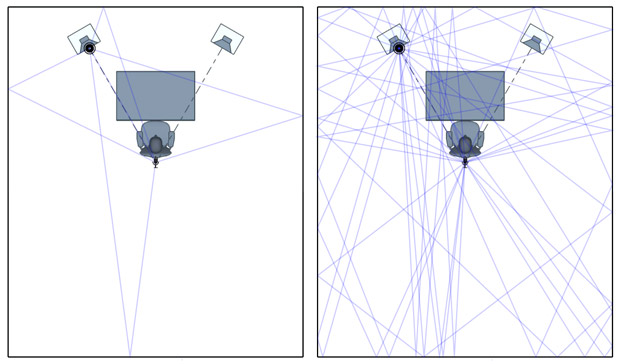
Your room is very close to that.
The way to tame a room like that is to absorb some of the sound waves and diffuse some of them. By absorbing the waves you reduce the energy of the waves by directly absorbing their energy, and by diffusing them you reduce their energy by breaking the waves up into smaller waves that go in many different directions, each wave having less energy and losing their energy as travel at angles.
You need some sound <U>absorption</U> and/or <U>diffusion</U>. This room has a variety of elements that both absorb and diffuse sound waves.
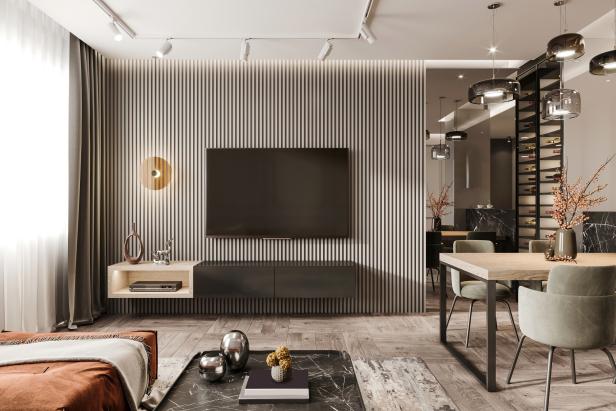
The easiest things for sound absorption are to add carpet or a large rug and/or drapes and/or sound absorbing furniture like a sofa.
Better still is to hang sound absorbing panels on the walls. They can be plain like these...
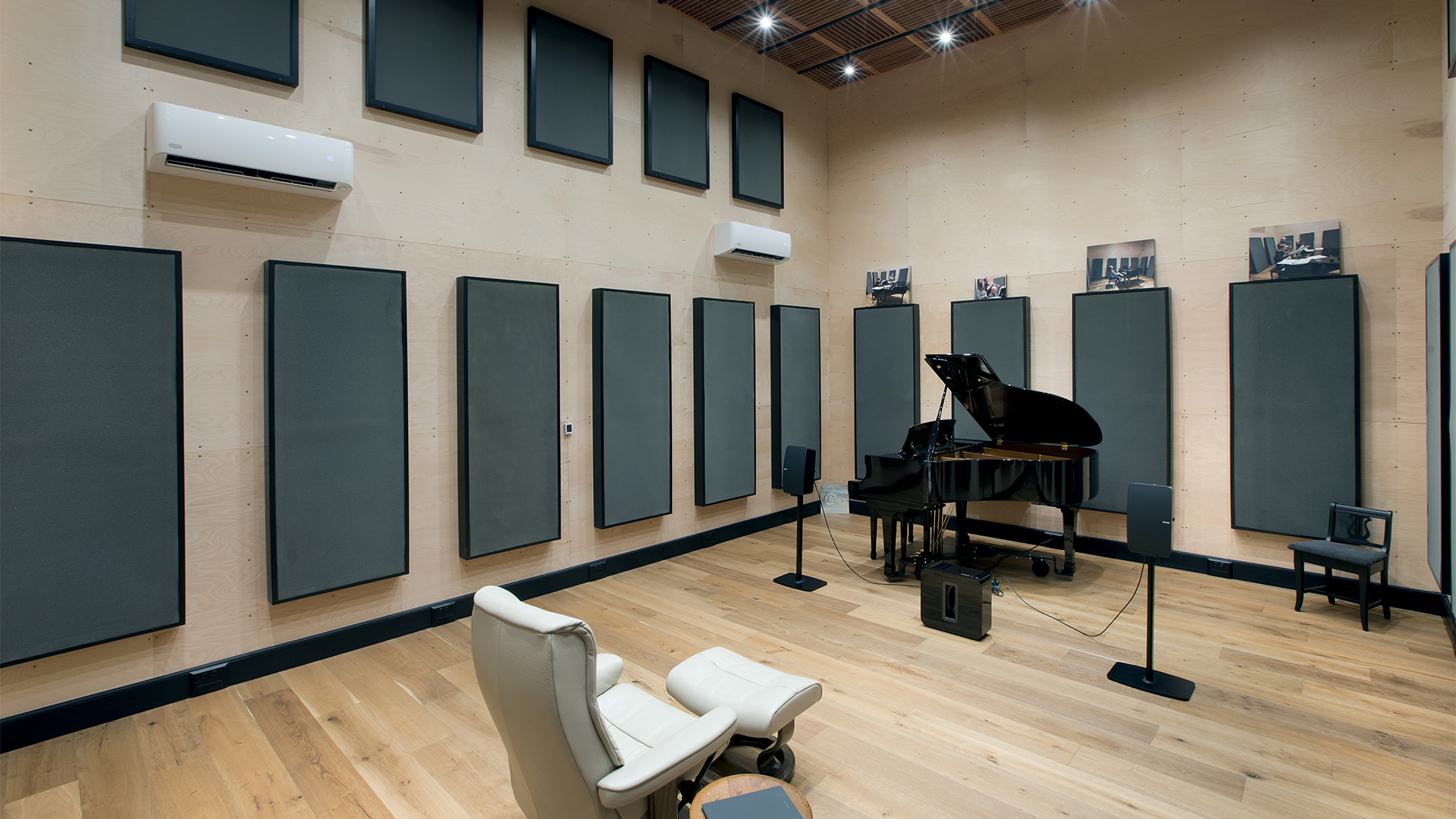
...or they can come with images, posters or art printed on them like these.
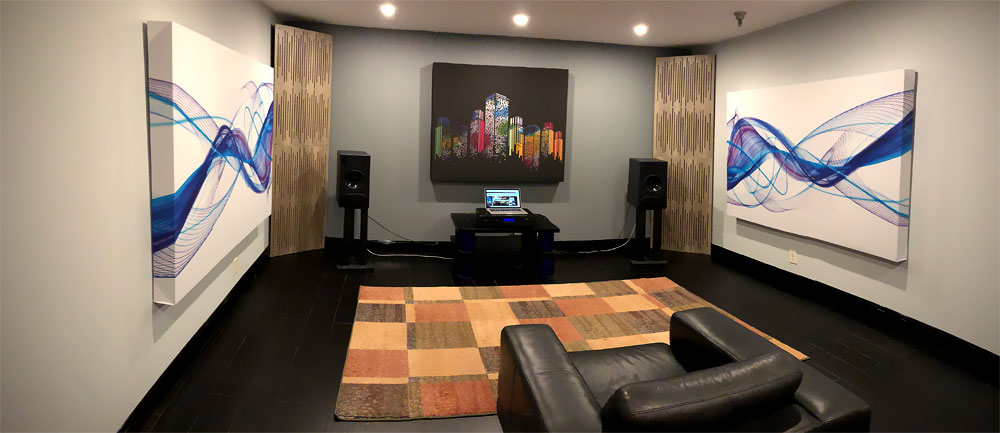
You can make them or buy them. These things absorb high energy reflected sound waves very well.
You can also diffuse the sound waves. This is the process of breaking them up into smaller waves with less energy that are reflected at angles so that they don't return directly to you and run out of energy before they get to you.

Diffusing sound is done by adding furniture and accessories with hard surfaces of many different angles. Convex and concave shapes, angled objects, etc., all break up the reflected waves. Examples are round surface lamps, shelves and boxes, cabinets, etc.
They make panels that are very effective in diffusing sound and are made for that purpose. They typically have hard surfaces with many angles on them so that the sound waves don't reflect straight back but are sent off at all sorts of angles and diffuse throughout the room. A very plain but effective one looks like this...

But there are more sophisticated and pleasing shapes, as well, such as this...
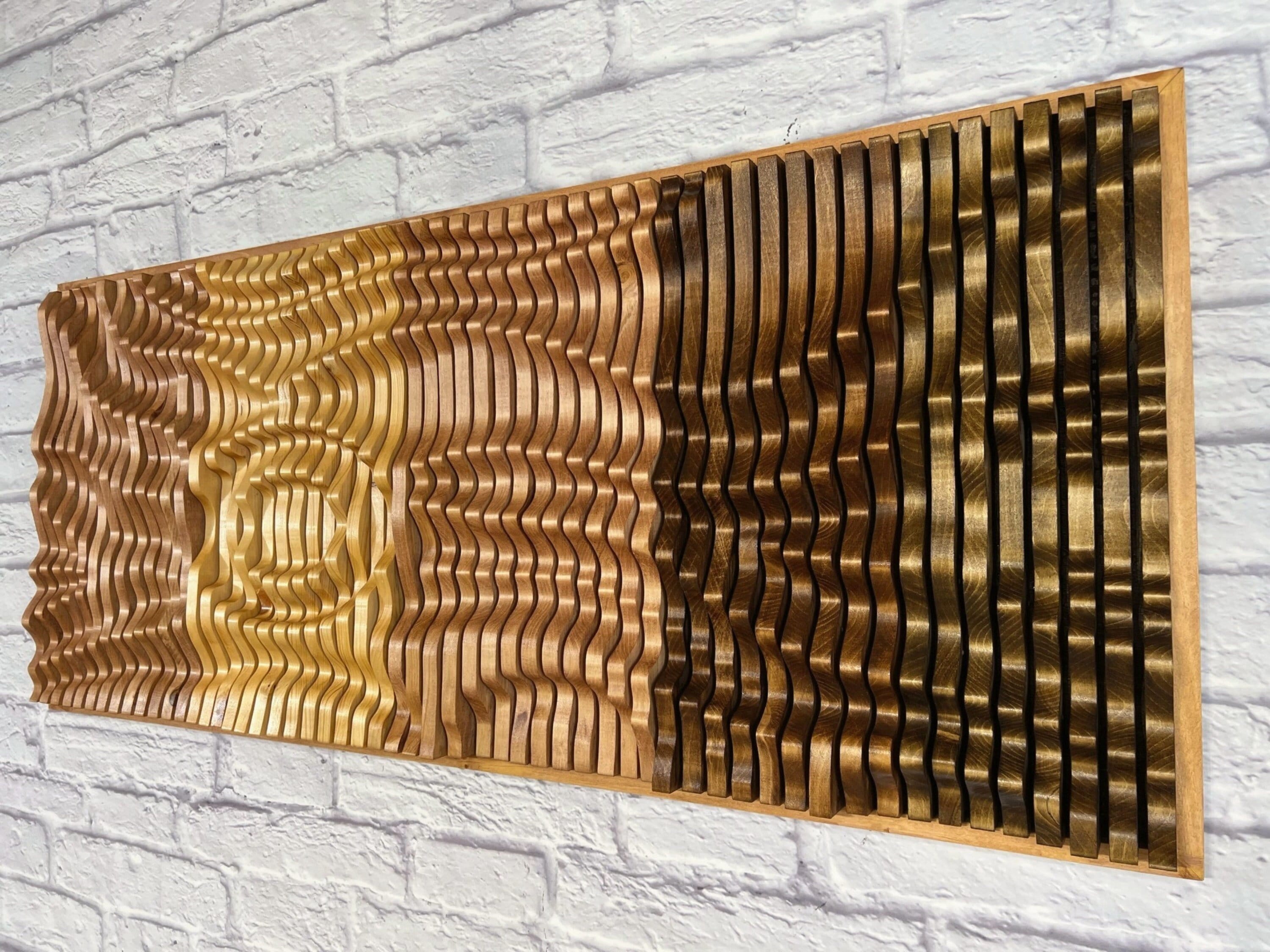
So, you can go the furniture/carpet/drapes route or the commercial panel route, or combine the two. But you must break up those high energy reflected sound waves one way or another in your square box of a room.
By the way, these rooms that I posted above...
...have sound absorption and diffusing reflective surfaces. These rooms, as different as they look, both probably sounds pretty good.
The worst kind of room is a square box with all hard, flat surfaces. In these rooms the sound waves bounce back and forth and careen around the room bouncing off floor, ceiling and walls, and keep bouncing until they lose all their energy.
Your room is very close to that.
The way to tame a room like that is to absorb some of the sound waves and diffuse some of them. By absorbing the waves you reduce the energy of the waves by directly absorbing their energy, and by diffusing them you reduce their energy by breaking the waves up into smaller waves that go in many different directions, each wave having less energy and losing their energy as travel at angles.
You need some sound <U>absorption</U> and/or <U>diffusion</U>. This room has a variety of elements that both absorb and diffuse sound waves.
The easiest things for sound absorption are to add carpet or a large rug and/or drapes and/or sound absorbing furniture like a sofa.
Better still is to hang sound absorbing panels on the walls. They can be plain like these...
...or they can come with images, posters or art printed on them like these.
You can make them or buy them. These things absorb high energy reflected sound waves very well.
You can also diffuse the sound waves. This is the process of breaking them up into smaller waves with less energy that are reflected at angles so that they don't return directly to you and run out of energy before they get to you.
Diffusing sound is done by adding furniture and accessories with hard surfaces of many different angles. Convex and concave shapes, angled objects, etc., all break up the reflected waves. Examples are round surface lamps, shelves and boxes, cabinets, etc.
They make panels that are very effective in diffusing sound and are made for that purpose. They typically have hard surfaces with many angles on them so that the sound waves don't reflect straight back but are sent off at all sorts of angles and diffuse throughout the room. A very plain but effective one looks like this...
But there are more sophisticated and pleasing shapes, as well, such as this...
So, you can go the furniture/carpet/drapes route or the commercial panel route, or combine the two. But you must break up those high energy reflected sound waves one way or another in your square box of a room.
By the way, these rooms that I posted above...
...have sound absorption and diffusing reflective surfaces. These rooms, as different as they look, both probably sounds pretty good.
- mgladdish
- Posts: 155
- Joined: Oct 10, 2021
[quote="bitbckt"]Funny, this just came up in another thread. I’m no acoustics engineer, but I have done this three times now and know what sort of room I like to practice in, so make of that what you will.
The bay around the door jumps out to me, and I would hang some heavy fabric curtains over that. They would probably look aesthetically awful, but would cheaply tame all of that glass.
For the walls, I like Audimute and Auralex. Googling those brands should give you a place to start.
You’ll might want bass traps in (at least) the upper corners of the room, but I prefer to add those last, after dealing with the higher frequency reflections.
I’ve never had a fireplace in a practice room before, so I don’t know how that might react. I might screen it somehow. Maybe with one of the folding, floor-standing screens.[/quote]
Yeah that's what reminded me to ask on here, but I didn't want to derail that one with my specific questions.
Agreed, curtains around the bay will be one of the first things to try.
It doesn't look like Audimute deal in the UK, but I've found https://gikacoustics.co.uk who look like they do similar products.
The bay around the door jumps out to me, and I would hang some heavy fabric curtains over that. They would probably look aesthetically awful, but would cheaply tame all of that glass.
For the walls, I like Audimute and Auralex. Googling those brands should give you a place to start.
You’ll might want bass traps in (at least) the upper corners of the room, but I prefer to add those last, after dealing with the higher frequency reflections.
I’ve never had a fireplace in a practice room before, so I don’t know how that might react. I might screen it somehow. Maybe with one of the folding, floor-standing screens.[/quote]
Yeah that's what reminded me to ask on here, but I didn't want to derail that one with my specific questions.
Agreed, curtains around the bay will be one of the first things to try.
It doesn't look like Audimute deal in the UK, but I've found https://gikacoustics.co.uk who look like they do similar products.
- mgladdish
- Posts: 155
- Joined: Oct 10, 2021
[quote="tbdana"]To answer your second question with what little I know:
The worst kind of room is a square box with all hard, flat surfaces. In these rooms the sound waves bounce back and forth and careen around the room bouncing off floor, ceiling and walls, and keep bouncing until they lose all their energy.
Your room is very close to that.
The way to tame a room like that is to absorb some of the sound waves and diffuse some of them. By absorbing the waves you reduce the energy of the waves by directly absorbing their energy, and by diffusing them you reduce their energy by breaking the waves up into smaller waves that go in many different directions, each wave having less energy and losing their energy as travel at angles.
You need some sound <U>absorption</U> and/or <U>diffusion</U>. This room has a variety of elements that both absorb and diffuse sound waves.
[...]snip for brevity[...]
[/quote]
Wow, thanks for all that.
Do you know where you'd start, or how to judge where and how much each of absorption and diffusion to put in? My assumption would be to install curtains and a rug, see how that sounds, then gradually add absorption panels until I'm happy. Based on nothing more than guessing the "loudness" of the room is due to the sound being reflected back to me again and again. Or is there a more structured approach that doesn't require a masters in acoustic engineering?
The worst kind of room is a square box with all hard, flat surfaces. In these rooms the sound waves bounce back and forth and careen around the room bouncing off floor, ceiling and walls, and keep bouncing until they lose all their energy.
Your room is very close to that.
The way to tame a room like that is to absorb some of the sound waves and diffuse some of them. By absorbing the waves you reduce the energy of the waves by directly absorbing their energy, and by diffusing them you reduce their energy by breaking the waves up into smaller waves that go in many different directions, each wave having less energy and losing their energy as travel at angles.
You need some sound <U>absorption</U> and/or <U>diffusion</U>. This room has a variety of elements that both absorb and diffuse sound waves.
[...]snip for brevity[...]
[/quote]
Wow, thanks for all that.
Do you know where you'd start, or how to judge where and how much each of absorption and diffusion to put in? My assumption would be to install curtains and a rug, see how that sounds, then gradually add absorption panels until I'm happy. Based on nothing more than guessing the "loudness" of the room is due to the sound being reflected back to me again and again. Or is there a more structured approach that doesn't require a masters in acoustic engineering?
- Matthias
- Posts: 20
- Joined: Jul 31, 2022
I studied acoustics during my bachelor's degree, covering various subjects including a module on room acoustics. In one practical project, we devised a strategy to enhance the acoustics of our university library. Initially, we conducted frequency-dependent reverberation time measurements and then calculated the necessary acoustic adjustments to meet DIN standards.
Although our efforts yielded positive results, the library wasn't fully optimized during my time as a student, so the effectiveness of our calculations in practice remains uncertain. Before investing in absorbers and diffusers costing thousands of euros, I'd advocate for conducting thorough measurements first. We utilized a custom program for reverberation time measurements, although numerous alternatives are available online.
Additionally, here's another paper (in German, but DeepL translation could assist) detailing the optimization of reverberation rooms in the local theater: <LINK_TEXT text="http://pub.dega-akustik.de/DAGA_2014/da ... 000389.pdf">http://pub.dega-akustik.de/DAGA_2014/data/articles/000389.pdf</LINK_TEXT>
Although our efforts yielded positive results, the library wasn't fully optimized during my time as a student, so the effectiveness of our calculations in practice remains uncertain. Before investing in absorbers and diffusers costing thousands of euros, I'd advocate for conducting thorough measurements first. We utilized a custom program for reverberation time measurements, although numerous alternatives are available online.
Additionally, here's another paper (in German, but DeepL translation could assist) detailing the optimization of reverberation rooms in the local theater: <LINK_TEXT text="http://pub.dega-akustik.de/DAGA_2014/da ... 000389.pdf">http://pub.dega-akustik.de/DAGA_2014/data/articles/000389.pdf</LINK_TEXT>
- harrisonreed
- Posts: 6479
- Joined: Aug 17, 2018
[quote="tbdana"]To answer your second question with what little I know:
*Proceeds to drop massive knowledge*
[/quote]
One of the best posts on the entire forum.
*Proceeds to drop massive knowledge*
[/quote]
One of the best posts on the entire forum.
- bitbckt
- Posts: 298
- Joined: Aug 19, 2020
I used four quadratic diffusers from GIK in my current room. They do the job but were slow to arrive and required a fair amount of finish work on my part to clean up their “craftsmanship”. I’m not sure I’d buy them again. I haven’t used their consulting services, so no feedback there.
- Burgerbob
- Posts: 6327
- Joined: Apr 23, 2018
I have foam panels on two walls, a rug, and all my horns in cases in my practice studio. It sounds pretty ok this way. Without those things it's awful.
- mgladdish
- Posts: 155
- Joined: Oct 10, 2021
[quote="Matthias"]I studied acoustics during my bachelor's degree, covering various subjects including a module on room acoustics. In one practical project, we devised a strategy to enhance the acoustics of our university library. Initially, we conducted frequency-dependent reverberation time measurements and then calculated the necessary acoustic adjustments to meet DIN standards.
Although our efforts yielded positive results, the library wasn't fully optimized during my time as a student, so the effectiveness of our calculations in practice remains uncertain. Before investing in absorbers and diffusers costing thousands of euros, I'd advocate for conducting thorough measurements first. We utilized a custom program for reverberation time measurements, although numerous alternatives are available online.
Additionally, here's another paper (in German, but DeepL translation could assist) detailing the optimization of reverberation rooms in the local theater: <LINK_TEXT text="http://pub.dega-akustik.de/DAGA_2014/da ... 000389.pdf">http://pub.dega-akustik.de/DAGA_2014/data/articles/000389.pdf</LINK_TEXT>[/quote]
Oof, that's all a bit above my pay grade.
I did find https://www.roomeqwizard.com/ but it seems it needs a specialist calibrated microphone to even start. And once I've got that, then I still need to know what I'm looking at. What would "good" look like in that analysis, and it wouldn't help judge what to put in the room to make it so!
Although our efforts yielded positive results, the library wasn't fully optimized during my time as a student, so the effectiveness of our calculations in practice remains uncertain. Before investing in absorbers and diffusers costing thousands of euros, I'd advocate for conducting thorough measurements first. We utilized a custom program for reverberation time measurements, although numerous alternatives are available online.
Additionally, here's another paper (in German, but DeepL translation could assist) detailing the optimization of reverberation rooms in the local theater: <LINK_TEXT text="http://pub.dega-akustik.de/DAGA_2014/da ... 000389.pdf">http://pub.dega-akustik.de/DAGA_2014/data/articles/000389.pdf</LINK_TEXT>[/quote]
Oof, that's all a bit above my pay grade.
I did find https://www.roomeqwizard.com/ but it seems it needs a specialist calibrated microphone to even start. And once I've got that, then I still need to know what I'm looking at. What would "good" look like in that analysis, and it wouldn't help judge what to put in the room to make it so!
- mgladdish
- Posts: 155
- Joined: Oct 10, 2021
[quote="bitbckt"]I used four quadratic diffusers from GIK in my current room. They do the job but were slow to arrive and required a fair amount of finish work on my part to clean up their “craftsmanship”. I’m not sure I’d buy them again. I haven’t used their consulting services, so no feedback there.[/quote]
Ah, that's great to know. Thanks.
Ah, that's great to know. Thanks.
- mgladdish
- Posts: 155
- Joined: Oct 10, 2021
[quote="Burgerbob"]I have foam panels on two walls, a rug, and all my horns in cases in my practice studio. It sounds pretty ok this way. Without those things it's awful.[/quote]
I've just tried hanging up two massive rugs on the walls and now the room sounds stuffy and crap!
So I guess I at least now know how much is too much.
I've just tried hanging up two massive rugs on the walls and now the room sounds stuffy and crap!
So I guess I at least now know how much is too much.
- Burgerbob
- Posts: 6327
- Joined: Apr 23, 2018
I have these in a checkerboard pattern on opposite walls to cut down on unwanted reflections, the direction I usually face when I play


- CharlieB
- Posts: 434
- Joined: Mar 29, 2018
My experience, starting with a bare room of about the same dimensions:
Covered the floor with carpet. Helped some.
Added an upholstered sofa to the room. Helped a little more.
Built four wood frames about 7 feet square, covered with carpet.
Experimented standing the carpeted frames around the room.
Experimented with the location of the trombonist in the room.
Trial and error, until the room sounded right. Then fastened the carpet frames to the walls.
Covered the floor with carpet. Helped some.
Added an upholstered sofa to the room. Helped a little more.
Built four wood frames about 7 feet square, covered with carpet.
Experimented standing the carpeted frames around the room.
Experimented with the location of the trombonist in the room.
Trial and error, until the room sounded right. Then fastened the carpet frames to the walls.
- izMadman
- Posts: 37
- Joined: Nov 27, 2019
[quote="tbdana"]The easiest things for sound absorption are to add carpet or a large rug and/or drapes and/or sound absorbing furniture like a sofa.[/quote]
Agree with that. A small sofa would be a great addition - something like[url=https://whataroom.com/collections/all-custom-sofa-sectionals/products/daphne-sofa]this. It would fit the room's size.
Agree with that. A small sofa would be a great addition - something like
- SGH
- Posts: 37
- Joined: Feb 15, 2023
Another advantage of diffusion is it makes the room sound like a bigger room. I used Skyline diffusers along one wall, and Sonex on the other end of the room. Absorptive treatment is helpful if you plan on recording music because microphone placement is less critical. Too much absorption and the room is dead. Check out F. Alton Everest’s books on acoustic treatment for home studios. He recommends pretty much what Dana described.
- AndrewMeronek
- Posts: 1487
- Joined: Mar 30, 2018
I have a slightly different yet effective take on managing a practice room's acoustics: randomly thrown around cardboard boxes. Works pretty well.
No, no pics.
No, no pics.
- VJOFan
- Posts: 529
- Joined: Apr 06, 2018
The one trick I know is to eliminate parallel reflections. If two walls are exactly parallel and the reflection of sound between them is not stopped, it creates a horrid, harsh effect.
And carpets on the laminate flooring.
And carpets on the laminate flooring.
- mgladdish
- Posts: 155
- Joined: Oct 10, 2021
Thread resurrection time!
I ended up finding an interior designer to help out - here's how far we've got.
There are still shelves to go on the walls and curtains to fit, which all will help towards deadening the sound again. And if that's not enough, the art I have planned for over the fireplace will be printed on an acoustic panel.
Oh, and I've come up with a cunning ruse to hang my spare trombones on the wall from the picture rail, but I'm still finishing off making the brackets so action shots of that will have to follow later.
I ended up finding an interior designer to help out - here's how far we've got.
There are still shelves to go on the walls and curtains to fit, which all will help towards deadening the sound again. And if that's not enough, the art I have planned for over the fireplace will be printed on an acoustic panel.
Oh, and I've come up with a cunning ruse to hang my spare trombones on the wall from the picture rail, but I'm still finishing off making the brackets so action shots of that will have to follow later.
- tbdana
- Posts: 1928
- Joined: Apr 08, 2023
That is a gorgeous room! I love it!
But...what the heck does "spare trombones" mean???
But...what the heck does "spare trombones" mean???
- mgladdish
- Posts: 155
- Joined: Oct 10, 2021
The rest of the room is now finished.
I'm particularly pleased with the way this has come out - my father and I designed (and he built) a custom hook to hang a trombone from a picture rail.
<ATTACHMENT filename="FCEB1A21-6DB2-4267-8862-9A3668DBC5B9_1_105_c.jpeg" index="1">[attachment=1]FCEB1A21-6DB2-4267-8862-9A3668DBC5B9_1_105_c.jpeg</ATTACHMENT>
And we also designed and built a mouthpiece stand, which I'm also delighted with *:
<ATTACHMENT filename="IMG_0793.jpeg" index="0">[attachment=0]IMG_0793.jpeg</ATTACHMENT>
* we made those wooden mouthpieces ourselves for a bit of a giggle. They're absoutely terrible to play on!
I'm particularly pleased with the way this has come out - my father and I designed (and he built) a custom hook to hang a trombone from a picture rail.
<ATTACHMENT filename="FCEB1A21-6DB2-4267-8862-9A3668DBC5B9_1_105_c.jpeg" index="1">
And we also designed and built a mouthpiece stand, which I'm also delighted with *:
<ATTACHMENT filename="IMG_0793.jpeg" index="0">
* we made those wooden mouthpieces ourselves for a bit of a giggle. They're absoutely terrible to play on!
- bitbckt
- Posts: 298
- Joined: Aug 19, 2020
Both pieces are excellent! I particularly like the mouthpiece stand.
- trombonebob
- Posts: 8
- Joined: Jun 16, 2024
Your practise room looks superb.
My experience is that rooms that are too lively to practice in are a bit too flattering and can lead to a thinning of your sound. A very dead acoustic with very little in the way of reflections/reverb makes you work harder and can be advantageous both from thickenning your sound but also by helping make your mistakes etc more noticable.
As lovely as your room is, I'd be putting lots of soft furnishing in there, carpet on the floor, curtains, shelves etc etc. Anything to break up and soak up the room reflections from all those hard surfaces.
I enjoy practising in a rather small box room that has lots of shelves with books etc, it's as dead as a doornail and I think my sound is better for it.
My experience is that rooms that are too lively to practice in are a bit too flattering and can lead to a thinning of your sound. A very dead acoustic with very little in the way of reflections/reverb makes you work harder and can be advantageous both from thickenning your sound but also by helping make your mistakes etc more noticable.
As lovely as your room is, I'd be putting lots of soft furnishing in there, carpet on the floor, curtains, shelves etc etc. Anything to break up and soak up the room reflections from all those hard surfaces.
I enjoy practising in a rather small box room that has lots of shelves with books etc, it's as dead as a doornail and I think my sound is better for it.
- HornboneandVocals
- Posts: 75
- Joined: Oct 04, 2023
There’s nothing more humbling than a dead room
- mgladdish
- Posts: 155
- Joined: Oct 10, 2021
You're right regarding acoustics. The finishing touches were to add curtains plus shelving. Together they've made a ton of difference - taking the room from annoyingly shrill to satisfyingly dull. I'll add an acoustic panel over the fireplace once I get around to finalising the artwork I want on it. As you say, there's no such thing as too dead.
<ATTACHMENT filename="731F9B2C-9FEB-4BB2-8381-4911B395FC0D_1_105_c.jpeg" index="0">[attachment=0]731F9B2C-9FEB-4BB2-8381-4911B395FC0D_1_105_c.jpeg</ATTACHMENT>
<ATTACHMENT filename="731F9B2C-9FEB-4BB2-8381-4911B395FC0D_1_105_c.jpeg" index="0">