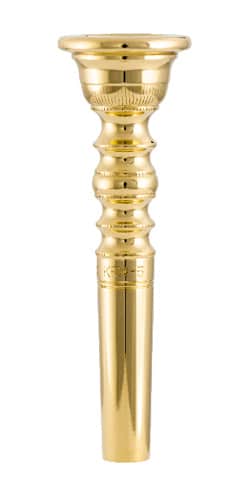
What is this called?
- harrisonreed
- Posts: 6479
- Joined: Aug 17, 2018
What is this section of the mouthpiece blank called? Does it do anything? Is it used to aid in manufacturing?
<ATTACHMENT filename="20241212_115426.jpg" index="0">[attachment=0]20241212_115426.jpg</ATTACHMENT>
My only guesses are that it either is just the maker's artistic touch, or perhaps something that you can use with a specific collar to hold the mouthpiece in the lathe while you are working on the mouthpiece face, rather than a Morse taper collar that might allow the MP to work loose.
<ATTACHMENT filename="20241212_115426.jpg" index="0">
My only guesses are that it either is just the maker's artistic touch, or perhaps something that you can use with a specific collar to hold the mouthpiece in the lathe while you are working on the mouthpiece face, rather than a Morse taper collar that might allow the MP to work loose.
- tbonesullivan
- Posts: 1959
- Joined: Jul 02, 2019
I saw a diagram once by Marcinkiewicz that pretty much said what that area was and how the particularly design they used helped with something, but for more the life of me I can't find it, and have been trying to for years. I'm sure it has some type of name.
- Doubler
- Posts: 435
- Joined: Jan 07, 2019
It is called "Outer Shape" <LINK_TEXT text="https://studylib.net/doc/18285363/how-t ... ce-for-you">https://studylib.net/doc/18285363/how-to-select-the-best-mouthpiece-for-you</LINK_TEXT> . In addition to illustrations, there is a description of its function on the last page of the document.
- Doug_Elliott
- Posts: 4155
- Joined: Mar 22, 2018
It's just a traditional design that has been used forever between the cup and shank. Doesn't necessarily have any particular purpose other than decoration.
- Posaunus
- Posts: 5018
- Joined: Mar 23, 2018
[quote="Doug Elliott"]It's just a traditional design that has been used forever between the cup and shank. Doesn't necessarily have any particular purpose other than decoration.[/quote]
I call these turned grooves "ribs." (They are NOT knurled!) There may be a more formal name used by some mouthpiece makers. As far as I know, they serve no other purpose than decoration. :idk:
I call these turned grooves "ribs." (They are NOT knurled!) There may be a more formal name used by some mouthpiece makers. As far as I know, they serve no other purpose than decoration. :idk:
- BGuttman
- Posts: 7368
- Joined: Mar 22, 2018
I'm glad Doug chimed in. I have no idea what to call it either. Looks like a "pommel".
Conn didn't use it on the CL series, on the older Conn 3 (and Conn 2 and Conn 1), the Remington (and the Connstellation Remington). I do have an old Conn Inness from about 100 years ago that has a "pommel".
My Rudy Muck had one. All my Bach mouthpieces have one. There is even a mouthpiece maker who offers O-rings that you can put on the mouthpiece shank to change the response much like the idea of the Harmonic Pillar on some Edwards/Getzen instruments.
We used to add accessories around the mouthpiece to change response. The earliest one was the Sound Sleeve, which I simulated with a steel bearing end.
Conn mouthpieces have rather heavy rims. I bet they thought having the mass at the rim would improve response more than the pommel on the shank.
Doug's mouthpieces have a hex fitting that he uses for connecting/removing the shank which probably acts like a pommel.
Conn didn't use it on the CL series, on the older Conn 3 (and Conn 2 and Conn 1), the Remington (and the Connstellation Remington). I do have an old Conn Inness from about 100 years ago that has a "pommel".
My Rudy Muck had one. All my Bach mouthpieces have one. There is even a mouthpiece maker who offers O-rings that you can put on the mouthpiece shank to change the response much like the idea of the Harmonic Pillar on some Edwards/Getzen instruments.
We used to add accessories around the mouthpiece to change response. The earliest one was the Sound Sleeve, which I simulated with a steel bearing end.
Conn mouthpieces have rather heavy rims. I bet they thought having the mass at the rim would improve response more than the pommel on the shank.
Doug's mouthpieces have a hex fitting that he uses for connecting/removing the shank which probably acts like a pommel.
- LeTromboniste
- Posts: 1634
- Joined: Apr 11, 2018
It originates in the Renaissance when mouthpieces were in two parts. The shank, made of thin brass sheet, rolled and seamed, was typically reinforced with a ferrule (often with turned decorations) at the top, where the cup was inserted.

When mouthpieces started being made in one piece, those turned ornaments below the cup stayed – and got pretty crazy in the 18th century before getting somewhat more sober again in the 19th. Look at this 18th century trumpet mouthpiece design for example:
When mouthpieces started being made in one piece, those turned ornaments below the cup stayed – and got pretty crazy in the 18th century before getting somewhat more sober again in the 19th. Look at this 18th century trumpet mouthpiece design for example:
- JohnL
- Posts: 2529
- Joined: Mar 23, 2018
Woodturners have names for all of those different shapes. Beads, coves, filets, etc..
- u_2bobone
- Posts: 474
- Joined: Mar 25, 2018
"Conn didn't use it on the CL series, on the older Conn 3 (and Conn 2 and Conn 1), the Remington (and the Connstellation Remington).
Pretty close, but not quite true. Attached is a photo of my "original" Remington small shank that I acquired when a student at Eastman in 1956. It is shown next to a Plexiglass copy of the same mouthpiece [with NO pommel]. After all, Eastman was in Rochester, NY, in close proximity to Buffalo, NY, the capitol city of "Winter at its Worst". That's a "pommel" all right ! Nothing was properly documented in those days. Whoever could have guessed that people would still be playing trombones in 2024 ?
Pretty close, but not quite true. Attached is a photo of my "original" Remington small shank that I acquired when a student at Eastman in 1956. It is shown next to a Plexiglass copy of the same mouthpiece [with NO pommel]. After all, Eastman was in Rochester, NY, in close proximity to Buffalo, NY, the capitol city of "Winter at its Worst". That's a "pommel" all right ! Nothing was properly documented in those days. Whoever could have guessed that people would still be playing trombones in 2024 ?
- Posaunus
- Posts: 5018
- Joined: Mar 23, 2018
[quote="2bobone"]Attached is a photo of my "original" Remington small shank that I acquired when a student at Eastman in 1956.[/quote]
Certainly not a typical Conn blank (outer profile). Interesting that the shank seems to be unplated.
Certainly not a typical Conn blank (outer profile). Interesting that the shank seems to be unplated.
- harrisonreed
- Posts: 6479
- Joined: Aug 17, 2018
Thanks all. You guys gave me a lot!
- Kbiggs
- Posts: 1768
- Joined: Mar 24, 2018
The narrowest part inside the mouthpiece is called the throat, so... I call it the neck. And just like the necks of people, they can be adorned with beautiful and utilitarian designs.
- Slidennis
- Posts: 100
- Joined: Jan 08, 2019
I always believed this was to put a ring on it (in the groove in between) to attach the mouthpiece to the instrument with a chain, as it was curently done on some post horns...