What are the general characteristics of a sterling silver instrument?
- tbdana
- Posts: 1928
- Joined: Apr 08, 2023
Not plated, but a sterling silver bell. How does this affect the sound and the way it plays, if at all?
- harrisonreed
- Posts: 6479
- Joined: Aug 17, 2018
Instruments with a sterling bell generally will have more perceived resistance to their brass counterparts, less upper overtones, and more projection. In my experience they play with more core sound, don't blend as well, and going along with this they "cut" through the ensemble sound. People would generally say the sound is "dark" at all volumes. Compare to a red brass horn which often is "dark" at low volumes and gets "bright" when played loudly, especially in the upper register.
You can, pretty famously, play a sterling 88H or Silversonic 3B at pretty ridiculous volume levels and the tone will still have core. Conn says that the sound won't "break up", but I would just say that they're nearly impossible to overblow.
I have a sterling 3B for the rock band and brass band gigs, and use an 88H-CL-SGX for parades and ceremonies that are outdoors.
The main drawback for both horns is that they weigh twice as much as their brass counterparts.
You can, pretty famously, play a sterling 88H or Silversonic 3B at pretty ridiculous volume levels and the tone will still have core. Conn says that the sound won't "break up", but I would just say that they're nearly impossible to overblow.
I have a sterling 3B for the rock band and brass band gigs, and use an 88H-CL-SGX for parades and ceremonies that are outdoors.
The main drawback for both horns is that they weigh twice as much as their brass counterparts.
- tbdana
- Posts: 1928
- Joined: Apr 08, 2023
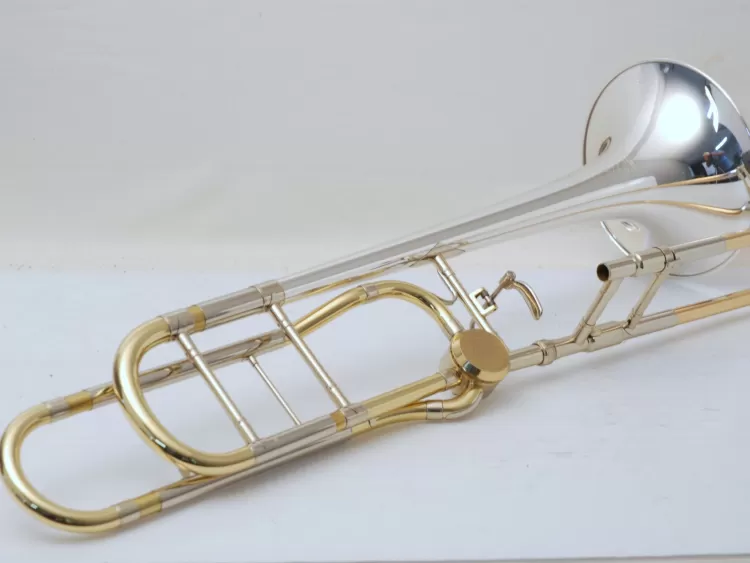
Harry, I, too, have an 88H-CL-SGX (middle, in photo), and agree that it doesn't break up when you lean on it.
<ATTACHMENT filename="trombone stable.jpg" index="0">[attachment=0]trombone stable.jpg</ATTACHMENT>
<ATTACHMENT filename="trombone stable.jpg" index="0">
- harrisonreed
- Posts: 6479
- Joined: Aug 17, 2018
It's so heavy though, isn't it? I get why Lindberg switched to it ∆, and I like it, but I think I prefer normal brass on large tenor
I'd be REALLY curious to try an unsoldered version of the SGX bell, though. I think Conn's move to solder the bead, for all their horns, might have made it *too* locked in.
∆ I saw a double trombone concerto he did, and the other guy playing him was basically inaudible, where Lindberg sounded like he was next to you (but not "loud").
I'd be REALLY curious to try an unsoldered version of the SGX bell, though. I think Conn's move to solder the bead, for all their horns, might have made it *too* locked in.
∆ I saw a double trombone concerto he did, and the other guy playing him was basically inaudible, where Lindberg sounded like he was next to you (but not "loud").
- NotSkilledHere
- Posts: 190
- Joined: Aug 07, 2024
I think it may depend on manufacturer but in general dark and solid core with fewer/minimal overtones and cutting as Harrison mentioned is the trend across the board. I have found that it takes slightly more air or more effort to play, not in a way that will make you much more exhausted playing it but just something you will notice. the same way perhaps that you might notice the water fountain at school being colder than another water fountain. Silver is a denser and heavier metal after all. But it also as Harrison pointed out, will happily take more blowing than a comparable brass equivalent, to the point where the one playing might be the only one who thinks they are overblowing.
- harrisonreed
- Posts: 6479
- Joined: Aug 17, 2018
I like it on my 3B because it will mask up "not light" playing that you might need to do in order to play technically demanding stuff. Again I'm not surprised that Lindberg switched to one right around the time he was having 200+ solo gigs with large orchestras per year.
That said you can always just put tape or suede around the throat of the bell and get some of the same benefits.
That said you can always just put tape or suede around the throat of the bell and get some of the same benefits.
- Leanit
- Posts: 160
- Joined: Sep 04, 2018
I spent about 10 years on a Cleveland era 2B SilverSonic. There were times when it rang like a bell, but almost always under pressure. Sweet? Not really. Flexible? Not that much. You could push it and it would hold together to the moon, but I'm not somebody who shreds. I found it hard to play in a flexible range of dynamics and color.
I asked my great mentor about my battles with the King SS. He said, "Tommy Dorsey was King's boy. He put them on the f**king map as a trombone maker. They would make him anything he wanted to play. Guess what ... he played f**king brass."
Traded it, and my life is easier.
I asked my great mentor about my battles with the King SS. He said, "Tommy Dorsey was King's boy. He put them on the f**king map as a trombone maker. They would make him anything he wanted to play. Guess what ... he played f**king brass."
Traded it, and my life is easier.
- elmsandr
- Posts: 1373
- Joined: Mar 23, 2018
Just to note that discussions of the various sheet Sterling bells here do not apply to the electroformed Bach Sterling flares. Different animals that share a part of a name.
Cheers,
Andy
Cheers,
Andy
- hyperbolica
- Posts: 3990
- Joined: Mar 23, 2018
[quote="elmsandr"]Just to note that discussions of the various sheet Sterling bells here do not apply to the electroformed Bach Sterling flares. Different animals that share a part of a name.
Cheers,
Andy[/quote]
How would you electroform Sterling? Sterling is an alloy, and plating is for pure metals. Are you just referring to electroformed silver?
Cheers,
Andy[/quote]
How would you electroform Sterling? Sterling is an alloy, and plating is for pure metals. Are you just referring to electroformed silver?
- NotSkilledHere
- Posts: 190
- Joined: Aug 07, 2024
[quote="hyperbolica"]<QUOTE author="elmsandr" post_id="268172" time="1740492052" user_id="147">
Just to note that discussions of the various sheet Sterling bells here do not apply to the electroformed Bach Sterling flares. Different animals that share a part of a name.
Cheers,
Andy[/quote]
How would you electroform Sterling? Sterling is an alloy, and plating is for pure metals. Are you just referring to electroformed silver?
</QUOTE>
it's bad marketing on Bach's part. They made Sterling Silver Plus bells which is 99.9% silver basically pure silver bells that are electroformed.
before that they did make Sterling Silver bells which were from sheet sterling silver, but those are much rarer.
Just to note that discussions of the various sheet Sterling bells here do not apply to the electroformed Bach Sterling flares. Different animals that share a part of a name.
Cheers,
Andy[/quote]
How would you electroform Sterling? Sterling is an alloy, and plating is for pure metals. Are you just referring to electroformed silver?
</QUOTE>
it's bad marketing on Bach's part. They made Sterling Silver Plus bells which is 99.9% silver basically pure silver bells that are electroformed.
before that they did make Sterling Silver bells which were from sheet sterling silver, but those are much rarer.
- octavposaune
- Posts: 160
- Joined: Jul 04, 2018
Hi all, I love sterling bells and own a few. What bells do I normally use? On tenors almost all yellow brass, on bass gold and rose brass currently.
Here are some practical things I have noticed.
Bach electroformed 36/42 bells vary a lot. Its bizarre because the only mechanical forming used is the bell wire fold over on the end of the flaie. IMO early sterling plus bells are darker sounding. I think this darker sound is due to heavier guage metal (electroformed for longer).
In regards to guage thickness of sterling bells and the tonal effects and player feedback here are my thoughts:
UMI produced sheet metal bells, which includes 1970s to end of Eastlake OH made King and Conn sterling bells. These bells are heavy guage. Very thick metal. This heavy guage makes them handle massive volume IMO, I don't think its just the material. Heavy guage bells also give players less feedback. I had a UMI 10" silver 62H bell that I had a hard time hearing myself. It was directionally loud, but sideways sound was hard to hear, I had to play everything down a dynamic or two from what I thought it should be.
I have a Shires 10" sterling bass bell and it is the polar opposite of my former UMI bell. It's as thin as possible and player feedback is much better. The tone can absolutely break up if pushed. I believe that some of the thoughts of Americans on Sterling bells are from the heavy guage King and later Conn bells.
What do I think Silver bells do better than brass? They are more volume efficient and have the most immediate articulation response. So, louder for air put in and no bloom in sounds when tonguing.
Why do I not play my sterling bells more often in performance? Someone also mentioned they don't blend, and I sort of agree. In a big band situation, a silver belled bass works great, in an orchestra with players using brass bells the balance could/can be out of balance, but less so with my Shires as the feedback is clearer. I bought a fixer upper 1485 King to turn into a possible custom big tenor along with my 42. I envisioned maybe kitting out an entire section sometime. You know for loud works, but it hasn't been a priority and so far is a pipe dream.
Anyways,
Thoughts of a trombone hoarder,
Benn
Here are some practical things I have noticed.
Bach electroformed 36/42 bells vary a lot. Its bizarre because the only mechanical forming used is the bell wire fold over on the end of the flaie. IMO early sterling plus bells are darker sounding. I think this darker sound is due to heavier guage metal (electroformed for longer).
In regards to guage thickness of sterling bells and the tonal effects and player feedback here are my thoughts:
UMI produced sheet metal bells, which includes 1970s to end of Eastlake OH made King and Conn sterling bells. These bells are heavy guage. Very thick metal. This heavy guage makes them handle massive volume IMO, I don't think its just the material. Heavy guage bells also give players less feedback. I had a UMI 10" silver 62H bell that I had a hard time hearing myself. It was directionally loud, but sideways sound was hard to hear, I had to play everything down a dynamic or two from what I thought it should be.
I have a Shires 10" sterling bass bell and it is the polar opposite of my former UMI bell. It's as thin as possible and player feedback is much better. The tone can absolutely break up if pushed. I believe that some of the thoughts of Americans on Sterling bells are from the heavy guage King and later Conn bells.
What do I think Silver bells do better than brass? They are more volume efficient and have the most immediate articulation response. So, louder for air put in and no bloom in sounds when tonguing.
Why do I not play my sterling bells more often in performance? Someone also mentioned they don't blend, and I sort of agree. In a big band situation, a silver belled bass works great, in an orchestra with players using brass bells the balance could/can be out of balance, but less so with my Shires as the feedback is clearer. I bought a fixer upper 1485 King to turn into a possible custom big tenor along with my 42. I envisioned maybe kitting out an entire section sometime. You know for loud works, but it hasn't been a priority and so far is a pipe dream.
Anyways,
Thoughts of a trombone hoarder,
Benn
- muschem
- Posts: 372
- Joined: Jan 17, 2021
[quote="octavposaune"]I have a Shires 10" sterling bass bell and it is the polar opposite of my formee UMI bell. It's as thin as possible and player feedback is much better. The tone can absolutely break up if pushed. I believe that some of the thoughts of Americans on Sterling bells are from the heavy guage King and later Conn bells.[/quote]
This description captures how I feel about my Shires sterling bells - much more player feedback and easier blending compared to the sterling bells I've tried from other makes.
This description captures how I feel about my Shires sterling bells - much more player feedback and easier blending compared to the sterling bells I've tried from other makes.
- harrisonreed
- Posts: 6479
- Joined: Aug 17, 2018
I do have to say that I like the silver bell 3B more AFTER removing the thick lacquer from the bell. I also had a scratch finish put on which thinned it a bit. It has a lot more "zing", but still can take all the volume you want to put in it.
- hyperbolica
- Posts: 3990
- Joined: Mar 23, 2018
Silver has a very wide range of hardness. Electroforming should produce something dead soft, and would thus emphasize the lower overtones. A worked bell would tend toward higher overtones. Heat treat/anneal also has big effect on hardness.
- elmsandr
- Posts: 1373
- Joined: Mar 23, 2018
[quote="hyperbolica"]Silver has a very wide range of hardness. Electroforming should produce something dead soft, and would thus emphasize the lower overtones. A worked bell would tend toward higher overtones. Heat treat/anneal also has big effect on hardness.[/quote]
The Bach Sterling plus bells are hilariously soft. The one I had…. Let’s just say that using a mute was a non starter on that for me. Bell wrinkled just due to basic handling.
Cheers,
Andy
The Bach Sterling plus bells are hilariously soft. The one I had…. Let’s just say that using a mute was a non starter on that for me. Bell wrinkled just due to basic handling.
Cheers,
Andy
- RJMason
- Posts: 390
- Joined: Jun 05, 2018
Most players just end up back on brass. Roy Lawler told me he likes brass. Steve Shires told me he likes brass. There are always exceptions, but besides a smokin 2B or 3B SS, most are gonna want to play brass.
Always wanted an early Bach sterling horn. The first ones were actually sheet brass, but they quickly moved to sterling plus electro formed. But the couple colleagues I have that owned sterling bachs ended up going back to brass and the horn has been sold or sits in the case waiting for a special occasion.
Still wish I had a 3BSS in the stable for fun, but they are too expensive now and often in iffy condition.
Always wanted an early Bach sterling horn. The first ones were actually sheet brass, but they quickly moved to sterling plus electro formed. But the couple colleagues I have that owned sterling bachs ended up going back to brass and the horn has been sold or sits in the case waiting for a special occasion.
Still wish I had a 3BSS in the stable for fun, but they are too expensive now and often in iffy condition.
- harrisonreed
- Posts: 6479
- Joined: Aug 17, 2018
I mean, going from one variation of Bach to another is just what Bach players do. They think it will somehow eventually be better, but... I wouldn't take someone eventually settling on a brass Bach to mean anything other than that they just stopped the search, but couldn't give up on the idea of needing to play Bach.
Ah, there's the door now!
Ah, there's the door now!
- Digidog
- Posts: 483
- Joined: Dec 13, 2018
[quote="harrisonreed"]I mean, going from one variation of Bach to another is just what Bach players do. They think it will somehow eventually be better, but... I wouldn't take someone eventually settling on a brass Bach to mean anything other than that they just stopped the search, but couldn't give up on the idea of needing to play Bach.
Ah, there's the door now![/quote]
:lol: :lol: Sad but true! I would more think of it as: "Ah, maybe this door will work this time?"
On topic: I love playing SS horns. I can't pinpoint what it is that suits me, but the slightly firmer slotting, the sense of a core to the blow (and maybe also to the tone), and of having the margins for really pushing the horn without loosing cohesion in the airflow - especially at the fringes of the blow, where one sometimes can feel the resonance of the horn and the room and other, simultaneous sources of sound.
Owning a SS small bore and bass, I have never owned a SS alto - but that is on my to do list!
Ah, there's the door now![/quote]
:lol: :lol: Sad but true! I would more think of it as: "Ah, maybe this door will work this time?"
On topic: I love playing SS horns. I can't pinpoint what it is that suits me, but the slightly firmer slotting, the sense of a core to the blow (and maybe also to the tone), and of having the margins for really pushing the horn without loosing cohesion in the airflow - especially at the fringes of the blow, where one sometimes can feel the resonance of the horn and the room and other, simultaneous sources of sound.
Owning a SS small bore and bass, I have never owned a SS alto - but that is on my to do list!
- tbdana
- Posts: 1928
- Joined: Apr 08, 2023
My experience with my Conn 88H-CL-SGX was that, at first, I found it difficult to make the horn speak at very low volume. I think that was the thickness of the bell. I guess I've adjusted to it.
On the other end, I found I can lean on the horn very hard and it won't break up and still has a gorgeous sound.
The only actual problem I've come across with my sterling silver horn is human prejudice. Orchestral humans taking one look at it and declaring things like, "It won't blend in a section," or "good solo horn, but not for orchestral work," or "maybe for principal, but not for second," and my favorite, "you'll never win an audition with that horn, it's too unlike what everyone else plays and they are looking for conformity." Of course, none of that turns out to be true, except, perhaps, for the last one.
On the other end, I found I can lean on the horn very hard and it won't break up and still has a gorgeous sound.
The only actual problem I've come across with my sterling silver horn is human prejudice. Orchestral humans taking one look at it and declaring things like, "It won't blend in a section," or "good solo horn, but not for orchestral work," or "maybe for principal, but not for second," and my favorite, "you'll never win an audition with that horn, it's too unlike what everyone else plays and they are looking for conformity." Of course, none of that turns out to be true, except, perhaps, for the last one.
- Burgerbob
- Posts: 6327
- Joined: Apr 23, 2018
Hmmm... there's more than prejudice. I have a friend that played an 88HCLSGX throughout college and after. Great player, he now plays 2nd in a major orchestra (that plays Conns!). He doesn't play the sterling 88 anymore, because 1. it doesn't blend as well 2. it doesn't work on 2nd nearly as well as principal.
- tbdana
- Posts: 1928
- Joined: Apr 08, 2023
[quote="Burgerbob"]Hmmm... there's more than prejudice. I have a friend that played an 88HCLSGX throughout college and after. Great player, he now plays 2nd in a major orchestra (that plays Conns!). He doesn't play the sterling 88 anymore, because 1. it doesn't blend as well 2. it doesn't work on 2nd nearly as well as principal.[/quote]
I wonder.
To me, it's all in how you play it.
Also, in a blind test I'll bet people couldn't tell whether I was playing the SGX or a brass 88H.
But okay.
I wonder.
To me, it's all in how you play it.
Also, in a blind test I'll bet people couldn't tell whether I was playing the SGX or a brass 88H.
But okay.
- Burgerbob
- Posts: 6327
- Joined: Apr 23, 2018
It's also worth saying that this orchestra used to play the sterling horns as a section, but no longer.
- Posaunus
- Posts: 5018
- Joined: Mar 23, 2018
May I ask which orchestra has an all-Conn (ex-Sterling silver) trombone section?
I'd love to hear a trombone-heavy concert!
I'd love to hear a trombone-heavy concert!