Earl Williams Model 10
- HawaiiTromboneGuy
- Posts: 1025
- Joined: Sep 03, 2018
The horn originally belonged to Karl DeKarske. John Noxon ended up buying the horn from his wife after his passing, and then sold it to me around 2008. John Noxon had John Sandhagen over at The Boneyard work his magic on the horn. Here is an email I received from John Sandhagen way back when I inquired about what all he had done to the horn.
“Hi Drew,
John found most of the bits needed like the male/female slide tenons, slide crook, hand slide braces. Mr DeKarske had a hacksaw and wasn't afraid to use it....
I fashioned the F lever, made a new brace tube receiver, got new Conn tubes, and put it all together. I gave John a Bach 50 short leadpipe...similar to what was in Bob Olson's Williams
What had happened to it was (besides the hacksaw) the Williams receiver was replaced with a Conn...so you could use a Conn slide and so with a shorter receiver you could use a Conn F lever. This also took over an inch out of the horn...probably was sharp and not much tuning slide available.
I went with everything Williams that I could...Conn Slide tubes...I think the reason that people put the Conn levers on was the ergonomics...I tried to make it similar to a Williams, but adjustable and easier on the hand.”
Mahalo.
[URL=http://s2.photobucket.com/user/01accord/media/F8FE1EDE-8123-491B-A2E7-94BE9C1E5BD2_zpsac007h18.jpeg.html]
[URL=http://s2.photobucket.com/user/01accord/media/235C5768-0B28-4C18-92C2-F3AED4CA64FD_zps6ouoafsz.jpeg.html]
[URL=http://s2.photobucket.com/user/01accord/media/A19249A1-D7B8-426C-A4B3-58E9E5500ACD_zps6jsqug2v.jpeg.html]
[URL=http://s2.photobucket.com/user/01accord/media/562DC8DC-308B-41DA-BFCD-27D3237F7FCF_zpsk8plfdds.jpeg.html]
[URL=http://s2.photobucket.com/user/01accord/media/506A4A49-6C20-4755-A40D-A7594FE96240_zps1zrilptv.jpeg.html]
[URL=http://s2.photobucket.com/user/01accord/media/33285F39-B303-48AE-9EB9-3A2D1AC18A50_zpsz60bzdfh.jpeg.html]
[URL=http://s2.photobucket.com/user/01accord/media/2A8D7A29-EE63-4126-BE30-61AD1ED8543F_zps7ewhevbw.jpeg.html]
[URL=http://s2.photobucket.com/user/01accord/media/6B6A3F70-809B-459C-AFC2-EFEB16AB75CE_zps260gbk9s.jpeg.html]
[URL=http://s2.photobucket.com/user/01accord/media/0F8A4592-FA5A-4DEF-8BEA-26F748124126_zpsbi3xt7ds.jpeg.html]
[URL=http://s2.photobucket.com/user/01accord/media/54192544-3B24-484C-B608-96CD07E8DB74_zpsnwm4wb8v.jpeg.html]
[URL=http://s2.photobucket.com/user/01accord/media/E862CD46-D04C-4DFB-8CC7-77BEE0464BCB_zpsk4eulg27.jpeg.html]
[URL=http://s2.photobucket.com/user/01accord/media/B0642F13-B05B-450E-B7D8-015494C86E2E_zpsk1h95pmk.jpeg.html]
[URL=http://s2.photobucket.com/user/01accord/media/1040A65D-DDEF-4495-ABFA-6759D5188208_zpsuqha9yhp.jpeg.html]
[URL=http://s2.photobucket.com/user/01accord/media/929CB986-AD9C-42F8-B650-05C035A54C41_zps5fhtfhx1.jpeg.html]
[URL=http://s2.photobucket.com/user/01accord/media/2DEF25AD-CEDE-4F77-81A2-8EDFDBBE8546_zpss3wbrhti.jpeg.html]
[URL=http://s2.photobucket.com/user/01accord/media/3473D6FB-9E64-4A6F-90B1-B9A18C661687_zpstql0oboh.jpeg.html]
[URL=http://s2.photobucket.com/user/01accord/media/0CA0C859-F5DC-4949-B60E-C2FB0DFEA5FB_zpsbbiiloms.jpeg.html]
“Hi Drew,
John found most of the bits needed like the male/female slide tenons, slide crook, hand slide braces. Mr DeKarske had a hacksaw and wasn't afraid to use it....
I fashioned the F lever, made a new brace tube receiver, got new Conn tubes, and put it all together. I gave John a Bach 50 short leadpipe...similar to what was in Bob Olson's Williams
What had happened to it was (besides the hacksaw) the Williams receiver was replaced with a Conn...so you could use a Conn slide and so with a shorter receiver you could use a Conn F lever. This also took over an inch out of the horn...probably was sharp and not much tuning slide available.
I went with everything Williams that I could...Conn Slide tubes...I think the reason that people put the Conn levers on was the ergonomics...I tried to make it similar to a Williams, but adjustable and easier on the hand.”
Mahalo.


- Tbarh
- Posts: 505
- Joined: Aug 16, 2018
Incredibly interesting horn.. :good:
Wish I could afford.. :idk:
Can i ask, why are You selling?
Trond
Wish I could afford.. :idk:
Can i ask, why are You selling?
Trond
- HawaiiTromboneGuy
- Posts: 1025
- Joined: Sep 03, 2018
[quote="Tbarh"]Incredibly interesting horn.. :good:
Wish I could afford.. :idk:
Can i ask, why are You selling?
Trond[/quote]
No reason in particular. I don’t play it as much as it should be played. Most of my playing is done on a silver sonic duo gravis.
Wish I could afford.. :idk:
Can i ask, why are You selling?
Trond[/quote]
No reason in particular. I don’t play it as much as it should be played. Most of my playing is done on a silver sonic duo gravis.
- Leanit
- Posts: 160
- Joined: Sep 04, 2018
Nice to see one on the market, and that adapted valve section looks quite nice. Good luck on the sale!
- HawaiiTromboneGuy
- Posts: 1025
- Joined: Sep 03, 2018
[quote="Leanit"]Nice to see one on the market, and that adapted valve section looks quite nice. Good luck on the sale![/quote]
Thanks!<EMOJI seq="1f919-1f3fb" tseq="1f919-1f3fb">🤙🏻</EMOJI>
Thanks!<EMOJI seq="1f919-1f3fb" tseq="1f919-1f3fb">🤙🏻</EMOJI>
- blast
- Posts: 671
- Joined: Mar 22, 2018
[quote="Leanit"]Nice to see one on the market, and that adapted valve section looks quite nice. Good luck on the sale![/quote]
Adapted? That's a stock Holton valve section. As it cannot be secured at the gooseneck, I would wonder if it is the original valve. Does not detract from the basic horn.... in fact you could replace it with a double section without losing sleep. I would love to try it, but thankfully that is not possible.
Must be a nice Duo Gravis :twisted:
Chris
Adapted? That's a stock Holton valve section. As it cannot be secured at the gooseneck, I would wonder if it is the original valve. Does not detract from the basic horn.... in fact you could replace it with a double section without losing sleep. I would love to try it, but thankfully that is not possible.
Must be a nice Duo Gravis :twisted:
Chris
- mrdeacon
- Posts: 1225
- Joined: May 08, 2018
OP if you don't mind me asking a question...
Can you tell if that's an Earl made bell or is it one of his juju magic 72H bells?
Can you tell how wide the throat is on the horn? Is it smaller like a 7XH series horn or is it wider like a 62H or Bach 50B... or EVEN wider like on a Fuchs or a couple of one-off Minick bells?
Can you tell if that's an Earl made bell or is it one of his juju magic 72H bells?
Can you tell how wide the throat is on the horn? Is it smaller like a 7XH series horn or is it wider like a 62H or Bach 50B... or EVEN wider like on a Fuchs or a couple of one-off Minick bells?
- mrdeacon
- Posts: 1225
- Joined: May 08, 2018
Oh! And is it a wide or narrow slide?
Actually wouldn't be too hard to make a horn similar to this... Have a A+ tech like Sandhagen or Eric Edwards chop up a 70H with a single bore slide or get a 72H, source a J bend and lighten and trim the handslide...
Of course it wouldn't be the same as Earl's work or be a piece of history like that horn!
Actually wouldn't be too hard to make a horn similar to this... Have a A+ tech like Sandhagen or Eric Edwards chop up a 70H with a single bore slide or get a 72H, source a J bend and lighten and trim the handslide...
Of course it wouldn't be the same as Earl's work or be a piece of history like that horn!
- Leanit
- Posts: 160
- Joined: Sep 04, 2018
[quote="blast"]<QUOTE author="Leanit" post_id="78654" time="1550624371" user_id="3703">
Nice to see one on the market, and that adapted valve section looks quite nice. Good luck on the sale![/quote]
Adapted? That's a stock Holton valve section.
</QUOTE>
Yes, he adapted a non-Williams F-section to the Williams 10 chassis. It looks like a well-crafted modification, enabling this horn to be usable. If you don't have all the parts, do the best you can.
Nice to see one on the market, and that adapted valve section looks quite nice. Good luck on the sale![/quote]
Adapted? That's a stock Holton valve section.
</QUOTE>
Yes, he adapted a non-Williams F-section to the Williams 10 chassis. It looks like a well-crafted modification, enabling this horn to be usable. If you don't have all the parts, do the best you can.
- HawaiiTromboneGuy
- Posts: 1025
- Joined: Sep 03, 2018
Hi all, I may be wrong, but I believe this is the original valve section that came with the horn. Earl’s earlier Model 10s had this style of wrap while his later 10s had the famous pigtail wrap. Again, I’m not 100% sure, but it’s what I was told.
As for the bell, yes, it is a raw Conn bell that Earl got and worked his magic on. In the Williams thread on the old forum, I believe all of the Model 10 bells were raw Conn bells that Earl did his magic on.
The flare on this bell is definitely big. I do have a Fuchs, but it’s currently in the hands of Benn in Washington state.
Hopefully John N. or John S. will chime in if they see this post.
As for the bell, yes, it is a raw Conn bell that Earl got and worked his magic on. In the Williams thread on the old forum, I believe all of the Model 10 bells were raw Conn bells that Earl did his magic on.
The flare on this bell is definitely big. I do have a Fuchs, but it’s currently in the hands of Benn in Washington state.
Hopefully John N. or John S. will chime in if they see this post.
- mrdeacon
- Posts: 1225
- Joined: May 08, 2018
[quote="HawaiiTromboneGuy"]Hi all, I may be wrong, but I believe this is the original valve section that came with the horn. Earl’s earlier Model 10s had this style of wrap while his later 10s had the famous pigtail wrap. Again, I’m not 100% sure, but it’s what I was told.
As for the bell, yes, it is a raw Conn bell that Earl got and worked his magic on. In the Williams thread on the old forum, I believe all of the Model 10 bells were raw Conn bells that Earl did his magic on.
The flare on this bell is definitely big. I do have a Fuchs, but it’s currently in the hands of Benn in Washington state.
Hopefully John N. or John S. will chime in if they see this post.[/quote]
Cool! Thanks for the info! I really am tempted to buy a 70H and have someone make something similar... haha. A Boy can dream.
I'll ask John what he remembers when I see him on Monday! I'll post an update after talking to him.
As for the bell, yes, it is a raw Conn bell that Earl got and worked his magic on. In the Williams thread on the old forum, I believe all of the Model 10 bells were raw Conn bells that Earl did his magic on.
The flare on this bell is definitely big. I do have a Fuchs, but it’s currently in the hands of Benn in Washington state.
Hopefully John N. or John S. will chime in if they see this post.[/quote]
Cool! Thanks for the info! I really am tempted to buy a 70H and have someone make something similar... haha. A Boy can dream.
I'll ask John what he remembers when I see him on Monday! I'll post an update after talking to him.
- HawaiiTromboneGuy
- Posts: 1025
- Joined: Sep 03, 2018
[quote="mrdeacon"]<QUOTE author="HawaiiTromboneGuy" post_id="78746" time="1550692542" user_id="3695">
Hi all, I may be wrong, but I believe this is the original valve section that came with the horn. Earl’s earlier Model 10s had this style of wrap while his later 10s had the famous pigtail wrap. Again, I’m not 100% sure, but it’s what I was told.
As for the bell, yes, it is a raw Conn bell that Earl got and worked his magic on. In the Williams thread on the old forum, I believe all of the Model 10 bells were raw Conn bells that Earl did his magic on.
The flare on this bell is definitely big. I do have a Fuchs, but it’s currently in the hands of Benn in Washington state.
Hopefully John N. or John S. will chime in if they see this post.[/quote]
Cool! Thanks for the info! I really am tempted to buy a 70H and have someone make something similar... haha. A Boy can dream.
I'll ask John what he remembers when I see him on Monday! I'll post an update after talking to him.
</QUOTE>
No problem. Definitely post up what you learn from John as I’m curious as well.
While digging through some old emails with John Noxon, I stumbled across this one from Sept. 2009.
“Correct. The model 10’s were Conn to begin with. Earl bought 72H bell blanks and then fashioned them into something resembling a Fuchs bell. Huge wide throat mainly. The early originals were a straight 72H “F” attachment, then he went to the pigtail wrap like the 9 for the last 7 built. I will send you some pictures of both types.”
Hi all, I may be wrong, but I believe this is the original valve section that came with the horn. Earl’s earlier Model 10s had this style of wrap while his later 10s had the famous pigtail wrap. Again, I’m not 100% sure, but it’s what I was told.
As for the bell, yes, it is a raw Conn bell that Earl got and worked his magic on. In the Williams thread on the old forum, I believe all of the Model 10 bells were raw Conn bells that Earl did his magic on.
The flare on this bell is definitely big. I do have a Fuchs, but it’s currently in the hands of Benn in Washington state.
Hopefully John N. or John S. will chime in if they see this post.[/quote]
Cool! Thanks for the info! I really am tempted to buy a 70H and have someone make something similar... haha. A Boy can dream.
I'll ask John what he remembers when I see him on Monday! I'll post an update after talking to him.
</QUOTE>
No problem. Definitely post up what you learn from John as I’m curious as well.
While digging through some old emails with John Noxon, I stumbled across this one from Sept. 2009.
“Correct. The model 10’s were Conn to begin with. Earl bought 72H bell blanks and then fashioned them into something resembling a Fuchs bell. Huge wide throat mainly. The early originals were a straight 72H “F” attachment, then he went to the pigtail wrap like the 9 for the last 7 built. I will send you some pictures of both types.”
- mrdeacon
- Posts: 1225
- Joined: May 08, 2018
Wow.... Groovy! Didn't even know you could stretch out a bell like that!
If any other techs or knowledgable people stumble on this thread... How would you alter the throat of a bell like that?
If any other techs or knowledgable people stumble on this thread... How would you alter the throat of a bell like that?
- TheBoneRanger
- Posts: 225
- Joined: Apr 04, 2018
[quote="HawaiiTromboneGuy"]
While digging through some old emails with John Noxon, I stumbled across this one from Sept. 2009.
“Correct. The model 10’s were Conn to begin with. Earl bought 72H bell blanks and then fashioned them into something resembling a Fuchs bell. Huge wide throat mainly.”[/quote]
Surely that's not possible?
Andrew
While digging through some old emails with John Noxon, I stumbled across this one from Sept. 2009.
“Correct. The model 10’s were Conn to begin with. Earl bought 72H bell blanks and then fashioned them into something resembling a Fuchs bell. Huge wide throat mainly.”[/quote]
Surely that's not possible?
Andrew
- paulyg
- Posts: 689
- Joined: May 17, 2018
That is possible, it's a variation on the same process that produces slide tubes (drawing). He would have essentially re-spun the bells.
- bellend
- Posts: 218
- Joined: Mar 23, 2018
As an ex bell maker I would say that is not a viable method !!!.
You would have to remove the bell wire to re spin the flare to a different contour and it would take hours and hours of annealing and re stamping down to try and make it fit the stem in the first place. In fact I'm not sure if the 60 series flare is shorter than a 70 series??
Why would you go to all that trouble any way ????
If Earl Williams had the mandrel to magically stretch a bell on to, why not just make one the right size in the first place????
I have played a Conn 62H with a Minick yellow brass bell on it and it was superb.
BellEnd
You would have to remove the bell wire to re spin the flare to a different contour and it would take hours and hours of annealing and re stamping down to try and make it fit the stem in the first place. In fact I'm not sure if the 60 series flare is shorter than a 70 series??
Why would you go to all that trouble any way ????
If Earl Williams had the mandrel to magically stretch a bell on to, why not just make one the right size in the first place????
I have played a Conn 62H with a Minick yellow brass bell on it and it was superb.
BellEnd
- paulyg
- Posts: 689
- Joined: May 17, 2018
[quote="bellend"]As an ex bell maker I would say that is not a viable method !!!.
You would have to remove the bell wire to re spin the flare to a different contour and it would take hours and hours of annealing and re stamping down to try and make it fit the stem in the first place. In fact I'm not sure if the 60 series flare is shorter than a 70 series??
Why would you go to all that trouble any way ????
If Earl Williams had the mandrel to magically stretch a bell on to, why not just make one the right size in the first place????
I have played a Conn 62H with a Minick yellow brass bell on it and it was superb.
BellEnd[/quote]
I'm getting the impression that the throat is what was being stretched, leaving the original rim and rim wire in place. In a sense, this makes a bit of sense- going from sheet metal to a bell requires more than just the mandrel. Brazing, carefully installing the rim wire, ect., where just opening up the throat can be done with some elbow grease and a lot of bells.
You would have to remove the bell wire to re spin the flare to a different contour and it would take hours and hours of annealing and re stamping down to try and make it fit the stem in the first place. In fact I'm not sure if the 60 series flare is shorter than a 70 series??
Why would you go to all that trouble any way ????
If Earl Williams had the mandrel to magically stretch a bell on to, why not just make one the right size in the first place????
I have played a Conn 62H with a Minick yellow brass bell on it and it was superb.
BellEnd[/quote]
I'm getting the impression that the throat is what was being stretched, leaving the original rim and rim wire in place. In a sense, this makes a bit of sense- going from sheet metal to a bell requires more than just the mandrel. Brazing, carefully installing the rim wire, ect., where just opening up the throat can be done with some elbow grease and a lot of bells.
- Jnoxon
- Posts: 75
- Joined: Apr 09, 2018
[quote="Leanit"]Nice to see one on the market, and that adapted valve section looks quite nice. Good luck on the sale![/quote]
Adapted Valve Section? This is a Meinlschmidt (sp) valve that Earl Williams used when this horn was made. Nothing "Adapted" nothing Holton!
Adapted Valve Section? This is a Meinlschmidt (sp) valve that Earl Williams used when this horn was made. Nothing "Adapted" nothing Holton!
- Jnoxon
- Posts: 75
- Joined: Apr 09, 2018
[quote="blast"]<QUOTE author="Leanit" post_id="78654" time="1550624371" user_id="3703">
Nice to see one on the market, and that adapted valve section looks quite nice. Good luck on the sale![/quote]
Adapted? That's a stock Holton valve section. As it cannot be secured at the gooseneck, I would wonder if it is the original valve. Does not detract from the basic horn.... in fact you could replace it with a double section without losing sleep. I would love to try it, but thankfully that is not possible.
Must be a nice Duo Gravis :twisted:
Chris
</QUOTE>
Not from any Holton horn. Its the original Meinlschmidt (sp) valve.
Nice to see one on the market, and that adapted valve section looks quite nice. Good luck on the sale![/quote]
Adapted? That's a stock Holton valve section. As it cannot be secured at the gooseneck, I would wonder if it is the original valve. Does not detract from the basic horn.... in fact you could replace it with a double section without losing sleep. I would love to try it, but thankfully that is not possible.
Must be a nice Duo Gravis :twisted:
Chris
</QUOTE>
Not from any Holton horn. Its the original Meinlschmidt (sp) valve.
- Jnoxon
- Posts: 75
- Joined: Apr 09, 2018
[quote="mrdeacon"]OP if you don't mind me asking a question...
Can you tell if that's an Earl made bell or is it one of his juju magic 72H bells?
Can you tell how wide the throat is on the horn? Is it smaller like a 7XH series horn or is it wider like a 62H or Bach 50B... or EVEN wider like on a Fuchs or a couple of one-off Minick bells?[/quote]
That is the original valve from Earl. W+Earl bought Bells from Conn. They were not finished bells the had only been seamed. Nothing els. He had his own drawing stake, and mandrill he finished the bell on. If I was to say what it resembled I would say a Fuchs. Wide dramatic flare on the horns.
Can you tell if that's an Earl made bell or is it one of his juju magic 72H bells?
Can you tell how wide the throat is on the horn? Is it smaller like a 7XH series horn or is it wider like a 62H or Bach 50B... or EVEN wider like on a Fuchs or a couple of one-off Minick bells?[/quote]
That is the original valve from Earl. W+Earl bought Bells from Conn. They were not finished bells the had only been seamed. Nothing els. He had his own drawing stake, and mandrill he finished the bell on. If I was to say what it resembled I would say a Fuchs. Wide dramatic flare on the horns.
- Jnoxon
- Posts: 75
- Joined: Apr 09, 2018
[quote="Leanit"]<QUOTE author="blast" post_id="78687" time="1550651951" user_id="52">
Adapted? That's a stock Holton valve section.[/quote]
Yes, he adapted a non-Williams F-section to the Williams 10 chassis. It looks like a well-crafted modification, enabling this horn to be usable. If you don't have all the parts, do the best you can.
</QUOTE>
This adapted is not correct. That is a Williams bell, J crook and valve. Nothing was adapted on this horn it is all original as it sits. I had a crook for the handslide, spit valve, Handgrip etc from my pile of parts..
Adapted? That's a stock Holton valve section.[/quote]
Yes, he adapted a non-Williams F-section to the Williams 10 chassis. It looks like a well-crafted modification, enabling this horn to be usable. If you don't have all the parts, do the best you can.
</QUOTE>
This adapted is not correct. That is a Williams bell, J crook and valve. Nothing was adapted on this horn it is all original as it sits. I had a crook for the handslide, spit valve, Handgrip etc from my pile of parts..
- Jnoxon
- Posts: 75
- Joined: Apr 09, 2018
[quote="mrdeacon"]Wow.... Groovy! Didn't even know you could stretch out a bell like that!
If any other techs or knowledgable people stumble on this thread... How would you alter the throat of a bell like that?[/quote]
Stretch out I don't get. The blanks had only been seamed not spun or anything else. As I stated Earl had his own Drawing stake and mandrel to spin and finish the bells.
If any other techs or knowledgable people stumble on this thread... How would you alter the throat of a bell like that?[/quote]
Stretch out I don't get. The blanks had only been seamed not spun or anything else. As I stated Earl had his own Drawing stake and mandrel to spin and finish the bells.
- Jnoxon
- Posts: 75
- Joined: Apr 09, 2018
[quote="bellend"]As an ex bell maker I would say that is not a viable method !!!.
You would have to remove the bell wire to re spin the flare to a different contour and it would take hours and hours of annealing and re stamping down to try and make it fit the stem in the first place. In fact I'm not sure if the 60 series flare is shorter than a 70 series??
Why would you go to all that trouble any way ????
If Earl Williams had the mandrel to magically stretch a bell on to, why not just make one the right size in the first place????
I have played a Conn 62H with a Minick yellow brass bell on it and it was superb.
BellEnd[/quote]
No you don't have to remove anything. They were only seamed not spun. Earl passed on Just 4th 1975 I wish I had answers to some of the things he did. This would be one of those questions?
You would have to remove the bell wire to re spin the flare to a different contour and it would take hours and hours of annealing and re stamping down to try and make it fit the stem in the first place. In fact I'm not sure if the 60 series flare is shorter than a 70 series??
Why would you go to all that trouble any way ????
If Earl Williams had the mandrel to magically stretch a bell on to, why not just make one the right size in the first place????
I have played a Conn 62H with a Minick yellow brass bell on it and it was superb.
BellEnd[/quote]
No you don't have to remove anything. They were only seamed not spun. Earl passed on Just 4th 1975 I wish I had answers to some of the things he did. This would be one of those questions?
- blast
- Posts: 671
- Joined: Mar 22, 2018
So is the main bell brace was made by Meinlschmidt too ?
Chris
Chris
- JohnL
- Posts: 2529
- Joined: Mar 23, 2018
John, would the following statement be accurate to the best of your knowledge?
Earl didn't buy bells from Conn, he bought seamed blanks, then spun them to his specs using his own tooling and added the bead, etc. to make a finished bell.
Earl didn't buy bells from Conn, he bought seamed blanks, then spun them to his specs using his own tooling and added the bead, etc. to make a finished bell.
- Jnoxon
- Posts: 75
- Joined: Apr 09, 2018
I hope this clears up some of the bad info in this thread. I bought the horn from Karl's wife. She wanted to get it out of his hands. He wanted a shorter lead pipe so he took a hacksaw and cut off part of the cork barrel. and some other minor mischief ha been done to the horn, I had 99% of the parts to put it back together. So that what John Sandhagen did for me. Slide Crook was replaced and was the spitvalve, hand grip, receiver male and female sides were replace, as were the slide tubes. Yes the slide tubes are Conn. Only thing we could find that would fit the horn.If anyone has questions and is serious about b buying tho from Drew Let me know! I would be happy to help with that.
- Jnoxon
- Posts: 75
- Joined: Apr 09, 2018
[quote="blast"]So is the main bell brace was made by Meinlschmidt too ?
Chris[/quote]
No just the Valve. He used Meinlschmidt on most of the "F" attachment horns he made.
Chris[/quote]
No just the Valve. He used Meinlschmidt on most of the "F" attachment horns he made.
- Jnoxon
- Posts: 75
- Joined: Apr 09, 2018
[quote="JohnL"]John, would the following statement be accurate to the best of your knowledge?
Earl didn't buy bells from Conn, he bought seamed blanks, then spun them to his specs using his own tooling and added the bead, etc. to make a finished bell.[/quote]
Yes that is the idea here, This thread got way out in the weeds, not sure how that happened.......
Earl didn't buy bells from Conn, he bought seamed blanks, then spun them to his specs using his own tooling and added the bead, etc. to make a finished bell.[/quote]
Yes that is the idea here, This thread got way out in the weeds, not sure how that happened.......
- JohnL
- Posts: 2529
- Joined: Mar 23, 2018
[quote="Jnoxon"]...and some other minor mischief ha been done to the horn[/quote]
:biggrin:
I remember seeing that horn before you and Sandhagen tag-teamed it. Old Karl had some, um, interesting ideas. Minor mischief, indeed. IIRC, John essentially built a complete new slide using your Williams parts and Conn tubes. When I saw the close-to-finished product, I didn't realize at first that it was the same horn.
:biggrin:
I remember seeing that horn before you and Sandhagen tag-teamed it. Old Karl had some, um, interesting ideas. Minor mischief, indeed. IIRC, John essentially built a complete new slide using your Williams parts and Conn tubes. When I saw the close-to-finished product, I didn't realize at first that it was the same horn.
- Jnoxon
- Posts: 75
- Joined: Apr 09, 2018
John Sandhagen did some absolutely fantastic work on that horn. It was in pretty bad shape when I got it. Then bringing it back to Bones West after it was done a few people played it thought it was a different horn!
I feel privileged to have owned two of those horns at the same time, for a couple of years. They were the icing on the cake so to speak of the collection of Williams I have.
I feel privileged to have owned two of those horns at the same time, for a couple of years. They were the icing on the cake so to speak of the collection of Williams I have.
- Jnoxon
- Posts: 75
- Joined: Apr 09, 2018
[quote="TheBoneRanger"]<QUOTE author="HawaiiTromboneGuy" post_id="78750" time="1550694132" user_id="3695">
While digging through some old emails with John Noxon, I stumbled across this one from Sept. 2009.
“Correct. The model 10’s were Conn to begin with. Earl bought 72H bell blanks and then fashioned them into something resembling a Fuchs bell. Huge wide throat mainly.”[/quote]
Surely that's not possible?
Andrew
</QUOTE>
Why would that not be possible? The bells Earl got were Seamed blanks nothing more. He had his own drawing stake and mandrel to spin the on? So what's not possible?
While digging through some old emails with John Noxon, I stumbled across this one from Sept. 2009.
“Correct. The model 10’s were Conn to begin with. Earl bought 72H bell blanks and then fashioned them into something resembling a Fuchs bell. Huge wide throat mainly.”[/quote]
Surely that's not possible?
Andrew
</QUOTE>
Why would that not be possible? The bells Earl got were Seamed blanks nothing more. He had his own drawing stake and mandrel to spin the on? So what's not possible?
- Tbarh
- Posts: 505
- Joined: Aug 16, 2018
Has anyone compared a Williams 10 bell to a Conn 62H or a Bach 50 bell throat.? . Something tells me i have asked this question before but i keep getting conflicting answer.. And... I get the impression that the Fuchs bells are bigger than the rest, while other say that both the early Bach 50 and Conn 62H are copied from the Fuchs.. I hope i get wiser this time around..
Trond (Who think that the Williams are bigger if only by the huge taper in the J bend/tuning slide)
Trond (Who think that the Williams are bigger if only by the huge taper in the J bend/tuning slide)
- Jnoxon
- Posts: 75
- Joined: Apr 09, 2018
It is the dramatic flare and the size of the throat that make them unique. If comparing to anything out there that I have seen, I think it would be close to the old Conn Fuchs.
- bellend
- Posts: 218
- Joined: Mar 23, 2018
Hi again, what your saying about un spun blanks would be possible , but given your assertion that he had all the tooling seems a very long winded process, far easier to make it from scratch.
I have never seen a yellow brass 62H/Fuch's ( I think they are one and the same) bell ( Other than the Minick I mentioned earlier which was I think one piece) so may be that was the reason???
Now, I should make it clear I am in no way trying to cast any doubt on the originality of this horn, but Earl Williams was clearly buying parts in for some of the model 10's before he went to the pig tale wrap and like many before and after he used what was obtainable at the time. I am making this clear as........
I would completely concur with Blast in saying There can be no doubt that the valve wrap is from a Holton either 169 or 185 just like the one in the second picture.
The first image is another pre pig tale model 10 but this time with a Conn wrap probably 72H.
The Conn one has been soldered at the top to the underside of the stem, were as the Holton has used a small stay exactly as used on the 169/185.
The radius on the large bend coming out of the rotor on the Williams in this thread is the tighter Holton one as opposed to the Conn wrap in the first picture which results in the vertical width being smaller , hence the little stay.
Also if you compere the stays on the long tuning slide pull there are two on the Holton and One on the Conn and there are small ferrules at the end of the outer legs....... Holton!
As for the rotors? I again I would be very surprised if they were not also Holton and Conn respectively but obviously can not say for sure with out examining them.
Again I stress this is not meant as a criticism!! I think both horns are original but have clearly be built using different manufacturers valve wraps and as I said most likely the respective rotors.
Maybe these were the prototypes :idk: and Earl was trialing different wraps and valves before he went to the effort and expense of tooling up to make his own version, I guess we'll never know.
The biggest shame to me is that the original leadpipe is not present.
I would love to have a blow on this but alas being poor and 6000 mile away that ain't gonna happen any time soon.
BellEnd
I have never seen a yellow brass 62H/Fuch's ( I think they are one and the same) bell ( Other than the Minick I mentioned earlier which was I think one piece) so may be that was the reason???
Now, I should make it clear I am in no way trying to cast any doubt on the originality of this horn, but Earl Williams was clearly buying parts in for some of the model 10's before he went to the pig tale wrap and like many before and after he used what was obtainable at the time. I am making this clear as........
I would completely concur with Blast in saying There can be no doubt that the valve wrap is from a Holton either 169 or 185 just like the one in the second picture.
The first image is another pre pig tale model 10 but this time with a Conn wrap probably 72H.
The Conn one has been soldered at the top to the underside of the stem, were as the Holton has used a small stay exactly as used on the 169/185.
The radius on the large bend coming out of the rotor on the Williams in this thread is the tighter Holton one as opposed to the Conn wrap in the first picture which results in the vertical width being smaller , hence the little stay.
Also if you compere the stays on the long tuning slide pull there are two on the Holton and One on the Conn and there are small ferrules at the end of the outer legs....... Holton!
As for the rotors? I again I would be very surprised if they were not also Holton and Conn respectively but obviously can not say for sure with out examining them.
Again I stress this is not meant as a criticism!! I think both horns are original but have clearly be built using different manufacturers valve wraps and as I said most likely the respective rotors.
Maybe these were the prototypes :idk: and Earl was trialing different wraps and valves before he went to the effort and expense of tooling up to make his own version, I guess we'll never know.
The biggest shame to me is that the original leadpipe is not present.
I would love to have a blow on this but alas being poor and 6000 mile away that ain't gonna happen any time soon.
BellEnd
- bellend
- Posts: 218
- Joined: Mar 23, 2018
Don't know why this didn't appear in above post Model 10 with Conn wrap.
BellEnd
BellEnd
- bellend
- Posts: 218
- Joined: Mar 23, 2018
Just as an aside whilst hunting out the pictures for my above post found this image of the templates used to make the Conn bass trombone bell mandrels, I think I lifted it from Steve Dillon's site years ago. Interesting if your an anorak like me........
BellEnd
BellEnd
- Leanit
- Posts: 160
- Joined: Sep 04, 2018
[quote="Jnoxon"]<QUOTE author="Leanit" post_id="78654" time="1550624371" user_id="3703">
Nice to see one on the market, and that adapted valve section looks quite nice. Good luck on the sale![/quote]
Adapted Valve Section? This is a Meinlschmidt (sp) valve that Earl Williams used when this horn was made. Nothing "Adapted" nothing Holton!
</QUOTE>
I stand very, very corrected. I thought all the 10's had the curly F routing. Thanks for the info.
I meant no put-down to the seller!
Nice to see one on the market, and that adapted valve section looks quite nice. Good luck on the sale![/quote]
Adapted Valve Section? This is a Meinlschmidt (sp) valve that Earl Williams used when this horn was made. Nothing "Adapted" nothing Holton!
</QUOTE>
I stand very, very corrected. I thought all the 10's had the curly F routing. Thanks for the info.
I meant no put-down to the seller!
- Tbarh
- Posts: 505
- Joined: Aug 16, 2018
I know that the Holton 169 came around 1960, right? When did Earl introduce the pigtail wrap.?..
Trond
Trond
- Jnoxon
- Posts: 75
- Joined: Apr 09, 2018
I do believe everyone is entitled to their opinion. If you want to say its a Holton valve whatever. Earl made a total of 13 model 10 horns. He used the Conn seamed bell blanks for his convenience I would guess! But we will never know. He and Larry Minick used a multitude of Conn parts. Why reinvent the wheel if you don't have to. Earl used the Meinlschmidt valves on 90% of what he made. There are some other horns of his that show who he was working for at the time. Drew also own a Bass Trumpet Earl built that is clearly and F E Olds derivative. I think a lot of the bass bones were all kind of one of's. I got the impression he was not dedicated to bass bones like he was to the Tenors he made.
Noah Gladstone has a Bass Bone from the early 1930's that he made that is clearly Olds. Earl also made a few trumpets (Bb) some had a Conn look some an Olds look to them. I have not found any where that Earl ever used a Holton part on his horns. Conn was willing to supply he and Larry so they both used those parts routinely.
The first 7 model 10's were the Conn style wrap. Then he went to the pigtail wrap for the last 6. I recently sold my 10 which was a XXX1 serial number. I knew the original owner and that horn was built in 1958. The las of the basses was around 1962. So they did not have a very long history at all.
I wish I had asked a lot more questions of Earl. But you never got a warm fuzzy feeling from him. It was all business not very much open to that line of communication. He was a very nice guy but hies trombone knowledge was his and his alone. He had a lot of interests in life. He built and patented some gunsmith tooling, was a bow and arrow guy. He was passionate about those things. there was a huge age difference between us also.
I think it was amazing how far word of his horns traveled in that day and time. I've gotten calls from England, France, Germany, Sweden, Norway, New Zealand, Italy, Czech Republic, Russia about his horns. He had a dealer in Malmo! All word of mouth no internet or anything like we have today. There are still things he did in the manufacturing process we have no idea why it was done. I think he was pretty far ahead of his time. He was the first "Boutique" horn maker as far as I can find. I have him making custom horns in 1923. The next I found was Dominic Calicchio started his trumpet business in 1928.
If you want to learn some more about Williams check out this website. I have picture of advertising and a multitude of things about Earl on it. www.jnoxon.com.
Noah Gladstone has a Bass Bone from the early 1930's that he made that is clearly Olds. Earl also made a few trumpets (Bb) some had a Conn look some an Olds look to them. I have not found any where that Earl ever used a Holton part on his horns. Conn was willing to supply he and Larry so they both used those parts routinely.
The first 7 model 10's were the Conn style wrap. Then he went to the pigtail wrap for the last 6. I recently sold my 10 which was a XXX1 serial number. I knew the original owner and that horn was built in 1958. The las of the basses was around 1962. So they did not have a very long history at all.
I wish I had asked a lot more questions of Earl. But you never got a warm fuzzy feeling from him. It was all business not very much open to that line of communication. He was a very nice guy but hies trombone knowledge was his and his alone. He had a lot of interests in life. He built and patented some gunsmith tooling, was a bow and arrow guy. He was passionate about those things. there was a huge age difference between us also.
I think it was amazing how far word of his horns traveled in that day and time. I've gotten calls from England, France, Germany, Sweden, Norway, New Zealand, Italy, Czech Republic, Russia about his horns. He had a dealer in Malmo! All word of mouth no internet or anything like we have today. There are still things he did in the manufacturing process we have no idea why it was done. I think he was pretty far ahead of his time. He was the first "Boutique" horn maker as far as I can find. I have him making custom horns in 1923. The next I found was Dominic Calicchio started his trumpet business in 1928.
If you want to learn some more about Williams check out this website. I have picture of advertising and a multitude of things about Earl on it. www.jnoxon.com.
- ngrinder
- Posts: 294
- Joined: Apr 24, 2018
Thanks so much for sharing all of this info on Earl, John. Very informative and illuminating to read everything! Great stuff.
- bellend
- Posts: 218
- Joined: Mar 23, 2018
Actually, if you'd taken the trouble to read my post properly you would have seen I never said it was a Holton valve, I just said it could be.
However, what I said about the wrap being from a Holton is not an opinion....... it is a simple fact!
Any tech worth his salt who works customizing trombones of this era would know this at a glance, in fact now I've looked again I would be very surprised if the main bell stay is not also a Holton part.
Your very emphatic statement in a earlier post "Adapted Valve Section? This is a Meinlschmidt (sp) valve that Earl Williams used when this horn was made. Nothing "Adapted" nothing Holton!" is just plain wrong .
So...... either you don't really know what you're talking about , or for some reason are trying to deliberately mislead people.
What Ever.....
BellEnd
However, what I said about the wrap being from a Holton is not an opinion....... it is a simple fact!
Any tech worth his salt who works customizing trombones of this era would know this at a glance, in fact now I've looked again I would be very surprised if the main bell stay is not also a Holton part.
Your very emphatic statement in a earlier post "Adapted Valve Section? This is a Meinlschmidt (sp) valve that Earl Williams used when this horn was made. Nothing "Adapted" nothing Holton!" is just plain wrong .
So...... either you don't really know what you're talking about , or for some reason are trying to deliberately mislead people.
What Ever.....
BellEnd
- mrdeacon
- Posts: 1225
- Joined: May 08, 2018
[quote="bellend"]Don't know why this didn't appear in above post Model 10 with Conn wrap.
BellEnd[/quote]
For what it's worth the horn bellend posted in this picture 100% has a Conn valve with Conn wrap and Conn linkage and trigger.
I don't think it's out of the realm of possibility that these first 7 Williams 10s probably did not use meinlschimdt valves.
Hard to tell from OPs post but it looks like it could be a pre Leblanc Holton valve but honestly it's impossible to tell without handling the horn or getting a dozen more pictures.
Unless if Earl bored out the valves or something like that, which Minick did on a number of bases, it doesn't matter too much what the valve is anyways.
Anyways... This thread has turned out to be a wealth of information!!! I'm excited to see if anything more comes out of it!
BellEnd[/quote]
For what it's worth the horn bellend posted in this picture 100% has a Conn valve with Conn wrap and Conn linkage and trigger.
I don't think it's out of the realm of possibility that these first 7 Williams 10s probably did not use meinlschimdt valves.
Hard to tell from OPs post but it looks like it could be a pre Leblanc Holton valve but honestly it's impossible to tell without handling the horn or getting a dozen more pictures.
Unless if Earl bored out the valves or something like that, which Minick did on a number of bases, it doesn't matter too much what the valve is anyways.
Anyways... This thread has turned out to be a wealth of information!!! I'm excited to see if anything more comes out of it!
- mrdeacon
- Posts: 1225
- Joined: May 08, 2018
Does anyone know what type of pipe Earl might have originally put in the horn? Did he ever produce his own pipes?
In that same post I quoted previously it almost looks like Earl straight up just used a stock 7Xh slide!
I know Minick originally had a tighter pipe in my horn which is in a similar style to Ops horn.
In that same post I quoted previously it almost looks like Earl straight up just used a stock 7Xh slide!
I know Minick originally had a tighter pipe in my horn which is in a similar style to Ops horn.
- HawaiiTromboneGuy
- Posts: 1025
- Joined: Sep 03, 2018
If anyone wants, I don’t mind providing more photos of any specific area they might want to see. Also, I should be getting my Fuchs back within the next two weeks or so. I will provide some side by side comparisons.
- blast
- Posts: 671
- Joined: Mar 22, 2018
Just a piece of information that has been out there in the past.... between the wars, Conn bought in German rotor valves.... why ? because they were top quality and dirt cheap I suppose. Any proof ? yep.... I have 'Conn' rotors that are stamped 'made in Germany' . Being written in English these were obviously for export to English speaking countries. Williams may well have bought some himself, or have bought German rotors from Conn, knowing they were such. He could have quite honestly told people that he used Meinlschmidt rotors.... with the start of WW 2 Conn may well have almost given away enemy valves !! Perhaps he got a great deal.
As to this model 10, I would love to see close-ups of the rotor outside, the faceplate and the core.... it might settle it, or might not. Holton rotors from that period were fantastic quality and whatever the valve, I am sure it is is a special trombone.
Chris
As to this model 10, I would love to see close-ups of the rotor outside, the faceplate and the core.... it might settle it, or might not. Holton rotors from that period were fantastic quality and whatever the valve, I am sure it is is a special trombone.
Chris
- Tbarh
- Posts: 505
- Joined: Aug 16, 2018
In any case, i guess its a Great horn.. How is the slide action?... An idea is to have an extra Tuning slide made with a 2nd valve attachment....
- greenbean
- Posts: 1958
- Joined: Mar 23, 2018
It seems Jnoxon was talking about the valve not being Holton, and BellEnd was talking about the valve wrap clearing being Holton.
So.. the valve was a Meinlschmidt and the wrap was Holton. Yes? Thank for clarifying...
So.. the valve was a Meinlschmidt and the wrap was Holton. Yes? Thank for clarifying...
- Jnoxon
- Posts: 75
- Joined: Apr 09, 2018
[quote="blast"]Just a piece of information that has been out there in the past.... between the wars, Conn bought in German rotor valves.... why ? because they were top quality and dirt cheap I suppose. Any proof ? yep.... I have 'Conn' rotors that are stamped 'made in Germany' . Being written in English these were obviously for export to English speaking countries. Williams may well have bought some himself, or have bought German rotors from Conn, knowing they were such. He could have quite honestly told people that he used Meinlschmidt rotors.... with the start of WW 2 Conn may well have almost given away enemy valves !! Perhaps he got a great deal.
As to this model 10, I would love to see close-ups of the rotor outside, the faceplate and the core.... it might settle it, or might not. Holton rotors from that period were fantastic quality and whatever the valve, I am sure it is is a special trombone.
Chris[/quote]
That is very interesting observation Chris. Thanks!
As to this model 10, I would love to see close-ups of the rotor outside, the faceplate and the core.... it might settle it, or might not. Holton rotors from that period were fantastic quality and whatever the valve, I am sure it is is a special trombone.
Chris[/quote]
That is very interesting observation Chris. Thanks!
- Jnoxon
- Posts: 75
- Joined: Apr 09, 2018
[quote="greenbean"]It seems Jnoxon was talking about the valve not being Holton, and BellEnd was talking about the valve wrap clearing being Holton.
So.. the valve was a Meinlschmidt and the wrap was Holton. Yes? Thank for clarifying...[/quote]
The valve was Meinlschmidt and the wrap is very similar to the Conn not Holton.
So.. the valve was a Meinlschmidt and the wrap was Holton. Yes? Thank for clarifying...[/quote]
The valve was Meinlschmidt and the wrap is very similar to the Conn not Holton.
- mrdeacon
- Posts: 1225
- Joined: May 08, 2018
[quote="Jnoxon"]<QUOTE author="greenbean" post_id="79083" time="1551027553" user_id="150">
It seems Jnoxon was talking about the valve not being Holton, and BellEnd was talking about the valve wrap clearing being Holton.
So.. the valve was a Meinlschmidt and the wrap was Holton. Yes? Thank for clarifying...[/quote]
The valve was Meinlschmidt and the wrap is very similar to the Conn not Holton.
</QUOTE>
Things are getting confusing now that we have pictures of two Williams 10s in the thread haha.
OPs horn clearly has a Holton wrap while the second horn posted is from a Conn 70h or 72h.
Also, something interesting to bring up is that means some Williams 10s have different bores going through the valve attachment tubing. That's kind of neat!
It seems Jnoxon was talking about the valve not being Holton, and BellEnd was talking about the valve wrap clearing being Holton.
So.. the valve was a Meinlschmidt and the wrap was Holton. Yes? Thank for clarifying...[/quote]
The valve was Meinlschmidt and the wrap is very similar to the Conn not Holton.
</QUOTE>
Things are getting confusing now that we have pictures of two Williams 10s in the thread haha.
OPs horn clearly has a Holton wrap while the second horn posted is from a Conn 70h or 72h.
Also, something interesting to bring up is that means some Williams 10s have different bores going through the valve attachment tubing. That's kind of neat!
- Jnoxon
- Posts: 75
- Joined: Apr 09, 2018
[quote="bellend"]Actually, if you'd taken the trouble to read my post properly you would have seen I never said it was a Holton valve, I just said it could be.
However, what I said about the wrap being from a Holton is not an opinion....... it is a simple fact!
Any tech worth his salt who works customizing trombones of this era would know this at a glance, in fact now I've looked again I would be very surprised if the main bell stay is not also a Holton part.
Your very emphatic statement in a earlier post "Adapted Valve Section? This is a Meinlschmidt (sp) valve that Earl Williams used when this horn was made. Nothing "Adapted" nothing Holton!" is just plain wrong .
So...... either you don't really know what you're talking about , or for some reason are trying to deliberately mislead people.
What Ever.....
BellEnd[/quote]
I have been around Williams horns all of my life. It was a phenomenal experience to be around that shop. I learned a whole lot about trombones. I was not there when this horn was made. But I spent the better part of 2 years hanging around and working to pay off about 1/2 of my first model 6. I have owned probable well over 50 Williams horns over the years. From the Wallace era to the end of Earls life. I know that Earl and Larry Minick used many Conn parts. Earl had a great relationship with Conn and F E Olds. If you think its a Holton valve and wrap whatever you entitled to your opinion. I never saw anything from Holton in the shop or have I seen it on any horn I've owned. So I guess I amazingly stupid and don't know anything about them and I do delight in lying to people about Williams Horns....... Just saying! You are entitled to you opinion!
However, what I said about the wrap being from a Holton is not an opinion....... it is a simple fact!
Any tech worth his salt who works customizing trombones of this era would know this at a glance, in fact now I've looked again I would be very surprised if the main bell stay is not also a Holton part.
Your very emphatic statement in a earlier post "Adapted Valve Section? This is a Meinlschmidt (sp) valve that Earl Williams used when this horn was made. Nothing "Adapted" nothing Holton!" is just plain wrong .
So...... either you don't really know what you're talking about , or for some reason are trying to deliberately mislead people.
What Ever.....
BellEnd[/quote]
I have been around Williams horns all of my life. It was a phenomenal experience to be around that shop. I learned a whole lot about trombones. I was not there when this horn was made. But I spent the better part of 2 years hanging around and working to pay off about 1/2 of my first model 6. I have owned probable well over 50 Williams horns over the years. From the Wallace era to the end of Earls life. I know that Earl and Larry Minick used many Conn parts. Earl had a great relationship with Conn and F E Olds. If you think its a Holton valve and wrap whatever you entitled to your opinion. I never saw anything from Holton in the shop or have I seen it on any horn I've owned. So I guess I amazingly stupid and don't know anything about them and I do delight in lying to people about Williams Horns....... Just saying! You are entitled to you opinion!
- Tbarh
- Posts: 505
- Joined: Aug 16, 2018
Could it be so simple that the Holton wrap has been added at a later point and subsequently is not the original one?.... I am sitting here with a Holton E185 as we speak and i find the wrap to be totally identical from what i can see from the pictures..
Trond
Trond
- nopos
- Posts: 25
- Joined: Feb 25, 2019
My main bass is a Holton 169, and both valve and wrap look identical to the Williams. I remember reading on another forum that DeKarske for some time in the mid 60's played a Holton 169. Williams may not originally have sourced or used Holton parts, but since DeKarske had access to the Holton parts on his own, maybe he had the Williams custom modified at a later time?
Alf
Alf
- blast
- Posts: 671
- Joined: Mar 22, 2018
I am of the same opinion as the last posters. DeKarske most likely put, or had fitted, a Holton valve wrap. I doubt it left Williams like that and I especially doubt that Williams put a Holton main bell brace (or stay as we call it over here) on, for that is unquestionably what it is.
John, nobody doubts your honesty or expertise on this thread, it's just that many of us know Holtons inside out and see what we see. With the history of the horn it is not a big leap to arrive at the replacement theory.
I have a modern 62H with indy valves made up from Conn parts by Larry Minick.... he died before that model came out and I built the valves into that horn.... after I am gone, someone might claim it is an early prototype that Larry built.... that would be fundamentally wrong, but it could look like that to some young player in 20 years time.... I'd better leave a card in the case.
One of my frankenbones came up on eBay a while back,totally wrongly described. I got in touch with the seller telling exactly what he was selling, but he refused to believe me. He got less for the horn than just the Shires valve section was worth.... sad, but you can only try. Lots of odd things happen to trombones over the years and we can often not be totally sure what have. One thing is sure, with a restoration by the two Johns, this horn will play very well whatever it contains.
Chris
John, nobody doubts your honesty or expertise on this thread, it's just that many of us know Holtons inside out and see what we see. With the history of the horn it is not a big leap to arrive at the replacement theory.
I have a modern 62H with indy valves made up from Conn parts by Larry Minick.... he died before that model came out and I built the valves into that horn.... after I am gone, someone might claim it is an early prototype that Larry built.... that would be fundamentally wrong, but it could look like that to some young player in 20 years time.... I'd better leave a card in the case.
One of my frankenbones came up on eBay a while back,totally wrongly described. I got in touch with the seller telling exactly what he was selling, but he refused to believe me. He got less for the horn than just the Shires valve section was worth.... sad, but you can only try. Lots of odd things happen to trombones over the years and we can often not be totally sure what have. One thing is sure, with a restoration by the two Johns, this horn will play very well whatever it contains.
Chris
- JackSchatz
- Posts: 28
- Joined: Sep 06, 2018
I have played two Williams bass trombones in my life. Both were single valve horns that were all original. Both had a stock Conn 70H bass trombone valve and wrap. Both bells had 10" bell flares. The horn for sale looks like a 9 1/2in. two piece bell flare. The Williams Bass Trombones I played were like no other horn I have ever played. The sound was teutonic. I was really impressed by the instrument. I have been playing Holton 169 and 185's for over 30 years and if I am not mistaken that is a stock 185 or 169 rotor and valve section. From the wrap to the bracing, valve cap, bumper plate and screw. It's all Holton. When I talked to Larry Minick about Earl Williams, he couldn't say enough about him. He felt that Williams knew more than anyone else about building horns. I don't recall if the Williams bass trombones I played had one or two piece bells, but they definitely had 10" bell flares.
- bellend
- Posts: 218
- Joined: Mar 23, 2018
"So I guess I amazingly stupid and don't know anything about them "
In this instance .... YES!
I would be the first to concede I'm no expert on Willams horns as we don't see many this side of the pond but I have many years experience working along side the UK's most well know trombone maker / customizer and know what I'm saying here is correct.
How many more people here have to tell you?? it's a Holton wrap.
Here's another 10 ( at least that's what it was listed as) that has certainly been altered since it left the maestro's hands
BellEnd
In this instance .... YES!
I would be the first to concede I'm no expert on Willams horns as we don't see many this side of the pond but I have many years experience working along side the UK's most well know trombone maker / customizer and know what I'm saying here is correct.
How many more people here have to tell you?? it's a Holton wrap.
Here's another 10 ( at least that's what it was listed as) that has certainly been altered since it left the maestro's hands
BellEnd
- Leanit
- Posts: 160
- Joined: Sep 04, 2018
With a Model 10 for sale on this site, it spawned a lot of interesting conversation. I thank John Noxon for his fascinating first-person insights as the keeper of the Williams flame. It seems strange to have piled all that info on the seller's ad posting, so I thought I'd lob up a few pictures of a Williams 10 valve here.
- Leanit
- Posts: 160
- Joined: Sep 04, 2018
<ATTACHMENT filename="IMG_5938.jpg" index="0">[attachment=0]IMG_5938.jpg</ATTACHMENT>
- Leanit
- Posts: 160
- Joined: Sep 04, 2018
This isn't the one for sale. Different horn, with the "later" wrap style that was part of the conversation on the listing.
- Leanit
- Posts: 160
- Joined: Sep 04, 2018
More...
<ATTACHMENT filename="IMG_5935.jpg" index="2">[attachment=2]IMG_5935.jpg</ATTACHMENT>
<ATTACHMENT filename="IMG_5935.jpg" index="2">
- Leanit
- Posts: 160
- Joined: Sep 04, 2018
<ATTACHMENT filename="IMG_5936.jpg" index="0">[attachment=0]IMG_5936.jpg</ATTACHMENT>
- Leanit
- Posts: 160
- Joined: Sep 04, 2018
<ATTACHMENT filename="IMG_5938.jpg" index="0">[attachment=0]IMG_5938.jpg</ATTACHMENT>
- bellend
- Posts: 218
- Joined: Mar 23, 2018
Thanks for posting these!
Always very intersting to see the work of the great man.
Any chance you could post a couple of pics of the whole horn?
Also, how does it blow?
Any comparisons you could make to other makes Or not???
Thanks
BellEnd
Always very intersting to see the work of the great man.
Any chance you could post a couple of pics of the whole horn?
Also, how does it blow?
Any comparisons you could make to other makes Or not???
Thanks
BellEnd
- Tbarh
- Posts: 505
- Joined: Aug 16, 2018
Everytime i hear about someone talking about having tried a Williams gives me the impression that it is something really special.. Allthough Earl 's expertise is lost, the design of the horn should be possible to copy(except maybe the bell flare?)... I for one would be interested.. Ray Premru was very attached to his 169 but said that the best horn he ever tried was a 10... That should mean something..
- Tbarh
- Posts: 505
- Joined: Aug 16, 2018
Btw, Bellend.. Where did that horn end up?.. I remember having talks with the owner before he decided to sell.. If only i knew he was considering selling it... And had the dough... :-(
- Leanit
- Posts: 160
- Joined: Sep 04, 2018
I find it a beautiful horn to play. Very flexible up and down the range. Decidedly not stuffy. Slide in great condition. Very short throw on that trigger. I'll grab more pics of the assembled instrument later on. I don't have a lot of bass experience to compare it to other horns.
- HawaiiTromboneGuy
- Posts: 1025
- Joined: Sep 03, 2018
Hot damn that’s a beautiful horn! <EMOJI seq="1f60d" tseq="1f60d">😍</EMOJI><EMOJI seq="1f60d" tseq="1f60d">😍</EMOJI>
- HawaiiTromboneGuy
- Posts: 1025
- Joined: Sep 03, 2018
[quote="Tbarh"]Btw, Bellend.. Where did that horn end up?.. I remember having talks with the owner before he decided to sell.. If only i knew he was considering selling it... And had the dough... :-([/quote]
It was listed on eBay and sold. No idea who got it.
It was listed on eBay and sold. No idea who got it.
- HawaiiTromboneGuy
- Posts: 1025
- Joined: Sep 03, 2018
[quote="JackSchatz"]I have played two Williams bass trombones in my life. Both were single valve horns that were all original. Both had a stock Conn 70H bass trombone valve and wrap. Both bells had 10" bell flares. The horn for sale looks like a 9 1/2in. two piece bell flare. The Williams Bass Trombones I played were like no other horn I have ever played. The sound was teutonic. I was really impressed by the instrument. I have been playing Holton 169 and 185's for over 30 years and if I am not mistaken that is a stock 185 or 169 rotor and valve section. From the wrap to the bracing, valve cap, bumper plate and screw. It's all Holton. When I talked to Larry Minick about Earl Williams, he couldn't say enough about him. He felt that Williams knew more than anyone else about building horns. I don't recall if the Williams bass trombones I played had one or two piece bells, but they definitely had 10" bell flares.[/quote]
Correct. The horn has a 9.5” bell.
Correct. The horn has a 9.5” bell.
- HawaiiTromboneGuy
- Posts: 1025
- Joined: Sep 03, 2018
Hi all,
After all this new discussion/ life to this thread, I have decided to hold on to the horn. Reading all these posts has really sparked my enthusiasm again and I would like to learn as much as possible regarding the basses Earl made, especially with this one. With that being said, I’d like to thank everyone who has contributed their incredible insight and knowledge regarding these horns. It’s all greatly appreciated and I look forward to continuing the discussion with all of you.
If possible, could a mod please combine this thread with the newly made Williams 10 thread in the instruments section? I think it would be a great wealth of info to combine the two.
Mahalo,
Drew
After all this new discussion/ life to this thread, I have decided to hold on to the horn. Reading all these posts has really sparked my enthusiasm again and I would like to learn as much as possible regarding the basses Earl made, especially with this one. With that being said, I’d like to thank everyone who has contributed their incredible insight and knowledge regarding these horns. It’s all greatly appreciated and I look forward to continuing the discussion with all of you.
If possible, could a mod please combine this thread with the newly made Williams 10 thread in the instruments section? I think it would be a great wealth of info to combine the two.
Mahalo,
Drew
- Tbarh
- Posts: 505
- Joined: Aug 16, 2018
Anyone have information of the leadpipe ? Big /open ,or ofset tighter to compliment the wide taper? As i said in the other thread: it should be made as a replica for more players to enjoy !
Trond
Trond
- mrdeacon
- Posts: 1225
- Joined: May 08, 2018
Could one of the mods fix the thread cut? The threads got a bit jumbled...
- Leanit
- Posts: 160
- Joined: Sep 04, 2018
One of the things I like about Earl's work is that he did things differently -- often because it was better, but nearly as often ... because he could.
The trigger return spring isn't a rotary spring. It's not a coil. In fact, it isn't a spring at all. It's a slender metal bar, like a toothpick. One end is fixed to the chassis, and the other to the moving arm of the actuator. When you throw the valve, it twists this little rod. Let go, and the torsion returns it to position. I love the simple madness.
<ATTACHMENT filename="IMG_5939.jpg" index="0">[attachment=0]IMG_5939.jpg</ATTACHMENT>
In that picture, your thumb rests on the little white ball and pushes it forward to actuate the valve. The lever turns a shaft inside that little brass tube to which it is attached. The outer end of that tube holds the torsion bar in a fixed position while the valve end of the bar twists with the action of the rotor arm, providing about a 70-degree flex on it. Just the right amount of tension to the touch, and it snaps right back when released.
The trigger return spring isn't a rotary spring. It's not a coil. In fact, it isn't a spring at all. It's a slender metal bar, like a toothpick. One end is fixed to the chassis, and the other to the moving arm of the actuator. When you throw the valve, it twists this little rod. Let go, and the torsion returns it to position. I love the simple madness.
<ATTACHMENT filename="IMG_5939.jpg" index="0">
In that picture, your thumb rests on the little white ball and pushes it forward to actuate the valve. The lever turns a shaft inside that little brass tube to which it is attached. The outer end of that tube holds the torsion bar in a fixed position while the valve end of the bar twists with the action of the rotor arm, providing about a 70-degree flex on it. Just the right amount of tension to the touch, and it snaps right back when released.
- paulyg
- Posts: 689
- Joined: May 17, 2018
Torsion bars! For a long time, MOPAR used torsion bar suspension on their cars (50's-70's), and these had a reputation for handling much better than leaf-sprung or even coil-sprung competitors.
Many armored vehicles use torsion bar suspensions.
A coil spring is just a torsion bar wrapped around itself.
Many armored vehicles use torsion bar suspensions.
A coil spring is just a torsion bar wrapped around itself.
- JohnL
- Posts: 2529
- Joined: Mar 23, 2018
[quote="paulyg"]Torsion bars! For a long time, MOPAR used torsion bar suspension on their cars (50's-70's), and these had a reputation for handling much better than leaf-sprung or even coil-sprung competitors.[/quote]
They were also adjustable. Loved that old '71 Barracuda.
They were also adjustable. Loved that old '71 Barracuda.
- Leanit
- Posts: 160
- Joined: Sep 04, 2018
Signature curved grip and fluted slide brace.
<ATTACHMENT filename="IMG_5940.JPG" index="0">[attachment=0]IMG_5940.JPG</ATTACHMENT>
<ATTACHMENT filename="IMG_5940.JPG" index="0">
- Leanit
- Posts: 160
- Joined: Sep 04, 2018
Wacky curved water key, guaranteed not to snag on a mic cord.
<ATTACHMENT filename="IMG_5942.jpg" index="0">[attachment=0]IMG_5942.jpg</ATTACHMENT>
<ATTACHMENT filename="IMG_5942.jpg" index="0">
- Leanit
- Posts: 160
- Joined: Sep 04, 2018
The whole.
<ATTACHMENT filename="IMG_5944.jpg" index="0">[attachment=0]IMG_5944.jpg</ATTACHMENT>
<ATTACHMENT filename="IMG_5944.jpg" index="0">
- shider
- Posts: 69
- Joined: Apr 30, 2018
Wow! i have never seen such a valve mechanism! That's really interesting!
- CharlieB
- Posts: 434
- Joined: Mar 29, 2018
My great-grandfather had a vintage trombone; a great old axe.
When he died, my grandfather inherited the horn, replaced the slide, and played it for many more years before passing it down my father, who replaced the damaged bell. The horn has passed to me now. I have replaced the old tuning slide and the leadpipe. I can't express feeling of joy I get from knowing that I am playing my great-grandfather's axe.
When he died, my grandfather inherited the horn, replaced the slide, and played it for many more years before passing it down my father, who replaced the damaged bell. The horn has passed to me now. I have replaced the old tuning slide and the leadpipe. I can't express feeling of joy I get from knowing that I am playing my great-grandfather's axe.
- JohnL
- Posts: 2529
- Joined: Mar 23, 2018
[quote="Tbarh"]Everytime i hear about someone talking about having tried a Williams gives me the impression that it is something really special.. Allthough Earl 's expertise is lost, the design of the horn should be possible to copy(except maybe the bell flare?)... I for one would be interested.. Ray Premru was very attached to his 169 but said that the best horn he ever tried was a 10... That should mean something..[/quote]
Dimensions can be copied; in fact, some of Earl's tooling is still around (not sure if the 10 tooling is among it). If you're willing to spend enough money, you could even duplicate the chemistry of the brass Earl used. But duplicating Earl's process?
People have been trying to duplicate Earl's work for decades. Some of them have produced some very nice horns that play quite well - but they're not quite the same.
Dimensions can be copied; in fact, some of Earl's tooling is still around (not sure if the 10 tooling is among it). If you're willing to spend enough money, you could even duplicate the chemistry of the brass Earl used. But duplicating Earl's process?
People have been trying to duplicate Earl's work for decades. Some of them have produced some very nice horns that play quite well - but they're not quite the same.
- bellend
- Posts: 218
- Joined: Mar 23, 2018
"you could even duplicate the chemistry of the brass Earl used"
And what exactly is that fabled to be?? ............... from the Harry Potter foundry ???........
Given that the largest component on the basses was actually fabricated by Conn ( bell) and on at least one so was the slide or did they use 'magic metal' as well.
Cartridge is brass is BRASS FOR CARTRIDGES........... what are modern shells made from......Cartridge brass :good:
If he bought old stock it was probably because it was cheap :horror:
Sorry to be the voice of skepticism but people get carried away with all this B.S.
Several years back I submitted the following question to The Copper Development Agency to try and establish if there was any factual evidence for the various rumors and stories that abound .
Below is the response to Case No. 167158
Your question was: Dear Sir / Madam, I am trombonist who has also been involved in the manufacture of brass instruments. Over the years have been told anecdotally on numerous occasions that the composition of Cartridge Brass changed around the period of the second world war and that instruments produced before this supposed change took place are Superior in tone to ones made after. I was wondering whether you could shed any light on this and tell me whether there actually was any change in the composition and or manufacturing process for this alloy at any point during the last century?
Yours faithfully,
A. Hutchinson
Response: Andy,
I have been involved in the US copper and brass industry for 48 years and am not aware of such a change ever being made. The deep drawing properties of Cartridge Brass is a function of the composition and the processing
in particular the penultimate anneal.
It is possible that the nominal composition 70/30 Cu/Zn was pushed to the high side for zinc in an attempt to conserve copper which was a critical metal during the war. The US penny in 1943 was minted as a zinc coated steel coin to conserve copper.
There are several histories on copper and brass, one by a note US metallurgist, Cyril Stanley Smith comes to mind. You could also check with the CDA affiliate in the UK at:
Copper Development Association
5 Grovelands Business Centre
Boundary Way
Hemel Hempstead
Herts HP2 7TE
UK
Phone: +44 (1442) 275 705
Fax +44 (1442) 275 716
E-mail: <EMAIL email="mail@copperdev.co.uk">mail@copperdev.co.uk</EMAIL>
Angela Vessey,
Director
I will continue to search for information and if I find anything I'll get back to you.
Regards,
Lou Lozano
Metallurgical Consultant, CDA
Interesting what Mr Louzano sais about the zinc content may be beeing pushed to the high side to preserve copper. However given that the tolerance range for the alloy is quite tight at:
Chemical Composition for C26000
(%max., unless shown as range or min.)
Cu Fe Pb Zn
Min./Max. 68.5-71.5 .05 .07 Rem.
Nominal 70.0 - - 30.0
Note: Cu + Sum of Named Elements, 99.7% min.
Having the zinc content at the top figure can't change the workability of the alloy too much otherwise it would have become unsuitable for it's primary purpose......making cartridges.
Just sayin'
BellEnd
And what exactly is that fabled to be?? ............... from the Harry Potter foundry ???........
Given that the largest component on the basses was actually fabricated by Conn ( bell) and on at least one so was the slide or did they use 'magic metal' as well.
Cartridge is brass is BRASS FOR CARTRIDGES........... what are modern shells made from......Cartridge brass :good:
If he bought old stock it was probably because it was cheap :horror:
Sorry to be the voice of skepticism but people get carried away with all this B.S.
Several years back I submitted the following question to The Copper Development Agency to try and establish if there was any factual evidence for the various rumors and stories that abound .
Below is the response to Case No. 167158
Your question was: Dear Sir / Madam, I am trombonist who has also been involved in the manufacture of brass instruments. Over the years have been told anecdotally on numerous occasions that the composition of Cartridge Brass changed around the period of the second world war and that instruments produced before this supposed change took place are Superior in tone to ones made after. I was wondering whether you could shed any light on this and tell me whether there actually was any change in the composition and or manufacturing process for this alloy at any point during the last century?
Yours faithfully,
A. Hutchinson
Response: Andy,
I have been involved in the US copper and brass industry for 48 years and am not aware of such a change ever being made. The deep drawing properties of Cartridge Brass is a function of the composition and the processing
in particular the penultimate anneal.
It is possible that the nominal composition 70/30 Cu/Zn was pushed to the high side for zinc in an attempt to conserve copper which was a critical metal during the war. The US penny in 1943 was minted as a zinc coated steel coin to conserve copper.
There are several histories on copper and brass, one by a note US metallurgist, Cyril Stanley Smith comes to mind. You could also check with the CDA affiliate in the UK at:
Copper Development Association
5 Grovelands Business Centre
Boundary Way
Hemel Hempstead
Herts HP2 7TE
UK
Phone: +44 (1442) 275 705
Fax +44 (1442) 275 716
E-mail: <EMAIL email="mail@copperdev.co.uk">mail@copperdev.co.uk</EMAIL>
Angela Vessey,
Director
I will continue to search for information and if I find anything I'll get back to you.
Regards,
Lou Lozano
Metallurgical Consultant, CDA
Interesting what Mr Louzano sais about the zinc content may be beeing pushed to the high side to preserve copper. However given that the tolerance range for the alloy is quite tight at:
Chemical Composition for C26000
(%max., unless shown as range or min.)
Cu Fe Pb Zn
Min./Max. 68.5-71.5 .05 .07 Rem.
Nominal 70.0 - - 30.0
Note: Cu + Sum of Named Elements, 99.7% min.
Having the zinc content at the top figure can't change the workability of the alloy too much otherwise it would have become unsuitable for it's primary purpose......making cartridges.
Just sayin'
BellEnd
- JohnL
- Posts: 2529
- Joined: Mar 23, 2018
[quote="bellend"]"you could even duplicate the chemistry of the brass Earl used"
And what exactly is that fabled to be?? ............... from the Harry Potter foundry ???........[/quote]
I included that for the people that subscribe to the "magic metal" theory (I don't). That legend has Earl buying a big batch of war surplus cartridge brass. Being war production, it supposedly had more and/or different trace elements (impurities, if you prefer) than modern, commercially-produced brass.
Even though I know first hand just how much trouble one can get into when dealing with different batches (heats) of alloy that all meet the spec (I've got a great story about drawn tube for bicycle parts and manganese content), I don't personally subscribe to the "magic metal" theory. Beyond any questions of metallurgy, there's the simple fact that Earl built horns before WWII, and they're just as awesome as the ones he built after the war.
And what exactly is that fabled to be?? ............... from the Harry Potter foundry ???........[/quote]
I included that for the people that subscribe to the "magic metal" theory (I don't). That legend has Earl buying a big batch of war surplus cartridge brass. Being war production, it supposedly had more and/or different trace elements (impurities, if you prefer) than modern, commercially-produced brass.
Even though I know first hand just how much trouble one can get into when dealing with different batches (heats) of alloy that all meet the spec (I've got a great story about drawn tube for bicycle parts and manganese content), I don't personally subscribe to the "magic metal" theory. Beyond any questions of metallurgy, there's the simple fact that Earl built horns before WWII, and they're just as awesome as the ones he built after the war.
- BGuttman
- Posts: 7368
- Joined: Mar 22, 2018
I an some X-ay Fluoescence for one of our regulars (Benn? Eric?) of samples of older tubing and newer tubing. The XRF would find trace metals down to a few tenths of a percent. There was no difference between the tubes.
Caveat: I couldn't analyze light metals so Beryllium or Aluminum would not show up.
Caveat: I couldn't analyze light metals so Beryllium or Aluminum would not show up.
- Tbarh
- Posts: 505
- Joined: Aug 16, 2018
[quote=bellend post_id=79715 time=1551727800 user_id=82]
"you could even duplicate the chemistry of the brass Earl used"
And what exactly is that fabled to be?? ............... from the Harry Potter foundry ???........
Given that the largest component on the basses was actually fabricated by Conn ( bell) and on at least one so was the slide or did they use 'magic metal' as well.
Cartridge is brass is BRASS FOR CARTRIDGES........... what are modern shells made from......Cartridge brass :good:
If he bought old stock it was probably because it was cheap :horror:
Sorry to be the voice of skepticism but people get carried away with all this B.S.
Several years back I submitted the following question to The Copper Development Agency to try and establish if there was any factual evidence for the various rumors and stories that abound .
Below is the response to Case No. 167158
Your question was: Dear Sir / Madam, I am trombonist who has also been involved in the manufacture of brass instruments. Over the years have been told anecdotally on numerous occasions that the composition of Cartridge Brass changed around the period of the second world war and that instruments produced before this supposed change took place are Superior in tone to ones made after. I was wondering whether you could shed any light on this and tell me whether there actually was any change in the composition and or manufacturing process for this alloy at any point during the last century?
Yours faithfully,
A. Hutchinson
Response: Andy,
I have been involved in the US copper and brass industry for 48 years and am not aware of such a change ever being made. The deep drawing properties of Cartridge Brass is a function of the composition and the processing
in particular the penultimate anneal.
It is possible that the nominal composition 70/30 Cu/Zn was pushed to the high side for zinc in an attempt to conserve copper which was a critical metal during the war. The US penny in 1943 was minted as a zinc coated steel coin to conserve copper.
There are several histories on copper and brass, one by a note US metallurgist, Cyril Stanley Smith comes to mind. You could also check with the CDA affiliate in the UK at:
Copper Development Association
5 Grovelands Business Centre
Boundary Way
Hemel Hempstead
Herts HP2 7TE
UK
Phone: +44 (1442) 275 705
Fax +44 (1442) 275 716
E-mail: <EMAIL email="mail@copperdev.co.uk">mail@copperdev.co.uk</EMAIL>
Angela Vessey,
Director
I will continue to search for information and if I find anything I'll get back to you.
Regards,
Lou Lozano
Metallurgical Consultant, CDA
Interesting what Mr Louzano sais about the zinc content may be beeing pushed to the high side to preserve copper. However given that the tolerance range for the alloy is quite tight at:
Chemical Composition for C26000
(%max., unless shown as range or min.)
Cu Fe Pb Zn
Min./Max. 68.5-71.5 .05 .07 Rem.
Nominal 70.0 - - 30.0
Note: Cu + Sum of Named Elements, 99.7% min.
Having the zinc content at the top figure can't change the workability of the alloy too much otherwise it would have become unsuitable for it's primary purpose......making cartridges.
Just sayin'
BellEnd
Andy!.. You are talking about cartridge brass only, but a lot of discussions about old Conn bells is about whether or not they used cartridge brass or another variant of Yellow brass.. I have heared the terms "french brass" and also "Conn brass" in similar discussions before.. All i know is that the bell of a 1934 Conn 70 H i used to own had a darker colour than the rest which looked more like standard Yellow brass (cartridge brass?).. Why would they use darker brass for the bell than the rest of the horn..?...
"you could even duplicate the chemistry of the brass Earl used"
And what exactly is that fabled to be?? ............... from the Harry Potter foundry ???........
Given that the largest component on the basses was actually fabricated by Conn ( bell) and on at least one so was the slide or did they use 'magic metal' as well.
Cartridge is brass is BRASS FOR CARTRIDGES........... what are modern shells made from......Cartridge brass :good:
If he bought old stock it was probably because it was cheap :horror:
Sorry to be the voice of skepticism but people get carried away with all this B.S.
Several years back I submitted the following question to The Copper Development Agency to try and establish if there was any factual evidence for the various rumors and stories that abound .
Below is the response to Case No. 167158
Your question was: Dear Sir / Madam, I am trombonist who has also been involved in the manufacture of brass instruments. Over the years have been told anecdotally on numerous occasions that the composition of Cartridge Brass changed around the period of the second world war and that instruments produced before this supposed change took place are Superior in tone to ones made after. I was wondering whether you could shed any light on this and tell me whether there actually was any change in the composition and or manufacturing process for this alloy at any point during the last century?
Yours faithfully,
A. Hutchinson
Response: Andy,
I have been involved in the US copper and brass industry for 48 years and am not aware of such a change ever being made. The deep drawing properties of Cartridge Brass is a function of the composition and the processing
in particular the penultimate anneal.
It is possible that the nominal composition 70/30 Cu/Zn was pushed to the high side for zinc in an attempt to conserve copper which was a critical metal during the war. The US penny in 1943 was minted as a zinc coated steel coin to conserve copper.
There are several histories on copper and brass, one by a note US metallurgist, Cyril Stanley Smith comes to mind. You could also check with the CDA affiliate in the UK at:
Copper Development Association
5 Grovelands Business Centre
Boundary Way
Hemel Hempstead
Herts HP2 7TE
UK
Phone: +44 (1442) 275 705
Fax +44 (1442) 275 716
E-mail: <EMAIL email="mail@copperdev.co.uk">mail@copperdev.co.uk</EMAIL>
Angela Vessey,
Director
I will continue to search for information and if I find anything I'll get back to you.
Regards,
Lou Lozano
Metallurgical Consultant, CDA
Interesting what Mr Louzano sais about the zinc content may be beeing pushed to the high side to preserve copper. However given that the tolerance range for the alloy is quite tight at:
Chemical Composition for C26000
(%max., unless shown as range or min.)
Cu Fe Pb Zn
Min./Max. 68.5-71.5 .05 .07 Rem.
Nominal 70.0 - - 30.0
Note: Cu + Sum of Named Elements, 99.7% min.
Having the zinc content at the top figure can't change the workability of the alloy too much otherwise it would have become unsuitable for it's primary purpose......making cartridges.
Just sayin'
BellEnd
Andy!.. You are talking about cartridge brass only, but a lot of discussions about old Conn bells is about whether or not they used cartridge brass or another variant of Yellow brass.. I have heared the terms "french brass" and also "Conn brass" in similar discussions before.. All i know is that the bell of a 1934 Conn 70 H i used to own had a darker colour than the rest which looked more like standard Yellow brass (cartridge brass?).. Why would they use darker brass for the bell than the rest of the horn..?...
- BGuttman
- Posts: 7368
- Joined: Mar 22, 2018
Conn used a lot of rose or red brass for bells. I know they used red brass on the 88Hs for a long time; probably on the basses as well.
- Tbarh
- Posts: 505
- Joined: Aug 16, 2018
I am not talking about red or gold brass.. This metal is more Brown-ish in colour.. Clearly different than both standard Yellow and Bach-style Gold brass.. The branch and valve tubing had the standard Yellow brass colour.. I am pretty certain of this..
- bellend
- Posts: 218
- Joined: Mar 23, 2018
Hi Tbarh,
I am not denying that there were maybe some alloys about that are not available today, just that cartridge brass is....... well cartridge brass.
I have seen that colour variation on an older Conn from memory a 70H ? but without actually getting some analysed it would be difficult to say for sure what it actually is.
I have made some bells from an alloy that was 80% copper 20% zinc that was designated as 'Low Brass' it could be something along those lines?
I'll have a look through my old notes and see if there's any more info.
BellEnd
I am not denying that there were maybe some alloys about that are not available today, just that cartridge brass is....... well cartridge brass.
I have seen that colour variation on an older Conn from memory a 70H ? but without actually getting some analysed it would be difficult to say for sure what it actually is.
I have made some bells from an alloy that was 80% copper 20% zinc that was designated as 'Low Brass' it could be something along those lines?
I'll have a look through my old notes and see if there's any more info.
BellEnd
- Tbarh
- Posts: 505
- Joined: Aug 16, 2018
Bellend
"Low brass" was also mentioned, yes!
Btw! Egger, the swiss periode brass instrument maker has in cooperation with Ian Bousfield among others made some replicas of old Heckel and J. C. Penzel romantic trombones and found a chinese foundry that could make the formula closest to the original.. The colour and appearance are very close to original Yellow cartridge brass.. It was apparently a very hard material to work with. I can send links if i find..
"Low brass" was also mentioned, yes!
Btw! Egger, the swiss periode brass instrument maker has in cooperation with Ian Bousfield among others made some replicas of old Heckel and J. C. Penzel romantic trombones and found a chinese foundry that could make the formula closest to the original.. The colour and appearance are very close to original Yellow cartridge brass.. It was apparently a very hard material to work with. I can send links if i find..
- bellend
- Posts: 218
- Joined: Mar 23, 2018
Hi again,
Had a quick look for my old notes but they must be in the attic somewhere as can't seem to lay my hands on them.
The Low Brass I mentioned above was being used by a company to make radiator caps for cars which is why we managed to get our hands on some.
I know we analysed a Conn outer slide leg to see what their P-27 alloy actually was and from memory found it was 85/15 gilding metal with the addition of 2% tin which would have the effect of making it much stronger. As far as I can recall the main commercial application for this alloy that was listed was for making fountain pen nibs.
The rolling mill that we used said you could have any formula of an old alloy re-made but the minimum quantity required would make it not economically viable for a small company, or a big one come to that!
FWIW
BellEnd
Had a quick look for my old notes but they must be in the attic somewhere as can't seem to lay my hands on them.
The Low Brass I mentioned above was being used by a company to make radiator caps for cars which is why we managed to get our hands on some.
I know we analysed a Conn outer slide leg to see what their P-27 alloy actually was and from memory found it was 85/15 gilding metal with the addition of 2% tin which would have the effect of making it much stronger. As far as I can recall the main commercial application for this alloy that was listed was for making fountain pen nibs.
The rolling mill that we used said you could have any formula of an old alloy re-made but the minimum quantity required would make it not economically viable for a small company, or a big one come to that!
FWIW
BellEnd
- JohnL
- Posts: 2529
- Joined: Mar 23, 2018
[quote="bellend"]The rolling mill that we used said you could have any formula of an old alloy re-made but the minimum quantity required would make it not economically viable for a small company, or a big one come to that![/quote]
Yeah, you're talking a LOT of metal in a heat.
If what you want meets a standard spec but needs to be on the high or low end of specific elements, a supplier might be willing to let you sift through the analyses of whatever they have on hand to see if any particular heat will meet your needs. That's what we finally ended up doing with that bicycle tubing; we needed the Mn to be toward the high end in order to make mechanical properties.
Yeah, you're talking a LOT of metal in a heat.
If what you want meets a standard spec but needs to be on the high or low end of specific elements, a supplier might be willing to let you sift through the analyses of whatever they have on hand to see if any particular heat will meet your needs. That's what we finally ended up doing with that bicycle tubing; we needed the Mn to be toward the high end in order to make mechanical properties.
- HawaiiTromboneGuy
- Posts: 1025
- Joined: Sep 03, 2018
[quote="Leanit"]The whole.
IMG_5944.jpg[/quote]
This is absolutely gorgeous. I sent you a PM looking for some info. Thanks!
IMG_5944.jpg[/quote]
This is absolutely gorgeous. I sent you a PM looking for some info. Thanks!
- hornbuilder
- Posts: 1384
- Joined: May 02, 2018
To piggy-back what Chris said. I was most surprised when I was overhauling my 1935 Conn 70H to find "Made in Germany" stamped on the valve knuckle. Bach was also using German valves in New York and into Mt Vernon, I believe.
- TheSheriff
- Posts: 199
- Joined: Jul 16, 2018
[quote="Leanit"]Wacky curved water key, guaranteed not to snag on a mic cord.
IMG_5942.jpg[/quote]
=====
Maybe it's been mentioned, but the rounded nickel bow means it was built by Earl's son, Bob Williams. That is my understanding. My model 6 is a Bob Williams. Love it!
-------
IMG_5942.jpg[/quote]
=====
Maybe it's been mentioned, but the rounded nickel bow means it was built by Earl's son, Bob Williams. That is my understanding. My model 6 is a Bob Williams. Love it!
-------
- HawaiiTromboneGuy
- Posts: 1025
- Joined: Sep 03, 2018
[quote="TheSheriff"]<QUOTE author="Leanit" post_id="79364" time="1551317484" user_id="3703">
Wacky curved water key, guaranteed not to snag on a mic cord.
IMG_5942.jpg[/quote]
=====
Maybe it's been mentioned, but the rounded nickel bow means it was built by Earl's son, Bob Williams. That is my understanding. My model 6 is a Bob Williams. Love it!
-------
</QUOTE>
That’s my understanding as well. Bob used the single radius tuning slides and slide crook while earl used dual radius. 1xxx horns were made by Earl while 3xxx were Bob.
Wacky curved water key, guaranteed not to snag on a mic cord.
IMG_5942.jpg[/quote]
=====
Maybe it's been mentioned, but the rounded nickel bow means it was built by Earl's son, Bob Williams. That is my understanding. My model 6 is a Bob Williams. Love it!
-------
</QUOTE>
That’s my understanding as well. Bob used the single radius tuning slides and slide crook while earl used dual radius. 1xxx horns were made by Earl while 3xxx were Bob.
- RJMason
- Posts: 390
- Joined: Jun 05, 2018
I bought one of Drew’s Williams horns almost two years ago, a model 7.
I love the instrument. I have been curious because the horn has a serial # indicating it was made by Earl, but has the Nickel slide crook characteristic of Bob’s horns.
While it also has the F Attachment, it doesn’t have the “J bend” tuning mechanism. Has a normal tuning slide with one Williams brace attached.
I wonder if it started its life as an earl made Burbank 6, and later on it was converted to a trigger horn and had the nickel crook added? There are no cosmetic signs of the modifications, it looks very clean and well done.
Also nickel doesn’t oxidize as fast as yellow brass but the crook definitely looks “newer” than the outer slide tubes which have a bit of corrosion but still perform wonderfully.
Don’t know if we will ever know, but these horns are works of art and decades ahead of their time! Would love to try a model 10 one day!
I love the instrument. I have been curious because the horn has a serial # indicating it was made by Earl, but has the Nickel slide crook characteristic of Bob’s horns.
While it also has the F Attachment, it doesn’t have the “J bend” tuning mechanism. Has a normal tuning slide with one Williams brace attached.
I wonder if it started its life as an earl made Burbank 6, and later on it was converted to a trigger horn and had the nickel crook added? There are no cosmetic signs of the modifications, it looks very clean and well done.
Also nickel doesn’t oxidize as fast as yellow brass but the crook definitely looks “newer” than the outer slide tubes which have a bit of corrosion but still perform wonderfully.
Don’t know if we will ever know, but these horns are works of art and decades ahead of their time! Would love to try a model 10 one day!
- HawaiiTromboneGuy
- Posts: 1025
- Joined: Sep 03, 2018
[quote="RJMason"]I bought one of Drew’s Williams horns almost two years ago, a model 7.
I love the instrument. I have been curious because the horn has a serial # indicating it was made by Earl, but has the Nickel slide crook characteristic of Bob’s horns.
While it also has the F Attachment, it doesn’t have the “J bend” tuning mechanism. Has a normal tuning slide with one Williams brace attached.
I wonder if it started its life as an earl made Burbank 6, and later on it was converted to a trigger horn and had the nickel crook added? There are no cosmetic signs of the modifications, it looks very clean and well done.
Also nickel doesn’t oxidize as fast as yellow brass but the crook definitely looks “newer” than the outer slide tubes which have a bit of corrosion but still perform wonderfully.
Don’t know if we will ever know, but these horns are works of art and decades ahead of their time! Would love to try a model 10 one day![/quote]
You know, I always wondered why that 7 was the way it is. I had a Bob 7 at the same time as that one and the Bob did not have that tuning slide brace. I can’t recall if the Bob 7 had a J bend or not. I wish the old forum were still available to us as I had posted quite a bit of photos of them. This is the only photo I could find from my library. The two 7s are the horns to the right of the photo.
I love the instrument. I have been curious because the horn has a serial # indicating it was made by Earl, but has the Nickel slide crook characteristic of Bob’s horns.
While it also has the F Attachment, it doesn’t have the “J bend” tuning mechanism. Has a normal tuning slide with one Williams brace attached.
I wonder if it started its life as an earl made Burbank 6, and later on it was converted to a trigger horn and had the nickel crook added? There are no cosmetic signs of the modifications, it looks very clean and well done.
Also nickel doesn’t oxidize as fast as yellow brass but the crook definitely looks “newer” than the outer slide tubes which have a bit of corrosion but still perform wonderfully.
Don’t know if we will ever know, but these horns are works of art and decades ahead of their time! Would love to try a model 10 one day![/quote]
You know, I always wondered why that 7 was the way it is. I had a Bob 7 at the same time as that one and the Bob did not have that tuning slide brace. I can’t recall if the Bob 7 had a J bend or not. I wish the old forum were still available to us as I had posted quite a bit of photos of them. This is the only photo I could find from my library. The two 7s are the horns to the right of the photo.
- HawaiiTromboneGuy
- Posts: 1025
- Joined: Sep 03, 2018
[quote="TheSheriff"]<QUOTE author="Leanit" post_id="79364" time="1551317484" user_id="3703">
Wacky curved water key, guaranteed not to snag on a mic cord.
IMG_5942.jpg[/quote]
=====
Maybe it's been mentioned, but the rounded nickel bow means it was built by Earl's son, Bob Williams. That is my understanding. My model 6 is a Bob Williams. Love it!
-------
</QUOTE>
It seems as though Leanit’s horn is definitely an Earl built 10 judging from his serial #11xx. The 7 that Ray has also has a 11xx serial # so perhaps Earl used both styles. :idk:
Wacky curved water key, guaranteed not to snag on a mic cord.
IMG_5942.jpg[/quote]
=====
Maybe it's been mentioned, but the rounded nickel bow means it was built by Earl's son, Bob Williams. That is my understanding. My model 6 is a Bob Williams. Love it!
-------
</QUOTE>
It seems as though Leanit’s horn is definitely an Earl built 10 judging from his serial #11xx. The 7 that Ray has also has a 11xx serial # so perhaps Earl used both styles. :idk:
- HawaiiTromboneGuy
- Posts: 1025
- Joined: Sep 03, 2018
Just realized that Leanit’s horn and the one attached by bellend are sibling 10s! :eek: :amazed:
- HawaiiTromboneGuy
- Posts: 1025
- Joined: Sep 03, 2018
[quote="RJMason"]I bought one of Drew’s Williams horns almost two years ago, a model 7.
I love the instrument. I have been curious because the horn has a serial # indicating it was made by Earl, but has the Nickel slide crook characteristic of Bob’s horns.
While it also has the F Attachment, it doesn’t have the “J bend” tuning mechanism. Has a normal tuning slide with one Williams brace attached.
I wonder if it started its life as an earl made Burbank 6, and later on it was converted to a trigger horn and had the nickel crook added? There are no cosmetic signs of the modifications, it looks very clean and well done.
Also nickel doesn’t oxidize as fast as yellow brass but the crook definitely looks “newer” than the outer slide tubes which have a bit of corrosion but still perform wonderfully.
Don’t know if we will ever know, but these horns are works of art and decades ahead of their time! Would love to try a model 10 one day![/quote]
Success! I was able to find my old photos I took of my Bob 7! This one definitely had a J bend.
I love the instrument. I have been curious because the horn has a serial # indicating it was made by Earl, but has the Nickel slide crook characteristic of Bob’s horns.
While it also has the F Attachment, it doesn’t have the “J bend” tuning mechanism. Has a normal tuning slide with one Williams brace attached.
I wonder if it started its life as an earl made Burbank 6, and later on it was converted to a trigger horn and had the nickel crook added? There are no cosmetic signs of the modifications, it looks very clean and well done.
Also nickel doesn’t oxidize as fast as yellow brass but the crook definitely looks “newer” than the outer slide tubes which have a bit of corrosion but still perform wonderfully.
Don’t know if we will ever know, but these horns are works of art and decades ahead of their time! Would love to try a model 10 one day![/quote]
Success! I was able to find my old photos I took of my Bob 7! This one definitely had a J bend.
- Leanit
- Posts: 160
- Joined: Sep 04, 2018
There are probably fewer rules to these prototype/small-batch horns than we expect. Anything is possible.
- Leanit
- Posts: 160
- Joined: Sep 04, 2018
[quote="HawaiiTromboneGuy"]Just realized that Leanit’s horn and the one attached by bellend are sibling 10s! :eek: :amazed:[/quote]
Indeed. Mine is 1146.
Indeed. Mine is 1146.
- HawaiiTromboneGuy
- Posts: 1025
- Joined: Sep 03, 2018
[quote="Leanit"]There are probably fewer rules to these prototype/small-batch horns than we expect. Anything is possible.[/quote]
I agree because all the 10s seem to vary with some different specs.
[quote="Leanit"]<QUOTE author="HawaiiTromboneGuy" post_id="86864" time="1559891470" user_id="3695">
Just realized that Leanit’s horn and the one attached by bellend are sibling 10s! :eek: :amazed:[/quote]
Indeed. Mine is 1146.
</QUOTE>
You know, I’m curious if Earl built these 10s sequentially or really closely together. Yours is 1146, the other is 1145, and I just recently got 1139. The serials are so close together that it makes you wonder.
I agree because all the 10s seem to vary with some different specs.
[quote="Leanit"]<QUOTE author="HawaiiTromboneGuy" post_id="86864" time="1559891470" user_id="3695">
Just realized that Leanit’s horn and the one attached by bellend are sibling 10s! :eek: :amazed:[/quote]
Indeed. Mine is 1146.
</QUOTE>
You know, I’m curious if Earl built these 10s sequentially or really closely together. Yours is 1146, the other is 1145, and I just recently got 1139. The serials are so close together that it makes you wonder.
- HawaiiTromboneGuy
- Posts: 1025
- Joined: Sep 03, 2018
Recently acquired this beauty from Noah. All original except for the added thumbring which actually helps with the ergonomics with this horn. This one has a 9” bell whereas the other has a 9 1/4”.
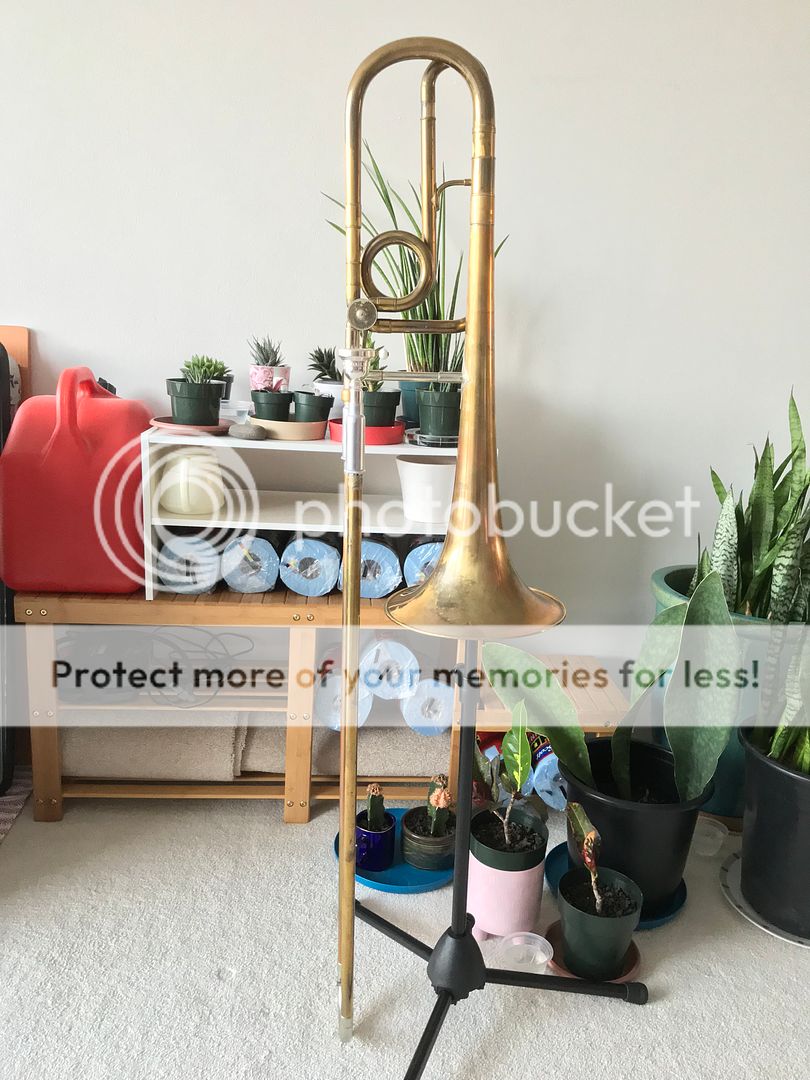
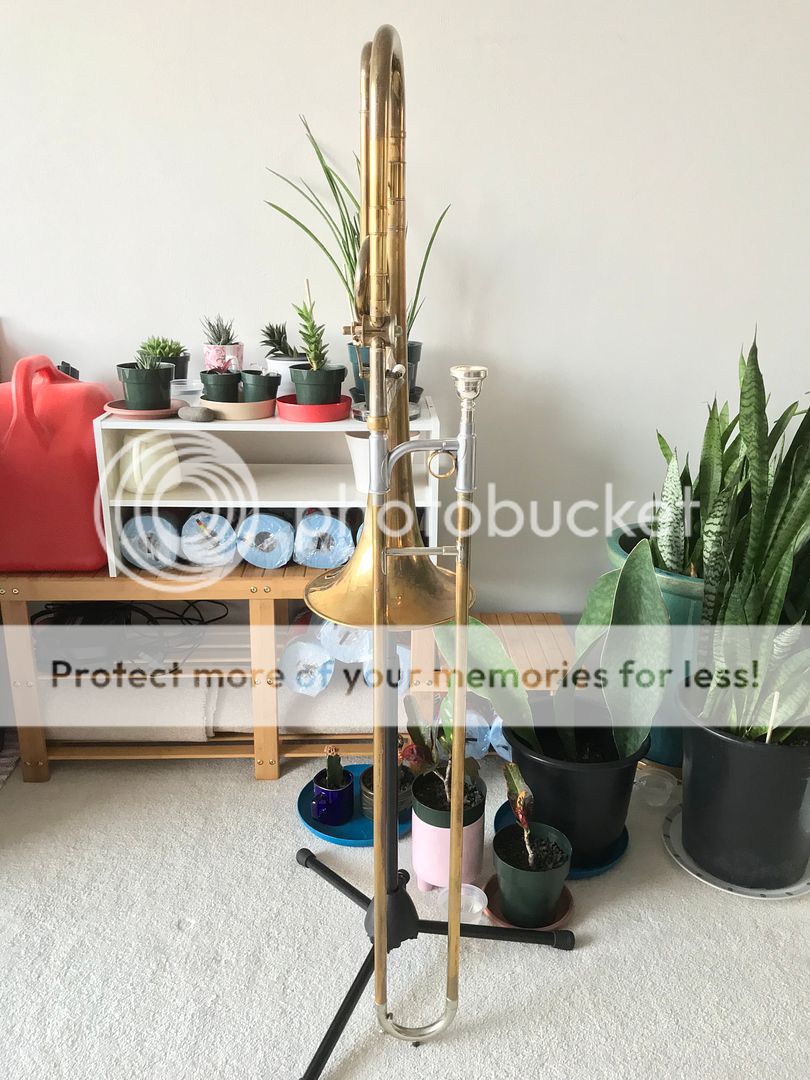
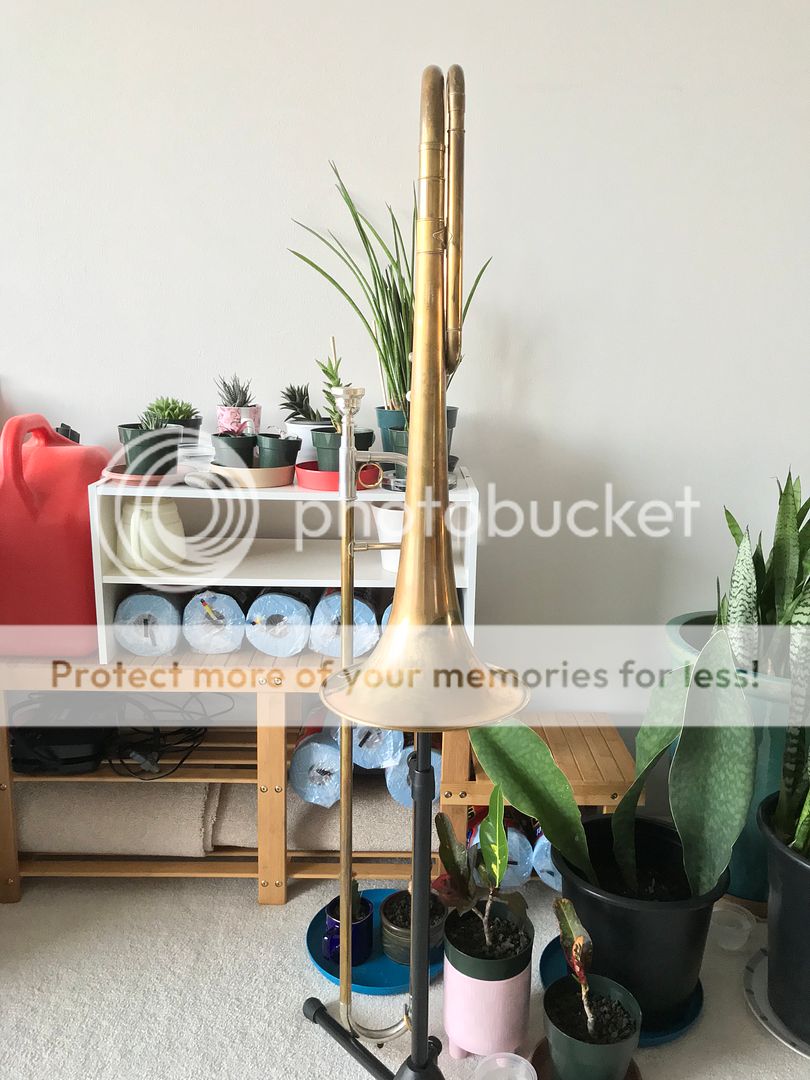
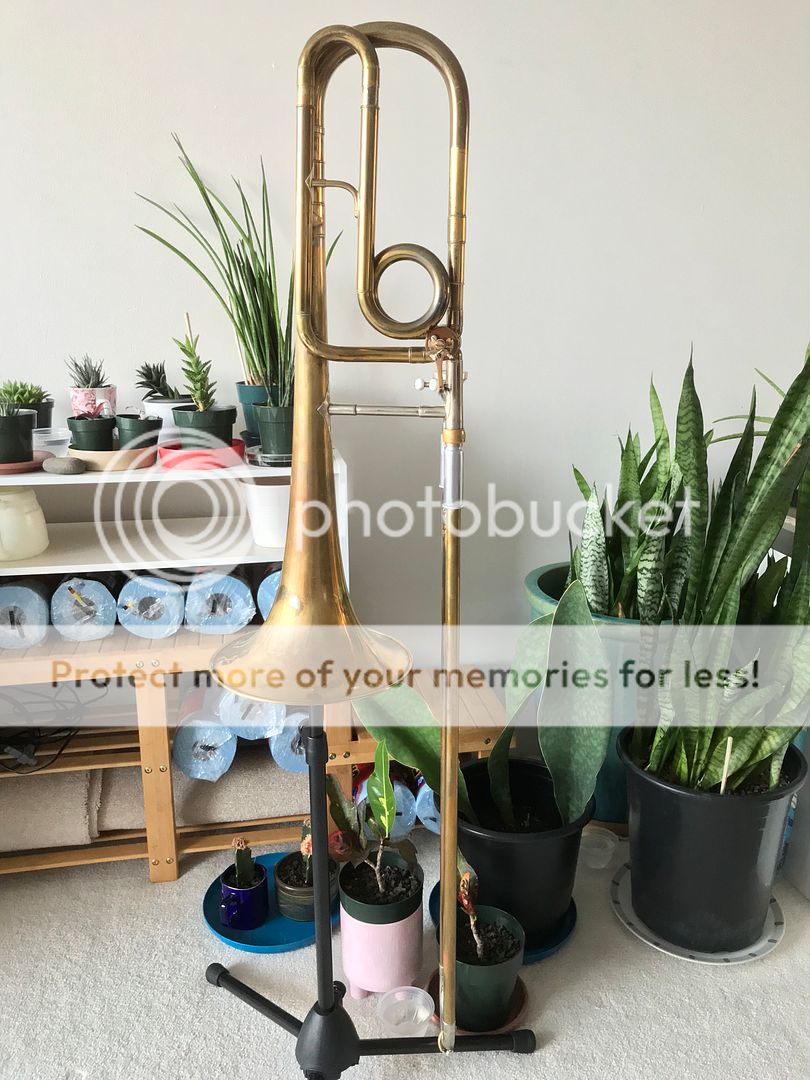
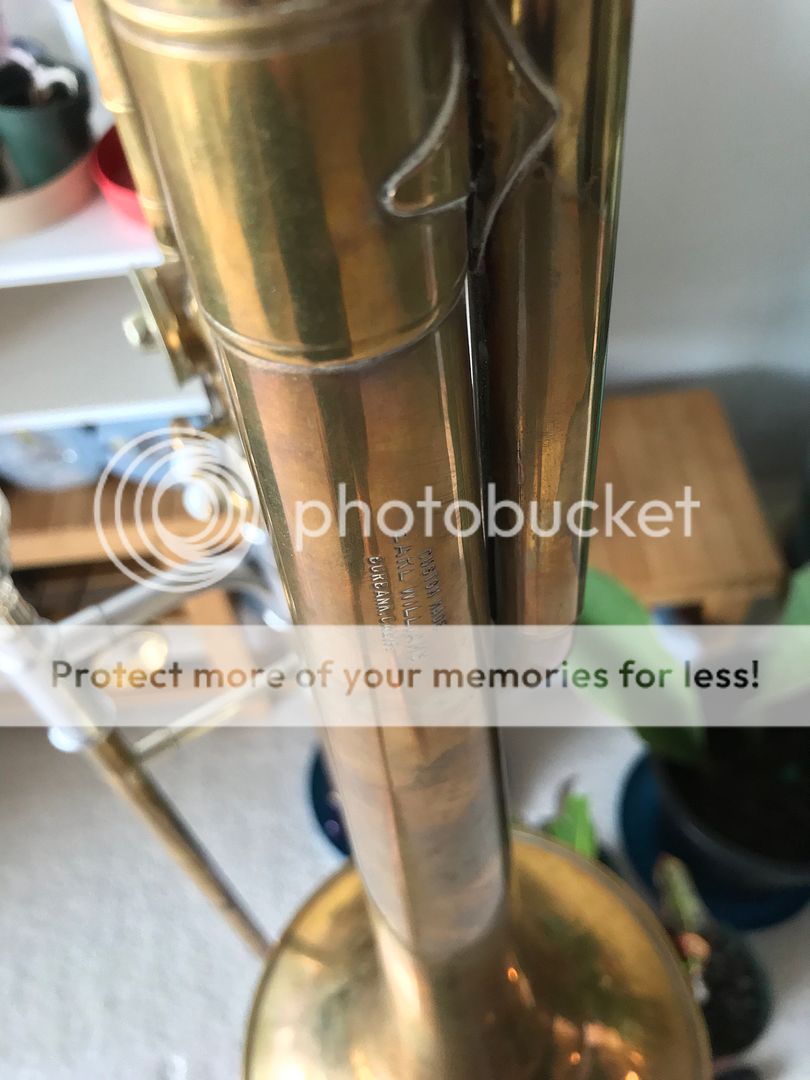
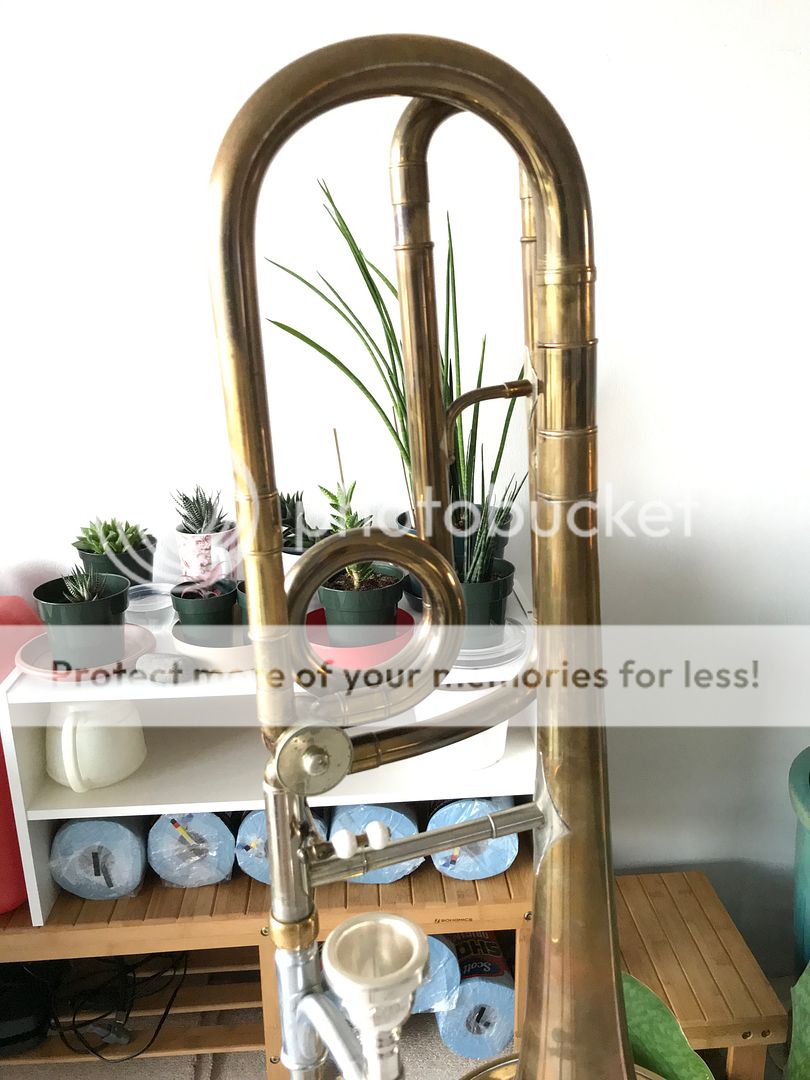
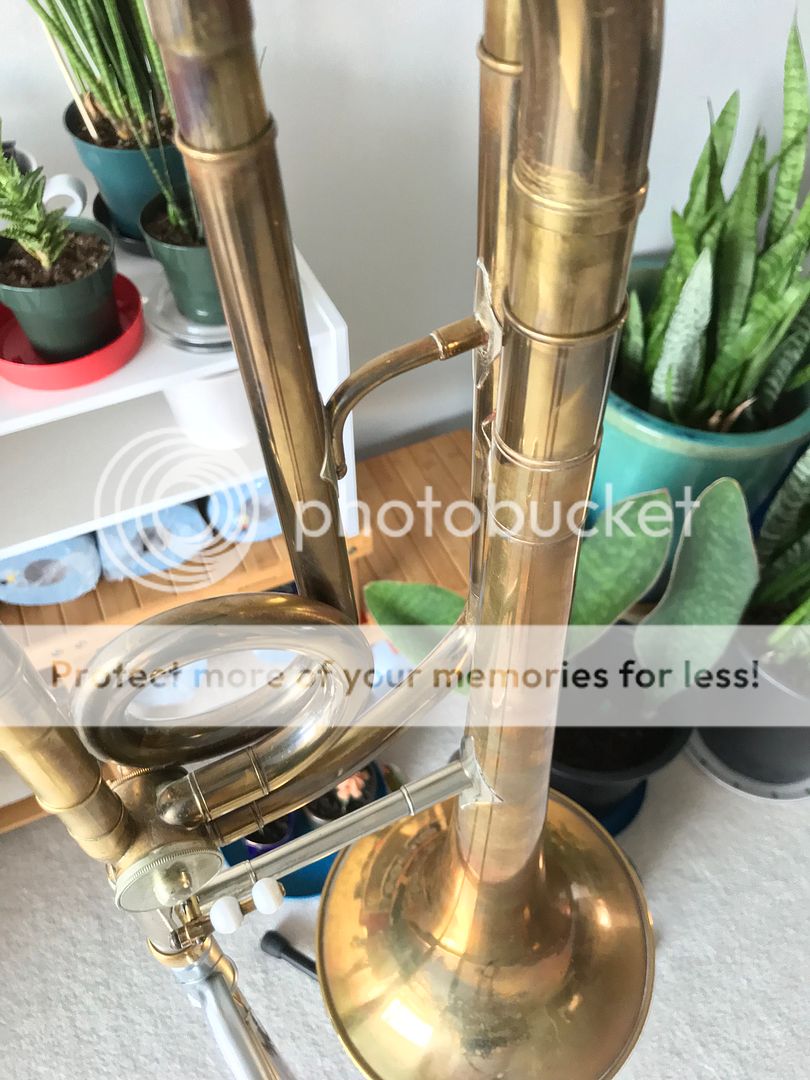
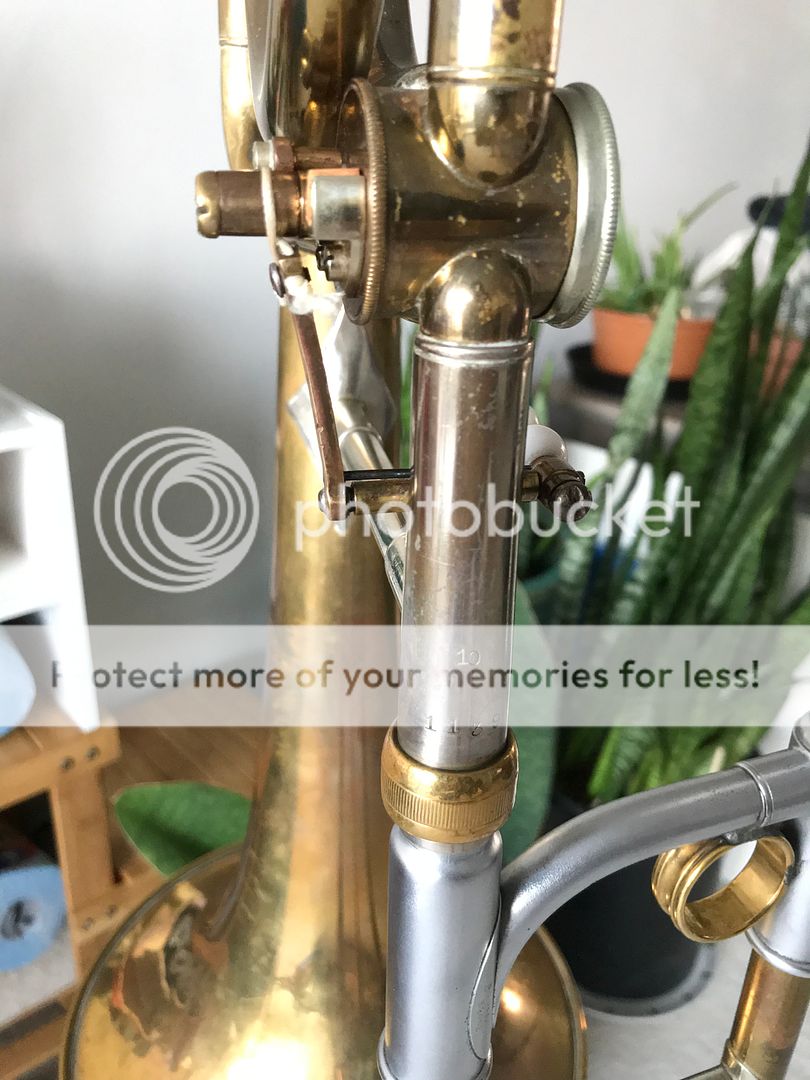
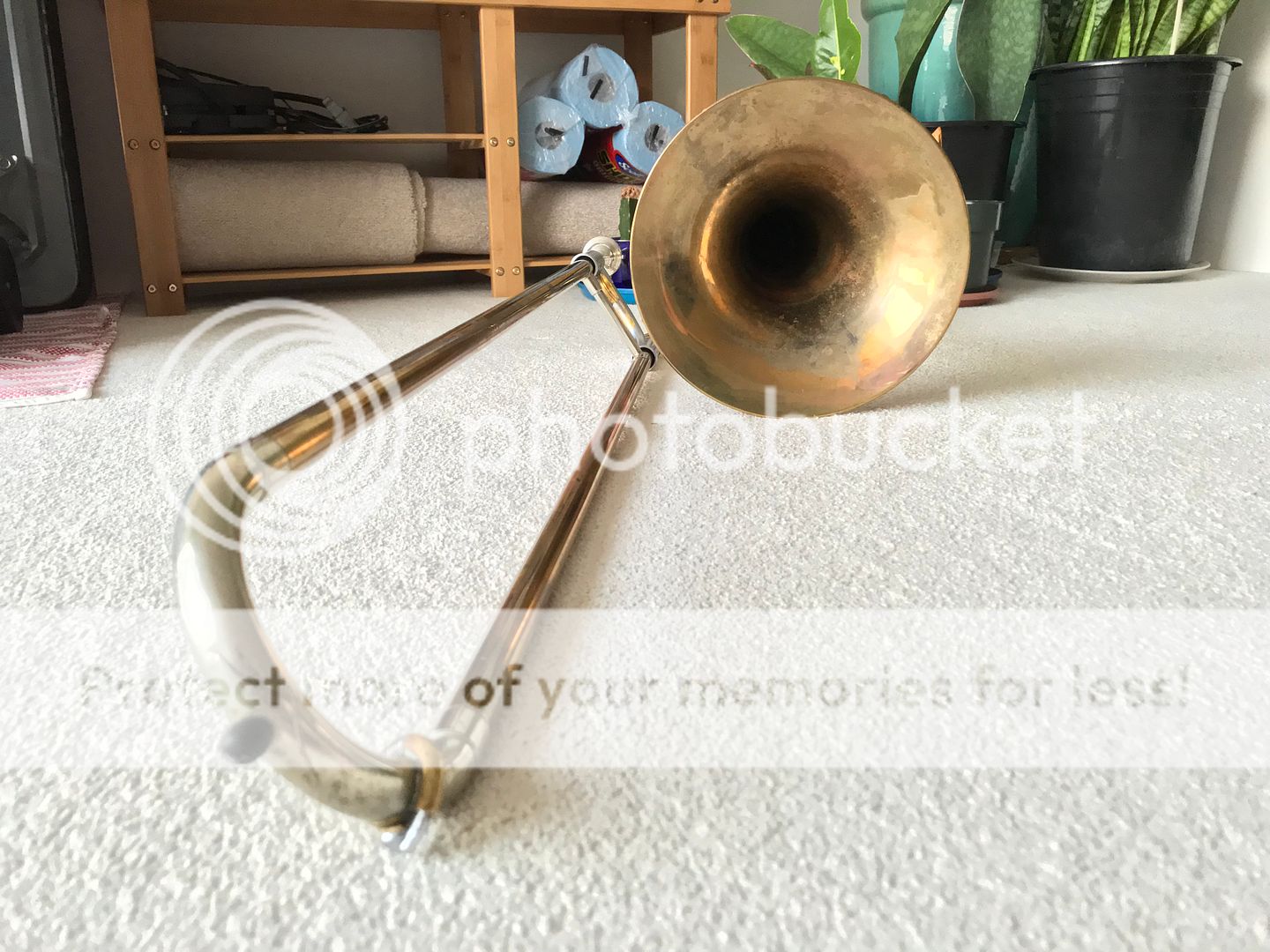
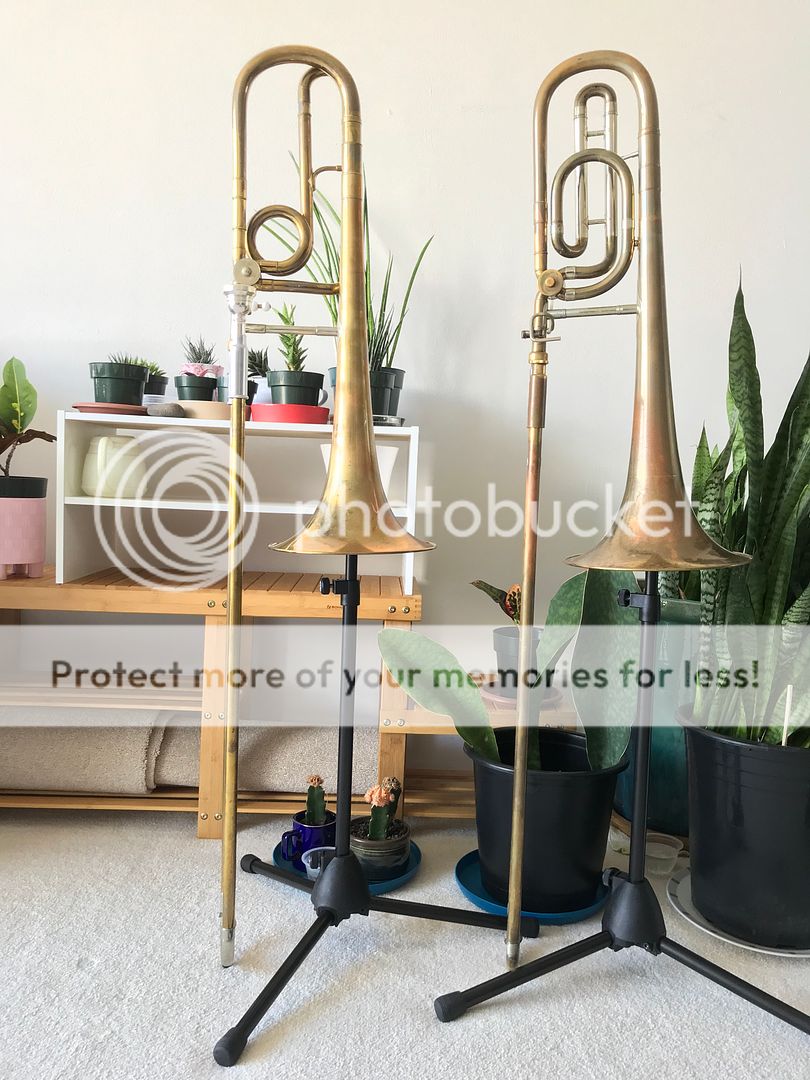
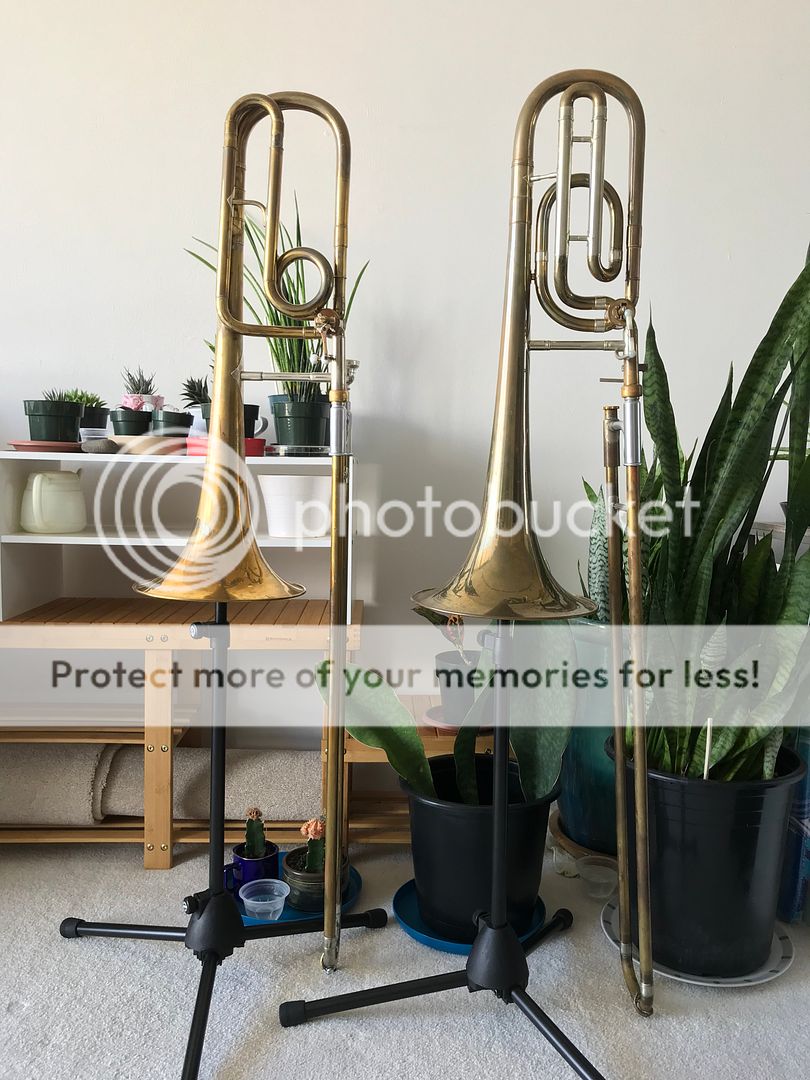
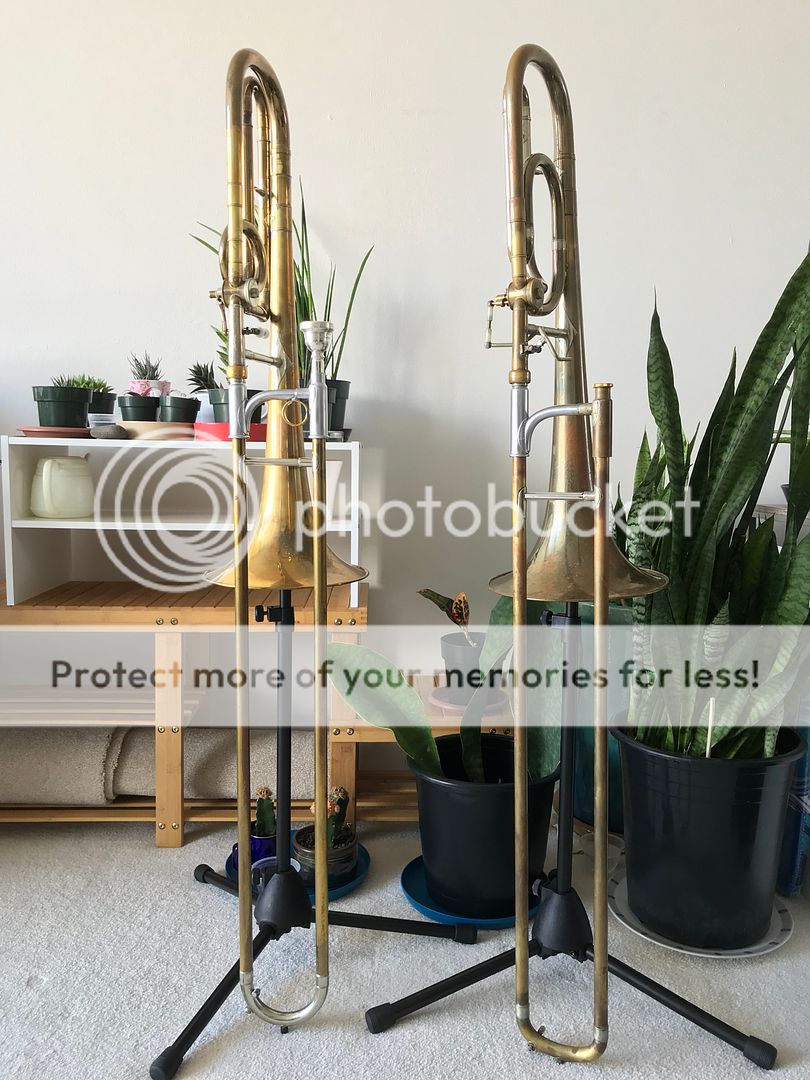
- Leanit
- Posts: 160
- Joined: Sep 04, 2018
And mine is 9.5" in bell diameter. What an eclectic little production.
- mrdeacon
- Posts: 1225
- Joined: May 08, 2018
Hawaiiguy, first off your trombone collection just keeps getting more ridiculous! I'm jealous!
Second off... Does this second 10 also have the fatter bell throat?
Second off... Does this second 10 also have the fatter bell throat?
- Leanit
- Posts: 160
- Joined: Sep 04, 2018
[quote="mrdeacon"]Hawaiiguy, first off your trombone collection just keeps getting more ridiculous! I'm jealous![/quote]
Second only to the shop towel collection!
Second only to the shop towel collection!
- HawaiiTromboneGuy
- Posts: 1025
- Joined: Sep 03, 2018
[quote="mrdeacon"]Hawaiiguy, first off your trombone collection just keeps getting more ridiculous! I'm jealous!
Second off... Does this second 10 also have the fatter bell throat?[/quote]
:mrgreen: :pant:
Yes, this 10 definitely has the large throat. The two 10s look identical to the naked eye in regards to throat size.
Second off... Does this second 10 also have the fatter bell throat?[/quote]
:mrgreen: :pant:
Yes, this 10 definitely has the large throat. The two 10s look identical to the naked eye in regards to throat size.
- HawaiiTromboneGuy
- Posts: 1025
- Joined: Sep 03, 2018
[quote="Leanit"]<QUOTE author="mrdeacon" post_id="87640" time="1560796738" user_id="3239">
Hawaiiguy, first off your trombone collection just keeps getting more ridiculous! I'm jealous![/quote]
Second only to the shop towel collection!
</QUOTE>
Hahaha yeah I noticed them in the background of the photos and moved them shortly after to take photos of the pair together. :lol:
Hawaiiguy, first off your trombone collection just keeps getting more ridiculous! I'm jealous![/quote]
Second only to the shop towel collection!
</QUOTE>
Hahaha yeah I noticed them in the background of the photos and moved them shortly after to take photos of the pair together. :lol:
- HawaiiTromboneGuy
- Posts: 1025
- Joined: Sep 03, 2018
Contemplating on doing a double valve/trigger setup on my Williams 10 that used to belong to Karl DeKarske. Wondering if I should opt for a drop-in second valve or have a second valve added to the existing setup. If I had the money I’d buy the 10 for sale over at Horn Stash, but it’s just too much. Any recommendations from the Williams folk?
- mrdeacon
- Posts: 1225
- Joined: May 08, 2018
[quote="HawaiiTromboneGuy"]Contemplating on doing a double valve/trigger setup on my Williams 10 that used to belong to Karl DeKarske. Wondering if I should opt for a drop-in second valve or have a second valve added to the existing setup. If I had the money I’d buy the 10 for sale over at Horn Stash, but it’s just too much. Any recommendations from the Williams folk?[/quote]
Take this from someone who just modified their Minick bass with a similar J bend setup. I would not touch the Williams. Get the drop in valve made if you need a second valve.
My reasoning is actually not because you're modifying the Williams, I'm ok with that. It's actually the J bend design that is a pain to work with.
Because of the lack of bracing inherent in the design, it makes putting the horn together a nightmare for your tech. I'm sure Minick and Williams both created specific jigs to put these J bend horns together. Your tech has to essentially freeball putting everything together and there are only so many places you can brace the horn once it's fully put together. Super easy to have tension sneak into the horn when you're freeballing it like that.
You'd also have to find a second valve to use and decide if you want to use "new" valves, rotax, Olsen ect., or another Conn or Holton rotor. Depending on your choice, especially if you decide to use a close tolerance valve like the Olsens, a number of problems can crop up because of the J bend. I really like the Olsens but they were difficult to get working right on my horn because of the J bend design.
At some point, I'm going to put together a post on my experiences with modifying my Minick. Again, I don't think you would have any regrets modifying your Williams to have a second fixed valve but it's 100% not as simple as just slapping a new valve in the horn. I learned that the hard way!
Take this from someone who just modified their Minick bass with a similar J bend setup. I would not touch the Williams. Get the drop in valve made if you need a second valve.
My reasoning is actually not because you're modifying the Williams, I'm ok with that. It's actually the J bend design that is a pain to work with.
Because of the lack of bracing inherent in the design, it makes putting the horn together a nightmare for your tech. I'm sure Minick and Williams both created specific jigs to put these J bend horns together. Your tech has to essentially freeball putting everything together and there are only so many places you can brace the horn once it's fully put together. Super easy to have tension sneak into the horn when you're freeballing it like that.
You'd also have to find a second valve to use and decide if you want to use "new" valves, rotax, Olsen ect., or another Conn or Holton rotor. Depending on your choice, especially if you decide to use a close tolerance valve like the Olsens, a number of problems can crop up because of the J bend. I really like the Olsens but they were difficult to get working right on my horn because of the J bend design.
At some point, I'm going to put together a post on my experiences with modifying my Minick. Again, I don't think you would have any regrets modifying your Williams to have a second fixed valve but it's 100% not as simple as just slapping a new valve in the horn. I learned that the hard way!
- elmsandr
- Posts: 1373
- Joined: Mar 23, 2018
[quote="HawaiiTromboneGuy"]Contemplating on doing a double valve/trigger setup on my Williams 10 that used to belong to Karl DeKarske. Wondering if I should opt for a drop-in second valve or have a second valve added to the existing setup. If I had the money I’d buy the 10 for sale over at Horn Stash, but it’s just too much. Any recommendations from the Williams folk?[/quote]
I forget which one of yours is which, but making/getting a drop in valve for the one with the Holton valve section would probably be a more straightforward task.
I would not alter the one with the pigtail. I would consider adding a drop in valve there, but making something that worked aesthetically there would be a little more challenging. If you are looking for a permanent mod, I think going for a nice dependent set on that one with the Holton section could be a mod that would require very little, if any permanent modification to the horn.
Cheers,
Andy
I forget which one of yours is which, but making/getting a drop in valve for the one with the Holton valve section would probably be a more straightforward task.
I would not alter the one with the pigtail. I would consider adding a drop in valve there, but making something that worked aesthetically there would be a little more challenging. If you are looking for a permanent mod, I think going for a nice dependent set on that one with the Holton section could be a mod that would require very little, if any permanent modification to the horn.
Cheers,
Andy
- HawaiiTromboneGuy
- Posts: 1025
- Joined: Sep 03, 2018
[quote="mrdeacon"]<QUOTE author="HawaiiTromboneGuy" post_id="90555" time="1564253704" user_id="3695">
Contemplating on doing a double valve/trigger setup on my Williams 10 that used to belong to Karl DeKarske. Wondering if I should opt for a drop-in second valve or have a second valve added to the existing setup. If I had the money I’d buy the 10 for sale over at Horn Stash, but it’s just too much. Any recommendations from the Williams folk?[/quote]
Take this from someone who just modified their Minick bass with a similar J bend setup. I would not touch the Williams. Get the drop in valve made if you need a second valve.
My reasoning is actually not because you're modifying the Williams, I'm ok with that. It's actually the J bend design that is a pain to work with.
Because of the lack of bracing inherent in the design, it makes putting the horn together a nightmare for your tech. I'm sure Minick and Williams both created specific jigs to put these J bend horns together. Your tech has to essentially freeball putting everything together and there are only so many places you can brace the horn once it's fully put together. Super easy to have tension sneak into the horn when you're freeballing it like that.
You'd also have to find a second valve to use and decide if you want to use "new" valves, rotax, Olsen ect., or another Conn or Holton rotor. Depending on your choice, especially if you decide to use a close tolerance valve like the Olsens, a number of problems can crop up because of the J bend. I really like the Olsens but they were difficult to get working right on my horn because of the J bend design.
At some point, I'm going to put together a post on my experiences with modifying my Minick. Again, I don't think you would have any regrets modifying your Williams to have a second fixed valve but it's 100% not as simple as just slapping a new valve in the horn. I learned that the hard way!
</QUOTE>
Good insight. I’m still on the fence as to what I’m going to do, but it seems like the majority is leaning towards having a drop in valve made for it. I never thought about how troublesome it would be due to the J bend design, but I can see how that would be a problem.
Contemplating on doing a double valve/trigger setup on my Williams 10 that used to belong to Karl DeKarske. Wondering if I should opt for a drop-in second valve or have a second valve added to the existing setup. If I had the money I’d buy the 10 for sale over at Horn Stash, but it’s just too much. Any recommendations from the Williams folk?[/quote]
Take this from someone who just modified their Minick bass with a similar J bend setup. I would not touch the Williams. Get the drop in valve made if you need a second valve.
My reasoning is actually not because you're modifying the Williams, I'm ok with that. It's actually the J bend design that is a pain to work with.
Because of the lack of bracing inherent in the design, it makes putting the horn together a nightmare for your tech. I'm sure Minick and Williams both created specific jigs to put these J bend horns together. Your tech has to essentially freeball putting everything together and there are only so many places you can brace the horn once it's fully put together. Super easy to have tension sneak into the horn when you're freeballing it like that.
You'd also have to find a second valve to use and decide if you want to use "new" valves, rotax, Olsen ect., or another Conn or Holton rotor. Depending on your choice, especially if you decide to use a close tolerance valve like the Olsens, a number of problems can crop up because of the J bend. I really like the Olsens but they were difficult to get working right on my horn because of the J bend design.
At some point, I'm going to put together a post on my experiences with modifying my Minick. Again, I don't think you would have any regrets modifying your Williams to have a second fixed valve but it's 100% not as simple as just slapping a new valve in the horn. I learned that the hard way!
</QUOTE>
Good insight. I’m still on the fence as to what I’m going to do, but it seems like the majority is leaning towards having a drop in valve made for it. I never thought about how troublesome it would be due to the J bend design, but I can see how that would be a problem.
- HawaiiTromboneGuy
- Posts: 1025
- Joined: Sep 03, 2018
[quote="elmsandr"]<QUOTE author="HawaiiTromboneGuy" post_id="90555" time="1564253704" user_id="3695">
Contemplating on doing a double valve/trigger setup on my Williams 10 that used to belong to Karl DeKarske. Wondering if I should opt for a drop-in second valve or have a second valve added to the existing setup. If I had the money I’d buy the 10 for sale over at Horn Stash, but it’s just too much. Any recommendations from the Williams folk?[/quote]
I forget which one of yours is which, but making/getting a drop in valve for the one with the Holton valve section would probably be a more straightforward task.
I would not alter the one with the pigtail. I would consider adding a drop in valve there, but making something that worked aesthetically there would be a little more challenging. If you are looking for a permanent mod, I think going for a nice dependent set on that one with the Holton section could be a mod that would require very little, if any permanent modification to the horn.
Cheers,
Andy
</QUOTE>
Yes, I don’t plan on touching the pigtail one since it’s basically all original. I am definitely leaning towards a drop in valve as I wouldn’t always need the additional valve. I figured since the DeKarske horn has already had work done to it that it would be the best candidate for the project.
Contemplating on doing a double valve/trigger setup on my Williams 10 that used to belong to Karl DeKarske. Wondering if I should opt for a drop-in second valve or have a second valve added to the existing setup. If I had the money I’d buy the 10 for sale over at Horn Stash, but it’s just too much. Any recommendations from the Williams folk?[/quote]
I forget which one of yours is which, but making/getting a drop in valve for the one with the Holton valve section would probably be a more straightforward task.
I would not alter the one with the pigtail. I would consider adding a drop in valve there, but making something that worked aesthetically there would be a little more challenging. If you are looking for a permanent mod, I think going for a nice dependent set on that one with the Holton section could be a mod that would require very little, if any permanent modification to the horn.
Cheers,
Andy
</QUOTE>
Yes, I don’t plan on touching the pigtail one since it’s basically all original. I am definitely leaning towards a drop in valve as I wouldn’t always need the additional valve. I figured since the DeKarske horn has already had work done to it that it would be the best candidate for the project.
- FOSSIL
- Posts: 688
- Joined: Jul 09, 2019
[quote="mrdeacon"]<QUOTE author="HawaiiTromboneGuy" post_id="90555" time="1564253704" user_id="3695">
Contemplating on doing a double valve/trigger setup on my Williams 10 that used to belong to Karl DeKarske. Wondering if I should opt for a drop-in second valve or have a second valve added to the existing setup. If I had the money I’d buy the 10 for sale over at Horn Stash, but it’s just too much. Any recommendations from the Williams folk?[/quote]
Take this from someone who just modified their Minick bass with a similar J bend setup. I would not touch the Williams. Get the drop in valve made if you need a second valve.
My reasoning is actually not because you're modifying the Williams, I'm ok with that. It's actually the J bend design that is a pain to work with.
Because of the lack of bracing inherent in the design, it makes putting the horn together a nightmare for your tech. I'm sure Minick and Williams both created specific jigs to put these J bend horns together. Your tech has to essentially freeball putting everything together and there are only so many places you can brace the horn once it's fully put together. Super easy to have tension sneak into the horn when you're freeballing it like that.
You'd also have to find a second valve to use and decide if you want to use "new" valves, rotax, Olsen ect., or another Conn or Holton rotor. Depending on your choice, especially if you decide to use a close tolerance valve like the Olsens, a number of problems can crop up because of the J bend. I really like the Olsens but they were difficult to get working right on my horn because of the J bend design.
At some point, I'm going to put together a post on my experiences with modifying my Minick. Again, I don't think you would have any regrets modifying your Williams to have a second fixed valve but it's 100% not as simple as just slapping a new valve in the horn. I learned that the hard way!
</QUOTE>
I'm sorry, but there is nothing intrinsically harder about building a TIS bell section..... actually, I would say, having built up both, the TIS section is easier. Building 'freehand' is LESS likely to result in tension in the build, unless the builder decides for some strange reason to force parts together. Bracing is a black art for sure, but often less is more in that department.
Since many people think that the Williams 10 in question has a Holton valve, a Holton slot-in would be perfect and easy to fit.
Chris
Contemplating on doing a double valve/trigger setup on my Williams 10 that used to belong to Karl DeKarske. Wondering if I should opt for a drop-in second valve or have a second valve added to the existing setup. If I had the money I’d buy the 10 for sale over at Horn Stash, but it’s just too much. Any recommendations from the Williams folk?[/quote]
Take this from someone who just modified their Minick bass with a similar J bend setup. I would not touch the Williams. Get the drop in valve made if you need a second valve.
My reasoning is actually not because you're modifying the Williams, I'm ok with that. It's actually the J bend design that is a pain to work with.
Because of the lack of bracing inherent in the design, it makes putting the horn together a nightmare for your tech. I'm sure Minick and Williams both created specific jigs to put these J bend horns together. Your tech has to essentially freeball putting everything together and there are only so many places you can brace the horn once it's fully put together. Super easy to have tension sneak into the horn when you're freeballing it like that.
You'd also have to find a second valve to use and decide if you want to use "new" valves, rotax, Olsen ect., or another Conn or Holton rotor. Depending on your choice, especially if you decide to use a close tolerance valve like the Olsens, a number of problems can crop up because of the J bend. I really like the Olsens but they were difficult to get working right on my horn because of the J bend design.
At some point, I'm going to put together a post on my experiences with modifying my Minick. Again, I don't think you would have any regrets modifying your Williams to have a second fixed valve but it's 100% not as simple as just slapping a new valve in the horn. I learned that the hard way!
</QUOTE>
I'm sorry, but there is nothing intrinsically harder about building a TIS bell section..... actually, I would say, having built up both, the TIS section is easier. Building 'freehand' is LESS likely to result in tension in the build, unless the builder decides for some strange reason to force parts together. Bracing is a black art for sure, but often less is more in that department.
Since many people think that the Williams 10 in question has a Holton valve, a Holton slot-in would be perfect and easy to fit.
Chris
- mrdeacon
- Posts: 1225
- Joined: May 08, 2018
[quote="FOSSIL"]I'm sorry, but there is nothing intrinsically harder about building a TIS bell section..... actually, I would say, having built up both, the TIS section is easier. Building 'freehand' is LESS likely to result in tension in the build, unless the builder decides for some strange reason to force parts together. Bracing is a black art for sure, but often less is more in that department.[/quote]
Thanks for your post Chris! I agree with you and think I could have been a little specific with my post. When I said J bend I meant a movable J bend tuning slide like on my horn and the Williams 10.
The specific issue we ran into was the alignment between the female tuning receiver part of the J bend and the male tuning bit extending out of the rotor were ever so slightly off. So visually it looked fine and the tuning slide moved freely but that extra small bit of tension caused issues with binding on the Olsen rotors. Took some trouble shooting to figure out what was going on but it was a quick to fix once we did. This problem of course never would have happened with a standard tuning slide or a fixed J bend.
I don't think it's impossible to put together a horn with a movable J bend but it's for sure finicky to put together.
My horn was also super picky about bracing. We finally figured out the best place for them but it took a couple of tries to get there.
Thanks for your post Chris! I agree with you and think I could have been a little specific with my post. When I said J bend I meant a movable J bend tuning slide like on my horn and the Williams 10.
The specific issue we ran into was the alignment between the female tuning receiver part of the J bend and the male tuning bit extending out of the rotor were ever so slightly off. So visually it looked fine and the tuning slide moved freely but that extra small bit of tension caused issues with binding on the Olsen rotors. Took some trouble shooting to figure out what was going on but it was a quick to fix once we did. This problem of course never would have happened with a standard tuning slide or a fixed J bend.
I don't think it's impossible to put together a horn with a movable J bend but it's for sure finicky to put together.
My horn was also super picky about bracing. We finally figured out the best place for them but it took a couple of tries to get there.
- FOSSIL
- Posts: 688
- Joined: Jul 09, 2019
[quote="mrdeacon"]<QUOTE author="FOSSIL" post_id="90715" time="1564436615" user_id="7109">
I'm sorry, but there is nothing intrinsically harder about building a TIS bell section..... actually, I would say, having built up both, the TIS section is easier. Building 'freehand' is LESS likely to result in tension in the build, unless the builder decides for some strange reason to force parts together. Bracing is a black art for sure, but often less is more in that department.[/quote]
Thanks for your post Chris! I agree with you and think I could have been a little specific with my post. When I said J bend I meant a movable J bend tuning slide like on my horn and the Williams 10.
The specific issue we ran into was the alignment between the female tuning receiver part of the J bend and the male tuning bit extending out of the rotor were ever so slightly off. So visually it looked fine and the tuning slide moved freely but that extra small bit of tension caused issues with binding on the Olsen rotors. Took some trouble shooting to figure out what was going on but it was a quick to fix once we did. This problem of course never would have happened with a standard tuning slide or a fixed J bend.
I don't think it's impossible to put together a horn with a movable J bend but it's for sure finicky to put together.
My horn was also super picky about bracing. We finally figured out the best place for them but it took a couple of tries to get there.
</QUOTE>
A couple of tries to get the best out of bracing is very good going... I can spend ages messing with bracing. Thanks for the clarification.... on that basis I would agree that a moveable J type tuning slide is very much the hardest type to set up, especially if the new valves take up more or less space on the main instrument than the original valves. Any change in that area will totally change the way the instrument plays. Risky world.
Chris
I'm sorry, but there is nothing intrinsically harder about building a TIS bell section..... actually, I would say, having built up both, the TIS section is easier. Building 'freehand' is LESS likely to result in tension in the build, unless the builder decides for some strange reason to force parts together. Bracing is a black art for sure, but often less is more in that department.[/quote]
Thanks for your post Chris! I agree with you and think I could have been a little specific with my post. When I said J bend I meant a movable J bend tuning slide like on my horn and the Williams 10.
The specific issue we ran into was the alignment between the female tuning receiver part of the J bend and the male tuning bit extending out of the rotor were ever so slightly off. So visually it looked fine and the tuning slide moved freely but that extra small bit of tension caused issues with binding on the Olsen rotors. Took some trouble shooting to figure out what was going on but it was a quick to fix once we did. This problem of course never would have happened with a standard tuning slide or a fixed J bend.
I don't think it's impossible to put together a horn with a movable J bend but it's for sure finicky to put together.
My horn was also super picky about bracing. We finally figured out the best place for them but it took a couple of tries to get there.
</QUOTE>
A couple of tries to get the best out of bracing is very good going... I can spend ages messing with bracing. Thanks for the clarification.... on that basis I would agree that a moveable J type tuning slide is very much the hardest type to set up, especially if the new valves take up more or less space on the main instrument than the original valves. Any change in that area will totally change the way the instrument plays. Risky world.
Chris
- pjanda1
- Posts: 158
- Joined: Aug 29, 2021
A double dependent Williams 10 just popped up on Ebay: https://www.ebay.com/itm/325810663991 A mere $20k!
I don't know the seller. I live 20 miles away and I'd go check out his tenors (8H and NY 34B listed) if the prices on those weren't also ... a little aggressive.
I thought folks might be interested to see this one.
Paul
I don't know the seller. I live 20 miles away and I'd go check out his tenors (8H and NY 34B listed) if the prices on those weren't also ... a little aggressive.
I thought folks might be interested to see this one.
Paul
- Burgerbob
- Posts: 6327
- Joined: Apr 23, 2018
Reminds me of a certain Williams model 4 that was for sale here...
- HawaiiTromboneGuy
- Posts: 1025
- Joined: Sep 03, 2018
<EMOJI seq="1f923" tseq="1f923">🤣</EMOJI><EMOJI seq="1f923" tseq="1f923">🤣</EMOJI>
- HawaiiTromboneGuy
- Posts: 1025
- Joined: Sep 03, 2018
I suspect that it’s this one.
- JohnL
- Posts: 2529
- Joined: Mar 23, 2018
Twenty thousand (US) dollars?
Excuse me...
[size=200]TWENTY
THOUSAND
DOLLARS!?
:idk:
Excuse me...
THOUSAND
DOLLARS!?
:idk:
- HawaiiTromboneGuy
- Posts: 1025
- Joined: Sep 03, 2018
Seems to not have the spare slide as well anymore.
- pjanda1
- Posts: 158
- Joined: Aug 29, 2021
I thought it was funny because I think there is a thread referencing a Williams 10 where DE (jokingly) mentions a price of $125k. Maybe the seller saw that! (Or maybe I'm misremembering).
It'd be interesting if these folks are trying to be flippers. I saw the eclectic mix of nice stuff and assumed it was just an attempt to liquidate a collection that had been painstakingly assembled by someone who doesn't know how to price stuff. There are easier ways to make a buck than flipping trombones.
Paul
It'd be interesting if these folks are trying to be flippers. I saw the eclectic mix of nice stuff and assumed it was just an attempt to liquidate a collection that had been painstakingly assembled by someone who doesn't know how to price stuff. There are easier ways to make a buck than flipping trombones.
Paul
- Posaunus
- Posts: 5018
- Joined: Mar 23, 2018
Apparently Jesus Torres learned the "value" of this "rare" trombone, even though he had to ask the world what it was that he had!
Note his eBay listing:
[color=#0000BF]For parts or not working
“The valves and slides move freely and the hand slide action is mostly smooth(approximately 8.5 out[color=#804000] of 10..."
From the photos, it's apparent that there was once also a second slide. Is that item also available (separately) "for parts or not working"?
The photos reveal a lot about this instrument's condition. (Hardly pristine!)
And only $300 shipping! No returns.
Remember what P. T. Barnum (allegedly) said! [[color=#008000]There's a sucker ...]
Note his eBay listing:
“The valves and slides move freely and the hand slide action is mostly smooth(approximately 8.5 out
From the photos, it's apparent that there was once also a second slide. Is that item also available (separately) "for parts or not working"?
The photos reveal a lot about this instrument's condition. (Hardly pristine!)
And only $300 shipping! No returns.
Remember what P. T. Barnum (allegedly) said! [
- JohnL
- Posts: 2529
- Joined: Mar 23, 2018
[quote="Posaunus"]Apparently Jesus Torres learned the "value" of this "rare" trombone, even though he had to ask the world what it was that he had![/quote]
I don't think Jesus Torres is the person selling it on eBay. The Trombone Marketplace listing indicates that the instrument is located in Whittier, California (in what looks like someone's garage or maybe a storage locker), while the current seller on eBay is listed as being located in Erie, Colorado.
Drew, how old is that screenshot?
I don't think Jesus Torres is the person selling it on eBay. The Trombone Marketplace listing indicates that the instrument is located in Whittier, California (in what looks like someone's garage or maybe a storage locker), while the current seller on eBay is listed as being located in Erie, Colorado.
Drew, how old is that screenshot?
- HawaiiTromboneGuy
- Posts: 1025
- Joined: Sep 03, 2018
[quote="JohnL"]<QUOTE author="Posaunus" post_id="220379" time="1695006462" user_id="158">
Apparently Jesus Torres learned the "value" of this "rare" trombone, even though he had to ask the world what it was that he had![/quote]
I don't think Jesus Torres is the person selling it on eBay. The Trombone Marketplace listing indicates that the instrument is located in Whittier, California (in what looks like someone's garage or maybe a storage locker), while the current seller on eBay is listed as being located in Erie, Colorado.
Drew, how old is that screenshot?
</QUOTE>
Yeah, I caught the different locations as well between Jesus’ post and where the eBay seller is based.
John, the screenshot was taken on June 27th of this year, so roughly 2 1/2 months ago.
Apparently Jesus Torres learned the "value" of this "rare" trombone, even though he had to ask the world what it was that he had![/quote]
I don't think Jesus Torres is the person selling it on eBay. The Trombone Marketplace listing indicates that the instrument is located in Whittier, California (in what looks like someone's garage or maybe a storage locker), while the current seller on eBay is listed as being located in Erie, Colorado.
Drew, how old is that screenshot?
</QUOTE>
Yeah, I caught the different locations as well between Jesus’ post and where the eBay seller is based.
John, the screenshot was taken on June 27th of this year, so roughly 2 1/2 months ago.
- HawaiiTromboneGuy
- Posts: 1025
- Joined: Sep 03, 2018
Messaged with the eBay seller a bit and the spare slide that was originally with this horn belongs to a Williams 4. He measured the tubes at .491” which is why it is no longer included with this bass.
- meine
- Posts: 397
- Joined: Feb 25, 2021
Messaged him too. He‘s quite convinced to get the money he‘s asking<EMOJI seq="1f913" tseq="1f913">🤓</EMOJI><EMOJI seq="1f37f" tseq="1f37f">🍿</EMOJI>
- JohnL
- Posts: 2529
- Joined: Mar 23, 2018
[quote="meine"]Messaged him too. He‘s quite convinced to get the money he‘s asking<EMOJI seq="1f913" tseq="1f913">🤓</EMOJI><EMOJI seq="1f37f" tseq="1f37f">🍿</EMOJI>[/quote]
I hope they're really patient. It could take quite while.
I hope they're really patient. It could take quite while.
- JohnL
- Posts: 2529
- Joined: Mar 23, 2018
[quote="Bach5G"]Buy low, sell high.[/quote]
So we don't have the right to comment on the price the seller is asking?
So we don't have the right to comment on the price the seller is asking?
- Burgerbob
- Posts: 6327
- Joined: Apr 23, 2018
[quote="Bach5G"]Buy low, sell high.[/quote]
Yes, but not buy low, hold out for someone to pay a stupid price for years and then eventually lower it.
Yes, but not buy low, hold out for someone to pay a stupid price for years and then eventually lower it.
- Bach5G
- Posts: 2874
- Joined: Apr 07, 2018
[quote="JohnL"]<QUOTE author="Bach5G" post_id="220697" time="1695327001" user_id="2999">
Buy low, sell high.[/quote]
So we don't have the right to comment on the price the seller is asking?
</QUOTE>
Of course you do. Who said otherwise? Well, maybe your mom who likely said if you can’t say anything nice…
[quote="Burgerbob"][/quote]
Yes, but not buy low, hold out for someone to pay a stupid price for years and then eventually lower it.
[/quote]
I think the seller is free to conduct the sale as he wishes.
Buy low, sell high.[/quote]
So we don't have the right to comment on the price the seller is asking?
</QUOTE>
Of course you do. Who said otherwise? Well, maybe your mom who likely said if you can’t say anything nice…
[quote="Burgerbob"][/quote]
Yes, but not buy low, hold out for someone to pay a stupid price for years and then eventually lower it.
[/quote]
I think the seller is free to conduct the sale as he wishes.