Does Tenuto actually mean "full value"?
- AndrewMeronek
- Posts: 1487
- Joined: Mar 30, 2018
Asking because of how often I see musicians play series of notes with tenuto markings as separated and NOT full value. It can be aggravating.
- LeTromboniste
- Posts: 1634
- Joined: Apr 11, 2018
Depends on context and any number of factors. For some composers, moments in time or places, tenuto has implications about weight of the note and stress more than just about holding full duration.
Edit: I meant that yes, generally that indicates full duration, but in certain contexts it means more than merely full duration. Especially in contexts where the default for an unmarked note already tends to be pretty much full duration. Then it's more about the articulation and shape of the note than the actual value
Edit: I meant that yes, generally that indicates full duration, but in certain contexts it means more than merely full duration. Especially in contexts where the default for an unmarked note already tends to be pretty much full duration. Then it's more about the articulation and shape of the note than the actual value
- Wilktone
- Posts: 720
- Joined: Mar 27, 2018
Yes, it should indicate the note is to be played full value.
What's the context? Big band, orchestra, concert band?
This topic has been on my mind a lot lately because I've been working with some other composers to produce a concert of original big band music. Some of the composers (usually the rhythm section players, but sometimes the horn players) are horrible at marking their articulations and leave quarter notes with no articulation at all over them. That would typically default to a short quarter note, but there are almost always circumstances in the same charts where the composer seems to have wanted them long. As a result, as we've been rehearsing this music the band sort of defaulted to a not-short-not-long quarter note, sometimes even on things that have articulations, because we've been constantly second guessing what's desired.
After getting the composers on board with marking their articulations and rehearsing the music a couple of times we're now locking in better. Maybe the musicians you're noticing just need feedback that they're not playing the articulations correctly because they're second guessing?
What's the context? Big band, orchestra, concert band?
This topic has been on my mind a lot lately because I've been working with some other composers to produce a concert of original big band music. Some of the composers (usually the rhythm section players, but sometimes the horn players) are horrible at marking their articulations and leave quarter notes with no articulation at all over them. That would typically default to a short quarter note, but there are almost always circumstances in the same charts where the composer seems to have wanted them long. As a result, as we've been rehearsing this music the band sort of defaulted to a not-short-not-long quarter note, sometimes even on things that have articulations, because we've been constantly second guessing what's desired.
After getting the composers on board with marking their articulations and rehearsing the music a couple of times we're now locking in better. Maybe the musicians you're noticing just need feedback that they're not playing the articulations correctly because they're second guessing?
- Wilktone
- Posts: 720
- Joined: Mar 27, 2018
Update, what Maximillian wrote before I submitted my post is absolutely true about context. But I would point out that the historical context is necessary to understand what was desired by the composer. These days articulations are more standardized than they used to be, so modern editions using tenutos I would suggest full value note unless you suspect that the context was otherwise.
- Doug_Elliott
- Posts: 4155
- Joined: Mar 22, 2018
It would be useful to have a discussion of ALL articulation markings, how they are used now and what they meant in different eras.
Unfortunately there's not as much standardization as I'd like. And a lot of printed music (and manuscript) is full of mistakes and inconsistencies between parts.
And I suspect there are regional differences in interpretation too.
Unfortunately there's not as much standardization as I'd like. And a lot of printed music (and manuscript) is full of mistakes and inconsistencies between parts.
And I suspect there are regional differences in interpretation too.
- AndrewMeronek
- Posts: 1487
- Joined: Mar 30, 2018
[quote="Wilktone"]What's the context? Big band, orchestra, concert band?[/quote]
My most recent observation is big band, but I've seen it in pretty much all contexts.
There is, in fact, a specific notation that is different from tenuto that means long but separated: portato.
I agree that when it comes to articulation, there are a lot of wildly different meanings for some markings. But as far as I know, tenuto should not be one of the them.
My most recent observation is big band, but I've seen it in pretty much all contexts.
There is, in fact, a specific notation that is different from tenuto that means long but separated: portato.
I agree that when it comes to articulation, there are a lot of wildly different meanings for some markings. But as far as I know, tenuto should not be one of the them.
- robcat2075
- Posts: 1867
- Joined: Sep 03, 2018
To add to the spectrum, I often see a lone tenuto mark in an already slurred phrase, meaning to slightly linger on that note.
I feel like the common "big band" performance practice of quarter-notes-short led to a profusion of tenuto marks by arrangers to counteract that habit among performers raised on that, just to get back to notes having their full value, short of being tied or slurred to the next note.
I also feel that keyboard, wind and string players have different ideas about what the various note-length marks should produce, creating further uncertainty when something is transcribed from one medium to another.
I feel like the common "big band" performance practice of quarter-notes-short led to a profusion of tenuto marks by arrangers to counteract that habit among performers raised on that, just to get back to notes having their full value, short of being tied or slurred to the next note.
I also feel that keyboard, wind and string players have different ideas about what the various note-length marks should produce, creating further uncertainty when something is transcribed from one medium to another.
- Doug_Elliott
- Posts: 4155
- Joined: Mar 22, 2018
Since when is an unmarked quarter note short?
- Wilktone
- Posts: 720
- Joined: Mar 27, 2018
[quote="Doug Elliott"]Since when is an unmarked quarter note short?[/quote]
Yeah, that’s part of the problem, it’s not always consistent from player to player.
But I have long heard that in a swing context quarter notes typically would be played short unless marked otherwise. Personally, I always mark them.
But here is an excellent resource on jazz articulations that also states quarter notes should be interpreted short unless marked otherwise.
<LINK_TEXT text="https://www.evanrogersmusic.com/blog-co ... ticulation">https://www.evanrogersmusic.com/blog-contents/big-band-arranging/articulation</LINK_TEXT>
The author also agrees that tenuto markings are to be played full value.
[quote="robcat2075"]I feel like the common "big band" performance practice of quarter-notes-short led to a profusion of tenuto marks by arrangers to counteract that habit among performers raised on that, just to get back to notes having their full value, short of being tied or slurred to the next note.[/quote]
That’s just the standard practice for big band writing. If you want a quarter note played full value, use a tenuto. Again, I feel the quarter note should be marked either way, no ambiguity and no one in the section second guesses wrong.
[quote="AndrewMeronek"]My most recent observation is big band, but I've seen it in pretty much all contexts.
There is, in fact, a specific notation that is different from tenuto that means long but separated: portato.
I agree that when it comes to articulation, there are a lot of wildly different meanings for some markings. But as far as I know, tenuto should not be one of the them.[/quote]
Yeah, I agree that it’s strange for good players to not play tenuto full value. Do you think it’s intentional or just laziness? Short changing long notes and releasing them early is something I work with students a lot.
Yeah, that’s part of the problem, it’s not always consistent from player to player.
But I have long heard that in a swing context quarter notes typically would be played short unless marked otherwise. Personally, I always mark them.
But here is an excellent resource on jazz articulations that also states quarter notes should be interpreted short unless marked otherwise.
<LINK_TEXT text="https://www.evanrogersmusic.com/blog-co ... ticulation">https://www.evanrogersmusic.com/blog-contents/big-band-arranging/articulation</LINK_TEXT>
The author also agrees that tenuto markings are to be played full value.
[quote="robcat2075"]I feel like the common "big band" performance practice of quarter-notes-short led to a profusion of tenuto marks by arrangers to counteract that habit among performers raised on that, just to get back to notes having their full value, short of being tied or slurred to the next note.[/quote]
That’s just the standard practice for big band writing. If you want a quarter note played full value, use a tenuto. Again, I feel the quarter note should be marked either way, no ambiguity and no one in the section second guesses wrong.
[quote="AndrewMeronek"]My most recent observation is big band, but I've seen it in pretty much all contexts.
There is, in fact, a specific notation that is different from tenuto that means long but separated: portato.
I agree that when it comes to articulation, there are a lot of wildly different meanings for some markings. But as far as I know, tenuto should not be one of the them.[/quote]
Yeah, I agree that it’s strange for good players to not play tenuto full value. Do you think it’s intentional or just laziness? Short changing long notes and releasing them early is something I work with students a lot.
- robcat2075
- Posts: 1867
- Joined: Sep 03, 2018
[quote="Wilktone"]<QUOTE author="robcat2075" post_id="282667" time="1754172498" user_id="3697">
I feel like the common "big band" performance practice of quarter-notes-short led to a profusion of tenuto marks by arrangers to counteract that habit among performers raised on that, just to get back to notes having their full value, short of being tied or slurred to the next note.[/quote]
That’s just the standard practice for big band writing....
</QUOTE>
That's the problem.
Those hard-charging big band players also show up in orchestras and concert bands where the standard big band practices don't apply.
I've been in ensembles where the conductor had to talk the trumpets down from a jazz articulation in a "classical" piece.
I feel like the common "big band" performance practice of quarter-notes-short led to a profusion of tenuto marks by arrangers to counteract that habit among performers raised on that, just to get back to notes having their full value, short of being tied or slurred to the next note.[/quote]
That’s just the standard practice for big band writing....
</QUOTE>
That's the problem.
Those hard-charging big band players also show up in orchestras and concert bands where the standard big band practices don't apply.
I've been in ensembles where the conductor had to talk the trumpets down from a jazz articulation in a "classical" piece.
- Wilktone
- Posts: 720
- Joined: Mar 27, 2018
[quote="robcat2075"]That's the problem.
Those hard-charging big band players also show up in orchestras and concert bands where the standard big band practices don't apply.
I've been in ensembles where the conductor had to talk the trumpets down from a jazz articulation in a "classical" piece.[/quote]
Oh, I don’t disagree with you here at all. I had to work hard to get out of that habit myself.
Context does matter.
Now let’s talk about getting string players to swing…
Those hard-charging big band players also show up in orchestras and concert bands where the standard big band practices don't apply.
I've been in ensembles where the conductor had to talk the trumpets down from a jazz articulation in a "classical" piece.[/quote]
Oh, I don’t disagree with you here at all. I had to work hard to get out of that habit myself.
Context does matter.
Now let’s talk about getting string players to swing…
- Doug_Elliott
- Posts: 4155
- Joined: Mar 22, 2018
A long rope
- JohnL
- Posts: 2529
- Joined: Mar 23, 2018
[quote="Doug Elliott"]A long rope[/quote]
I've been known to point out that our clarinet section couldn't swing from the end of a rope...
I've been known to point out that our clarinet section couldn't swing from the end of a rope...
- robcat2075
- Posts: 1867
- Joined: Sep 03, 2018
[quote="Wilktone"]Now let’s talk about getting string players to swing…[/quote]
I recall, back in college, writing an orchestral piece that had a section I imagined to be swing-like and to that end, I wrote in upside-down bowings for the strings that were up-bows on the down beats and down-bows on the up beats.
Even though "the college orchestra" was not going to play this thing... I recruited an orchestra of my own for that... the college orchestra conductor still freaked when he saw these bowings in my score.
"NO! You are not going to confuse MY STRING PLAYERS with that nonsense." :clever:
So I said i'd change it, but never did. I had already copied out the parts... in ink!
I recall, back in college, writing an orchestral piece that had a section I imagined to be swing-like and to that end, I wrote in upside-down bowings for the strings that were up-bows on the down beats and down-bows on the up beats.
Even though "the college orchestra" was not going to play this thing... I recruited an orchestra of my own for that... the college orchestra conductor still freaked when he saw these bowings in my score.
"NO! You are not going to confuse MY STRING PLAYERS with that nonsense." :clever:
So I said i'd change it, but never did. I had already copied out the parts... in ink!
- LeTromboniste
- Posts: 1634
- Joined: Apr 11, 2018
In the defence of string players, modern bows, with their concave curve and weighted tip, are physically designed to play as even as possible, with as little difference in articulation and note length between downbows and upbows as possible. Swinging requires fighting against the physics of the instrument (on top of going against the strong emphasis on evenness in their modern classical training). Go back to short, light, tapered bows, and uneven 8ths become the default.
- Doug_Elliott
- Posts: 4155
- Joined: Mar 22, 2018
In my opinion, which only counts in my world, unmarked quarter notes should be 3/4 to 7/8 length, long but articulated - in other words differently from staccato or tenuto.. Of all the horn players I've hired for my own gigs rhere have only been one or two I had to ask to play longer quarters.
- Wilktone
- Posts: 720
- Joined: Mar 27, 2018
[quote="LeTromboniste"]In the defence of string players, modern bows, with their concave curve and weighted tip, are physically designed to play as even as possible, with as little difference in articulation and note length between downbows and upbows as possible. Swinging requires fighting against the physics of the instrument (on top of going against the strong emphasis on evenness in their modern classical training). Go back to short, light, tapered bows, and uneven 8ths become the default.[/quote]
Well, maybe? Certainly there are string players who are quite capable of swinging hard while playing arco. It's just a rhythmic change, from a mechanical standpoint not any different from playing dotted 8th-16th figures or the quarter note triplet-8th note triplet rhythms, which are certainly playable on strings. I think it's probably more of a factor of enculturation. String players who focus on playing classical music don't listen to swing music enough to have it feel natural to them. Of course this also happens with other instruments as well, there are some great trombonists that can't swing too.
[quote="Doug Elliott"]In my opinion, which only counts in my world, unmarked quarter notes should be 3/4 to 7/8 length, long but articulated - in other words differently from staccato or tenuto.. Of all the horn players I've hired for my own gigs rhere have only been one or two I had to ask to play longer quarters.[/quote]
Interesting. You write your own arrangements mostly, right?

Out of curiosity, how would you play those unmarked quarter notes? According to my understanding, they should be played short (even though they are marked with a slur over the phrase, which I would personally not use there). Do you recognize the excerpt?
<YOUTUBE id="fm8uHT-BJP4" t="38">https://youtu.be/fm8uHT-BJP4?si=vg-KL8qaSNeuux9Y&t=38</YOUTUBE>
I imagine that the sheet music the Basie band was playing from is different from the published arrangement, but they played it short.
Well, maybe? Certainly there are string players who are quite capable of swinging hard while playing arco. It's just a rhythmic change, from a mechanical standpoint not any different from playing dotted 8th-16th figures or the quarter note triplet-8th note triplet rhythms, which are certainly playable on strings. I think it's probably more of a factor of enculturation. String players who focus on playing classical music don't listen to swing music enough to have it feel natural to them. Of course this also happens with other instruments as well, there are some great trombonists that can't swing too.
[quote="Doug Elliott"]In my opinion, which only counts in my world, unmarked quarter notes should be 3/4 to 7/8 length, long but articulated - in other words differently from staccato or tenuto.. Of all the horn players I've hired for my own gigs rhere have only been one or two I had to ask to play longer quarters.[/quote]
Interesting. You write your own arrangements mostly, right?
Out of curiosity, how would you play those unmarked quarter notes? According to my understanding, they should be played short (even though they are marked with a slur over the phrase, which I would personally not use there). Do you recognize the excerpt?
<YOUTUBE id="fm8uHT-BJP4" t="38">https://youtu.be/fm8uHT-BJP4?si=vg-KL8qaSNeuux9Y&t=38</YOUTUBE>
I imagine that the sheet music the Basie band was playing from is different from the published arrangement, but they played it short.
- Wilktone
- Posts: 720
- Joined: Mar 27, 2018
While I'm at it, here is an example of tenuto quarter notes, to be played full value.

<YOUTUBE id="ebQtutJ1Gx4">https://youtu.be/ebQtutJ1Gx4?si=stgYiHDrUm9_9DeY</YOUTUBE>
Can anyone think of or find an example of big band writing or recording where the quarter notes aren't meant to be played short or long, but somewhere in between? One non-specific example I can think of now would be to have the quarter note with a marking above stating the note should be played "fat."
<YOUTUBE id="ebQtutJ1Gx4">https://youtu.be/ebQtutJ1Gx4?si=stgYiHDrUm9_9DeY</YOUTUBE>
Can anyone think of or find an example of big band writing or recording where the quarter notes aren't meant to be played short or long, but somewhere in between? One non-specific example I can think of now would be to have the quarter note with a marking above stating the note should be played "fat."
- Mamaposaune
- Posts: 657
- Joined: Sep 22, 2018
Back in the days when I was playing in a British-style brass band, our British-born and raised conductor said that over there, tenuto markings over the notes are meant to be played long and slightly accented. First time I had ever heard that, but if course we did as instructed!
- Doug_Elliott
- Posts: 4155
- Joined: Mar 22, 2018
The line with a slur over it I would play long except the 1st note with the ^ over it. If I transcribed that Basie recording I would put dots over the quarters. To me, a slur indicates both phrasing and style - so the quarters aren't "unmarked."
But mayne that's my classical background talking.
But mayne that's my classical background talking.
- robcat2075
- Posts: 1867
- Joined: Sep 03, 2018
[quote="LeTromboniste"]In the defence of string players, modern bows, with their concave curve and weighted tip, are physically designed to play as even as possible, with as little difference in articulation and note length between downbows and upbows as possible.[/quote]
And so it should not have caused any great panic to give my my little bowing experiment a try.
Modern string players have been drilled on more unnatural rhythmic and accenting oddities than "swing".
I think the problem, when there is one, is more that they are not seriously familiar with what they are trying to sound like than a limitation of the axe. They've heard it but not noticed it.
And so it should not have caused any great panic to give my my little bowing experiment a try.
Swinging requires fighting against the physics of the instrument (on top of going against the strong emphasis on evenness in their modern classical training). Go back to short, light, tapered bows, and uneven 8ths become the default.
Modern string players have been drilled on more unnatural rhythmic and accenting oddities than "swing".
I think the problem, when there is one, is more that they are not seriously familiar with what they are trying to sound like than a limitation of the axe. They've heard it but not noticed it.
- AndrewMeronek
- Posts: 1487
- Joined: Mar 30, 2018
[quote="Wilktone"]Can anyone think of or find an example of big band writing or recording where the quarter notes aren't meant to be played short or long, but somewhere in between?[/quote]
Hmmm, there might be some of that going on here, but I've never actually seen what the Kenton band was reading:
<YOUTUBE id="FmuNLoUtxdc">[media]https://www.youtube.com/watch?v=FmuNLoUtxdc</YOUTUBE>
It can also sometimes be tough with the Kenton recordings to really hear note lengths because they liked to overload the recordings with reverb. Which I don't like.
A while ago I attempted a transcription of this and now listening again . . . yeah, I did some glaring errors. I guess (at least) I've gotten better at it over the years. I think. :shuffle:
Hmmm, there might be some of that going on here, but I've never actually seen what the Kenton band was reading:
<YOUTUBE id="FmuNLoUtxdc">
It can also sometimes be tough with the Kenton recordings to really hear note lengths because they liked to overload the recordings with reverb. Which I don't like.
A while ago I attempted a transcription of this and now listening again . . . yeah, I did some glaring errors. I guess (at least) I've gotten better at it over the years. I think. :shuffle:
- EriKon
- Posts: 636
- Joined: Apr 03, 2022
It's not on YouTube but I think some of the late Bob Brookmeyer stuff is played quite long but not full value. This is also what I learned back when I played in national/local youth bigbands. (edit: in terms of how to play Brookmeyer charts)
This would be the best example that comes to mind to me at the moment:
Bob Brookmeyer - Dance For Life https://share.google/84UNIax1lGyf9cVUr
This would be the best example that comes to mind to me at the moment:
Bob Brookmeyer - Dance For Life https://share.google/84UNIax1lGyf9cVUr
- Wilktone
- Posts: 720
- Joined: Mar 27, 2018
[quote="AndrewMeronek"]<QUOTE author="Wilktone" post_id="282707" time="1754239828" user_id="220">
Can anyone think of or find an example of big band writing or recording where the quarter notes aren't meant to be played short or long, but somewhere in between?[/quote]
Hmmm, there might be some of that going on here, but I've never actually seen what the Kenton band was reading:
It can also sometimes be tough with the Kenton recordings to really hear note lengths because they liked to overload the recordings with reverb. Which I don't like.
A while ago I attempted a transcription of this and now listening again . . . yeah, I did some glaring errors. I guess (at least) I've gotten better at it over the years. I think. :shuffle:
</QUOTE>
I hear what you're talking about in that, but also agree that it's dripping with reverb and that makes it harder to hear. It probably also needs to be interpreted in the context of the time period, who the arranger was, etc.
With some Kenton charts the length of quarter notes seem to me more distinctly long or short.


There's a couple of excerpts from Limehouse Blues, arranged by Bill Holman.
<YOUTUBE id="2tcJKwcRc2Y">[media]https://youtu.be/2tcJKwcRc2Y?si=huHruPEhLlOHkxjo</YOUTUBE>
[quote="EriKon"]It's not on YouTube but I think some of the late Bob Brookmeyer stuff is played quite long but not full value. This is also what I learned back when I played in national/local youth bigbands. (edit: in terms of how to play Brookmeyer charts)
This would be the best example that comes to mind to me at the moment:
Bob Brookmeyer - Dance For Life https://share.google/84UNIax1lGyf9cVUr[/quote]
That reminded me of Brookmeyer's arrangement of Skylark. There's one moment in there where the quarter notes start short and soft and get progressively louder and a touch longer, without going full tenuto. This is how it is notated in the published chart.

Here's that moment.
<YOUTUBE id="lTV_TJKBftE" t="294">[media]https://youtu.be/lTV_TJKBftE?si=Z_LUy5IhNScfm6te&t=294</YOUTUBE>
[quote="robcat2075"]And so it should not have caused any great panic to give my little bowing experiment a try.[/quote]
If there is enough time to experiment with the group, it's nice to have your original idea and your corrected music both there to see which works better. That said, it's usually a good idea to take what a string player says about idiomatic string writing seriously. Have you ever had a chance to ask a string player to try bowing like you were asking for, just to hear what the results are?
[quote="Doug Elliott"]The line with a slur over it I would play long except the 1st note with the ^ over it. If I transcribed that Basie recording I would put dots over the quarters. To me, a slur indicates both phrasing and style - so the quarters aren't "unmarked."
But mayne that's my classical background talking.[/quote]
Right, I agree with you about the slur. I would probably use ^ instead of dots over the quarter notes personally. I don't know why the publisher (or Sammy Nestico) put a slur over that phrase, it really doesn't do anything for the way the performers will play it. I guess if you're sight reading this chart and don't already know it (what rock would you be living under?) you'd have to pick up the articulation from context clues and following the rest of the section.
The Limehouse Blues excerpt above is how I prefer to use slurs, when the quarter notes are meant to be played connected.
To return to the original question, I can't think of any particular example where a tenuto mark is meant to be played less than full value.
Can anyone think of or find an example of big band writing or recording where the quarter notes aren't meant to be played short or long, but somewhere in between?[/quote]
Hmmm, there might be some of that going on here, but I've never actually seen what the Kenton band was reading:
It can also sometimes be tough with the Kenton recordings to really hear note lengths because they liked to overload the recordings with reverb. Which I don't like.
A while ago I attempted a transcription of this and now listening again . . . yeah, I did some glaring errors. I guess (at least) I've gotten better at it over the years. I think. :shuffle:
</QUOTE>
I hear what you're talking about in that, but also agree that it's dripping with reverb and that makes it harder to hear. It probably also needs to be interpreted in the context of the time period, who the arranger was, etc.
With some Kenton charts the length of quarter notes seem to me more distinctly long or short.
There's a couple of excerpts from Limehouse Blues, arranged by Bill Holman.
<YOUTUBE id="2tcJKwcRc2Y">
[quote="EriKon"]It's not on YouTube but I think some of the late Bob Brookmeyer stuff is played quite long but not full value. This is also what I learned back when I played in national/local youth bigbands. (edit: in terms of how to play Brookmeyer charts)
This would be the best example that comes to mind to me at the moment:
Bob Brookmeyer - Dance For Life https://share.google/84UNIax1lGyf9cVUr[/quote]
That reminded me of Brookmeyer's arrangement of Skylark. There's one moment in there where the quarter notes start short and soft and get progressively louder and a touch longer, without going full tenuto. This is how it is notated in the published chart.
Here's that moment.
<YOUTUBE id="lTV_TJKBftE" t="294">
[quote="robcat2075"]And so it should not have caused any great panic to give my little bowing experiment a try.[/quote]
If there is enough time to experiment with the group, it's nice to have your original idea and your corrected music both there to see which works better. That said, it's usually a good idea to take what a string player says about idiomatic string writing seriously. Have you ever had a chance to ask a string player to try bowing like you were asking for, just to hear what the results are?
[quote="Doug Elliott"]The line with a slur over it I would play long except the 1st note with the ^ over it. If I transcribed that Basie recording I would put dots over the quarters. To me, a slur indicates both phrasing and style - so the quarters aren't "unmarked."
But mayne that's my classical background talking.[/quote]
Right, I agree with you about the slur. I would probably use ^ instead of dots over the quarter notes personally. I don't know why the publisher (or Sammy Nestico) put a slur over that phrase, it really doesn't do anything for the way the performers will play it. I guess if you're sight reading this chart and don't already know it (what rock would you be living under?) you'd have to pick up the articulation from context clues and following the rest of the section.
The Limehouse Blues excerpt above is how I prefer to use slurs, when the quarter notes are meant to be played connected.
To return to the original question, I can't think of any particular example where a tenuto mark is meant to be played less than full value.
- JTeagarden
- Posts: 625
- Joined: Feb 24, 2025
[quote="Doug Elliott"]Since when is an unmarked quarter note short?[/quote]
In a dance band/big band setting, I think Alan Raph would have said the default is that unmarked quarter notes are to be played short:
<ATTACHMENT filename="Alan Raph Rules.png" index="0">[attachment=0]Alan Raph Rules.png</ATTACHMENT>
I checked out this "quarter notes short" rule against original charts to say 1950, and it seemed to hold true most of the time, but this began to break down as a universal rule for charts writeen later.
In a dance band/big band setting, I think Alan Raph would have said the default is that unmarked quarter notes are to be played short:
<ATTACHMENT filename="Alan Raph Rules.png" index="0">
I checked out this "quarter notes short" rule against original charts to say 1950, and it seemed to hold true most of the time, but this began to break down as a universal rule for charts writeen later.
- AndrewMeronek
- Posts: 1487
- Joined: Mar 30, 2018
That Alan Raph page says "dance band music" but I'd say even for period music that is specifically for medium-to-fast tempo swing music. Dance bands often cover many more styles than that. It's part of the challenge of getting good at being a dance band: knowing all the different stylistic quirks.
Polkas? Probably also obey the "unmarked quarter = short" rule.
Bossa Novas? Unmarked quarters may very well be longer.
Jazz "belt buckle rubbing" ballads? Unmarked quarters are definitely long.
Good dance bands will spend the time to mark up parts so subs have a better shot at correct reading. Tenuto markings included!
Polkas? Probably also obey the "unmarked quarter = short" rule.
Bossa Novas? Unmarked quarters may very well be longer.
Jazz "belt buckle rubbing" ballads? Unmarked quarters are definitely long.
Good dance bands will spend the time to mark up parts so subs have a better shot at correct reading. Tenuto markings included!
- harrisonreed
- Posts: 6479
- Joined: Aug 17, 2018
[quote="Doug Elliott"]Since when is an unmarked quarter note short?[/quote]
Implied short (and accented) if quarter notes are off beats in swing, right? The dang eighth note will be longer than the quarters. For example:
<ATTACHMENT filename="20250806_102402.jpg" index="0">[attachment=0]20250806_102402.jpg</ATTACHMENT>
I would play all those short in a big band chart, given no articulation otherwise.
The question from the OP is loaded. A tenuto in an orchestral excerpt is different from a tenuto in a march, which is different from a tenuto in a big band chart, which is different from the tenuto marks in a method book trying to teach legato.
Implied short (and accented) if quarter notes are off beats in swing, right? The dang eighth note will be longer than the quarters. For example:
<ATTACHMENT filename="20250806_102402.jpg" index="0">
I would play all those short in a big band chart, given no articulation otherwise.
The question from the OP is loaded. A tenuto in an orchestral excerpt is different from a tenuto in a march, which is different from a tenuto in a big band chart, which is different from the tenuto marks in a method book trying to teach legato.
- Wilktone
- Posts: 720
- Joined: Mar 27, 2018
[quote="harrisonreed"]The question from the OP is loaded. A tenuto in an orchestral excerpt is different from a tenuto in a march, which is different from a tenuto in a big band chart, which is different from the tenuto marks in a method book trying to teach legato.[/quote]
Sure, we did cover this briefly before we went down this tangent about unmarked quarter notes in big band.
But just to turn it around, Harrison, which of the examples you mentioned would the tenuto NOT be played full value?
While I can think of examples where composers/arrangers/editors intended a tenuto to be played with some accents, I can't think of any examples where the length of the note would be anything other than full value.
Sure, we did cover this briefly before we went down this tangent about unmarked quarter notes in big band.
But just to turn it around, Harrison, which of the examples you mentioned would the tenuto NOT be played full value?
While I can think of examples where composers/arrangers/editors intended a tenuto to be played with some accents, I can't think of any examples where the length of the note would be anything other than full value.
- harrisonreed
- Posts: 6479
- Joined: Aug 17, 2018
A tenuto with a staccato under it would not be played full value. Even though the definition says, full value but with separation from the following note. That's just a conflict of interests. If there is separation, it's not full value.
<EMOJI seq="1f92a" tseq="1f92a">🤪</EMOJI>
Still one of the most confusing articulations I've seen, and I do understand what it means.
<EMOJI seq="1f92a" tseq="1f92a">🤪</EMOJI>
Still one of the most confusing articulations I've seen, and I do understand what it means.
- AtomicClock
- Posts: 1094
- Joined: Oct 19, 2023
And a tenuto under a slur would be ... more than full value?
- tbdana
- Posts: 1928
- Joined: Apr 08, 2023
Sticking with the big band thread drift, while it's canon that swing/funk/rock/latin quarter notes are played short unless otherwise marked, I think the better practice is to mark every quarter note you write to avoid exactly the kind of argument going on in this thread. Clarity is the goal, right? Mark the damn quarter notes.
That said, most of the time the context will dictate length to anyone with big band experience. It's those occasional "wobblers" that could go either way that really need clarification.
Otherwise, tenuto is tenuto. Playing notes too long is far less of a problem in the real world than playing notes too short.
That said, most of the time the context will dictate length to anyone with big band experience. It's those occasional "wobblers" that could go either way that really need clarification.
Otherwise, tenuto is tenuto. Playing notes too long is far less of a problem in the real world than playing notes too short.
- tbdana
- Posts: 1928
- Joined: Apr 08, 2023
[quote="AtomicClock"]And a tenuto under a slur would be ... more than full value?[/quote]
Ha! :D No, it would be full value played as a phrase. In that instance the "slur" is more of a phrase marking than an instruction not to tongue.
Ha! :D No, it would be full value played as a phrase. In that instance the "slur" is more of a phrase marking than an instruction not to tongue.
- Wilktone
- Posts: 720
- Joined: Mar 27, 2018
[quote="harrisonreed"]A tenuto with a staccato under it would not be played full value.[/quote]
That's not strictly considered a tenuto, that's portato. Maybe. It probably depends on who you ask.
[quote="AndrewMeronek"]There is, in fact, a specific notation that is different from tenuto that means long but separated: portato.[/quote]
I haven't been able to find much online about how articulations came to be what they are, but I recall hearing that many articulations were written to indicate a specific bowing technique. For example, portato would be played by keeping the bow direction the same, but pulsing slightly on the beginning of the note. So the string portato might be more accurately described as "connected but with a gentle attack."
[quote="harrisonreed"]Implied short (and accented) if quarter notes are off beats in swing, right? The dang eighth note will be longer than the quarters. For example:
<ATTACHMENT filename="20250806_102402.jpg" index="0">[attachment=0]20250806_102402.jpg</ATTACHMENT>[/quote]
Oh man, I hate seeing things written out this way. It goes against what I expect to read.
Personally, I prefer to see the middle of the measure. The tied note across the bar line is also problematic, since it can read on first glance as if it should be a longer note. In the concert I mentioned above (which happened last Sunday) there was one composer who wanted offbeat short notes but he wrote them as two 8th notes tied together. Even with the ^ accent he put over the note the band was still playing the note too long, it took rehearsal time to fix it.
Personally, I think I would probably notate it like the first measure in this example, but the other two measure also work pretty well, I think. I might change the ^ to > accents over 8th notes followed by a rest, but I believe that the ^ accent is considered the standard big band way.
For clarity, I'm assuming swing style, big band context. If in a symphonic context there's a different standard practice that would affect how it probably should be written.
I'm curious, out of the original example posted by Harrison and the three alternate ways to notate this figure, which do you all prefer?

That's not strictly considered a tenuto, that's portato. Maybe. It probably depends on who you ask.
[quote="AndrewMeronek"]There is, in fact, a specific notation that is different from tenuto that means long but separated: portato.[/quote]
I haven't been able to find much online about how articulations came to be what they are, but I recall hearing that many articulations were written to indicate a specific bowing technique. For example, portato would be played by keeping the bow direction the same, but pulsing slightly on the beginning of the note. So the string portato might be more accurately described as "connected but with a gentle attack."
[quote="harrisonreed"]Implied short (and accented) if quarter notes are off beats in swing, right? The dang eighth note will be longer than the quarters. For example:
<ATTACHMENT filename="20250806_102402.jpg" index="0">
Oh man, I hate seeing things written out this way. It goes against what I expect to read.
Personally, I prefer to see the middle of the measure. The tied note across the bar line is also problematic, since it can read on first glance as if it should be a longer note. In the concert I mentioned above (which happened last Sunday) there was one composer who wanted offbeat short notes but he wrote them as two 8th notes tied together. Even with the ^ accent he put over the note the band was still playing the note too long, it took rehearsal time to fix it.
Personally, I think I would probably notate it like the first measure in this example, but the other two measure also work pretty well, I think. I might change the ^ to > accents over 8th notes followed by a rest, but I believe that the ^ accent is considered the standard big band way.
For clarity, I'm assuming swing style, big band context. If in a symphonic context there's a different standard practice that would affect how it probably should be written.
I'm curious, out of the original example posted by Harrison and the three alternate ways to notate this figure, which do you all prefer?
- ithinknot
- Posts: 1339
- Joined: Jul 24, 2020
[quote="Wilktone"]I'm curious, out of the original example posted by Harrison and the three alternate ways to notate this figure, which do you all prefer?[/quote]
If the premise is that D/C/B/A are the same articulation/length, then your number 1 is good, Harrison's is less so but comprehensible in the light of convention, and 2 and 3 are intolerable.
If the premise is that D/C/B/A are the same articulation/length, then your number 1 is good, Harrison's is less so but comprehensible in the light of convention, and 2 and 3 are intolerable.
- Wilktone
- Posts: 720
- Joined: Mar 27, 2018
[quote="tbdana"]I think the better practice is to mark every quarter note you write to avoid exactly the kind of argument going on in this thread. Clarity is the goal, right? Mark the damn quarter notes.[/quote]
Amen! Please tell all my big band composer friends about this so they stop writing this...

...
When they want this...

Here's another one I recently had to play.

Medium swing tune. The composer wanted the quarter notes full value.
Here's another one.

This one is problematic because in a swing context this sort of figure might be separated or they might be full value. Or "portato," not quite short not quite full value.
In my humble opinion, even with great big band players arrangers take a risk of having the articulations played differently by different people in the section, at least during the initial reading.
*steps off soap box*
Amen! Please tell all my big band composer friends about this so they stop writing this...
...
When they want this...
Here's another one I recently had to play.
Medium swing tune. The composer wanted the quarter notes full value.
Here's another one.
This one is problematic because in a swing context this sort of figure might be separated or they might be full value. Or "portato," not quite short not quite full value.
In my humble opinion, even with great big band players arrangers take a risk of having the articulations played differently by different people in the section, at least during the initial reading.
*steps off soap box*
- Wilktone
- Posts: 720
- Joined: Mar 27, 2018
[quote="ithinknot"]
If the premise is that D/C/Bb/A are the same articulation/length, then your number 1 is good, Harrison's is less so but comprehensible in the light of convention, and 2 and 3 are intolerable.[/quote]
What makes 2 and 3 intolerable for you? If it's because the ^ marked quarter notes imply a longer pitch than the 8th note, I do agree with you that it's less clear (which is why I prefer the first measure that I posted). That said, it is the big band convention that a quarter note and 8th note both marked with a short articulation (whether it's a dot or ^) are to be played a similar length. In big band, this is a common figure:

The Evan Rogers resource I link to above comments for a bit on this rhythm. He wrote, "You’d expect the 1/4 note to be held for full length in most other styles, but here, following the long-short rule, the 1/4 note is played short. There is no need for a staccato dot on the 1/4 note, and no need to write it as an 8th note instead."
But I tend to agree with you there, ithinknot.
Dave
If the premise is that D/C/Bb/A are the same articulation/length, then your number 1 is good, Harrison's is less so but comprehensible in the light of convention, and 2 and 3 are intolerable.[/quote]
What makes 2 and 3 intolerable for you? If it's because the ^ marked quarter notes imply a longer pitch than the 8th note, I do agree with you that it's less clear (which is why I prefer the first measure that I posted). That said, it is the big band convention that a quarter note and 8th note both marked with a short articulation (whether it's a dot or ^) are to be played a similar length. In big band, this is a common figure:
The Evan Rogers resource I link to above comments for a bit on this rhythm. He wrote, "You’d expect the 1/4 note to be held for full length in most other styles, but here, following the long-short rule, the 1/4 note is played short. There is no need for a staccato dot on the 1/4 note, and no need to write it as an 8th note instead."
But I tend to agree with you there, ithinknot.
Dave
- ithinknot
- Posts: 1339
- Joined: Jul 24, 2020
As a standalone gesture (eighth/quarter/eighth), it's pretty unproblematic. But when we're talking about four in a row of the same length, the alternation is visually annoying. That being said, I'll backtrack far enough to say that your option 3 wouldn't be disturbing encountered in the wild and the intention is entirely clear (but, given the choice, 1 is obviously better). I might even allow that 3 is preferable to Harrison's because the middle of the bar stays visible, though there's not much in it either way.
2 definitely stinks, though - it's not obviously four of the same thing, and the repeated alternation is misleading at first glance (you start thinking about pairs).
2 definitely stinks, though - it's not obviously four of the same thing, and the repeated alternation is misleading at first glance (you start thinking about pairs).
- Savio
- Posts: 688
- Joined: Apr 26, 2018
I have not read all the above comments, just the examples. It means full value yes. But some styles, composers or genre can vary. Even bands, symphony orchestra, conductors vary. When I see all the examples above I would say one thing. We adopt to the musical environment where we play in the moment.
I think all the other markings are more subjective like marcato or Staccatissimo , even more when there are no markings. What about legato?
But tenuto means full value yes. :good:
Leif
I think all the other markings are more subjective like marcato or Staccatissimo , even more when there are no markings. What about legato?
But tenuto means full value yes. :good:
Leif
- Doug_Elliott
- Posts: 4155
- Joined: Mar 22, 2018
I don't ever want to see 8th note 8th rest if a quarter with a dot will suffice. The rule about splitting a bar in the middle doesn't count if it's something as obvious as eighth quarter quarter quarter eighth. And without dots I would play the quarters long. If you want them short put dots on them. Housetops generally mean short AND accented, but I prefer to see both a ^ and a dot if that's what's intended.
In a big band, follow what the lead trumpet does.
I want consistency - that stuff about quarters short but anything longer is full value is BS.
In a big band, follow what the lead trumpet does.
I want consistency - that stuff about quarters short but anything longer is full value is BS.
- harrisonreed
- Posts: 6479
- Joined: Aug 17, 2018
[quote="Wilktone"]<QUOTE author="harrisonreed" post_id="282912" time="1754492669" user_id="3642">
A tenuto with a staccato under it would not be played full value.[/quote]
That's not strictly considered a tenuto, that's portato. Maybe. It probably depends on who you ask.
[quote="harrisonreed"]Implied short (and accented) if quarter notes are off beats in swing, right? The dang eighth note will be longer than the quarters. For example:
20250806_102402.jpg[/quote]
Oh man, I hate seeing things written out this way. It goes against what I expect to read.
Personally, I prefer to see the middle of the measure. The tied note across the bar line is also problematic, since it can read on first glance as if it should be a longer note. In the concert I mentioned above (which happened last Sunday) there was one composer who wanted offbeat short notes but he wrote them as two 8th notes tied together. Even with the ^ accent he put over the note the band was still playing the note too long, it took rehearsal time to fix it.
Personally, I think I would probably notate it like the first measure in this example, but the other two measure also work pretty well, I think. I might change the ^ to > accents over 8th notes followed by a rest, but I believe that the ^ accent is considered the standard big band way.
For clarity, I'm assuming swing style, big band context. If in a symphonic context there's a different standard practice that would affect how it probably should be written.
I'm curious, out of the original example posted by Harrison and the three alternate ways to notate this figure, which do you all prefer?
</QUOTE>
Portato, tomato. It definitely looks like a tenuto mark is there somewhere. You asked, I delivered!
As for the short quarters on up beats in big band charts ... Sometimes you get a nice ^ accent. But sometimes not. I used to not like it, but then I got used to it.
What you have in the quoted image, with the 8th rests, is counterintuitive to the style of writing. It's not right. It's also in the wrong engraving font, so it will trick people into playing like squares. 2 and 3 are out completely for me.
A tenuto with a staccato under it would not be played full value.[/quote]
That's not strictly considered a tenuto, that's portato. Maybe. It probably depends on who you ask.
[quote="harrisonreed"]Implied short (and accented) if quarter notes are off beats in swing, right? The dang eighth note will be longer than the quarters. For example:
20250806_102402.jpg[/quote]
Oh man, I hate seeing things written out this way. It goes against what I expect to read.
Personally, I prefer to see the middle of the measure. The tied note across the bar line is also problematic, since it can read on first glance as if it should be a longer note. In the concert I mentioned above (which happened last Sunday) there was one composer who wanted offbeat short notes but he wrote them as two 8th notes tied together. Even with the ^ accent he put over the note the band was still playing the note too long, it took rehearsal time to fix it.
Personally, I think I would probably notate it like the first measure in this example, but the other two measure also work pretty well, I think. I might change the ^ to > accents over 8th notes followed by a rest, but I believe that the ^ accent is considered the standard big band way.
For clarity, I'm assuming swing style, big band context. If in a symphonic context there's a different standard practice that would affect how it probably should be written.
I'm curious, out of the original example posted by Harrison and the three alternate ways to notate this figure, which do you all prefer?
</QUOTE>
Portato, tomato. It definitely looks like a tenuto mark is there somewhere. You asked, I delivered!
As for the short quarters on up beats in big band charts ... Sometimes you get a nice ^ accent. But sometimes not. I used to not like it, but then I got used to it.
What you have in the quoted image, with the 8th rests, is counterintuitive to the style of writing. It's not right. It's also in the wrong engraving font, so it will trick people into playing like squares. 2 and 3 are out completely for me.
- harrisonreed
- Posts: 6479
- Joined: Aug 17, 2018
[quote="Wilktone"]
Here's another one.
This one is problematic because in a swing context this sort of figure might be separated or they might be full value. Or "portato," not quite short not quite full value.
In my humble opinion, even with great big band players arrangers take a risk of having the articulations played differently by different people in the section, at least during the initial reading.
*steps off soap box*[/quote]
The one with the accent is the only full value quarter there.
Here's another one.
This one is problematic because in a swing context this sort of figure might be separated or they might be full value. Or "portato," not quite short not quite full value.
In my humble opinion, even with great big band players arrangers take a risk of having the articulations played differently by different people in the section, at least during the initial reading.
*steps off soap box*[/quote]
The one with the accent is the only full value quarter there.
- Doug_Elliott
- Posts: 4155
- Joined: Mar 22, 2018
That's just stupid writing.
- tbdana
- Posts: 1928
- Joined: Apr 08, 2023
[quote="Doug Elliott"]I don't ever want to see 8th note 8th rest if a quarter with a dot will suffice. The rule about splitting a bar in the middle doesn't count if it's something as obvious as eighth quarter quarter quarter eighth. And without dots I would play the quarters long. If you want them short put dots on them. Housetops generally mean short AND accented, but I prefer to see both a ^ and a dot if that's what's intended.
In a big band, follow what the lead trumpet does.
[/quote]
In a big band, follow what the lead trumpet does.
[/quote]
- TomInME
- Posts: 315
- Joined: Jan 03, 2024
Gah... Maybe some understanding of the historical traditions and writing/reading conventions would be useful before any attempts at composing "in the style of"?
The big band players I know wouldn't know what you meant by the word "tenuto". "Oh, you mean that line over the note? Yeah, lines are long, man."
The big band players I know wouldn't know what you meant by the word "tenuto". "Oh, you mean that line over the note? Yeah, lines are long, man."
- TomInME
- Posts: 315
- Joined: Jan 03, 2024
Btw: not-formally-trained jazz composers writing for legit groups are usually smart enough to write in 12/8. The reverse is less often true.
- TomInME
- Posts: 315
- Joined: Jan 03, 2024
[quote="harrisonreed"]<QUOTE author="Wilktone" post_id="282955" time="1754514837" user_id="220">
Here's another one.
This one is problematic because in a swing context this sort of figure might be separated or they might be full value. Or "portato," not quite short not quite full value.
In my humble opinion, even with great big band players arrangers take a risk of having the articulations played differently by different people in the section, at least during the initial reading.
*steps off soap box*[/quote]
The one with the accent is the only full value quarter there.
</QUOTE>
Maybe. Some writers use the sideways accent for short quarters. But most writers don't, which is what makes it bad.
As far as the length of all the other quarters, context and the overall feel of the piece are really informative. Gentle latin? Those are all long, and the accented note might actually be shorter. Up-tempo swing? Quite short. Slow, hard swing? Those are fat.
Here's another one.
This one is problematic because in a swing context this sort of figure might be separated or they might be full value. Or "portato," not quite short not quite full value.
In my humble opinion, even with great big band players arrangers take a risk of having the articulations played differently by different people in the section, at least during the initial reading.
*steps off soap box*[/quote]
The one with the accent is the only full value quarter there.
</QUOTE>
Maybe. Some writers use the sideways accent for short quarters. But most writers don't, which is what makes it bad.
As far as the length of all the other quarters, context and the overall feel of the piece are really informative. Gentle latin? Those are all long, and the accented note might actually be shorter. Up-tempo swing? Quite short. Slow, hard swing? Those are fat.
- TomInME
- Posts: 315
- Joined: Jan 03, 2024
Wouldn't that line be played differently if it was Bach vs Bruckner? Same idea. Big bands don't play a single style any more than orchestras do.
- Doug_Elliott
- Posts: 4155
- Joined: Mar 22, 2018
At some point there has to be standardization.
In big band wtiting > means long, not short.
In big band wtiting > means long, not short.
- harrisonreed
- Posts: 6479
- Joined: Aug 17, 2018
[quote="Doug Elliott"]At some point there has to be standardization.
In big band wtiting > means long, not short.[/quote]
^^^
Yessir.
This whole thread gives me pause especially since nearly all of the examples are not written in the correct font. That screams "arranger/writer has no idea what genre they are in or how to write for it".
Sure, I've heard that on the studio scene a lot of studio charts are not put in the correct font lately ... But those are not the examples we are seeing here.
Conventions (such as > meaning "long") don't stop being conventions just because you've never played real big band charts or learned the conventions.
In big band wtiting > means long, not short.[/quote]
^^^
Yessir.
This whole thread gives me pause especially since nearly all of the examples are not written in the correct font. That screams "arranger/writer has no idea what genre they are in or how to write for it".
Sure, I've heard that on the studio scene a lot of studio charts are not put in the correct font lately ... But those are not the examples we are seeing here.
Conventions (such as > meaning "long") don't stop being conventions just because you've never played real big band charts or learned the conventions.
- AndrewMeronek
- Posts: 1487
- Joined: Mar 30, 2018
Adding that another convention that can clarify for some people who don't understand what "full value" means even if they connect that idea to tenuto markings: writing "-2" or "-3" (or etc.) after a note to make crystal clear that the note is held and cut off on the beginning of beat 2 (or 3 or etc.). This works when a full value note leads into a rest. But it doesn't help people who get confused and play with separation on a sequence of notes with tenuto markings . . .
- tbdana
- Posts: 1928
- Joined: Apr 08, 2023
Someone who actually plays an instrument and reads music doesn't know what "full value" means?
- AndrewMeronek
- Posts: 1487
- Joined: Mar 30, 2018
[quote="tbdana"]Someone who actually plays an instrument and reads music doesn't know what "full value" means?[/quote]
Believe me, this has made me scratch my head a lot.
Also, the dandruff.
Believe me, this has made me scratch my head a lot.
Also, the dandruff.
- Wilktone
- Posts: 720
- Joined: Mar 27, 2018
[quote="harrisonreed"]It's not right. It's also in the wrong engraving font, so it will trick people into playing like squares. 2 and 3 are out completely for me.[/quote]
[quote="harrisonreed"]This whole thread gives me pause especially since nearly all of the examples are not written in the correct font. That screams "arranger/writer has no idea what genre they are in or how to write for it".[/quote]
[quote="harrisonreed"][/quote]

I don't have the money to buy that cool handwriting font you use, Harrison. I just cranked out screen shots with a default new file to ask questions. Some of the examples were from actual arrangements I have been asked to play and were not intended to be examples of what to follow.
But seriously, font selection is important. Use something that is close to what the performers would be used to reading, when possible.
[quote="harrisonreed"]Conventions (such as > meaning "long") don't stop being conventions just because you've never played real big band charts or learned the conventions.[/quote]
Well here's another interesting side topic, when do conventions stop being so and new conventions become the norm? The use of the term "obbligato" comes to mind. I sometimes wonder how much longer circling something in the music will indicate tacit, since so many music students circle things on their parts to help remember to play it correctly.
[quote="tbdana"]Someone who actually plays an instrument and reads music doesn't know what "full value" means?[/quote]
Often students will equate playing a whole note as "Play(one), two, three, four(off on four)" instead of "-4," if my short hand makes sense. I have worked with students before who needed to have the idea explained to them that a whole note is "Play(one), two, thee, four, off (one one)," if that makes sense.
Longer notes are commonly short changed (or held too long) because there's a natural tendency to turn off our brain for long notes and stop keeping track of the beat. It takes training and practice to keep the beat (and count) in mind at all times.
[quote="harrisonreed"]This whole thread gives me pause especially since nearly all of the examples are not written in the correct font. That screams "arranger/writer has no idea what genre they are in or how to write for it".[/quote]
[quote="harrisonreed"][/quote]
I don't have the money to buy that cool handwriting font you use, Harrison. I just cranked out screen shots with a default new file to ask questions. Some of the examples were from actual arrangements I have been asked to play and were not intended to be examples of what to follow.
But seriously, font selection is important. Use something that is close to what the performers would be used to reading, when possible.
[quote="harrisonreed"]Conventions (such as > meaning "long") don't stop being conventions just because you've never played real big band charts or learned the conventions.[/quote]
Well here's another interesting side topic, when do conventions stop being so and new conventions become the norm? The use of the term "obbligato" comes to mind. I sometimes wonder how much longer circling something in the music will indicate tacit, since so many music students circle things on their parts to help remember to play it correctly.
[quote="tbdana"]Someone who actually plays an instrument and reads music doesn't know what "full value" means?[/quote]
Often students will equate playing a whole note as "Play(one), two, three, four(off on four)" instead of "-4," if my short hand makes sense. I have worked with students before who needed to have the idea explained to them that a whole note is "Play(one), two, thee, four, off (one one)," if that makes sense.
Longer notes are commonly short changed (or held too long) because there's a natural tendency to turn off our brain for long notes and stop keeping track of the beat. It takes training and practice to keep the beat (and count) in mind at all times.
- harrisonreed
- Posts: 6479
- Joined: Aug 17, 2018
[quote="Wilktone"]
But seriously, font selection is important. Use something that is close to what the performers would be used to reading, when possible.
<QUOTE author="harrisonreed" post_id="283165" time="1754747835" user_id="3642">
Conventions (such as > meaning "long") don't stop being conventions just because you've never played real big band charts or learned the conventions.[/quote]
Well here's another interesting side topic, when do conventions stop being so and new conventions become the norm?
</QUOTE>
Dave, come on. Seven years ago I would have agreed with you about all this. But now when I see new/poorly arranged big band charts that don't follow the historic conventions, strangely written rhythms, and are poorly engraved with bad or excessive accent markings, it is really difficult to read. It did not take very long playing in a big band for me to make that change of mind. The old way is clean and intuitive, and assumes the player is familiar with the style up front.
Unlike most other historic styles, the entire history of Big Band music is well documented, both in terms of sheet music as well as recordings by the artists who wrote the tunes. They played the tunes that way. So if someone studies the genre, just by listening to charts and then playing the charts with a band, they should know about these things.
Sure we can change convention, I guess. But why? It works really well.
But seriously, font selection is important. Use something that is close to what the performers would be used to reading, when possible.
<QUOTE author="harrisonreed" post_id="283165" time="1754747835" user_id="3642">
Conventions (such as > meaning "long") don't stop being conventions just because you've never played real big band charts or learned the conventions.[/quote]
Well here's another interesting side topic, when do conventions stop being so and new conventions become the norm?
</QUOTE>
Dave, come on. Seven years ago I would have agreed with you about all this. But now when I see new/poorly arranged big band charts that don't follow the historic conventions, strangely written rhythms, and are poorly engraved with bad or excessive accent markings, it is really difficult to read. It did not take very long playing in a big band for me to make that change of mind. The old way is clean and intuitive, and assumes the player is familiar with the style up front.
Unlike most other historic styles, the entire history of Big Band music is well documented, both in terms of sheet music as well as recordings by the artists who wrote the tunes. They played the tunes that way. So if someone studies the genre, just by listening to charts and then playing the charts with a band, they should know about these things.
Sure we can change convention, I guess. But why? It works really well.
- Wilktone
- Posts: 720
- Joined: Mar 27, 2018
Sorry, Harrison. I didn't mean to imply I am for changing convention. I agree whole heartedly with you on notating the music according to what the musicians are comfortable seeing.
All I was doing was musing that convention changes and it's possible that some of the things we're discussing could potentially change over time.
All I was doing was musing that convention changes and it's possible that some of the things we're discussing could potentially change over time.
- Doug_Elliott
- Posts: 4155
- Joined: Mar 22, 2018
There was a time when > meant short, at least some of the time. Eighths tied across a bar line were always short notes - the tie to another eighth meant nothing. Slurs meant legato and phrasing - most of the time.
But there was lots of ambiguity and nonsensical interpretation. That's why we have conventions now, so you don't have to re-mark the parts for consistency. Well written charts should be sightreadable with virtually all the interpretation already there.
But there was lots of ambiguity and nonsensical interpretation. That's why we have conventions now, so you don't have to re-mark the parts for consistency. Well written charts should be sightreadable with virtually all the interpretation already there.
- Wilktone
- Posts: 720
- Joined: Mar 27, 2018
[quote="Doug Elliott"]But there was lots of ambiguity and nonsensical interpretation. That's why we have conventions now, so you don't have to re-mark the parts for consistency. Well written charts should be sightreadable with virtually all the interpretation already there.[/quote]
Yeah, there's a band I sometimes play with that specializes in 1930s-1940s jazz. Much of the book are stock arrangements with very widely different notation. I don't have a bunch of stocks in my library, so I couldn't find something with the specific rhythmic example we've been discussing. But here's something close, from Song of India.

There seems to be less agreement about the conventions for big band writing, compared with notation and engraving for classical styles. I've been looking around now for a single resource that goes over standard big band notation practice and there aren't really a lot out there. The best one I've found is the[url=https://www.evanrogersmusic.com/blog]Rogers Evans resource I mentioned earlier in this thread.
Anyone know of any other good ones out there?
But getting back to the conventions, there are differences and it makes sense for composer/arrangers to pick one approach and be consistent, at least in the same chart. Here are some different ways I've found to notate that off-beat quarter note figure Harrison posted (or at least similar to it).
Sesame Street (Denis DiBlasio arrangement, adapted by Bob Lowden)
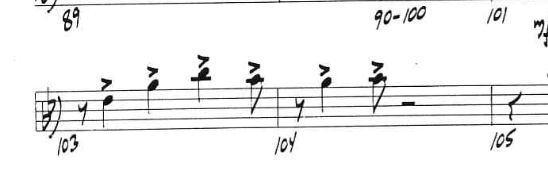
It's Not Polite To Point (Gordon Goodwin)

Granada Smoothy (Mark Taylor)
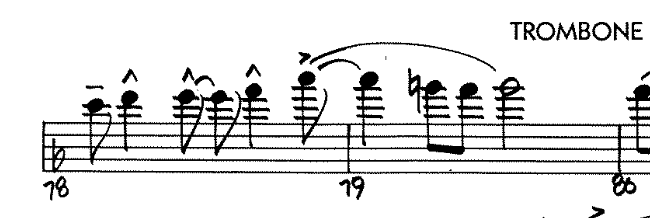
Basie Straight Ahead (Sammy Nestico)
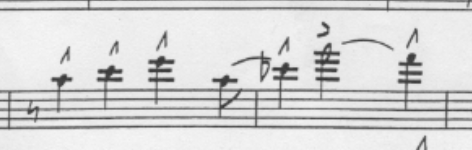
Orange Colored Sky (Roger Holmes)
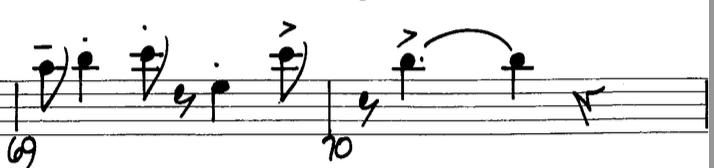
The Day I Saw You (Wendy Jones/David Wilken arr.) - Harrison, the following font is what I'm currently using with Dorico for big band writing, Petaluma.
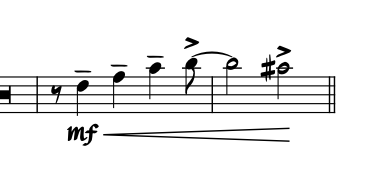
How those rhythms and articulations were written may not have been the decision of the composer/arranger, but may have come from the publisher (who may not have ever played in a big band).
Looking through my collection of jazz arranging text books, I only found one that deals specifically with how to notate things properly. Here's what Commercial Arranging, Vol. 1 (Andrew Charlton and John M. DeVries) has to say:

Yeah, there's a band I sometimes play with that specializes in 1930s-1940s jazz. Much of the book are stock arrangements with very widely different notation. I don't have a bunch of stocks in my library, so I couldn't find something with the specific rhythmic example we've been discussing. But here's something close, from Song of India.
There seems to be less agreement about the conventions for big band writing, compared with notation and engraving for classical styles. I've been looking around now for a single resource that goes over standard big band notation practice and there aren't really a lot out there. The best one I've found is the
Anyone know of any other good ones out there?
But getting back to the conventions, there are differences and it makes sense for composer/arrangers to pick one approach and be consistent, at least in the same chart. Here are some different ways I've found to notate that off-beat quarter note figure Harrison posted (or at least similar to it).
Sesame Street (Denis DiBlasio arrangement, adapted by Bob Lowden)
It's Not Polite To Point (Gordon Goodwin)
Granada Smoothy (Mark Taylor)
Basie Straight Ahead (Sammy Nestico)
Orange Colored Sky (Roger Holmes)
The Day I Saw You (Wendy Jones/David Wilken arr.) - Harrison, the following font is what I'm currently using with Dorico for big band writing, Petaluma.
How those rhythms and articulations were written may not have been the decision of the composer/arranger, but may have come from the publisher (who may not have ever played in a big band).
Looking through my collection of jazz arranging text books, I only found one that deals specifically with how to notate things properly. Here's what Commercial Arranging, Vol. 1 (Andrew Charlton and John M. DeVries) has to say:
- harrisonreed
- Posts: 6479
- Joined: Aug 17, 2018
I will say that the figure with eighths with marcatos over them is NOT the same as syncopated short quarters. Those are big fat "DAHHT"s. It's notated that way on purpose.
Actually you've chosen a lot of examples with marcatos. Not the same thing. These examples are all clean, and not showing the same thing at all. I think you're focused on just the note start timing but missing the accents.
And the alternating quarter / tied eighth is just splitting the bar into two. Maybe a two feel.
Actually you've chosen a lot of examples with marcatos. Not the same thing. These examples are all clean, and not showing the same thing at all. I think you're focused on just the note start timing but missing the accents.
And the alternating quarter / tied eighth is just splitting the bar into two. Maybe a two feel.
- Doug_Elliott
- Posts: 4155
- Joined: Mar 22, 2018
I have not listened to recorded examples if those excerpts...
But I think they are all different composer/arranger/copyist's versions of how to write the same thing.
In big band writing, ^ frequently only means "short," not "marcato."
But I think they are all different composer/arranger/copyist's versions of how to write the same thing.
In big band writing, ^ frequently only means "short," not "marcato."
- TomInME
- Posts: 315
- Joined: Jan 03, 2024
Naming the composer/arranger provides important context about the notation, because they all have their quirks, and the more influential they were, the more likely those quirks became conventions.
Internal consistency is more important than conventions when conventions aren't explicit and/or universally agreed-upon. If I know a composer wrote tenutos when they wanted it short, I'll play them short.
Internal consistency is more important than conventions when conventions aren't explicit and/or universally agreed-upon. If I know a composer wrote tenutos when they wanted it short, I'll play them short.
- Wilktone
- Posts: 720
- Joined: Mar 27, 2018
I was more looking for the rhythmic notation of successive off-beats with the latest examples, rather than the different articulations. But the articulations also aren't standardized between the excerpts either.
[quote="harrisonreed"]I will say that the figure with eighths with marcatos over them is NOT the same as syncopated short quarters. Those are big fat "DAHHT"s. It's notated that way on purpose.[/quote]
This one?
Those were played short by Maynards band.
<YOUTUBE id="3ErOyCIIqzY" t="308">[media]https://youtu.be/3ErOyCIIqzY?si=t5dfHTeEElaPLh7g&t=308</YOUTUBE>
Yes, I was focused with the rhythmic notation, but again, almost all the examples I posted have off beats that were played short by the bands that originally recorded them.
[quote="harrisonreed"]And the alternating quarter / tied eighth is just splitting the bar into two. Maybe a two feel.[/quote]
This one?
If so, yes, that's more of a two feel. It's a very bright samba feel.
<YOUTUBE id="sOHDYoUCRZc" t="66">[media]https://youtu.be/sOHDYoUCRZc?si=tFpMPi0qqiq1Q1Un&t=66</YOUTUBE>
[quote="Doug Elliott"]But I think they are all different composer/arranger/copyist's versions of how to write the same thing.[/quote]
Yep, that's why I posed them. There are different ways that the same figure can be notated, some are better than others. With the exception of the Song of India stock arrangement, all the quarter notes (or tied 8th notes) have an articulation marked. The excerpt with the tenuto markings over them is the only one I posted intended to be played full value. As the arranger of that example I can say with absolute certainty that I wanted the off-beat quarter notes to be played connected. The groove is a bossa on that chart, by the way.
[quote="harrisonreed"]Conventions (such as > meaning "long") don't stop being conventions just because you've never played real big band charts or learned the conventions.[/quote]
Unless they aren't meant to be played long (such as the Maynard example). Different arrangers often use different ways to notate. Personally, I don't want the confusion when I put one of my own charts in front of a band for the first time, so I don't use > over quarter notes unless they are long.
[quote="TomInME"]Internal consistency is more important than conventions when conventions aren't explicit and/or universally agreed-upon.[/quote]
Yes, and listening to the lead player to follow their interpretation.
Dave
[quote="harrisonreed"]I will say that the figure with eighths with marcatos over them is NOT the same as syncopated short quarters. Those are big fat "DAHHT"s. It's notated that way on purpose.[/quote]
This one?
Those were played short by Maynards band.
<YOUTUBE id="3ErOyCIIqzY" t="308">
Actually you've chosen a lot of examples with marcatos. Not the same thing. These examples are all clean, and not showing the same thing at all. I think you're focused on just the note start timing but missing the accents.
Yes, I was focused with the rhythmic notation, but again, almost all the examples I posted have off beats that were played short by the bands that originally recorded them.
[quote="harrisonreed"]And the alternating quarter / tied eighth is just splitting the bar into two. Maybe a two feel.[/quote]
This one?
If so, yes, that's more of a two feel. It's a very bright samba feel.
<YOUTUBE id="sOHDYoUCRZc" t="66">
[quote="Doug Elliott"]But I think they are all different composer/arranger/copyist's versions of how to write the same thing.[/quote]
Yep, that's why I posed them. There are different ways that the same figure can be notated, some are better than others. With the exception of the Song of India stock arrangement, all the quarter notes (or tied 8th notes) have an articulation marked. The excerpt with the tenuto markings over them is the only one I posted intended to be played full value. As the arranger of that example I can say with absolute certainty that I wanted the off-beat quarter notes to be played connected. The groove is a bossa on that chart, by the way.
[quote="harrisonreed"]Conventions (such as > meaning "long") don't stop being conventions just because you've never played real big band charts or learned the conventions.[/quote]
Unless they aren't meant to be played long (such as the Maynard example). Different arrangers often use different ways to notate. Personally, I don't want the confusion when I put one of my own charts in front of a band for the first time, so I don't use > over quarter notes unless they are long.
[quote="TomInME"]Internal consistency is more important than conventions when conventions aren't explicit and/or universally agreed-upon.[/quote]
Yes, and listening to the lead player to follow their interpretation.
Dave
- tbdana
- Posts: 1928
- Joined: Apr 08, 2023
[quote="Wilktone"]Yes, and listening to the lead player to follow their interpretation.[/quote]
All these posts, and right there is the ultimate answer.
All these posts, and right there is the ultimate answer.
- Wilktone
- Posts: 720
- Joined: Mar 27, 2018
Well, Doug did mention following the lead trumpet earlier.
But as an arranger, I don't want to count on my lead players to accurately guess the articulation I want. This thread started because there were players who must have been listening to each other well enough to play the wrong articulation.
But as an arranger, I don't want to count on my lead players to accurately guess the articulation I want. This thread started because there were players who must have been listening to each other well enough to play the wrong articulation.
- robcat2075
- Posts: 1867
- Joined: Sep 03, 2018
Naming the composer/arranger provides important context about the notation, because they all have their quirks, and the more influential they were, the more likely those quirks became conventions.
imagine if we had to know who the Road Commissioner was in a city when a sign was installed to discern its true meaning.
- harrisonreed
- Posts: 6479
- Joined: Aug 17, 2018
[quote="tbdana"]<QUOTE author="Wilktone" post_id="283346" time="1754919416" user_id="220">
Yes, and listening to the lead player to follow their interpretation.[/quote]
All these posts, and right there is the ultimate answer.
</QUOTE>
Agree
Yes, and listening to the lead player to follow their interpretation.[/quote]
All these posts, and right there is the ultimate answer.
</QUOTE>
Agree
- TomInME
- Posts: 315
- Joined: Jan 03, 2024
[quote="robcat2075"]<QUOTE>
Naming the composer/arranger provides important context about the notation, because they all have their quirks, and the more influential they were, the more likely those quirks became conventions.[/quote]
imagine if we had to know who the Road Commissioner was in a city when a sign was installed to discern its true meaning.
</QUOTE>
If you don't know what country you're in, which side of the road do you drive on? Context matters. Especially when conventions aren't 100% consistent.
As for following the lead player, what if the lead isn't playing there? What if you're the lead? How do you know what the composer was looking for?
1. If they're alive, let them know that it's not clear and ask what they meant.
2. Listen to recordings if possible, and compare them with the notation. THIS is really useful, because how you feel it should look and how it actually looks are often very different.
3. Learn the historical context.
All of those things require effort and giving up your personal biases, so I get why most people don't bother.
Composers should read that list in reverse order: historical context first, then use recordings to learn how those writers' conventions looked and sounded, then be clear about what you want (using words is OK - composers have done this for centuries).
Naming the composer/arranger provides important context about the notation, because they all have their quirks, and the more influential they were, the more likely those quirks became conventions.[/quote]
imagine if we had to know who the Road Commissioner was in a city when a sign was installed to discern its true meaning.
</QUOTE>
If you don't know what country you're in, which side of the road do you drive on? Context matters. Especially when conventions aren't 100% consistent.
As for following the lead player, what if the lead isn't playing there? What if you're the lead? How do you know what the composer was looking for?
1. If they're alive, let them know that it's not clear and ask what they meant.
2. Listen to recordings if possible, and compare them with the notation. THIS is really useful, because how you feel it should look and how it actually looks are often very different.
3. Learn the historical context.
All of those things require effort and giving up your personal biases, so I get why most people don't bother.
Composers should read that list in reverse order: historical context first, then use recordings to learn how those writers' conventions looked and sounded, then be clear about what you want (using words is OK - composers have done this for centuries).
- tbdana
- Posts: 1928
- Joined: Apr 08, 2023
[quote="TomInME"]As for following the lead player, what if the lead isn't playing there? What if you're the lead? How do you know what the composer was looking for?
1. If they're alive, let them know that it's not clear and ask what they meant.
2. Listen to recordings if possible, and compare them with the notation. THIS is really useful, because how you feel it should look and how it actually looks are often very different.
3. Learn the historical context.
All of those things require effort and giving up your personal biases, so I get why most people don't bother.
Composers should read that list in reverse order: historical context first, then use recordings to learn how those writers' conventions looked and sounded, then be clear about what you want (using words is OK - composers have done this for centuries).[/quote]
A couple observations. First, I think everything Tom said is good, except the little snark about personal biases. It's all great. But a lot of posts in this discussion don't reflect the practical aspects for someone sitting down to a part and playing it. So I just want to focus on that part for a minute. To me, it's a practical question, not a theoretical one. As a trombone player, I sit down in front of a chart and have to play it. So, what do I do when I get to those unmarked or weirdly marked quarter notes?
This thread has drifted (as they all do) from the original post to discussing big band notations, with varying excerpts that were provided as examples. I'll stick with that part of it.
As with any genre, musicians are expected to understand that genre's contexts and conventions. In big band music and jazz in general, the conventions are much more about how something sounds or is played than how it is notated. Musicians are expected to know how the passage sounds in context, rather than knowing how to interpret figures on a page. In big band music it's more about hearing and feeling than seeing.
"Follow the lead player" is the first and most important of the Big Band 10 Commandments. Much is left to interpretation. Find the groove, follow the lead player. If I don't know how to interpret something and I'm not the lead player, I only have to hear a few notes from any decent lead player to know how the whole chart is to be played.
Then you are the lead player for the moment, and it's your job to know. In practical terms, unless it's the first few bars of the chart, you've heard this rhythm played earlier by the lead player, so copy that. These interpretations get established early on in the piece and carry throughout the chart.
Then you should know how to play it. You should be able to hear it and feel it. It doesn't matter how the arranger notated it, 99% of the time you're going to know the feel. If you don't know that stuff, then look to what the lead trumpet or sax is setting down, and do that. If that didn't happen and you're just stumped, ask the damn bandleader how he wants it played. And this is big band jazz we're talking about, not some 19th century historical thing. It really doesn't matter how it was played on the recording. In jazz, people get to put their own stamp on things. If the bandleader wants it a certain way, that's the way you play it. Jazz is entirely malleable. There are conventions as general guidelines, but if the bandleader (or lead trumpet) feel it in a way different from the recording, that's how it's going to be.
In big band music, unless he's there conducting, who cares what the composer was looking for?
For some of us, when we hear "listen to the recording," we're sometimes the ones who played it on the recording. We who playe these things on recordings didn't have any special knowledge when we recorded it. There was likely zero discussion about it in the context of the recording session. The fact is that 99% of these inconsistent notations fall within the hearing conventions, so it doesn't really matter how it was written.
As I'm writing this, I'm remembering playing on one of Watrous' albums. I think it was A Time For Love. At the end of the session we had a few more minutes, so they passed out a chart we had never seen before. It was "Not Really The Blues," which I think was arranged by Sammy Nestico. We had no rehearsal time, we just sight read it and did it in one take, and it made it onto the record. The whole tune is based on a four-note quarter note pattern that repeats, on and off the beat, throughout the chart. None of the quarter notes were marked. There was no indication of duration on a single one. And yet, sight reading the chart with the red light on, everyone played those notes exactly the same because people knew the conventions and followed the lead trumpet (Wayne Bergeron on this tune).
Actually, I found the recording, even though the tune name is wrong. This was recorded in one take with no rehearsal. Listen to all those short quarter notes, even though not a single one was marked short. How did everyone know to play them that way?
<YOUTUBE id="Tk3BnHc9gMU">https://youtu.be/Tk3BnHc9gMU?si=XiNAHbV__HXpWmED</YOUTUBE>
So, yeah, as a practical matter for musicians sitting there faced with having to figure out how to play a chart, there are conventions of how things "sound" more so than how they are "written" for big bands, so knowing those conventions solves the problem most of the time.
But if someone could convince composers/arrangers of a coherent and consistent notation convention for these things, that would obviate the need to be "in the know."
1. If they're alive, let them know that it's not clear and ask what they meant.
2. Listen to recordings if possible, and compare them with the notation. THIS is really useful, because how you feel it should look and how it actually looks are often very different.
3. Learn the historical context.
All of those things require effort and giving up your personal biases, so I get why most people don't bother.
Composers should read that list in reverse order: historical context first, then use recordings to learn how those writers' conventions looked and sounded, then be clear about what you want (using words is OK - composers have done this for centuries).[/quote]
A couple observations. First, I think everything Tom said is good, except the little snark about personal biases. It's all great. But a lot of posts in this discussion don't reflect the practical aspects for someone sitting down to a part and playing it. So I just want to focus on that part for a minute. To me, it's a practical question, not a theoretical one. As a trombone player, I sit down in front of a chart and have to play it. So, what do I do when I get to those unmarked or weirdly marked quarter notes?
This thread has drifted (as they all do) from the original post to discussing big band notations, with varying excerpts that were provided as examples. I'll stick with that part of it.
As with any genre, musicians are expected to understand that genre's contexts and conventions. In big band music and jazz in general, the conventions are much more about how something sounds or is played than how it is notated. Musicians are expected to know how the passage sounds in context, rather than knowing how to interpret figures on a page. In big band music it's more about hearing and feeling than seeing.
"Follow the lead player" is the first and most important of the Big Band 10 Commandments. Much is left to interpretation. Find the groove, follow the lead player. If I don't know how to interpret something and I'm not the lead player, I only have to hear a few notes from any decent lead player to know how the whole chart is to be played.
what if the lead isn't playing there?
Then you are the lead player for the moment, and it's your job to know. In practical terms, unless it's the first few bars of the chart, you've heard this rhythm played earlier by the lead player, so copy that. These interpretations get established early on in the piece and carry throughout the chart.
What if you're the lead?
Then you should know how to play it. You should be able to hear it and feel it. It doesn't matter how the arranger notated it, 99% of the time you're going to know the feel. If you don't know that stuff, then look to what the lead trumpet or sax is setting down, and do that. If that didn't happen and you're just stumped, ask the damn bandleader how he wants it played. And this is big band jazz we're talking about, not some 19th century historical thing. It really doesn't matter how it was played on the recording. In jazz, people get to put their own stamp on things. If the bandleader wants it a certain way, that's the way you play it. Jazz is entirely malleable. There are conventions as general guidelines, but if the bandleader (or lead trumpet) feel it in a way different from the recording, that's how it's going to be.
How do you know what the composer was looking for?
In big band music, unless he's there conducting, who cares what the composer was looking for?
For some of us, when we hear "listen to the recording," we're sometimes the ones who played it on the recording. We who playe these things on recordings didn't have any special knowledge when we recorded it. There was likely zero discussion about it in the context of the recording session. The fact is that 99% of these inconsistent notations fall within the hearing conventions, so it doesn't really matter how it was written.
As I'm writing this, I'm remembering playing on one of Watrous' albums. I think it was A Time For Love. At the end of the session we had a few more minutes, so they passed out a chart we had never seen before. It was "Not Really The Blues," which I think was arranged by Sammy Nestico. We had no rehearsal time, we just sight read it and did it in one take, and it made it onto the record. The whole tune is based on a four-note quarter note pattern that repeats, on and off the beat, throughout the chart. None of the quarter notes were marked. There was no indication of duration on a single one. And yet, sight reading the chart with the red light on, everyone played those notes exactly the same because people knew the conventions and followed the lead trumpet (Wayne Bergeron on this tune).
Actually, I found the recording, even though the tune name is wrong. This was recorded in one take with no rehearsal. Listen to all those short quarter notes, even though not a single one was marked short. How did everyone know to play them that way?
<YOUTUBE id="Tk3BnHc9gMU">https://youtu.be/Tk3BnHc9gMU?si=XiNAHbV__HXpWmED</YOUTUBE>
So, yeah, as a practical matter for musicians sitting there faced with having to figure out how to play a chart, there are conventions of how things "sound" more so than how they are "written" for big bands, so knowing those conventions solves the problem most of the time.
But if someone could convince composers/arrangers of a coherent and consistent notation convention for these things, that would obviate the need to be "in the know."
- robcat2075
- Posts: 1867
- Joined: Sep 03, 2018
[quote="TomInME"]<QUOTE author="robcat2075" post_id="283353" time="1754923139" user_id="3697">
imagine if we had to know who the Road Commissioner was in a city when a sign was installed to discern its true meaning.[/quote]
If you don't know what country you're in, which side of the road do you drive on? Context matters. Especially when conventions aren't 100% consistent.
</QUOTE>
[size=75]
(...it's an allegory.)
imagine if we had to know who the Road Commissioner was in a city when a sign was installed to discern its true meaning.[/quote]
If you don't know what country you're in, which side of the road do you drive on? Context matters. Especially when conventions aren't 100% consistent.
</QUOTE>
(...it's an allegory.)
- Wilktone
- Posts: 720
- Joined: Mar 27, 2018
[quote="tbdana"]In big band music, unless he's there conducting, who cares what the composer was looking for?[/quote]
Hey! I do! When it's my music.
But if my sheet music isn't clearly marked, then it's my fault if the band didn't understand what I was after. And if it's their conscious decision to change something, then at least it wasn't my fault for being too lazy to mark my parts correctly. Maybe what they play ends up being better, that's happened to my music before.
[quote="tbdana"]So, yeah, as a practical matter for musicians sitting there faced with having to figure out how to play a chart, there are conventions of how things "sound" more so than how they are "written" for big bands, so knowing those conventions solves the problem most of the time.
But if someone could convince composers/arrangers of a coherent and consistent notation convention for these things, that would obviate the need to be "in the know."[/quote]
The players should understand the tradition and what's expected. The arranger also needs to understand the tradition and what the players need to perform the music correctly with as little ambiguity as possible.
From the Evan Rogers resource on[url=https://www.evanrogersmusic.com/blog-contents/big-band-arranging/articulation]big band articulations:
Hey! I do! When it's my music.
But if my sheet music isn't clearly marked, then it's my fault if the band didn't understand what I was after. And if it's their conscious decision to change something, then at least it wasn't my fault for being too lazy to mark my parts correctly. Maybe what they play ends up being better, that's happened to my music before.
[quote="tbdana"]So, yeah, as a practical matter for musicians sitting there faced with having to figure out how to play a chart, there are conventions of how things "sound" more so than how they are "written" for big bands, so knowing those conventions solves the problem most of the time.
But if someone could convince composers/arrangers of a coherent and consistent notation convention for these things, that would obviate the need to be "in the know."[/quote]
The players should understand the tradition and what's expected. The arranger also needs to understand the tradition and what the players need to perform the music correctly with as little ambiguity as possible.
From the Evan Rogers resource on
What's the biggest tell-tale sign of a non-jazz musician arranging jazz? Other than perhaps the infamous 'dotted-8th-note-16th-note' swing pattern, it's probably the use - or misuse - of articulation.
Ignoring harmony, form and the eye-sore of a font that is Inkpen 2, the most immediately obvious symbols that tell you it’s a jazz chart are the liberal use of articulation markings. Getting these wrong shows a player at first glance they'll have to figure out the phrasing on their own and that the arranger does not have their back. It would be synonymous with turning up to a session and seeing an orchestral score place the strings above the brass - no matter how well it's orchestrated, it's difficult to be taken seriously when the stylistic fundamental are so wrong.
- TomInME
- Posts: 315
- Joined: Jan 03, 2024
[quote="robcat2075"]<QUOTE author="TomInME" post_id="283358" time="1754925434" user_id="17474">
If you don't know what country you're in, which side of the road do you drive on? Context matters. Especially when conventions aren't 100% consistent.[/quote]
[size=75]
(...it's an allegory.)
</QUOTE>
It's a failed allegory.
If you don't know what country you're in, which side of the road do you drive on? Context matters. Especially when conventions aren't 100% consistent.[/quote]
(...it's an allegory.)
</QUOTE>
It's a failed allegory.
- TomInME
- Posts: 315
- Joined: Jan 03, 2024
[quote="tbdana"]As with any genre, musicians are expected to understand that genre's contexts and conventions.[/quote]
This really gets to the core of the discussion, because "musicians" should include the composer/arranger, and the problems result from them (or the performers) not understanding the genre. Big band is more than just a different instrumentation.
As for recordings, those are a supplement, when available - and that's a major difference between jazz and classical. We don't have original recordings of Bach or Brahms, but we do of Ellington, Ella, Armstrong and everyone else. How can you expect to play in the style of those masters, or any of the styles that descended from theirs, without ever having listened to any of them? That's a core part of understanding the genre.
If you're reading something and have zero information from or about the composer/arranger, then all that the players have to go by is what's on the page and the contexts and conventions of the genre. That's fine (assuming the players are knowledgeable about those contexts and conventions). But it's not an excuse to avoid learning more about what the composer specifically wanted/wants if you have the opportunity to do so. Especially if they're in the same room!
This really gets to the core of the discussion, because "musicians" should include the composer/arranger, and the problems result from them (or the performers) not understanding the genre. Big band is more than just a different instrumentation.
As for recordings, those are a supplement, when available - and that's a major difference between jazz and classical. We don't have original recordings of Bach or Brahms, but we do of Ellington, Ella, Armstrong and everyone else. How can you expect to play in the style of those masters, or any of the styles that descended from theirs, without ever having listened to any of them? That's a core part of understanding the genre.
If you're reading something and have zero information from or about the composer/arranger, then all that the players have to go by is what's on the page and the contexts and conventions of the genre. That's fine (assuming the players are knowledgeable about those contexts and conventions). But it's not an excuse to avoid learning more about what the composer specifically wanted/wants if you have the opportunity to do so. Especially if they're in the same room!
- AndrewMeronek
- Posts: 1487
- Joined: Mar 30, 2018
[quote="Wilktone"]But as an arranger, I don't want to count on my lead players to accurately guess the articulation I want.[/quote]
The whole "follow the lead player" comes with a grain of salt: I have to trust them to play what's on the page, accurately, and stylistically. If that's all there then yes, absolutely follow the lead player - and it's even easy! If the lead player is guessing, then the 1st time reading a particular phrase is a crapshoot, and let's hope that the lead player plays it the same the next time around. You can't "follow the lead player" if you can't predict the lead player.
The whole "follow the lead player" comes with a grain of salt: I have to trust them to play what's on the page, accurately, and stylistically. If that's all there then yes, absolutely follow the lead player - and it's even easy! If the lead player is guessing, then the 1st time reading a particular phrase is a crapshoot, and let's hope that the lead player plays it the same the next time around. You can't "follow the lead player" if you can't predict the lead player.
- TomInME
- Posts: 315
- Joined: Jan 03, 2024
[quote="AndrewMeronek"]You can't "follow the lead player" if you can't predict the lead player.[/quote]
:clever:
:clever:
- tbdana
- Posts: 1928
- Joined: Apr 08, 2023
[quote="AndrewMeronek"]You can't "follow the lead player" if you can't predict the lead player.[/quote]
Well, that's a pretty terrible lead player, then. Either this is a group playing at a very low level (in which case you'll probably never get agreement on note duration, much less things like pitch, time, and groove), or that person has no business being on lead.
A lead trombone player first follows the lead trumpet. If s/he can't do that in any predictable way, that's a problem.
If the lead player isn't predictable, then absolutely none of this thread matters, because no matter how perfectly the charts are notated, or how perfectly you honor that notation, that lead player is going to screw it up for everyone.
Well, that's a pretty terrible lead player, then. Either this is a group playing at a very low level (in which case you'll probably never get agreement on note duration, much less things like pitch, time, and groove), or that person has no business being on lead.
A lead trombone player first follows the lead trumpet. If s/he can't do that in any predictable way, that's a problem.
If the lead player isn't predictable, then absolutely none of this thread matters, because no matter how perfectly the charts are notated, or how perfectly you honor that notation, that lead player is going to screw it up for everyone.
- harrisonreed
- Posts: 6479
- Joined: Aug 17, 2018
Agree <EMOJI seq="2b06" tseq="2b06">⬆️</EMOJI>
- AndrewMeronek
- Posts: 1487
- Joined: Mar 30, 2018
. . . and that brings it right back around to
:(
Does Tenuto actually mean "full value"?
:(
- Wilktone
- Posts: 720
- Joined: Mar 27, 2018
[quote="AndrewMeronek"]. . . and that brings it right back around to
<QUOTE>Does Tenuto actually mean "full value"?[/quote]
:(
</QUOTE>
Sorry for the thread creep. But in our defense...
[quote="LeTromboniste"]I meant that yes, generally that indicates full duration, but in certain contexts it means more than merely full duration. Especially in contexts where the default for an unmarked note already tends to be pretty much full duration. Then it's more about the articulation and shape of the note than the actual value[/quote]
[quote="Wilktone"]Yes, it should indicate the note is to be played full value.[/quote]
[quote="Wilktone"]Yeah, I agree that it’s strange for good players to not play tenuto full value.[/quote]
[quote="Mamaposaune"]Back in the days when I was playing in a British-style brass band, our British-born and raised conductor said that over there, tenuto markings over the notes are meant to be played long and slightly accented.[/quote]
None of us have come up with any examples of tenuto markings that are intended to be played full value (unless you consider portato marked with a dash and a dot, which isn't tenuto).
But let me ask you again, is this because the players are lazy and just not playing things full value (perhaps being unaware of their mistake) or are they misinterpreting the marking?
Dave
<QUOTE>Does Tenuto actually mean "full value"?[/quote]
:(
</QUOTE>
Sorry for the thread creep. But in our defense...
[quote="LeTromboniste"]I meant that yes, generally that indicates full duration, but in certain contexts it means more than merely full duration. Especially in contexts where the default for an unmarked note already tends to be pretty much full duration. Then it's more about the articulation and shape of the note than the actual value[/quote]
[quote="Wilktone"]Yes, it should indicate the note is to be played full value.[/quote]
[quote="Wilktone"]Yeah, I agree that it’s strange for good players to not play tenuto full value.[/quote]
[quote="Mamaposaune"]Back in the days when I was playing in a British-style brass band, our British-born and raised conductor said that over there, tenuto markings over the notes are meant to be played long and slightly accented.[/quote]
None of us have come up with any examples of tenuto markings that are intended to be played full value (unless you consider portato marked with a dash and a dot, which isn't tenuto).
But let me ask you again, is this because the players are lazy and just not playing things full value (perhaps being unaware of their mistake) or are they misinterpreting the marking?
Dave
- AndrewMeronek
- Posts: 1487
- Joined: Mar 30, 2018
[quote="Wilktone"]But let me ask you again, is this because the players are lazy and just not playing things full value (perhaps being unaware of their mistake) or are they misinterpreting the marking?[/quote]
Both, in my experience.
I guess this has simply become a pet peeve of mine.
:shuffle:
Both, in my experience.
I guess this has simply become a pet peeve of mine.
:shuffle:
- AndrewMeronek
- Posts: 1487
- Joined: Mar 30, 2018
Providing another example (and this is simply a really fun tune). See the timestamp of the shout chorus starting at 1:17 :
<YOUTUBE id="BVURcG-RWU8">[media]https://www.youtube.com/watch?v=BVURcG-RWU8</YOUTUBE>
The band I mentioned in a different thread has a reasonably good transcription of this tune, and these 4 quarter notes of that first measure happen in that version to be notated tenuto, marcato, tenuto, marcato. This is, the horizontal wedge and not the vertical wedge.
I know the horizontal wedge interpretation has TONS of variations, so that I definitely forgive. And the tenuto marking is correct according to the recording, assuming it DOES mean "full value".
Oh, and it's worth noting that lead trumpet players in "the band I mentioned" NEVER are ambiguous about stuff like this. They're pros, and wonderful to perform with.
<YOUTUBE id="BVURcG-RWU8">
The band I mentioned in a different thread has a reasonably good transcription of this tune, and these 4 quarter notes of that first measure happen in that version to be notated tenuto, marcato, tenuto, marcato. This is, the horizontal wedge and not the vertical wedge.
I know the horizontal wedge interpretation has TONS of variations, so that I definitely forgive. And the tenuto marking is correct according to the recording, assuming it DOES mean "full value".
Oh, and it's worth noting that lead trumpet players in "the band I mentioned" NEVER are ambiguous about stuff like this. They're pros, and wonderful to perform with.
- Doug_Elliott
- Posts: 4155
- Joined: Mar 22, 2018
I would notate those quarters: accent with tenuto, and housetop with dot, to leave no question of how it is to be played.
(Typing these on separate lines)
> ^ > ^
_ . _ .
(Typing these on separate lines)
> ^ > ^
_ . _ .