Advantages of axial flow valves
- norbie2018
- Posts: 1051
- Joined: Apr 05, 2018
I've played large bore trombones with rotors since I started at 15: Holton tr150, various Bach 42b, and, for the last 10+ years, a slightly modified Yamaha 882go. All I know are rotors. What are the advantages of axial flow valves?
- Burgerbob
- Posts: 6327
- Joined: Apr 23, 2018
The members here will tell you that they are air hogs and not worth it, of course... And I am selling mine! But, I think they are some of the best choices for bass trombones.
The 42 also takes very well to a Thayer. I have played several with different kinds of axials that were very good.
Basically, you are dealing with less resistance. The blow is much different from the perspective of the player, both with and without the valves. If you can supply the air, then it's just a good thing.
The sound is also different. You'll get a larger, broader sound with the valves engaged than with most other valves. This is what draws me to them for the most part.
Play some!
The 42 also takes very well to a Thayer. I have played several with different kinds of axials that were very good.
Basically, you are dealing with less resistance. The blow is much different from the perspective of the player, both with and without the valves. If you can supply the air, then it's just a good thing.
The sound is also different. You'll get a larger, broader sound with the valves engaged than with most other valves. This is what draws me to them for the most part.
Play some!
- norbie2018
- Posts: 1051
- Joined: Apr 05, 2018
[quote="Burgerbob"]Play some![/quote]
That's my intent.
That's my intent.
- harrisonreed
- Posts: 6479
- Joined: Aug 17, 2018
I actually perceive more resistance on an axial. It probably has to do with how I use my air (I use a lot). I like them.
- TheBoneRanger
- Posts: 225
- Joined: Apr 04, 2018
[quote="Burgerbob"]The sound is also different. You'll get a larger, broader sound with the valves engaged than with most other valves. This is what draws me to them for the most part.[/quote]
I'd agree with this, and add that it also has an influence on articulation. Thayers have quite an effect over all aspects of a horn.
[quote="harrisonreed"]I actually perceive more resistance on an axial. It probably has to do with how I use my air (I use a lot). I like them.[/quote]
It could also be that you are generating more resistance at the lips in order to counter the more open instrument.
For all of the above reasons, after many years, I find myself gravitating away from instruments with axial valves.
Andrew
I'd agree with this, and add that it also has an influence on articulation. Thayers have quite an effect over all aspects of a horn.
[quote="harrisonreed"]I actually perceive more resistance on an axial. It probably has to do with how I use my air (I use a lot). I like them.[/quote]
It could also be that you are generating more resistance at the lips in order to counter the more open instrument.
For all of the above reasons, after many years, I find myself gravitating away from instruments with axial valves.
Andrew
- norbie2018
- Posts: 1051
- Joined: Apr 05, 2018
[quote="TheBoneRanger"]I'd agree with this, and add that it also has an influence on articulation. Thayers have quite an effect over all aspects of a horn.[/quote]
How does it influence articulations?
How does it influence articulations?
- elmsandr
- Posts: 1373
- Joined: Mar 23, 2018
You can get addicted to how they blow, especially on a bass bone. It can just be so easy and open down low that you seem powerful and fully in control with less effort.
I still love them, but I am turning gradually to easier maintenance horns. A couple of Shires trubores and a 60-70 year old rotor. I do miss blowing the hinges off some times, but it really is a lot easier for everything else with a slightly tighter valve.
Cheers,
Andy
I still love them, but I am turning gradually to easier maintenance horns. A couple of Shires trubores and a 60-70 year old rotor. I do miss blowing the hinges off some times, but it really is a lot easier for everything else with a slightly tighter valve.
Cheers,
Andy
- Burgerbob
- Posts: 6327
- Joined: Apr 23, 2018
[quote="norbie2018"]<QUOTE author="TheBoneRanger" post_id="80583" time="1552610214" user_id="2973">
I'd agree with this, and add that it also has an influence on articulation. Thayers have quite an effect over all aspects of a horn.[/quote]
How does it influence articulations?
</QUOTE>
There's less to blow against, so you have to provide more of the articulation yourself. I'm using a Hagmann set right now and having a hard time dialing that back, actually...
I'd agree with this, and add that it also has an influence on articulation. Thayers have quite an effect over all aspects of a horn.[/quote]
How does it influence articulations?
</QUOTE>
There's less to blow against, so you have to provide more of the articulation yourself. I'm using a Hagmann set right now and having a hard time dialing that back, actually...
- TheBoneRanger
- Posts: 225
- Joined: Apr 04, 2018
[quote="norbie2018"]How does it influence articulations?[/quote]
Like most equipment choices, the answer is: it depends.
Generally speaking, because a Thayer-equipped horn is more open (and often heavier and slower responding), a horn so-equipped necessitates a different approach to your air in order to gain the same 'ping' to the front of the note.
There are ways to overcome such things, of course, and these characteristics may actually be of benefit to your personal approach to playing.
Andrew
Like most equipment choices, the answer is: it depends.
Generally speaking, because a Thayer-equipped horn is more open (and often heavier and slower responding), a horn so-equipped necessitates a different approach to your air in order to gain the same 'ping' to the front of the note.
There are ways to overcome such things, of course, and these characteristics may actually be of benefit to your personal approach to playing.
Andrew
- fwbassbone
- Posts: 131
- Joined: Apr 07, 2018
I played a Shires Bollinger model for a couple of years and went back to rotors when I got my Greenhoe. For me the the Greenhoe works better but there are plenty of people who sound great on axials. Go with what feels best to you. The two bass trombones I have now are the Greenhoe and an Edwards B502. I like them both but thats me, your opinion may vary greatly.
- norbie2018
- Posts: 1051
- Joined: Apr 05, 2018
If a person likes the openness in blow and broadness of sound axial flows provide but wants "help" from the horn for articulation, can this be provided by leadpipe choice? Harmonic brace on the edwards?
- Matt_K
- Posts: 4809
- Joined: Mar 21, 2018
[quote="norbie2018"]If a person likes the openness in blow and broadness of sound axial flows provide but wants "help" from the horn for articulation, can this be provided by leadpipe choice? Harmonic brace on the edwards?[/quote]
Yeah so basically the horn is a collection of its parts and so a Thayer won't necessarily work on any collection of components just in the same way a rotor may not. There are horns that are middle-of-the-road enough to work on both depending on what you want out of it... but there are other horns where it probably won't be a good fit for just about anyone.
The clearest example of this that I've experienced was two Shires tenors that I owned. Both were really great horns... one was a 2.5SS, T47LW, rotor, seamed yellow ts, 2RVET7. The other was a '2', TB4762, thayer, drawn gold ts, and a 2Y. So rather different on paper. As I mentioned, each horn played really well; I preferred the former but I definitely see the appeal in the latter. Very close. However, when I swapped the valves... no dice on either horn. Former became really diffuse and the second was a hard blow. Swapping the slides around brought things into focus on one and made it easier on the other but still not so good... ditto on the leadpipe. But the closer I got to their original configurations, the better they were.
So in my estimation the literal and simple answer to your question is, "No." However, it would be more accurate to say, "It depends." Thayers aren't a panacea in the same way that any other component isn't a panacea, but they *can* be on a horn that otherwise feels tight or overly difficult to steer. In other words... the Thayer itself isn't necessarily causes it to blow the way it does but it is a major factor as is the leadpipe BUT it isn't guaranteed that the end result will be a horn that is open in blow w/ broadness of sound. However, historically it has worked because throughout the 80s, 90s it seems like most people were 'upgrading' Bach horns, and heavy ones at that. Those tend to be good horns to transition to thayers. And the leadpipe also is fairly conducive to that way of playing as well. (I believe similar to a Shires 1.5 if I've been told correctly).
Yeah so basically the horn is a collection of its parts and so a Thayer won't necessarily work on any collection of components just in the same way a rotor may not. There are horns that are middle-of-the-road enough to work on both depending on what you want out of it... but there are other horns where it probably won't be a good fit for just about anyone.
The clearest example of this that I've experienced was two Shires tenors that I owned. Both were really great horns... one was a 2.5SS, T47LW, rotor, seamed yellow ts, 2RVET7. The other was a '2', TB4762, thayer, drawn gold ts, and a 2Y. So rather different on paper. As I mentioned, each horn played really well; I preferred the former but I definitely see the appeal in the latter. Very close. However, when I swapped the valves... no dice on either horn. Former became really diffuse and the second was a hard blow. Swapping the slides around brought things into focus on one and made it easier on the other but still not so good... ditto on the leadpipe. But the closer I got to their original configurations, the better they were.
So in my estimation the literal and simple answer to your question is, "No." However, it would be more accurate to say, "It depends." Thayers aren't a panacea in the same way that any other component isn't a panacea, but they *can* be on a horn that otherwise feels tight or overly difficult to steer. In other words... the Thayer itself isn't necessarily causes it to blow the way it does but it is a major factor as is the leadpipe BUT it isn't guaranteed that the end result will be a horn that is open in blow w/ broadness of sound. However, historically it has worked because throughout the 80s, 90s it seems like most people were 'upgrading' Bach horns, and heavy ones at that. Those tend to be good horns to transition to thayers. And the leadpipe also is fairly conducive to that way of playing as well. (I believe similar to a Shires 1.5 if I've been told correctly).
- hyperbolica
- Posts: 3990
- Joined: Mar 23, 2018
I can see why people get seduced by axials. The first time I played a set, I was kind of blown away by how little resistance there was. But then I realized that resistance is what makes the world go round, trombonistically speaking. I prefer the horn providing the resistance rather than having to think about providing that myself at the chops. I play a Kanstul 1662i with the open-ish CR rotors (CR for controlled resistance). I think they work like some of the big Shires rotors, but they're made differently (and a bit lighter).
Plus, axials are tougher to maintain, it seems. And heavy.
Someone else mentioned Hagmanns. I think I'd go that way if I had to make another choice. They make for a funky wrap, but seem to have some similarities to rotors in how they play, with a bit more openness.
Plus, axials are tougher to maintain, it seems. And heavy.
Someone else mentioned Hagmanns. I think I'd go that way if I had to make another choice. They make for a funky wrap, but seem to have some similarities to rotors in how they play, with a bit more openness.
- ExZacLee
- Posts: 153
- Joined: May 09, 2018
I really dug the openness of the Axial - if you feel like a traditional rotor gives too much pushback, you might dig the axial. That low B in T7+ is easiest with an axial IMO.
I didn't dig the air hog factor so much, but adjusting to it wasn't difficult. It's just different. Never had adjustment or maintenance issues, I don't eat before I play and I take pretty good care of my equipment - and I don't open up my triggers. If you like to eat before you play you might wanna find something else.
Worst part of axial was the throw... my thumb/left hand got tired well before the chops ever did.
I didn't dig the air hog factor so much, but adjusting to it wasn't difficult. It's just different. Never had adjustment or maintenance issues, I don't eat before I play and I take pretty good care of my equipment - and I don't open up my triggers. If you like to eat before you play you might wanna find something else.
Worst part of axial was the throw... my thumb/left hand got tired well before the chops ever did.
- harrisonreed
- Posts: 6479
- Joined: Aug 17, 2018
I don't agreee with axials being tough to maintain. Who is deciding that? I don't even play on axials, but I'd prefer to maintain them. Anyone who has ever reseated a bearing plate would know that axials, which literally come apart with a twist of a few screws and a ring, are way easier to take apart and clean.
- Burgerbob
- Posts: 6327
- Joined: Apr 23, 2018
Yup, I much prefer to take an axial section apart to clean than rotors. It looks scarier because the bell section ends up in so many pieces!
- norbie2018
- Posts: 1051
- Joined: Apr 05, 2018
I get the impression that if you oil axials every couple of weeks and clean them out every 6 months to a year you're good to go.
- Burgerbob
- Posts: 6327
- Joined: Apr 23, 2018
It depends. I had to clean my last set every couple of weeks, and I would probably clean valves more often than 6 months apart...
As for oiling, much more often than every couple of weeks, unless you're using Infinity valves.
As for oiling, much more often than every couple of weeks, unless you're using Infinity valves.
- harrisonreed
- Posts: 6479
- Joined: Aug 17, 2018
Because they are infinite
- Matt_K
- Posts: 4809
- Joined: Mar 21, 2018
Yeah you should be oiling basically anythign more often than that. Remember, it isn't necessarily about the action per se --- the oil keeps the rotor from corroding. NAPBIRT recommends a few drops every time you play regardless of what type if I"m not mistaken.
- norbie2018
- Posts: 1051
- Joined: Apr 05, 2018
My impressions came directly from the Edwards website.
- Burgerbob
- Posts: 6327
- Joined: Apr 23, 2018
Well... I would take that with a grain of salt, sadly.
I've definitely seen/played my fair share of pretty trashed Edwards axials from lack of care.
I've definitely seen/played my fair share of pretty trashed Edwards axials from lack of care.
- Matt_K
- Posts: 4809
- Joined: Mar 21, 2018
[quote="norbie2018"]My impressions came directly from the Edwards website.[/quote]
If one of these are what you are referring to:
[url]<LINK_TEXT text="https://web.archive.org/web/20170605234 ... e_care.php">https://web.archive.org/web/20170605234430/http://www.edwards-instruments.com/trombone/maintenance/valve_care.php</LINK_TEXT>
[url]<LINK_TEXT text="https://www.edwards-instruments.com/tro ... intenance/">https://www.edwards-instruments.com/trombone-maintenance/axial-flow-valve-maintenance/</LINK_TEXT>
I can see where the confusion would lie. It is easily interpreted as "no matter how much playing you do, you won't need to oil this more than once in any given two week period." What it basically means is, 'no matter how little you play the valve, it should be oiled every two weeks and then up to 2 times a year, but no less than one, the entire section should be disassembled to be thoroughly oiled'
The[url=https://www.seshires.com/faq]Shires FAQ is a little more clear about frequency:
So in that sense, they aren't really all that much more maintinance than rotors. It's like every 1-2 days instead of 2-5 days. I tend to oil my rotors more frequently honestly. I wouldn't not choose a Thayer because of maintenance, personally.
If one of these are what you are referring to:
You should only have to disassemble your valve once every six months to a year if you oil the valve every two weeks through the slide receiver and main tuning slides. When oiling in this manner also put a drop of rotor (clear) oil on the valve spindle. Only take apart your valve if oiling it from the outside does not work as well as you would like. It is easy to take these valves apart but one must be careful to not: 1) drop the valves, 2) accidentally use F valve in Gb casing (on bass), and 3) drop oil onto your wife's new carpet. These procedures do require using oil that can stain your clothes or carpet so be careful.
I can see where the confusion would lie. It is easily interpreted as "no matter how much playing you do, you won't need to oil this more than once in any given two week period." What it basically means is, 'no matter how little you play the valve, it should be oiled every two weeks and then up to 2 times a year, but no less than one, the entire section should be disassembled to be thoroughly oiled'
The
We find that most brass players don’t oil their valves nearly often enough. Axial-flow valves in particular need to be oiled frequently for best action, about every day or two. Rotary valves should be oiled about twice a week. We recommend oiling your valves before you put the instrument in the case, particularly after long practice sessions or heavy performances or rehearsals. This practice will help prevent wear over the life of the instrument.
So in that sense, they aren't really all that much more maintinance than rotors. It's like every 1-2 days instead of 2-5 days. I tend to oil my rotors more frequently honestly. I wouldn't not choose a Thayer because of maintenance, personally.
- norbie2018
- Posts: 1051
- Joined: Apr 05, 2018
I oil my Yamaha rotors once every 2-3 weeks. I also wouldn't not choose a Thayer because of the maintenance. I'm excited to try some and compare!
- elmsandr
- Posts: 1373
- Joined: Mar 23, 2018
[quote="harrisonreed"]I don't agreee with axials being tough to maintain. Who is deciding that? I don't even play on axials, but I'd prefer to maintain them. Anyone who has ever reseated a bearing plate would know that axials, which literally come apart with a twist of a few screws and a ring, are way easier to take apart and clean.[/quote]
It isn’t that the maintenance is tough, it is that it is required.
You can have a standard rotor for decades and barely oil it and never take it apart.
I would not do that with any of the axial I’ve ever owned. They need to be clean, they need to be oiled or they get sluggish. Sure, rotors can get sluggish, too. But a sluggish rotor works a lot better than a sluggish Thayer.
The reputation for maintenance needs is earned.
Andy
It isn’t that the maintenance is tough, it is that it is required.
You can have a standard rotor for decades and barely oil it and never take it apart.
I would not do that with any of the axial I’ve ever owned. They need to be clean, they need to be oiled or they get sluggish. Sure, rotors can get sluggish, too. But a sluggish rotor works a lot better than a sluggish Thayer.
The reputation for maintenance needs is earned.
Andy
- harrisonreed
- Posts: 6479
- Joined: Aug 17, 2018
Yikes. I must really be a maintenance freak, I guess.
- LIBrassCo
- Posts: 585
- Joined: Feb 24, 2019
I had a shires thayer horn for years. Horn played great, but the Gb valve was nothing but trouble. Ultimately had shires fix it under warranty, then sold it. Horn was a beast, but wasn't worth the issues i had. I think there's something to be said for a traditional rotor, or designs that start here. The Olsen rotors improve on this design, and are meant to last. From an installation perspective i hate them, but as a player i really like them.
My favorite valve these days are the CL2000 (Lindberg) valves. Conn improved them a little with better coatings, and the trick to get a better sound from them is even though the valve is .580, use .593 tubing. It gets rid of the complaints people have about their sound entirely. Adding a nickel gooseneck helps too. The throw cannot be beat, i actually play with the linkage/lever lengths to make the throw a hair longer, so its more comfortable to press, still something like 60% of the throw of a normal valve. As far as openness, i find it really similar to a thayer. Only downside is the funky tubing coming out the side of it, which takes a little getting used to.
My favorite valve these days are the CL2000 (Lindberg) valves. Conn improved them a little with better coatings, and the trick to get a better sound from them is even though the valve is .580, use .593 tubing. It gets rid of the complaints people have about their sound entirely. Adding a nickel gooseneck helps too. The throw cannot be beat, i actually play with the linkage/lever lengths to make the throw a hair longer, so its more comfortable to press, still something like 60% of the throw of a normal valve. As far as openness, i find it really similar to a thayer. Only downside is the funky tubing coming out the side of it, which takes a little getting used to.
- Steerpike
- Posts: 4
- Joined: Mar 31, 2018
How can a horn with any kind of valve be more open; more of an airhog than a straight horn?
Is it that we so rarely play a straight large bore or bass?
Is it that we like a bit of extra back pressure when playing really low?
Is it that we so rarely play a straight large bore or bass?
Is it that we like a bit of extra back pressure when playing really low?
- norbie2018
- Posts: 1051
- Joined: Apr 05, 2018
[quote="Steerpike"]How can a horn with any kind of valve be more open; more of an airhog than a straight horn?
Is it that we so rarely play a straight large bore or bass?
Is it that we like a bit of extra back pressure when playing really low?[/quote]
Those are reasonable questions. I think we're sticking to axial valves vs rotors in this discussion. I don't think valved horns are more open then a straight horn, but there could be exceptions. It's the point that rotors seem to give more resistance than axial flow valves, and some players benefit from that resistance.
Is it that we so rarely play a straight large bore or bass?
Is it that we like a bit of extra back pressure when playing really low?[/quote]
Those are reasonable questions. I think we're sticking to axial valves vs rotors in this discussion. I don't think valved horns are more open then a straight horn, but there could be exceptions. It's the point that rotors seem to give more resistance than axial flow valves, and some players benefit from that resistance.
- Matt_K
- Posts: 4809
- Joined: Mar 21, 2018
Bear in mind that 'open' isn't an objective standard and that Thayer compression is not as high as rotors, which in turn isn't as high as straight (unless there's a hole in your neckpipe!). So the feeling of the air not goign through the tube may well be what some consider to be 'open'.
- Burgerbob
- Posts: 6327
- Joined: Apr 23, 2018
[quote="Steerpike"]Is it that we so rarely play a straight large bore or bass?[/quote]
That's because those horns are, well, pretty useless in the grand scheme of things.
That's because those horns are, well, pretty useless in the grand scheme of things.
- norbie2018
- Posts: 1051
- Joined: Apr 05, 2018
[quote="Burgerbob"]<QUOTE author="Steerpike" post_id="80757" time="1552832284" user_id="2886">
Is it that we so rarely play a straight large bore or bass?[/quote]
That's because those horns are, well, pretty useless in the grand scheme of things.
</QUOTE>
Large bore bass? You're probably right. Large bore straight tenor? I believe they are used by players in professional settings, but I would state large bores with f attachments are far more common.
Is it that we so rarely play a straight large bore or bass?[/quote]
That's because those horns are, well, pretty useless in the grand scheme of things.
</QUOTE>
Large bore bass? You're probably right. Large bore straight tenor? I believe they are used by players in professional settings, but I would state large bores with f attachments are far more common.
- norbie2018
- Posts: 1051
- Joined: Apr 05, 2018
From the Edwards website (bolded for emphasis):
"The Edwards Axial Flow Valve is the most open trombone valve on the market. It gives the player the ability to blow freely in all registers as it maintains the same sound and feel on the Bb and F sides. Combine this with the valve’s open wrap design and the T350-E and T350-HB behave much like a straight tenor while giving up none of the versatility of a valved instrument."
"The Edwards Axial Flow Valve is the most open trombone valve on the market. It gives the player the ability to blow freely in all registers as it maintains the same sound and feel on the Bb and F sides. Combine this with the valve’s open wrap design and the T350-E and T350-HB behave much like a straight tenor while giving up none of the versatility of a valved instrument."
- hyperbolica
- Posts: 3990
- Joined: Mar 23, 2018
[quote="Burgerbob"]
That's because those horns are, well, pretty useless in the grand scheme of things.[/quote]
An 8h is a glorious thing. Really. Try one on lead or second in an orchestra. Or a Holton 156. Orchestral trombone players for over a century didn't use triggers. Straight large bores are far from useless.
That's because those horns are, well, pretty useless in the grand scheme of things.[/quote]
An 8h is a glorious thing. Really. Try one on lead or second in an orchestra. Or a Holton 156. Orchestral trombone players for over a century didn't use triggers. Straight large bores are far from useless.
- Matt_K
- Posts: 4809
- Joined: Mar 21, 2018
[quote="norbie2018"]From the Edwards website (bolded for emphasis):
"The Edwards Axial Flow Valve is the most open trombone valve on the market. It gives the player the ability to blow freely in all registers as it maintains the same sound and feel on the Bb and F sides. Combine this with the valve’s open wrap design and the T350-E and T350-HB behave much like a straight tenor while giving up none of the versatility of a valved instrument."[/quote]
If you check out the Shires Q&A on the TTF Archive we have here, you'll find references to Ben Griffin at the time indicating a spectrum between what was essentially 'articulate' and 'broad'. He basically played an open neckpipe right in the center, thayers on the 'broad' side and rotors on the 'articulate' side with Trubores being closer to the neckpipe than either but on the slightly broader side of the spectrum. As with any other part of the horn there are still tradeoffs, no matter what the marketing says. My experience reveals this to be pretty accurate for me but when you at the variability for the horn that it is going on as well as humans into the mix... all bets are off.
And beyond that, there is absolutely a psychological element as well. I hadn't played a straight horn in a few months as my main small bore is a 356 now, which happens to have an F attachment. Picking up a straight horn makes you feel more nimble, whether or not the horn is actually more nimble. Or is it the extra weight of the tubing? Or is it the way that it makes the horn balance? etc. etc. There's a good chunk that is placebo but I would be surprised if it was 100%... but is it closer to 10% or 90%? I'm not sure if we'll ever have a definitive answer.
"The Edwards Axial Flow Valve is the most open trombone valve on the market. It gives the player the ability to blow freely in all registers as it maintains the same sound and feel on the Bb and F sides. Combine this with the valve’s open wrap design and the T350-E and T350-HB behave much like a straight tenor while giving up none of the versatility of a valved instrument."[/quote]
If you check out the Shires Q&A on the TTF Archive we have here, you'll find references to Ben Griffin at the time indicating a spectrum between what was essentially 'articulate' and 'broad'. He basically played an open neckpipe right in the center, thayers on the 'broad' side and rotors on the 'articulate' side with Trubores being closer to the neckpipe than either but on the slightly broader side of the spectrum. As with any other part of the horn there are still tradeoffs, no matter what the marketing says. My experience reveals this to be pretty accurate for me but when you at the variability for the horn that it is going on as well as humans into the mix... all bets are off.
And beyond that, there is absolutely a psychological element as well. I hadn't played a straight horn in a few months as my main small bore is a 356 now, which happens to have an F attachment. Picking up a straight horn makes you feel more nimble, whether or not the horn is actually more nimble. Or is it the extra weight of the tubing? Or is it the way that it makes the horn balance? etc. etc. There's a good chunk that is placebo but I would be surprised if it was 100%... but is it closer to 10% or 90%? I'm not sure if we'll ever have a definitive answer.
- Doug_Elliott
- Posts: 4155
- Joined: Mar 22, 2018
[quote="Steerpike"]How can a horn with any kind of valve be more open; more of an airhog than a straight horn?[/b][/quote]
Because Thayers typically leak some. A straight horn doesn't leak at all unless there's a bad solder joint or spit valve.
Because Thayers typically leak some. A straight horn doesn't leak at all unless there's a bad solder joint or spit valve.
- Burgerbob
- Posts: 6327
- Joined: Apr 23, 2018
I have one! And I love a good 8H. Doesn't change that the use case is very limited.
- hyperbolica
- Posts: 3990
- Joined: Mar 23, 2018
[quote="Burgerbob"]I have one! And I love a good 8H. Doesn't change that the use case is very limited.[/quote]
Your point of view is very narrow. The only place you couldn't play a straight 547 is essentially 3rd parts, and even most of those would be playable. I've got a pro buddy that all he plays is a straight 547 Yamaha, in orchestra, quartet, quintet, church jobs, even big band. You're discounting generations of music and musicians.
Your point of view is very narrow. The only place you couldn't play a straight 547 is essentially 3rd parts, and even most of those would be playable. I've got a pro buddy that all he plays is a straight 547 Yamaha, in orchestra, quartet, quintet, church jobs, even big band. You're discounting generations of music and musicians.
- Burgerbob
- Posts: 6327
- Joined: Apr 23, 2018
[quote="hyperbolica"]<QUOTE author="Burgerbob" post_id="80780" time="1552852379" user_id="3131">
I have one! And I love a good 8H. Doesn't change that the use case is very limited.[/quote]
Your point of view is very narrow. The only place you couldn't play a straight 547 is essentially 3rd parts, and even most of those would be playable. I've got a pro buddy that all he plays is a straight 547 Yamaha, in orchestra, quartet, quintet, church jobs, even big band. You're discounting generations of music and musicians.
</QUOTE>
I'm sure he does.
I would still rather own one .547 with a valve (maybe an axial flow, heh) than deal with multiple of the same size.
I have one! And I love a good 8H. Doesn't change that the use case is very limited.[/quote]
Your point of view is very narrow. The only place you couldn't play a straight 547 is essentially 3rd parts, and even most of those would be playable. I've got a pro buddy that all he plays is a straight 547 Yamaha, in orchestra, quartet, quintet, church jobs, even big band. You're discounting generations of music and musicians.
</QUOTE>
I'm sure he does.
I would still rather own one .547 with a valve (maybe an axial flow, heh) than deal with multiple of the same size.
- Matt_K
- Posts: 4809
- Joined: Mar 21, 2018
The valve is really an extreme convenience, particularly if you have short arms (as I do) or play in cramped quarters as I seem to often deal with quite often. Obviously it works well for other people, particularly if you have a consistent gig where you know both the location and guaranteed general tessitura of the parts in advance. But I personally gain no benefit by not having the valve so it is truly an absolute advantage for myself.
If I *really* want a more nimble horn, I just play something smaller, which in my case is a YSL356 or 646 which incidentally both have F attachments as well. That isn't discounting that people have played on straight horns in the past; it's merely diverging from their standard with the myriad new options that have emerged in the last few years in particular. Afterall, there has been a lot of music written in the last 10,20,30, etc. years. For example, I'm in a big band on 3rd bone where we play some pretty progressive stuff that often descends into the F attachment range or has disjunct sections that are greatly aided by the F attachment. Would be even better with a G attachment but that's an entirely different can of worms.
If I *really* want a more nimble horn, I just play something smaller, which in my case is a YSL356 or 646 which incidentally both have F attachments as well. That isn't discounting that people have played on straight horns in the past; it's merely diverging from their standard with the myriad new options that have emerged in the last few years in particular. Afterall, there has been a lot of music written in the last 10,20,30, etc. years. For example, I'm in a big band on 3rd bone where we play some pretty progressive stuff that often descends into the F attachment range or has disjunct sections that are greatly aided by the F attachment. Would be even better with a G attachment but that's an entirely different can of worms.
- harrisonreed
- Posts: 6479
- Joined: Aug 17, 2018
Straight tenors are the reason most of Europe was using valve trombones from the mid to late 19th century. Just saying.
The idea that rejecting valves and sticking to straight tenor is the one true way and historically informed is ... not historically informed. A great portion of mid to late 19th century assumed 3 tenor-bass trombones (ie, with F attachment), and increasingly as the century went on the composer assumed that valve bones would be used.
So little was the slide used that the Mozart solo was assumed to be unplayable even as late as the 1910s and was often given to the bassoon or horn. Think about that for a second!
The idea that rejecting valves and sticking to straight tenor is the one true way and historically informed is ... not historically informed. A great portion of mid to late 19th century assumed 3 tenor-bass trombones (ie, with F attachment), and increasingly as the century went on the composer assumed that valve bones would be used.
So little was the slide used that the Mozart solo was assumed to be unplayable even as late as the 1910s and was often given to the bassoon or horn. Think about that for a second!
- Specialk3700
- Posts: 132
- Joined: Mar 27, 2018
I don't think anyone is saying you can't use a straight large bore but, almost no one wants too.
- norbie2018
- Posts: 1051
- Joined: Apr 05, 2018
[quote="harrisonreed"]Straight tenors are the reason most of Europe was using valve trombones from tge mid to late 19th century. Just saying.[/quote]
Though I cannot prove it, my guess is that slides of the time period were not very good, necessitating the use if valved instruments.
Though I cannot prove it, my guess is that slides of the time period were not very good, necessitating the use if valved instruments.
- norbie2018
- Posts: 1051
- Joined: Apr 05, 2018
[quote="Specialk3700"]I don't think anyone is saying you can't use a straight large bore but, almost no one wants too.[/quote]
That's not a reasonable statement. There are those playing at the professional level using straight large bores. Perhaps not exclusively, but they are used.
That's not a reasonable statement. There are those playing at the professional level using straight large bores. Perhaps not exclusively, but they are used.
- harrisonreed
- Posts: 6479
- Joined: Aug 17, 2018
[quote="norbie2018"]
Though I cannot prove it, my guess is that slides of the time period were not very good, necessitating the use if valved instruments.[/quote]
You know everything was bad about them, including whatever slide lube they used. Clearly, it was possible to have a good slide based on music from the 18th century and even earlier, like Castellos music. But as soon as valves and rotors became available, there was a rush to get either a f attachment or a 3 valve trombone. For example, Dvorak was writing for an all valve trombone section with the exception of perhaps his first symphony. It is highly likely that Brahms 2 and Bruckner 4 premiered with valve trombones.
The "no valve ever unless on 3rd" stance is not very "trombone player" in its approach.
Though I cannot prove it, my guess is that slides of the time period were not very good, necessitating the use if valved instruments.[/quote]
You know everything was bad about them, including whatever slide lube they used. Clearly, it was possible to have a good slide based on music from the 18th century and even earlier, like Castellos music. But as soon as valves and rotors became available, there was a rush to get either a f attachment or a 3 valve trombone. For example, Dvorak was writing for an all valve trombone section with the exception of perhaps his first symphony. It is highly likely that Brahms 2 and Bruckner 4 premiered with valve trombones.
The "no valve ever unless on 3rd" stance is not very "trombone player" in its approach.
- GBP
- Posts: 270
- Joined: Jun 05, 2018
[quote="harrisonreed"]I don't agreee with axials being tough to maintain. Who is deciding that? I don't even play on axials, but I'd prefer to maintain them. Anyone who has ever reseated a bearing plate would know that axials, which literally come apart with a twist of a few screws and a ring, are way easier to take apart and clean.[/quote]
It is the bearings that make Thayer valves a pain. Due to the design, it needs to be looked at every couple years because they slowly lose compression. That and the amount of oiling that Thayers require compared to rotors can be a put off for some.
It is the bearings that make Thayer valves a pain. Due to the design, it needs to be looked at every couple years because they slowly lose compression. That and the amount of oiling that Thayers require compared to rotors can be a put off for some.
- bbocaner
- Posts: 315
- Joined: Mar 26, 2018
[quote="Steerpike"]How can a horn with any kind of valve be more open; more of an airhog than a straight horn?[/quote]
I put this down to, at least partially, the fact that an instrument with an axial flow valve necessitates a shorter gooseneck, especially on a independent bass. More cylindrical tubing, less tapered tubing in that area of the instrument.
I put this down to, at least partially, the fact that an instrument with an axial flow valve necessitates a shorter gooseneck, especially on a independent bass. More cylindrical tubing, less tapered tubing in that area of the instrument.
- hyperbolica
- Posts: 3990
- Joined: Mar 23, 2018
[quote="Specialk3700"]I don't think anyone is saying you can't use a straight large bore but, almost no one wants too.[/quote]
Well, I play with people who use straight horns, and large bores among them. Not everybody, not all the time (except that one fellow who only has a straight large bore), but far from no one. And if you look at the last 70 years of trombone playing, I'll bet you find a lot of that. I'll bet if you keep your eyes open, you might see things you don't expect. If you have a particular bias, you might tend to not see what you aren't looking for.
For example, around here, I can't remember the last tenor I saw with an axial. I don't have any illusions that it's like that everywhere, but it's like that here.
Well, I play with people who use straight horns, and large bores among them. Not everybody, not all the time (except that one fellow who only has a straight large bore), but far from no one. And if you look at the last 70 years of trombone playing, I'll bet you find a lot of that. I'll bet if you keep your eyes open, you might see things you don't expect. If you have a particular bias, you might tend to not see what you aren't looking for.
For example, around here, I can't remember the last tenor I saw with an axial. I don't have any illusions that it's like that everywhere, but it's like that here.
- norbie2018
- Posts: 1051
- Joined: Apr 05, 2018
Another related question: can a person decide that an axial valve trombone (or any trombone for that matter) is right for them after a 2-3 hour trial?
- Matt_K
- Posts: 4809
- Joined: Mar 21, 2018
[quote="norbie2018"]Another related question: can a person decide that an axial valve trombone (or any trombone for that matter) is right for them after a 2-3 hour trial?[/quote]
As you discovered, the parenthetical here is the real question. There is a honeymoon period for any horn where our perceptions are slightly tainted towards the new. However, if you can get a certain % better sound out of a new horn at an acceptable level of effort then in my experience it's worth keeping that horn. But to further complicate issues... the mouthpiece might not be right for the horn. To use an example in my case... I was playing on an XT104N/G/G8 for quite some time on a Bach 42. I eventually acquired the core of the horn I have now, which is a Shires that is sort of setup like a Conn 88. The colors were a lot easier for me to utilize on that horn but it took a little more effort than the 42. After practicing on it for awhile I eventually settled on the XT104N/E/E8 (then later I shifted things again so on and so forth).
But then there are more dimensions to this. Do you do your playing primarily in the room like the one you tried the horn in for 2-3 hours? Probably not, but possibly. For example, if you have a full time job playing in a particular hall, it probably behooves you to hyper optimize for that hall, as the Alessi horn did or as Jay Friedman did with his 5042 setup. You could play an array of music in that hall on it and see if it satisfies your tastes. If not, does it sound good in a variety of ambiances (small rooms, big rooms, carpeted rooms, etc.)? Do you need it to sound good in a wide variety of contexts? Then sound itself has many characteristics... do you like the way one blooms (gets edgier at louder dynamics and darker at softer dynamics) or do you want something that is very consistent across all dynamic registers? What about a horn that is articulate?
There are so many variables that the only way to evaluate a horn is to think about all of the possible things that you want it to be able to do and then determine how many things you are willing to compromise on to get a horn that might be able to satisfy all of those dimensions or not. This gets to the discussion that is currently ongoing. For a lot of players, particularly younger players, it seems that the total array of possible things they might play necessitates a valve and for them, the compromise (if there is one for them) of a straight horn isn't worth the compromise of not having the facility or range that they provide.
To speak specifically of your question though, let's say you try a Thayer horn and it satisfies all of the possible playing that you'll want to do. There is one added element you'll have to think of and that is if you have the discipline or desire to maintain it more than you would a straight horn or a rotary horn. As mentioned, it isn't exactly onerous... but I also know people who seldom oil their rotor for one reason or another. Technically, it'll still function with little oil for a long time... it still isn't good for it but it'll work for awhile. With thayers, as discussed above, you're going to have to oil it more often than that. For some players that's totally fine. But if you aren't dilligent about upkeep, it's probably going to preclude it from being a good choice.
As you discovered, the parenthetical here is the real question. There is a honeymoon period for any horn where our perceptions are slightly tainted towards the new. However, if you can get a certain % better sound out of a new horn at an acceptable level of effort then in my experience it's worth keeping that horn. But to further complicate issues... the mouthpiece might not be right for the horn. To use an example in my case... I was playing on an XT104N/G/G8 for quite some time on a Bach 42. I eventually acquired the core of the horn I have now, which is a Shires that is sort of setup like a Conn 88. The colors were a lot easier for me to utilize on that horn but it took a little more effort than the 42. After practicing on it for awhile I eventually settled on the XT104N/E/E8 (then later I shifted things again so on and so forth).
But then there are more dimensions to this. Do you do your playing primarily in the room like the one you tried the horn in for 2-3 hours? Probably not, but possibly. For example, if you have a full time job playing in a particular hall, it probably behooves you to hyper optimize for that hall, as the Alessi horn did or as Jay Friedman did with his 5042 setup. You could play an array of music in that hall on it and see if it satisfies your tastes. If not, does it sound good in a variety of ambiances (small rooms, big rooms, carpeted rooms, etc.)? Do you need it to sound good in a wide variety of contexts? Then sound itself has many characteristics... do you like the way one blooms (gets edgier at louder dynamics and darker at softer dynamics) or do you want something that is very consistent across all dynamic registers? What about a horn that is articulate?
There are so many variables that the only way to evaluate a horn is to think about all of the possible things that you want it to be able to do and then determine how many things you are willing to compromise on to get a horn that might be able to satisfy all of those dimensions or not. This gets to the discussion that is currently ongoing. For a lot of players, particularly younger players, it seems that the total array of possible things they might play necessitates a valve and for them, the compromise (if there is one for them) of a straight horn isn't worth the compromise of not having the facility or range that they provide.
To speak specifically of your question though, let's say you try a Thayer horn and it satisfies all of the possible playing that you'll want to do. There is one added element you'll have to think of and that is if you have the discipline or desire to maintain it more than you would a straight horn or a rotary horn. As mentioned, it isn't exactly onerous... but I also know people who seldom oil their rotor for one reason or another. Technically, it'll still function with little oil for a long time... it still isn't good for it but it'll work for awhile. With thayers, as discussed above, you're going to have to oil it more often than that. For some players that's totally fine. But if you aren't dilligent about upkeep, it's probably going to preclude it from being a good choice.
- whitbey
- Posts: 654
- Joined: Mar 23, 2018
I had a Thayer many years ago. It was an oil and maintenance hog. I have Bach bass made in the 60's that needs care so seldom you do it because your bored. I use the new CR from Edwards now for my tenor. I think the bracing has more benefit then the valve.
Something that works is a big advantage.
Something that works is a big advantage.
- norbie2018
- Posts: 1051
- Joined: Apr 05, 2018
[quote="whitbey"]I had a Thayer many years ago. It was an oil and maintenance hog. I have Bach bass made in the 60's that needs care so seldom you do it because your bored. I use the new CR from Edwards now for my tenor. I think the bracing has more benefit then the valve.
Something that works is a big advantage.[/quote]
You don't like the valve?
Something that works is a big advantage.[/quote]
You don't like the valve?
- LeTromboniste
- Posts: 1634
- Joined: Apr 11, 2018
[quote="harrisonreed"]Straight tenors are the reason most of Europe was using valve trombones from the mid to late 19th century. Just saying.
The idea that rejecting valves and sticking to straight tenor is the one true way and historically informed is ... not historically informed. A great portion of mid to late 19th century assumed 3 tenor-bass trombones (ie, with F attachment), and increasingly as the century went on the composer assumed that valve bones would be used.
So little was the slide used that the Mozart solo was assumed to be unplayable even as late as the 1910s and was often given to the bassoon or horn. Think about that for a second![/quote]
What you say about F attachment is probably true. We know they were used more and more and not just for bass. What you say about valve trombone is a bit of an overgeneralization. Italy did have valve trombones very early on and where the last to change back to slides, that we have known for a very long time. There is strong evidence now that valve trombones were predominant in Austria and Bohemia roughly between 1840 and 1880, more predominant than had previously been assumed. But that's a relatively short period in the big scheme of things. Yes, it means Bruckner and Dvorak wrote for valve trombones (and pieces premiered there premiered on valves but any piece written for Vienna was also performed on slides when played elsewhere...) There's also still much to be learned about that, and we only have a clear picture for Vienna and nearby centres. Valve trombones saw little use in France (probably mostly military), I'm not sure about Britain but I haven't seen claims of widespread use of valves there and certainly they were still making slide trombones without interruption through the 19th century into the 20th. Germany certainly not. Slides (and F attachments) were predominant in most of Germany - there may have been valve trombones in used but there is no evidence that it was the standard. There was a lot of use of valves in the Low Countries, but it is unclear to what extent that was widespread in concert music - it may very have been more a military band thing. Also let's face it we don't play much 19th century Dutch or Belgian music! Russia I really don't know.
[quote="norbie2018"]
Though I cannot prove it, my guess is that slides of the time period were not very good, necessitating the use if valved instruments.[/quote]
Well there are instruments that are older than that and still have functional slides, and as Harrison mentionned there is lots of virtuosic music written for trombones long before the advent of valves, and certainly if slides were that bad you wouldn't find pieces in the 17th century that are more virtuosic than anything written until well into the 20th century.
My slide trumpet's slide was made entirely by hand, without drawing even on a mechanical draw bench. It was formed using techniques that would have been available 500 years ago. It has no stockings but the tolerance is similar to that Around the stockings on modern instruments, and I assure you it has little to envy to most modern slides. And I would go so far as to say unplated tubes probably stay better longer than modern slides. A brass slide probably can't quite be as smooth and fast as the best chrome plated slides, but if it is well built, well aligned and kept well maintained, it can be a solid 8.5, maybe 9 on 10. The beauty is if it tarnishes or has surface wear, it can be polished. A 10/10 modern slide will only stay 10/10 until the plating starts showing wear. Then it's only downhill from there, and replating is cost-prohibitive.
The idea that rejecting valves and sticking to straight tenor is the one true way and historically informed is ... not historically informed. A great portion of mid to late 19th century assumed 3 tenor-bass trombones (ie, with F attachment), and increasingly as the century went on the composer assumed that valve bones would be used.
So little was the slide used that the Mozart solo was assumed to be unplayable even as late as the 1910s and was often given to the bassoon or horn. Think about that for a second![/quote]
What you say about F attachment is probably true. We know they were used more and more and not just for bass. What you say about valve trombone is a bit of an overgeneralization. Italy did have valve trombones very early on and where the last to change back to slides, that we have known for a very long time. There is strong evidence now that valve trombones were predominant in Austria and Bohemia roughly between 1840 and 1880, more predominant than had previously been assumed. But that's a relatively short period in the big scheme of things. Yes, it means Bruckner and Dvorak wrote for valve trombones (and pieces premiered there premiered on valves but any piece written for Vienna was also performed on slides when played elsewhere...) There's also still much to be learned about that, and we only have a clear picture for Vienna and nearby centres. Valve trombones saw little use in France (probably mostly military), I'm not sure about Britain but I haven't seen claims of widespread use of valves there and certainly they were still making slide trombones without interruption through the 19th century into the 20th. Germany certainly not. Slides (and F attachments) were predominant in most of Germany - there may have been valve trombones in used but there is no evidence that it was the standard. There was a lot of use of valves in the Low Countries, but it is unclear to what extent that was widespread in concert music - it may very have been more a military band thing. Also let's face it we don't play much 19th century Dutch or Belgian music! Russia I really don't know.
[quote="norbie2018"]
Though I cannot prove it, my guess is that slides of the time period were not very good, necessitating the use if valved instruments.[/quote]
Well there are instruments that are older than that and still have functional slides, and as Harrison mentionned there is lots of virtuosic music written for trombones long before the advent of valves, and certainly if slides were that bad you wouldn't find pieces in the 17th century that are more virtuosic than anything written until well into the 20th century.
My slide trumpet's slide was made entirely by hand, without drawing even on a mechanical draw bench. It was formed using techniques that would have been available 500 years ago. It has no stockings but the tolerance is similar to that Around the stockings on modern instruments, and I assure you it has little to envy to most modern slides. And I would go so far as to say unplated tubes probably stay better longer than modern slides. A brass slide probably can't quite be as smooth and fast as the best chrome plated slides, but if it is well built, well aligned and kept well maintained, it can be a solid 8.5, maybe 9 on 10. The beauty is if it tarnishes or has surface wear, it can be polished. A 10/10 modern slide will only stay 10/10 until the plating starts showing wear. Then it's only downhill from there, and replating is cost-prohibitive.
- norbie2018
- Posts: 1051
- Joined: Apr 05, 2018
[quote="LeTromboniste"]Well there are instruments that are older than that and still have functional slides, and as Harrison mentionned there is lots of virtuosic music written for trombones long before the advent of valves, and certainly if slides were that bad you wouldn't find pieces in the 17th century that are more virtuosic than anything written until well into the 20th century.[/quote]
What are some examples of the virtuosic music you allude to? I know of pieces from the 19th century out of Germany, but not earlier pieces I'd consider virtuosic. It may sound silly, but I always assumed poor slide quality in horns from this era due to the way trombone pieces from this area/era emphasised the harmonic series so much (less slide movement).
What are some examples of the virtuosic music you allude to? I know of pieces from the 19th century out of Germany, but not earlier pieces I'd consider virtuosic. It may sound silly, but I always assumed poor slide quality in horns from this era due to the way trombone pieces from this area/era emphasised the harmonic series so much (less slide movement).
- harrisonreed
- Posts: 6479
- Joined: Aug 17, 2018
Listen to any albums by the group Caecilia-Concert, or the album "The Baroque Trombone", or Alain Trudel playing the Wagenseil/Haydn/Mozart/Albrechtsberger pieces.
- norbie2018
- Posts: 1051
- Joined: Apr 05, 2018
Thanks!
- LeTromboniste
- Posts: 1634
- Joined: Apr 11, 2018
[quote="norbie2018"]What are some examples of the virtuosic music you allude to? I know of pieces from the 19th century out of Germany, but not earlier pieces I'd consider virtuosic. It may sound silly, but I always assumed poor slide quality in horns from this era due to the way trombone pieces from this area/era emphasised the harmonic series so much (less slide movement).[/quote]
There is a great number of chamber music pieces in the seventeenth century with specified trombone parts, many of which are somewhat to very virtuosic. Add to that the Viennese baroque obbligato trombone solos in arie da capo which are already somewhat florid in the written music but where more ornaments would have been improvised in the da capo. And of course add to that music of both the 15th and 16th centuries when instrumentation was almost never specified (and quite a bit of 17th century literature where that is also the case) but where trombone could be used. There's a whole entirely different trombone world out there.
This for example is a page from the earliest (1620) known solo piece that specifies trombone. That is, bass trombone, given the range - and it would have to be a very large instrument in D (or even crooked down to C) to have the lowest written notes (low Bb, which doesn't exist on a G or F bass), so think that you're wielding a slide roughly 50% longer (and heavier) with a one-foot long handle. They just must have had at least decent slides to play all those notes.
Now sorry for the big digression. Of course with a Thayer valve (or any valve) this piece works on a modern tenor. There back on topic :shuffle:

There is a great number of chamber music pieces in the seventeenth century with specified trombone parts, many of which are somewhat to very virtuosic. Add to that the Viennese baroque obbligato trombone solos in arie da capo which are already somewhat florid in the written music but where more ornaments would have been improvised in the da capo. And of course add to that music of both the 15th and 16th centuries when instrumentation was almost never specified (and quite a bit of 17th century literature where that is also the case) but where trombone could be used. There's a whole entirely different trombone world out there.
This for example is a page from the earliest (1620) known solo piece that specifies trombone. That is, bass trombone, given the range - and it would have to be a very large instrument in D (or even crooked down to C) to have the lowest written notes (low Bb, which doesn't exist on a G or F bass), so think that you're wielding a slide roughly 50% longer (and heavier) with a one-foot long handle. They just must have had at least decent slides to play all those notes.
Now sorry for the big digression. Of course with a Thayer valve (or any valve) this piece works on a modern tenor. There back on topic :shuffle:
- BGuttman
- Posts: 7368
- Joined: Mar 22, 2018
Maximilien, your image doesn't show, but I was able to look at it by quoting your post and "harvesting" the URL. I wish I could figure out the tabulature used for that music. It sure looks busy.
Hah! I see you fixed it. Noting that it seems to be in tenor and alto clef, I don't see the low notes you mention. Or am I missing something?
Hah! I see you fixed it. Noting that it seems to be in tenor and alto clef, I don't see the low notes you mention. Or am I missing something?
- LeTromboniste
- Posts: 1634
- Joined: Apr 11, 2018
[quote="BGuttman"]Maximilien, your image doesn't show, but I was able to look at it by quoting your post and "harvesting" the URL. I wish I could figure out the tabulature used for that music. It sure looks busy.
Hah! I see you fixed it. Noting that it seems to be in tenor and alto clef, I don't see the low notes you mention. Or am I missing something?[/quote]
The notation is the same as modern notation, it's just that the notes are not beamed together and each have an individual flag. The scan is not great so it's a bit hard to read but mostly it's 16th and 8th note runs. And those are F clefs, i.e. baritone and bass. Range is Bb1 to F4. When played on tenor it is traditionally played up a fifth (in alto and tenor clef) with rage F2 to C5.
Hah! I see you fixed it. Noting that it seems to be in tenor and alto clef, I don't see the low notes you mention. Or am I missing something?[/quote]
The notation is the same as modern notation, it's just that the notes are not beamed together and each have an individual flag. The scan is not great so it's a bit hard to read but mostly it's 16th and 8th note runs. And those are F clefs, i.e. baritone and bass. Range is Bb1 to F4. When played on tenor it is traditionally played up a fifth (in alto and tenor clef) with rage F2 to C5.
- BGuttman
- Posts: 7368
- Joined: Mar 22, 2018
OK. So that thing that looks like a figure 8 on a stick is actually an F clef. And it's doubly clefed (cleffed?) because the things at the end of the line are real alto and tenor clefs.
Not being an aficionado of this kind of music, I bow to your knowledge. It does look like it would be a challenge; especially on a slide with a handle.
Not being an aficionado of this kind of music, I bow to your knowledge. It does look like it would be a challenge; especially on a slide with a handle.
- LeTromboniste
- Posts: 1634
- Joined: Apr 11, 2018
[quote="BGuttman"]OK. So that thing that looks like a figure 8 on a stick is actually an F clef. And it's doubly clefed (cleffed?) because the things at the end of the line are real alto and tenor clefs.
Not being an aficionado of this kind of music, I bow to your knowledge. It does look like it would be a challenge; especially on a slide with a handle.[/quote]
No double clef here, it's just regular F clefs, alternating between bass and baritone to avoid ledger lines. That shape was common for F clefs in early prints. Some common F clef and C clef were designed using noteheads and stems.
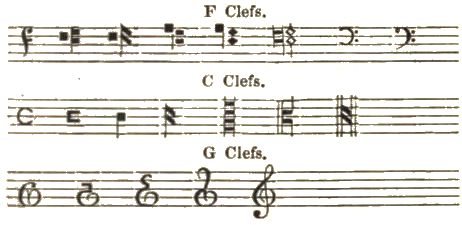
Not sure what you mean by things at the end of the line, but maybe you mean the little squiggles at the end of each system - those are a super practical notation feature that should never have been abandoned : it tells you the pitch of the first note of the next system.
Not being an aficionado of this kind of music, I bow to your knowledge. It does look like it would be a challenge; especially on a slide with a handle.[/quote]
No double clef here, it's just regular F clefs, alternating between bass and baritone to avoid ledger lines. That shape was common for F clefs in early prints. Some common F clef and C clef were designed using noteheads and stems.
Not sure what you mean by things at the end of the line, but maybe you mean the little squiggles at the end of each system - those are a super practical notation feature that should never have been abandoned : it tells you the pitch of the first note of the next system.
- brtnats
- Posts: 341
- Joined: Apr 26, 2018
He’s not talking about the custos; he’s talking about the part of the F clef that looks like really big natural sign.
- BGuttman
- Posts: 7368
- Joined: Mar 22, 2018
[quote="brtnats"]He’s not talking about the custos; he’s talking about the part of the F clef that looks like really big natural sign.[/quote]
That's what I was referring to. Glad you posted the pictures of all the clef signs so I could see my error.
That's what I was referring to. Glad you posted the pictures of all the clef signs so I could see my error.
- whitbey
- Posts: 654
- Joined: Mar 23, 2018
[quote="norbie2018"]<QUOTE author="whitbey" post_id="80862" time="1552929551" user_id="125">
I had a Thayer many years ago. It was an oil and maintenance hog. I have Bach bass made in the 60's that needs care so seldom you do it because your bored. I use the new CR from Edwards now for my tenor. I think the bracing has more benefit then the valve.
Something that works is a big advantage.[/quote]
You don't like the valve?
</QUOTE>
Overall no. Yes it blows nice when it worked. I have become a fan of less mass on the horn and the leaner valve.
I had a Thayer many years ago. It was an oil and maintenance hog. I have Bach bass made in the 60's that needs care so seldom you do it because your bored. I use the new CR from Edwards now for my tenor. I think the bracing has more benefit then the valve.
Something that works is a big advantage.[/quote]
You don't like the valve?
</QUOTE>
Overall no. Yes it blows nice when it worked. I have become a fan of less mass on the horn and the leaner valve.
- norbie2018
- Posts: 1051
- Joined: Apr 05, 2018
[quote="whitbey"]<QUOTE author="norbie2018" post_id="80864" time="1552930983" user_id="2978">
You don't like the valve?[/quote]
Overall no. Yes it blows nice when it worked. I have become a fan of less mass on the horn and the leaner valve.
</QUOTE>
Sorry, I meant the CR valve.
You don't like the valve?[/quote]
Overall no. Yes it blows nice when it worked. I have become a fan of less mass on the horn and the leaner valve.
</QUOTE>
Sorry, I meant the CR valve.
- norbie2018
- Posts: 1051
- Joined: Apr 05, 2018
One last (related) question: for those of you who have tried them, is there an advantage to the Edwards axial flow with harmonic bridge?
- whitbey
- Posts: 654
- Joined: Mar 23, 2018
[quote="norbie2018"]<QUOTE author="whitbey" post_id="80971" time="1553014764" user_id="125">
Overall no. Yes it blows nice when it worked. I have become a fan of less mass on the horn and the leaner valve.[/quote]
Sorry, I meant the CR valve.
</QUOTE>
I love the CR valve! The bracing and the sound pillar help too.
Overall no. Yes it blows nice when it worked. I have become a fan of less mass on the horn and the leaner valve.[/quote]
Sorry, I meant the CR valve.
</QUOTE>
I love the CR valve! The bracing and the sound pillar help too.
- Mhoutris
- Posts: 20
- Joined: Jul 26, 2018
[quote="hyperbolica"]<QUOTE author="Burgerbob" post_id="80780" time="1552852379" user_id="3131">
I have one! And I love a good 8H. Doesn't change that the use case is very limited.[/quote]
Your point of view is very narrow. The only place you couldn't play a straight 547 is essentially 3rd parts, and even most of those would be playable. I've got a pro buddy that all he plays is a straight 547 Yamaha, in orchestra, quartet, quintet, church jobs, even big band. You're discounting generations of music and musicians.
</QUOTE>
Sorry to disagree - his point of view is realistic.
There are plenty of second parts which require a valve to play certain notes. Hell, I'm playing 2nd on Mahler 5 right now and there's a low D# right out the gate in the 3rd line of the first page.
With regards to convenience, you're kidding yourself if you think you can win an audition by playing all natural positions against someone with the agility provided by a valve. Why bring a knife to a gunfight?
I have one! And I love a good 8H. Doesn't change that the use case is very limited.[/quote]
Your point of view is very narrow. The only place you couldn't play a straight 547 is essentially 3rd parts, and even most of those would be playable. I've got a pro buddy that all he plays is a straight 547 Yamaha, in orchestra, quartet, quintet, church jobs, even big band. You're discounting generations of music and musicians.
</QUOTE>
Sorry to disagree - his point of view is realistic.
There are plenty of second parts which require a valve to play certain notes. Hell, I'm playing 2nd on Mahler 5 right now and there's a low D# right out the gate in the 3rd line of the first page.
With regards to convenience, you're kidding yourself if you think you can win an audition by playing all natural positions against someone with the agility provided by a valve. Why bring a knife to a gunfight?
- norbie2018
- Posts: 1051
- Joined: Apr 05, 2018
Not everyone plays auditions/orchestral music; there are other genres of music for large bore trombones, with and without triggers.
- harrisonreed
- Posts: 6479
- Joined: Aug 17, 2018
[quote="norbie2018"]One last (related) question: for those of you who have tried them, is there an advantage to the Edwards axial flow with harmonic bridge?[/quote]
I tried the Oft Model. Holy crap is that a sweet horn.
I tried the Oft Model. Holy crap is that a sweet horn.
- ssking2b
- Posts: 487
- Joined: Sep 29, 2018
Advantage is all in the mind of they player. I just got a new XO bass bone, and I had a choice of axial or traditional rotors. I took traditional. Reason: less maintenance, shorter throw, and I don't care for the way axial valves feel up next to my neck, and the blow wasn't any beter, just a bit less focus - all of this for me. If you like axial, more power to you. Use what works best for you, and not what others think should work best.
- norbie2018
- Posts: 1051
- Joined: Apr 05, 2018
[quote="harrisonreed"]<QUOTE author="norbie2018" post_id="80987" time="1553029859" user_id="2978">
One last (related) question: for those of you who have tried them, is there an advantage to the Edwards axial flow with harmonic bridge?[/quote]
I tried the Oft Model. Holy crap is that a sweet horn.
</QUOTE>
Can you elaborate?
One last (related) question: for those of you who have tried them, is there an advantage to the Edwards axial flow with harmonic bridge?[/quote]
I tried the Oft Model. Holy crap is that a sweet horn.
</QUOTE>
Can you elaborate?
- harrisonreed
- Posts: 6479
- Joined: Aug 17, 2018
Not in a useful way. I think that I should have gone the axial route. You can throw a ton of air to get it to do what you want and it still has the flexibility of the harmonic bridge. I didn't think it was all that special at first, and then I put a 1 copper pillar on top. Was easily feeling better than my edwards and that's saying a lot.
- ParLawGod
- Posts: 133
- Joined: Mar 11, 2019
I've never had problems with maintenance on the axial-flow. Easy to take apart and clean, actually. Keep it lubricated and you'll probably never experience any issues...though I always take it apart once a year to give it a "once over." Always Hetman oils through mine as well...perhaps that plays a factor.
- Wilco
- Posts: 211
- Joined: Mar 24, 2019
Some side question: did the shires basses axials always come with nickel plated cores? Was there a periode when they did not?
- BGuttman
- Posts: 7368
- Joined: Mar 22, 2018
Yes there was. At various times they experimented with anodized aluminum, Teflon, and other treatments to try to control corrosion. I can't give you dates; I was talking with my friend who worked there to try to help him solve the problem. I have no idea how many of these experiments actually made it to sale.
- Wilco
- Posts: 211
- Joined: Mar 24, 2019
[quote="BGuttman"]Yes there was. At various times they experimented with anodized aluminum, Teflon, and other treatments to try to control corrosion. I can't give you dates; I was talking with my friend who worked there to try to help him solve the problem. I have no idea how many of these experiments actually made it to sale.[/quote]
Thanks for the insight! I have the opportunity to buy one which is 10 years old at a good price
Thanks for the insight! I have the opportunity to buy one which is 10 years old at a good price
- Wilco
- Posts: 211
- Joined: Mar 24, 2019
I bought the instrument! 11YM bell, dual bore slide, C tuning slide and B2.5 leadpipe. This is my first time on thayers, I like it! What I noticed right away is that the instrument was lighter than I thought. Nice clear sound!
- Wilco
- Posts: 211
- Joined: Mar 24, 2019
[quote="Wilco"]I bought the instrument! 11YM bell, dual bore slide, C tuning slide and B2.5 leadpipe. This is my first time on thayers, I like it! What I noticed right away is that the instrument was lighter than I thought. Nice clear sound![/quote]
Btw, this slide seems to have a fixed leadpipe. Is that possible? I cant see any threading...
Btw, this slide seems to have a fixed leadpipe. Is that possible? I cant see any threading...
- Burgerbob
- Posts: 6327
- Joined: Apr 23, 2018
[quote="Wilco"]<QUOTE author="Wilco" post_id="82012" time="1554141487" user_id="5654">
I bought the instrument! 11YM bell, dual bore slide, C tuning slide and B2.5 leadpipe. This is my first time on thayers, I like it! What I noticed right away is that the instrument was lighter than I thought. Nice clear sound![/quote]
Btw, this slide seems to have a fixed leadpipe. Is that possible? I cant see any threading...
</QUOTE>
Pictures?
I bought the instrument! 11YM bell, dual bore slide, C tuning slide and B2.5 leadpipe. This is my first time on thayers, I like it! What I noticed right away is that the instrument was lighter than I thought. Nice clear sound![/quote]
Btw, this slide seems to have a fixed leadpipe. Is that possible? I cant see any threading...
</QUOTE>
Pictures?
- Wilco
- Posts: 211
- Joined: Mar 24, 2019
[quote="Burgerbob"]<QUOTE author="Wilco" post_id="82140" time="1554281873" user_id="5654">
Btw, this slide seems to have a fixed leadpipe. Is that possible? I cant see any threading...[/quote]
Pictures?
</QUOTE>
I checked with Shires and shared some pictures. It is possible to custom order a fixed leadpipe, so that is what most likely happend!
Btw, this slide seems to have a fixed leadpipe. Is that possible? I cant see any threading...[/quote]
Pictures?
</QUOTE>
I checked with Shires and shared some pictures. It is possible to custom order a fixed leadpipe, so that is what most likely happend!
- brassmedic
- Posts: 1447
- Joined: Dec 14, 2018
[quote="Steerpike"]How can a horn with any kind of valve be more open; more of an airhog than a straight horn?[/quote]
When the valve and neckpipe are a larger bore than the straight neckpipe. That was definitely the case with the Bach 42. They used to use the neckpipe provided by O.E. Thayer, which is a much larger diameter than a straight Bach 42 neckpipe. I haven't taken measurements on new Bachs or other brands, but I imagine that might be the case with a lot of trombones.
When the valve and neckpipe are a larger bore than the straight neckpipe. That was definitely the case with the Bach 42. They used to use the neckpipe provided by O.E. Thayer, which is a much larger diameter than a straight Bach 42 neckpipe. I haven't taken measurements on new Bachs or other brands, but I imagine that might be the case with a lot of trombones.