TIme to ditch Lassus Trombone
- PhilTrombone
- Posts: 161
- Joined: Nov 06, 2018
- mrdeacon
- Posts: 1225
- Joined: May 08, 2018
Wow. I didn't know that.
On one hand... the piece is old enough that its original intention/meaning is almost completely gone from living memory. Does that mean the piece is now alright to perform? There are countless pieces of art, literature, film, and music that fall within this category. Still... Mr.Yeo makes a very cut and dry argument here that is hard to disagree with.
On one hand... the piece is old enough that its original intention/meaning is almost completely gone from living memory. Does that mean the piece is now alright to perform? There are countless pieces of art, literature, film, and music that fall within this category. Still... Mr.Yeo makes a very cut and dry argument here that is hard to disagree with.
- Burgerbob
- Posts: 6327
- Joined: Apr 23, 2018
[quote="mrdeacon"]Wow. I didn't know that.
On one hand... the piece is old enough that its original intention/meaning is almost completely gone from living memory. Does that mean the piece is now alright to perform?[/quote]
IMO, it's already a pretty garbage novelty piece. Now we knows it's a racist, garbage novelty piece. Time to replace it.
On one hand... the piece is old enough that its original intention/meaning is almost completely gone from living memory. Does that mean the piece is now alright to perform?[/quote]
IMO, it's already a pretty garbage novelty piece. Now we knows it's a racist, garbage novelty piece. Time to replace it.
- mrdeacon
- Posts: 1225
- Joined: May 08, 2018
[quote="Burgerbob"]<QUOTE author="mrdeacon" post_id="117934" time="1593389999" user_id="3239">
Wow. I didn't know that.
On one hand... the piece is old enough that its original intention/meaning is almost completely gone from living memory. Does that mean the piece is now alright to perform?[/quote]
IMO, it's already a pretty garbage novelty piece. Now we knows it's a racist, garbage novelty piece. Time to replace it.
</QUOTE>
Totally agree! I won't complain if I never have to play it again. Still felt I needed to mention the point.
Wow. I didn't know that.
On one hand... the piece is old enough that its original intention/meaning is almost completely gone from living memory. Does that mean the piece is now alright to perform?[/quote]
IMO, it's already a pretty garbage novelty piece. Now we knows it's a racist, garbage novelty piece. Time to replace it.
</QUOTE>
Totally agree! I won't complain if I never have to play it again. Still felt I needed to mention the point.
- Crazy4Tbone86
- Posts: 1654
- Joined: Jan 14, 2020
Wow! I really wish I would have known this many years ago. I even performed a couple of those Fillmore pieces last summer. From this point forward, I will consider it my duty to advise against the performance of those pieces at every opportunity. Thanks to Doug Yeo for enlightening us (and PhilTrombone for the post).
- harrisonreed
- Posts: 6479
- Joined: Aug 17, 2018
I'm not sure about the post script in that article. It's a very interesting article that changes the way I think about that set of pieces, which I already did not think were good pieces of music, but the post script ... at the very least I don't think it adds anything to the article.
- Bach5G
- Posts: 2874
- Joined: Apr 07, 2018
Cherry Music will no longer carry it. GC will donate proceeds from selling it in the past to a anti-racism charity.
- brassmedic
- Posts: 1447
- Joined: Dec 14, 2018
I used to play that as my "demo" piece for children's concerts. I was told about its history by a colleague last year, so I no longer use it. There is plenty of other music for us to play.
- BGuttman
- Posts: 7368
- Joined: Mar 22, 2018
You have to interpret it in light of the period when it was written.
It was the era of Vaudeville. Not far removed from the Minstrel shows of the mid 19th Century.
The original subtitles are certainly not PC by today's standards. In fact, a lot of other music of the period doesn't qualify as PC either. Pryor had a solo called "Coon Band Revue" which has been renamed "In Darkest Africa" because the word Coon was used to refer to an African-American, and not the animal that loves to ramble in garbage cans. How many people know that Darktown refers to a Black ghetto?
Wagner was a notorious anti-Semite. Do we drop all his music as well?
These pieces were not like the Confederate War Memorial statues intended to honor traitors to the US in order to remind Blacks of "their place". They are an attempt to describe a humorous (and fictional) culture.
It's like the folks who want to pull down statues of George Washington and Thomas Jefferson because they owned slaves. We don't honor them for owning slaves (we accept it as an unfortunate part of their history). We honor them for their contributions to the creation of this nation. Why pull down the Emancipation Proclamation monument because the Slave is kneeling before Lincoln? Incidentally, that monument was paid for by African-Americans. Frederick Douglass spoke at the dedication.
We need to step back and see if something is really deserving of being changed before we go tilting at the windmill.
Incidentally, I feel that Lassus is one of the lesser of the Trombone Rags. It's just the most frequently played
It was the era of Vaudeville. Not far removed from the Minstrel shows of the mid 19th Century.
The original subtitles are certainly not PC by today's standards. In fact, a lot of other music of the period doesn't qualify as PC either. Pryor had a solo called "Coon Band Revue" which has been renamed "In Darkest Africa" because the word Coon was used to refer to an African-American, and not the animal that loves to ramble in garbage cans. How many people know that Darktown refers to a Black ghetto?
Wagner was a notorious anti-Semite. Do we drop all his music as well?
These pieces were not like the Confederate War Memorial statues intended to honor traitors to the US in order to remind Blacks of "their place". They are an attempt to describe a humorous (and fictional) culture.
It's like the folks who want to pull down statues of George Washington and Thomas Jefferson because they owned slaves. We don't honor them for owning slaves (we accept it as an unfortunate part of their history). We honor them for their contributions to the creation of this nation. Why pull down the Emancipation Proclamation monument because the Slave is kneeling before Lincoln? Incidentally, that monument was paid for by African-Americans. Frederick Douglass spoke at the dedication.
We need to step back and see if something is really deserving of being changed before we go tilting at the windmill.
Incidentally, I feel that Lassus is one of the lesser of the Trombone Rags. It's just the most frequently played
- Burgerbob
- Posts: 6327
- Joined: Apr 23, 2018
Bruce, go ahead and read the full article. I don't think there's any defending Fillmore or the piece.
- Bach5G
- Posts: 2874
- Joined: Apr 07, 2018
“Wagner was a notorious anti-Semite. Do we drop all his music as well?“
Lassus Trombone isn’t Parsifal. No one will miss Fillmore’s music.
Lassus Trombone isn’t Parsifal. No one will miss Fillmore’s music.
- mrdeacon
- Posts: 1225
- Joined: May 08, 2018
I'll say that I appreciate the forums for being civil and in agreement about all of this. Some of the posts on facebook about this article are rough! :eek:
- BGuttman
- Posts: 7368
- Joined: Mar 22, 2018
[quote="Burgerbob"]Bruce, go ahead and read the full article. I don't think there's any defending Fillmore or the piece.[/quote]
This has come up time and again. Doug posted the same sentiments on The Trombone Forum. Sam Burtis has expressed the same feelings.
We have lots of second rate music out there. We play an awful lot of it during outdoor concert band performances. Fillmore's "Rags" are a way to feature the trombone section without making the audience have to endure a piece that bores them to tears. Personally I wouldn't miss "Instant Concert" if I never had to play it again, but audiences seem to like it.
There are a lot of things from before the "woke" generation that seem to insult Blacks. I know Rochester on the Jack Benny show is a stereotype. So are Amos 'n Andy. So are some of the "Blackie" scenes of Showboat. Read Huck Finn. We shouldn't ignore this heritage because someone claims to be an arbiter of taste. Instead we should explain the context and accept them for what they are. And then not be guilty of discrimination ourselves.
Or shall we go on a crusade and ban "Darktown Strutters' Ball" as well? After all, the title is just as offensive as the Fillmore Rags.
This has come up time and again. Doug posted the same sentiments on The Trombone Forum. Sam Burtis has expressed the same feelings.
We have lots of second rate music out there. We play an awful lot of it during outdoor concert band performances. Fillmore's "Rags" are a way to feature the trombone section without making the audience have to endure a piece that bores them to tears. Personally I wouldn't miss "Instant Concert" if I never had to play it again, but audiences seem to like it.
There are a lot of things from before the "woke" generation that seem to insult Blacks. I know Rochester on the Jack Benny show is a stereotype. So are Amos 'n Andy. So are some of the "Blackie" scenes of Showboat. Read Huck Finn. We shouldn't ignore this heritage because someone claims to be an arbiter of taste. Instead we should explain the context and accept them for what they are. And then not be guilty of discrimination ourselves.
Or shall we go on a crusade and ban "Darktown Strutters' Ball" as well? After all, the title is just as offensive as the Fillmore Rags.
- Burgerbob
- Posts: 6327
- Joined: Apr 23, 2018
I don't see a problem with not doing any of those things anymore.
And I don't think there should be an issue removing awful music that was written by a racist to be racist. Period.
And I don't think there should be an issue removing awful music that was written by a racist to be racist. Period.
- Bach5G
- Posts: 2874
- Joined: Apr 07, 2018
“Or shall we go on a crusade and ban "Darktown Strutters' Ball" as well?”
Ok.
Ok.
- BGuttman
- Posts: 7368
- Joined: Mar 22, 2018
[quote="Burgerbob"]I don't see a problem with not doing any of those things anymore.
And I don't think there should be an issue removing awful music that was written by a racist to be racist. Period.[/quote]
Fillmore also wrote "Americans We" and "Rolling Thunder". Do we stop playing them, too? How about all the stuff published as his pseudonyms like Harold Bennett? Al Hayes? Harry Hartley?
I agree that the subtitles of the Trombone Family Rags are pretty tough to take. So don't promulgate them. Fact remains, they are easy solos that can be played by any High Schooler (and even some Middle Schoolers). Just don't look at the subtitles. What's wrong with a piece called Sally Trombone? Hank Trombone? Parson Trombone?
Oh, and ask a Trad Jazz (Dixieland Jazz) band to drop Darktown Strutters' Ball. They won't. It's a classic tune.
And I don't think there should be an issue removing awful music that was written by a racist to be racist. Period.[/quote]
Fillmore also wrote "Americans We" and "Rolling Thunder". Do we stop playing them, too? How about all the stuff published as his pseudonyms like Harold Bennett? Al Hayes? Harry Hartley?
I agree that the subtitles of the Trombone Family Rags are pretty tough to take. So don't promulgate them. Fact remains, they are easy solos that can be played by any High Schooler (and even some Middle Schoolers). Just don't look at the subtitles. What's wrong with a piece called Sally Trombone? Hank Trombone? Parson Trombone?
Oh, and ask a Trad Jazz (Dixieland Jazz) band to drop Darktown Strutters' Ball. They won't. It's a classic tune.
- Burgerbob
- Posts: 6327
- Joined: Apr 23, 2018
[quote="BGuttman"]<QUOTE author="Burgerbob" post_id="117979" time="1593407303" user_id="3131">
I don't see a problem with not doing any of those things anymore.
And I don't think there should be an issue removing awful music that was written by a racist to be racist. Period.[/quote]
Fillmore also wrote "Americans We" and "Rolling Thunder". Do we stop playing them, too? How about all the stuff published as his pseudonyms like Harold Bennett? Al Hayes? Harry Hartley?
</QUOTE>
Sure. What's the big loss? We have plenty of marches, and many of them are even good.
In any case- this topic is about Lassus Trombone, not the "slippery slope" that leads to us not playing any music at all at community band concerts.
I don't see a problem with not doing any of those things anymore.
And I don't think there should be an issue removing awful music that was written by a racist to be racist. Period.[/quote]
Fillmore also wrote "Americans We" and "Rolling Thunder". Do we stop playing them, too? How about all the stuff published as his pseudonyms like Harold Bennett? Al Hayes? Harry Hartley?
</QUOTE>
Sure. What's the big loss? We have plenty of marches, and many of them are even good.
In any case- this topic is about Lassus Trombone, not the "slippery slope" that leads to us not playing any music at all at community band concerts.
- paulyg
- Posts: 689
- Joined: May 17, 2018
[quote="BGuttman"]Fillmore also wrote "Americans We" and "Rolling Thunder". Do we stop playing them, too? How about all the stuff published as his pseudonyms like Harold Bennett? Al Hayes? Harry Hartley?[/quote]
As far as I can tell, the Doug's essay is focused on the "suite" of 14 pieces that are overtly racist, not on Fillmore's entire body of work.
[quote="BGuttman"]I agree that the subtitles of the Trombone Family Rags are pretty tough to take. So don't promulgate them. Fact remains, they are easy solos that can be played by any High Schooler (and even some Middle Schoolers). Just don't look at the subtitles. What's wrong with a piece called Sally Trombone? Hank Trombone? Parson Trombone?[/quote]
There are a gazillion easy solos out there. These particular ones are, as I've said elsewhere, artistically bereft. Have a similarly capable student take a shot at Still's "Romance," arranged by Doug Yeo.
[quote="BGuttman"]Oh, and ask a Trad Jazz (Dixieland Jazz) band to drop Darktown Strutters' Ball. They won't. It's a classic tune.[/quote]
OK... how would you feel listening to a piece with that title? In a certain context, that "trad jazz" band might be able to find a receptive audience. I think though, if you're talking nowadays about programming music that is accessible to a wider audience, that tune may require some explanation.
Right now, we're confronting the reality that past bad acts are getting in the way of music making, in that they're limiting our ability as performers to affect an audience in a positive way. When people speak of music "standing the test of time..." well... this is that test.
As far as I can tell, the Doug's essay is focused on the "suite" of 14 pieces that are overtly racist, not on Fillmore's entire body of work.
[quote="BGuttman"]I agree that the subtitles of the Trombone Family Rags are pretty tough to take. So don't promulgate them. Fact remains, they are easy solos that can be played by any High Schooler (and even some Middle Schoolers). Just don't look at the subtitles. What's wrong with a piece called Sally Trombone? Hank Trombone? Parson Trombone?[/quote]
There are a gazillion easy solos out there. These particular ones are, as I've said elsewhere, artistically bereft. Have a similarly capable student take a shot at Still's "Romance," arranged by Doug Yeo.
[quote="BGuttman"]Oh, and ask a Trad Jazz (Dixieland Jazz) band to drop Darktown Strutters' Ball. They won't. It's a classic tune.[/quote]
OK... how would you feel listening to a piece with that title? In a certain context, that "trad jazz" band might be able to find a receptive audience. I think though, if you're talking nowadays about programming music that is accessible to a wider audience, that tune may require some explanation.
Right now, we're confronting the reality that past bad acts are getting in the way of music making, in that they're limiting our ability as performers to affect an audience in a positive way. When people speak of music "standing the test of time..." well... this is that test.
- SaigonSlide
- Posts: 78
- Joined: Apr 06, 2018
[quote="Bach5G"]“Wagner was a notorious anti-Semite. Do we drop all his music as well?“
Lassus Trombone isn’t Parsifal. No one will miss Fillmore’s music.[/quote]
So where do we draw that line? So a composer like Wagner is tolerated because his music was so historically important, but others we censor because they are/were not? If we know that 'X' artist was a racist, pedophile, murderer, etc., do we censor their ENTIRE body of work, or just pieces that explicitly mention racism?
And who makes these decisions?
I find it difficult to censure an artists work, even if it is revolting or disrespectful. It happened, and it happened in the context of history, good or bad. That doesn't make it ok, and by current standards, it is not acceptable. But, an artist's life needs to be separate from their art. I don't like the piece, and as mentioned, there are lots of other better pieces to play. I just won't play it. I think it's more of a general discussion point though.
Lassus Trombone isn’t Parsifal. No one will miss Fillmore’s music.[/quote]
So where do we draw that line? So a composer like Wagner is tolerated because his music was so historically important, but others we censor because they are/were not? If we know that 'X' artist was a racist, pedophile, murderer, etc., do we censor their ENTIRE body of work, or just pieces that explicitly mention racism?
And who makes these decisions?
I find it difficult to censure an artists work, even if it is revolting or disrespectful. It happened, and it happened in the context of history, good or bad. That doesn't make it ok, and by current standards, it is not acceptable. But, an artist's life needs to be separate from their art. I don't like the piece, and as mentioned, there are lots of other better pieces to play. I just won't play it. I think it's more of a general discussion point though.
- Burgerbob
- Posts: 6327
- Joined: Apr 23, 2018
[quote="SaigonSlide"]<QUOTE author="Bach5G" post_id="117976" time="1593401098" user_id="2999">
“Wagner was a notorious anti-Semite. Do we drop all his music as well?“
Lassus Trombone isn’t Parsifal. No one will miss Fillmore’s music.[/quote]
So where do we draw that line? So a composer like Wagner is tolerated because his music was so historically important, but others we censor because they are/were not? If we know that 'X' artist was a racist, pedophile, murderer, etc., do we censor their ENTIRE body of work, or just pieces that explicitly mention racism?
And who makes these decisions?
I find it difficult to censure an artists work, even if it is revolting or disrespectful. It happened, and it happened in the context of history, good or bad. That doesn't make it ok, and by current standards, it is not acceptable. But, an artist's life needs to be separate from their art. I don't like the piece, and as mentioned, there are lots of other better pieces to play. I just won't play it. I think it's more of a general discussion point though.
</QUOTE>
Again- missing the point. The "artist with an iffy background" is not this case. This is a case of an artist with an iffy background, writing music that is racist in its own nature.
Wagner was an anti-semite, but his music was not inherently anti-semitic on purpose (unless someone has evidence to that point).
Again, this is not about the slippery slope! This is about Fillmore and his pieces.
“Wagner was a notorious anti-Semite. Do we drop all his music as well?“
Lassus Trombone isn’t Parsifal. No one will miss Fillmore’s music.[/quote]
So where do we draw that line? So a composer like Wagner is tolerated because his music was so historically important, but others we censor because they are/were not? If we know that 'X' artist was a racist, pedophile, murderer, etc., do we censor their ENTIRE body of work, or just pieces that explicitly mention racism?
And who makes these decisions?
I find it difficult to censure an artists work, even if it is revolting or disrespectful. It happened, and it happened in the context of history, good or bad. That doesn't make it ok, and by current standards, it is not acceptable. But, an artist's life needs to be separate from their art. I don't like the piece, and as mentioned, there are lots of other better pieces to play. I just won't play it. I think it's more of a general discussion point though.
</QUOTE>
Again- missing the point. The "artist with an iffy background" is not this case. This is a case of an artist with an iffy background, writing music that is racist in its own nature.
Wagner was an anti-semite, but his music was not inherently anti-semitic on purpose (unless someone has evidence to that point).
Again, this is not about the slippery slope! This is about Fillmore and his pieces.
- bigbandbone
- Posts: 602
- Joined: Jan 17, 2019
Burgerbob wrote "Again, this is not about the slippery slope! This is about Fillmore and his pieces."
In the short view you are correct. The editorial was about Filmore. But in the long view it's about the precedent that it sets throughout all of the arts.
In the short view you are correct. The editorial was about Filmore. But in the long view it's about the precedent that it sets throughout all of the arts.
- timothy42b
- Posts: 1812
- Joined: Mar 27, 2018
[quote="Burgerbob"]<QUOTE author="mrdeacon" post_id="117934" time="1593389999" user_id="3239">
Wow. I didn't know that.
On one hand... the piece is old enough that its original intention/meaning is almost completely gone from living memory. Does that mean the piece is now alright to perform?[/quote]
IMO, it's already a pretty garbage novelty piece. Now we knows it's a racist, garbage novelty piece. Time to replace it.
</QUOTE>
And while I don't disagree completely, I ask: "replace it with what?"
"There are plenty of easy trombone features out there that the audience will like."
No, no there aren't. This stands alone. Insisting on "really good" music, when the audience really wants a listenable novelty piece, is part of why we don't have an audience. If you want to replace it, start writing.
This one doesn't get played because someone is inherently racist and making a statement. It gets played because most people don't know it has a racist background and makes a statement - a statement that very possibly nobody in an audience has ever deciphered.
I also find it a little uncomfortable that we make a distinction between good racist music that we should keep anyway, like maybe some of Wagner, and garbage racist music like the Fillmore Family that we should discard. It's like we're willing to be noble when it doesn't cost us anything. Maybe I'm overreacting on that point and I'm not trying to criticize anyone.
Wow. I didn't know that.
On one hand... the piece is old enough that its original intention/meaning is almost completely gone from living memory. Does that mean the piece is now alright to perform?[/quote]
IMO, it's already a pretty garbage novelty piece. Now we knows it's a racist, garbage novelty piece. Time to replace it.
</QUOTE>
And while I don't disagree completely, I ask: "replace it with what?"
"There are plenty of easy trombone features out there that the audience will like."
No, no there aren't. This stands alone. Insisting on "really good" music, when the audience really wants a listenable novelty piece, is part of why we don't have an audience. If you want to replace it, start writing.
This one doesn't get played because someone is inherently racist and making a statement. It gets played because most people don't know it has a racist background and makes a statement - a statement that very possibly nobody in an audience has ever deciphered.
I also find it a little uncomfortable that we make a distinction between good racist music that we should keep anyway, like maybe some of Wagner, and garbage racist music like the Fillmore Family that we should discard. It's like we're willing to be noble when it doesn't cost us anything. Maybe I'm overreacting on that point and I'm not trying to criticize anyone.
- ArbanRubank
- Posts: 424
- Joined: Feb 23, 2019
What are we to do with Frank Rosolino's brilliant solo? Delete it? For that matter, what are we to do with the entire track on The Trombones, Inc vinyl? Take a razor blade and scratch it out? What is correct and proper; not just knee-jerk here and now, but to stand the test of time.
- StevenC
- Posts: 128
- Joined: Mar 23, 2018
[quote="timothy42b"]
And while I don't disagree completely, I ask: "replace it with what?"
[/quote]
A suggestion Doug Yeo made right in the article is Slidus trombonus by Mayhew Lake.
And while I don't disagree completely, I ask: "replace it with what?"
[/quote]
A suggestion Doug Yeo made right in the article is Slidus trombonus by Mayhew Lake.
- GabrielRice
- Posts: 1496
- Joined: Mar 23, 2018
I see very good reasons to stop playing it. I have yet to see a good reason to keep playing it.
"But what about Wagner?"
There are very good reasons to question our value of Wagner, to talk openly about his personal beliefs and the ideology that his operas come from and support. And then there are very good reasons to keep his music along with those conversations: the operas are truly revolutionary and the music is sublime.
None of that is true of Fillmore. They're novelty pieces at best. Doug has suggested a period replacement, and we're perfectly capable of writing some new ones!
I've also seen Miles Davis come up. He was another complicated figure. Some say he was racist against whites. I would say there's no such thing as being racist against whites; some might say that's splitting linguistic hairs, but prejudice and racism are not the same thing. It's fair to say he was cruel to women, and that's unforgivable. But again, I say look at all that plainly and with clear eyes, and then continue to acknowledge and enjoy the revolutionary and sublime music he made.
Again, it's hard to argue that Fillmore is worth that consideration.
I'll give one more example: it's now very clear that Michael Jackson was a pedophile. That's a very difficult one for me personally for reasons I won't detail here. Was he an artist at the level of Wagner or Miles Davis? Maybe. Or maybe he was just an extremely talented performer with the tremendous backing of the big record company business - not to mention Quincy Jones. In any case, I'm trying to abstain from Michael Jackson for the time being. My choice, which doesn't have to be everybody else's.
"But what about Wagner?"
There are very good reasons to question our value of Wagner, to talk openly about his personal beliefs and the ideology that his operas come from and support. And then there are very good reasons to keep his music along with those conversations: the operas are truly revolutionary and the music is sublime.
None of that is true of Fillmore. They're novelty pieces at best. Doug has suggested a period replacement, and we're perfectly capable of writing some new ones!
I've also seen Miles Davis come up. He was another complicated figure. Some say he was racist against whites. I would say there's no such thing as being racist against whites; some might say that's splitting linguistic hairs, but prejudice and racism are not the same thing. It's fair to say he was cruel to women, and that's unforgivable. But again, I say look at all that plainly and with clear eyes, and then continue to acknowledge and enjoy the revolutionary and sublime music he made.
Again, it's hard to argue that Fillmore is worth that consideration.
I'll give one more example: it's now very clear that Michael Jackson was a pedophile. That's a very difficult one for me personally for reasons I won't detail here. Was he an artist at the level of Wagner or Miles Davis? Maybe. Or maybe he was just an extremely talented performer with the tremendous backing of the big record company business - not to mention Quincy Jones. In any case, I'm trying to abstain from Michael Jackson for the time being. My choice, which doesn't have to be everybody else's.
- hyperbolica
- Posts: 3990
- Joined: Mar 23, 2018
I have very much respect for Mr. Yeo. But, if you follow his reasoning, we would cancel our entire civilization because it came through the horrors of American slavery, treatment of American Indians, McCarthy, the atomic bomb, Nazi oppression, centuries of European Tyrants, all of the barbarity and slavery of the Roman empire, and countless other examples of abhorrent treatment of people by other people.
Is Fillmore great music? Is much current pop music great music? Fillmore wrote a lot of marches. He is at least a musical historical figure. He is flawed. Like everyone else you and I know. It is SO hypocritical to erase someone just because they had flaws. Because we all have flaws. Maybe not the same flaws. I did something wrong once. I'll bet you did too, regardless of who you are.
Tolstoy. Dostoevsky. Dickens. Mark Twain. Wagner, Strauss, Beethoven, Michelangelo, DaVinci, Picasso. We can't just erase stuff because it was somehow connected to a bad idea. Erasing the past will not help us move on. What if we threw away all of the music that came from the Catholic church? Bach? Mozart?
Lassus is in my quartet's book. It's one of a couple hundred. It doesn't get played much. It belongs to a style from that period. It's fun for people to hear. If you replace it with something inspired by it, what's the difference?
Is Fillmore great music? Is much current pop music great music? Fillmore wrote a lot of marches. He is at least a musical historical figure. He is flawed. Like everyone else you and I know. It is SO hypocritical to erase someone just because they had flaws. Because we all have flaws. Maybe not the same flaws. I did something wrong once. I'll bet you did too, regardless of who you are.
Tolstoy. Dostoevsky. Dickens. Mark Twain. Wagner, Strauss, Beethoven, Michelangelo, DaVinci, Picasso. We can't just erase stuff because it was somehow connected to a bad idea. Erasing the past will not help us move on. What if we threw away all of the music that came from the Catholic church? Bach? Mozart?
Lassus is in my quartet's book. It's one of a couple hundred. It doesn't get played much. It belongs to a style from that period. It's fun for people to hear. If you replace it with something inspired by it, what's the difference?
- timothy42b
- Posts: 1812
- Joined: Mar 27, 2018
[quote="GabeLangfur"]
None of that is true of Fillmore. They're novelty pieces at best. Doug has suggested a period replacement, and we're perfectly capable of writing some new ones!
[/quote]
"Novelty at best" is kind of revealing, I think. Audiences love that stuff, and when written well amateurs can pull it off.
I'd never heard of Doug's suggestion, nor has anybody else. It's long vanished. I listened on youtube, and my assessment is there's a good reason it disappeared. It's neither listenable nor playable by most amateur groups. Hickey's doesn't even carry it, I see it on JW Pepper though.
Granted, the full ensemble wind band is largely a feature of the past, useful now as a pedagogical device and a social outlet for us amateurs. But programming novelty pieces is easy to sneer at, and writing them an audience will like turns out to be difficult. Apparently, impossible.
The Fillmore pieces are playable and the audiences enjoyed them. There are lots of novelty pieces for other instruments, even for typewriters, not much for trombone.
Germany has Bayrische Polka, and the UK has Trombone Frolic. I've played the latter; it's not too bad though the band struggled to do it at tempo. Bayrische demands a solo effort and I haven't played in a band that had it in the book. If you compare either of those two to Doug's selection you'll see slidus trombonus comes off about 10th best. I have to assume Doug knows the literature thoroughly and was able to come up with the best of what's out there, so that's kind of telling.
None of that is true of Fillmore. They're novelty pieces at best. Doug has suggested a period replacement, and we're perfectly capable of writing some new ones!
[/quote]
"Novelty at best" is kind of revealing, I think. Audiences love that stuff, and when written well amateurs can pull it off.
I'd never heard of Doug's suggestion, nor has anybody else. It's long vanished. I listened on youtube, and my assessment is there's a good reason it disappeared. It's neither listenable nor playable by most amateur groups. Hickey's doesn't even carry it, I see it on JW Pepper though.
Granted, the full ensemble wind band is largely a feature of the past, useful now as a pedagogical device and a social outlet for us amateurs. But programming novelty pieces is easy to sneer at, and writing them an audience will like turns out to be difficult. Apparently, impossible.
The Fillmore pieces are playable and the audiences enjoyed them. There are lots of novelty pieces for other instruments, even for typewriters, not much for trombone.
Germany has Bayrische Polka, and the UK has Trombone Frolic. I've played the latter; it's not too bad though the band struggled to do it at tempo. Bayrische demands a solo effort and I haven't played in a band that had it in the book. If you compare either of those two to Doug's selection you'll see slidus trombonus comes off about 10th best. I have to assume Doug knows the literature thoroughly and was able to come up with the best of what's out there, so that's kind of telling.
- GabrielRice
- Posts: 1496
- Joined: Mar 23, 2018
Tim, I did add another clause to that sentence...
- BGuttman
- Posts: 7368
- Joined: Mar 22, 2018
We have to look at some scale here. Fillmore wrote over 250 pieces and another 100 adaptations of classical orchestral works for concert band. There are 15 pieces in the "Trombone Family". Why dump him for these 15 pieces? Are we sure he was a racist from these 15 pieces? He had a career as a bandmaster for a circus, then a bandmaster, composer, and publisher in Florida. In three biographies on line I have yet to see a reference to prejudice or racism. One day I'll find a copy of "Hallelujah Trombone" (a reference to "Shoutin' Liza") to see if there is something there.
We need to look at these things in the context of their time. Amos 'n Andy was a stereotype of American Blacks that was about as racist as the Fillmore Trombone rags. I cringe listening to some of the stuff, but sometimes it is quite funny.
Do we stop playing Arthur Pryor solos because he wrote one solo called "Coon Band Revue"?
I certainly support your right not to play Lassus Trombone. I usually tell people about the rather uncomfortable subtitles as being a part of the tenor of the time in which it was written. Again, I usually try to play one of the other family; generally one with a less obscene subtitle.
We need to look at these things in the context of their time. Amos 'n Andy was a stereotype of American Blacks that was about as racist as the Fillmore Trombone rags. I cringe listening to some of the stuff, but sometimes it is quite funny.
Do we stop playing Arthur Pryor solos because he wrote one solo called "Coon Band Revue"?
I certainly support your right not to play Lassus Trombone. I usually tell people about the rather uncomfortable subtitles as being a part of the tenor of the time in which it was written. Again, I usually try to play one of the other family; generally one with a less obscene subtitle.
- GabrielRice
- Posts: 1496
- Joined: Mar 23, 2018
Who is suggesting dumping everything Fillmore wrote?
- GabrielRice
- Posts: 1496
- Joined: Mar 23, 2018
I find the "where will it stop" line of argument to be a tiresome distraction. Does it matter? Every decision doesn't have to become some sort of monumental precedent that decides every other issue even remotely similar.
The Trombone Family pieces are offensively racist in conception, then and now, and there's no good reason to keep playing them. We can decide to keep playing Fillmore's non-racist pieces and not be hypocrites. Wagner can be a completely separate discussion.
The slope isn't even remotely slippery.
The Trombone Family pieces are offensively racist in conception, then and now, and there's no good reason to keep playing them. We can decide to keep playing Fillmore's non-racist pieces and not be hypocrites. Wagner can be a completely separate discussion.
The slope isn't even remotely slippery.
- timothy42b
- Posts: 1812
- Joined: Mar 27, 2018
[quote="GabeLangfur"]Tim, I did add another clause to that sentence...[/quote]
Somebody is capable of writing some new novelty features, sure. Not me though.
I wish Leroy Anderson had done so. He wrote a huge number of popular pieces that come pretty close to the novelty genre, are wonderfully listenable, are playable at various skill levels, and would not be called high art.
But there currently are not any decent replacements for that kind of trombone feature. And we've had this conversation before, and while I'm sure Gabe wouldn't be one there are plenty of people too elitist to play something popular or perform a gliss in public. Some of that attitude usually comes out. Who needs a glissy trombone feature when we can play an excerpt from Mahler?
Somebody is capable of writing some new novelty features, sure. Not me though.
I wish Leroy Anderson had done so. He wrote a huge number of popular pieces that come pretty close to the novelty genre, are wonderfully listenable, are playable at various skill levels, and would not be called high art.
But there currently are not any decent replacements for that kind of trombone feature. And we've had this conversation before, and while I'm sure Gabe wouldn't be one there are plenty of people too elitist to play something popular or perform a gliss in public. Some of that attitude usually comes out. Who needs a glissy trombone feature when we can play an excerpt from Mahler?
- JulesShinkle
- Posts: 3
- Joined: May 04, 2020
[quote="hyperbolica"]I have very much respect for Mr. Yeo. But, if you follow his reasoning, we would cancel our entire civilization because it came through the horrors of American slavery, treatment of American Indians, McCarthy, the atomic bomb, Nazi oppression, centuries of European Tyrants, all of the barbarity and slavery of the Roman empire, and countless other examples of abhorrent treatment of people by other people.
Tolstoy. Dostoevsky. Dickens. Mark Twain. Wagner, Strauss, Beethoven, Michelangelo, DaVinci, Picasso. We can't just erase stuff because it was somehow connected to a bad idea. Erasing the past will not help us move on. What if we threw away all of the music that came from the Catholic church? Bach? Mozart?[/quote]
I get that you intended this to be an ad absurdum argument...but it's ironic that you're short of almost getting it. God forbid we reflect on how white supremacy throughout history has shaped our current lives. It is important, actually, that we acknowledge these things and many others. We *should* harshly scrutinize why we allow some things to remain.
It seems that you equate "canceling" with "erasing", and that if we stop playing Lassus Trombone that good art will be caught up in the Great Cancelation. You make some false equivalencies to what Yeo is advocating for and what you fear will happen. Yeo's line of reasoning is that we shouldn't perpetuate racist art. The difference between Fillmore's pieces in question and...Beethoven(?) is that minstrelsy is and was racist! It wasn't "okay" then (as Yeo points out) and it isn't okay now. Nobody has to do much deep digging to know that Lassus Trombone is "connected to a bad idea". What's being held on trial here is unquestionably racist music. Music that perpetuated white supremacy!
The question of whether we should play Wagner, or the rest of Fillmore's works, is more interesting. I think the fact that Wagner has recieved a pass represents a larger theme within Western art music that we are very quick to forgive horrible characters, as long as they're white men. That being said, it doesn't answer the question of if they should be forgiven. I think no, the men shouldn't be. They shouldn't be idolized as heroes within our sacred canon. The art, however, may still be forgiven. I love Wagner's music and I have a academic interest in his aesthetic philosophy. It's hard to make an argument that he can be separated from his art because he purposely entwined the two. He very purposely crafted his liberettos to represent his beliefs on love, death... the exaltation of Christian Germans...and so forth. As far as antisemitism goes, there's some who argue that Die Meistersinger contains a blatant antisemitic characature.
I'm not here to encourage an erasure of all things problematic. But I do think being anti-racist includes, at a minimum, having discussions about why we uphold certain traditions and people. It's okay for some art to not be acceptable. We're not going to suffer much by scrutinizing and letting some things go. Or, at least, not suffer nearly as much as was the history of white supremacy has inflicted upon POC.
Tolstoy. Dostoevsky. Dickens. Mark Twain. Wagner, Strauss, Beethoven, Michelangelo, DaVinci, Picasso. We can't just erase stuff because it was somehow connected to a bad idea. Erasing the past will not help us move on. What if we threw away all of the music that came from the Catholic church? Bach? Mozart?[/quote]
I get that you intended this to be an ad absurdum argument...but it's ironic that you're short of almost getting it. God forbid we reflect on how white supremacy throughout history has shaped our current lives. It is important, actually, that we acknowledge these things and many others. We *should* harshly scrutinize why we allow some things to remain.
It seems that you equate "canceling" with "erasing", and that if we stop playing Lassus Trombone that good art will be caught up in the Great Cancelation. You make some false equivalencies to what Yeo is advocating for and what you fear will happen. Yeo's line of reasoning is that we shouldn't perpetuate racist art. The difference between Fillmore's pieces in question and...Beethoven(?) is that minstrelsy is and was racist! It wasn't "okay" then (as Yeo points out) and it isn't okay now. Nobody has to do much deep digging to know that Lassus Trombone is "connected to a bad idea". What's being held on trial here is unquestionably racist music. Music that perpetuated white supremacy!
The question of whether we should play Wagner, or the rest of Fillmore's works, is more interesting. I think the fact that Wagner has recieved a pass represents a larger theme within Western art music that we are very quick to forgive horrible characters, as long as they're white men. That being said, it doesn't answer the question of if they should be forgiven. I think no, the men shouldn't be. They shouldn't be idolized as heroes within our sacred canon. The art, however, may still be forgiven. I love Wagner's music and I have a academic interest in his aesthetic philosophy. It's hard to make an argument that he can be separated from his art because he purposely entwined the two. He very purposely crafted his liberettos to represent his beliefs on love, death... the exaltation of Christian Germans...and so forth. As far as antisemitism goes, there's some who argue that Die Meistersinger contains a blatant antisemitic characature.
I'm not here to encourage an erasure of all things problematic. But I do think being anti-racist includes, at a minimum, having discussions about why we uphold certain traditions and people. It's okay for some art to not be acceptable. We're not going to suffer much by scrutinizing and letting some things go. Or, at least, not suffer nearly as much as was the history of white supremacy has inflicted upon POC.
- PhilTrombone
- Posts: 161
- Joined: Nov 06, 2018
I find the comparisons with Wagner (and Miles Davis) inapt.
If Wagner had written a silly feature with an anti-semitic title, I doubt we would be playing it today.
I have read Dizzy Gillespie's autobiography, and he also voiced anti-caucasian sentiments. Neither he nor Miles wrote any music with that sentiment imbedded in it (at least I cannot think of any). On top of that, they both had a lifetime of experience of their times to back up how they felt.
Most people make a distinction between the human and his compositions, which justifies playing Wagner (and others) in spite of their politics. The same rationale can be used here, albeit in reverse.
I think some folks here have not completely read Doug's post. He is only talking about the Trombone Family, not the rest of Fillmore's works. The rest of Fillmore's works have no bigotry, AFAIK. Rolling Thunder, Circus Bee, etc.
btw, All the trombone family full titles are insulting, even Sally Trombone. See below:
[url]https://en.wikipedia.org/wiki/Henry_Fillmore#Music
It's up to individuals to decide what to do. I won't play this any more, and there are plenty of alternatives for filling a program.
If Wagner had written a silly feature with an anti-semitic title, I doubt we would be playing it today.
I have read Dizzy Gillespie's autobiography, and he also voiced anti-caucasian sentiments. Neither he nor Miles wrote any music with that sentiment imbedded in it (at least I cannot think of any). On top of that, they both had a lifetime of experience of their times to back up how they felt.
Most people make a distinction between the human and his compositions, which justifies playing Wagner (and others) in spite of their politics. The same rationale can be used here, albeit in reverse.
I think some folks here have not completely read Doug's post. He is only talking about the Trombone Family, not the rest of Fillmore's works. The rest of Fillmore's works have no bigotry, AFAIK. Rolling Thunder, Circus Bee, etc.
btw, All the trombone family full titles are insulting, even Sally Trombone. See below:
It's up to individuals to decide what to do. I won't play this any more, and there are plenty of alternatives for filling a program.
- Bach5G
- Posts: 2874
- Joined: Apr 07, 2018
It’s likely impossible to come up with a grand unifying theory that will establish a bright line rule between acceptable and unacceptable. Let’s assume Hitler, instead of a painter, was a undistinguished composer. Would anyone have difficulty saying we wouldn’t play his music?
And maybe that line will vary from person to person.
And on the other hand, maybe Santayana would advise keeping it around to remind people of the not-so-distant past.
The Trombone Family vs Huck Finn?
And maybe that line will vary from person to person.
And on the other hand, maybe Santayana would advise keeping it around to remind people of the not-so-distant past.
The Trombone Family vs Huck Finn?
- hyperbolica
- Posts: 3990
- Joined: Mar 23, 2018
If you can apply the thinking to racism, you can apply it to any other type of sin against humanity, like sexism, pedophilia, religious extremism, any -ism, or any ideological difference like x, y or z.
Instead of going through this purge of ideas and art and objects and culture, why don't we just learn bi-directional tolerance. This is the essence of civilization, after all. Everyone thinks everyone else is wrong, but we coexist. So who is right? The group who is most sanctimonious or the most outraged, the most violent? Aren't we solving problems with a lot more problems? The alternative to tolerance is some sort of purge war, which is what we have now. And it's as wrong as anything it is protesting.
No, we just have to learn to live with people we don't like. Which includes people we think are wrong, which includes everyone. That is the only solution that really has any chance of working. Pulling down culture can only result in civil war, because you're always going to be fighting someone. Learn tolerance. That means the racist and the antiracist. It means everybody.
Instead of going through this purge of ideas and art and objects and culture, why don't we just learn bi-directional tolerance. This is the essence of civilization, after all. Everyone thinks everyone else is wrong, but we coexist. So who is right? The group who is most sanctimonious or the most outraged, the most violent? Aren't we solving problems with a lot more problems? The alternative to tolerance is some sort of purge war, which is what we have now. And it's as wrong as anything it is protesting.
No, we just have to learn to live with people we don't like. Which includes people we think are wrong, which includes everyone. That is the only solution that really has any chance of working. Pulling down culture can only result in civil war, because you're always going to be fighting someone. Learn tolerance. That means the racist and the antiracist. It means everybody.
- GabrielRice
- Posts: 1496
- Joined: Mar 23, 2018
hyperbolica, I'm not sure I follow you, put I'm pretty sure I disagree strongly. We most certainly do NOT need to tolerate abhorrent, racist viewpoints or the people that espouse them.
- timothy42b
- Posts: 1812
- Joined: Mar 27, 2018
[quote="PhilTrombone"]
If Wagner had written a silly feature with an anti-semitic title, I doubt we would be playing it today.
[/quote]
But dig one level past. Wagner was deeply and passionately anti-Semitic. He wrote lots of music. Does it make sense to differentiate between his different pieces? Contrast that to someone who was not, but wrote one piece with an unacceptable title.
In the latter case it seems quite reasonable to erase one piece and leave the rest. But in the former, it seems to me we're insisting we can be righteous but only if it doesn't hurt.
In Fillmore's case, I don't know how racist he really was. Certainly he published 14 pieces with blatantly racist subtitles, and 350 or so without, according to Bruce. Apparently Mr. Yeo feels it is sufficient to drop those 14 and not the rest, which implies Mr. Yeo didn't consider him overtly racist in general. .
There is nothing detectably racist in the notes themselves. If we removed the ad copy (most of the sheet music I've played from had already had that done) then only historians know, right?
I'm not sure there is any ultimate right answer. I do think it's worth discussing and thinking about.
Up to this point our approach seems to be to reject individual pieces of music regardless of the intent or character of the composer. And we're quicker to reject music that we don't want to play anyway. (In favor of stuff that our audiences don't want to hear, in many cases.)
Personally I find "Tie a Yellow Ribbon" offensive.
If Wagner had written a silly feature with an anti-semitic title, I doubt we would be playing it today.
[/quote]
But dig one level past. Wagner was deeply and passionately anti-Semitic. He wrote lots of music. Does it make sense to differentiate between his different pieces? Contrast that to someone who was not, but wrote one piece with an unacceptable title.
In the latter case it seems quite reasonable to erase one piece and leave the rest. But in the former, it seems to me we're insisting we can be righteous but only if it doesn't hurt.
In Fillmore's case, I don't know how racist he really was. Certainly he published 14 pieces with blatantly racist subtitles, and 350 or so without, according to Bruce. Apparently Mr. Yeo feels it is sufficient to drop those 14 and not the rest, which implies Mr. Yeo didn't consider him overtly racist in general. .
There is nothing detectably racist in the notes themselves. If we removed the ad copy (most of the sheet music I've played from had already had that done) then only historians know, right?
I'm not sure there is any ultimate right answer. I do think it's worth discussing and thinking about.
Up to this point our approach seems to be to reject individual pieces of music regardless of the intent or character of the composer. And we're quicker to reject music that we don't want to play anyway. (In favor of stuff that our audiences don't want to hear, in many cases.)
Personally I find "Tie a Yellow Ribbon" offensive.
- hyperbolica
- Posts: 3990
- Joined: Mar 23, 2018
[quote="GabeLangfur"]hyperbolica, I'm not sure I follow you, put I'm pretty sure I disagree strongly. We most certainly do NOT need to tolerate abhorrent, racist viewpoints or the people that espouse them.[/quote]
Ok, so you're not going to tolerate people who are wrong. What are you going to do? Jail them for "thinking racist" or shout them down for playing Fillmore? Burn their shops? Destroy their history? Kill them? What are the limits of your intolerance? You've heard of the Taliban? Do you recognize these ideas: Diversity, Tolerance, Coexist? These were left-of-center ideas that have been conveniently forgotten.
Do you remember the mistake this country made called McCarthyism? It was exactly where you are headed, on the other side of the spectrum. Try to learn from that. It was well meaning people who got too zealous and strayed into darkness. Thought police stuff. Right where you're headed, in case you're having trouble seeing it.
Having a country with a lot of different people (and points of view) is not easy.
Ok, so you're not going to tolerate people who are wrong. What are you going to do? Jail them for "thinking racist" or shout them down for playing Fillmore? Burn their shops? Destroy their history? Kill them? What are the limits of your intolerance? You've heard of the Taliban? Do you recognize these ideas: Diversity, Tolerance, Coexist? These were left-of-center ideas that have been conveniently forgotten.
Do you remember the mistake this country made called McCarthyism? It was exactly where you are headed, on the other side of the spectrum. Try to learn from that. It was well meaning people who got too zealous and strayed into darkness. Thought police stuff. Right where you're headed, in case you're having trouble seeing it.
Having a country with a lot of different people (and points of view) is not easy.
- sungfw
- Posts: 257
- Joined: Jul 17, 2018
[quote="Burgerbob"]Again- missing the point. The "artist with an iffy background" is not this case. This is a case of an artist with an iffy background, writing music that is racist in its own nature.
Wagner was an anti-semite, but his music was not inherently anti-semitic on purpose (unless someone has evidence to that point).[/quote]
[url=https://www.amazon.com/Richard-Wagner-Anti-Semitic-Imagination-Contexts/dp/0803247753]Marc A. Weiner, Richard Wagner and the Anti-Semitic Imagination. Lincoln: University of Nebraska Press, 1995. xii + 439 pp.
[url=https://muse.jhu.edu/article/22232]Review
Wagner was an anti-semite, but his music was not inherently anti-semitic on purpose (unless someone has evidence to that point).[/quote]
- timothy42b
- Posts: 1812
- Joined: Mar 27, 2018
[quote="sungfw"]
[url=https://www.amazon.com/Richard-Wagner-Anti-Semitic-Imagination-Contexts/dp/0803247753]Marc A. Weiner, Richard Wagner and the Anti-Semitic Imagination. Lincoln: University of Nebraska Press, 1995. xii + 439 pp.
[url=https://muse.jhu.edu/article/22232]Review[/quote]
Thanks. That was new to me, and very interesting.
Thanks. That was new to me, and very interesting.
- paulyg
- Posts: 689
- Joined: May 17, 2018
[quote="hyperbolica"]
Tolstoy. Dostoevsky. Dickens. Mark Twain. Wagner, Strauss, Beethoven, Michelangelo, DaVinci, Picasso. We can't just erase stuff because it was somehow connected to a bad idea. Erasing the past will not help us move on. What if we threw away all of the music that came from the Catholic church? Bach? Mozart?[/quote]
Wow, you're really greasing the slope here. Also, if you're going to weigh in, you might want to crack a book at some point- Bach was VERY MUCH a Lutheran, not Catholic.
In addition, mentioning Henry Fillmore in the same breath as any of those great artists is ludicrous. The artistic output of the people you mentioned here is worth studying, and therefore the context of the art and the artists is also worth studying. Fillmore simply wasn't good enough, and Lassus Trombone simply isn't good enough, to justify contextualization beyond Doug's blog post- I'd consider that the last word on this piece.
Tolstoy. Dostoevsky. Dickens. Mark Twain. Wagner, Strauss, Beethoven, Michelangelo, DaVinci, Picasso. We can't just erase stuff because it was somehow connected to a bad idea. Erasing the past will not help us move on. What if we threw away all of the music that came from the Catholic church? Bach? Mozart?[/quote]
Wow, you're really greasing the slope here. Also, if you're going to weigh in, you might want to crack a book at some point- Bach was VERY MUCH a Lutheran, not Catholic.
In addition, mentioning Henry Fillmore in the same breath as any of those great artists is ludicrous. The artistic output of the people you mentioned here is worth studying, and therefore the context of the art and the artists is also worth studying. Fillmore simply wasn't good enough, and Lassus Trombone simply isn't good enough, to justify contextualization beyond Doug's blog post- I'd consider that the last word on this piece.
- ArbanRubank
- Posts: 424
- Joined: Feb 23, 2019
[quote="paulyg"]<QUOTE author="hyperbolica" post_id="118007" time="1593439958" user_id="104">
Tolstoy. Dostoevsky. Dickens. Mark Twain. Wagner, Strauss, Beethoven, Michelangelo, DaVinci, Picasso. We can't just erase stuff because it was somehow connected to a bad idea. Erasing the past will not help us move on. What if we threw away all of the music that came from the Catholic church? Bach? Mozart?[/quote]
Wow, you're really greasing the slope here. Also, if you're going to weigh in, you might want to crack a book at some point- Bach was VERY MUCH a Lutheran, not Catholic.
In addition, mentioning Henry Fillmore in the same breath as any of those great artists is ludicrous. The artistic output of the people you mentioned here is worth studying, and therefore the context of the art and the artists is also worth studying. Fillmore simply wasn't good enough, and Lassus Trombone simply isn't good enough, to justify contextualization beyond Doug's blog post- I'd consider that the last word on this piece.
</QUOTE>
This isn't good enough?
[url]https://www.youtube.com/watch?v=Ra-NfLmQWtc
Tolstoy. Dostoevsky. Dickens. Mark Twain. Wagner, Strauss, Beethoven, Michelangelo, DaVinci, Picasso. We can't just erase stuff because it was somehow connected to a bad idea. Erasing the past will not help us move on. What if we threw away all of the music that came from the Catholic church? Bach? Mozart?[/quote]
Wow, you're really greasing the slope here. Also, if you're going to weigh in, you might want to crack a book at some point- Bach was VERY MUCH a Lutheran, not Catholic.
In addition, mentioning Henry Fillmore in the same breath as any of those great artists is ludicrous. The artistic output of the people you mentioned here is worth studying, and therefore the context of the art and the artists is also worth studying. Fillmore simply wasn't good enough, and Lassus Trombone simply isn't good enough, to justify contextualization beyond Doug's blog post- I'd consider that the last word on this piece.
</QUOTE>
This isn't good enough?
- paulyg
- Posts: 689
- Joined: May 17, 2018
[quote="TimBrown"]<QUOTE author="paulyg" post_id="118052" time="1593455471" user_id="3299">
Wow, you're really greasing the slope here. Also, if you're going to weigh in, you might want to crack a book at some point- Bach was VERY MUCH a Lutheran, not Catholic.
In addition, mentioning Henry Fillmore in the same breath as any of those great artists is ludicrous. The artistic output of the people you mentioned here is worth studying, and therefore the context of the art and the artists is also worth studying. Fillmore simply wasn't good enough, and Lassus Trombone simply isn't good enough, to justify contextualization beyond Doug's blog post- I'd consider that the last word on this piece.[/quote]
This isn't good enough?
[url]https://www.youtube.com/watch?v=Ra-NfLmQWtc
</QUOTE>
Nobody's talking about erasing past recordings of this piece. This is about continued performances. But to your point, yes, I'd say that future arrangers should find a different tune/pig to put lipstick on.
Wow, you're really greasing the slope here. Also, if you're going to weigh in, you might want to crack a book at some point- Bach was VERY MUCH a Lutheran, not Catholic.
In addition, mentioning Henry Fillmore in the same breath as any of those great artists is ludicrous. The artistic output of the people you mentioned here is worth studying, and therefore the context of the art and the artists is also worth studying. Fillmore simply wasn't good enough, and Lassus Trombone simply isn't good enough, to justify contextualization beyond Doug's blog post- I'd consider that the last word on this piece.[/quote]
This isn't good enough?
</QUOTE>
Nobody's talking about erasing past recordings of this piece. This is about continued performances. But to your point, yes, I'd say that future arrangers should find a different tune/pig to put lipstick on.
- ArbanRubank
- Posts: 424
- Joined: Feb 23, 2019
[quote="paulyg"]<QUOTE author="TimBrown" post_id="118057" time="1593456631" user_id="4907">
This isn't good enough?
[url]https://www.youtube.com/watch?v=Ra-NfLmQWtc[/quote]
Nobody's talking about erasing past recordings of this piece. This is about continued performances. But to your point, yes, I'd say that future arrangers should find a different tune/pig to put lipstick on.
</QUOTE>
Agreed, but not because "it's not good enough". That is the wrong reason to trash future performances of it or I would insist that there be no future performances of many works that others think are splendid. The right reason to never perform it again would be it represents that which is now considered to be highly offensive. OK, so perhaps "it's not good enough" is just semantics...
This isn't good enough?
Nobody's talking about erasing past recordings of this piece. This is about continued performances. But to your point, yes, I'd say that future arrangers should find a different tune/pig to put lipstick on.
</QUOTE>
Agreed, but not because "it's not good enough". That is the wrong reason to trash future performances of it or I would insist that there be no future performances of many works that others think are splendid. The right reason to never perform it again would be it represents that which is now considered to be highly offensive. OK, so perhaps "it's not good enough" is just semantics...
- paulyg
- Posts: 689
- Joined: May 17, 2018
[quote="TimBrown"]<QUOTE author="paulyg" post_id="118058" time="1593457009" user_id="3299">
Nobody's talking about erasing past recordings of this piece. This is about continued performances. But to your point, yes, I'd say that future arrangers should find a different tune/pig to put lipstick on.[/quote]
Agreed, but not because "it's not good enough". That is the wrong reason to trash future performances of it or I would insist that there be no future performances of many works that others think are splendid. The right reason to never perform it again would be it represents that which is now considered to be highly offensive. OK, so perhaps "it's not good enough" is just semantics...
</QUOTE>
You've somehow missed my point. Art forces people to think- about the work itself, about the artist, about the context in history- because it's great. When we give a performance, we should force people to think about where that greatness came from. Great art speaks for itself. At this point, there is a lot of great music out there, even some genius music. Understanding that flawed individuals can produce great art forces us to confront the fact that all of us are, indeed, flawed at some level. Perfection is not attainable.
Lassus trombone does not fall into that class of art. It's narrow, and devoid of merit. What little introspection it can afford anybody has been addressed in Doug Yeo's article. It's worn-out as art. It did not endure the test of time. Continued performances of this thing contribute nothing. They don't enrich the audience or performer, and at this point, with the real history of the piece becoming common knowledge, they do explicit harm. "Not good enough" is not semantics, it's at the core of this whole issue.
Nobody's talking about erasing past recordings of this piece. This is about continued performances. But to your point, yes, I'd say that future arrangers should find a different tune/pig to put lipstick on.[/quote]
Agreed, but not because "it's not good enough". That is the wrong reason to trash future performances of it or I would insist that there be no future performances of many works that others think are splendid. The right reason to never perform it again would be it represents that which is now considered to be highly offensive. OK, so perhaps "it's not good enough" is just semantics...
</QUOTE>
You've somehow missed my point. Art forces people to think- about the work itself, about the artist, about the context in history- because it's great. When we give a performance, we should force people to think about where that greatness came from. Great art speaks for itself. At this point, there is a lot of great music out there, even some genius music. Understanding that flawed individuals can produce great art forces us to confront the fact that all of us are, indeed, flawed at some level. Perfection is not attainable.
Lassus trombone does not fall into that class of art. It's narrow, and devoid of merit. What little introspection it can afford anybody has been addressed in Doug Yeo's article. It's worn-out as art. It did not endure the test of time. Continued performances of this thing contribute nothing. They don't enrich the audience or performer, and at this point, with the real history of the piece becoming common knowledge, they do explicit harm. "Not good enough" is not semantics, it's at the core of this whole issue.
- timothy42b
- Posts: 1812
- Joined: Mar 27, 2018
I've changed my mind several times since we started discussing this on the trombone-l list serv before some of you were born, and I reserve the right to do so again.
I made a comment earlier about how it's easy to give up something we don't care much about, and feel righteous about it. I think that needs to be expanded a bit.
As humans we should all oppose injustice, racism, bigotry. As trombonists it's natural to focus on a piece of music, but.....
As trombonists we may feel we're more important than we are. In the grand scheme of things this is a niche piece played by trombonists in a dying tradition listened to by nobody. It's inconsequential, and nobody but us cares.
If we really feel the need to stand for justice, shouldn't it be on something that has an impact? Shouldn't it be for an effort that actually requires something of us beyond giving up a piece of music most of us don't like all that much anyway? I don't know if rejecting this piece is the right thing to do, but it sure is the easy thing to do.
***********************
It's a road map piece. Wind band pieces were once like that - you had to actually pay attention to 1st ending, 2cnd ending, folge strain, DS, CODA, etc. In the past 20 years I have yet to play this thing all the way through on a reading with any band before about half the band was lost and quit. That's a tradition we should retain.
I made a comment earlier about how it's easy to give up something we don't care much about, and feel righteous about it. I think that needs to be expanded a bit.
As humans we should all oppose injustice, racism, bigotry. As trombonists it's natural to focus on a piece of music, but.....
As trombonists we may feel we're more important than we are. In the grand scheme of things this is a niche piece played by trombonists in a dying tradition listened to by nobody. It's inconsequential, and nobody but us cares.
If we really feel the need to stand for justice, shouldn't it be on something that has an impact? Shouldn't it be for an effort that actually requires something of us beyond giving up a piece of music most of us don't like all that much anyway? I don't know if rejecting this piece is the right thing to do, but it sure is the easy thing to do.
***********************
It's a road map piece. Wind band pieces were once like that - you had to actually pay attention to 1st ending, 2cnd ending, folge strain, DS, CODA, etc. In the past 20 years I have yet to play this thing all the way through on a reading with any band before about half the band was lost and quit. That's a tradition we should retain.
- ArbanRubank
- Posts: 424
- Joined: Feb 23, 2019
[quote="paulyg"]<QUOTE author="TimBrown" post_id="118062" time="1593457917" user_id="4907">
Agreed, but not because "it's not good enough". That is the wrong reason to trash future performances of it or I would insist that there be no future performances of many works that others think are splendid. The right reason to never perform it again would be it represents that which is now considered to be highly offensive. OK, so perhaps "it's not good enough" is just semantics...[/quote]
You've somehow missed my point. Art forces people to think- about the work itself, about the artist, about the context in history- because it's great. When we give a performance, we should force people to think about where that greatness came from. Great art speaks for itself. At this point, there is a lot of great music out there, even some genius music. Understanding that flawed individuals can produce great art forces us to confront the fact that all of us are, indeed, flawed at some level. Perfection is not attainable.
Lassus trombone does not fall into that class of art. It's narrow, and devoid of merit. What little introspection it can afford anybody has been addressed in Doug Yeo's article. It's worn-out as art. It did not endure the test of time. Continued performances of this thing contribute nothing. They don't enrich the audience or performer, and at this point, with the real history of the piece becoming common knowledge, they do explicit harm. "Not good enough" is not semantics, it's at the core of this whole issue.
</QUOTE>
Thanks. I understand the point you are making and I believe it is very sound. I just want to know who gets to draw where the line is on artistic merit. You? Me? Doug Yeo? Voc Populi? When you state that something hasn't stood the test of time, well - time hasn't stopped yet. Or has it? We always think that what we think, say and do now is way cooler than what we used to think, say or do in years past. Sometimes it is and sometimes it isn't. As far as racist stuff is concerned, we are on the right track, but I don' think we are anywhere close to where we should be yet. So in a few years, where-ever we will be will be way cooler than where we are now. Which is why we really need to try to get it right - right now.
I have recently heard some very old and archaic ballads aka corny played in a new context and was surprised at how vital they still can be - if they would just get dusted off and played fresh. Wasn't the rendition I pointed to a rather fresh take - in the 60's - on that tired old rag? Could it ever be again? Should it ever be again? Probably not if it represents something vile. But that it is not good enough as a piece of art is very, very subjective, IMO.
So, I actually do agree with you wholeheartedly. I just don't know where that line of "class of art" exists. And honestly, the more I think about it, the more I'm confusing myself. So for now, OK, let us arbitrarily say that it is not good enough. But I also hope it - and others like it - don't get wiped out of existence; it should be preserved somewhere for future minds to ponder. After all, future minds will be way cooler than us.
Agreed, but not because "it's not good enough". That is the wrong reason to trash future performances of it or I would insist that there be no future performances of many works that others think are splendid. The right reason to never perform it again would be it represents that which is now considered to be highly offensive. OK, so perhaps "it's not good enough" is just semantics...[/quote]
You've somehow missed my point. Art forces people to think- about the work itself, about the artist, about the context in history- because it's great. When we give a performance, we should force people to think about where that greatness came from. Great art speaks for itself. At this point, there is a lot of great music out there, even some genius music. Understanding that flawed individuals can produce great art forces us to confront the fact that all of us are, indeed, flawed at some level. Perfection is not attainable.
Lassus trombone does not fall into that class of art. It's narrow, and devoid of merit. What little introspection it can afford anybody has been addressed in Doug Yeo's article. It's worn-out as art. It did not endure the test of time. Continued performances of this thing contribute nothing. They don't enrich the audience or performer, and at this point, with the real history of the piece becoming common knowledge, they do explicit harm. "Not good enough" is not semantics, it's at the core of this whole issue.
</QUOTE>
Thanks. I understand the point you are making and I believe it is very sound. I just want to know who gets to draw where the line is on artistic merit. You? Me? Doug Yeo? Voc Populi? When you state that something hasn't stood the test of time, well - time hasn't stopped yet. Or has it? We always think that what we think, say and do now is way cooler than what we used to think, say or do in years past. Sometimes it is and sometimes it isn't. As far as racist stuff is concerned, we are on the right track, but I don' think we are anywhere close to where we should be yet. So in a few years, where-ever we will be will be way cooler than where we are now. Which is why we really need to try to get it right - right now.
I have recently heard some very old and archaic ballads aka corny played in a new context and was surprised at how vital they still can be - if they would just get dusted off and played fresh. Wasn't the rendition I pointed to a rather fresh take - in the 60's - on that tired old rag? Could it ever be again? Should it ever be again? Probably not if it represents something vile. But that it is not good enough as a piece of art is very, very subjective, IMO.
So, I actually do agree with you wholeheartedly. I just don't know where that line of "class of art" exists. And honestly, the more I think about it, the more I'm confusing myself. So for now, OK, let us arbitrarily say that it is not good enough. But I also hope it - and others like it - don't get wiped out of existence; it should be preserved somewhere for future minds to ponder. After all, future minds will be way cooler than us.
- paulyg
- Posts: 689
- Joined: May 17, 2018
[quote="timothy42b"]
If we really feel the need to stand for justice, shouldn't it be on something that has an impact? Shouldn't it be for an effort that actually requires something of us beyond giving up a piece of music most of us don't like all that much anyway? I don't know if rejecting this piece is the right thing to do, but it sure is the easy thing to do.
[/quote]
So that's your problem with this, it's too easy? For something this inconsequential, there sure seems to be a lot of resistance to revising our approach to this music here and in some other groups.
If we really feel the need to stand for justice, shouldn't it be on something that has an impact? Shouldn't it be for an effort that actually requires something of us beyond giving up a piece of music most of us don't like all that much anyway? I don't know if rejecting this piece is the right thing to do, but it sure is the easy thing to do.
[/quote]
So that's your problem with this, it's too easy? For something this inconsequential, there sure seems to be a lot of resistance to revising our approach to this music here and in some other groups.
- hyperbolica
- Posts: 3990
- Joined: Mar 23, 2018
Yeah, Lassus is such a small hill to make a stand on. It's kind of pointless. The cancel movement overall seems like its working in a way contrary to its actual goals. And they seem to be above any kind of criticism. Which makes engaging them useless. They say "come together", but that's not at all what they mean. They are very eager to draw a sharp line, even if it's in the wrong place, and as Gabe shows, there's no part way with them.
- King2bPlus
- Posts: 49
- Joined: Apr 01, 2018
99% of the listening public doesn't know or care. I'd bet 90% of musicians don't know or care. They're canceling Stan Kenton at NTSU. What's next?
- timothy42b
- Posts: 1812
- Joined: Mar 27, 2018
[quote="hyperbolica"]Yeah, Lassus is such a small hill to make a stand on.[/quote]
Yes, and we don't all have to have the same causes, but it seems like this is an area where there is a real problem being unaddressed while we get to feel good about not playing a piece written in 1915 nobody ever heard of.
Yes, and we don't all have to have the same causes, but it seems like this is an area where there is a real problem being unaddressed while we get to feel good about not playing a piece written in 1915 nobody ever heard of.
- Burgerbob
- Posts: 6327
- Joined: Apr 23, 2018
[quote="hyperbolica"]Yeah, Lassus is such a small hill to make a stand on. It's kind of pointless. The cancel movement overall seems like its working in a way contrary to its actual goals. And they seem to be above any kind of criticism. Which makes engaging them useless. They say "come together", but that's not at all what they mean. They are very eager to draw a sharp line, even if it's in the wrong place, and as Gabe shows, there's no part way with them.[/quote]
Lots of "they" speak here. "Cancel movement." Lots of scary words.
What's your counter-proposition? That we just play Lassus Trombone anyway because... because...?
Lots of "they" speak here. "Cancel movement." Lots of scary words.
What's your counter-proposition? That we just play Lassus Trombone anyway because... because...?
- Bach5G
- Posts: 2874
- Joined: Apr 07, 2018
Not quite the same, but the last time I had to perform Christmas carols at a concert, I felt uncomfortable doing so.
- hyperbolica
- Posts: 3990
- Joined: Mar 23, 2018
[quote="Burgerbob"]
Lots of "they" speak here. "Cancel movement." Lots of scary words.
What's your counter-proposition? That we just play Lassus Trombone anyway because... because...?[/quote]
Counter-proposition few posts up. Tolerance. Used to be a liberal thing, now "they" make it sound like a bad idea.
Keep playing Lassus as much as you did before. For most of us, that's rarely. It never offended anyone before. There's no reason why it should now. Very odd place to first manufacture a problem where there isn't one, and then make a stand.
Lots of "they" speak here. "Cancel movement." Lots of scary words.
What's your counter-proposition? That we just play Lassus Trombone anyway because... because...?[/quote]
Counter-proposition few posts up. Tolerance. Used to be a liberal thing, now "they" make it sound like a bad idea.
Keep playing Lassus as much as you did before. For most of us, that's rarely. It never offended anyone before. There's no reason why it should now. Very odd place to first manufacture a problem where there isn't one, and then make a stand.
- paulyg
- Posts: 689
- Joined: May 17, 2018
[quote="hyperbolica"]<QUOTE author="Burgerbob" post_id="118083" time="1593462404" user_id="3131">
Lots of "they" speak here. "Cancel movement." Lots of scary words.
What's your counter-proposition? That we just play Lassus Trombone anyway because... because...?[/quote]
Counter-proposition few posts up. Tolerance. Used to be a liberal thing, now "they" make it sound like a bad idea.
Keep playing Lassus as much as you did before. For most of us, that's rarely. It never offended anyone before. There's no reason why it should now. Very odd place to first manufacture a problem where there isn't one, and then make a stand.
</QUOTE>
America has "tolerated" racism for too long.
Also, your assertion that it's never offended people before is just unbelievable.
Lots of "they" speak here. "Cancel movement." Lots of scary words.
What's your counter-proposition? That we just play Lassus Trombone anyway because... because...?[/quote]
Counter-proposition few posts up. Tolerance. Used to be a liberal thing, now "they" make it sound like a bad idea.
Keep playing Lassus as much as you did before. For most of us, that's rarely. It never offended anyone before. There's no reason why it should now. Very odd place to first manufacture a problem where there isn't one, and then make a stand.
</QUOTE>
America has "tolerated" racism for too long.
Also, your assertion that it's never offended people before is just unbelievable.
- Burgerbob
- Posts: 6327
- Joined: Apr 23, 2018
[quote="hyperbolica"]<QUOTE author="Burgerbob" post_id="118083" time="1593462404" user_id="3131">
Lots of "they" speak here. "Cancel movement." Lots of scary words.
What's your counter-proposition? That we just play Lassus Trombone anyway because... because...?[/quote]
Counter-proposition few posts up. Tolerance. Used to be a liberal thing, now "they" make it sound like a bad idea.
Keep playing Lassus as much as you did before. For most of us, that's rarely. It never offended anyone before. There's no reason why it should now. Very odd place to first manufacture a problem where there isn't one, and then make a stand.
</QUOTE>
I'm sorry, but this doesn't hold up. Now that we know there's an issue with the composer AND the music itself- I can't go on playing like before. Why can you?
And since when has tolerance meant just openly performing racist things? Tolerance doesn't mean just dealing with everything all the time, no matter the source. Not in that way.
Lots of "they" speak here. "Cancel movement." Lots of scary words.
What's your counter-proposition? That we just play Lassus Trombone anyway because... because...?[/quote]
Counter-proposition few posts up. Tolerance. Used to be a liberal thing, now "they" make it sound like a bad idea.
Keep playing Lassus as much as you did before. For most of us, that's rarely. It never offended anyone before. There's no reason why it should now. Very odd place to first manufacture a problem where there isn't one, and then make a stand.
</QUOTE>
I'm sorry, but this doesn't hold up. Now that we know there's an issue with the composer AND the music itself- I can't go on playing like before. Why can you?
And since when has tolerance meant just openly performing racist things? Tolerance doesn't mean just dealing with everything all the time, no matter the source. Not in that way.
- hyperbolica
- Posts: 3990
- Joined: Mar 23, 2018
But we've been over all this. Tolerance doesn't mean giving in, it means accepting that others have a different point of view, and not feeling the need to destroy them because of the difference in opinion. You have to be careful about what you mean when you say you won't tolerate something. That only leaves a few options, all of which severely escalate the problems in a way that's not helpful. That's exactly what we see happening right now. You're not going to "solve" racism. The only thing you can do with intolerance is make the same situation, but reversed. That's still not ok. You've got an angry mob. Most people just go along with the mob to avoid problems. That's not the solution you want - compliance out of fear.
The one common ground for most of civilization is peace. Most of us want peace. How do we get peace? By accepting each other as we are. Anything short of that is violence or unrest. Ever been to marriage counseling? If you're unhappy with the music that exists, write something better. If you don't like the way the police do their job, become a cop and be part of the solution. If you don't like laws, run for office. You can only make change by creating a positive alternative. Basic management/leadership training. Fear and destruction (physical and cultural) and angry yelling will only make things worse. As is evidenced by the last few weeks.
The one common ground for most of civilization is peace. Most of us want peace. How do we get peace? By accepting each other as we are. Anything short of that is violence or unrest. Ever been to marriage counseling? If you're unhappy with the music that exists, write something better. If you don't like the way the police do their job, become a cop and be part of the solution. If you don't like laws, run for office. You can only make change by creating a positive alternative. Basic management/leadership training. Fear and destruction (physical and cultural) and angry yelling will only make things worse. As is evidenced by the last few weeks.
- Burgerbob
- Posts: 6327
- Joined: Apr 23, 2018
Hyperbolica, you preach this "peace" message every time, but it's always in defense of something strange. And I have yet to see you act on it in any meaningful way.
This post is originally about Fillmore's Lassus Trombone, one in a series of works explicitly written to be racist. Why defend them? Are we losing some semblance of peace by not playing this dumb, novelty piece because it's 1. horrible and 2. also racist?
Why are you like this?
This post is originally about Fillmore's Lassus Trombone, one in a series of works explicitly written to be racist. Why defend them? Are we losing some semblance of peace by not playing this dumb, novelty piece because it's 1. horrible and 2. also racist?
Why are you like this?
- paulyg
- Posts: 689
- Joined: May 17, 2018
[quote="hyperbolica"]But we've been over all this. Tolerance doesn't mean giving in, it means accepting that others have a different point of view, and not feeling the need to destroy them because of the difference in opinion. You have to be careful about what you mean when you say you won't tolerate something. That only leaves a few options, all of which severely escalate the problems in a way that's not helpful. That's exactly what we see happening right now. You're not going to "solve" racism. The only thing you can do with intolerance is make the same situation, but reversed. That's still not ok. You've got an angry mob. Most people just go along with the mob to avoid problems. That's not the solution you want - compliance out of fear.
The one common ground for most of civilization is peace. Most of us want peace. How do we get peace? By accepting each other as we are. Anything short of that is violence or unrest. Ever been to marriage counseling? If you're unhappy with the music that exists, write something better. If you don't like the way the police do their job, become a cop and be part of the solution. If you don't like laws, run for office. You can only make change by creating a positive alternative. Basic management/leadership training. Fear and destruction (physical and cultural) and angry yelling will only make things worse. As is evidenced by the last few weeks.[/quote]
Some people don't realize the hole they're digging for themselves, until they're in it- permanently. You can adapt as the world changes, or let it pass you by and wonder what happened.
The one common ground for most of civilization is peace. Most of us want peace. How do we get peace? By accepting each other as we are. Anything short of that is violence or unrest. Ever been to marriage counseling? If you're unhappy with the music that exists, write something better. If you don't like the way the police do their job, become a cop and be part of the solution. If you don't like laws, run for office. You can only make change by creating a positive alternative. Basic management/leadership training. Fear and destruction (physical and cultural) and angry yelling will only make things worse. As is evidenced by the last few weeks.[/quote]
Some people don't realize the hole they're digging for themselves, until they're in it- permanently. You can adapt as the world changes, or let it pass you by and wonder what happened.
- harrisonreed
- Posts: 6479
- Joined: Aug 17, 2018
I think a lot of the talk here is from people in deep holes that aren't looking around and seeing the forest for the trees. This is good information, for the musicians to be informed about the set of pieces, yes, but even more so for the organizations programming them.
If I was running a community band, I wouldn't want to program the piece. Imagine the higher profile groups that have been programming this music without knowing the meaning behind it. All it takes is one informed audience member, and then you have a big problem. And if your group is something like a service band or some other group like that, you can't say "we didn't know" even if it's true.
There is no real argument for it, once you know. What do you do when your customer comes up after the concert asking why you programmed horrible racist music? "Oh, we didn't know"? At this point, now, that would be a lie.
If I was running a community band, I wouldn't want to program the piece. Imagine the higher profile groups that have been programming this music without knowing the meaning behind it. All it takes is one informed audience member, and then you have a big problem. And if your group is something like a service band or some other group like that, you can't say "we didn't know" even if it's true.
There is no real argument for it, once you know. What do you do when your customer comes up after the concert asking why you programmed horrible racist music? "Oh, we didn't know"? At this point, now, that would be a lie.
- hyperbolica
- Posts: 3990
- Joined: Mar 23, 2018
[quote="Burgerbob"]Why are you like this?[/quote]
??? What an odd thing to say. Why do I want peace?
[quote="paulyg"]
Some people don't realize the hole they're digging for themselves, until they're in it- permanently. You can adapt as the world changes, or let it pass you by and wonder what happened.[/quote]
So peace and harmony are passe? I see a mob digging holes all over, and putting their collective heads in them so ifthey don't see something, it can't exist.
Why don't you take the rest of the night off and collect your thoughts. I'm done.
??? What an odd thing to say. Why do I want peace?
[quote="paulyg"]
Some people don't realize the hole they're digging for themselves, until they're in it- permanently. You can adapt as the world changes, or let it pass you by and wonder what happened.[/quote]
So peace and harmony are passe? I see a mob digging holes all over, and putting their collective heads in them so ifthey don't see something, it can't exist.
Why don't you take the rest of the night off and collect your thoughts. I'm done.
- Burgerbob
- Posts: 6327
- Joined: Apr 23, 2018
[quote="hyperbolica"]<QUOTE author="Burgerbob" post_id="118097" time="1593467035" user_id="3131">
Why are you like this?[/quote]
??? What an odd thing to say. Why do I want peace?
Why don't you take the rest of the night off and collect your thoughts. I'm done.
</QUOTE>
You proclaim "peace" at every turn, but you're also advocating here for highly racist music written for a racist reason. Please, PLEASE think about it for a bit while your collect your thoughts.
I don't want to assume, but here you sound like the average older white guy that I have seen trying to defend the piece in various online forums. Of course it doesn't affect white people the same way. But just for a second, put yourself in the shoes of a Black musician that has to play this and doesn't want to, now that they know the history of it.
I am not representing the views of Disney in any way (please, lawyers!), but we play this piece at Disneyland in one our sets. I'm hoping it is no longer played.
Why are you like this?[/quote]
??? What an odd thing to say. Why do I want peace?
Why don't you take the rest of the night off and collect your thoughts. I'm done.
</QUOTE>
You proclaim "peace" at every turn, but you're also advocating here for highly racist music written for a racist reason. Please, PLEASE think about it for a bit while your collect your thoughts.
I don't want to assume, but here you sound like the average older white guy that I have seen trying to defend the piece in various online forums. Of course it doesn't affect white people the same way. But just for a second, put yourself in the shoes of a Black musician that has to play this and doesn't want to, now that they know the history of it.
I am not representing the views of Disney in any way (please, lawyers!), but we play this piece at Disneyland in one our sets. I'm hoping it is no longer played.
- bigbandbone
- Posts: 602
- Joined: Jan 17, 2019
[quote="King2bPlus"]99% of the listening public doesn't know or care. I'd bet 90% of musicians don't know or care. They're canceling Stan Kenton at NTSU. What's next?[/quote]
Maybe I missed something. Why are they canceling Stan Kenton?
Maybe I missed something. Why are they canceling Stan Kenton?
- Burgerbob
- Posts: 6327
- Joined: Apr 23, 2018
[quote="bigbandbone"]<QUOTE author="King2bPlus" post_id="118079" time="1593461730" user_id="2922">
99% of the listening public doesn't know or care. I'd bet 90% of musicians don't know or care. They're canceling Stan Kenton at NTSU. What's next?[/quote]
Maybe I missed something. Why are they canceling Stan Kenton?
</QUOTE>
<LINK_TEXT text="https://www.dallasobserver.com/arts/unt ... s-11921670">https://www.dallasobserver.com/arts/unt-stan-kenton-hall-jazz-studies-11921670</LINK_TEXT>
99% of the listening public doesn't know or care. I'd bet 90% of musicians don't know or care. They're canceling Stan Kenton at NTSU. What's next?[/quote]
Maybe I missed something. Why are they canceling Stan Kenton?
</QUOTE>
<LINK_TEXT text="https://www.dallasobserver.com/arts/unt ... s-11921670">https://www.dallasobserver.com/arts/unt-stan-kenton-hall-jazz-studies-11921670</LINK_TEXT>
- BGuttman
- Posts: 7368
- Joined: Mar 22, 2018
[quote="Burgerbob"]Hyperbolica, you preach this "peace" message every time, but it's always in defense of something strange. And I have yet to see you act on it in any meaningful way.
This post is originally about Fillmore's Lassus Trombone, one in a series of works explicitly written to be racist. Why defend them? Are we losing some semblance of peace by not playing this dumb, novelty piece because it's 1. horrible and 2. also racist?
Why are you like this?[/quote]
Do we really know this is racist? Racism usually involves some kind of malice. I think the Fillmore pieces are meant to be more parodies. Poke gentle fun at a group. Like Maggie and Jiggs in Bringing Up Father (which pokes fun at Irish-Americans). Jack Benny poking fun at Jews by pretending to be miserly. The problem comes when people look at the exaggerations and think them realities.
I think this is where I diverge from Doug Yeo and Sam Burtis. They look at the thing and see malice and I don't. I wish I had a Black friend whom I could ask whether they would take offense at it.
And I wouldn't confuse the music with Bach. But I consider it better than some of the stuff being blasted out by today's Rock groups
This post is originally about Fillmore's Lassus Trombone, one in a series of works explicitly written to be racist. Why defend them? Are we losing some semblance of peace by not playing this dumb, novelty piece because it's 1. horrible and 2. also racist?
Why are you like this?[/quote]
Do we really know this is racist? Racism usually involves some kind of malice. I think the Fillmore pieces are meant to be more parodies. Poke gentle fun at a group. Like Maggie and Jiggs in Bringing Up Father (which pokes fun at Irish-Americans). Jack Benny poking fun at Jews by pretending to be miserly. The problem comes when people look at the exaggerations and think them realities.
I think this is where I diverge from Doug Yeo and Sam Burtis. They look at the thing and see malice and I don't. I wish I had a Black friend whom I could ask whether they would take offense at it.
And I wouldn't confuse the music with Bach. But I consider it better than some of the stuff being blasted out by today's Rock groups
- harrisonreed
- Posts: 6479
- Joined: Aug 17, 2018
Bruce, I just sent you a PM. The piece, as advertised by the publisher, is racist. I don't want to post the ad here, because it's gross, but it is also in Doug's article. You must've missed what was actually written in the ad. The collection is actually titled "The N***** Smears"
- Burgerbob
- Posts: 6327
- Joined: Apr 23, 2018
[quote="BGuttman"]<QUOTE author="Burgerbob" post_id="118097" time="1593467035" user_id="3131">
Hyperbolica, you preach this "peace" message every time, but it's always in defense of something strange. And I have yet to see you act on it in any meaningful way.
This post is originally about Fillmore's Lassus Trombone, one in a series of works explicitly written to be racist. Why defend them? Are we losing some semblance of peace by not playing this dumb, novelty piece because it's 1. horrible and 2. also racist?
Why are you like this?[/quote]
Do we really know this is racist? Racism usually involves some kind of malice. I think the Fillmore pieces are meant to be more parodies. Poke gentle fun at a group. Like Maggie and Jiggs in Bringing Up Father (which pokes fun at Irish-Americans). Jack Benny poking fun at Jews by pretending to be miserly. The problem comes when people look at the exaggerations and think them realities.
I think this is where I diverge from Doug Yeo and Sam Burtis. They look at the thing and see malice and I don't. I wish I had a Black friend whom I could ask whether they would take offense at it.
And I wouldn't confuse the music with Bach. But I consider it better than some of the stuff being blasted out by today's Rock groups
</QUOTE>
Bruce. For the 3rd or 4th time... The glisses in the piece are written with the intent to represent the laziness of Black people. That's malice, Bruce. Simple as that.
Plus, "poking fun" at a group that has been marginalized, killed, and enslaved for hundreds of years? Not something we should be ok with, on this level.
Hyperbolica, you preach this "peace" message every time, but it's always in defense of something strange. And I have yet to see you act on it in any meaningful way.
This post is originally about Fillmore's Lassus Trombone, one in a series of works explicitly written to be racist. Why defend them? Are we losing some semblance of peace by not playing this dumb, novelty piece because it's 1. horrible and 2. also racist?
Why are you like this?[/quote]
Do we really know this is racist? Racism usually involves some kind of malice. I think the Fillmore pieces are meant to be more parodies. Poke gentle fun at a group. Like Maggie and Jiggs in Bringing Up Father (which pokes fun at Irish-Americans). Jack Benny poking fun at Jews by pretending to be miserly. The problem comes when people look at the exaggerations and think them realities.
I think this is where I diverge from Doug Yeo and Sam Burtis. They look at the thing and see malice and I don't. I wish I had a Black friend whom I could ask whether they would take offense at it.
And I wouldn't confuse the music with Bach. But I consider it better than some of the stuff being blasted out by today's Rock groups
</QUOTE>
Bruce. For the 3rd or 4th time... The glisses in the piece are written with the intent to represent the laziness of Black people. That's malice, Bruce. Simple as that.
Plus, "poking fun" at a group that has been marginalized, killed, and enslaved for hundreds of years? Not something we should be ok with, on this level.
- WilliamLang
- Posts: 636
- Joined: Nov 22, 2019
racism does not need to involve malice. i recommend looking into the term systamatic/institutional racism if you have the time. [url]https://en.wikipedia.org/wiki/Institutional_racism
- mrdeacon
- Posts: 1225
- Joined: May 08, 2018
[quote="Burgerbob"]<QUOTE author="bigbandbone" post_id="118102" time="1593470653" user_id="4328">
Maybe I missed something. Why are they canceling Stan Kenton?[/quote]
<LINK_TEXT text="https://www.dallasobserver.com/arts/unt ... s-11921670">https://www.dallasobserver.com/arts/unt-stan-kenton-hall-jazz-studies-11921670</LINK_TEXT>
</QUOTE>
Wow. That's shocking and something I had no idea about.
This falls under Kevin Spacey for me.
Kevin Spacey is a terrible human being who made some amazing films and TV shows. Should Kevin Spacey have a hall named after him? NO! Should he still be working in Hollywood? No! Should his stuff be taken off of Netflix? Probably. Does that detract from the fact his films are amazing and he's a great actor? Not really. But it does make a few of his films like American Beauty borderline unwatchable considering his life choices.
Maybe I missed something. Why are they canceling Stan Kenton?[/quote]
<LINK_TEXT text="https://www.dallasobserver.com/arts/unt ... s-11921670">https://www.dallasobserver.com/arts/unt-stan-kenton-hall-jazz-studies-11921670</LINK_TEXT>
</QUOTE>
Wow. That's shocking and something I had no idea about.
This falls under Kevin Spacey for me.
Kevin Spacey is a terrible human being who made some amazing films and TV shows. Should Kevin Spacey have a hall named after him? NO! Should he still be working in Hollywood? No! Should his stuff be taken off of Netflix? Probably. Does that detract from the fact his films are amazing and he's a great actor? Not really. But it does make a few of his films like American Beauty borderline unwatchable considering his life choices.
- timothy42b
- Posts: 1812
- Joined: Mar 27, 2018
[quote="BGuttman"]
And I wouldn't confuse the music with Bach. But I consider it better than some of the stuff being blasted out by today's Rock groups[/quote]
Yeah, me too. And the audiences at a typical concert in the park love it, and there is currently nothing that comes close as a trombone feature.
So those of you who want to end it, fine, but again it causes you zero pain to do so, no skin in the game.
How about doing something about it? Get off your butt and write something.
And I wouldn't confuse the music with Bach. But I consider it better than some of the stuff being blasted out by today's Rock groups[/quote]
Yeah, me too. And the audiences at a typical concert in the park love it, and there is currently nothing that comes close as a trombone feature.
So those of you who want to end it, fine, but again it causes you zero pain to do so, no skin in the game.
How about doing something about it? Get off your butt and write something.
- GBP
- Posts: 270
- Joined: Jun 05, 2018
[quote="BGuttman"]You have to interpret it in light of the period when it was written.
It was the era of Vaudeville. Not far removed from the Minstrel shows of the mid 19th Century.
The original subtitles are certainly not PC by today's standards. In fact, a lot of other music of the period doesn't qualify as PC either. Pryor had a solo called "Coon Band Revue" which has been renamed "In Darkest Africa" because the word Coon was used to refer to an African-American, and not the animal that loves to ramble in garbage cans. How many people know that Darktown refers to a Black ghetto?
Wagner was a notorious anti-Semite. Do we drop all his music as well?
These pieces were not like the Confederate War Memorial statues intended to honor traitors to the US in order to remind Blacks of "their place". They are an attempt to describe a humorous (and fictional) culture.
It's like the folks who want to pull down statues of George Washington and Thomas Jefferson because they owned slaves. We don't honor them for owning slaves (we accept it as an unfortunate part of their history). We honor them for their contributions to the creation of this nation. Why pull down the Emancipation Proclamation monument because the Slave is kneeling before Lincoln? Incidentally, that monument was paid for by African-Americans. Frederick Douglass spoke at the dedication.
We need to step back and see if something is really deserving of being changed before we go tilting at the windmill.
Incidentally, I feel that Lassus is one of the lesser of the Trombone Rags. It's just the most frequently played[/quote]
This post is BS. Wrong is wrong.
It was the era of Vaudeville. Not far removed from the Minstrel shows of the mid 19th Century.
The original subtitles are certainly not PC by today's standards. In fact, a lot of other music of the period doesn't qualify as PC either. Pryor had a solo called "Coon Band Revue" which has been renamed "In Darkest Africa" because the word Coon was used to refer to an African-American, and not the animal that loves to ramble in garbage cans. How many people know that Darktown refers to a Black ghetto?
Wagner was a notorious anti-Semite. Do we drop all his music as well?
These pieces were not like the Confederate War Memorial statues intended to honor traitors to the US in order to remind Blacks of "their place". They are an attempt to describe a humorous (and fictional) culture.
It's like the folks who want to pull down statues of George Washington and Thomas Jefferson because they owned slaves. We don't honor them for owning slaves (we accept it as an unfortunate part of their history). We honor them for their contributions to the creation of this nation. Why pull down the Emancipation Proclamation monument because the Slave is kneeling before Lincoln? Incidentally, that monument was paid for by African-Americans. Frederick Douglass spoke at the dedication.
We need to step back and see if something is really deserving of being changed before we go tilting at the windmill.
Incidentally, I feel that Lassus is one of the lesser of the Trombone Rags. It's just the most frequently played[/quote]
This post is BS. Wrong is wrong.
- GBP
- Posts: 270
- Joined: Jun 05, 2018
[quote="WilliamLang"]racism does not need to involve malice. i recommend looking into the term systamatic/institutional racism if you have the time. [url]https://en.wikipedia.org/wiki/Institutional_racism[/quote]
Thank you for posting this.
Thank you for posting this.
- BGuttman
- Posts: 7368
- Joined: Mar 22, 2018
You guys are applying 2020's sentience to 1920s stuff. Just the same attitude that claims Mark Twain must have been a racist because he tries to capture the dialect of Jim as an illiterate. Jim was an ex-slave -- do you think he had a Harvard education? Ever see the dialog in Porgy and Bess? Not exactly portraying African-Americans as scholars.
If you didn't know anything about Lassus Trombone and I played it for you; maybe under the name "Slidin' Trombone" would you still think it racist? Is there something inherent in the music that is intentionally denigrating to African-Americans? Or is it just a result of the sales material trying to characterize it?
If you didn't know anything about Lassus Trombone and I played it for you; maybe under the name "Slidin' Trombone" would you still think it racist? Is there something inherent in the music that is intentionally denigrating to African-Americans? Or is it just a result of the sales material trying to characterize it?
- brassmedic
- Posts: 1447
- Joined: Dec 14, 2018
Inadvertent duplicate post deleted
- Burgerbob
- Posts: 6327
- Joined: Apr 23, 2018
[quote="BGuttman"]
If you didn't know anything about Lassus Trombone and I played it for you; maybe under the name "Slidin' Trombone" would you still think it racist? Is there something inherent in the music that is intentionally denigrating to African-Americans? Or is it just a result of the sales material trying to characterize it?[/quote]
I'd think it's a dumb novelty piece. And now that I know it's a dumb novelty piece with a racist backstory, I'd rather not hear it or play it.
Again... what a strange hill to die on. This is NOT GOOD music. This is also RACIST music. What is there to disagree on? Good riddance.
If you didn't know anything about Lassus Trombone and I played it for you; maybe under the name "Slidin' Trombone" would you still think it racist? Is there something inherent in the music that is intentionally denigrating to African-Americans? Or is it just a result of the sales material trying to characterize it?[/quote]
I'd think it's a dumb novelty piece. And now that I know it's a dumb novelty piece with a racist backstory, I'd rather not hear it or play it.
Again... what a strange hill to die on. This is NOT GOOD music. This is also RACIST music. What is there to disagree on? Good riddance.
- brassmedic
- Posts: 1447
- Joined: Dec 14, 2018
Do we have to form some sort of personal moral code before we can act on anything? Is it really necessary to form a universal policy as to where we draw the line in every situation? Can't I decide I will draw this line, and when another situation comes up I will decide if I want to draw a line there or not?
I played Lassus Trombone at a concert, and a black man who I respect a great deal and who is my friend, told me that song had a racist background. I hadn't been aware of this, but I probably should have been. I think I had seen photos of those racist caricatures that were published with the music, and I just never made the connection. Maybe I didn't want to make the connection. Maybe I was too intellectually lazy to do that, and I wanted to still have an easy demo piece that the audience enjoyed hearing. But I am not going to play it anymore, and there are plenty of other things I can play.
I don't buy the slippery slope argument, nor do I buy the heritage argument. Those are the same arguments made by white supremacists to justify protecting Confederate statues and flags in public spaces, when these things are clearly hurting black people, and symbolize their oppression. "If we take down the General Lee statue, what's next? Abraham Lincoln?" How about we just do something, anything, today, and we worry about what the slippery slope will lead to when that comes up?
I also don't buy the argument that nobody knows what this music is anyway. Obviously people do, because somebody told me about it. He knew. Perhaps white people don't know. Perhaps they don't want to know. I don't think that's a very good excuse.
This is not a case of censuring an artist for being racist; this is music that is inherently racist. The music itself is racist. The very title of the song is a parody of what a white man thought "black" speech sounded like.
Walt Disney was a racist. When was the last time you saw Song of the South broadcast on television? Probably never, right? But we don't shut down Disneyland (well it is shut down, but not for that reason) and we don't remove the image of Mickey Mouse from the world. But just choosing not to show or perform a work that is inherently racist seems a perfectly fine course of action to me. All your hand wringing about slippery slopes shouldn't paralyze you and stop you from ever doing anything. Maybe it's just a convenient excuse for you not to do anything?
I played Lassus Trombone at a concert, and a black man who I respect a great deal and who is my friend, told me that song had a racist background. I hadn't been aware of this, but I probably should have been. I think I had seen photos of those racist caricatures that were published with the music, and I just never made the connection. Maybe I didn't want to make the connection. Maybe I was too intellectually lazy to do that, and I wanted to still have an easy demo piece that the audience enjoyed hearing. But I am not going to play it anymore, and there are plenty of other things I can play.
I don't buy the slippery slope argument, nor do I buy the heritage argument. Those are the same arguments made by white supremacists to justify protecting Confederate statues and flags in public spaces, when these things are clearly hurting black people, and symbolize their oppression. "If we take down the General Lee statue, what's next? Abraham Lincoln?" How about we just do something, anything, today, and we worry about what the slippery slope will lead to when that comes up?
I also don't buy the argument that nobody knows what this music is anyway. Obviously people do, because somebody told me about it. He knew. Perhaps white people don't know. Perhaps they don't want to know. I don't think that's a very good excuse.
This is not a case of censuring an artist for being racist; this is music that is inherently racist. The music itself is racist. The very title of the song is a parody of what a white man thought "black" speech sounded like.
Walt Disney was a racist. When was the last time you saw Song of the South broadcast on television? Probably never, right? But we don't shut down Disneyland (well it is shut down, but not for that reason) and we don't remove the image of Mickey Mouse from the world. But just choosing not to show or perform a work that is inherently racist seems a perfectly fine course of action to me. All your hand wringing about slippery slopes shouldn't paralyze you and stop you from ever doing anything. Maybe it's just a convenient excuse for you not to do anything?
- brtnats
- Posts: 341
- Joined: Apr 26, 2018
@Gabe and Aidan,
I don’t normally indulge in slippery slope, but I’m having a hard time with this one.
I will concede the piece is not a masterwork of the Western canon. I will concede that Fillmore as a composer is not spoken of in the same breadth as Wagner. But I will not accept the esthetic opinion that his music is somehow inferior and therefore deserves a higher level of scrutiny, or vice versa, that Wagner gets a pass. That’s ridiculous, completely subjective, and at the whim of the winds of change.
I also fundamentally do not accept the position that the reception of works of art remains stationary over time. If it did, Bach wouldn’t have been studied after his death. We wouldn’t know the Messiah. Schumann would have wilted in obscurity. Schoenberg would be a ghost. The flip side of “cancel Lassus Trombone” on this ground seems very relevant. If you cannot accept the position that a work is received differently now than a century ago, then you need to cancel Jingle Bells. You need to cancel the Star Spangled Banner. You need to cancel half the songs in the Orff curriculum. You need to cancel all of early jazz. You need to cancel the entirety of the Kenton band, Miles Davis, and Coltrane. There has to be a position between whitewashing the nineteenth century and cancelling the nineteenth century.
Why is it such a heavy lift that our understanding of music changes over time, and that a piece of music is not indicative of the biography of its composer? Yes, these pieces had a terrible past. They’ve also been public domain for quite some time, rearranged and adapted by thousands of people who aren’t Fillmore, and have lost their racist liner notes. The absolute music that exists today is different than what Fillmore wrote. Why is that not a thing? The story of “this was a minstrel song intended on turning a profit at others expense” to “once people forgot this was a minstrel song, it was a trombone feature that was adapted in that spirit by a generation of musicians” is not inconsequential.
I am also going to make the point that the original author of the attached article has an established history of declaring moral superiority on a point and then putting a period at the end of that sentence. I think the period is what we’re arguing about.
I don’t normally indulge in slippery slope, but I’m having a hard time with this one.
I will concede the piece is not a masterwork of the Western canon. I will concede that Fillmore as a composer is not spoken of in the same breadth as Wagner. But I will not accept the esthetic opinion that his music is somehow inferior and therefore deserves a higher level of scrutiny, or vice versa, that Wagner gets a pass. That’s ridiculous, completely subjective, and at the whim of the winds of change.
I also fundamentally do not accept the position that the reception of works of art remains stationary over time. If it did, Bach wouldn’t have been studied after his death. We wouldn’t know the Messiah. Schumann would have wilted in obscurity. Schoenberg would be a ghost. The flip side of “cancel Lassus Trombone” on this ground seems very relevant. If you cannot accept the position that a work is received differently now than a century ago, then you need to cancel Jingle Bells. You need to cancel the Star Spangled Banner. You need to cancel half the songs in the Orff curriculum. You need to cancel all of early jazz. You need to cancel the entirety of the Kenton band, Miles Davis, and Coltrane. There has to be a position between whitewashing the nineteenth century and cancelling the nineteenth century.
Why is it such a heavy lift that our understanding of music changes over time, and that a piece of music is not indicative of the biography of its composer? Yes, these pieces had a terrible past. They’ve also been public domain for quite some time, rearranged and adapted by thousands of people who aren’t Fillmore, and have lost their racist liner notes. The absolute music that exists today is different than what Fillmore wrote. Why is that not a thing? The story of “this was a minstrel song intended on turning a profit at others expense” to “once people forgot this was a minstrel song, it was a trombone feature that was adapted in that spirit by a generation of musicians” is not inconsequential.
I am also going to make the point that the original author of the attached article has an established history of declaring moral superiority on a point and then putting a period at the end of that sentence. I think the period is what we’re arguing about.
- harrisonreed
- Posts: 6479
- Joined: Aug 17, 2018
Applying 2020 thinking to things that happened in the past seems like a good idea to me, especially if we are thinking about doing the same thing people in the past were doing. Applying 1915 thinking to the things we do today makes no sense whatsoever.
In the past, people were ok with (or at least went along with) sacrificing humans in order to get better crops for the year. Luckily, applying 2020 thinking to this gives us a clear cut "no, that can't be right".
That doesn't mean we censure it or delete it. Doing that to Mark Twain would be foolish, no matter what the reasons were. The same can be said for these pieces. Once you know the background of the piece, it should be easy to make the call. "I have now understood where this piece comes from, and don't want to use it as a form of entertainment for others. Maybe I'll use it to illustrate some historical points." Once you know the background of Mark Twain's novels, and have context, again, it's easy to make the call "I've read Mark Twain's novels and have a different insight into the time period he was writing in, and possibly how his style affected writers after his time"
In both cases the info is there, but how we use it is what counts.
Should I know about people doing human sacrifices to improve crops? Yes. Especially when the concept is taken to the extreme, even in modern times...
Should I sacrifice humans to improve crops? No. Applying 2020 thinking to this problem tells us that it's not a good idea and won't work.
Should I know about Mark Twain, and the controversy about some of his portrayals of people in rural America? Yes. It's important, especially as an American or a writer, to know about Mark Twain and his work.
Should I read Mark Twain's novels? Yes. Applying 2020 thinking to his novels and knowing the context in which they were written gives the modern reader insight into many things, including a contemporary portrayal of rural America, the thoughts and attitudes of people at that time from the author's perspective, and especially the storytelling and writing style of an extremely influential writer.
Should I know about Lassus Trombone and Fillmore's ****** Smears? Maybe. As a trombonist or member of a concert band, you should know about these pieces that you will encounter. I think Doug's article provides excellent information and context.
Should I perform these pieces for entertainment to an audience? Applying 2020 thinking, probably not. What was acceptable as entertainment in the past maybe isn't acceptable today. Could a performance of the pieces, or parts of them, along with some of the info in Doug Yeo's article be a part of a larger project or documentary on racism in America, or the history of band music in general? Absolutely. Censor nothing.
In the past, people were ok with (or at least went along with) sacrificing humans in order to get better crops for the year. Luckily, applying 2020 thinking to this gives us a clear cut "no, that can't be right".
That doesn't mean we censure it or delete it. Doing that to Mark Twain would be foolish, no matter what the reasons were. The same can be said for these pieces. Once you know the background of the piece, it should be easy to make the call. "I have now understood where this piece comes from, and don't want to use it as a form of entertainment for others. Maybe I'll use it to illustrate some historical points." Once you know the background of Mark Twain's novels, and have context, again, it's easy to make the call "I've read Mark Twain's novels and have a different insight into the time period he was writing in, and possibly how his style affected writers after his time"
In both cases the info is there, but how we use it is what counts.
Should I know about people doing human sacrifices to improve crops? Yes. Especially when the concept is taken to the extreme, even in modern times...
Should I sacrifice humans to improve crops? No. Applying 2020 thinking to this problem tells us that it's not a good idea and won't work.
Should I know about Mark Twain, and the controversy about some of his portrayals of people in rural America? Yes. It's important, especially as an American or a writer, to know about Mark Twain and his work.
Should I read Mark Twain's novels? Yes. Applying 2020 thinking to his novels and knowing the context in which they were written gives the modern reader insight into many things, including a contemporary portrayal of rural America, the thoughts and attitudes of people at that time from the author's perspective, and especially the storytelling and writing style of an extremely influential writer.
Should I know about Lassus Trombone and Fillmore's ****** Smears? Maybe. As a trombonist or member of a concert band, you should know about these pieces that you will encounter. I think Doug's article provides excellent information and context.
Should I perform these pieces for entertainment to an audience? Applying 2020 thinking, probably not. What was acceptable as entertainment in the past maybe isn't acceptable today. Could a performance of the pieces, or parts of them, along with some of the info in Doug Yeo's article be a part of a larger project or documentary on racism in America, or the history of band music in general? Absolutely. Censor nothing.
- Burgerbob
- Posts: 6327
- Joined: Apr 23, 2018
[quote="brtnats"]@Gabe and Aidan,
Why is it such a heavy lift that our understanding of music changes over time, and that a piece of music is not indicative of the biography of its composer? Yes, these pieces had a terrible past. They’ve also been public domain for quite some time, rearranged and adapted by thousands of people who aren’t Fillmore, and have lost their racist liner notes. The absolute music that exists today is different than what Fillmore wrote. Why is that not a thing? The story of “this was a minstrel song intended on turning a profit at others expense” to “once people forgot this was a minstrel song, it was a trombone feature that was adapted in that spirit by a generation of musicians” is not inconsequential.[/quote]
Our understanding of it was clouded, the context lost (whether on purpose or not) to time. Now that we know it... I can't be comfortable performing it or listening to it. I'm sure others would feel the same.
I don't think anyone will argue against many composers having darkness to their lives in one way or another, but most of them (Wagner excluded, it seems) didn't see fit to bake that into their music in the manner Fillmore did.
Again! Not performing music does NOT mean the music ceases to exist. It just means it won't get played. Is that so bad?
Why is it such a heavy lift that our understanding of music changes over time, and that a piece of music is not indicative of the biography of its composer? Yes, these pieces had a terrible past. They’ve also been public domain for quite some time, rearranged and adapted by thousands of people who aren’t Fillmore, and have lost their racist liner notes. The absolute music that exists today is different than what Fillmore wrote. Why is that not a thing? The story of “this was a minstrel song intended on turning a profit at others expense” to “once people forgot this was a minstrel song, it was a trombone feature that was adapted in that spirit by a generation of musicians” is not inconsequential.[/quote]
Our understanding of it was clouded, the context lost (whether on purpose or not) to time. Now that we know it... I can't be comfortable performing it or listening to it. I'm sure others would feel the same.
I don't think anyone will argue against many composers having darkness to their lives in one way or another, but most of them (Wagner excluded, it seems) didn't see fit to bake that into their music in the manner Fillmore did.
Again! Not performing music does NOT mean the music ceases to exist. It just means it won't get played. Is that so bad?
- GBP
- Posts: 270
- Joined: Jun 05, 2018
Burger Bob, what you are seeing is institutional racism. Racism is so part of America, that a lot of people can’t see it. Many people who I would consider having racist beliefs swear up and down they do not. I had someone explain to me that there are black people and niggers. Nicest guy you would ever want to meet and he explained this to me with no malice. Many of these people will never come to grips with it because in their eyes they don’t have a problem. They feel like they are just stating facts. Remember Jimmy the Greek explains why black athletes made better running backs?A lot of times they will tell you about their black friend or the black guy at worked. The older generation like me, we put up with it. We didn’t want to be labeled uppity. I remember teaching at a high minority school and asking the music facilitator why my kids couldn’t get a bus like all the other schools. He accused me of being insubordinate. This younger generation, they are not having it. You will hear from them.
- brtnats
- Posts: 341
- Joined: Apr 26, 2018
[quote="Burgerbob"]
Our understanding of it was clouded, the context lost (whether on purpose or not) to time. Now that we know it... I can't be comfortable performing it or listening to it. I'm sure others would feel the same.
I don't think anyone will argue against many composers having darkness to their lives in one way or another, but most of them (Wagner excluded, it seems) didn't see fit to bake that into their music in the manner Fillmore did.
Again! Not performing music does NOT mean the music ceases to exist. It just means it won't get played. Is that so bad?[/quote]
I think, arguably, it is. If you were playing Fillmore’s edition, he was profiting off it, and both the audience and performers knew what was going on, then yes. That’s bad. But that’s not what we’re talking about. We’re talking about a piece that has changed multiple times over a century, and hundreds of editions that have removed the materials that *absolutely were* abhorrent, but still decided that the piece was worth performing. I have a very difficult time seeing the piece as presented in 2020, as a novelty edited by whoever from the public domain, as the same as a minstrel piece designed to profit off of racism in 1920.
“Jingle Bells” was a minstrel song by an anti-abolitionist-turned-Confederate. The original text is incredibly racist. The modern tune contains none of that text. Are you going to judge the modern rendition of that song by its 19th century version or its 21st century version? If 19th, why are you going to pretend the last 200 years haven’t happened?
Our understanding of it was clouded, the context lost (whether on purpose or not) to time. Now that we know it... I can't be comfortable performing it or listening to it. I'm sure others would feel the same.
I don't think anyone will argue against many composers having darkness to their lives in one way or another, but most of them (Wagner excluded, it seems) didn't see fit to bake that into their music in the manner Fillmore did.
Again! Not performing music does NOT mean the music ceases to exist. It just means it won't get played. Is that so bad?[/quote]
I think, arguably, it is. If you were playing Fillmore’s edition, he was profiting off it, and both the audience and performers knew what was going on, then yes. That’s bad. But that’s not what we’re talking about. We’re talking about a piece that has changed multiple times over a century, and hundreds of editions that have removed the materials that *absolutely were* abhorrent, but still decided that the piece was worth performing. I have a very difficult time seeing the piece as presented in 2020, as a novelty edited by whoever from the public domain, as the same as a minstrel piece designed to profit off of racism in 1920.
“Jingle Bells” was a minstrel song by an anti-abolitionist-turned-Confederate. The original text is incredibly racist. The modern tune contains none of that text. Are you going to judge the modern rendition of that song by its 19th century version or its 21st century version? If 19th, why are you going to pretend the last 200 years haven’t happened?
- Burgerbob
- Posts: 6327
- Joined: Apr 23, 2018
I'm ok with tossing out Jingle Bells, too. No problems there.
- Burgerbob
- Posts: 6327
- Joined: Apr 23, 2018
[quote="brassmedic"]How about we just do something, anything, today, and we worry about what the slippery slope will lead to when that comes up?[/quote]
I think this is exactly the point that a lot of people are missing. Brad nailed it.
Is now the time to preserve the status quo? With this piece?
I think this is exactly the point that a lot of people are missing. Brad nailed it.
Is now the time to preserve the status quo? With this piece?
- Bach5G
- Posts: 2874
- Joined: Apr 07, 2018
I’m surprised people are against DY’s premise.
Let me know when they go after Parsifal or Merchant of Venice.
But The Trombone Family?
Let me know when they go after Parsifal or Merchant of Venice.
But The Trombone Family?
- Neo_Bri
- Posts: 1342
- Joined: Mar 21, 2018
Let's be sure to keep this topic ON-topic and germaine to music and trombone. Also, I feel it's important to not attack each other personally. This is not a political board; there are plenty of those out there.
- GBP
- Posts: 270
- Joined: Jun 05, 2018
[quote="Neo Bri"]Let's be sure to keep this topic ON-topic and germaine to music and trombone. Also, I feel it's important to not attack each other personally. This is not a political board; there are plenty of those out there.[/quote]
Racism is not political.
Racism is not political.
- Redthunder
- Posts: 294
- Joined: Mar 29, 2018
This whole debate is just sad and embarrassing.
I teach beginner band to mostly black and brown kids. I like what I do. I think it's important. Recently I've been reckoning with this idea that band and orchestra are filled with lots of inherently racist traditions and cultural practices, and I've been debating with other colleagues of mine about how I have believed that it is absolutely possible and worthwhile to find a way to teach what I love without all of the racist baggage, where as there are several older and more experienced educators than me that have begun doing away with even trying to keep these things around at all and rebuilding from the ground up with new mediums.
Seeing just how many people are tying themselves into knots trying to defend and preserve this awful piece of music really makes me feel sad, and it also makes me start to believe that maybe my colleagues are right to give up on these things all together to start fresh.
I teach beginner band to mostly black and brown kids. I like what I do. I think it's important. Recently I've been reckoning with this idea that band and orchestra are filled with lots of inherently racist traditions and cultural practices, and I've been debating with other colleagues of mine about how I have believed that it is absolutely possible and worthwhile to find a way to teach what I love without all of the racist baggage, where as there are several older and more experienced educators than me that have begun doing away with even trying to keep these things around at all and rebuilding from the ground up with new mediums.
Seeing just how many people are tying themselves into knots trying to defend and preserve this awful piece of music really makes me feel sad, and it also makes me start to believe that maybe my colleagues are right to give up on these things all together to start fresh.
- brtnats
- Posts: 341
- Joined: Apr 26, 2018
[quote="Burgerbob"]I'm ok with tossing out Jingle Bells, too. No problems there.[/quote]
So why are you ok insisting that people who have looked at the same information and drawn different conclusions need to conform to your cancellation? I have no objection to someone refusing to perform a piece because they found it objectionable. I have a very real problem telling someone *they shouldn’t* perform a piece because I find objectionable.
So why are you ok insisting that people who have looked at the same information and drawn different conclusions need to conform to your cancellation? I have no objection to someone refusing to perform a piece because they found it objectionable. I have a very real problem telling someone *they shouldn’t* perform a piece because I find objectionable.
- GBP
- Posts: 270
- Joined: Jun 05, 2018
[quote="Redthunder"]This whole debate is just sad and embarrassing.
I teach beginner band to mostly black and brown kids. I like what I do. I think it's important. Recently I've been reckoning with this idea that band and orchestra are filled with lots of inherently racist traditions and cultural practices, and I've been debating with other colleagues of mine about how I have believed that it is absolutely possible and worthwhile to find a way to teach what I love without all of the racist baggage, where as there are several older and more experienced educators than me that have begun doing away with even trying to keep these things around at all and rebuilding from the ground up with new mediums.
Seeing just how many people are tying themselves into knots trying to defend and preserve this awful piece of music really makes me feel sad, and it also makes me start to believe that maybe my colleagues are right to give up on these things all together to start fresh.[/quote]
Both music and education are extremely racist institutions. Education has begun looking at itself and attempting to right the wrongs that have been occurring for many years. Music has always been behind the curve in these kind of things. I am Facebook friends with Weston Sprott. Awhile ago he posted something about the importance of giving opportunities to black performers in the classical arts. A person who, I think might have been a professor, posted a comment that stated black performers weren’t interested in classical performance. He then posted a bunch of nonsense to support his position. On the positive side Ralph Sauer made it clear if you post any nonsense on his Facebook page, he would unfriend you. A couple people challenged him on that and they disappeared off his feed.
I teach beginner band to mostly black and brown kids. I like what I do. I think it's important. Recently I've been reckoning with this idea that band and orchestra are filled with lots of inherently racist traditions and cultural practices, and I've been debating with other colleagues of mine about how I have believed that it is absolutely possible and worthwhile to find a way to teach what I love without all of the racist baggage, where as there are several older and more experienced educators than me that have begun doing away with even trying to keep these things around at all and rebuilding from the ground up with new mediums.
Seeing just how many people are tying themselves into knots trying to defend and preserve this awful piece of music really makes me feel sad, and it also makes me start to believe that maybe my colleagues are right to give up on these things all together to start fresh.[/quote]
Both music and education are extremely racist institutions. Education has begun looking at itself and attempting to right the wrongs that have been occurring for many years. Music has always been behind the curve in these kind of things. I am Facebook friends with Weston Sprott. Awhile ago he posted something about the importance of giving opportunities to black performers in the classical arts. A person who, I think might have been a professor, posted a comment that stated black performers weren’t interested in classical performance. He then posted a bunch of nonsense to support his position. On the positive side Ralph Sauer made it clear if you post any nonsense on his Facebook page, he would unfriend you. A couple people challenged him on that and they disappeared off his feed.
- Redthunder
- Posts: 294
- Joined: Mar 29, 2018
[quote="GBP"]
Both music and education are extremely racist institutions. Education has begun looking at itself and attempting to right the wrongs that have been occurring for many years. Music has always been behind the curve in these kind of things. I am Facebook friends with Weston Sprott. Awhile ago he posted something about the importance of giving opportunities to black performers in the classical arts. A person who, I think might have been a professor, posted a comment that stated black performers weren’t interested in classical performance. He then posted a bunch of nonsense to support his position. On the positive side Ralph Sauer made it clear if you post any nonsense on his Facebook page, he would unfriend you. A couple people challenged him on that and they disappeared off his feed.[/quote]
That argument always blows my mind. I've seen it before. And the people promoting that claim never acknowledge that the reason that there are so few black people interested in classical music is actually just because they've been deliberately excluded for generations, at nearly every level.
And the people that do stick around are then tokenized over and over again by the white people in charge of the organizations that play or promote classical music.
Both music and education are extremely racist institutions. Education has begun looking at itself and attempting to right the wrongs that have been occurring for many years. Music has always been behind the curve in these kind of things. I am Facebook friends with Weston Sprott. Awhile ago he posted something about the importance of giving opportunities to black performers in the classical arts. A person who, I think might have been a professor, posted a comment that stated black performers weren’t interested in classical performance. He then posted a bunch of nonsense to support his position. On the positive side Ralph Sauer made it clear if you post any nonsense on his Facebook page, he would unfriend you. A couple people challenged him on that and they disappeared off his feed.[/quote]
That argument always blows my mind. I've seen it before. And the people promoting that claim never acknowledge that the reason that there are so few black people interested in classical music is actually just because they've been deliberately excluded for generations, at nearly every level.
And the people that do stick around are then tokenized over and over again by the white people in charge of the organizations that play or promote classical music.
- Burgerbob
- Posts: 6327
- Joined: Apr 23, 2018
[quote="brtnats"]<QUOTE author="Burgerbob" post_id="118139" time="1593481542" user_id="3131">
I'm ok with tossing out Jingle Bells, too. No problems there.[/quote]
So why are you ok insisting that people who have looked at the same information and drawn different conclusions need to conform to your cancellation? I have no objection to someone refusing to perform a piece because they found it objectionable. I have a very real problem telling someone *they shouldn’t* perform a piece because I find objectionable.
</QUOTE>
I'm mainly confused at the other conclusions they have come to. To my ears, I haven't heard a good defense.
I think the point is that plenty of people would be offended by this piece for the right reasons with context, and that's good enough for me to shelve it.
I'm ok with tossing out Jingle Bells, too. No problems there.[/quote]
So why are you ok insisting that people who have looked at the same information and drawn different conclusions need to conform to your cancellation? I have no objection to someone refusing to perform a piece because they found it objectionable. I have a very real problem telling someone *they shouldn’t* perform a piece because I find objectionable.
</QUOTE>
I'm mainly confused at the other conclusions they have come to. To my ears, I haven't heard a good defense.
I think the point is that plenty of people would be offended by this piece for the right reasons with context, and that's good enough for me to shelve it.
- Redthunder
- Posts: 294
- Joined: Mar 29, 2018
[quote="Burgerbob"]I'm mainly confused at the other conclusions they have come to. To my ears, I haven't heard a good defense.[/quote]
Me neither. And most of the defenses seem to deliberately weave around or misrepresent what Doug's article (and many other individuals since) actually said.
It all just seems like bad faith reactionary criticism to me.
Me neither. And most of the defenses seem to deliberately weave around or misrepresent what Doug's article (and many other individuals since) actually said.
It all just seems like bad faith reactionary criticism to me.
- BGuttman
- Posts: 7368
- Joined: Mar 22, 2018
I guess Doug and Burgerbob will never agree with my point of view and I don't think I will ever agree with theirs.
I agree that the text associated with the original Fillmore Trombone Family pieces is abhorrent. Fortunately it has not carried on to today. If you were to look at the original Aunt Jemimah or Uncle Ben, they were also racial stereotypes. Both have undergone "mainstreaming" over the years and now Aunt Jemimah is going to be eliminated altogether. Good riddance. Maybe some day beards wiil be obsolete and the Smith Brothers will be clean shaven.
My problem is that some of these "offensive" labels were products of their time. We should explain them. Like the new prologue to "Gone with The Wind". We should collect all the Confederate general statues and place them in a museum with labels describing who they were and the awful system they defended. Then we need to turn around and treat everybody equally.
Incidentally, I like "Zip-A-Dee-Doo-Dah" from "The Jungle Book" even though I think the film deserves to remain in the vault.
But burning things smacks of 1930s Germany.
I agree that the text associated with the original Fillmore Trombone Family pieces is abhorrent. Fortunately it has not carried on to today. If you were to look at the original Aunt Jemimah or Uncle Ben, they were also racial stereotypes. Both have undergone "mainstreaming" over the years and now Aunt Jemimah is going to be eliminated altogether. Good riddance. Maybe some day beards wiil be obsolete and the Smith Brothers will be clean shaven.
My problem is that some of these "offensive" labels were products of their time. We should explain them. Like the new prologue to "Gone with The Wind". We should collect all the Confederate general statues and place them in a museum with labels describing who they were and the awful system they defended. Then we need to turn around and treat everybody equally.
Incidentally, I like "Zip-A-Dee-Doo-Dah" from "The Jungle Book" even though I think the film deserves to remain in the vault.
But burning things smacks of 1930s Germany.
- Redthunder
- Posts: 294
- Joined: Mar 29, 2018
[quote="BGuttman"]I guess Doug and Burgerbob will never agree with my point of view and I don't think I will ever agree with theirs.
I agree that the text associated with the original Fillmore Trombone Family pieces is abhorrent. Fortunately it has not carried on to today. If you were to look at the original Aunt Jemimah or Uncle Ben, they were also racial stereotypes. Both have undergone "mainstreaming" over the years and now Aunt Jemimah is going to be eliminated altogether. Good riddance. Maybe some day beards wiil be obsolete and the Smith Brothers will be clean shaven.
My problem is that some of these "offensive" labels were products of their time. We should explain them. Like the new prologue to "Gone with The Wind". We should collect all the Confederate general statues and place them in a museum with labels describing who they were and the awful system they defended. Then we need to turn around and treat everybody equally.
Incidentally, I like "Zip-A-Dee-Doo-Dah" from "The Jungle Book" even though I think the film deserves to remain in the vault.
But burning things smacks of 1930s Germany.[/quote]
Can you point to ANYBODY that has said we should burn and destroy Lassus Trombone and never speak about it again?
Seriously. This is exactly what I posted earlier about deliberately ignoring what Doug’s article said.
Doug DID explain the work, and provided the important historical context that was largely MISSING before!! Now people are actually doing the thing that you claim you want to happen, but you’re criticizing that as being some sort of purge!
I agree that the text associated with the original Fillmore Trombone Family pieces is abhorrent. Fortunately it has not carried on to today. If you were to look at the original Aunt Jemimah or Uncle Ben, they were also racial stereotypes. Both have undergone "mainstreaming" over the years and now Aunt Jemimah is going to be eliminated altogether. Good riddance. Maybe some day beards wiil be obsolete and the Smith Brothers will be clean shaven.
My problem is that some of these "offensive" labels were products of their time. We should explain them. Like the new prologue to "Gone with The Wind". We should collect all the Confederate general statues and place them in a museum with labels describing who they were and the awful system they defended. Then we need to turn around and treat everybody equally.
Incidentally, I like "Zip-A-Dee-Doo-Dah" from "The Jungle Book" even though I think the film deserves to remain in the vault.
But burning things smacks of 1930s Germany.[/quote]
Can you point to ANYBODY that has said we should burn and destroy Lassus Trombone and never speak about it again?
Seriously. This is exactly what I posted earlier about deliberately ignoring what Doug’s article said.
Doug DID explain the work, and provided the important historical context that was largely MISSING before!! Now people are actually doing the thing that you claim you want to happen, but you’re criticizing that as being some sort of purge!
- brumpone
- Posts: 54
- Joined: May 09, 2019
Bruce, you are suggesting then that this piece only be played in a museum where it can be presented in its historical context. That seems proper.
If it is played at a concert, explaining its background and then going on to play it tells the audience “we know this was offensive in its time. We choose it to entertain you.”
If it is played at a concert, explaining its background and then going on to play it tells the audience “we know this was offensive in its time. We choose it to entertain you.”
- GBP
- Posts: 270
- Joined: Jun 05, 2018
[quote="BGuttman"]But burning things smacks of 1930s Germany.[/quote]
I have a dear friend who played in one of the orchestras in Israel in the early 80 and maybe late seventies. I asked him recently if Wagner was performed when he was living there. He told me no, that musicians were banned from playing Wagner and List (I think). He told me that the National Orchestra attempted to. They gave the public advance notice, but there was an uprising. Many of the musicians refused to play. My friend told me a lot of the stage crew had numbers tattooed on their arms. My friend told me pain like that doesn’t really ever go away. All this talk about it being long ago and nobody knowing is crap. I have parents, aunts, uncles and grandparents who have told me of their hardships growing up. I know. I remember. I talk to my students about how it was. They know. They remember. These songs are a reminder that there was a time when the value of black people wasn’t much. Given, what has been going on (remember Rodney King?), we really don’t need to be playing music like that.
I have a dear friend who played in one of the orchestras in Israel in the early 80 and maybe late seventies. I asked him recently if Wagner was performed when he was living there. He told me no, that musicians were banned from playing Wagner and List (I think). He told me that the National Orchestra attempted to. They gave the public advance notice, but there was an uprising. Many of the musicians refused to play. My friend told me a lot of the stage crew had numbers tattooed on their arms. My friend told me pain like that doesn’t really ever go away. All this talk about it being long ago and nobody knowing is crap. I have parents, aunts, uncles and grandparents who have told me of their hardships growing up. I know. I remember. I talk to my students about how it was. They know. They remember. These songs are a reminder that there was a time when the value of black people wasn’t much. Given, what has been going on (remember Rodney King?), we really don’t need to be playing music like that.
- GBP
- Posts: 270
- Joined: Jun 05, 2018
Thank you those of you have spoken up against this piece. This is the type of courageous conversations that must occur if we are ever to overcome the grip institutional racism has on our country.
- Burgerbob
- Posts: 6327
- Joined: Apr 23, 2018
Bruce, if you can announce this piece at a concert (giving the full context) and then perform it with no shame, then bully to you. I couldn't.
- brassmedic
- Posts: 1447
- Joined: Dec 14, 2018
[quote="BGuttman"]But burning things smacks of 1930s Germany.[/quote]
And there it is: Godwin's Law. https://knowyourmeme.com/memes/godwins-law
Thread's over. Good night everyone.
And there it is: Godwin's Law. https://knowyourmeme.com/memes/godwins-law
Thread's over. Good night everyone.
- Vegasbound
- Posts: 1328
- Joined: Jul 06, 2019
Maybe some day beards wiil be obsolete and the Smith Brothers will be clean shaven.
Incidentally, I like "Zip-A-Dee-Doo-Dah" from "The Jungle Book" even though I think the film deserves to remain in the vault.
What do you have against beards? As a bearded trombonist I am offended......and who are the smith brothers? :idk:
Also zip-a-Dee-do-dah is from song of the south, but let's not get into the History of that studio and its founder
Serious question from those of you stateside, what about the history of the Democratic Party? It was the pro slavery party of the south
Probably not a question for this thread
Incidentally, I like "Zip-A-Dee-Doo-Dah" from "The Jungle Book" even though I think the film deserves to remain in the vault.
What do you have against beards? As a bearded trombonist I am offended......and who are the smith brothers? :idk:
Also zip-a-Dee-do-dah is from song of the south, but let's not get into the History of that studio and its founder
Serious question from those of you stateside, what about the history of the Democratic Party? It was the pro slavery party of the south
Probably not a question for this thread
- ArbanRubank
- Posts: 424
- Joined: Feb 23, 2019
I don't perform in public any more. But for those of you who do - when groups start up again, I wonder how many of you will be performing those pieces you have either railed against on this thread or wanted to. Will your ideals or your wallet prevail? Will you perform "Jingle Bells" embedded in a composition as a part of a secular Christmas concert? Or will the horn come down from your face at that point. Will you play an embedded "Dixie" in a Civil War fantasy as part of an historic re-enactment? And since this thread is specifically about Lassus Trombone, will you ever even perform the tiniest snippet of it embedded in a piece, even if it's a piece on what has historically been wrong with music? If you don't, will you get called back, even though you were politically, socially and righteously correct?
And imagine you get called in last-minute as a sub. You have no idea what is on the set list until it unfolds in front of you and you see what you see. You turn to your right or left and quickly ask a band-mate if you are really going to play this and the band-mate looks at you as though you were from Mars, while he says, "Well, duh, yeah!" What are you going to do, man? Do you have a plan?
And imagine you get called in last-minute as a sub. You have no idea what is on the set list until it unfolds in front of you and you see what you see. You turn to your right or left and quickly ask a band-mate if you are really going to play this and the band-mate looks at you as though you were from Mars, while he says, "Well, duh, yeah!" What are you going to do, man? Do you have a plan?
- timothy42b
- Posts: 1812
- Joined: Mar 27, 2018
[quote="GBP"]Thank you those of you have spoken up against this piece. This is the type of courageous conversations that must occur if we are ever to overcome the grip institutional racism has on our country.[/quote]
I haven't spoken up against this piece (though I have in the past. Sometimes I see things from different directions as time passes.) I haven't defended it except in the sense of correcting what I see as wrong, like the idea there are lots of similar pieces just as good. I've focused on a different aspect of the conversation, and explained it badly, I guess.
I think this is a complex issue that has more than one possible viewpoint. I see some of you violently disagree, but I think most real world issues are like that. Further, I think this piece is racist but not racism.
This piece was written in a racist time with a racist title, granted. It has survived 105 years, not because it espoused racism, but because it's a catchy tune. Think about that for a moment. We have statues and other symbols that have survived and are defended because they stand for racism, that are poorly executed. They survive because of the message. That isn't really true of this piece. The number of people who know about its racist past is inconsequentially small. (as, probably, are the people who hear and play it)
Now I come to my point, I'll try again and probably fail again. GBP says
We all oppose racism, right? Enough to do something real? Or are we making a statement that is meaningless but makes us feel good?
I'm imagining a neighbor, person of color, coming home after picking up a teenage son who's been arrested for Driving While Black or any of a number of instances of what institutionalized racism leads to, and I rush over to his driveway all excited and say, "Dude! Dude! You'll be so proud of me! I've stopped playing Lassus!"
I think this is maybe a debate only privileged white people can afford to have.
I hope that's not too offensive. It's my perspective. I don't claim it should be yours. I do claim there's more than one way to look at this.
I haven't spoken up against this piece (though I have in the past. Sometimes I see things from different directions as time passes.) I haven't defended it except in the sense of correcting what I see as wrong, like the idea there are lots of similar pieces just as good. I've focused on a different aspect of the conversation, and explained it badly, I guess.
I think this is a complex issue that has more than one possible viewpoint. I see some of you violently disagree, but I think most real world issues are like that. Further, I think this piece is racist but not racism.
This piece was written in a racist time with a racist title, granted. It has survived 105 years, not because it espoused racism, but because it's a catchy tune. Think about that for a moment. We have statues and other symbols that have survived and are defended because they stand for racism, that are poorly executed. They survive because of the message. That isn't really true of this piece. The number of people who know about its racist past is inconsequentially small. (as, probably, are the people who hear and play it)
Now I come to my point, I'll try again and probably fail again. GBP says
This is the type of courageous conversationsetc. I don't think that's true. I don't think there's anything courageous at all about attacking a piece nobody really cares about and 99.9999% of the country have never heard of.
We all oppose racism, right? Enough to do something real? Or are we making a statement that is meaningless but makes us feel good?
I'm imagining a neighbor, person of color, coming home after picking up a teenage son who's been arrested for Driving While Black or any of a number of instances of what institutionalized racism leads to, and I rush over to his driveway all excited and say, "Dude! Dude! You'll be so proud of me! I've stopped playing Lassus!"
I think this is maybe a debate only privileged white people can afford to have.
I hope that's not too offensive. It's my perspective. I don't claim it should be yours. I do claim there's more than one way to look at this.
- harrisonreed
- Posts: 6479
- Joined: Aug 17, 2018
Not as catchy as Lazarus Trombone, by Luciano Berio and the 5th work in his series of works for solo instruments, which uses voice multiphonics and spooky glisses to create a ghostlike effect, which is not even close to the sound Lazarus made as he rose from the dead.
- bigbandbone
- Posts: 602
- Joined: Jan 17, 2019
I wonder if Mr. Yeo is a man of conviction? I wonder if he vigorously investigates all the composers of the pieces he is paid handsomely to play. If he doesn't, why not? And if he did find a composer he finds objectionable would he refuse to play their works? Or would he / does he sit in his chair, play the music, and collect his paycheck.
And where would this end? Investigate conductors before you perform under their baton? The director of the Big Band you are asked to join? I wonder if CG Conn was a racist? I'd hate to have to give up my 72H!
My head is spinning! I think I'll go practice low notes, but first I guess I should investigate Phil Teele, it's his stuff I'll be working on!
And where would this end? Investigate conductors before you perform under their baton? The director of the Big Band you are asked to join? I wonder if CG Conn was a racist? I'd hate to have to give up my 72H!
My head is spinning! I think I'll go practice low notes, but first I guess I should investigate Phil Teele, it's his stuff I'll be working on!
- Redthunder
- Posts: 294
- Joined: Mar 29, 2018
[quote="timothy42b"]
Now I come to my point, I'll try again and probably fail again. GBP says <QUOTE>This is the type of courageous conversations[/quote] etc. I don't think that's true. I don't think there's anything courageous at all about attacking a piece nobody really cares about and 99.9999% of the country have never heard of.
We all oppose racism, right? Enough to do something real? Or are we making a statement that is meaningless but makes us feel good?
I'm imagining a neighbor, person of color, coming home after picking up a teenage son who's been arrested for Driving While Black or any of a number of instances of what institutionalized racism leads to, and I rush over to his driveway all excited and say, "Dude! Dude! You'll be so proud of me! I've stopped playing Lassus!"
I think this is maybe a debate only privileged white people can afford to have.
I hope that's not too offensive. It's my perspective. I don't claim it should be yours. I do claim there's more than one way to look at this.
</QUOTE>
This is an absolutely terrible justification. First of all, it's entirely apparent from the conversations that have happened over something that you are saying is totally inconsequential (which it definitely isn't inconsequential given the number of people who are fighting about it) that no, not every member of the trombone playing world opposes racism, or cares about it, or understands what it really looks like it, so don't pretend that they all do.
This is not an either or situation. You can "do something real" (like protest the treatment of black people by the police), and still want to see "smaller" instances of racism to be dealt with too. Do you really believe that Doug Yeo wrote this article to get a pat on the back about it from his black friends? To brag to them about it? Also it's not at all your place to tell a black person what is and isn't a "worthy" example of racism to deal with. THAT smacks of YOUR privilege. Have you actually talked to any black people about this?
Now I come to my point, I'll try again and probably fail again. GBP says <QUOTE>This is the type of courageous conversations[/quote] etc. I don't think that's true. I don't think there's anything courageous at all about attacking a piece nobody really cares about and 99.9999% of the country have never heard of.
We all oppose racism, right? Enough to do something real? Or are we making a statement that is meaningless but makes us feel good?
I'm imagining a neighbor, person of color, coming home after picking up a teenage son who's been arrested for Driving While Black or any of a number of instances of what institutionalized racism leads to, and I rush over to his driveway all excited and say, "Dude! Dude! You'll be so proud of me! I've stopped playing Lassus!"
I think this is maybe a debate only privileged white people can afford to have.
I hope that's not too offensive. It's my perspective. I don't claim it should be yours. I do claim there's more than one way to look at this.
</QUOTE>
This is an absolutely terrible justification. First of all, it's entirely apparent from the conversations that have happened over something that you are saying is totally inconsequential (which it definitely isn't inconsequential given the number of people who are fighting about it) that no, not every member of the trombone playing world opposes racism, or cares about it, or understands what it really looks like it, so don't pretend that they all do.
This is not an either or situation. You can "do something real" (like protest the treatment of black people by the police), and still want to see "smaller" instances of racism to be dealt with too. Do you really believe that Doug Yeo wrote this article to get a pat on the back about it from his black friends? To brag to them about it? Also it's not at all your place to tell a black person what is and isn't a "worthy" example of racism to deal with. THAT smacks of YOUR privilege. Have you actually talked to any black people about this?
- brtnats
- Posts: 341
- Joined: Apr 26, 2018
[quote="timothy42b"]<QUOTE author="GBP" post_id="118170" time="1593496655" user_id="3368">
Thank you those of you have spoken up against this piece. This is the type of courageous conversations that must occur if we are ever to overcome the grip institutional racism has on our country.[/quote]
I think this is a complex issue that has more than one possible viewpoint. I see some of you violently disagree, but I think most real world issues are like that. Further, I think this piece is racist but not racism.
This piece was written in a racist time with a racist title, granted. It has survived 105 years, not because it espoused racism, but because it's a catchy tune. Think about that for a moment. We have statues and other symbols that have survived and are defended because they stand for racism, that are poorly executed. They survive because of the message. That isn't really true of this piece. The number of people who know about its racist past is inconsequentially small. (as, probably, are the people who hear and play it)
</QUOTE>
I’m with you. I see a lot of congratulatory chest-beating for being woke, at the expense of losing most of the points of the conversation. I see reasonable questions about censorship and reception being batted aside on esthetic terms. I see cancel-ites piling on a bandwagon without being willing to address the deeper points they’re espousing. I also see Doug Yeo making a moral-superiority argument as an exceptionally privileged white man, and that maybe taking his argument as Gospel misses a heck of a lot along the way.
I’m not going to defend the advertising materials for these pieces, but I’m also not going to give Doug a free pass on the idea that we should always judge previous zeitgeists with modern criticism. If that’s what we’re going to do, we have to tear down western culture and start again. Those advertising materials are overtly racist, and are undoubtedly so so that they can capitalize on a specific market. If you don’t think minstrelsy was acceptable in the 19th century, then you’re using a hammer to drive in a screw. I can’t fault Fillmore for using a common marketing tactic in his market, even though I can call it repulsive and indignant. There’s a difference there that I don’t think some of the people reading understand.
I also can’t personally fault the music itself. I just can’t. Go to IMSLP and you can find a public-domain edition of the piece from Fillmore with absolutely no mentions of any of the racist content. I would actually venture that most of us who have performed the piece have played from an edition with no mention of racist advertising. So then I have to ask myself: Is there identifiable racism in the piece itself? Is the glissando itself inherently racist? No. Is the “trombone smear” itself inherently racist? No. Do I have to know an enormous amount of historical-contextual information to decide that this piece is racist? Yes. And then I have to decide what to do next, and as Tim mentioned above, I cannot help but notice that the piece survived 100 years on esthetics alone when publishers, editors, and arrangers scrubbed the overtly racist content from it.
Doug’s argument, in a reduction is: This piece of music was conceived and built in racism, and should be wholly discarded on those grounds alone.
The counter to that is: Two entire generations of musicians preserved the piece in absentia of the racist materials as strictly a novelty piece, on esthetic grounds alone.
If we’re going to follow Doug’s principle, then we need to start looking hard at all music that was conceived and built in racism, regardless of how we now perceive it as modern musicians. And we have to decide if we’re going to define racism as just the Black experience in America, or as a prevailing 19th century institution that was very much invested in “othering” all over the globe. Either way, you’re going to have to cherry pick your examples. I don’t think Doug Yeo gets to be the arbiter of what is tasteful and what is not. I don’t think anyone does. But if you want to follow Doug’s reasoning to its logical conclusions, you need to eliminate huge parts of the Western canon. Wagner is just the tip of the iceberg. But if we’re not going to allow music to speak for itself, and we’re going to make these decision on supplementary materials, then yes, you’re cancelling a lot of stuff. BurgerBob is fine with that, which is his right. I assume when he takes his next audition, he won’t play the Wagner excerpts because they were written by one of the most explicitly racist composers in western history, and if the creative context is racist, the piece itself must also be. If you’re jumping to cancel “Lassus Trombone,” my broader question is are you ready to cancel things with a lot more historical importance, or are you jumping on this pile because it’s an easy lift? Everyone from Bach to Mile Davis is waiting for that answer.
Or, do you take the counter to Doug’s approach? Do you acknowledge the racism present at the piece’s creation, and then acknowledge the intentional stripping of that racist content by subsequent generations of musicians? Why do we get to ignore them and their esthetic tastes, when the piece in question was preserved because of its musical value? There are ample examples in the visual arts of paintings that were “sanitized” to represent contemporary values. There are also ample examples of pieces destroyed because of vulgarity. I know we’re not talking about burning copies, but we ARE talking about erasing a piece of music from the our collective conscious. Doug’s call is specifically we should ALL stop playing this piece. Again, this piece is a easy lift.
I have to wonder if our current immediate cancellation-reaction is not a symptom of the rise of neo-facism. In other other fascist states, history has shown similar movement to purge the artistic record of undesirable content. I know that’s outside the scope of this thread, but it’s a thought that’s been playing on a loop in my head.
I want to reiterate that I have no problem at all with a person saying they don’t want to perform this piece. I have real problems with telling someone else not to perform it, and that is what we are debating.
Thank you those of you have spoken up against this piece. This is the type of courageous conversations that must occur if we are ever to overcome the grip institutional racism has on our country.[/quote]
I think this is a complex issue that has more than one possible viewpoint. I see some of you violently disagree, but I think most real world issues are like that. Further, I think this piece is racist but not racism.
This piece was written in a racist time with a racist title, granted. It has survived 105 years, not because it espoused racism, but because it's a catchy tune. Think about that for a moment. We have statues and other symbols that have survived and are defended because they stand for racism, that are poorly executed. They survive because of the message. That isn't really true of this piece. The number of people who know about its racist past is inconsequentially small. (as, probably, are the people who hear and play it)
</QUOTE>
I’m with you. I see a lot of congratulatory chest-beating for being woke, at the expense of losing most of the points of the conversation. I see reasonable questions about censorship and reception being batted aside on esthetic terms. I see cancel-ites piling on a bandwagon without being willing to address the deeper points they’re espousing. I also see Doug Yeo making a moral-superiority argument as an exceptionally privileged white man, and that maybe taking his argument as Gospel misses a heck of a lot along the way.
I’m not going to defend the advertising materials for these pieces, but I’m also not going to give Doug a free pass on the idea that we should always judge previous zeitgeists with modern criticism. If that’s what we’re going to do, we have to tear down western culture and start again. Those advertising materials are overtly racist, and are undoubtedly so so that they can capitalize on a specific market. If you don’t think minstrelsy was acceptable in the 19th century, then you’re using a hammer to drive in a screw. I can’t fault Fillmore for using a common marketing tactic in his market, even though I can call it repulsive and indignant. There’s a difference there that I don’t think some of the people reading understand.
I also can’t personally fault the music itself. I just can’t. Go to IMSLP and you can find a public-domain edition of the piece from Fillmore with absolutely no mentions of any of the racist content. I would actually venture that most of us who have performed the piece have played from an edition with no mention of racist advertising. So then I have to ask myself: Is there identifiable racism in the piece itself? Is the glissando itself inherently racist? No. Is the “trombone smear” itself inherently racist? No. Do I have to know an enormous amount of historical-contextual information to decide that this piece is racist? Yes. And then I have to decide what to do next, and as Tim mentioned above, I cannot help but notice that the piece survived 100 years on esthetics alone when publishers, editors, and arrangers scrubbed the overtly racist content from it.
Doug’s argument, in a reduction is: This piece of music was conceived and built in racism, and should be wholly discarded on those grounds alone.
The counter to that is: Two entire generations of musicians preserved the piece in absentia of the racist materials as strictly a novelty piece, on esthetic grounds alone.
If we’re going to follow Doug’s principle, then we need to start looking hard at all music that was conceived and built in racism, regardless of how we now perceive it as modern musicians. And we have to decide if we’re going to define racism as just the Black experience in America, or as a prevailing 19th century institution that was very much invested in “othering” all over the globe. Either way, you’re going to have to cherry pick your examples. I don’t think Doug Yeo gets to be the arbiter of what is tasteful and what is not. I don’t think anyone does. But if you want to follow Doug’s reasoning to its logical conclusions, you need to eliminate huge parts of the Western canon. Wagner is just the tip of the iceberg. But if we’re not going to allow music to speak for itself, and we’re going to make these decision on supplementary materials, then yes, you’re cancelling a lot of stuff. BurgerBob is fine with that, which is his right. I assume when he takes his next audition, he won’t play the Wagner excerpts because they were written by one of the most explicitly racist composers in western history, and if the creative context is racist, the piece itself must also be. If you’re jumping to cancel “Lassus Trombone,” my broader question is are you ready to cancel things with a lot more historical importance, or are you jumping on this pile because it’s an easy lift? Everyone from Bach to Mile Davis is waiting for that answer.
Or, do you take the counter to Doug’s approach? Do you acknowledge the racism present at the piece’s creation, and then acknowledge the intentional stripping of that racist content by subsequent generations of musicians? Why do we get to ignore them and their esthetic tastes, when the piece in question was preserved because of its musical value? There are ample examples in the visual arts of paintings that were “sanitized” to represent contemporary values. There are also ample examples of pieces destroyed because of vulgarity. I know we’re not talking about burning copies, but we ARE talking about erasing a piece of music from the our collective conscious. Doug’s call is specifically we should ALL stop playing this piece. Again, this piece is a easy lift.
I have to wonder if our current immediate cancellation-reaction is not a symptom of the rise of neo-facism. In other other fascist states, history has shown similar movement to purge the artistic record of undesirable content. I know that’s outside the scope of this thread, but it’s a thought that’s been playing on a loop in my head.
I want to reiterate that I have no problem at all with a person saying they don’t want to perform this piece. I have real problems with telling someone else not to perform it, and that is what we are debating.
- Redthunder
- Posts: 294
- Joined: Mar 29, 2018
[quote="brtnats"]I want to reiterate that I have no problem at all with a person saying they don’t want to perform this piece. I have real problems with telling someone else not to perform it, and that is what we are debating.[/quote]
Nah, that's what you are debating, and it's a sideshow. I'm tired of being compared to the literal Nazi's because I care about not alienating black people with racist minstrel music. Nobody is putting a gun to your head to make you stop playing this music, so don't be so dramatic.
Nah, that's what you are debating, and it's a sideshow. I'm tired of being compared to the literal Nazi's because I care about not alienating black people with racist minstrel music. Nobody is putting a gun to your head to make you stop playing this music, so don't be so dramatic.
- ArbanRubank
- Posts: 424
- Joined: Feb 23, 2019
I applaud all those who are trying to think, say and do the right thing. I also believe that social change comes about better and faster if we polish a rough-cut gem, rather than publicly smashing it with a sledgehammer because there is still a flaw in it. Pobody's nerfect (a comedic line from "The Good Place").
- brtnats
- Posts: 341
- Joined: Apr 26, 2018
[quote="Redthunder"]<QUOTE author="brtnats" post_id="118191" time="1593527612" user_id="3153">
I want to reiterate that I have no problem at all with a person saying they don’t want to perform this piece. I have real problems with telling someone else not to perform it, and that is what we are debating.[/quote]
Nah, that's what you are debating, and it's a sideshow. I'm tired of being compared to the literal Nazi's because I care about not alienating black people with racist minstrel music. Nobody is putting a gun to your head to make you stop playing this music, so don't be so dramatic.
</QUOTE>
1. Doug Yeo’s article is very much telling others they shouldn’t perform this music, from a position of authority as an eminent performer and professor.
2. It’s not minstrel music. It outlasted minstrelsy by 100 years. Our perception of it grew beyond minstrelsy as the society changed.
3. I didn’t compare you to a Nazi. I compared you to a futurist who wanted to silence an offensive past in response to a worldwide rise in Fascism.
4. You don’t get to imply that people who are cautious about censorship want to alienate “black people,” just like you don’t get to imply that “black people” is some kind of homogeneous group. That’s intellectually dishonest, at best.
I want to reiterate that I have no problem at all with a person saying they don’t want to perform this piece. I have real problems with telling someone else not to perform it, and that is what we are debating.[/quote]
Nah, that's what you are debating, and it's a sideshow. I'm tired of being compared to the literal Nazi's because I care about not alienating black people with racist minstrel music. Nobody is putting a gun to your head to make you stop playing this music, so don't be so dramatic.
</QUOTE>
1. Doug Yeo’s article is very much telling others they shouldn’t perform this music, from a position of authority as an eminent performer and professor.
2. It’s not minstrel music. It outlasted minstrelsy by 100 years. Our perception of it grew beyond minstrelsy as the society changed.
3. I didn’t compare you to a Nazi. I compared you to a futurist who wanted to silence an offensive past in response to a worldwide rise in Fascism.
4. You don’t get to imply that people who are cautious about censorship want to alienate “black people,” just like you don’t get to imply that “black people” is some kind of homogeneous group. That’s intellectually dishonest, at best.
- Redthunder
- Posts: 294
- Joined: Mar 29, 2018
[quote="brtnats"]1. Doug Yeo’s article is very much telling others they shouldn’t perform this music, from a position of authority as an eminent performer and professor.
2. It’s not minstrel music. It outlasted minstrelsy by 100 years. Our perception of it grew beyond minstrelsy as the society changed.
3. I didn’t compare you to a Nazi. I compared you to a futurist who wanted to silence an offensive past in response to a worldwide rise in Fascism.
4. You don’t get to imply that people who are cautious about censorship want to alienate “black people,” just like you don’t get to imply that “black people” is some kind of homogeneous group. That’s intellectually dishonest, at best.[/quote]
Doug's "authority" is that of any other citizen and he's exercising his free speech, just like you are. Again, he's not making you do anything. He's just talking. Again, he's not putting a gun to your head.
Oh sure, I'm not a nazi, I'm just another "f" word that's doing all of the things you associate with fascism.
When other people state their opinions, it's fascism, but when you do it, you're just fighting for freedom.
Jesus. This is ridiculous. And I'm the intellectually dishonest one? Do you need someone to hold a flag behind you and shake it a bit while you create a diabolical enemy out of us?
Also, since you think it's unfair that I brought up what black people might think about this debate, I'll ask you just like I asked Timothy42b - have you actually discussed this with any black people? Do you even care what they think? My guess is no.
2. It’s not minstrel music. It outlasted minstrelsy by 100 years. Our perception of it grew beyond minstrelsy as the society changed.
3. I didn’t compare you to a Nazi. I compared you to a futurist who wanted to silence an offensive past in response to a worldwide rise in Fascism.
4. You don’t get to imply that people who are cautious about censorship want to alienate “black people,” just like you don’t get to imply that “black people” is some kind of homogeneous group. That’s intellectually dishonest, at best.[/quote]
Doug's "authority" is that of any other citizen and he's exercising his free speech, just like you are. Again, he's not making you do anything. He's just talking. Again, he's not putting a gun to your head.
Oh sure, I'm not a nazi, I'm just another "f" word that's doing all of the things you associate with fascism.
When other people state their opinions, it's fascism, but when you do it, you're just fighting for freedom.
Jesus. This is ridiculous. And I'm the intellectually dishonest one? Do you need someone to hold a flag behind you and shake it a bit while you create a diabolical enemy out of us?
Also, since you think it's unfair that I brought up what black people might think about this debate, I'll ask you just like I asked Timothy42b - have you actually discussed this with any black people? Do you even care what they think? My guess is no.
- brtnats
- Posts: 341
- Joined: Apr 26, 2018
Yeah, it is ridiculous. It’s ridiculous that you are being so incredibly presumptuous.
For starters, none of the Black artists I’ve spoken with would presume to speak for the entire Black community. Their opinions have been far more nuanced than the hammer you’re currently wielding.
If you find yourself constantly being compared to fascists, which I did not do, then perhaps you need to look at what it is that you’re saying and how it’s being received by the people you’re saying it to.
For starters, none of the Black artists I’ve spoken with would presume to speak for the entire Black community. Their opinions have been far more nuanced than the hammer you’re currently wielding.
If you find yourself constantly being compared to fascists, which I did not do, then perhaps you need to look at what it is that you’re saying and how it’s being received by the people you’re saying it to.
- Redthunder
- Posts: 294
- Joined: Mar 29, 2018
[quote="brtnats"]Yeah, it is ridiculous. It’s ridiculous that you are being so incredibly presumptuous.
For starters, none of the Black artists I’ve spoken with would presume to speak for the entire Black community. Their opinions have been far more nuanced than the hammer you’re currently wielding.
If you find yourself constantly being compared to fascists, which I did not do, then perhaps you need to look at what it is that you’re saying and how it’s being received by the people you’re saying it to.[/quote]
Lol, just like I asked Bruce, can you actually point to where I said ban the music? Erase the history? Can you show me anybody else that said that? You are strawmanning hard. Where's my hammer? Doug said we should stop putting them on concerts for entertainment. I agree with him. The entire premise of your argument is based on a misrepresentation about what Doug's actual point is, and you and many others seem to be doing it on purpose.
Yep, I'm a real goosestepper.
For starters, none of the Black artists I’ve spoken with would presume to speak for the entire Black community. Their opinions have been far more nuanced than the hammer you’re currently wielding.
If you find yourself constantly being compared to fascists, which I did not do, then perhaps you need to look at what it is that you’re saying and how it’s being received by the people you’re saying it to.[/quote]
Lol, just like I asked Bruce, can you actually point to where I said ban the music? Erase the history? Can you show me anybody else that said that? You are strawmanning hard. Where's my hammer? Doug said we should stop putting them on concerts for entertainment. I agree with him. The entire premise of your argument is based on a misrepresentation about what Doug's actual point is, and you and many others seem to be doing it on purpose.
Yep, I'm a real goosestepper.
- GBP
- Posts: 270
- Joined: Jun 05, 2018
[quote="Redthunder"]<QUOTE author="timothy42b" post_id="118178" time="1593518468" user_id="211">
Now I come to my point, I'll try again and probably fail again. GBP says etc. I don't think that's true. I don't think there's anything courageous at all about attacking a piece nobody really cares about and 99.9999% of the country have never heard of.
We all oppose racism, right? Enough to do something real? Or are we making a statement that is meaningless but makes us feel good?
I'm imagining a neighbor, person of color, coming home after picking up a teenage son who's been arrested for Driving While Black or any of a number of instances of what institutionalized racism leads to, and I rush over to his driveway all excited and say, "Dude! Dude! You'll be so proud of me! I've stopped playing Lassus!"
I think this is maybe a debate only privileged white people can afford to have.
I hope that's not too offensive. It's my perspective. I don't claim it should be yours. I do claim there's more than one way to look at this.[/quote]
This is an absolutely terrible justification. First of all, it's entirely apparent from the conversations that have happened over something that you are saying is totally inconsequential (which it definitely isn't inconsequential given the number of people who are fighting about it) that no, not every member of the trombone playing world opposes racism, or cares about it, or understands what it really looks like it, so don't pretend that they all do.
This is not an either or situation. You can "do something real" (like protest the treatment of black people by the police), and still want to see "smaller" instances of racism to be dealt with too. Do you really believe that Doug Yeo wrote this article to get a pat on the back about it from his black friends? To brag to them about it? Also it's not at all your place to tell a black person what is and isn't a "worthy" example of racism to deal with. THAT smacks of YOUR privilege. Have you actually talked to any black people about this?
</QUOTE>
Timothy42 has talked to at least one black person about it, me. Notice how he has dismissed everything I have said. The imagine what a black person would say part of his post is a gem. I don’t have to imagine, I have live it everyday.
Now I come to my point, I'll try again and probably fail again. GBP says etc. I don't think that's true. I don't think there's anything courageous at all about attacking a piece nobody really cares about and 99.9999% of the country have never heard of.
We all oppose racism, right? Enough to do something real? Or are we making a statement that is meaningless but makes us feel good?
I'm imagining a neighbor, person of color, coming home after picking up a teenage son who's been arrested for Driving While Black or any of a number of instances of what institutionalized racism leads to, and I rush over to his driveway all excited and say, "Dude! Dude! You'll be so proud of me! I've stopped playing Lassus!"
I think this is maybe a debate only privileged white people can afford to have.
I hope that's not too offensive. It's my perspective. I don't claim it should be yours. I do claim there's more than one way to look at this.[/quote]
This is an absolutely terrible justification. First of all, it's entirely apparent from the conversations that have happened over something that you are saying is totally inconsequential (which it definitely isn't inconsequential given the number of people who are fighting about it) that no, not every member of the trombone playing world opposes racism, or cares about it, or understands what it really looks like it, so don't pretend that they all do.
This is not an either or situation. You can "do something real" (like protest the treatment of black people by the police), and still want to see "smaller" instances of racism to be dealt with too. Do you really believe that Doug Yeo wrote this article to get a pat on the back about it from his black friends? To brag to them about it? Also it's not at all your place to tell a black person what is and isn't a "worthy" example of racism to deal with. THAT smacks of YOUR privilege. Have you actually talked to any black people about this?
</QUOTE>
Timothy42 has talked to at least one black person about it, me. Notice how he has dismissed everything I have said. The imagine what a black person would say part of his post is a gem. I don’t have to imagine, I have live it everyday.
- Redthunder
- Posts: 294
- Joined: Mar 29, 2018
[quote="GBP"]
Timothy42 has talked to at least one black person about it, me. Notice how he has dismissed everything I have said. The imagine what a black person would say part of his post is a gem. I don’t have to imagine, I have live it everyday.[/quote]
I'm really sorry that your experiences and opinions about this are being dismissed.
Timothy42 has talked to at least one black person about it, me. Notice how he has dismissed everything I have said. The imagine what a black person would say part of his post is a gem. I don’t have to imagine, I have live it everyday.[/quote]
I'm really sorry that your experiences and opinions about this are being dismissed.
- GBP
- Posts: 270
- Joined: Jun 05, 2018
[quote="Redthunder"]<QUOTE author="GBP" post_id="118206" time="1593536409" user_id="3368">
Timothy42 has talked to at least one black person about it, me. Notice how he has dismissed everything I have said. The imagine what a black person would say part of his post is a gem. I don’t have to imagine, I have live it everyday.[/quote]
I'm really sorry that your experiences and opinions about this are being dismissed.
</QUOTE>
Here is what is truly sad, I expect to be ignored or called uppity or be dismissed.
Timothy42 has talked to at least one black person about it, me. Notice how he has dismissed everything I have said. The imagine what a black person would say part of his post is a gem. I don’t have to imagine, I have live it everyday.[/quote]
I'm really sorry that your experiences and opinions about this are being dismissed.
</QUOTE>
Here is what is truly sad, I expect to be ignored or called uppity or be dismissed.
- Redthunder
- Posts: 294
- Joined: Mar 29, 2018
[quote="GBP"]Here is what is truly sad, I expect to be ignored or called uppity or be dismissed.[/quote]
Thank you for posting here. Truly. I really appreciate your willingness to continue to share your experiences even despite these things.
One thing that is so bizarre about this debate is that people are accusing Doug and others as wanting to "erase" or "forget" the history when he was the one who shone a light on the history to a large number of people for the first time that didn't know. The history was ALREADY FORGOTTEN AND ERASED AND THAT IS THE PROBLEM. And, it took someone of his stature and background in order to attract a large discussion, despite it being pointed out that there were definitely other people that already knew about the background of this piece.
I wonder if this article would have triggered even half the reaction to it that it has if a black trombonist had written it.
Thank you for posting here. Truly. I really appreciate your willingness to continue to share your experiences even despite these things.
One thing that is so bizarre about this debate is that people are accusing Doug and others as wanting to "erase" or "forget" the history when he was the one who shone a light on the history to a large number of people for the first time that didn't know. The history was ALREADY FORGOTTEN AND ERASED AND THAT IS THE PROBLEM. And, it took someone of his stature and background in order to attract a large discussion, despite it being pointed out that there were definitely other people that already knew about the background of this piece.
I wonder if this article would have triggered even half the reaction to it that it has if a black trombonist had written it.
- timothy42b
- Posts: 1812
- Joined: Mar 27, 2018
[quote="GBP"]
Timothy42 has talked to at least one black person about it, me. Notice how he has dismissed everything I have said.[/quote]
More than one.
No. Not true, not even close. I have disagreed with what you said. That is not the same as dismissing.
I'll repeat what I disagreed with.
Specifically, I do not think it is even slightly courageous for a priviliged white person (and that is most of us here) to think they are fighting racism by not playing a song most people don't even know is racist. They might as well wear a Black Lives Matter teeshirt under a sweater.
I don't insist you agree or anybody agree with me. I don't even insist not playing that song could be the right thing to do. But courageous?
People do a lot of things that have zero impact, but makes them feel good or safe. Okay, that's human nature. As soon as they feel good, many have no reason to continue into actions that might matter.
Timothy42 has talked to at least one black person about it, me. Notice how he has dismissed everything I have said.[/quote]
More than one.
Notice how he has dismissed everything I have said.
No. Not true, not even close. I have disagreed with what you said. That is not the same as dismissing.
I'll repeat what I disagreed with.
Specifically, I do not think it is even slightly courageous for a priviliged white person (and that is most of us here) to think they are fighting racism by not playing a song most people don't even know is racist. They might as well wear a Black Lives Matter teeshirt under a sweater.
I don't insist you agree or anybody agree with me. I don't even insist not playing that song could be the right thing to do. But courageous?
People do a lot of things that have zero impact, but makes them feel good or safe. Okay, that's human nature. As soon as they feel good, many have no reason to continue into actions that might matter.
- Redthunder
- Posts: 294
- Joined: Mar 29, 2018
[quote="timothy42b"]
More than one.
<QUOTE>Notice how he has dismissed everything I have said.[/quote]
No. Not true, not even close. I have disagreed with what you said. That is not the same as dismissing.
I'll repeat what I disagreed with.
Specifically, I do not think it is even slightly courageous for a priviliged white person (and that is most of us here) to think they are fighting racism by not playing a song most people don't even know is racist. They might as well wear a Black Lives Matter teeshirt under a sweater.
I don't insist you agree or anybody agree with me. I don't even insist not playing that song could be the right thing to do. But courageous?
People do a lot of things that have zero impact, but makes them feel good or safe. Okay, that's human nature. As soon as they feel good, many have no reason to continue into actions that might matter.
</QUOTE>
You still haven't addressed the other issue I mentioned earlier, which is that it's not your place to dictate which examples of racism are worthy to address, and that it's entirely possible for people to address more than one issue at once.
This is not and will NEVER be an all-or-nothing discussion. So stop making it one.
Here's the thing about racism - it's big and small issues TOGETHER, macro and micro not either or. They are inseparable, and you can't just address one without the other.
You need to address systemic racism of the police department, of our education system, of our workforce. You also need to address smaller scale stuff that affect individuals and more niche communities like ours. Like how racist songs that have been whitewashed and are still played by high school and college bands all over the country.
Nobody has ever said this was the only thing to do to address the racism that persists in our society. This is just ONE example.
More than one.
<QUOTE>Notice how he has dismissed everything I have said.[/quote]
No. Not true, not even close. I have disagreed with what you said. That is not the same as dismissing.
I'll repeat what I disagreed with.
Specifically, I do not think it is even slightly courageous for a priviliged white person (and that is most of us here) to think they are fighting racism by not playing a song most people don't even know is racist. They might as well wear a Black Lives Matter teeshirt under a sweater.
I don't insist you agree or anybody agree with me. I don't even insist not playing that song could be the right thing to do. But courageous?
People do a lot of things that have zero impact, but makes them feel good or safe. Okay, that's human nature. As soon as they feel good, many have no reason to continue into actions that might matter.
</QUOTE>
You still haven't addressed the other issue I mentioned earlier, which is that it's not your place to dictate which examples of racism are worthy to address, and that it's entirely possible for people to address more than one issue at once.
This is not and will NEVER be an all-or-nothing discussion. So stop making it one.
Here's the thing about racism - it's big and small issues TOGETHER, macro and micro not either or. They are inseparable, and you can't just address one without the other.
You need to address systemic racism of the police department, of our education system, of our workforce. You also need to address smaller scale stuff that affect individuals and more niche communities like ours. Like how racist songs that have been whitewashed and are still played by high school and college bands all over the country.
Nobody has ever said this was the only thing to do to address the racism that persists in our society. This is just ONE example.
- elmsandr
- Posts: 1373
- Joined: Mar 23, 2018
Another interesting facet to this discussion on Lassus that also ties in to the Syrup/Rice/Whatever brands changing that goes often un-investigated: what message do we send by keeping something around when we KNOW that it was racist by design?
'Yeah, we know that was racist, but that guy kinda liked it so we kept it around. If that bothers you, sorry!'
Not sure how that isn't making the same mistake as the original. Keeping it around now would clearly note that it is not worth giving up anything, no matter how trivial, because it works for some of us. That has to sting a little bit to hear. Folks come forward, point out that it horrible, that this has a palpable effect, even if very minor, almost zero... and that discomfort is seen and not addressed because it "doesn't matter."
I do agree with Tim that this takes no courage to give up Lassus, heck, I'm not sure it takes any courage for most amateur ensembles to give up Wagner... would anybody notice if my community band no longer plays Elsa once a decade? That does not preclude doing something more substantial, but it could communicate an unwillingness to do anything else by keeping it.
We make these decisions all the time, some intentionally, some unitentionally. This music was sold with the advertising copy and subtitles for a while. Then it was taken off. To save ink? Nah, they knew it was wrong then. We aren't putting 2020 morality onto 1915 music... there were plenty of folks who knew it was wrong then and just did not care. The question is do we care enough now?
Random last point, many of the other Trombone Family pieces are a lot better than Lassus... If we are going to go for the racism, how come we couldn't get stuck with the better ones? I was not aware that they were a suite of sorts, but I've played about 10 of them as small section features over the decades. Some had the original subtitles on them... was a youth in an adult ensemble then, now thinking a bit about the adults that ran those groups and wondering what, if any discussions were had about these when they were programmed. I will note that I do not believe we ever played the subtitled ones twice, but I don't know if that was intentional or not. Interesting to think about how I would/should react to that today. I hope that I will be more vocal when presented the opportunity.
Cheers,
Andy
'Yeah, we know that was racist, but that guy kinda liked it so we kept it around. If that bothers you, sorry!'
Not sure how that isn't making the same mistake as the original. Keeping it around now would clearly note that it is not worth giving up anything, no matter how trivial, because it works for some of us. That has to sting a little bit to hear. Folks come forward, point out that it horrible, that this has a palpable effect, even if very minor, almost zero... and that discomfort is seen and not addressed because it "doesn't matter."
I do agree with Tim that this takes no courage to give up Lassus, heck, I'm not sure it takes any courage for most amateur ensembles to give up Wagner... would anybody notice if my community band no longer plays Elsa once a decade? That does not preclude doing something more substantial, but it could communicate an unwillingness to do anything else by keeping it.
We make these decisions all the time, some intentionally, some unitentionally. This music was sold with the advertising copy and subtitles for a while. Then it was taken off. To save ink? Nah, they knew it was wrong then. We aren't putting 2020 morality onto 1915 music... there were plenty of folks who knew it was wrong then and just did not care. The question is do we care enough now?
Random last point, many of the other Trombone Family pieces are a lot better than Lassus... If we are going to go for the racism, how come we couldn't get stuck with the better ones? I was not aware that they were a suite of sorts, but I've played about 10 of them as small section features over the decades. Some had the original subtitles on them... was a youth in an adult ensemble then, now thinking a bit about the adults that ran those groups and wondering what, if any discussions were had about these when they were programmed. I will note that I do not believe we ever played the subtitled ones twice, but I don't know if that was intentional or not. Interesting to think about how I would/should react to that today. I hope that I will be more vocal when presented the opportunity.
Cheers,
Andy
- paulyg
- Posts: 689
- Joined: May 17, 2018
I'm honestly at a loss for words.
The argument for discontinuing performance of this piece was clearly articulated by Doug Yeo. It is very straightforward- the piece has a legacy of racism, and further performances harm the performers and the audience by communicating nostalgia for a racist past, turning the performance into a racist present. That seems very straightforward to me, and easy to understand. Nobody wants to burn the piece, or any others, or any books- we just want to stop performing this piece, for the sole reason I mentioned above.
On the other hand, from the crowd that wants to preserve this piece as part of the performing repertoire, I've heard circular arguments, ad-hominem attacks, slippery slope arguments, and "whataboutisms." The discussion has swayed away from "is it right to continue to perform this piece in light of this information" to "why do people want to take this piece away from me."
I have news for those people: nobody is going to take this piece away from you. Despite what's been brought up, the trombone secret police are not going to storm into your homes, search your music shelf, and toss all of your "trombone family" arrangements into a bonfire in the street. You will not be hauled off to secret prison for being in possession of a "forbidden" work. This is not Nazi Germany.
Fair warning, though. This bell cannot be un-rung. EVERYONE knows the explicitly racist background and content of the piece now, thanks to Doug. While you're still free to play it at home, and perform it, don't expect adulation from your fellow performers or the audience. And, while it's your prerogative to continue to give air time to this abhorrent rag of a piece, it is society's prerogative to judge you for it. Believe me, we will, because frankly, tolerance of the vigorous defenses of this racist work, tolerance the rabid personal attacks on people trying to elevate your understanding, and tolerance your general narrow-mindedness have an expiration date. You will find yourselves left behind by good and decent people, a band of fools tooting lamely into the void.
The argument for discontinuing performance of this piece was clearly articulated by Doug Yeo. It is very straightforward- the piece has a legacy of racism, and further performances harm the performers and the audience by communicating nostalgia for a racist past, turning the performance into a racist present. That seems very straightforward to me, and easy to understand. Nobody wants to burn the piece, or any others, or any books- we just want to stop performing this piece, for the sole reason I mentioned above.
On the other hand, from the crowd that wants to preserve this piece as part of the performing repertoire, I've heard circular arguments, ad-hominem attacks, slippery slope arguments, and "whataboutisms." The discussion has swayed away from "is it right to continue to perform this piece in light of this information" to "why do people want to take this piece away from me."
I have news for those people: nobody is going to take this piece away from you. Despite what's been brought up, the trombone secret police are not going to storm into your homes, search your music shelf, and toss all of your "trombone family" arrangements into a bonfire in the street. You will not be hauled off to secret prison for being in possession of a "forbidden" work. This is not Nazi Germany.
Fair warning, though. This bell cannot be un-rung. EVERYONE knows the explicitly racist background and content of the piece now, thanks to Doug. While you're still free to play it at home, and perform it, don't expect adulation from your fellow performers or the audience. And, while it's your prerogative to continue to give air time to this abhorrent rag of a piece, it is society's prerogative to judge you for it. Believe me, we will, because frankly, tolerance of the vigorous defenses of this racist work, tolerance the rabid personal attacks on people trying to elevate your understanding, and tolerance your general narrow-mindedness have an expiration date. You will find yourselves left behind by good and decent people, a band of fools tooting lamely into the void.
- GBP
- Posts: 270
- Joined: Jun 05, 2018
The term courageous conversation is used by minority affairs and human rights organizations. It refers to having the courage to point out racism in people and institutions when you see it. It does take courage. Courage to accept being dismissed, being labeled, being told that your cause doesn’t matter. There are examples in this thread. It is very difficult for people to admit that they have racist beliefs because those beliefs are so ingrained in American culture. I have have always wondered how many black trombonists are members of this site. When I first got on the site there was one who posted a lot. He hasn’t been in in years. There are things that have been posted that have made me wonder if this is a community I really want to be a part of. Sadly, I am so used to behavior like this from musicians, I am almost numb to it. Most of my playing and teaching career, I have been the only black person on staff. Music has along way to go. I applaud Doug for his courage. This might cost him opportunities. Yet he is willing to accept that. Doug and Kapp are my heroes.
- WilliamLang
- Posts: 636
- Joined: Nov 22, 2019
the entire classical music world needs to take a hard look at who we are, who we play, who we work with, and who we commission moving forward. the brass community sadly might have the most work to do.
- timothy42b
- Posts: 1812
- Joined: Mar 27, 2018
[quote="paulyg"]
The argument for discontinuing performance of this piece was clearly articulated by Doug Yeo. It is very straightforward- the piece has a legacy of racism, and further performances harm the performers and the audience by communicating nostalgia for a racist past, turning the performance into a racist present.[/quote]
Doug's argument distilled a bit is that anything conceived in racism remains racist and damaging for ever, even long after anyone knows it started that way.
It is not unreasonable to think and discuss whether that must be the party line, or whether other viewpoints are possible. Is it possible for the meaning of any type of art to change through time? What about the reverse - pieces conceived with good intent that acquire connotations? For example, Onward Christian Soldiers. It's in our hymnal, not overtly racist, but was a well known Klan rallying song, and for that reason I decline to sing or play it.
Doug preached a good sermon but he isn't the sole arbiter of all musical opinion.
The argument for discontinuing performance of this piece was clearly articulated by Doug Yeo. It is very straightforward- the piece has a legacy of racism, and further performances harm the performers and the audience by communicating nostalgia for a racist past, turning the performance into a racist present.[/quote]
Doug's argument distilled a bit is that anything conceived in racism remains racist and damaging for ever, even long after anyone knows it started that way.
It is not unreasonable to think and discuss whether that must be the party line, or whether other viewpoints are possible. Is it possible for the meaning of any type of art to change through time? What about the reverse - pieces conceived with good intent that acquire connotations? For example, Onward Christian Soldiers. It's in our hymnal, not overtly racist, but was a well known Klan rallying song, and for that reason I decline to sing or play it.
Doug preached a good sermon but he isn't the sole arbiter of all musical opinion.
- paulyg
- Posts: 689
- Joined: May 17, 2018
[quote="timothy42b"]
Doug's argument distilled a bit is that anything conceived in racism remains racist and damaging for ever, even long after anyone knows it started that way.
[/quote]
After all of this, you STILL don't understand that by now, EVERYONE knows? And if they don't yet, they will shortly?
Perhaps it's time to check in to a home.
Doug's argument distilled a bit is that anything conceived in racism remains racist and damaging for ever, even long after anyone knows it started that way.
[/quote]
After all of this, you STILL don't understand that by now, EVERYONE knows? And if they don't yet, they will shortly?
Perhaps it's time to check in to a home.
- Redthunder
- Posts: 294
- Joined: Mar 29, 2018
[quote="timothy42b"]Doug preached a good sermon but he isn't the sole arbiter of all musical opinion.[/quote]
Nobody ever said he was.
The fact that Doug wrote the post has literally nothing to do with why this discussion is happening.
The overt racism in the material Doug presented is the reason why the discussion is happening.
Nobody ever said he was.
The fact that Doug wrote the post has literally nothing to do with why this discussion is happening.
The overt racism in the material Doug presented is the reason why the discussion is happening.
- Redthunder
- Posts: 294
- Joined: Mar 29, 2018
Can we cut to the chase about this?
Some of you think that the history of this song is not a good reason to stop performing it. Fine, that's your opinion, and clearly we all see this differently.
But can some of you please stop cloaking your disagreement in other reasons? Trying to "well ack-shually" your way into feeling justified about your position isn't a good strategy. It's disingenuous concern trolling. Clearly, we all have the ability to talk about this as freely as we like until we are blue in the face. There is absolutely zero censorship occurring.
Some of you think that the history of this song is not a good reason to stop performing it. Fine, that's your opinion, and clearly we all see this differently.
But can some of you please stop cloaking your disagreement in other reasons? Trying to "well ack-shually" your way into feeling justified about your position isn't a good strategy. It's disingenuous concern trolling. Clearly, we all have the ability to talk about this as freely as we like until we are blue in the face. There is absolutely zero censorship occurring.
- brtnats
- Posts: 341
- Joined: Apr 26, 2018
[quote="Redthunder"]Can we cut to the chase about this?
Some of you think that the history of this song is not a good reason to stop performing it. Fine, that's your opinion, and clearly we all see this differently.
But can some of you please stop cloaking your disagreement in other reasons? Trying to "well ack-shually" your way into feeling justified about your position isn't a good strategy. It's disingenuous concern trolling. Clearly, we all have the ability to talk about this as freely as we like until we are blue in the face. There is absolutely zero censorship occurring.[/quote]
No. You can insist on insulting people who don’t agree with you, but you’re not cutting to chase. There’s an entirely different chase that you, and others, are either willfully (or not) choosing to ignore.
You don’t get to cherry-pick your examples. Period. If this piece is too racist for you, but countless works by Strauss, Tchaikovsky, Mozart, Bach, Monteverdi, Caccini, Gershwin, Bernstein, Puccini and yes, Wager are ‘just racist enough to be ok,” then I call BS. I am more comfortable throwing out the entire lot than I am arbitrating the racist content within a given piece of music and deciding how much is ok and how much is too much.
It is NOT courageous to come down against “Lassus Trombone,” a novelty piece by a 3rd-tier composer composer. “The bell has been rung” against a novelty piece by a 3rd-tier composer. And the guy that rung the bell did so from a position of privilege as a professor and emeritus player in one of the most important orchestras of the world. Courage would be coming down against “Elsa.“ Courage would be coming down against “Magic Flute.” Courage would be coming down against “Porgy and Bess.” Courage would be coming down against the makeup of American orchestras, which resemble a bottle of White Out, or American conservatories, which do the same. Courage would be using your platform to spotlight Black performers struggling in the classical world. Courage would be talking about all those “diversity panels” which often include 1 BIPOC. Courage would be a long hard look at academia that perpetuates this. But courage isn’t smearing Henry Fillmore and leaving the rest alone.
You’ve either got to see the racism inherent in all of this music, or you’ve got to admit that you’re cherry-picking and that this is an awkward, hard conversation without definitive answers that we have to have in order to move forward as artists and citizens.. If you want to burn down the whole thing and start again, I’ll be right there with you. But I’m not going to banish Fillmore and let somebody more profitable stand. That’s the very definition of hypocrisy.
Some of you think that the history of this song is not a good reason to stop performing it. Fine, that's your opinion, and clearly we all see this differently.
But can some of you please stop cloaking your disagreement in other reasons? Trying to "well ack-shually" your way into feeling justified about your position isn't a good strategy. It's disingenuous concern trolling. Clearly, we all have the ability to talk about this as freely as we like until we are blue in the face. There is absolutely zero censorship occurring.[/quote]
No. You can insist on insulting people who don’t agree with you, but you’re not cutting to chase. There’s an entirely different chase that you, and others, are either willfully (or not) choosing to ignore.
You don’t get to cherry-pick your examples. Period. If this piece is too racist for you, but countless works by Strauss, Tchaikovsky, Mozart, Bach, Monteverdi, Caccini, Gershwin, Bernstein, Puccini and yes, Wager are ‘just racist enough to be ok,” then I call BS. I am more comfortable throwing out the entire lot than I am arbitrating the racist content within a given piece of music and deciding how much is ok and how much is too much.
It is NOT courageous to come down against “Lassus Trombone,” a novelty piece by a 3rd-tier composer composer. “The bell has been rung” against a novelty piece by a 3rd-tier composer. And the guy that rung the bell did so from a position of privilege as a professor and emeritus player in one of the most important orchestras of the world. Courage would be coming down against “Elsa.“ Courage would be coming down against “Magic Flute.” Courage would be coming down against “Porgy and Bess.” Courage would be coming down against the makeup of American orchestras, which resemble a bottle of White Out, or American conservatories, which do the same. Courage would be using your platform to spotlight Black performers struggling in the classical world. Courage would be talking about all those “diversity panels” which often include 1 BIPOC. Courage would be a long hard look at academia that perpetuates this. But courage isn’t smearing Henry Fillmore and leaving the rest alone.
You’ve either got to see the racism inherent in all of this music, or you’ve got to admit that you’re cherry-picking and that this is an awkward, hard conversation without definitive answers that we have to have in order to move forward as artists and citizens.. If you want to burn down the whole thing and start again, I’ll be right there with you. But I’m not going to banish Fillmore and let somebody more profitable stand. That’s the very definition of hypocrisy.
- Redthunder
- Posts: 294
- Joined: Mar 29, 2018
[quote="brtnats"]No. You can insist on insulting people who don’t agree with you, but you’re not cutting to chase. There’s an entirely different chase that you, and others, are either willfully (or not) choosing to ignore.[/quote]
Show me where I insulted anybody? Also, pot, meet kettle.
Whataboutism. Next.
I didn't say it was courageous. GBP did. Also, more whatboutism. Next.
Oh look, all-or-nothing thinking and MORE whataboutism. You keep reframing the debate about something that it isn't about.
Show me where I insulted anybody? Also, pot, meet kettle.
You don’t get to cherry-pick your examples. Period. If this piece is too racist for you, but countless works by Strauss, Tchaikovsky, Mozart, Bach, Monteverdi, Caccini, Gershwin, Bernstein, Puccini and yes, Wager are ‘just racist enough to be ok,” then I call BS. I am more comfortable throwing out the entire lot than I am arbitrating the racist content within a given piece of music and deciding how much is ok and how much is too much.
Whataboutism. Next.
It is NOT courageous to come down against “Lassus Trombone,” a novelty piece by a 3rd-tier composer composer. “The bell has been rung” against a novelty piece by a 3rd-tier composer. And the guy that rung the bell did so from a position of privilege as a professor and emeritus player in one of the most important orchestras of the world. Courage would be coming down against “Elsa.“ Courage would be coming down against “Magic Flute.” Courage would be coming down against “Porgy and Bess.” Courage would be coming down against the makeup of American orchestras, which resemble a bottle of White Out, or American conservatories, which do the same. Courage would be using your platform to spotlight Black performers struggling in the classical world. Courage would be talking about all those “diversity panels” which often include 1 BIPOC. Courage would be a long hard look at academia that perpetuates this. But courage isn’t smearing Henry Fillmore and leaving the rest alone.
I didn't say it was courageous. GBP did. Also, more whatboutism. Next.
You’ve either got to see the racism inherent in all of this music, or you’ve got to admit that you’re cherry-picking and that this is an awkward, hard conversation without definitive answers that we have to have in order to move forward as artists and citizens.. If you want to burn down the whole thing and start again, I’ll be right there with you. But I’m not going to banish Fillmore and let somebody more profitable stand. That’s the very definition of hypocrisy.
Oh look, all-or-nothing thinking and MORE whataboutism. You keep reframing the debate about something that it isn't about.
- Redthunder
- Posts: 294
- Joined: Mar 29, 2018
Also, brtnats, since you're so worked up about it, can you even show where anybody suggested that they wanted to banish the entirety of Fillmore's works or his entire legacy?
...
I'll wait.
...
I'll wait.
- brumpone
- Posts: 54
- Joined: May 09, 2019
[quote="brtnats"]It is NOT courageous to come down against “Lassus Trombone,” a novelty piece by a 3rd-tier composer.... Courage would be coming down against .... Courage would be a long hard look at academia that perpetuates this.[/quote]
What signal is the defence of this piece sending about the perpetuation of all the things that actually do require courage? If you wish to make a start on the courageous stuff, start, and build momentum.
What signal is the defence of this piece sending about the perpetuation of all the things that actually do require courage? If you wish to make a start on the courageous stuff, start, and build momentum.
- brtnats
- Posts: 341
- Joined: Apr 26, 2018
[quote="brumpone"]<QUOTE author="brtnats" post_id="118242" time="1593552150" user_id="3153">
It is NOT courageous to come down against “Lassus Trombone,” a novelty piece by a 3rd-tier composer.... Courage would be coming down against .... Courage would be a long hard look at academia that perpetuates this.[/quote]
What signal is the defence of this piece sending about the perpetuation of all the things that actually do require courage? If you wish to make a start on the courageous stuff, start, and build momentum.
</QUOTE>
I’m not defending the racist content in this piece. I’m saying that if you’re going to cancel Fillmore on those grounds, and not Mozart or Tchaikovsky on those same grounds, then that’s arbitrary.
@Redthunder: You’re too busy screaming to listen. I’m done with you. Pax.
It is NOT courageous to come down against “Lassus Trombone,” a novelty piece by a 3rd-tier composer.... Courage would be coming down against .... Courage would be a long hard look at academia that perpetuates this.[/quote]
What signal is the defence of this piece sending about the perpetuation of all the things that actually do require courage? If you wish to make a start on the courageous stuff, start, and build momentum.
</QUOTE>
I’m not defending the racist content in this piece. I’m saying that if you’re going to cancel Fillmore on those grounds, and not Mozart or Tchaikovsky on those same grounds, then that’s arbitrary.
@Redthunder: You’re too busy screaming to listen. I’m done with you. Pax.
- paulyg
- Posts: 689
- Joined: May 17, 2018
[quote="brtnats"]
I’m not defending the racist content in this piece. I’m saying that if you’re going to cancel Fillmore on those grounds, and not Mozart or Tchaikovsky on those same grounds, then that’s arbitrary.
[/quote]
You're so wrapped up in your own wrong assumptions about what people are saying here that you can't see that you're actually defending this piece, explicitly. Here's a direct quote of you defending this piece:
[quote="brtnats"]1. Doug Yeo’s article is very much telling others they shouldn’t perform this music, from a position of authority as an eminent performer and professor.
2. It’s not minstrel music. It outlasted minstrelsy by 100 years. Our perception of it grew beyond minstrelsy as the society changed.
3. I didn’t compare you to a Nazi. I compared you to a futurist who wanted to silence an offensive past in response to a worldwide rise in Fascism.
4. You don’t get to imply that people who are cautious about censorship want to alienate “black people,” just like you don’t get to imply that “black people” is some kind of homogeneous group. That’s intellectually dishonest, at best.[/quote]
I read this list as an argument that Lassus Trombone is music that has transcended its racist roots, and is still acceptable to perform (especially point No. 2). If that weren't enough, there's this:
[quote="brtnats"]
I’m with you. I see a lot of congratulatory chest-beating for being woke, at the expense of losing most of the points of the conversation. I see reasonable questions about censorship and reception being batted aside on esthetic terms. I see cancel-ites piling on a bandwagon without being willing to address the deeper points they’re espousing. I also see Doug Yeo making a moral-superiority argument as an exceptionally privileged white man, and that maybe taking his argument as Gospel misses a heck of a lot along the way.
I’m not going to defend the advertising materials for these pieces, but I’m also not going to give Doug a free pass on the idea that we should always judge previous zeitgeists with modern criticism. If that’s what we’re going to do, we have to tear down western culture and start again. Those advertising materials are overtly racist, and are undoubtedly so so that they can capitalize on a specific market. If you don’t think minstrelsy was acceptable in the 19th century, then you’re using a hammer to drive in a screw. I can’t fault Fillmore for using a common marketing tactic in his market, even though I can call it repulsive and indignant. There’s a difference there that I don’t think some of the people reading understand.
I also can’t personally fault the music itself. I just can’t. Go to IMSLP and you can find a public-domain edition of the piece from Fillmore with absolutely no mentions of any of the racist content. I would actually venture that most of us who have performed the piece have played from an edition with no mention of racist advertising. So then I have to ask myself: Is there identifiable racism in the piece itself? Is the glissando itself inherently racist? No. Is the “trombone smear” itself inherently racist? No. Do I have to know an enormous amount of historical-contextual information to decide that this piece is racist? Yes. And then I have to decide what to do next, and as Tim mentioned above, I cannot help but notice that the piece survived 100 years on esthetics alone when publishers, editors, and arrangers scrubbed the overtly racist content from it.
Doug’s argument, in a reduction is: This piece of music was conceived and built in racism, and should be wholly discarded on those grounds alone.
The counter to that is: Two entire generations of musicians preserved the piece <I>in absentia</I> of the racist materials as strictly a novelty piece, on esthetic grounds alone.
If we’re going to follow Doug’s principle, then we need to start looking hard at all music that was conceived and built in racism, regardless of how we now perceive it as modern musicians. And we have to decide if we’re going to define racism as just the Black experience in America, or as a prevailing 19th century institution that was very much invested in “othering” all over the globe. Either way, you’re going to have to cherry pick your examples. I don’t think Doug Yeo gets to be the arbiter of what is tasteful and what is not. I don’t think anyone does. But if you want to follow Doug’s reasoning to its logical conclusions, you need to eliminate huge parts of the Western canon. Wagner is just the tip of the iceberg. But if we’re not going to allow music to speak for itself, and we’re going to make these decision on supplementary materials, then yes, you’re cancelling a lot of stuff. BurgerBob is fine with that, which is his right. I assume when he takes his next audition, he won’t play the Wagner excerpts because they were written by one of the most explicitly racist composers in western history, and if the creative context is racist, the piece itself must also be. If you’re jumping to cancel “Lassus Trombone,” my broader question is are you ready to cancel things with a lot more historical importance, or are you jumping on this pile because it’s an easy lift? Everyone from Bach to Mile Davis is waiting for that answer.
Or, do you take the counter to Doug’s approach? Do you acknowledge the racism present at the piece’s creation, and then acknowledge the intentional stripping of that racist content by subsequent generations of musicians? Why do we get to ignore them and their esthetic tastes, when the piece in question was preserved because of its musical value? There are ample examples in the visual arts of paintings that were “sanitized” to represent contemporary values. There are also ample examples of pieces destroyed because of vulgarity. I know we’re not talking about burning copies, but we ARE talking about erasing a piece of music from the our collective conscious. Doug’s call is specifically we should ALL stop playing this piece. Again, this piece is a easy lift.
I have to wonder if our current immediate cancellation-reaction is not a symptom of the rise of neo-facism. In other other fascist states, history has shown similar movement to purge the artistic record of undesirable content. I know that’s outside the scope of this thread, but it’s a thought that’s been playing on a loop in my head.
I want to reiterate that I have no problem at all with a person saying they don’t want to perform this piece. I have real problems with telling someone else not to perform it, and that is what we are debating. [/quote]
Maybe get your own arguments straight in your head. I see YOU as the person bringing up "cancelling" other pieces, not the people trying to get you to acknowledge that this piece is racist (which you emphatically refuse to do).
You also seem to fall back on the idea that because this piece has been performed for a hundred years, it can't be racist anymore. If only it were true that time cured that affliction.
There is no good reason to perform this piece anymore. There are a lot of bad ones.
I’m not defending the racist content in this piece. I’m saying that if you’re going to cancel Fillmore on those grounds, and not Mozart or Tchaikovsky on those same grounds, then that’s arbitrary.
[/quote]
You're so wrapped up in your own wrong assumptions about what people are saying here that you can't see that you're actually defending this piece, explicitly. Here's a direct quote of you defending this piece:
[quote="brtnats"]1. Doug Yeo’s article is very much telling others they shouldn’t perform this music, from a position of authority as an eminent performer and professor.
2. It’s not minstrel music. It outlasted minstrelsy by 100 years. Our perception of it grew beyond minstrelsy as the society changed.
3. I didn’t compare you to a Nazi. I compared you to a futurist who wanted to silence an offensive past in response to a worldwide rise in Fascism.
4. You don’t get to imply that people who are cautious about censorship want to alienate “black people,” just like you don’t get to imply that “black people” is some kind of homogeneous group. That’s intellectually dishonest, at best.[/quote]
I read this list as an argument that Lassus Trombone is music that has transcended its racist roots, and is still acceptable to perform (especially point No. 2). If that weren't enough, there's this:
[quote="brtnats"]
I’m with you. I see a lot of congratulatory chest-beating for being woke, at the expense of losing most of the points of the conversation. I see reasonable questions about censorship and reception being batted aside on esthetic terms. I see cancel-ites piling on a bandwagon without being willing to address the deeper points they’re espousing. I also see Doug Yeo making a moral-superiority argument as an exceptionally privileged white man, and that maybe taking his argument as Gospel misses a heck of a lot along the way.
I’m not going to defend the advertising materials for these pieces, but I’m also not going to give Doug a free pass on the idea that we should always judge previous zeitgeists with modern criticism. If that’s what we’re going to do, we have to tear down western culture and start again. Those advertising materials are overtly racist, and are undoubtedly so so that they can capitalize on a specific market. If you don’t think minstrelsy was acceptable in the 19th century, then you’re using a hammer to drive in a screw. I can’t fault Fillmore for using a common marketing tactic in his market, even though I can call it repulsive and indignant. There’s a difference there that I don’t think some of the people reading understand.
I also can’t personally fault the music itself. I just can’t. Go to IMSLP and you can find a public-domain edition of the piece from Fillmore with absolutely no mentions of any of the racist content. I would actually venture that most of us who have performed the piece have played from an edition with no mention of racist advertising. So then I have to ask myself: Is there identifiable racism in the piece itself? Is the glissando itself inherently racist? No. Is the “trombone smear” itself inherently racist? No. Do I have to know an enormous amount of historical-contextual information to decide that this piece is racist? Yes. And then I have to decide what to do next, and as Tim mentioned above, I cannot help but notice that the piece survived 100 years on esthetics alone when publishers, editors, and arrangers scrubbed the overtly racist content from it.
Doug’s argument, in a reduction is: This piece of music was conceived and built in racism, and should be wholly discarded on those grounds alone.
The counter to that is: Two entire generations of musicians preserved the piece <I>in absentia</I> of the racist materials as strictly a novelty piece, on esthetic grounds alone.
If we’re going to follow Doug’s principle, then we need to start looking hard at all music that was conceived and built in racism, regardless of how we now perceive it as modern musicians. And we have to decide if we’re going to define racism as just the Black experience in America, or as a prevailing 19th century institution that was very much invested in “othering” all over the globe. Either way, you’re going to have to cherry pick your examples. I don’t think Doug Yeo gets to be the arbiter of what is tasteful and what is not. I don’t think anyone does. But if you want to follow Doug’s reasoning to its logical conclusions, you need to eliminate huge parts of the Western canon. Wagner is just the tip of the iceberg. But if we’re not going to allow music to speak for itself, and we’re going to make these decision on supplementary materials, then yes, you’re cancelling a lot of stuff. BurgerBob is fine with that, which is his right. I assume when he takes his next audition, he won’t play the Wagner excerpts because they were written by one of the most explicitly racist composers in western history, and if the creative context is racist, the piece itself must also be. If you’re jumping to cancel “Lassus Trombone,” my broader question is are you ready to cancel things with a lot more historical importance, or are you jumping on this pile because it’s an easy lift? Everyone from Bach to Mile Davis is waiting for that answer.
Or, do you take the counter to Doug’s approach? Do you acknowledge the racism present at the piece’s creation, and then acknowledge the intentional stripping of that racist content by subsequent generations of musicians? Why do we get to ignore them and their esthetic tastes, when the piece in question was preserved because of its musical value? There are ample examples in the visual arts of paintings that were “sanitized” to represent contemporary values. There are also ample examples of pieces destroyed because of vulgarity. I know we’re not talking about burning copies, but we ARE talking about erasing a piece of music from the our collective conscious. Doug’s call is specifically we should ALL stop playing this piece. Again, this piece is a easy lift.
I have to wonder if our current immediate cancellation-reaction is not a symptom of the rise of neo-facism. In other other fascist states, history has shown similar movement to purge the artistic record of undesirable content. I know that’s outside the scope of this thread, but it’s a thought that’s been playing on a loop in my head.
I want to reiterate that I have no problem at all with a person saying they don’t want to perform this piece. I have real problems with telling someone else not to perform it, and that is what we are debating. [/quote]
Maybe get your own arguments straight in your head. I see YOU as the person bringing up "cancelling" other pieces, not the people trying to get you to acknowledge that this piece is racist (which you emphatically refuse to do).
You also seem to fall back on the idea that because this piece has been performed for a hundred years, it can't be racist anymore. If only it were true that time cured that affliction.
There is no good reason to perform this piece anymore. There are a lot of bad ones.
- Redthunder
- Posts: 294
- Joined: Mar 29, 2018
[quote="brtnats"]
I’m not defending the racist content in this piece. I’m saying that if you’re going to cancel Fillmore on those grounds, and not Mozart or Tchaikovsky on those same grounds, then that’s arbitrary.
@Redthunder: You’re too busy screaming to listen. I’m done with you. Pax.[/quote]
Lol are you for real dude? You rest your entire argument on the entire premise of “WELL WHAT ABOUT X?!?”
You won’t actually answer any of my questions about the gaping holes in your argument, and you keep doubling down.
I’m not defending the racist content in this piece. I’m saying that if you’re going to cancel Fillmore on those grounds, and not Mozart or Tchaikovsky on those same grounds, then that’s arbitrary.
@Redthunder: You’re too busy screaming to listen. I’m done with you. Pax.[/quote]
Lol are you for real dude? You rest your entire argument on the entire premise of “WELL WHAT ABOUT X?!?”
You won’t actually answer any of my questions about the gaping holes in your argument, and you keep doubling down.
- timothy42b
- Posts: 1812
- Joined: Mar 27, 2018
[quote="brtnats"]If this piece is too racist for you, but countless works by Strauss, Tchaikovsky, Mozart, Bach, Monteverdi, Caccini, Gershwin, Bernstein, Puccini and yes, Wager are ‘just racist enough to be ok,” then I call BS.[/quote]
Is there an element of self importance and elitism permeating this discussion?
You just mentioned 10 dead white guys that 99% of the US have never heard of.
Fillmore? Make that about 5 Sigma. The symphony orchestra is a dying beast, but the town band was buried some decades back. We're really arguing about something less than consequential.
Is there an element of self importance and elitism permeating this discussion?
You just mentioned 10 dead white guys that 99% of the US have never heard of.
Fillmore? Make that about 5 Sigma. The symphony orchestra is a dying beast, but the town band was buried some decades back. We're really arguing about something less than consequential.
- BGuttman
- Posts: 7368
- Joined: Mar 22, 2018
We are talking past each other and neither side wants to even consider the other's arguments.
I'm seeing a lot of "don't confuse me with facts, I've made up my mind", labeling contradicting examples as "whataboutism" and a clear refusal to engage in constructive discussion.
I think we can all agree that the promotional material from 1915 is stomach churning. Where we seem to diverge is that over the intervening 100 years that material has been abandoned, much like "Mammy" Aunt Jemimah (she now looks more like a normal person). Some seem to say that the racist text is a Mark of Cain and can never be erased. Others say the mark has disappeared some and we can discuss the piece on its merits (or lack of them).
I believe this is a "slippery slope" and as we start down this path many other things that may have more artistic merit will be attacked in the spirit of "Woke". As somebody who lost a considerable amount of family between 1940 and 1945, and who has a cousin who managed to escape from FIVE different Death Camps, living 2 years in the forest, I am very sensitive to this kind of mob censorship.
I still respectfully disagree with Mr. Yeo.
I'm seeing a lot of "don't confuse me with facts, I've made up my mind", labeling contradicting examples as "whataboutism" and a clear refusal to engage in constructive discussion.
I think we can all agree that the promotional material from 1915 is stomach churning. Where we seem to diverge is that over the intervening 100 years that material has been abandoned, much like "Mammy" Aunt Jemimah (she now looks more like a normal person). Some seem to say that the racist text is a Mark of Cain and can never be erased. Others say the mark has disappeared some and we can discuss the piece on its merits (or lack of them).
I believe this is a "slippery slope" and as we start down this path many other things that may have more artistic merit will be attacked in the spirit of "Woke". As somebody who lost a considerable amount of family between 1940 and 1945, and who has a cousin who managed to escape from FIVE different Death Camps, living 2 years in the forest, I am very sensitive to this kind of mob censorship.
I still respectfully disagree with Mr. Yeo.
- Bach5G
- Posts: 2874
- Joined: Apr 07, 2018
And if the Weimar regime had cracked down on anti-semitism and fascism?
- Redthunder
- Posts: 294
- Joined: Mar 29, 2018
[quote="BGuttman"]We are talking past each other and neither side wants to even consider the other's arguments.[/quote]
Bruce, I asked you yesterday to provide a clear example of anybody advocating for banning music of any kind. I considered your argument. You did not bother to respond. That is hardly "talking past" one another. I have asked questions to BOTH brtnats and Timothy42b, and they simply DO NOT answer them. I'm not "talking past" anybody.
Labeling something as. "whataboutism" when that is exactly what it is, when somebody tries to redirect from a discussion about one topic to try and prove "hypocrisy" is hardly a "refusal to engage". Whataboutism is a logical fallacy and has been recognized as such as a tactic for changing the focus of a debate on a new, irrelevant topic.
I ask you AGAIN, where can you demonstrate that "mob censorship" is happening?
Bruce, I asked you yesterday to provide a clear example of anybody advocating for banning music of any kind. I considered your argument. You did not bother to respond. That is hardly "talking past" one another. I have asked questions to BOTH brtnats and Timothy42b, and they simply DO NOT answer them. I'm not "talking past" anybody.
I'm seeing a lot of "don't confuse me with facts, I've made up my mind", labeling contradicting examples as "whataboutism" and a clear refusal to engage in constructive discussion.
Labeling something as. "whataboutism" when that is exactly what it is, when somebody tries to redirect from a discussion about one topic to try and prove "hypocrisy" is hardly a "refusal to engage". Whataboutism is a logical fallacy and has been recognized as such as a tactic for changing the focus of a debate on a new, irrelevant topic.
I believe this is a "slippery slope" and as we start down this path many other things that may have more artistic merit will be attacked in the spirit of "Woke". As somebody who lost a considerable amount of family between 1940 and 1945, and who has a cousin who managed to escape from FIVE different Death Camps, living 2 years in the forest, I am very sensitive to this kind of mob censorship.
I ask you AGAIN, where can you demonstrate that "mob censorship" is happening?
- BGuttman
- Posts: 7368
- Joined: Mar 22, 2018
Just look at the title. You want to censor 15 pieces of music for being "unwoke". Where do you go from here? Beckmesser in "Meistersinger" is a caricature of a Jew. Do we now ban Meistersinger? The dialog in Huck Finn shows illiterate Blacks. Do we ditch that as well?
OK. I see the Whataboutism charge coming up. But that's the actual argument. If we destroy this piece for not being "woke" do we move on to other items that are not of our current mindset? Where does it stop? Or will we be left with nothing but Kenny G?
OK. I see the Whataboutism charge coming up. But that's the actual argument. If we destroy this piece for not being "woke" do we move on to other items that are not of our current mindset? Where does it stop? Or will we be left with nothing but Kenny G?
- Redthunder
- Posts: 294
- Joined: Mar 29, 2018
[quote="BGuttman"]Just look at the title. You want to censor 15 pieces of music for being "unwoke". Where do you go from here? Beckmesser in "Meistersinger" is a caricature of a Jew. Do we now ban Meistersinger> The dialog in Huck Finn shows illiterate Blacks. Do we ditch that as well?
OK. I see the Whataboutism charge coming up. But that's the actual argument. If we destroy this piece for not being "woke" do we move on to other items that are not of our current mindset? Where does it stop? Or will we be left with nothing but Kenny G?[/quote]
Oh my god Bruce. You are trying to discredit one accusation of a fallacious argument by using an even more egregious fallacy with the "slippery slope".
Also, the title is not in any way shape or form, censorship of any kind, or a mob rule.
OK. I see the Whataboutism charge coming up. But that's the actual argument. If we destroy this piece for not being "woke" do we move on to other items that are not of our current mindset? Where does it stop? Or will we be left with nothing but Kenny G?[/quote]
Oh my god Bruce. You are trying to discredit one accusation of a fallacious argument by using an even more egregious fallacy with the "slippery slope".
Also, the title is not in any way shape or form, censorship of any kind, or a mob rule.
- brtnats
- Posts: 341
- Joined: Apr 26, 2018
[*][quote="Bach5G"]And if the Weimar regime had cracked down on anti-semitism and fascism?[/quote]
Then the discussion of those traditions would be very different! I’m not at all against talking about racism in music, and I totally agree with Tim above, that there’s a lot of elitism built in. But I don’t understand, functionally, how someone like Doug Yeo decides ‘this piece is racist enough that I’m going to leverage my position to make everybody know I disapprove of it’ but simultaneously looks past so many other examples that are as bad or worse. Some people in this room may say I’m engaging in whataboutism, but when you’re having a discussion about a principle, then other similar examples are relevant. I honestly don’t see how anyone can claim to objectively judge the offensive content of an artwork, especially without indulging in some serious biography digging.
I disagree with Doug Yeo on a lot of things. This is just another. He has clearly incited a mob of righteous warriors to his cause. I wish he was here to here to help nuance the discussion.
Then the discussion of those traditions would be very different! I’m not at all against talking about racism in music, and I totally agree with Tim above, that there’s a lot of elitism built in. But I don’t understand, functionally, how someone like Doug Yeo decides ‘this piece is racist enough that I’m going to leverage my position to make everybody know I disapprove of it’ but simultaneously looks past so many other examples that are as bad or worse. Some people in this room may say I’m engaging in whataboutism, but when you’re having a discussion about a principle, then other similar examples are relevant. I honestly don’t see how anyone can claim to objectively judge the offensive content of an artwork, especially without indulging in some serious biography digging.
I disagree with Doug Yeo on a lot of things. This is just another. He has clearly incited a mob of righteous warriors to his cause. I wish he was here to here to help nuance the discussion.
- Redthunder
- Posts: 294
- Joined: Mar 29, 2018
[quote="brtnats"]Then the discussion of those traditions would be very different! I’m not at all against talking about racism in music, and I totally agree with Tim above, that there’s a lot of elitism built in. But I don’t understand, functionally, how someone like Doug Yeo decides ‘this piece is racist enough that I’m going to leverage my position to make everybody know I disapprove of it’ but simultaneously looks past so many other examples that are as bad or worse. Some people in this room may say I’m engaging in whataboutism, but when you’re having a discussion about a principle, then other similar examples are relevant. I honestly don’t see how anyone can claim to objectively judge the offensive content of an artwork, especially without indulging in some serious biography digging.
I disagree with Doug Yeo on a lot of things. This is just another. He has clearly incited a mob of righteous warriors to his cause. I wish he was here to here to help nuance the discussion.[/quote]
Since you clearly don't know what "whataboutism" is and why it's a bad way to defend something, here's an article for you.
Read it, don't read it. But just know that YOU freaked out and refused to engage because I (and several others) pushed you to respond to THE TOPIC AT HAND, while you tried to fight a broader culture war.
[url]<LINK_TEXT text="https://www.merriam-webster.com/words-a ... in-meaning">https://www.merriam-webster.com/words-at-play/whataboutism-origin-meaning</LINK_TEXT>
I disagree with Doug Yeo on a lot of things. This is just another. He has clearly incited a mob of righteous warriors to his cause. I wish he was here to here to help nuance the discussion.[/quote]
Since you clearly don't know what "whataboutism" is and why it's a bad way to defend something, here's an article for you.
Read it, don't read it. But just know that YOU freaked out and refused to engage because I (and several others) pushed you to respond to THE TOPIC AT HAND, while you tried to fight a broader culture war.
- BGuttman
- Posts: 7368
- Joined: Mar 22, 2018
[quote="Redthunder"]<QUOTE author="BGuttman" post_id="118259" time="1593560185" user_id="53">
Just look at the title. You want to censor 15 pieces of music for being "unwoke". Where do you go from here? Beckmesser in "Meistersinger" is a caricature of a Jew. Do we now ban Meistersinger> The dialog in Huck Finn shows illiterate Blacks. Do we ditch that as well?
OK. I see the Whataboutism charge coming up. But that's the actual argument. If we destroy this piece for not being "woke" do we move on to other items that are not of our current mindset? Where does it stop? Or will we be left with nothing but Kenny G?[/quote]
Oh my god Bruce. You are trying to discredit one accusation of a fallacious argument by using an even more egregious fallacy with the "slippery slope".
</QUOTE>
OK. So we can't discuss anything but "Lassus Trombone"? And just because there was a pretty slanderous advertisement for it in 1915?
[quote="Redthunder"]Also, the title is not in any way shape or form, censorship of any kind, or a mob rule.[/quote]
What part of "ditch Lassus Trombone" is not an incitement to mob rule? We have a slogan. "Lock Her Up".
This is total destruction not constructivism. What can we play instead that won't put our audience to sleep and is of reasonably low difficulty?
Just look at the title. You want to censor 15 pieces of music for being "unwoke". Where do you go from here? Beckmesser in "Meistersinger" is a caricature of a Jew. Do we now ban Meistersinger> The dialog in Huck Finn shows illiterate Blacks. Do we ditch that as well?
OK. I see the Whataboutism charge coming up. But that's the actual argument. If we destroy this piece for not being "woke" do we move on to other items that are not of our current mindset? Where does it stop? Or will we be left with nothing but Kenny G?[/quote]
Oh my god Bruce. You are trying to discredit one accusation of a fallacious argument by using an even more egregious fallacy with the "slippery slope".
</QUOTE>
OK. So we can't discuss anything but "Lassus Trombone"? And just because there was a pretty slanderous advertisement for it in 1915?
[quote="Redthunder"]Also, the title is not in any way shape or form, censorship of any kind, or a mob rule.[/quote]
What part of "ditch Lassus Trombone" is not an incitement to mob rule? We have a slogan. "Lock Her Up".
This is total destruction not constructivism. What can we play instead that won't put our audience to sleep and is of reasonably low difficulty?
- paulyg
- Posts: 689
- Joined: May 17, 2018
[quote="BGuttman"]Just look at the title. You want to censor 15 pieces of music for being "unwoke". Where do you go from here? Beckmesser in "Meistersinger" is a caricature of a Jew. Do we now ban Meistersinger? The dialog in Huck Finn shows illiterate Blacks. Do we ditch that as well?[/quote]
Not "unwoke," Bruce, very actively racist. What is the obsession with downplaying the actual racist content in this music?
[quote="BGuttman"]OK. I see the Whataboutism charge coming up. But that's the actual argument. If we destroy this piece for not being "woke" do we move on to other items that are not of our current mindset? Where does it stop? Or will we be left with nothing but Kenny G?[/quote]
I think that makes 100% participation in that particular straw man argument from people on one side of this. This discussion is not about other pieces of music, it's about Lassus Trombone. As for the rest, let's burn that bridge when we come to it. The point is, we're here now, and we're having THIS conversation now, and there's a troubling amount of resistance to even acknowledging that this piece is very clearly racist.
If you believe that by taking collective action to not play this racist piece of music ever again, that we're hopping on a train with no brakes to Nazi Germany, then I'm sorry- I can't see a lot of room for growth or progress in your mindset.
Not "unwoke," Bruce, very actively racist. What is the obsession with downplaying the actual racist content in this music?
[quote="BGuttman"]OK. I see the Whataboutism charge coming up. But that's the actual argument. If we destroy this piece for not being "woke" do we move on to other items that are not of our current mindset? Where does it stop? Or will we be left with nothing but Kenny G?[/quote]
I think that makes 100% participation in that particular straw man argument from people on one side of this. This discussion is not about other pieces of music, it's about Lassus Trombone. As for the rest, let's burn that bridge when we come to it. The point is, we're here now, and we're having THIS conversation now, and there's a troubling amount of resistance to even acknowledging that this piece is very clearly racist.
If you believe that by taking collective action to not play this racist piece of music ever again, that we're hopping on a train with no brakes to Nazi Germany, then I'm sorry- I can't see a lot of room for growth or progress in your mindset.
- Redthunder
- Posts: 294
- Joined: Mar 29, 2018
[quote="BGuttman"]
OK. So we can't discuss anything but "Lassus Trombone"? And just because there was a pretty slanderous advertisement for it in 1915?[/quote]
Doug's article is about how Lassus Trombone is a racist piece of music, and because of that, Lassus trombone should not be played as entertainment anymore. When you bring up things like "What about Wagner!" you are trying to say that Doug is a hypocrite because "what about all of these other things that he DIDN'T write blog posts about".
Wagner (or any other person, composer, instrumentalist) and his troubled opinions are well worthy of a discussion, and it HAS been discussed before. But the point of "whataboutism" is that the existence of one bad thing does NOT negate or cancel out another. Additionally, I don't believe for a second if we DID talk about all of those other troubled examples brought up to distract from what this is really about that the same people who brought them up would be engaging in the same kind of bad faith arguments about THAT too.
Really? And I'm the one being accused of lacking nuance?
OK. So we can't discuss anything but "Lassus Trombone"? And just because there was a pretty slanderous advertisement for it in 1915?[/quote]
Doug's article is about how Lassus Trombone is a racist piece of music, and because of that, Lassus trombone should not be played as entertainment anymore. When you bring up things like "What about Wagner!" you are trying to say that Doug is a hypocrite because "what about all of these other things that he DIDN'T write blog posts about".
Wagner (or any other person, composer, instrumentalist) and his troubled opinions are well worthy of a discussion, and it HAS been discussed before. But the point of "whataboutism" is that the existence of one bad thing does NOT negate or cancel out another. Additionally, I don't believe for a second if we DID talk about all of those other troubled examples brought up to distract from what this is really about that the same people who brought them up would be engaging in the same kind of bad faith arguments about THAT too.
What part of "ditch Lassus Trombone" is not an incitement to mob rule? We have a slogan. "Lock Her Up".
This is total destruction not constructivism. What can we play instead that won't put our audience to sleep and is of reasonably low difficulty?
Really? And I'm the one being accused of lacking nuance?
- BGuttman
- Posts: 7368
- Joined: Mar 22, 2018
Where I'm having trouble with this is how you define Lassus Trombone as racist.
No doubt the ad from 1915 has some really problematic descriptions. But absent the title and the description, what is racist? Is it the trombone smears? Stravinsky uses some in "Pulcinella". If you had this piece with a different title, say, "Snowflakes Falling on a Red Field", would it still be racist?
What next? White supremacists like the tune "Dixie" It was written by a Northerner, Dan Emmett, for a Minstrel show. And Abraham Lincoln was said to enjoy the tune.
Understand. I am horrified by cops taking it out o Blacks. I agree that there are barriers put in the path of Blacks by White owned businesses. There's lots of injustice out there. But is this where we have to draw the line?
No doubt the ad from 1915 has some really problematic descriptions. But absent the title and the description, what is racist? Is it the trombone smears? Stravinsky uses some in "Pulcinella". If you had this piece with a different title, say, "Snowflakes Falling on a Red Field", would it still be racist?
What next? White supremacists like the tune "Dixie" It was written by a Northerner, Dan Emmett, for a Minstrel show. And Abraham Lincoln was said to enjoy the tune.
Understand. I am horrified by cops taking it out o Blacks. I agree that there are barriers put in the path of Blacks by White owned businesses. There's lots of injustice out there. But is this where we have to draw the line?
- brtnats
- Posts: 341
- Joined: Apr 26, 2018
[quote="paulyg"]Not "unwoke," Bruce, very actively racist. What is the obsession with downplaying the actual racist content in this music?[/quote]
Paul, I have an immense amount of respect for you, but that’s the part you’re not hearing. The actual music doesn’t have any racist content. The titles used to. The marketing did. But in the intervening years, the titles were changed and the marketing materials dropped. I don’t think anybody here is saying that those elements weren’t racist. People are asking a totally valid question and getting chided like children: If we are to remove these 15 pieces from concerted repertoire because of how they were originally conceived, and pay no regard to what they have evolved to, why? People can throw a whataboutism fallacy all over the place, but if one removes the actual racist content from a piece of music, and still deems it racist because of original intent, that feels likely slippery ground, and some of us are asking about the theoretical limits. It seems absolutely pertinent to ask the question and get a straight answer without having accusations levied. It’s certainly how I thought we operated here.
Paul, I have an immense amount of respect for you, but that’s the part you’re not hearing. The actual music doesn’t have any racist content. The titles used to. The marketing did. But in the intervening years, the titles were changed and the marketing materials dropped. I don’t think anybody here is saying that those elements weren’t racist. People are asking a totally valid question and getting chided like children: If we are to remove these 15 pieces from concerted repertoire because of how they were originally conceived, and pay no regard to what they have evolved to, why? People can throw a whataboutism fallacy all over the place, but if one removes the actual racist content from a piece of music, and still deems it racist because of original intent, that feels likely slippery ground, and some of us are asking about the theoretical limits. It seems absolutely pertinent to ask the question and get a straight answer without having accusations levied. It’s certainly how I thought we operated here.
- GBP
- Posts: 270
- Joined: Jun 05, 2018
[quote="BGuttman"]Where I'm having trouble with this is how you define Lassus Trombone as racist.
No doubt the ad from 1915 has some really problematic descriptions. But absent the title and the description, what is racist? Is it the trombone smears? Stravinsky uses some in "Pulcinella". If you had this piece with a different title, say, "Snowflakes Falling on a Red Field", would it still be racist?
What next? White supremacists like the tune "Dixie" It was written by a Northerner, Dan Emmett, for a Minstrel show. And Abraham Lincoln was said to enjoy the tune.
Understand. I am horrified by cops taking it out o Blacks. I agree that there are barriers put in the path of Blacks by White owned businesses. There's lots of injustice out there. But is this where we have to draw the line?[/quote]
Just rinse and repeat.
No doubt the ad from 1915 has some really problematic descriptions. But absent the title and the description, what is racist? Is it the trombone smears? Stravinsky uses some in "Pulcinella". If you had this piece with a different title, say, "Snowflakes Falling on a Red Field", would it still be racist?
What next? White supremacists like the tune "Dixie" It was written by a Northerner, Dan Emmett, for a Minstrel show. And Abraham Lincoln was said to enjoy the tune.
Understand. I am horrified by cops taking it out o Blacks. I agree that there are barriers put in the path of Blacks by White owned businesses. There's lots of injustice out there. But is this where we have to draw the line?[/quote]
I think that makes 100% participation in that particular straw man argument from people on one side of this. This discussion is not about other pieces of music, it's about Lassus Trombone. As for the rest, let's burn that bridge when we come to it. The point is, we're here now, and we're having THIS conversation now, and there's a troubling amount of resistance to even acknowledging that this piece is very clearly racist.
If you believe that by taking collective action to not play this racist piece of music ever again, that we're hopping on a train with no brakes to Nazi Germany, then I'm sorry- I can't see a lot of room for growth or progress in your mindset.
Just rinse and repeat.
- Redthunder
- Posts: 294
- Joined: Mar 29, 2018
[quote="BGuttman"]Where I'm having trouble with this is how you define Lassus Trombone as racist.
No doubt the ad from 1915 has some really problematic descriptions. But absent the title and the description, what is racist?[/quote]
"But absent all of the racism, what about this is racist?"
That is a dumb dumb question. That's like asking what would be racist about "Birth of a Nation" if you took out all of the Klansmen. That's not how it went down.
No, it is absolutely and very obviously NOT the trombone smears.
I don't know, because that's not the title of the song or the suite. If "Snowflakes Falling on A Red Field" were meant to be a stereotypical and hateful depiction of a Black family, then yes, it absolutely would still be racist.
Wow, do you think anybody here is going to take that bait? Who said northerners aren't racist? There are tons of them that are. Yes, Dixie, written for a minstrel show, is emphatically racist too. Abraham Lincoln liking it doesn't mean it's not racist, and nobody would ever make the fake argument you're alluding to.
If you have to ask "where do we draw the line in dealing with four hundred years of the dehumanization, enslavement, and marginalization of another race", I'm really questioning whether you actually care about the other, much larger issues at play. Especially when you refer to Black people as "blacks".
No doubt the ad from 1915 has some really problematic descriptions. But absent the title and the description, what is racist?[/quote]
"But absent all of the racism, what about this is racist?"
That is a dumb dumb question. That's like asking what would be racist about "Birth of a Nation" if you took out all of the Klansmen. That's not how it went down.
Is it the trombone smears? Stravinsky uses some in "Pulcinella".
No, it is absolutely and very obviously NOT the trombone smears.
If you had this piece with a different title, say, "Snowflakes Falling on a Red Field", would it still be racist?
I don't know, because that's not the title of the song or the suite. If "Snowflakes Falling on A Red Field" were meant to be a stereotypical and hateful depiction of a Black family, then yes, it absolutely would still be racist.
What next? White supremacists like the tune "Dixie" It was written by a Northerner, Dan Emmett, for a Minstrel show. And Abraham Lincoln was said to enjoy the tune.
Wow, do you think anybody here is going to take that bait? Who said northerners aren't racist? There are tons of them that are. Yes, Dixie, written for a minstrel show, is emphatically racist too. Abraham Lincoln liking it doesn't mean it's not racist, and nobody would ever make the fake argument you're alluding to.
Understand. I am horrified by cops taking it out o Blacks. I agree that there are barriers put in the path of Blacks by White owned businesses. There's lots of injustice out there. But is this where we have to draw the line?
If you have to ask "where do we draw the line in dealing with four hundred years of the dehumanization, enslavement, and marginalization of another race", I'm really questioning whether you actually care about the other, much larger issues at play. Especially when you refer to Black people as "blacks".
- Redthunder
- Posts: 294
- Joined: Mar 29, 2018
[quote="brtnats"]
Paul, I have an immense amount of respect for you, but that’s the part you’re not hearing. The actual music doesn’t have any racist content. The titles used to. The marketing did. But in the intervening years, the titles were changed and the marketing materials dropped. I don’t think anybody here is saying that those elements weren’t racist. People are asking a totally valid question and getting chided like children: If we are to remove these 15 pieces from concerted repertoire because of how they were originally conceived, and pay no regard to what they have evolved to, why? People can throw a whataboutism fallacy all over the place, but if one removes the actual racist content from a piece of music, and still deems it racist because of original intent, that feels likely slippery ground, and some of us are asking about the theoretical limits. It seems absolutely pertinent to ask the question and get a straight answer without having accusations levied. It’s certainly how I thought we operated here.[/quote]
The "marketing" was driven by Fillmore Music House. As in Henry Fillmore. You're gonna sit here and write about how it's the publisher's fault, and that Henry Fillmore had no role in it with a straight face. Bad argument.
Maybe I wouldn't be throwing "whataboutism all over the place" if you weren't using it as your only defense "all over the place".
Paul, I have an immense amount of respect for you, but that’s the part you’re not hearing. The actual music doesn’t have any racist content. The titles used to. The marketing did. But in the intervening years, the titles were changed and the marketing materials dropped. I don’t think anybody here is saying that those elements weren’t racist. People are asking a totally valid question and getting chided like children: If we are to remove these 15 pieces from concerted repertoire because of how they were originally conceived, and pay no regard to what they have evolved to, why? People can throw a whataboutism fallacy all over the place, but if one removes the actual racist content from a piece of music, and still deems it racist because of original intent, that feels likely slippery ground, and some of us are asking about the theoretical limits. It seems absolutely pertinent to ask the question and get a straight answer without having accusations levied. It’s certainly how I thought we operated here.[/quote]
The "marketing" was driven by Fillmore Music House. As in Henry Fillmore. You're gonna sit here and write about how it's the publisher's fault, and that Henry Fillmore had no role in it with a straight face. Bad argument.
Maybe I wouldn't be throwing "whataboutism all over the place" if you weren't using it as your only defense "all over the place".
- brtnats
- Posts: 341
- Joined: Apr 26, 2018
The "marketing" was driven by Fillmore Music House. As in Henry Fillmore. You're gonna sit here and write about how it's the publisher's fault, and that Henry Fillmore had no role in it with a straight face. Bad argument.
Maybe I wouldn't be throwing "whataboutism all over the place" if you weren't using it as your only defense "all over the place".
Sigh. Ok man. I’ll bite.
I don’t think I said any of that. If you want to put words in my mouth, please listen to the ones I’m saying first.
The titles of the pieces are racist. They were changed.
The marketing was racist. It was dropped.
The actual content of the music? Crappy character pieces that are largely indistinguishable from hundreds of others.
I don’t care about Fillmore. Fillmore himself tells us nothing about the actual content of the music. If you want to keep hurling whataboutism like a Freshman philosophy major, then look up the biographical fallacy too.
Were these pieces, as presented in 1920, racist? Yes. Absolutely. Are they, as presented in 2020, racist? I honestly don’t know. If your kneejerk reaction is “Yes,” I want to know more about that. I’m not playing the piece as presented in 1920. I’m playing the piece as presented through a century of Bowdlerizing and coalescence around common practice that has clearly tried to edit out the racist components. So I genuinely don’t know if art that used to be overtly racist must always remain so. But that’s clearly the conversation some of us are trying to have, and you’re shouting WHATABOUT over everyone. Yes, what about!
If you think that the perception of art remains static once it’s created, as you seem to suggest, then that begs a lot of questions. People are asking some of those questions out loud, and you’re seeing that as a deflection. It’s not; it’s the next logical step in the conversation. I taught courses on reception history for several years, and tehre is a lot of precedent for thinking that perceptions of artworks change to reflect the society they’re in at any given moment. So I have a very hard time understanding why we shouldn’t see these pieces as having been evolved beyond their racist roots by societies who valued the artistic content but not their racist baggage. That’s the next step in the conversation, and when someone brings up other music, it’s to illustrate that what we do on this step matters to the next step.
Or, to put it another way, do you believe a person can grow beyond racist tendencies? If so, then can people collectively grow their understanding of an artwork to exclude the offensive material? Why or why not. Because...the rest of the canon is waiting.
(Edited to fix the html on the quote)
- Redthunder
- Posts: 294
- Joined: Mar 29, 2018
[quote="brtnats"]Sigh. Ok man. I’ll bite.
I don’t think I said any of that. If you want to put words in my mouth, please listen to the ones I’m saying first.
The titles of the pieces are racist. They were changed.
The marketing was racist. It was dropped.
The actual content of the music? Crappy character pieces that are largely indistinguishable from hundreds of others.
I don’t care about Fillmore. Fillmore himself tells us nothing about the actual content of the music. If you want to keep hurling whataboutism like a Freshman philosophy major, then look up the biographical fallacy too.
Were these pieces, as presented in 1920, racist? Yes. Absolutely. Are they, as presented in 2020, racist? I honestly don’t know. If your kneejerk reaction is “Yes,” I want to know more about that. I’m not playing the piece as presented in 1920. I’m playing the piece as presented through a century of Bowdlerizing and coalescence around common practice that has clearly tried to edit out the racist components. So I genuinely don’t know if art that used to be overtly racist must always remain so. But that’s clearly the conversation some of us are trying to have, and you’re shouting WHATABOUT over everyone. Yes, what about!
If you think that the perception of art remains static once it’s created, as you seem to suggest, then that begs a lot of questions. People are asking some of those questions out loud, and you’re seeing that as a deflection. It’s not; it’s the next logical step in the conversation. I taught courses on reception history for several years, and tehre is a lot of precedent for thinking that perceptions of artworks change to reflect the society they’re in at any given moment. So I have a very hard time understanding why we shouldn’t see these pieces as having been evolved beyond their racist roots by societies who valued the artistic content but not their racist baggage. That’s the next step in the conversation, and when someone brings up other music, it’s to illustrate that what we do on this step matters to the next step.
Or, to put it another way, do you believe a person can grow beyond racist tendencies? If so, then can people collectively grow their understanding of an artwork to exclude the offensive material? Why or why not. Because...the rest of the canon is waiting.
(Edited to fix the html on the quote)[/quote]
If you are really trying to boil this down to the literal ink dots on the page, you are missing the forest for the trees. You are asking people to ignore that the music that was written, marketed, and sold, deliberately and repeatedly, as racist and mocking of a group of people who have historically been considered "less than" in society. I can't even begin to see how you can act like this will be possible for everyone as it is for you. Why was the racist advertising dropped? Because the racists changed their minds? No way. The history of the past 100 years since it was written shows that is hardly the case. Taking the slurs off of the ads doesn't change or make everybody forget the purpose behind its existence, even if you didn't know the history. If the history were really that far gone, Doug Yeo wouldn't have been able to dig up everything that he did.
Just like I said to Bruce, you are basically saying "If you take away all of the racism, what's racist about it!"
That's just not how it went down. I care about Henry Fillmore, and I care that he wrote a racist piece of music. Intent matters, even if it doesn't to you. This isn't about whether people can grow or not.
I think you are deeply underestimating the trauma and persecution that black people have faced in this country, and you are misplacing your efforts in trying to justify the continued performance of just one small but still important reminder of that trauma based around a very naive and lofty idea of how "art can change". This wasn't art. This was propaganda, minstrelsy, and hatred, bundled up together.
I don't want to see the memory of these things erased. I want it contextualized properly and remembered so white people can learn from it. And I don't believe this can be done in a concert setting, by white people. I have yet to see a convincing argument from anybody that shows otherwise.
Do you still think I'm arguing for censorship?
I don’t think I said any of that. If you want to put words in my mouth, please listen to the ones I’m saying first.
The titles of the pieces are racist. They were changed.
The marketing was racist. It was dropped.
The actual content of the music? Crappy character pieces that are largely indistinguishable from hundreds of others.
I don’t care about Fillmore. Fillmore himself tells us nothing about the actual content of the music. If you want to keep hurling whataboutism like a Freshman philosophy major, then look up the biographical fallacy too.
Were these pieces, as presented in 1920, racist? Yes. Absolutely. Are they, as presented in 2020, racist? I honestly don’t know. If your kneejerk reaction is “Yes,” I want to know more about that. I’m not playing the piece as presented in 1920. I’m playing the piece as presented through a century of Bowdlerizing and coalescence around common practice that has clearly tried to edit out the racist components. So I genuinely don’t know if art that used to be overtly racist must always remain so. But that’s clearly the conversation some of us are trying to have, and you’re shouting WHATABOUT over everyone. Yes, what about!
If you think that the perception of art remains static once it’s created, as you seem to suggest, then that begs a lot of questions. People are asking some of those questions out loud, and you’re seeing that as a deflection. It’s not; it’s the next logical step in the conversation. I taught courses on reception history for several years, and tehre is a lot of precedent for thinking that perceptions of artworks change to reflect the society they’re in at any given moment. So I have a very hard time understanding why we shouldn’t see these pieces as having been evolved beyond their racist roots by societies who valued the artistic content but not their racist baggage. That’s the next step in the conversation, and when someone brings up other music, it’s to illustrate that what we do on this step matters to the next step.
Or, to put it another way, do you believe a person can grow beyond racist tendencies? If so, then can people collectively grow their understanding of an artwork to exclude the offensive material? Why or why not. Because...the rest of the canon is waiting.
(Edited to fix the html on the quote)[/quote]
If you are really trying to boil this down to the literal ink dots on the page, you are missing the forest for the trees. You are asking people to ignore that the music that was written, marketed, and sold, deliberately and repeatedly, as racist and mocking of a group of people who have historically been considered "less than" in society. I can't even begin to see how you can act like this will be possible for everyone as it is for you. Why was the racist advertising dropped? Because the racists changed their minds? No way. The history of the past 100 years since it was written shows that is hardly the case. Taking the slurs off of the ads doesn't change or make everybody forget the purpose behind its existence, even if you didn't know the history. If the history were really that far gone, Doug Yeo wouldn't have been able to dig up everything that he did.
Just like I said to Bruce, you are basically saying "If you take away all of the racism, what's racist about it!"
That's just not how it went down. I care about Henry Fillmore, and I care that he wrote a racist piece of music. Intent matters, even if it doesn't to you. This isn't about whether people can grow or not.
I think you are deeply underestimating the trauma and persecution that black people have faced in this country, and you are misplacing your efforts in trying to justify the continued performance of just one small but still important reminder of that trauma based around a very naive and lofty idea of how "art can change". This wasn't art. This was propaganda, minstrelsy, and hatred, bundled up together.
I don't want to see the memory of these things erased. I want it contextualized properly and remembered so white people can learn from it. And I don't believe this can be done in a concert setting, by white people. I have yet to see a convincing argument from anybody that shows otherwise.
Do you still think I'm arguing for censorship?
- brtnats
- Posts: 341
- Joined: Apr 26, 2018
[quote="Redthunder"]<QUOTE author="brtnats" post_id="118292" time="1593572138" user_id="3153">
Sigh. Ok man. I’ll bite.
I don’t think I said any of that. If you want to put words in my mouth, please listen to the ones I’m saying first.
The titles of the pieces are racist. They were changed.
The marketing was racist. It was dropped.
The actual content of the music? Crappy character pieces that are largely indistinguishable from hundreds of others.
I don’t care about Fillmore. Fillmore himself tells us nothing about the actual content of the music. If you want to keep hurling whataboutism like a Freshman philosophy major, then look up the biographical fallacy too.
Were these pieces, as presented in 1920, racist? Yes. Absolutely. Are they, as presented in 2020, racist? I honestly don’t know. If your kneejerk reaction is “Yes,” I want to know more about that. I’m not playing the piece as presented in 1920. I’m playing the piece as presented through a century of Bowdlerizing and coalescence around common practice that has clearly tried to edit out the racist components. So I genuinely don’t know if art that used to be overtly racist must always remain so. But that’s clearly the conversation some of us are trying to have, and you’re shouting WHATABOUT over everyone. Yes, what about!
If you think that the perception of art remains static once it’s created, as you seem to suggest, then that begs a lot of questions. People are asking some of those questions out loud, and you’re seeing that as a deflection. It’s not; it’s the next logical step in the conversation. I taught courses on reception history for several years, and tehre is a lot of precedent for thinking that perceptions of artworks change to reflect the society they’re in at any given moment. So I have a very hard time understanding why we shouldn’t see these pieces as having been evolved beyond their racist roots by societies who valued the artistic content but not their racist baggage. That’s the next step in the conversation, and when someone brings up other music, it’s to illustrate that what we do on this step matters to the next step.
Or, to put it another way, do you believe a person can grow beyond racist tendencies? If so, then can people collectively grow their understanding of an artwork to exclude the offensive material? Why or why not. Because...the rest of the canon is waiting.
(Edited to fix the html on the quote)[/quote]
If you are really trying to boil this down to the literal ink dots on the page, you are missing the forest for the trees. You are asking people to ignore that the music that was written, marketed, and sold, deliberately and repeatedly, as racist and mocking of a group of people who have historically been considered "less than" in society. I can't even begin to see how you can act like this will be possible for everyone as it is for you. Why was the racist advertising dropped? Because the racists changed their minds? No way. The history of the past 80 years since it was written shows that is hardly the case. Taking the slurs off of the ads doesn't change or make everybody forget the purpose behind its existence, even if you didn't know the history. If the history were really that far gone, Doug Yeo wouldn't have been able to dig up everything that he did.
Just like I said to Bruce, you are basically saying "If you take away all of the racism, what's racist about it!"
That's just not how it went down. I care about Henry Fillmore, and I care that he wrote a racist piece of music. Intent matters, even if it doesn't to you. This isn't about whether people can grow or not.
I think you are deeply underestimating the trauma and persecution that black people have faced in this country, and you are misplacing your efforts in trying to justify the continued performance of just one small but still important reminder of that trauma based around a very naive and lofty idea of how "art can change". This wasn't art. This was propaganda, minstrelsy, and hatred, bundled up together.
I don't want to see the memory of these things erased. I want it contextualized properly and remembered so white people can learn from it. And I don't believe this can be done in a concert setting, by white people. I have yet to see a convincing argument from anybody that shows otherwise.
Do you still think I'm arguing for censorship?
</QUOTE>
Yeah, I do. I think you’re ready to take a sledgehammer to the Rape of the Sabines, because you feel qualified to speak for, and over, people without listening to them. Now I’m done with you.
Sigh. Ok man. I’ll bite.
I don’t think I said any of that. If you want to put words in my mouth, please listen to the ones I’m saying first.
The titles of the pieces are racist. They were changed.
The marketing was racist. It was dropped.
The actual content of the music? Crappy character pieces that are largely indistinguishable from hundreds of others.
I don’t care about Fillmore. Fillmore himself tells us nothing about the actual content of the music. If you want to keep hurling whataboutism like a Freshman philosophy major, then look up the biographical fallacy too.
Were these pieces, as presented in 1920, racist? Yes. Absolutely. Are they, as presented in 2020, racist? I honestly don’t know. If your kneejerk reaction is “Yes,” I want to know more about that. I’m not playing the piece as presented in 1920. I’m playing the piece as presented through a century of Bowdlerizing and coalescence around common practice that has clearly tried to edit out the racist components. So I genuinely don’t know if art that used to be overtly racist must always remain so. But that’s clearly the conversation some of us are trying to have, and you’re shouting WHATABOUT over everyone. Yes, what about!
If you think that the perception of art remains static once it’s created, as you seem to suggest, then that begs a lot of questions. People are asking some of those questions out loud, and you’re seeing that as a deflection. It’s not; it’s the next logical step in the conversation. I taught courses on reception history for several years, and tehre is a lot of precedent for thinking that perceptions of artworks change to reflect the society they’re in at any given moment. So I have a very hard time understanding why we shouldn’t see these pieces as having been evolved beyond their racist roots by societies who valued the artistic content but not their racist baggage. That’s the next step in the conversation, and when someone brings up other music, it’s to illustrate that what we do on this step matters to the next step.
Or, to put it another way, do you believe a person can grow beyond racist tendencies? If so, then can people collectively grow their understanding of an artwork to exclude the offensive material? Why or why not. Because...the rest of the canon is waiting.
(Edited to fix the html on the quote)[/quote]
If you are really trying to boil this down to the literal ink dots on the page, you are missing the forest for the trees. You are asking people to ignore that the music that was written, marketed, and sold, deliberately and repeatedly, as racist and mocking of a group of people who have historically been considered "less than" in society. I can't even begin to see how you can act like this will be possible for everyone as it is for you. Why was the racist advertising dropped? Because the racists changed their minds? No way. The history of the past 80 years since it was written shows that is hardly the case. Taking the slurs off of the ads doesn't change or make everybody forget the purpose behind its existence, even if you didn't know the history. If the history were really that far gone, Doug Yeo wouldn't have been able to dig up everything that he did.
Just like I said to Bruce, you are basically saying "If you take away all of the racism, what's racist about it!"
That's just not how it went down. I care about Henry Fillmore, and I care that he wrote a racist piece of music. Intent matters, even if it doesn't to you. This isn't about whether people can grow or not.
I think you are deeply underestimating the trauma and persecution that black people have faced in this country, and you are misplacing your efforts in trying to justify the continued performance of just one small but still important reminder of that trauma based around a very naive and lofty idea of how "art can change". This wasn't art. This was propaganda, minstrelsy, and hatred, bundled up together.
I don't want to see the memory of these things erased. I want it contextualized properly and remembered so white people can learn from it. And I don't believe this can be done in a concert setting, by white people. I have yet to see a convincing argument from anybody that shows otherwise.
Do you still think I'm arguing for censorship?
</QUOTE>
Yeah, I do. I think you’re ready to take a sledgehammer to the Rape of the Sabines, because you feel qualified to speak for, and over, people without listening to them. Now I’m done with you.
- Burgerbob
- Posts: 6327
- Joined: Apr 23, 2018
[quote="brtnats"]
Yeah, I do. I think you’re ready to take a sledgehammer to the Rape of the Sabines, because you feel qualified to speak for, and over, people without listening to them. Now I’m done with you.[/quote]
What?
Yeah, I do. I think you’re ready to take a sledgehammer to the Rape of the Sabines, because you feel qualified to speak for, and over, people without listening to them. Now I’m done with you.[/quote]
What?
- Redthunder
- Posts: 294
- Joined: Mar 29, 2018
[quote="Burgerbob"]What? 0[/quote]
Your guess is as good as mine.
Your guess is as good as mine.
- brassmedic
- Posts: 1447
- Joined: Dec 14, 2018
[quote="brtnats"]
The titles of the pieces are racist. They were changed.
[/quote]
Huh? The original title was Lassus Trombone. What was it changed to? I thought it was still called that. Lassus is short for molasses. It's the way Fillmore thought a black person would say "molasses". He was making fun of black people. It's racist. Read the Br'er Rabbit stories or listen to Amos 'n' Andy if you don't know what I'm talking about. How is the same title magically not racist now?
The titles of the pieces are racist. They were changed.
[/quote]
Huh? The original title was Lassus Trombone. What was it changed to? I thought it was still called that. Lassus is short for molasses. It's the way Fillmore thought a black person would say "molasses". He was making fun of black people. It's racist. Read the Br'er Rabbit stories or listen to Amos 'n' Andy if you don't know what I'm talking about. How is the same title magically not racist now?
- timothy42b
- Posts: 1812
- Joined: Mar 27, 2018
Found this quote.
It doesn't come down on either side. It is just food for thought.
It doesn't come down on either side. It is just food for thought.
Lurking in the background is the arrogant presumption that what we know today is the correct view of history. To think that only today, after thousands of years of human history, that we are the chosen generation, should give us pause. We shouldn’t believe that we are the people with the absolute moral authority to look at generations past with a righteous judgment.
- BurckhardtS
- Posts: 253
- Joined: Mar 25, 2018
What is that quote and why should we give it any thought?
I don't think anyone is claiming to be a "chosen" generation. Every generation contributes in some way (positive and negatively) to society. I don't think anyone is claiming to know exactly what went on in history. If we don't base it off of what we already know and is recorded, what are we going to base it off of anyway?
I don't think anyone is claiming to be a "chosen" generation. Every generation contributes in some way (positive and negatively) to society. I don't think anyone is claiming to know exactly what went on in history. If we don't base it off of what we already know and is recorded, what are we going to base it off of anyway?
- Bach5G
- Posts: 2874
- Joined: Apr 07, 2018
I think, for example, that most of us would agree that pogroms and slavery are bad. This is not a judgment call.
- fsgazda
- Posts: 219
- Joined: Jun 24, 2018
I've been avoiding these discussions because I don't really know if I have anything original to add, but I'll just say this. I teach at a historically black university. My students are very well aware of minstrel shows, blackface, and the 10,000 little ways that black people are casually denigrated in this country every day. I have colleagues that went to segregated schools. I have made mistakes in my assumptions, and learned and grown enormously.
Is it really such a big deal to stop performing a piece of music that was conceived in and marketed to denigrate (not poke fun at in a well meaning way) a race of humans? It's not just the titles, it's the subtitles.
I haven't read anywhere that anyone has suggested dropping Fillmore's marches, just the racist novelty pieces. If Wagner had written an opera titled "Jews are Subhuman", I suspect that would have been dropped from the repertoire even if we still staged The Flying Dutchman.
Is it really such a big deal to stop performing a piece of music that was conceived in and marketed to denigrate (not poke fun at in a well meaning way) a race of humans? It's not just the titles, it's the subtitles.
I haven't read anywhere that anyone has suggested dropping Fillmore's marches, just the racist novelty pieces. If Wagner had written an opera titled "Jews are Subhuman", I suspect that would have been dropped from the repertoire even if we still staged The Flying Dutchman.
- ngrinder
- Posts: 294
- Joined: Apr 24, 2018
Bruce, brtnats et al: Doug Yeo is suggesting this is offensive to play this piece of music to black folks. He is correct. If that makes you invoke Nazi Germany then I really, really think you need to question your knowledge of racial history in this country. There is a lot more I could say to express my frustration and exasperation at your responses but I don't think the words I'd use would be fitting for a forum who's moderators attempt to achieve a certain level of decorum.
Fillmore wrote a piece both entrenched in and praising of racist, offensive stereotypes. These stereotypes were directly connected to the violence an entire culture of people experienced at the hands of our government through slavery and other horrid, horrid practices that unfortunately still occur today (did you know five black men were lynched just in the past 2 months?) These stereotypes dehumanized an entire people, and when you dehumanize people it gives much more cover and excuse for those who commit violence against them. Slavery and the violence experienced by black people was much, much closer to the horrors of the Holocaust than a retired bass trombonist suggesting we stop playing a certain piece of music. Is that so hard to see, Bruce? Racial stereotyping dehumanizes people and is heavily, heavily connected to the precursors of genocide, and was heavily connected to the violence black Americans have faced ever since this country's inception. Dehumanizing happened in Nazi Germany. It happened in the Rwandan genocide. It happened and still happens here in America. I am sorry you had family who suffered at the hands of the Nazis, Bruce. I too have distant family who suffered because they were Jewish, both in Russia and also in Germany, but I have a completely different take on this whole debate.
Slavery, Jim Crow, and the racial violence black Americans experienced is deeply connected to the images and music in Fillmore's the trombone family. The more a people are dehumanized the easier it is to treat them as less human. Is that something we want to perpetuate? Even if we play this piece without telling the audience what it's about, what happens when they listen to Kid Ory or King Oliver? How do we contextualize this piece with what (actually brilliant) black musicians were doing at the time? This music is a white washed, dumbed down interpretation of what many great black musicians were doing in the early 1900s. You all may enjoy it, but try listening to and transcribing some of that truly great, early black music! It's worth it.
Also, you know what? You can still play the piece! Many people might question that judgement, but Doug Yeo holds no political office! There's no law saying you'll be arrested if you do so. Even better, you can still listen to it and read about it. Stating the clear racism in a piece of art is not the same as the government banning it.
I'll leave you with this quote from Mr. Yeo's essay which I think is very prescient to some of the opinions expressed on this thread:
Fillmore wrote a piece both entrenched in and praising of racist, offensive stereotypes. These stereotypes were directly connected to the violence an entire culture of people experienced at the hands of our government through slavery and other horrid, horrid practices that unfortunately still occur today (did you know five black men were lynched just in the past 2 months?) These stereotypes dehumanized an entire people, and when you dehumanize people it gives much more cover and excuse for those who commit violence against them. Slavery and the violence experienced by black people was much, much closer to the horrors of the Holocaust than a retired bass trombonist suggesting we stop playing a certain piece of music. Is that so hard to see, Bruce? Racial stereotyping dehumanizes people and is heavily, heavily connected to the precursors of genocide, and was heavily connected to the violence black Americans have faced ever since this country's inception. Dehumanizing happened in Nazi Germany. It happened in the Rwandan genocide. It happened and still happens here in America. I am sorry you had family who suffered at the hands of the Nazis, Bruce. I too have distant family who suffered because they were Jewish, both in Russia and also in Germany, but I have a completely different take on this whole debate.
Slavery, Jim Crow, and the racial violence black Americans experienced is deeply connected to the images and music in Fillmore's the trombone family. The more a people are dehumanized the easier it is to treat them as less human. Is that something we want to perpetuate? Even if we play this piece without telling the audience what it's about, what happens when they listen to Kid Ory or King Oliver? How do we contextualize this piece with what (actually brilliant) black musicians were doing at the time? This music is a white washed, dumbed down interpretation of what many great black musicians were doing in the early 1900s. You all may enjoy it, but try listening to and transcribing some of that truly great, early black music! It's worth it.
Also, you know what? You can still play the piece! Many people might question that judgement, but Doug Yeo holds no political office! There's no law saying you'll be arrested if you do so. Even better, you can still listen to it and read about it. Stating the clear racism in a piece of art is not the same as the government banning it.
I'll leave you with this quote from Mr. Yeo's essay which I think is very prescient to some of the opinions expressed on this thread:
Yet in the face of all of this, some may protest. “But Fillmore was just a product of his time. Minstrelsy and blackface were socially acceptable and he was just playing to the market.” This kind of apology just won’t do. It is revisionist history, a fiction promulgated by white “scholars” and others who try to make a distinction between “good minstrelsy” and “bad minstrelsy,” between “good blackface” and “bad blackface.” The truth of the matter is that there never was good minstrelsy or good blackface. It has always been offensive. Always. And the use of the “n-word” by whites was always offensive. Always. It was offensive in the nineteenth century, it was offensive in the twentieth century, and it is offensive today. Minstrelsy did not originate in or reflect the true black experience and true black cultural practices. It was a racist caricature of black life that was based in racial ridicule. It was always offensive, it was always racist, and it was always wrong. Henry Fillmore’s The Trombone Family promoted the racial stereotypes promulgated by the minstrel show era, promoted white domination of blacks, and reinforced harmful, hurtful stereotypes that are still, regrettably, with us today.
- GBP
- Posts: 270
- Joined: Jun 05, 2018
Thank you and Professor Gazda for your posts. They are courageous.
- brassmedic
- Posts: 1447
- Joined: Dec 14, 2018
[quote="timothy42b"]Found this quote.
It doesn't come down on either side. It is just food for thought.
<QUOTE>Lurking in the background is the arrogant presumption that what we know today is the correct view of history. To think that only today, after thousands of years of human history, that we are the chosen generation, should give us pause. We shouldn’t believe that we are the people with the absolute moral authority to look at generations past with a righteous judgment.[/quote]
</QUOTE>
I'll give you credit for posting the first argument that is not either blatant tu quoque, slippery slope, or strawman fallacy.
Problem is, it's an extremely weak argument. If I'm understanding the meaning, what he is saying is that since we are not qualified to judge past injustices, we shouldn't take action to try to rectify them.
So that leads me to ask you a simple question: If there were a Charles Manson High School, would you send your children there?
Food for thought.
It doesn't come down on either side. It is just food for thought.
<QUOTE>Lurking in the background is the arrogant presumption that what we know today is the correct view of history. To think that only today, after thousands of years of human history, that we are the chosen generation, should give us pause. We shouldn’t believe that we are the people with the absolute moral authority to look at generations past with a righteous judgment.[/quote]
</QUOTE>
I'll give you credit for posting the first argument that is not either blatant tu quoque, slippery slope, or strawman fallacy.
Problem is, it's an extremely weak argument. If I'm understanding the meaning, what he is saying is that since we are not qualified to judge past injustices, we shouldn't take action to try to rectify them.
So that leads me to ask you a simple question: If there were a Charles Manson High School, would you send your children there?
Food for thought.
- CalgaryTbone
- Posts: 1460
- Joined: May 10, 2018
The title "Lassus Trombone" (I've been told) is indeed a play on the word molasses, or more to the point, the old saying - "Slower than molasses". This was a saying that was meant to characterize a person as lazy, and it was often applied to black people to promote an insulting image of them.
The types of shows where this music was used initially would have also had comedic bits where there almost certainly were jokes that no one would feel comfortable repeating today. This music was intended for the same audience - the title alone shows distain and a lack of respect for an entire race of people. The music has lived on mostly because it is light and humorous - it fills a space on a program that can be hard to find material for. Unfortunately the humour is at the expense of others and contributes to the promotion of ugly stereotypes, so I'll be looking something else to fill that void. Others can make their own choices.
Jim Scott
The types of shows where this music was used initially would have also had comedic bits where there almost certainly were jokes that no one would feel comfortable repeating today. This music was intended for the same audience - the title alone shows distain and a lack of respect for an entire race of people. The music has lived on mostly because it is light and humorous - it fills a space on a program that can be hard to find material for. Unfortunately the humour is at the expense of others and contributes to the promotion of ugly stereotypes, so I'll be looking something else to fill that void. Others can make their own choices.
Jim Scott
- Dennis
- Posts: 404
- Joined: Mar 24, 2018
[quote="GBP"]The term courageous conversation is used by minority affairs and human rights organizations. It refers to having the courage to point out racism in people and institutions when you see it. It does take courage. Courage to accept being dismissed, being labeled, being told that your cause doesn’t matter. There are examples in this thread. It is very difficult for people to admit that they have racist beliefs because those beliefs are so ingrained in American culture. I have have always wondered how many black trombonists are members of this site. When I first got on the site there was one who posted a lot. He hasn’t been in in years. There are things that have been posted that have made me wonder if this is a community I really want to be a part of. Sadly, I am so used to behavior like this from musicians, I am almost numb to it. Most of my playing and teaching career, I have been the only black person on staff. Music has along way to go. I applaud Doug for his courage. This might cost him opportunities. Yet he is willing to accept that. Doug and Kapp are my heroes.[/quote]
I got "woke" in the mid-90s when I was doing some transcriptions for brass quintet. Someone in my quintet suggested that doing 'Lassus might be a good thing, because audiences love it. I countered, "Fillmore wrote a bunch of trombone rags, how about one of the others?"
"There are others?"
"Yes. One of them is called Teddy Trombone, another is Parson Trombone."
"Sure. Why not do one of those."
So I schlepped off to the library to find the music. I found early editions of 'Lassus, Teddy, and Sally. It was the first time I'd seen the full content of the pieces, including the cover art and advertising. I'd only played them in a band context before then. I was appalled. At the next rehearsal, I told my friends I wasn't going to be doing any trombone rags, and if we needed a trombone feature we could use Luther Henderson's Saint's Hallelujah (which was in our book already).
Life is loaded with coincidences. The next season the concert band I played in had 'Lassus scheduled for one of the concerts. I asked the director if I could speak to him after rehearsal. When we spoke, I told him that I didn't think much of 'Lassus as a piece of music, but that after learning the history of the piece I thought it was objectionable and I would prefer not to play it.
I got the "Yeah, I know that and you know that, but no one else in the band knows that. I'm the music director, and I pick the repertoire. Audiences like the piece, and it's playable by the section," response. I'd like to say that I sat that concert out. I cannot: I played, and I played 'Lassus Trombone with the rest of the section.
The next time I'm asked to play any of Fillmore's trombone rags, I'm going to print a bunch of copies of the advertising for the series and leave them on everyone's stand. Then we'll see if we play it or not.
GBP: Only you can make the decision about being a part of this community or not. I ask you to stay, but if you choose to go, I understand. Please do what is right for you.
I got "woke" in the mid-90s when I was doing some transcriptions for brass quintet. Someone in my quintet suggested that doing 'Lassus might be a good thing, because audiences love it. I countered, "Fillmore wrote a bunch of trombone rags, how about one of the others?"
"There are others?"
"Yes. One of them is called Teddy Trombone, another is Parson Trombone."
"Sure. Why not do one of those."
So I schlepped off to the library to find the music. I found early editions of 'Lassus, Teddy, and Sally. It was the first time I'd seen the full content of the pieces, including the cover art and advertising. I'd only played them in a band context before then. I was appalled. At the next rehearsal, I told my friends I wasn't going to be doing any trombone rags, and if we needed a trombone feature we could use Luther Henderson's Saint's Hallelujah (which was in our book already).
Life is loaded with coincidences. The next season the concert band I played in had 'Lassus scheduled for one of the concerts. I asked the director if I could speak to him after rehearsal. When we spoke, I told him that I didn't think much of 'Lassus as a piece of music, but that after learning the history of the piece I thought it was objectionable and I would prefer not to play it.
I got the "Yeah, I know that and you know that, but no one else in the band knows that. I'm the music director, and I pick the repertoire. Audiences like the piece, and it's playable by the section," response. I'd like to say that I sat that concert out. I cannot: I played, and I played 'Lassus Trombone with the rest of the section.
The next time I'm asked to play any of Fillmore's trombone rags, I'm going to print a bunch of copies of the advertising for the series and leave them on everyone's stand. Then we'll see if we play it or not.
GBP: Only you can make the decision about being a part of this community or not. I ask you to stay, but if you choose to go, I understand. Please do what is right for you.
- fsgazda
- Posts: 219
- Joined: Jun 24, 2018
[quote="GBP"]Thank you and Professor Gazda for your posts. They are courageous.[/quote]
Thank you, but I am not courageous. My students who regularly get pulled over for driving while black are far braver than I ever will be.
Thank you, but I am not courageous. My students who regularly get pulled over for driving while black are far braver than I ever will be.
- Posaunus
- Posts: 5018
- Joined: Mar 23, 2018
[quote="fsgazda"]My students who regularly get pulled over for driving while black are far braver than I ever will be.[/quote]
If any Chat members don't think this happens, they have their heads buried deep.
I've known about this for at least 50 years – even here in California. (We are NOT exceptional!)
It's depressed me since the first time I was told about it. :(
Now that I have family members who experience this, it hurts even more deeply.
We (all) need to change!
If any Chat members don't think this happens, they have their heads buried deep.
I've known about this for at least 50 years – even here in California. (We are NOT exceptional!)
It's depressed me since the first time I was told about it. :(
Now that I have family members who experience this, it hurts even more deeply.
We (all) need to change!
- BGuttman
- Posts: 7368
- Joined: Mar 22, 2018
[quote="Posaunus"]<QUOTE author="fsgazda" post_id="118387" time="1593650788" user_id="3435">
My students who regularly get pulled over for driving while black are far braver than I ever will be.[/quote]
If any Chat members don't think this happens, they have their heads buried deep.
I've known about this for at least 50 years – even here in California. (We are NOT exceptional!)
It's depressed me since the first time I was told about it. :(
Now that I have family members who experience this, it hurts even more deeply.
We (all) need to change!
</QUOTE>
Amen!
People of Color (a nice new term for various persecuted groups) are subject to all kinds of harassment. Apart from Floyd or Garner being killed by cops doing choke holds, we have the bird watcher who was threatened by a white woman walking an unleashed dog because he noted the leash law, and too many deaths to mention. Going back to lynchings and Emmett Till.
And the ridiculous demands by some cops who simultaneously insist you hand them your credentials while forbidding you to move must be eternally frustrating.
My students who regularly get pulled over for driving while black are far braver than I ever will be.[/quote]
If any Chat members don't think this happens, they have their heads buried deep.
I've known about this for at least 50 years – even here in California. (We are NOT exceptional!)
It's depressed me since the first time I was told about it. :(
Now that I have family members who experience this, it hurts even more deeply.
We (all) need to change!
</QUOTE>
Amen!
People of Color (a nice new term for various persecuted groups) are subject to all kinds of harassment. Apart from Floyd or Garner being killed by cops doing choke holds, we have the bird watcher who was threatened by a white woman walking an unleashed dog because he noted the leash law, and too many deaths to mention. Going back to lynchings and Emmett Till.
And the ridiculous demands by some cops who simultaneously insist you hand them your credentials while forbidding you to move must be eternally frustrating.
- brtnats
- Posts: 341
- Joined: Apr 26, 2018
[quote="ngrinder"]Bruce, brtnats et al: Doug Yeo is suggesting this is offensive to play this piece of music to black folks. He is correct. If that makes you invoke Nazi Germany then I really, really think you need to question your knowledge of racial history in this country. There is a lot more I could say to express my frustration and exasperation at your responses but I don't think the words I'd use would be fitting for a forum who's moderators attempt to achieve a certain level of decorum.
[/quote]
This is going to be my last post in this thread.
I don’t think I’ve said anything about Nazis. I don’t think we’re in Nazi territory. I do think we’re in reactionary territory. There’s a lot I could say to express my frustration and exasperation at some of the responses I’ve seen here, but like ngrinder, I’m going to maintain a level of decorum. But here’s what I see:
-Doug Yeo is suggesting it’s offensive to play this piece of music to Black folks, assuming everyone knows what the original editions looked like, know what the racist marketing materials looked like, and every bit of contextual history about this piece as it was originally published, that most of you didn’t know existed until a week ago. With that, I totally agree. I disagree that the next 100 years of editing and performance history are meaningless. I think the fact that subsequent editions intentionally removed overtly-racist materials matters. I think that publishers keeping the piece in circulation, while removing obviously racist content is an important part of the story. I get to think that. You (plural) get to disagree, but you don’t get to tell me that my assertion is false.
-Many here are not interested in hearing about that part. It’s a nice easy thing to be able to label an artwork as totally racist, forever, no questions asked, the end. Several of you have felt free to make major assumptions about me, my history, and my knowledge. Why do you feel entitled to do that? My academic credentials, which are just as good as Frank’s, wouldn’t matter. I could give you my thesis or my dissertation, written on musical appropriation and representation, but that wouldn’t matter. I could talk to you about my experience mentoring Black students in Title I schools or HBU affiliates, but that wouldn’t matter. Several of you have made up your minds that Doug Yeo gets to be the definitive voice here, and that’s the end of the conversation. When I want to ask how Doug’s logic is to be extended, I’m batted down as changing the topic. That tells me some people aren’t interested in talking, they’re interested in something else. Maybe it’s performative wokeness. Maybe it’s virtue signaling. Maybe it just feels good to talk down to someone because you disagree with them. I have a lot of questions about what removing music from common performance, on these grounds, means. This is supposed to be the proper forum to hash that out.
-@Brad: That quote is saying that no society is able to objectively judge its history, especially not on moral grounds, because we carry the baggage along with us. We feel free to declare with moral certitude that these pieces are endemically racist because previous generations that acted to remove the overt racism weren’t as morally pure as us. In other words, we know better than them because we’re better than them. Which is exactly the kind of conversation I’ve been trying to have and have been shut down.
-Regarding banning, I’m not convinced everyone read every word of Doug’s piece. He is clearly in favor of, and is advocating for, removing these pieces from the concerted repertoire. He’s not just talking about labeling them as racist, he’s saying they have no place in public performance. And he’s making a singular argument to you to sell you that goal. This is not academic writing, it’s persuasive writing. You don’t have to ban something to promote its silence. So it’s a relevant question to ask why we’re going to stop playing this overtly racist piece, but we’re going to continue play so many others. That’s discourse. That’s working through hard ideas together.
Do I care if we never play these pieces again? No. But if we’re going to label something as totally racist, we’re going to ignore half the history of the piece because we’re morally superior, and we’re going to argue to stop performing it publicly, I’m going to ask why. I don’t see these as black/white questions with easy, sound-bite answers. Bully to you if you do.
Representation matters. Appropriation matters. History matters. Reception matters. And you can’t articulate the complexity of those things with the hammers some of you are so clearly wielding.
So I’m done trying.
And you’re totally right Frank. Courage is our students who have to live it, not the people who get to argue about it on the internet.
[/quote]
This is going to be my last post in this thread.
I don’t think I’ve said anything about Nazis. I don’t think we’re in Nazi territory. I do think we’re in reactionary territory. There’s a lot I could say to express my frustration and exasperation at some of the responses I’ve seen here, but like ngrinder, I’m going to maintain a level of decorum. But here’s what I see:
-Doug Yeo is suggesting it’s offensive to play this piece of music to Black folks, assuming everyone knows what the original editions looked like, know what the racist marketing materials looked like, and every bit of contextual history about this piece as it was originally published, that most of you didn’t know existed until a week ago. With that, I totally agree. I disagree that the next 100 years of editing and performance history are meaningless. I think the fact that subsequent editions intentionally removed overtly-racist materials matters. I think that publishers keeping the piece in circulation, while removing obviously racist content is an important part of the story. I get to think that. You (plural) get to disagree, but you don’t get to tell me that my assertion is false.
-Many here are not interested in hearing about that part. It’s a nice easy thing to be able to label an artwork as totally racist, forever, no questions asked, the end. Several of you have felt free to make major assumptions about me, my history, and my knowledge. Why do you feel entitled to do that? My academic credentials, which are just as good as Frank’s, wouldn’t matter. I could give you my thesis or my dissertation, written on musical appropriation and representation, but that wouldn’t matter. I could talk to you about my experience mentoring Black students in Title I schools or HBU affiliates, but that wouldn’t matter. Several of you have made up your minds that Doug Yeo gets to be the definitive voice here, and that’s the end of the conversation. When I want to ask how Doug’s logic is to be extended, I’m batted down as changing the topic. That tells me some people aren’t interested in talking, they’re interested in something else. Maybe it’s performative wokeness. Maybe it’s virtue signaling. Maybe it just feels good to talk down to someone because you disagree with them. I have a lot of questions about what removing music from common performance, on these grounds, means. This is supposed to be the proper forum to hash that out.
-@Brad: That quote is saying that no society is able to objectively judge its history, especially not on moral grounds, because we carry the baggage along with us. We feel free to declare with moral certitude that these pieces are endemically racist because previous generations that acted to remove the overt racism weren’t as morally pure as us. In other words, we know better than them because we’re better than them. Which is exactly the kind of conversation I’ve been trying to have and have been shut down.
-Regarding banning, I’m not convinced everyone read every word of Doug’s piece. He is clearly in favor of, and is advocating for, removing these pieces from the concerted repertoire. He’s not just talking about labeling them as racist, he’s saying they have no place in public performance. And he’s making a singular argument to you to sell you that goal. This is not academic writing, it’s persuasive writing. You don’t have to ban something to promote its silence. So it’s a relevant question to ask why we’re going to stop playing this overtly racist piece, but we’re going to continue play so many others. That’s discourse. That’s working through hard ideas together.
Do I care if we never play these pieces again? No. But if we’re going to label something as totally racist, we’re going to ignore half the history of the piece because we’re morally superior, and we’re going to argue to stop performing it publicly, I’m going to ask why. I don’t see these as black/white questions with easy, sound-bite answers. Bully to you if you do.
Representation matters. Appropriation matters. History matters. Reception matters. And you can’t articulate the complexity of those things with the hammers some of you are so clearly wielding.
So I’m done trying.
And you’re totally right Frank. Courage is our students who have to live it, not the people who get to argue about it on the internet.
- brassmedic
- Posts: 1447
- Joined: Dec 14, 2018
[quote="brtnats"]-@Brad: That quote is saying that no society is able to objectively judge its history, especially not on moral grounds, because we carry the baggage along with us. We feel free to declare with moral certitude that these pieces are endemically racist because previous generations that acted to remove the overt racism weren’t as morally pure as us. In other words, we know better than them because we’re better than them. Which is exactly the kind of conversation I’ve been trying to have and have been shut down.[/quote]
Whaaa??? The quote Timothy posted doesn't say anything about "previous generations that acted to remove the overt racism". You just made that up. Why don't you let him answer my question?
Whaaa??? The quote Timothy posted doesn't say anything about "previous generations that acted to remove the overt racism". You just made that up. Why don't you let him answer my question?
- brassmedic
- Posts: 1447
- Joined: Dec 14, 2018
[quote="Burgerbob"]That was certainly a lot of words.[/quote]
You mean this isn't a "most words" contest?
You mean this isn't a "most words" contest?
- Burgerbob
- Posts: 6327
- Joined: Apr 23, 2018
[quote="brassmedic"]<QUOTE author="Burgerbob" post_id="118407" time="1593658685" user_id="3131">
That was certainly a lot of words.[/quote]
You mean this isn't a "most words" contest?
</QUOTE>
No wonder I'm losing!!
That was certainly a lot of words.[/quote]
You mean this isn't a "most words" contest?
</QUOTE>
No wonder I'm losing!!
- brassmedic
- Posts: 1447
- Joined: Dec 14, 2018
[quote="Burgerbob"]<QUOTE author="brassmedic" post_id="118412" time="1593662099" user_id="4102">
You mean this isn't a "most words" contest?[/quote]
No wonder I'm losing!!
</QUOTE>
Sadly, I think everyone is losing.
You mean this isn't a "most words" contest?[/quote]
No wonder I'm losing!!
</QUOTE>
Sadly, I think everyone is losing.
- LeTromboniste
- Posts: 1634
- Joined: Apr 11, 2018
Ok seriously people need to stop with the "it's the marketing and the titles that are racist, not the music itself". The music is absolutely 100% inherently racist. It's a caricature of "black music" of the time meant to entertain racist audiences, playing on racist stereotypes. And there seems to be reluctance to admit it, but I'll say it: Yes, the trombone glisses in that piece are racist, absolutely, because of what they're depicting (and no, obviously not all trombone glisses in the repertoire are; context and intentions matter). Art has meaning, music is not just a random collection of notes and sounds.
You like your strawmans and whataboutism and absurd thought experiments. Here's one for you. Imagine Wagner had written a piece titled "Yid party on a happy Saturday" and the writing was a "humourous" caricature of Klezmer music, accompanied by subtitles using racist stereotypes against Jews. Now maybe the subtitles were deleted since, maybe the title was changed. Would that make the piece neutral enough that you would play it? (If yes, please explain)
Back to Lassus, no amount of whitewashing and deleting the marketing and subtitles and changing the titles (which by the way, wasn't done, the titles are still there and still racist) changes the fact that the music itself is racist. It's racist in the composer's intent (or have we completely forgotten that that's supposed to be something we value as performers and try to be faithful to?), it's racist in its function (entertaining white people, whether they know or not that they're laughing at the expense of another race), and it's racist down to the very writing. The whitewashing made it harder to know it was racist, maybe, but it didn't make it non-racist. No, that doesn't mean we were all monsters for playing it before. We didn't know. But now that you do know, you can't pretend like you don't, is the point. You can't pretend you don't know that someone in the audience or the band might also know. And you don't get to decide for oppressed people what should or shouldn't be offensive to them.
If you choose to perform it, it's your right, and nobody will arrest you. But you are concsiously making the decision that your convenience and the entertainment of your crowd matter more than the hurt it could cause to a black band member or concertgoer who does know about the intent of the piece.
You like your strawmans and whataboutism and absurd thought experiments. Here's one for you. Imagine Wagner had written a piece titled "Yid party on a happy Saturday" and the writing was a "humourous" caricature of Klezmer music, accompanied by subtitles using racist stereotypes against Jews. Now maybe the subtitles were deleted since, maybe the title was changed. Would that make the piece neutral enough that you would play it? (If yes, please explain)
Back to Lassus, no amount of whitewashing and deleting the marketing and subtitles and changing the titles (which by the way, wasn't done, the titles are still there and still racist) changes the fact that the music itself is racist. It's racist in the composer's intent (or have we completely forgotten that that's supposed to be something we value as performers and try to be faithful to?), it's racist in its function (entertaining white people, whether they know or not that they're laughing at the expense of another race), and it's racist down to the very writing. The whitewashing made it harder to know it was racist, maybe, but it didn't make it non-racist. No, that doesn't mean we were all monsters for playing it before. We didn't know. But now that you do know, you can't pretend like you don't, is the point. You can't pretend you don't know that someone in the audience or the band might also know. And you don't get to decide for oppressed people what should or shouldn't be offensive to them.
If you choose to perform it, it's your right, and nobody will arrest you. But you are concsiously making the decision that your convenience and the entertainment of your crowd matter more than the hurt it could cause to a black band member or concertgoer who does know about the intent of the piece.
- brassmedic
- Posts: 1447
- Joined: Dec 14, 2018
Max, that was great. I wish I could have put it as well as you just did.
- u_8parktoollover
- Posts: 206
- Joined: Jul 06, 2018
[quote="GBP"]<QUOTE author="BGuttman" post_id="118163" time="1593494462" user_id="53">
But burning things smacks of 1930s Germany.[/quote]
I have a dear friend who played in one of the orchestras in Israel in the early 80 and maybe late seventies. I asked him recently if Wagner was performed when he was living there. He told me no, that musicians were banned from playing Wagner and List (I think). He told me that the National Orchestra attempted to. They gave the public advance notice, but there was an uprising. Many of the musicians refused to play. My friend told me a lot of the stage crew had numbers tattooed on their arms. My friend told me pain like that doesn’t really ever go away. All this talk about it being long ago and nobody knowing is crap. I have parents, aunts, uncles and grandparents who have told me of their hardships growing up. I know. I remember. I talk to my students about how it was. They know. They remember. These songs are a reminder that there was a time when the value of black people wasn’t much. Given, what has been going on (remember Rodney King?), we really don’t need to be playing music like that.
</QUOTE>
I think you are talking about Daniel Barenboin. He was litteraly shunned by the prime minister for that incident.
But burning things smacks of 1930s Germany.[/quote]
I have a dear friend who played in one of the orchestras in Israel in the early 80 and maybe late seventies. I asked him recently if Wagner was performed when he was living there. He told me no, that musicians were banned from playing Wagner and List (I think). He told me that the National Orchestra attempted to. They gave the public advance notice, but there was an uprising. Many of the musicians refused to play. My friend told me a lot of the stage crew had numbers tattooed on their arms. My friend told me pain like that doesn’t really ever go away. All this talk about it being long ago and nobody knowing is crap. I have parents, aunts, uncles and grandparents who have told me of their hardships growing up. I know. I remember. I talk to my students about how it was. They know. They remember. These songs are a reminder that there was a time when the value of black people wasn’t much. Given, what has been going on (remember Rodney King?), we really don’t need to be playing music like that.
</QUOTE>
I think you are talking about Daniel Barenboin. He was litteraly shunned by the prime minister for that incident.
- Dennis
- Posts: 404
- Joined: Mar 24, 2018
[quote="brtnats"]
This is going to be my last post in this thread.
{snip}
-Doug Yeo is suggesting it’s offensive to play this piece of music to Black folks, assuming everyone knows what the original editions looked like, know what the racist marketing materials looked like, and every bit of contextual history about this piece as it was originally published, that most of you didn’t know existed until a week ago. With that, I totally agree. I disagree that the next 100 years of editing and performance history are meaningless. I think the fact that subsequent editions intentionally removed overtly-racist materials matters. I think that publishers keeping the piece in circulation, while removing obviously racist content is an important part of the story. I get to think that. You (plural) get to disagree, but you don’t get to tell me that my assertion is false.
-Many here are not interested in hearing about that part. It’s a nice easy thing to be able to label an artwork as totally racist, forever, no questions asked, the end. Several of you have felt free to make major assumptions about me, my history, and my knowledge. Why do you feel entitled to do that? My academic credentials, which are just as good as Frank’s, wouldn’t matter. I could give you my thesis or my dissertation, written on musical appropriation and representation, but that wouldn’t matter. I could talk to you about my experience mentoring Black students in Title I schools or HBU affiliates, but that wouldn’t matter. Several of you have made up your minds that Doug Yeo gets to be the definitive voice here, and that’s the end of the conversation. When I want to ask how Doug’s logic is to be extended, I’m batted down as changing the topic. That tells me some people aren’t interested in talking, they’re interested in something else. Maybe it’s performative wokeness. Maybe it’s virtue signaling. Maybe it just feels good to talk down to someone because you disagree with them. I have a lot of questions about what removing music from common performance, on these grounds, means. This is supposed to be the proper forum to hash that out.
{snip}
Representation matters. Appropriation matters. History matters. Reception matters. And you can’t articulate the complexity of those things with the hammers some of you are so clearly wielding.
[/quote]
(Emphasis added)
First off, thank you for your work in the HBUs and with underprivileged youth.
The only versions of 'Lassus I have personally seen are the parts handed out in various bands I've played in, and the early trombone + piano versions I saw in our university's library.
The parts obviously had no advertising copy attached, but those early versions did.
Has anyone seen later versions of the trombone + piano editions, or later part folders or scores -- basically, things that would have the advertising copy and drawings on it? Knowing what I do of the publishing business, I'd be surprised if much changed at all before the 1980s. New engraving was expensive then and publishers would be loath to change advertising copy without a really good reason. If Fillmore House or their heirs and assigns removed the offensive advertising material, I think that at least indicates some consciousness of what their earlier material was doing.
It won't change how I feel about the trombone rags: they are mediocre works and I don't care to ever play them again. Of the fifteen, Hallelujah Trombone at least has an amusing basis: had Fillmore stuck to his guns with the title it might be the one in the collection I'd feel differently about. But no, he changed the title to Shoutin' Liza Trombone, used the same racist ad copy, and grouped it with the others.
In the genre of marches and particularly the subgenre of screamers, Fillmore is an important composer. Given the importance of marches in the history of wind bands, I don't think Fillmore can be accurately called a third-rate composer. (Incidentally, Fillmore is the only composer I know of who has a march named for him, viz, Uncle Henry. Fillmore did *not* write that one.) We'd be poorer without Circus Bee, Americans We, and Rolling Thunder. I will resist any attempt to censor Fillmore's marches from the canon.
This is going to be my last post in this thread.
{snip}
-Doug Yeo is suggesting it’s offensive to play this piece of music to Black folks, assuming everyone knows what the original editions looked like, know what the racist marketing materials looked like, and every bit of contextual history about this piece as it was originally published, that most of you didn’t know existed until a week ago. With that, I totally agree. I disagree that the next 100 years of editing and performance history are meaningless. I think the fact that subsequent editions intentionally removed overtly-racist materials matters. I think that publishers keeping the piece in circulation, while removing obviously racist content is an important part of the story. I get to think that. You (plural) get to disagree, but you don’t get to tell me that my assertion is false.
-Many here are not interested in hearing about that part. It’s a nice easy thing to be able to label an artwork as totally racist, forever, no questions asked, the end. Several of you have felt free to make major assumptions about me, my history, and my knowledge. Why do you feel entitled to do that? My academic credentials, which are just as good as Frank’s, wouldn’t matter. I could give you my thesis or my dissertation, written on musical appropriation and representation, but that wouldn’t matter. I could talk to you about my experience mentoring Black students in Title I schools or HBU affiliates, but that wouldn’t matter. Several of you have made up your minds that Doug Yeo gets to be the definitive voice here, and that’s the end of the conversation. When I want to ask how Doug’s logic is to be extended, I’m batted down as changing the topic. That tells me some people aren’t interested in talking, they’re interested in something else. Maybe it’s performative wokeness. Maybe it’s virtue signaling. Maybe it just feels good to talk down to someone because you disagree with them. I have a lot of questions about what removing music from common performance, on these grounds, means. This is supposed to be the proper forum to hash that out.
{snip}
Representation matters. Appropriation matters. History matters. Reception matters. And you can’t articulate the complexity of those things with the hammers some of you are so clearly wielding.
[/quote]
(Emphasis added)
First off, thank you for your work in the HBUs and with underprivileged youth.
The only versions of 'Lassus I have personally seen are the parts handed out in various bands I've played in, and the early trombone + piano versions I saw in our university's library.
The parts obviously had no advertising copy attached, but those early versions did.
Has anyone seen later versions of the trombone + piano editions, or later part folders or scores -- basically, things that would have the advertising copy and drawings on it? Knowing what I do of the publishing business, I'd be surprised if much changed at all before the 1980s. New engraving was expensive then and publishers would be loath to change advertising copy without a really good reason. If Fillmore House or their heirs and assigns removed the offensive advertising material, I think that at least indicates some consciousness of what their earlier material was doing.
It won't change how I feel about the trombone rags: they are mediocre works and I don't care to ever play them again. Of the fifteen, Hallelujah Trombone at least has an amusing basis: had Fillmore stuck to his guns with the title it might be the one in the collection I'd feel differently about. But no, he changed the title to Shoutin' Liza Trombone, used the same racist ad copy, and grouped it with the others.
In the genre of marches and particularly the subgenre of screamers, Fillmore is an important composer. Given the importance of marches in the history of wind bands, I don't think Fillmore can be accurately called a third-rate composer. (Incidentally, Fillmore is the only composer I know of who has a march named for him, viz, Uncle Henry. Fillmore did *not* write that one.) We'd be poorer without Circus Bee, Americans We, and Rolling Thunder. I will resist any attempt to censor Fillmore's marches from the canon.
- Bach5G
- Posts: 2874
- Joined: Apr 07, 2018
[quote="LeTromboniste"]Ok seriously people need to stop with the "it's the marketing and the titles that are racist, not the music itself". The music is absolutely 100% inherently racist. ...[/quote]
Very well said, Max.
Although wrt your Wagner example, without a doubt there would be people who would insist on their “right” to perform it. No one is going to tell them what they can and can’t do.
Very well said, Max.
Although wrt your Wagner example, without a doubt there would be people who would insist on their “right” to perform it. No one is going to tell them what they can and can’t do.
- Schlitz
- Posts: 259
- Joined: Mar 23, 2018
https://www.windrep.org/Lassus_Trombone_(arr_Schissel)
Read the program notes, and dig deeper into who Sarah was.
<YOUTUBE id="KgIqdX-cqrg">https://www.youtube.com/watch?v=KgIqdX-cqrg</YOUTUBE>
Might be a good time to look up this school. Fairly inclusive and talented trombonists.
<YOUTUBE id="tL7zfYAhoiE">https://youtu.be/tL7zfYAhoiE</YOUTUBE>
FAMU 2002
<YOUTUBE id="iwOdP3pKxpg">https://www.youtube.com/watch?v=iwOdP3pKxpg</YOUTUBE>
2011 edition
From my experiences, playing in bands with guest conductors, such as William P Foster, and Charles Sampson (Prof. Bing), they not only liked Fillmore's trombone smears, they incorporated them into their teaching methods.
<LINK_TEXT text="https://www.marching100alumni.com/resou ... ituary.pdf">https://www.marching100alumni.com/resources/Documents/Prof_Bing_Obituary.pdf</LINK_TEXT>
Here's a link to Prof Bing's funeral program. Skip to page 6, for the Order of Service.
What do they open with? Was Lassus Trombone his favorite?
This nonsense has to stop. The loud echo chamber here of uneducated opinion does nothing for the community and advocacy of the trombone. Doug Yeo has an opinion. I disagree based upon different experiences. I also believe that all three of the above are more accomplished than Doug. Certainly academically, and by the sheer numbers of young people they influenced. Wow.
Read the program notes, and dig deeper into who Sarah was.
<YOUTUBE id="KgIqdX-cqrg">https://www.youtube.com/watch?v=KgIqdX-cqrg</YOUTUBE>
Might be a good time to look up this school. Fairly inclusive and talented trombonists.
<YOUTUBE id="tL7zfYAhoiE">https://youtu.be/tL7zfYAhoiE</YOUTUBE>
FAMU 2002
<YOUTUBE id="iwOdP3pKxpg">https://www.youtube.com/watch?v=iwOdP3pKxpg</YOUTUBE>
2011 edition
From my experiences, playing in bands with guest conductors, such as William P Foster, and Charles Sampson (Prof. Bing), they not only liked Fillmore's trombone smears, they incorporated them into their teaching methods.
<LINK_TEXT text="https://www.marching100alumni.com/resou ... ituary.pdf">https://www.marching100alumni.com/resources/Documents/Prof_Bing_Obituary.pdf</LINK_TEXT>
Here's a link to Prof Bing's funeral program. Skip to page 6, for the Order of Service.
What do they open with? Was Lassus Trombone his favorite?
This nonsense has to stop. The loud echo chamber here of uneducated opinion does nothing for the community and advocacy of the trombone. Doug Yeo has an opinion. I disagree based upon different experiences. I also believe that all three of the above are more accomplished than Doug. Certainly academically, and by the sheer numbers of young people they influenced. Wow.
- brassmedic
- Posts: 1447
- Joined: Dec 14, 2018
Oooh, guess he told us, huh?
<ATTACHMENT filename="pelosi.png" index="0">[attachment=0]pelosi.png</ATTACHMENT>
<ATTACHMENT filename="pelosi.png" index="0">
- Redthunder
- Posts: 294
- Joined: Mar 29, 2018
[quote="Schlitz"]https://www.windrep.org/Lassus_Trombone_(arr_Schissel)
Read the program notes, and dig deeper into who Sarah was.
[/quote]
Wow, somehow this link made your defense of this tune even more fucked up.
Here’s a quote from the program notes tab that you think disproves the claim that the song is racist.
So just to make sure that we’re clear on what you’re getting at, Henry Fillmore turned a healthy profit by ripping off the music sang by his grandmothers former slave, but that’s okay because the Fillmore Family claims that this woman was treated with dignity and respect?
And you believe that this somehow makes the song less racist and offensive to play?
Unbelievable.
Read the program notes, and dig deeper into who Sarah was.
[/quote]
Wow, somehow this link made your defense of this tune even more fucked up.
Here’s a quote from the program notes tab that you think disproves the claim that the song is racist.
Fillmore’s trombone smears, beginning with Miss Trombone in 1908, often included subtitles which were in the minstrel-vaudeville idiom of the time. Paul Bierley writes that they were also influenced by his Grandmother McKrell’s former slave, Sarah, a jolly soul who sang catchy old spirituals while she worked and was always treated with respect and kindness in the Fillmore household.
So just to make sure that we’re clear on what you’re getting at, Henry Fillmore turned a healthy profit by ripping off the music sang by his grandmothers former slave, but that’s okay because the Fillmore Family claims that this woman was treated with dignity and respect?
And you believe that this somehow makes the song less racist and offensive to play?
Unbelievable.
- dershem
- Posts: 117
- Joined: Aug 16, 2018
[quote="BGuttman"]<QUOTE author="Burgerbob" post_id="117975" time="1593400891" user_id="3131">
Bruce, go ahead and read the full article. I don't think there's any defending Fillmore or the piece.[/quote]
This has come up time and again. Doug posted the same sentiments on The Trombone Forum. Sam Burtis has expressed the same feelings.
We have lots of second rate music out there. We play an awful lot of it during outdoor concert band performances. Fillmore's "Rags" are a way to feature the trombone section without making the audience have to endure a piece that bores them to tears. Personally I wouldn't miss "Instant Concert" if I never had to play it again, but audiences seem to like it.
There are a lot of things from before the "woke" generation that seem to insult Blacks. I know Rochester on the Jack Benny show is a stereotype. So are Amos 'n Andy. So are some of the "Blackie" scenes of Showboat. Read Huck Finn. We shouldn't ignore this heritage because someone claims to be an arbiter of taste. Instead we should explain the context and accept them for what they are. And then not be guilty of discrimination ourselves.
Or shall we go on a crusade and ban "Darktown Strutters' Ball" as well? After all, the title is just as offensive as the Fillmore Rags.
</QUOTE>
Well, that's throwing a lot of apples and oranges into one bag and claiming they are the same. Lassus Trombone can easily be classified with Amos 'n Andy and Most of Showboat - they are the equivalent of "Song of the South" or "Birth of a nation" sociologically speaking. Doing away with them would benefit society.
Eddie "Rochester" Anderson, on the other hand, was not making fun of people or demeaning people, and Huck Finn is very clearly a story of someone from a horrific background learning that Black people are PEOPLE. Polar opposites. Anderson was a major civil rights activist in his time and did a lot of good. Amos 'n Andy were white men making fun of [REDACTED]. Not comparable.
Bruce, go ahead and read the full article. I don't think there's any defending Fillmore or the piece.[/quote]
This has come up time and again. Doug posted the same sentiments on The Trombone Forum. Sam Burtis has expressed the same feelings.
We have lots of second rate music out there. We play an awful lot of it during outdoor concert band performances. Fillmore's "Rags" are a way to feature the trombone section without making the audience have to endure a piece that bores them to tears. Personally I wouldn't miss "Instant Concert" if I never had to play it again, but audiences seem to like it.
There are a lot of things from before the "woke" generation that seem to insult Blacks. I know Rochester on the Jack Benny show is a stereotype. So are Amos 'n Andy. So are some of the "Blackie" scenes of Showboat. Read Huck Finn. We shouldn't ignore this heritage because someone claims to be an arbiter of taste. Instead we should explain the context and accept them for what they are. And then not be guilty of discrimination ourselves.
Or shall we go on a crusade and ban "Darktown Strutters' Ball" as well? After all, the title is just as offensive as the Fillmore Rags.
</QUOTE>
Well, that's throwing a lot of apples and oranges into one bag and claiming they are the same. Lassus Trombone can easily be classified with Amos 'n Andy and Most of Showboat - they are the equivalent of "Song of the South" or "Birth of a nation" sociologically speaking. Doing away with them would benefit society.
Eddie "Rochester" Anderson, on the other hand, was not making fun of people or demeaning people, and Huck Finn is very clearly a story of someone from a horrific background learning that Black people are PEOPLE. Polar opposites. Anderson was a major civil rights activist in his time and did a lot of good. Amos 'n Andy were white men making fun of [REDACTED]. Not comparable.
- Savio
- Posts: 688
- Joined: Apr 26, 2018
I have not read the hole tread, but I read the the article from Douglas Yeo. Im glad he enlighten the story behind the composer and this songs. Im glad he share it and even told to share it on internet. I dont have much to add to the discussion. The only thing I can say is we cant change the sad history from the past, but we can learn. We can change history from this day and develop. We are all humans, we are all equal. "I have a dream"
Leif
Leif
- robcat2075
- Posts: 1867
- Joined: Sep 03, 2018
If I read his argument right, "Lassus Trombone" and the ragtime trombone features like it have to go because they are born of minstrelsy and were promoted with racist imagery.
I presume his facts are correct.
But all ragtime will need to go. The whole genre is born of minstrelsy and racist caricature including the work by black composers...

[url=https://en.wikipedia.org/wiki/Ernest_Hogan]Ernest Hogan was the originator of the "coon" song:

[url=https://en.wikipedia.org/wiki/Sam_Lucas]Sam Lucas, black minstrel, wrote this...

But he didn't write the seriously racist lyrics to this. Oops, wait... "[url=https://books.google.com/books?id=eYc0DwAAQBAJ&pg=PA586&lpg=PA586&dq=Wm+F.+Quown&source=bl&ots=CXipu6EFCu&sig=ACfU3U3O_HvFa5MKnR0GzFL2tOTV49uH7w&hl=en&sa=X&ved=2ahUKEwitkdm9k7DqAhVMCKwKHZ7LBakQ6AEwAnoECAsQAQ#v=onepage&q=Wm%20F.%20Quown&f=false]Wm. F. Quown" is just a pseudonym he used. He did write this...

But they had to write these coon rags to make a buck, you say? Maybe.
But how does that make the genre any less born of minstrelsy and racism? When that is the test (Doug Yeo says that is the test), it all has to go.
Or is it just the trombone pieces that are the problem?
I presume his facts are correct.
But all ragtime will need to go. The whole genre is born of minstrelsy and racist caricature including the work by black composers...
But he didn't write the seriously racist lyrics to this. Oops, wait... "
But they had to write these coon rags to make a buck, you say? Maybe.
But how does that make the genre any less born of minstrelsy and racism? When that is the test (Doug Yeo says that is the test), it all has to go.
Or is it just the trombone pieces that are the problem?
- BGuttman
- Posts: 7368
- Joined: Mar 22, 2018
Rob, I think the issue might be that all of the pieces you show except the Joplin have (thankfully) passed out of favor. I know I'd have a real problem programming a piece called "De Coon Dat Had De Razor" for anything but a KKK rally.
- EdwardSolomon
- Posts: 130
- Joined: Mar 23, 2018
I have taken the time and trouble to read through four pages of (somewhat tedious) to-and-fro over racism in music. I have seen the same subject discussed on Facebook. If we are going to consider racism in music, then it must be all racism, not merely that expressed toward people with dark skin.
I am friendly with Micha Davis (bass trombone, Israel Philharmonic Orchestra), who writes:
The subject of racism in music has a pedigree dating back to the 18th century. Was Mozart racist towards Turks in Die Entführung aus dem Serail or towards blacks in Die Zauberflöte? Perhaps, but only one composer stands head and shoulders above the others in his direct expression of racism - towards Jews. Richard Wagner.
Not just Wagner, either. Also Liszt and Pfitzner, to name but two other antisemitic composers; another interesting one was Chopin, also an antisemite, as well as the Mighty Handful circle around Mussorgsky, who were also apparently anti-Jewish. Pfitzner in particular was even worse than Wagner and that takes some doing. And Percy Grainger. Another died-in-the-wool antisemite. Plenty of them, unfortunately. Richard Wagner remains the kingpin, but Hans Pfitzner is far, far worse. A little judicious digging reveals that he hated Jews so much that he said after the Holocaust:
Not comfortable with this kind of racism, the Germans have taken to heart the business of Pfitzner's overt antisemitism and renamed streets and squares named after him across the entire country. Little wonder that it's only the orchestral music (the preludes to Palestrina Acts 1-3) that is usually performed. Pfitzner was a weirdo. A real head case. He even had a falling out with Cosima Wagner, that arch-antisemite herself, because he wanted recognition from the anti-Wagner composers, such as Johannes Brahms. And for him to say the things he did about Jews is simply unforgivable. Remember: he penned that stuff about the Jews in 1945, after the horrors of the Holocaust had come to light. Utterly abhorrent.
To reiterate, Pfitzner was utterly abhorrent. What he said was that the presence of Jews in the world is a problem, indeed a problem of race. He said that Hitler was right to have dealt with the problem. However, where people took issue, he says, is not with the 'why', nor even with the fact that Hitler did so, but with the 'how' - the methods used to solve the Jewish problem. He claims that Hitler had the attitude of a berserker, who was led inexorably through the course events to the atrocities that he is accused of leading.
In other words, in Pftizner's mind, the Jews were a problem to be solved and Hitler was the man for the job. The only issue people had was with how he solved the problem, but given the circumstances, he couldn't help himself, he had no agency and was led from one thing to another to the Holocaust of millions of souls.
As I said, in the wake of the revelations of the Holocaust, to say things like this reveals a really twisted mind. Pfitzner was a real POS.
Richard Wagner, though, is a case apart. He considered himself first and foremost a philosopher and no other composer went to the lengths he did. He penned a screed entitled Das Judentum in der Musik, a work in which he sets out his worldview and all other things aside in his artistic output, this one document should be sufficient to condemn him from ever being even so much as considered for performance ever again. Insofar as his music and philosophy were adopted wholeheartedly by Adolf Hitler, even though Wagner and his views were abhorrent, it is still unfair to judge him based on what the Nazis later did with his music, though that doesn’t give Wagner a free pass.
Let us be clear: of the composers I have named (and there are others besides), only one stands out when it comes to antisemitism - Richard Wagner. There were several other composers that I have named who were also antisemitic, but in comparative terms, only Wagner stands out from the pack because of that diatribe. Even his son Siegfried went to some lengths to back-pedal from his father’s overt antisemitism and reiterate that any Jew was welcome to play music, even that of his father. With Richard Wagner, there is no instrumental music to speak of (very little actual purely instrumental music of his exists). Almost everything performed is a bleeding chunk torn from one of his operas and should be considered in the full context of the opera from which it is drawn. Die Meistersinger and the Ring cycle are racist (Beckmesser, Alberich, Hagen, and Mime are all caricatures of Jews), yet some of the most popular orchestral music is drawn from these works.
I’m not suggesting erasing history. You cannot change what has happened. We Jews of all people know that. We have a collective memory dating back over 4,500 years. I also accept that antisemitism reached levels of popularity in the nineteenth century when it was almost impossible to escape and many composers expressed antisemitic views, including the popular Mighty Handful in Russia and even Tchaikovsky. That doesn’t excuse them or even Wagner. But we should know what has happened and the racism they espoused should be brought to the attention of the listener.
Only Wagner has been upheld as a shining example by the totalitarian government of a dictatorship, only Wagner's music has been performed continuously at a festival run by an antisemitic family with a known history of association with Adolf Hitler and the Nazis. Any comparison to any other composer is hideous in the extreme.
I am friendly with Micha Davis (bass trombone, Israel Philharmonic Orchestra), who writes:
Wagner to Fillmore
Fillmore? Who is this? Ask anyone who doesn't play trombone. Well, Fillmore was a composer of funny trombone clips, Dixieland-style glissandi stock and from that time (early 20th century US). All the trombonists grew up on these parts, some are fed up with them and some started playing trombone because of these parts. The Lassus Trombone thing was performed by and by Nir Erez in a great section at a youth concert at the Cultural Hall with Roni Porat. So what to the same Fillmore and the known composer Richard Wagner? It turns out that a few days ago a study was released on him in the United States, a study done by two known trombonists, a study that indicates his racist and offensive roots towards black skin, which reflects in these segments. So in the spirit of our period the petition of political correctness, when statues of past figures are cut off, here is also a call to boycott the same Henry Fillmore. In dramatic discussions in Facebook groups, trombonist musicians confessed that we played the same clips and even though there was no known about the composer's past they apologise from the bottom of their hearts and promise that from today on they will check the background of each composer before they play his works. I of course threw a few questions in the air: and what about Debussy's cakewalk clips? Also them to boycott? And maybe Strovinsky's Petrushka and Mozart's Magic Flute? Here in Israel are experts in such boycotts. And what about you, my friends of the American profession? Are you ready to boycott Wagner in the name of the same historical justice?
The subject of racism in music has a pedigree dating back to the 18th century. Was Mozart racist towards Turks in Die Entführung aus dem Serail or towards blacks in Die Zauberflöte? Perhaps, but only one composer stands head and shoulders above the others in his direct expression of racism - towards Jews. Richard Wagner.
Not just Wagner, either. Also Liszt and Pfitzner, to name but two other antisemitic composers; another interesting one was Chopin, also an antisemite, as well as the Mighty Handful circle around Mussorgsky, who were also apparently anti-Jewish. Pfitzner in particular was even worse than Wagner and that takes some doing. And Percy Grainger. Another died-in-the-wool antisemite. Plenty of them, unfortunately. Richard Wagner remains the kingpin, but Hans Pfitzner is far, far worse. A little judicious digging reveals that he hated Jews so much that he said after the Holocaust:
„Das Weltjudentum ist ein Problem & zwar ein Rassenproblem, aber nicht nur ein solches, & es wird noch einmal aufgegriffen werden, wobei man sich Hitlers erinnern wird & ihn anders sehen, als jetzt, wo man dem gescheiterten Belsazar den bekannten Eselstritt versetzt. Es war sein angeborenes Proletentum, welches ihn gegenüber dem schwierigsten aller Menschenprobleme den Standpunkt des Kammerjägers einnehmen liess, der zum Vertilgen einer bestimmten Insektensorte angefordert wird. Also nicht das ‚Warum‘ ist ihm vorzuwerfen, nicht, ‚dass er es getan‘, sondern nur das ‚wie‘ er die Aufgabe angefasst hat, die berserkerhafte Plumpheit, die ihn dann auch, im Verlauf der Ereignisse, zu den Grausamkeiten, die ihm vorgeworfen werden, führen musste.“
Not comfortable with this kind of racism, the Germans have taken to heart the business of Pfitzner's overt antisemitism and renamed streets and squares named after him across the entire country. Little wonder that it's only the orchestral music (the preludes to Palestrina Acts 1-3) that is usually performed. Pfitzner was a weirdo. A real head case. He even had a falling out with Cosima Wagner, that arch-antisemite herself, because he wanted recognition from the anti-Wagner composers, such as Johannes Brahms. And for him to say the things he did about Jews is simply unforgivable. Remember: he penned that stuff about the Jews in 1945, after the horrors of the Holocaust had come to light. Utterly abhorrent.
To reiterate, Pfitzner was utterly abhorrent. What he said was that the presence of Jews in the world is a problem, indeed a problem of race. He said that Hitler was right to have dealt with the problem. However, where people took issue, he says, is not with the 'why', nor even with the fact that Hitler did so, but with the 'how' - the methods used to solve the Jewish problem. He claims that Hitler had the attitude of a berserker, who was led inexorably through the course events to the atrocities that he is accused of leading.
In other words, in Pftizner's mind, the Jews were a problem to be solved and Hitler was the man for the job. The only issue people had was with how he solved the problem, but given the circumstances, he couldn't help himself, he had no agency and was led from one thing to another to the Holocaust of millions of souls.
As I said, in the wake of the revelations of the Holocaust, to say things like this reveals a really twisted mind. Pfitzner was a real POS.
Richard Wagner, though, is a case apart. He considered himself first and foremost a philosopher and no other composer went to the lengths he did. He penned a screed entitled Das Judentum in der Musik, a work in which he sets out his worldview and all other things aside in his artistic output, this one document should be sufficient to condemn him from ever being even so much as considered for performance ever again. Insofar as his music and philosophy were adopted wholeheartedly by Adolf Hitler, even though Wagner and his views were abhorrent, it is still unfair to judge him based on what the Nazis later did with his music, though that doesn’t give Wagner a free pass.
Let us be clear: of the composers I have named (and there are others besides), only one stands out when it comes to antisemitism - Richard Wagner. There were several other composers that I have named who were also antisemitic, but in comparative terms, only Wagner stands out from the pack because of that diatribe. Even his son Siegfried went to some lengths to back-pedal from his father’s overt antisemitism and reiterate that any Jew was welcome to play music, even that of his father. With Richard Wagner, there is no instrumental music to speak of (very little actual purely instrumental music of his exists). Almost everything performed is a bleeding chunk torn from one of his operas and should be considered in the full context of the opera from which it is drawn. Die Meistersinger and the Ring cycle are racist (Beckmesser, Alberich, Hagen, and Mime are all caricatures of Jews), yet some of the most popular orchestral music is drawn from these works.
I’m not suggesting erasing history. You cannot change what has happened. We Jews of all people know that. We have a collective memory dating back over 4,500 years. I also accept that antisemitism reached levels of popularity in the nineteenth century when it was almost impossible to escape and many composers expressed antisemitic views, including the popular Mighty Handful in Russia and even Tchaikovsky. That doesn’t excuse them or even Wagner. But we should know what has happened and the racism they espoused should be brought to the attention of the listener.
Only Wagner has been upheld as a shining example by the totalitarian government of a dictatorship, only Wagner's music has been performed continuously at a festival run by an antisemitic family with a known history of association with Adolf Hitler and the Nazis. Any comparison to any other composer is hideous in the extreme.
- Redthunder
- Posts: 294
- Joined: Mar 29, 2018
[quote="robcat2075"]If I read his argument right, "Lassus Trombone" and the ragtime trombone features like it have to go because they are born of minstrelsy and were promoted with racist imagery.
I presume his facts are correct.
But all ragtime will need to go. The whole genre is born of minstrelsy and racist caricature including the work by black composers...
snip
But they had to write these coon rags to make a buck, you say? Maybe.
But how does that make the genre any less born of minstrelsy and racism? When that is the test (Doug Yeo says that is the test), it all has to go.
Or is it just the trombone pieces that are the problem?[/quote]
Robert,
Your logic here conflates minstrelsy’s role in popularizing ragtime with a larger white audience with its development by African American musicians, including Scott Joplin. After all, the entire MO of minstrel shows was ripping off and mocking black culture that already existed.
Also, it is a disturbing justification to say the least to imply that because specific historical black Americans participated in a racist minstrel culture at a time when most were under the brutal yoke of Jim Crow and often had very little opportunity for success thanks to white people, that the racist music written by white people who copied them is somehow acceptable because of that. Which is what it seems like you’re getting at. And it’s just not true.
I presume his facts are correct.
But all ragtime will need to go. The whole genre is born of minstrelsy and racist caricature including the work by black composers...
snip
But they had to write these coon rags to make a buck, you say? Maybe.
But how does that make the genre any less born of minstrelsy and racism? When that is the test (Doug Yeo says that is the test), it all has to go.
Or is it just the trombone pieces that are the problem?[/quote]
Robert,
Your logic here conflates minstrelsy’s role in popularizing ragtime with a larger white audience with its development by African American musicians, including Scott Joplin. After all, the entire MO of minstrel shows was ripping off and mocking black culture that already existed.
Also, it is a disturbing justification to say the least to imply that because specific historical black Americans participated in a racist minstrel culture at a time when most were under the brutal yoke of Jim Crow and often had very little opportunity for success thanks to white people, that the racist music written by white people who copied them is somehow acceptable because of that. Which is what it seems like you’re getting at. And it’s just not true.
- timothy42b
- Posts: 1812
- Joined: Mar 27, 2018
Edward says:
and supports his claim with unassailable logic and evidence.
The US has a huge array of institutionalized racism that does constant harm. Of that array music is a part; probably a very small part in most people's lives. Of music, wind ensemble is a very small genre. Of that, trombone gliss features become a near undetectable part. The actual harm done by this particular piece given how rarely it's played and how unlikely the audience is to understand the racist background is a small part of that! except of course in cases like Frank mentioned, by musically sophisticated students at an HBCU.
And yet that piece seems to be the ONLY one that arouses the indignation of the community here and Doug Yeo.
Only Wagner has been upheld as a shining example by the totalitarian government of a dictatorship, only Wagner's music has been performed continuously at a festival run by an antisemitic family with a known history of association with Adolf Hitler and the Nazis. Any comparison to any other composer is hideous in the extreme.
and supports his claim with unassailable logic and evidence.
The US has a huge array of institutionalized racism that does constant harm. Of that array music is a part; probably a very small part in most people's lives. Of music, wind ensemble is a very small genre. Of that, trombone gliss features become a near undetectable part. The actual harm done by this particular piece given how rarely it's played and how unlikely the audience is to understand the racist background is a small part of that! except of course in cases like Frank mentioned, by musically sophisticated students at an HBCU.
And yet that piece seems to be the ONLY one that arouses the indignation of the community here and Doug Yeo.
- Pre59
- Posts: 372
- Joined: May 12, 2018
[quote="timothy42b"]
And yet that piece seems to be the ONLY one that arouses the indignation of the community here and Doug Yeo.
[/quote]
A phrase that that springs to my mind is, "Bringing the Trombone into disrepute"..
And yet that piece seems to be the ONLY one that arouses the indignation of the community here and Doug Yeo.
[/quote]
A phrase that that springs to my mind is, "Bringing the Trombone into disrepute"..
- GabrielRice
- Posts: 1496
- Joined: Mar 23, 2018
Ed, we absolutely have to talk about Wagner, but he is not the subject of this discussion. That's not the house on fire.
The house on fire, at least in the US - and judging by the outpouring of support around the world, elsewhere too - is the fact of violence against Black people by police, housing policies, education policies, the (in)justice system, etc. etc.
Talking about Wagner in this context is what my students call "centering." And what they say is: "Stop centering. This isn't about you." They say it to me sometimes, and it stings, but they're right.
We might contend that a bunch of trombone players arguing about a dumb piece of gimmick music is so peripheral to the house on fire that it's completely inconsequential. And that might be true. But why not just stop playing the dumb piece of music because some among us find it hurtful? Why not? Is that so hard?
If you won't listen to me or anybody else on this forum, will you listen to one of the greatest trombonists of any generation?
<LINK_TEXT text="https://wycliffegordon.com/2020/07/we-a ... bVcZXrWm3I">https://wycliffegordon.com/2020/07/we-are-ready-for-change/?fbclid=IwAR2HPgJbt_qkp6WEl31uSb2DcE5nHE1etKXgEZMoBQdv7ncnZbVcZXrWm3I</LINK_TEXT>
“Things are really rough and bad out here” is something that I have heard from my parents for as long as I can remember. “You’re supposed to act this way in public. You’re not supposed to do things that way around here.” Statements like these are what I heard as warnings throughout my childhood because of my parents’ relationship to dealing with racism in the south of the United States. My mother would say to me and my siblings “Y’all have it easy. You get to catch a bus to school. We had to walk for miles to go to school, and only got one pair of shoes a year.” We of course thought it was somewhat funny and well, “she’s just trying to make us feel bad for missing the bus.” Those chuckles bring us to today, because what our parents were trying to prepare us for are the things that we could not see as important and how they would affect us later in life. After all, we were the children they had to protect, but now we have our own children to look out for. But from a very different viewpoint now. Will Things Change THIS Time?
Within Our Gates (Oscar Micheaux, 1920) tells a wonderful story of love and tragedy throughout racist times in our great United States. Louis Armstrong spoke out about and against racism in the US in the mid to late 50’s and was ostracized quite a bit for simply stating the truth. He was considered unpatriotic by many, including his fellow African Americans for whom he was trying to help to get a fair shake at things. We are now in the year 2020 but the racist narrative somehow remains the same. We have figured out how to advance technology and benefit from it, but how we treat fellow human beings has somehow remained the same. “Why do you hate me?” Pops asked (someone once in Texas who was trying to start trouble). Trying to answer that question only defused the man, who was initially on a rant to hurt Pops, but then the man began to compliment Pops for being a good human being and a great musician. Will Things Change THIS Time?
As a trombonist I want to share an article written by my friend and master bass trombonist Doug Yeo that exposes some of the racist practices associated with a well known composer of works for our instrument. I’ve performed the piece Lassus Trombone by Henry Fillmore several times over the years as it was literature widely accepted, taught, and played in the schools of trombone all over the US and abroad. I must admit that while I was aware of many racist cartoons and caricatures used to brand and sell products, I was completely oblivious to the history associated with this piece and others in the “Trombone Family” created by Fillmore. My desire here is to share this (re) discovered bit of history brought to light by my brother Yeo, so we can do what I feel needs to be done to address all racists and racism issues. Let us all sit and talk about it. I already know there will be mixed feelings and reviews about history and the importance of preserving it. I have already had some of those conversations, but there needs to be a continuum so that all voices are heard and considered. Perhaps everyone should look at the images prior to speaking. Please read the article and take from it what you will. It is a piece of history and there is nothing that we can do to change what has happened in the past. Can we finally put racism in the past and leave it there? It has yet to happen.
Thanks to Doug Yeo for sharing this article about these works and for sharing a little bit of himself with us. Much love to you for that.
Trombone players: It’s time to bury Henry Fillmore’s “Lassus Trombone.”
Wycliffe Gordon
The house on fire, at least in the US - and judging by the outpouring of support around the world, elsewhere too - is the fact of violence against Black people by police, housing policies, education policies, the (in)justice system, etc. etc.
Talking about Wagner in this context is what my students call "centering." And what they say is: "Stop centering. This isn't about you." They say it to me sometimes, and it stings, but they're right.
We might contend that a bunch of trombone players arguing about a dumb piece of gimmick music is so peripheral to the house on fire that it's completely inconsequential. And that might be true. But why not just stop playing the dumb piece of music because some among us find it hurtful? Why not? Is that so hard?
If you won't listen to me or anybody else on this forum, will you listen to one of the greatest trombonists of any generation?
<LINK_TEXT text="https://wycliffegordon.com/2020/07/we-a ... bVcZXrWm3I">https://wycliffegordon.com/2020/07/we-are-ready-for-change/?fbclid=IwAR2HPgJbt_qkp6WEl31uSb2DcE5nHE1etKXgEZMoBQdv7ncnZbVcZXrWm3I</LINK_TEXT>
“Things are really rough and bad out here” is something that I have heard from my parents for as long as I can remember. “You’re supposed to act this way in public. You’re not supposed to do things that way around here.” Statements like these are what I heard as warnings throughout my childhood because of my parents’ relationship to dealing with racism in the south of the United States. My mother would say to me and my siblings “Y’all have it easy. You get to catch a bus to school. We had to walk for miles to go to school, and only got one pair of shoes a year.” We of course thought it was somewhat funny and well, “she’s just trying to make us feel bad for missing the bus.” Those chuckles bring us to today, because what our parents were trying to prepare us for are the things that we could not see as important and how they would affect us later in life. After all, we were the children they had to protect, but now we have our own children to look out for. But from a very different viewpoint now. Will Things Change THIS Time?
Within Our Gates (Oscar Micheaux, 1920) tells a wonderful story of love and tragedy throughout racist times in our great United States. Louis Armstrong spoke out about and against racism in the US in the mid to late 50’s and was ostracized quite a bit for simply stating the truth. He was considered unpatriotic by many, including his fellow African Americans for whom he was trying to help to get a fair shake at things. We are now in the year 2020 but the racist narrative somehow remains the same. We have figured out how to advance technology and benefit from it, but how we treat fellow human beings has somehow remained the same. “Why do you hate me?” Pops asked (someone once in Texas who was trying to start trouble). Trying to answer that question only defused the man, who was initially on a rant to hurt Pops, but then the man began to compliment Pops for being a good human being and a great musician. Will Things Change THIS Time?
As a trombonist I want to share an article written by my friend and master bass trombonist Doug Yeo that exposes some of the racist practices associated with a well known composer of works for our instrument. I’ve performed the piece Lassus Trombone by Henry Fillmore several times over the years as it was literature widely accepted, taught, and played in the schools of trombone all over the US and abroad. I must admit that while I was aware of many racist cartoons and caricatures used to brand and sell products, I was completely oblivious to the history associated with this piece and others in the “Trombone Family” created by Fillmore. My desire here is to share this (re) discovered bit of history brought to light by my brother Yeo, so we can do what I feel needs to be done to address all racists and racism issues. Let us all sit and talk about it. I already know there will be mixed feelings and reviews about history and the importance of preserving it. I have already had some of those conversations, but there needs to be a continuum so that all voices are heard and considered. Perhaps everyone should look at the images prior to speaking. Please read the article and take from it what you will. It is a piece of history and there is nothing that we can do to change what has happened in the past. Can we finally put racism in the past and leave it there? It has yet to happen.
Thanks to Doug Yeo for sharing this article about these works and for sharing a little bit of himself with us. Much love to you for that.
Trombone players: It’s time to bury Henry Fillmore’s “Lassus Trombone.”
Wycliffe Gordon
- EdwardSolomon
- Posts: 130
- Joined: Mar 23, 2018
[quote="GabeLangfur"]Ed, we absolutely have to talk about Wagner, but he is not the subject of this discussion. That's not the house on fire.[/quote]
I read and heard what was said. Our house has been on fire for centuries. Nobody gives a damn. Why? Simple: money. Who could give a rat's ass about Fillmore? His music doesn't monetise. But Wagner, well, that's a different story, isn't it? There are entire opera companies that make a fortune from his music-dramas, orchestras that programme his music and yet other ensembles that perform arrangements. Crikey, there's even an annual festival in Bayreuth that is exclusively dedicated to his music and has notorious ties to Hitler and the Nazis.
But let's talk about Fillmore and his really insignificant trombone pieces because that's so much more important than other racist composers' music raking in millions. Jeez, as trombonists, we even lionise Wagner and practise excerpts from his operas ad infinitum. How many people have stopped to think about what they're practising or performing? Why does Fillmore get everyone's attention now, but Wagner, about whom huge tomes have been written, gets a free pass?
Really? Seriously? Pull the other one, it's got bells on!
I read and heard what was said. Our house has been on fire for centuries. Nobody gives a damn. Why? Simple: money. Who could give a rat's ass about Fillmore? His music doesn't monetise. But Wagner, well, that's a different story, isn't it? There are entire opera companies that make a fortune from his music-dramas, orchestras that programme his music and yet other ensembles that perform arrangements. Crikey, there's even an annual festival in Bayreuth that is exclusively dedicated to his music and has notorious ties to Hitler and the Nazis.
But let's talk about Fillmore and his really insignificant trombone pieces because that's so much more important than other racist composers' music raking in millions. Jeez, as trombonists, we even lionise Wagner and practise excerpts from his operas ad infinitum. How many people have stopped to think about what they're practising or performing? Why does Fillmore get everyone's attention now, but Wagner, about whom huge tomes have been written, gets a free pass?
Really? Seriously? Pull the other one, it's got bells on!
- GabrielRice
- Posts: 1496
- Joined: Mar 23, 2018
Ed, your arguments are solid; they are. And I started my comment by saying we absolutely have to talk about Wagner.
But you're centering. This conversation is about racism against Black people, not anti-Semitism.
Also, this Fillmore conversation should have been quick and easy so we could get on to more important things. I think you and I probably agree on that point.
But you're centering. This conversation is about racism against Black people, not anti-Semitism.
Also, this Fillmore conversation should have been quick and easy so we could get on to more important things. I think you and I probably agree on that point.
- EdwardSolomon
- Posts: 130
- Joined: Mar 23, 2018
[quote="GabeLangfur"]Ed, your arguments are solid; they are. And I started my comment by saying we absolutely have to talk about Wagner.
But you're centering. This conversation is about racism against Black people, not anti-Semitism.
Also, this Fillmore conversation should have been quick and easy so we could get on to more important things. I think you and I probably agree on that point.[/quote]
Totally agree, but I also think Fillmore is a soft target. He is relatively speaking a nobody. We are dancing around the elephant in the room. Big deal, Fillmore was a racist and his music can be quietly shelved for good. No great loss. neither man nor music. But someone with much more clout? A Wagner or a Chopin, even someone like Percy Grainger? Much harder.
If anything, the whole BLM affair should be making us question racism - all of it. And if we are doing it in music, then there are no excuses. Absolutely not a single one.
But you're centering. This conversation is about racism against Black people, not anti-Semitism.
Also, this Fillmore conversation should have been quick and easy so we could get on to more important things. I think you and I probably agree on that point.[/quote]
Totally agree, but I also think Fillmore is a soft target. He is relatively speaking a nobody. We are dancing around the elephant in the room. Big deal, Fillmore was a racist and his music can be quietly shelved for good. No great loss. neither man nor music. But someone with much more clout? A Wagner or a Chopin, even someone like Percy Grainger? Much harder.
If anything, the whole BLM affair should be making us question racism - all of it. And if we are doing it in music, then there are no excuses. Absolutely not a single one.
- brassmedic
- Posts: 1447
- Joined: Dec 14, 2018
[quote="EdwardSolomon"]
But let's talk about Fillmore and his really insignificant trombone pieces because that's so much more important than other racist composers' music raking in millions.[/quote]
I can't believe we got this far in this thread, and this is still coming up. For about the hundredth time now, this is not about a racist composer, it is about a racist piece of music.
Also, if you want to boycott Wagner, then write your own damn article. Who's stopping you? It doesn't invalidate What Doug Yeo said.
But let's talk about Fillmore and his really insignificant trombone pieces because that's so much more important than other racist composers' music raking in millions.[/quote]
I can't believe we got this far in this thread, and this is still coming up. For about the hundredth time now, this is not about a racist composer, it is about a racist piece of music.
Also, if you want to boycott Wagner, then write your own damn article. Who's stopping you? It doesn't invalidate What Doug Yeo said.
- brassmedic
- Posts: 1447
- Joined: Dec 14, 2018
You know, I'm really sick to death of people who have done nothing, criticizing a person who has at least done something, for not doing enough.
- EdwardSolomon
- Posts: 130
- Joined: Mar 23, 2018
[quote="brassmedic"]You know, I'm really sick to death of people who have done nothing, criticizing a person who has at least done something, for not doing enough.[/quote]
Spare me the righteous indignation. I’m not critiquing Doug Yeo or anyone else. All I’m saying is that if we are to tackle the question of racism in music, pick something that really counts.
Have a nice day.
Spare me the righteous indignation. I’m not critiquing Doug Yeo or anyone else. All I’m saying is that if we are to tackle the question of racism in music, pick something that really counts.
Have a nice day.
- Redthunder
- Posts: 294
- Joined: Mar 29, 2018
[quote="EdwardSolomon"]
Spare me the righteous indignation. I’m not critiquing Doug Yeo or anyone else. All I’m saying is that if we are to tackle the question of racism in music, pick something that really counts.
Have a nice day.[/quote]
“If it doesn’t ‘really count’ to me, then it must not ‘really count’ to anybody else.”
This is a really selfish way to assume that this affects you the same way that it affects everyone else. And frankly, you’re from the UK, so what right do you have to make judgement calls about what’s a worthy cause for other Americans, dealing with American racism from an American composer. You are just not thinking about how this might be viewed differently from someone much much closer to the heart of it than you are.
Spare me the righteous indignation. I’m not critiquing Doug Yeo or anyone else. All I’m saying is that if we are to tackle the question of racism in music, pick something that really counts.
Have a nice day.[/quote]
“If it doesn’t ‘really count’ to me, then it must not ‘really count’ to anybody else.”
This is a really selfish way to assume that this affects you the same way that it affects everyone else. And frankly, you’re from the UK, so what right do you have to make judgement calls about what’s a worthy cause for other Americans, dealing with American racism from an American composer. You are just not thinking about how this might be viewed differently from someone much much closer to the heart of it than you are.
- brtnats
- Posts: 341
- Joined: Apr 26, 2018
[quote="brassmedic"]You know, I'm really sick to death of people who have done nothing, criticizing a person who has at least done something, for not doing enough.[/quote]
I can’t not respond to the unbound pretentiousness you’re displaying. Your Pelosi clapback was rude for this forum, but this is beyond that. You cannot possibly know what some of us have done in this fight. You cannot possibly know the sacrifices and compromises and battles people give and wage and engage in though the myopic window of a trombone chat forum on the internet. You want to see somebody essentilaizing people? You’re doing it.
People can disagree about topics without being evil people! The amount of whitesplaining going on around this topic is bonkers. Ed Solomon makes the same points I did and gets chastised just as roughly because you are not interested in a discussion on race and representation in music. What practical experience do most of us have with this topic? Micha Davis has a lot. Wycliffe has a lot. Edward Solomon has a lot. Doug Yeo does not. Why are you all so keen to dance on this particular grave without looking at the actual problems you claim you’re addressing? Why is your certainty so fragile when confronted with counterexamples?
I can’t not respond to the unbound pretentiousness you’re displaying. Your Pelosi clapback was rude for this forum, but this is beyond that. You cannot possibly know what some of us have done in this fight. You cannot possibly know the sacrifices and compromises and battles people give and wage and engage in though the myopic window of a trombone chat forum on the internet. You want to see somebody essentilaizing people? You’re doing it.
People can disagree about topics without being evil people! The amount of whitesplaining going on around this topic is bonkers. Ed Solomon makes the same points I did and gets chastised just as roughly because you are not interested in a discussion on race and representation in music. What practical experience do most of us have with this topic? Micha Davis has a lot. Wycliffe has a lot. Edward Solomon has a lot. Doug Yeo does not. Why are you all so keen to dance on this particular grave without looking at the actual problems you claim you’re addressing? Why is your certainty so fragile when confronted with counterexamples?
- Redthunder
- Posts: 294
- Joined: Mar 29, 2018
[quote="brtnats"]
I can’t not respond to the unbound pretentiousness you’re displaying. Your Pelosi clapback was rude for this forum, but this is beyond that. You cannot possibly know what some of us have done in this fight. You cannot possibly know the sacrifices and compromises and battles people give and wage and engage in though the myopic window of a trombone chat forum on the internet. You want to see somebody essentilaizing people? You’re doing it.
People can disagree about topics without being evil people! The amount of whitesplaining going on around this topic is bonkers. Ed Solomon makes the same points I did and gets chastised just as roughly because you are not interested in a discussion on race and representation in music. What practical experience do most of us have with this topic? Micha Davis has a lot. Wycliffe has a lot. Edward Solomon has a lot. Doug Yeo does not. Why are you all so keen to dance on this particular grave without looking at the actual problems you claim you’re addressing? Why is your certainty so fragile when confronted with counterexamples?[/quote]
I thought you were done posting here?
I can’t not respond to the unbound pretentiousness you’re displaying. Your Pelosi clapback was rude for this forum, but this is beyond that. You cannot possibly know what some of us have done in this fight. You cannot possibly know the sacrifices and compromises and battles people give and wage and engage in though the myopic window of a trombone chat forum on the internet. You want to see somebody essentilaizing people? You’re doing it.
People can disagree about topics without being evil people! The amount of whitesplaining going on around this topic is bonkers. Ed Solomon makes the same points I did and gets chastised just as roughly because you are not interested in a discussion on race and representation in music. What practical experience do most of us have with this topic? Micha Davis has a lot. Wycliffe has a lot. Edward Solomon has a lot. Doug Yeo does not. Why are you all so keen to dance on this particular grave without looking at the actual problems you claim you’re addressing? Why is your certainty so fragile when confronted with counterexamples?[/quote]
I thought you were done posting here?
- EdwardSolomon
- Posts: 130
- Joined: Mar 23, 2018
[quote="Redthunder"]“If it doesn’t ‘really count’ to me, then it must not ‘really count’ to anybody else.”
This is a really selfish way to assume that this affects you the same way that it affects everyone else. And frankly, you’re from the UK, so what right do you have to make judgement calls about what’s a worthy cause for other Americans, dealing with American racism from an American composer. You are just not thinking about how this might be viewed differently from someone much much closer to the heart of it than you are.[/quote]
UK trombonists need not apply. I get it. So it’s OK if we play Fillmore, then, is it? How about the Horst-Wessel Lied, too, while we are about it?
Don’t get me wrong: I read you loud and clear. It’s a great pity the inverse isn’t true.
This is a really selfish way to assume that this affects you the same way that it affects everyone else. And frankly, you’re from the UK, so what right do you have to make judgement calls about what’s a worthy cause for other Americans, dealing with American racism from an American composer. You are just not thinking about how this might be viewed differently from someone much much closer to the heart of it than you are.[/quote]
UK trombonists need not apply. I get it. So it’s OK if we play Fillmore, then, is it? How about the Horst-Wessel Lied, too, while we are about it?
Don’t get me wrong: I read you loud and clear. It’s a great pity the inverse isn’t true.
- Redthunder
- Posts: 294
- Joined: Mar 29, 2018
[quote="EdwardSolomon"]
UK trombonists need not apply. I get it. So it’s OK if we play Fillmore, then, is it? How about the Horst-Wessel Lied, too, while we are about it?
Don’t get me wrong: I read you loud and clear. It’s a great pity the inverse isn’t true.[/quote]
No, your argument is nearly identical to the one made over and over again by Timothy42b, brtnats, and BGuttman.
You just don’t have a right to tell others that the racism here isn’t “worthy” of the attention it’s getting.
People can do two things at once you know.
UK trombonists need not apply. I get it. So it’s OK if we play Fillmore, then, is it? How about the Horst-Wessel Lied, too, while we are about it?
Don’t get me wrong: I read you loud and clear. It’s a great pity the inverse isn’t true.[/quote]
No, your argument is nearly identical to the one made over and over again by Timothy42b, brtnats, and BGuttman.
You just don’t have a right to tell others that the racism here isn’t “worthy” of the attention it’s getting.
People can do two things at once you know.
- brtnats
- Posts: 341
- Joined: Apr 26, 2018
I was done arguing with you, kid. But while we’re at it...
A white guy from Philadelphia doesn’t get to be the arbiter of what’s racist either. He certainly doesn’t get a free pass to explain racism to a British POC. Check your privilege.
A white guy from Philadelphia doesn’t get to be the arbiter of what’s racist either. He certainly doesn’t get a free pass to explain racism to a British POC. Check your privilege.
- Redthunder
- Posts: 294
- Joined: Mar 29, 2018
[quote="brtnats"]I was done arguing with you, kid. But while we’re at it...
A white guy from Philadelphia doesn’t get to be the arbiter of what’s racist either. He certainly doesn’t get a free pass to explain racism to a British POC. Check your privilege.[/quote]
Lol, “kid”.
Tell me more about how rude Brad is.
A white guy from Philadelphia doesn’t get to be the arbiter of what’s racist either. He certainly doesn’t get a free pass to explain racism to a British POC. Check your privilege.[/quote]
Lol, “kid”.
Tell me more about how rude Brad is.
- brtnats
- Posts: 341
- Joined: Apr 26, 2018
[quote="Redthunder"][/quote]
Lol, “kid”.
Tell me more about how rude Brad is.
[/quote]
Profile says you’re 27. Public profiles agree. I have tools as old as you.
Lol, “kid”.
Tell me more about how rude Brad is.
[/quote]
Profile says you’re 27. Public profiles agree. I have tools as old as you.
- Redthunder
- Posts: 294
- Joined: Mar 29, 2018
[quote="brtnats"]
Profile says you’re 27. Public profiles agree. I have tools as old as you.[/quote]
How’s that adage go? I think it’s apt when talking about tools.
“Takes one to know one”
I’m not hiding anything about myself. I buy, sell, and post freely using my info all the time. Is this really the direction you want to go?
Profile says you’re 27. Public profiles agree. I have tools as old as you.[/quote]
How’s that adage go? I think it’s apt when talking about tools.
“Takes one to know one”
I’m not hiding anything about myself. I buy, sell, and post freely using my info all the time. Is this really the direction you want to go?
- mrpillow
- Posts: 89
- Joined: Mar 23, 2018
First warning to all - keep the ad hominem nonsense to your personal conversations or this thread won't be open much longer.
Stay on topic or move it offline.
Stay on topic or move it offline.
- sungfw
- Posts: 257
- Joined: Jul 17, 2018
[quote="EdwardSolomon"]Totally agree, but I also think Fillmore is a soft target. He is relatively speaking a nobody. We are dancing around the elephant in the room. Big deal, Fillmore was a racist and his music can be quietly shelved for good. No great loss. neither man nor music. But someone with much more clout? A Wagner or a Chopin, even someone like Percy Grainger? Much harder
If anything, the whole BLM affair should be making us question racism - all of it. And if we are doing it in music, then there are no excuses. Absolutely not a single one.[/quote]
You're right: Fillmore IS a soft target, and classical music—from organizations to promoters to musicians to audiences—HAVE danced and CONTINUE TO dance around the elephants in the orchestra pit and on the opera stage. And, yes, if we are going to address the problem of racism—both overt and covert—in music, we need, ultimately, to address it root and branch. But the reckoning has to start somewhere, and soft targets like Fillmore's Trombone Family, around which there is largely a consensus on their relative lack of "artistic merit," (however one chooses to define the phrase) are a good place start. The alternative to starting with soft targets is not starting at all.
If anything, the whole BLM affair should be making us question racism - all of it. And if we are doing it in music, then there are no excuses. Absolutely not a single one.[/quote]
You're right: Fillmore IS a soft target, and classical music—from organizations to promoters to musicians to audiences—HAVE danced and CONTINUE TO dance around the elephants in the orchestra pit and on the opera stage. And, yes, if we are going to address the problem of racism—both overt and covert—in music, we need, ultimately, to address it root and branch. But the reckoning has to start somewhere, and soft targets like Fillmore's Trombone Family, around which there is largely a consensus on their relative lack of "artistic merit," (however one chooses to define the phrase) are a good place start. The alternative to starting with soft targets is not starting at all.
- Redthunder
- Posts: 294
- Joined: Mar 29, 2018
Even though I didn’t think I had to, I’m going to clarify since it was brought up that my comment to Edward was prompted by his saying this topic about Fillmore was trivial compared to others. It’s not trivial and it’s grossly unfair to say that this example of racism in music isn’t worth discussing and that we should save our energy for “the big examples of it.”
I said the same thing to Timothy42b, several pages ago.
I said the same thing to Timothy42b, several pages ago.
- brassmedic
- Posts: 1447
- Joined: Dec 14, 2018
[quote="EdwardSolomon"]<QUOTE author="brassmedic" post_id="118603" time="1593792076" user_id="4102">
You know, I'm really sick to death of people who have done nothing, criticizing a person who has at least done something, for not doing enough.[/quote]
Spare me the righteous indignation. I’m not critiquing Doug Yeo or anyone else. All I’m saying is that if we are to tackle the question of racism in music, pick something that really counts.
Have a nice day.
</QUOTE>
O.K., tell us what you have done toward furthering that goal.
You know, I'm really sick to death of people who have done nothing, criticizing a person who has at least done something, for not doing enough.[/quote]
Spare me the righteous indignation. I’m not critiquing Doug Yeo or anyone else. All I’m saying is that if we are to tackle the question of racism in music, pick something that really counts.
Have a nice day.
</QUOTE>
O.K., tell us what you have done toward furthering that goal.
- brassmedic
- Posts: 1447
- Joined: Dec 14, 2018
[quote="Redthunder"]Even though I didn’t think I had to, I’m going to clarify since it was brought up that my comment to Edward was prompted by his saying this topic about Fillmore was trivial compared to others. It’s not trivial and it’s grossly unfair to say that this example of racism in music isn’t worth discussing and that we should save our energy for “the big examples of it.”
I said the same thing to Timothy42b, several pages ago.[/quote]
I absolutely agree. In my opinion, comments like this are exactly the same as people shouting "ALL lives matter" in response to "Black lives matter". They aren't really trying to get their point across; they're just trying to minimalize your point.
I said the same thing to Timothy42b, several pages ago.[/quote]
I absolutely agree. In my opinion, comments like this are exactly the same as people shouting "ALL lives matter" in response to "Black lives matter". They aren't really trying to get their point across; they're just trying to minimalize your point.
- timothy42b
- Posts: 1812
- Joined: Mar 27, 2018
From the start of this thread I have tried to talk about a serious question: if something, for example art, is abhorrent at one point, must it remain so forever, or is it possible to be rehabilitated? I can think of examples where pieces went the other direction - songs that were written for one purpose then adopted by groups with bad intent.
If the answer is no, unequivocally no, that is a defendable position. It will lead to some awkward conclusions, but we aren't entitled to be spared those. I'm not sure it's always true though. I know that the politically correct here will not consider this question and will just shout me down.
With respect to Lassus being called trivial, that is in no way shouting all lives matter. It is a recognition that there are serious racial issues here that dwarf anything to do with that piece. Sorry, there are. The impact of not playing it is realistically zero for most though not all of us.
I feel like people get their feelings hurt if every single forum member doesn't proclaim them wonderful for being woke enough to recognize Lassus has a bad past. And those hurt feelings are the driver of most of the flame on this thread.
For a proposed moral action: does it make a difference? does it ask something of me? (pareto in process improvement)
Abandoning Lassus will realistically not matter to anybody outside here, either as help or harm, and not much in here. It can still be the moral thing to do. But it would never be the first thing one would do.
But dropping a song you don't even like? What did that cost you? Not a single person here said "I'm serious about fighting racism, I won't play Lassus, and I also............................"
If the answer is no, unequivocally no, that is a defendable position. It will lead to some awkward conclusions, but we aren't entitled to be spared those. I'm not sure it's always true though. I know that the politically correct here will not consider this question and will just shout me down.
With respect to Lassus being called trivial, that is in no way shouting all lives matter. It is a recognition that there are serious racial issues here that dwarf anything to do with that piece. Sorry, there are. The impact of not playing it is realistically zero for most though not all of us.
I feel like people get their feelings hurt if every single forum member doesn't proclaim them wonderful for being woke enough to recognize Lassus has a bad past. And those hurt feelings are the driver of most of the flame on this thread.
For a proposed moral action: does it make a difference? does it ask something of me? (pareto in process improvement)
Abandoning Lassus will realistically not matter to anybody outside here, either as help or harm, and not much in here. It can still be the moral thing to do. But it would never be the first thing one would do.
But dropping a song you don't even like? What did that cost you? Not a single person here said "I'm serious about fighting racism, I won't play Lassus, and I also............................"
- GabrielRice
- Posts: 1496
- Joined: Mar 23, 2018
[quote="timothy42b"]I feel like people get their feelings hurt if every single forum member doesn't proclaim them wonderful for being woke enough to recognize Lassus has a bad past. And those hurt feelings are the driver of most of the flame on this thread.[/quote]
Seriously, Tim? That's the driver of the flame on this thread? That's a backwards way of putting it. The driver of the flame on this thread is that people can't bear to let go of something just because it's racially offensive.
OK, I'll bite. I like this exercise, and I sometimes challenge people the same way.
I'm serious about fighting racism, I won't play Lassus, and I also listen to Black people in my life when they tell me what their lives are like, work to educate myself in how to be a better ally, and give money to the Equal Justice Initiative and the ACLU every month. It's a start.
Seriously, Tim? That's the driver of the flame on this thread? That's a backwards way of putting it. The driver of the flame on this thread is that people can't bear to let go of something just because it's racially offensive.
But dropping a song you don't even like? What did that cost you? Not a single person here said "I'm serious about fighting racism, I won't play Lassus, and I also............................"
OK, I'll bite. I like this exercise, and I sometimes challenge people the same way.
I'm serious about fighting racism, I won't play Lassus, and I also listen to Black people in my life when they tell me what their lives are like, work to educate myself in how to be a better ally, and give money to the Equal Justice Initiative and the ACLU every month. It's a start.
- EdwardSolomon
- Posts: 130
- Joined: Mar 23, 2018
Ditch Fillmore. Stop performing all his works. I understand the motivation behind doing so. But it’s low-hanging fruit of limited value. Nobody is really going to notice it except a bunch of trombonists who’ve spent untold hours wringing their hands over a relatively unknown composer whose works are really only well-known to them.
The world will only change when a serious challenge to racism in music is brought about, one that doesn’t only concern practitioners of a rather marginal brass instrument, but one that affects the entire musical world, performers, promoters, audiences - the lot.
I stand resolutely behind Micha Davis’ challenge. If this isn’t just gesture politics and virtue signalling and people want to effect real change, we have to be the change we want to see and while that may start with Fillmore, it goes much, much further. The problem, as always, is where does it end?
The world will only change when a serious challenge to racism in music is brought about, one that doesn’t only concern practitioners of a rather marginal brass instrument, but one that affects the entire musical world, performers, promoters, audiences - the lot.
I stand resolutely behind Micha Davis’ challenge. If this isn’t just gesture politics and virtue signalling and people want to effect real change, we have to be the change we want to see and while that may start with Fillmore, it goes much, much further. The problem, as always, is where does it end?
- brtnats
- Posts: 341
- Joined: Apr 26, 2018
[quote="GabeLangfur"]<QUOTE author="timothy42b" post_id="118634" time="1593807463" user_id="211">
I feel like people get their feelings hurt if every single forum member doesn't proclaim them wonderful for being woke enough to recognize Lassus has a bad past. And those hurt feelings are the driver of most of the flame on this thread.[/quote]
Seriously, Tim? That's the driver of the flame on this thread? That's a backwards way of putting it. The driver of the flame on this thread is that people can't bear to let go of something just because it's racially offensive.
OK, I'll bite. I like this exercise, and I sometimes challenge people the same way.
I'm serious about fighting racism, I won't play Lassus, and I also listen to Black people in my life when they tell me what their lives are like, work to educate myself in how to be a better ally, and give money to the Equal Justice Initiative and the ACLU every month. It's a start.
</QUOTE>
Gabe: The fact you insist it’s a backwards way of putting it says you’re not listening to what we’re saying. The equally culpable driver of this thread is that some people insist on a morally superior position, on an anthill, and are frothing at the mouth when reasonable questions are asked about the position. I don’t care if we ever play Fillmore again. But if we want to dismiss Fillmore on these grounds, which some people find dubious for the multitude of reasons summarily dismissed in this thread, then we need to be able to have constructive conversations about Wagner and the major western canon without a bunch of people crying foul.
I feel like people get their feelings hurt if every single forum member doesn't proclaim them wonderful for being woke enough to recognize Lassus has a bad past. And those hurt feelings are the driver of most of the flame on this thread.[/quote]
Seriously, Tim? That's the driver of the flame on this thread? That's a backwards way of putting it. The driver of the flame on this thread is that people can't bear to let go of something just because it's racially offensive.
But dropping a song you don't even like? What did that cost you? Not a single person here said "I'm serious about fighting racism, I won't play Lassus, and I also............................"
OK, I'll bite. I like this exercise, and I sometimes challenge people the same way.
I'm serious about fighting racism, I won't play Lassus, and I also listen to Black people in my life when they tell me what their lives are like, work to educate myself in how to be a better ally, and give money to the Equal Justice Initiative and the ACLU every month. It's a start.
</QUOTE>
Gabe: The fact you insist it’s a backwards way of putting it says you’re not listening to what we’re saying. The equally culpable driver of this thread is that some people insist on a morally superior position, on an anthill, and are frothing at the mouth when reasonable questions are asked about the position. I don’t care if we ever play Fillmore again. But if we want to dismiss Fillmore on these grounds, which some people find dubious for the multitude of reasons summarily dismissed in this thread, then we need to be able to have constructive conversations about Wagner and the major western canon without a bunch of people crying foul.
- WilliamLang
- Posts: 636
- Joined: Nov 22, 2019
i'm serious about fighting racism, and I will never (and have never) perform(ed) Lassus Trombone or any other piece from Henry Fillmore's collection of pieces in that vein. In addition, I will continue to work with BIPOC composer at every opportunity, and help address the balance of composers represented who would write pieces for our instrument.
- brassmedic
- Posts: 1447
- Joined: Dec 14, 2018
[quote="brtnats"]<QUOTE author="GabeLangfur" post_id="118636" time="1593809397" user_id="102">
Seriously, Tim? That's the driver of the flame on this thread? That's a backwards way of putting it. The driver of the flame on this thread is that people can't bear to let go of something just because it's racially offensive.
OK, I'll bite. I like this exercise, and I sometimes challenge people the same way.
I'm serious about fighting racism, I won't play Lassus, and I also listen to Black people in my life when they tell me what their lives are like, work to educate myself in how to be a better ally, and give money to the Equal Justice Initiative and the ACLU every month. It's a start.[/quote]
Gabe: The fact you insist it’s a backwards way of putting it says you’re not listening to what we’re saying. The equally culpable driver of this thread is that some people insist on a morally superior position, on an anthill, and are frothing at the mouth when reasonable questions are asked about the position. I don’t care if we ever play Fillmore again. But if we want to dismiss Fillmore on these grounds, which some people find dubious for the multitude of reasons summarily dismissed in this thread, then we need to be able to have constructive conversations about Wagner and the major western canon without a bunch of people crying foul.
</QUOTE>
"Frothing at the mouth"? And I'm the one being rude?
Seriously, Tim? That's the driver of the flame on this thread? That's a backwards way of putting it. The driver of the flame on this thread is that people can't bear to let go of something just because it's racially offensive.
OK, I'll bite. I like this exercise, and I sometimes challenge people the same way.
I'm serious about fighting racism, I won't play Lassus, and I also listen to Black people in my life when they tell me what their lives are like, work to educate myself in how to be a better ally, and give money to the Equal Justice Initiative and the ACLU every month. It's a start.[/quote]
Gabe: The fact you insist it’s a backwards way of putting it says you’re not listening to what we’re saying. The equally culpable driver of this thread is that some people insist on a morally superior position, on an anthill, and are frothing at the mouth when reasonable questions are asked about the position. I don’t care if we ever play Fillmore again. But if we want to dismiss Fillmore on these grounds, which some people find dubious for the multitude of reasons summarily dismissed in this thread, then we need to be able to have constructive conversations about Wagner and the major western canon without a bunch of people crying foul.
</QUOTE>
"Frothing at the mouth"? And I'm the one being rude?
- GabrielRice
- Posts: 1496
- Joined: Mar 23, 2018
In the spirit of full disclosure, I skipped pages 2-4 of this topic. So maybe it's true I'm not listening to what you're saying.
I'm saying this one is simple. Just don't play it. Next topic.
I'm saying this one is simple. Just don't play it. Next topic.
- BGuttman
- Posts: 7368
- Joined: Mar 22, 2018
Easy on the personal attacks, guys. I'm glad Byron has checked in as traffic cop. If I shut this down there would be all kinds of complaints of prejudice.
Fact remains, "The Trombone Family" represents a very small part of Fillmore's output. It was characteristic of a genre that has basically gone away. In its day composers and performers all participated. Robcat showed a bunch of pieces by Black composers all more obnoxious than Fillmore's. Why did they do it? To make a buck.
Don't want to perform these pieces? Have at it. But to trash them with 21st Century "Woke" attitude is unfair to the time they were written. Note that Pryor's "Coon Band Revue" has been reissued under a more benign title ("Cakewalk Contest"?). We still perform "Darktown Strutters' Ball", but I'll bet most of the audience hasn't any idea it's not "woke".
Fact remains, "The Trombone Family" represents a very small part of Fillmore's output. It was characteristic of a genre that has basically gone away. In its day composers and performers all participated. Robcat showed a bunch of pieces by Black composers all more obnoxious than Fillmore's. Why did they do it? To make a buck.
Don't want to perform these pieces? Have at it. But to trash them with 21st Century "Woke" attitude is unfair to the time they were written. Note that Pryor's "Coon Band Revue" has been reissued under a more benign title ("Cakewalk Contest"?). We still perform "Darktown Strutters' Ball", but I'll bet most of the audience hasn't any idea it's not "woke".
- GabrielRice
- Posts: 1496
- Joined: Mar 23, 2018
[quote="BGuttman"]Don't want to perform these pieces? Have at it. But to trash them with 21st Century "Woke" attitude is unfair to the time they were written.[/quote]
Sorry, Bruce. That doesn't cut it. Lots of things that were commonplace in the past are considered abhorrent now. You can't just excuse them by saying it was a different time.
Sorry, Bruce. That doesn't cut it. Lots of things that were commonplace in the past are considered abhorrent now. You can't just excuse them by saying it was a different time.
- GBP
- Posts: 270
- Joined: Jun 05, 2018
[quote="EdwardSolomon"]<QUOTE author="brassmedic" post_id="118603" time="1593792076" user_id="4102">
You know, I'm really sick to death of people who have done nothing, criticizing a person who has at least done something, for not doing enough.[/quote]
Spare me the righteous indignation. I’m not critiquing Doug Yeo or anyone else. All I’m saying is that if we are to tackle the question of racism in music, pick something that really counts.
Have a nice day.
</QUOTE>
I am ready to not play Wagner anymore. I didn’t realize how hurtful hearing his music is to some of the Jewish faith. I will add other composers to that list as I become more informed, such as Grainger.
You know, I'm really sick to death of people who have done nothing, criticizing a person who has at least done something, for not doing enough.[/quote]
Spare me the righteous indignation. I’m not critiquing Doug Yeo or anyone else. All I’m saying is that if we are to tackle the question of racism in music, pick something that really counts.
Have a nice day.
</QUOTE>
I am ready to not play Wagner anymore. I didn’t realize how hurtful hearing his music is to some of the Jewish faith. I will add other composers to that list as I become more informed, such as Grainger.
- Schlitz
- Posts: 259
- Joined: Mar 23, 2018
[quote="GabeLangfur"]<QUOTE author="BGuttman" post_id="118648" time="1593817789" user_id="53">
Don't want to perform these pieces? Have at it. But to trash them with 21st Century "Woke" attitude is unfair to the time they were written.[/quote]
Sorry, Bruce. That doesn't cut it. Lots of things that were commonplace in the past are considered abhorrent now. You can't just excuse them by saying it was a different time.
</QUOTE>
Well then to be fair, take away the materials you find racist, or otherwise offensive. That won't change anything. Fillmore was more successful than you, me, lots of other people commenting here. That publishing house was with his brothers. By chance have you bothered with reading their histories? Fillmore was, and is a far more superior composer, musician, bandleader than Doug Yeo. Is this his first blast at Fillmore? No. Quite incidentally, or by design, Doug has also gotten the ITA Awards Committee into a controversy this week as well. I don't think you, or Doug would've made the cut for one of Fillmore's bands either.
Don't want to perform these pieces? Have at it. But to trash them with 21st Century "Woke" attitude is unfair to the time they were written.[/quote]
Sorry, Bruce. That doesn't cut it. Lots of things that were commonplace in the past are considered abhorrent now. You can't just excuse them by saying it was a different time.
</QUOTE>
Well then to be fair, take away the materials you find racist, or otherwise offensive. That won't change anything. Fillmore was more successful than you, me, lots of other people commenting here. That publishing house was with his brothers. By chance have you bothered with reading their histories? Fillmore was, and is a far more superior composer, musician, bandleader than Doug Yeo. Is this his first blast at Fillmore? No. Quite incidentally, or by design, Doug has also gotten the ITA Awards Committee into a controversy this week as well. I don't think you, or Doug would've made the cut for one of Fillmore's bands either.
- Burgerbob
- Posts: 6327
- Joined: Apr 23, 2018
[quote="Schlitz"]<QUOTE author="GabeLangfur" post_id="118649" time="1593818116" user_id="102">
Sorry, Bruce. That doesn't cut it. Lots of things that were commonplace in the past are considered abhorrent now. You can't just excuse them by saying it was a different time.[/quote]
Well then to be fair, take away the materials you find racist, or otherwise offensive. That won't change anything. Fillmore was more successful than you, me, lots of other people commenting here. That publishing house was with his brothers. By chance have you bothered with reading their histories? Fillmore was, and is a far more superior composer, musician, bandleader than Doug Yeo. Is this his first blast at Fillmore? No. Quite incidentally, or by design, Doug has also gotten the ITA Awards Committee into a controversy this week as well. I don't think you, or Doug would've made the cut for one of Fillmore's bands either.
</QUOTE>
Why does success matter?
Sorry, Bruce. That doesn't cut it. Lots of things that were commonplace in the past are considered abhorrent now. You can't just excuse them by saying it was a different time.[/quote]
Well then to be fair, take away the materials you find racist, or otherwise offensive. That won't change anything. Fillmore was more successful than you, me, lots of other people commenting here. That publishing house was with his brothers. By chance have you bothered with reading their histories? Fillmore was, and is a far more superior composer, musician, bandleader than Doug Yeo. Is this his first blast at Fillmore? No. Quite incidentally, or by design, Doug has also gotten the ITA Awards Committee into a controversy this week as well. I don't think you, or Doug would've made the cut for one of Fillmore's bands either.
</QUOTE>
Why does success matter?
- GabrielRice
- Posts: 1496
- Joined: Mar 23, 2018
Schlitz, what does how I might do in Fillmore's band have to do with anything? And how is that not a personal attack that gets you censored on this forum?
And the only reason Fillmore's financial success has any relevance to this thread is the fact that a good deal of it was made literally by exploiting ugly caricatures of Black people. Profit from racist exploitation. Remind you of anything? Slavery maybe?
Why oh why is it so hard to just decide not to play these pieces because people living now find them offensive? And not just the Black people who have to deal with this crap every day of their lives, but also White people who just want to do and be better.
When my wife asks me to do or not do things I typically comply, just because she cared enough about it to ask me. Why is so hard to just stop playing these pieces?
And the only reason Fillmore's financial success has any relevance to this thread is the fact that a good deal of it was made literally by exploiting ugly caricatures of Black people. Profit from racist exploitation. Remind you of anything? Slavery maybe?
Why oh why is it so hard to just decide not to play these pieces because people living now find them offensive? And not just the Black people who have to deal with this crap every day of their lives, but also White people who just want to do and be better.
When my wife asks me to do or not do things I typically comply, just because she cared enough about it to ask me. Why is so hard to just stop playing these pieces?
- brassmedic
- Posts: 1447
- Joined: Dec 14, 2018
[quote="EdwardSolomon"]Ditch Fillmore. Stop performing all his works. I understand the motivation behind doing so. But it’s low-hanging fruit of limited value. Nobody is really going to notice it except a bunch of trombonists who’ve spent untold hours wringing their hands over a relatively unknown composer whose works are really only well-known to them.[/quote]
This is such a dismissive and pompous way to say something, AND if you had paid any kind of attention in this thread, you would know that nobody even said we should stop performing all Fillmore's works. My plan is to simply not perform the ones that are part of the "7 Niggah Smears" from the "cullu'd fambly". You want to keep playing and promoting them? - be my guest. I choose not to, and if you want to judge me and say I'm insincere and going after low hanging fruit, go ahead, because I couldn't care less about your opinion.
This is such a dismissive and pompous way to say something, AND if you had paid any kind of attention in this thread, you would know that nobody even said we should stop performing all Fillmore's works. My plan is to simply not perform the ones that are part of the "7 Niggah Smears" from the "cullu'd fambly". You want to keep playing and promoting them? - be my guest. I choose not to, and if you want to judge me and say I'm insincere and going after low hanging fruit, go ahead, because I couldn't care less about your opinion.
- Schlitz
- Posts: 259
- Joined: Mar 23, 2018
[quote="GabeLangfur"]Schlitz, what does how I might do in Fillmore's band have to do with anything? And how is that not a personal attack that gets you censored on this forum?
And the only reason Fillmore's financial success has any relevance to this thread is the fact that a good deal of it was made literally by exploiting ugly caricatures of Black people. Profit from racist exploitation. Remind you of anything? Slavery maybe?
Why oh why is it so hard to just decide not to play these pieces because people living now find them offensive? And not just the Black people who have to deal with this crap every day of their lives, but also White people who just want to do and be better.
When my wife asks me to do or not do things I typically comply, just because she cared enough about it to ask me. Why is so hard to just stop playing these pieces?[/quote]
It's a critical credibility issue. There's more to Fillmore than the Trombone Family of smears. I should have the choice to play them, or not. There are editions without the racist material. If you're speaking to me as an authority as to what is racist, yet you can't perform at his level, or have his output of work, I say sour grapes, and a lack of talent. Go ahead and hate him, his work, all you want. I'm asking would you pass Fillmore's rubric for performance and admission, for tenure in his band, talent for composition, and match his ability to lead a band? Are you at that level? Then, do you have the ability/credibility to condemn him?
And the only reason Fillmore's financial success has any relevance to this thread is the fact that a good deal of it was made literally by exploiting ugly caricatures of Black people. Profit from racist exploitation. Remind you of anything? Slavery maybe?
Why oh why is it so hard to just decide not to play these pieces because people living now find them offensive? And not just the Black people who have to deal with this crap every day of their lives, but also White people who just want to do and be better.
When my wife asks me to do or not do things I typically comply, just because she cared enough about it to ask me. Why is so hard to just stop playing these pieces?[/quote]
It's a critical credibility issue. There's more to Fillmore than the Trombone Family of smears. I should have the choice to play them, or not. There are editions without the racist material. If you're speaking to me as an authority as to what is racist, yet you can't perform at his level, or have his output of work, I say sour grapes, and a lack of talent. Go ahead and hate him, his work, all you want. I'm asking would you pass Fillmore's rubric for performance and admission, for tenure in his band, talent for composition, and match his ability to lead a band? Are you at that level? Then, do you have the ability/credibility to condemn him?
- Burgerbob
- Posts: 6327
- Joined: Apr 23, 2018
Schlitz, please read the rest of the posts in this topic.
Also, not a great argument.
Also, not a great argument.
- GabrielRice
- Posts: 1496
- Joined: Mar 23, 2018
What a ridiculous argument. Buh-bye.
- Schlitz
- Posts: 259
- Joined: Mar 23, 2018
[quote="Burgerbob"]Schlitz, please read the rest of the posts in this topic.
Also, not a great argument.[/quote]
Here's another one without a job, or at that level. How is that noted educators, like William P Foster, and Charles Bing performed these works regularly, and incorporated them into their teaching techniques? How can you not be familiar with them?
Here it is again at page 6. What's the opener? Was Lassus Prof Bing's favorite? Try reading that.
<LINK_TEXT text="https://www.marching100alumni.com/resou ... ituary.pdf">https://www.marching100alumni.com/resources/Documents/Prof_Bing_Obituary.pdf</LINK_TEXT>
Also, not a great argument.[/quote]
Here's another one without a job, or at that level. How is that noted educators, like William P Foster, and Charles Bing performed these works regularly, and incorporated them into their teaching techniques? How can you not be familiar with them?
Here it is again at page 6. What's the opener? Was Lassus Prof Bing's favorite? Try reading that.
<LINK_TEXT text="https://www.marching100alumni.com/resou ... ituary.pdf">https://www.marching100alumni.com/resources/Documents/Prof_Bing_Obituary.pdf</LINK_TEXT>
- Burgerbob
- Posts: 6327
- Joined: Apr 23, 2018
[quote="Schlitz"]<QUOTE author="Burgerbob" post_id="118662" time="1593824721" user_id="3131">
Schlitz, please read the rest of the posts in this topic.
Also, not a great argument.[/quote]
Here's another one without a job, or at that level. How is that noted educators, like William P Foster, and Charles Bing performed these works regularly, and incorporated them into their teaching techniques? How can you not be familiar with them?
Here it is again at page 6. What's the opener? Was Lassus Prof Bing's favorite? Try reading that.
<LINK_TEXT text="https://www.marching100alumni.com/resou ... ituary.pdf">https://www.marching100alumni.com/resources/Documents/Prof_Bing_Obituary.pdf</LINK_TEXT>
</QUOTE>
I literally have a job, playing Lassus Trombone every day. Hopefully not anymore.
Schlitz, please read the rest of the posts in this topic.
Also, not a great argument.[/quote]
Here's another one without a job, or at that level. How is that noted educators, like William P Foster, and Charles Bing performed these works regularly, and incorporated them into their teaching techniques? How can you not be familiar with them?
Here it is again at page 6. What's the opener? Was Lassus Prof Bing's favorite? Try reading that.
<LINK_TEXT text="https://www.marching100alumni.com/resou ... ituary.pdf">https://www.marching100alumni.com/resources/Documents/Prof_Bing_Obituary.pdf</LINK_TEXT>
</QUOTE>
I literally have a job, playing Lassus Trombone every day. Hopefully not anymore.
- mrpillow
- Posts: 89
- Joined: Mar 23, 2018
Any further accusations about who does or doesn’t suck at playing trombone will be removed.
- GabrielRice
- Posts: 1496
- Joined: Mar 23, 2018
OK Schlitz, complete this sentence:
I don't think it's racist to play Lassus Trombone, but I'm committed to combating racism in real and meaningful ways, so I ________________________.
I don't think it's racist to play Lassus Trombone, but I'm committed to combating racism in real and meaningful ways, so I ________________________.
- BGuttman
- Posts: 7368
- Joined: Mar 22, 2018
[quote="GabeLangfur"]...
And the only reason Fillmore's financial success has any relevance to this thread is the fact that a good deal of it was made literally by exploiting ugly caricatures of Black people. Profit from racist exploitation. Remind you of anything? Slavery maybe?
...[/quote]
A good deal? 15 out of over 300 works?
And I'm sure the Black composers of the stuff posted by RobCat were racist as well?
And the only reason Fillmore's financial success has any relevance to this thread is the fact that a good deal of it was made literally by exploiting ugly caricatures of Black people. Profit from racist exploitation. Remind you of anything? Slavery maybe?
...[/quote]
A good deal? 15 out of over 300 works?
And I'm sure the Black composers of the stuff posted by RobCat were racist as well?
- brassmedic
- Posts: 1447
- Joined: Dec 14, 2018
[quote="Schlitz"]There's more to Fillmore than the Trombone Family of smears. I should have the choice to play them, or not.[/quote]
I searched this whole thread for the part that says, "Hey guys, let's not allow Schlitz to play anything by Fillmore." Funny, I couldn't find it. :lol:
I searched this whole thread for the part that says, "Hey guys, let's not allow Schlitz to play anything by Fillmore." Funny, I couldn't find it. :lol:
- BGuttman
- Posts: 7368
- Joined: Mar 22, 2018
[quote="brassmedic"]<QUOTE author="Schlitz" post_id="118661" time="1593824450" user_id="70">
There's more to Fillmore than the Trombone Family of smears. I should have the choice to play them, or not.[/quote]
I searched this whole thread for the part that says, "Hey guys, let's not allow Schlitz to play anything by Fillmore." Funny, I couldn't find it. :lol:
</QUOTE>
No, but I did read the following:
1. Because the subtitles of Lassus Trombone are racist we should stop playing anything by Henry Fillmore. Fillmore wrote over 300 pieces and only 15 are in the "trombone family".
2. Because the original advertising for Lassus Trombone appears to be racist we should all stop playing it. But we should ignore any other music that might be racist, anti-semitic, anti Chinese, etc. because we are considering the Fillmore Trombone Rags to be the only music worthy of consideration.
There's more to Fillmore than the Trombone Family of smears. I should have the choice to play them, or not.[/quote]
I searched this whole thread for the part that says, "Hey guys, let's not allow Schlitz to play anything by Fillmore." Funny, I couldn't find it. :lol:
</QUOTE>
No, but I did read the following:
1. Because the subtitles of Lassus Trombone are racist we should stop playing anything by Henry Fillmore. Fillmore wrote over 300 pieces and only 15 are in the "trombone family".
2. Because the original advertising for Lassus Trombone appears to be racist we should all stop playing it. But we should ignore any other music that might be racist, anti-semitic, anti Chinese, etc. because we are considering the Fillmore Trombone Rags to be the only music worthy of consideration.
- tbonepar
- Posts: 2
- Joined: Jul 03, 2020
[quote="paulyg"]<QUOTE author="hyperbolica" post_id="118007" time="1593439958" user_id="104">
Tolstoy. Dostoevsky. Dickens. Mark Twain. Wagner, Strauss, Beethoven, Michelangelo, DaVinci, Picasso. We can't just erase stuff because it was somehow connected to a bad idea. Erasing the past will not help us move on. What if we threw away all of the music that came from the Catholic church? Bach? Mozart?[/quote]
Wow, you're really greasing the slope here. Also, if you're going to weigh in, you might want to crack a book at some point- Bach was VERY MUCH a Lutheran, not Catholic.
</QUOTE>
You might want to reconsider the advice you gave hyperbolica. He didn't connect Bach to the Catholic Church. He gave Bach and Mozart their very own one-word sentences. (Luther, BTW, got into some pretty heavy anti-semitic stuff late in his life. I don't know what Bach's views were).
I view conversation about the relative merits of the works of the "great composers" and "great art" versus music such as Fillmore's Trombone Family and rationalizing its excommunication by substituting other similar works to program or writing something "better" as more like shoveling smoke than descending a slippery slope.
It's not "great art" - but it doesn't have to be. The music has been programmed for a variety of reasons, not the least of which there are times, places and ensembles and audiences where it works. That's really all that needs to be said. At that point, the threshold merit of the work has been established. If someone wants to program it, it should be programmed. UNLESS, .... Cue the discussion about the in-your-face racist gloss that attaches to these works.
Tolstoy. Dostoevsky. Dickens. Mark Twain. Wagner, Strauss, Beethoven, Michelangelo, DaVinci, Picasso. We can't just erase stuff because it was somehow connected to a bad idea. Erasing the past will not help us move on. What if we threw away all of the music that came from the Catholic church? Bach? Mozart?[/quote]
Wow, you're really greasing the slope here. Also, if you're going to weigh in, you might want to crack a book at some point- Bach was VERY MUCH a Lutheran, not Catholic.
</QUOTE>
You might want to reconsider the advice you gave hyperbolica. He didn't connect Bach to the Catholic Church. He gave Bach and Mozart their very own one-word sentences. (Luther, BTW, got into some pretty heavy anti-semitic stuff late in his life. I don't know what Bach's views were).
I view conversation about the relative merits of the works of the "great composers" and "great art" versus music such as Fillmore's Trombone Family and rationalizing its excommunication by substituting other similar works to program or writing something "better" as more like shoveling smoke than descending a slippery slope.
It's not "great art" - but it doesn't have to be. The music has been programmed for a variety of reasons, not the least of which there are times, places and ensembles and audiences where it works. That's really all that needs to be said. At that point, the threshold merit of the work has been established. If someone wants to program it, it should be programmed. UNLESS, .... Cue the discussion about the in-your-face racist gloss that attaches to these works.
- brassmedic
- Posts: 1447
- Joined: Dec 14, 2018
[quote="BGuttman"]<QUOTE author="brassmedic" post_id="118679" time="1593830300" user_id="4102">
I searched this whole thread for the part that says, "Hey guys, let's not allow Schlitz to play anything by Fillmore." Funny, I couldn't find it. :lol:[/quote]
No, but I did read the following:
1. Because the subtitles of Lassus Trombone are racist we should stop playing anything by Henry Fillmore. Fillmore wrote over 300 pieces and only 15 are in the "trombone family".
2. Because the original advertising for Lassus Trombone appears to be racist we should all stop playing it. But we should ignore any other music that might be racist, anti-semitic, anti Chinese, etc. because we are considering the Fillmore Trombone Rags to be the only music worthy of consideration.
</QUOTE>
No you didn't.
<LINK_TEXT text="http://www.trombonechat.com/search.php? ... sf=msgonly">http://www.trombonechat.com/search.php?keywords=we+should+stop+playing+anything+by+Henry+Fillmore&t=15627&sf=msgonly</LINK_TEXT>
I searched this whole thread for the part that says, "Hey guys, let's not allow Schlitz to play anything by Fillmore." Funny, I couldn't find it. :lol:[/quote]
No, but I did read the following:
1. Because the subtitles of Lassus Trombone are racist we should stop playing anything by Henry Fillmore. Fillmore wrote over 300 pieces and only 15 are in the "trombone family".
2. Because the original advertising for Lassus Trombone appears to be racist we should all stop playing it. But we should ignore any other music that might be racist, anti-semitic, anti Chinese, etc. because we are considering the Fillmore Trombone Rags to be the only music worthy of consideration.
</QUOTE>
No you didn't.
<LINK_TEXT text="http://www.trombonechat.com/search.php? ... sf=msgonly">http://www.trombonechat.com/search.php?keywords=we+should+stop+playing+anything+by+Henry+Fillmore&t=15627&sf=msgonly</LINK_TEXT>
- LeTromboniste
- Posts: 1634
- Joined: Apr 11, 2018
Seriously who is this, calling out Gabe Langfur and Doug Yeo and referring to them as bottom tier players and educators?! They should by all means show us their credentials. All I see on their profile is that they have deleted the contents of almost all of the posts they've ever made on TromboneChat... typical troll behaviour.
Bruce, I don't recall anyone here saying we should ditch the entirety of Fillmore's output. I think if you read the thread again you'll see that the consensus on this side of the debate had been that while we should definitely have a discussion about the complex issue of problematic actions or ideas from composers, Lassus Trombone and the Trombone Family are not part of that complicated (and probably more important) conversation, and are a much more clear-cut case, because the problem in this case is not with the composer but with the music itself. Fillmore as a person and the rest of his output notwithstanding, and him being a racist or not, the point is the piece itself is racist both in contents and conception. Now you can disagree with that (although I'm really having a hard time seeing how one can in good faith say this music is not racist) and you can disagree with what we think we should do. But reframing the debate to censorship at large and to the much more complex issue of how to deal with the dark side of composers of the past is just not helpful to the question at hand, and it comes off as a way to refuse to even consider the question and question our biases and privilege. Not everything has to be all or nothing and not all slopes have to be slippery.
Bruce, I don't recall anyone here saying we should ditch the entirety of Fillmore's output. I think if you read the thread again you'll see that the consensus on this side of the debate had been that while we should definitely have a discussion about the complex issue of problematic actions or ideas from composers, Lassus Trombone and the Trombone Family are not part of that complicated (and probably more important) conversation, and are a much more clear-cut case, because the problem in this case is not with the composer but with the music itself. Fillmore as a person and the rest of his output notwithstanding, and him being a racist or not, the point is the piece itself is racist both in contents and conception. Now you can disagree with that (although I'm really having a hard time seeing how one can in good faith say this music is not racist) and you can disagree with what we think we should do. But reframing the debate to censorship at large and to the much more complex issue of how to deal with the dark side of composers of the past is just not helpful to the question at hand, and it comes off as a way to refuse to even consider the question and question our biases and privilege. Not everything has to be all or nothing and not all slopes have to be slippery.
- brtnats
- Posts: 341
- Joined: Apr 26, 2018
Max: The part you’re missing is that there is a totally legitimate argument to be had for reclaiming music with racist roots. It’s not my argument; it’s been elaborated on in scholarly and popular writing about minstrelsy for decades. Here is the briefest of examples if you care to read it:
<LINK_TEXT text="https://www.theavidlistener.com/2017/07 ... relsy.html">https://www.theavidlistener.com/2017/07/before-it-goes-away-performance-and-reclamation-of-songs-from-blackface-minstrelsy.html</LINK_TEXT>
We cannot, in America, separate our popular music from a blackface, whiteface, racist past. It’s just impossible. And I think the resistance you’re hearing from people is coming from people tied to the idea that through years of performance and pedagogy and intentional common use, we have reclaimed this piece from its racist roots. It’s clearly how we as a community rationalize Wagner. It’s how we rationalize Gershwin. It’s how we rationalize ragtime and American folk songs. The insistence that no amount of reclamation is going to save something as dumb as Lassus Trombone clearly implies that no amount of reclamation is going to save things far worse. Thus, the demand that we talk about far worse examples.
I’m not going to assume Doug’s motives for writing this piece now. I know that Trevor Herbert wrote about it 2007 and we didn’t react like this. Bruce Gunia wrote about it in 2013 and we didn’t react like this. Sam Burtis wrote about it in the early 2000s and we didn’t react like this. And Doug is taking a victory lap while cautiously avoiding the broader discussion of what to do about racist music that makes a lot of money. I don’t think anybody is faulting Doug for shining a light. I think quite a few people are faulting him for saying we need to bury something. And if you don’t believe music can be reclaimed, then you’re going to disagree. That doesn’t make you inherently “right,” which is clearly how some proponents of that position feel.
<LINK_TEXT text="https://www.theavidlistener.com/2017/07 ... relsy.html">https://www.theavidlistener.com/2017/07/before-it-goes-away-performance-and-reclamation-of-songs-from-blackface-minstrelsy.html</LINK_TEXT>
We cannot, in America, separate our popular music from a blackface, whiteface, racist past. It’s just impossible. And I think the resistance you’re hearing from people is coming from people tied to the idea that through years of performance and pedagogy and intentional common use, we have reclaimed this piece from its racist roots. It’s clearly how we as a community rationalize Wagner. It’s how we rationalize Gershwin. It’s how we rationalize ragtime and American folk songs. The insistence that no amount of reclamation is going to save something as dumb as Lassus Trombone clearly implies that no amount of reclamation is going to save things far worse. Thus, the demand that we talk about far worse examples.
I’m not going to assume Doug’s motives for writing this piece now. I know that Trevor Herbert wrote about it 2007 and we didn’t react like this. Bruce Gunia wrote about it in 2013 and we didn’t react like this. Sam Burtis wrote about it in the early 2000s and we didn’t react like this. And Doug is taking a victory lap while cautiously avoiding the broader discussion of what to do about racist music that makes a lot of money. I don’t think anybody is faulting Doug for shining a light. I think quite a few people are faulting him for saying we need to bury something. And if you don’t believe music can be reclaimed, then you’re going to disagree. That doesn’t make you inherently “right,” which is clearly how some proponents of that position feel.
- bwilliams
- Posts: 44
- Joined: Apr 25, 2018
[quote="harrisonreed"]I think a lot of the talk here is from people in deep holes that aren't looking around and seeing the forest for the trees. This is good information, for the musicians to be informed about the set of pieces, yes, but even more so for the organizations programming them.
If I was running a community band, I wouldn't want to program the piece. Imagine the higher profile groups that have been programming this music without knowing the meaning behind it. All it takes is one informed audience member, and then you have a big problem. And if your group is something like a service band or some other group like that, you can't say "we didn't know" even if it's true.
There is no real argument for it, once you know. What do you do when your customer comes up after the concert asking why you programmed horrible racist music? "Oh, we didn't know"? At this point, now, that would be a lie.[/quote]
<YOUTUBE id="KYTjodb65zQ">https://www.youtube.com/watch?v=KYTjodb65zQ</YOUTUBE>
Oooops!!! :shock:
If I was running a community band, I wouldn't want to program the piece. Imagine the higher profile groups that have been programming this music without knowing the meaning behind it. All it takes is one informed audience member, and then you have a big problem. And if your group is something like a service band or some other group like that, you can't say "we didn't know" even if it's true.
There is no real argument for it, once you know. What do you do when your customer comes up after the concert asking why you programmed horrible racist music? "Oh, we didn't know"? At this point, now, that would be a lie.[/quote]
<YOUTUBE id="KYTjodb65zQ">https://www.youtube.com/watch?v=KYTjodb65zQ</YOUTUBE>
Oooops!!! :shock:
- WilliamLang
- Posts: 636
- Joined: Nov 22, 2019
lassus trombone and that suite of music needs to go away for a long time before rehabilitation can be addressed. other pieces can and should be addressed on their own, but lassus should for lack of a better word be cancelled.
also doug yeo is not taking any sort of victory lap or whatever. he wrote a good article. it does make me chuckle to imagine that "doug yeo is antifa" now though. i don't really have a point here, just wanted to write that phrase out loud for my own amusement.
also doug yeo is not taking any sort of victory lap or whatever. he wrote a good article. it does make me chuckle to imagine that "doug yeo is antifa" now though. i don't really have a point here, just wanted to write that phrase out loud for my own amusement.
- LeTromboniste
- Posts: 1634
- Joined: Apr 11, 2018
Brtnats: I don't think merely having performed the piece for decades despite (and at first, because of) its racism until we forgot that it's racist, but without actually making any effort to reframe it in any meaningful way, qualifies as "reclaiming" (and I don't think the publisher stripping the obviously offensive subtitles counts as a meaningful reframing, it was certainly justified only by the will to keep selling it and making money). I also don't personally think it's up to me as a white person to "reclaim" and rehabilitate culturally appropriated material or racist music written by other white people to ridicule black people.
At the very least, I think the nature of the piece ought to be acknowledged when performing it, which raises the issue that not many people will be willing to program it if its nature is acknowledged, and not a lot of audiences would enjoy it the way they had before if they're told what its meaning is. If its musical content lent itself to be reframed in a thought-provoking way, it might very well be a different conversation, but it's unfortunately not really the case. It's pretty hard to program it as anything else than a "funny", silly showpiece.
I don't agree, by the way, that merely having performed Wagner all this time is enough in itself to rationalize him, or that "it's clearly how we as a community" do it.
At the very least, I think the nature of the piece ought to be acknowledged when performing it, which raises the issue that not many people will be willing to program it if its nature is acknowledged, and not a lot of audiences would enjoy it the way they had before if they're told what its meaning is. If its musical content lent itself to be reframed in a thought-provoking way, it might very well be a different conversation, but it's unfortunately not really the case. It's pretty hard to program it as anything else than a "funny", silly showpiece.
I don't agree, by the way, that merely having performed Wagner all this time is enough in itself to rationalize him, or that "it's clearly how we as a community" do it.
- BGuttman
- Posts: 7368
- Joined: Mar 22, 2018
[quote="GabeLangfur"]<QUOTE author="BGuttman" post_id="118648" time="1593817789" user_id="53">
Don't want to perform these pieces? Have at it. But to trash them with 21st Century "Woke" attitude is unfair to the time they were written.[/quote]
Sorry, Bruce. That doesn't cut it. Lots of things that were commonplace in the past are considered abhorrent now. You can't just excuse them by saying it was a different time.
</QUOTE>
Gabe, you can't erase history. Whatever you try to do about it, it will remain Just like dumb posts on the Internet.
The best thing we can do is to acknowledge our history and accept responsibility for the more unseemly parts. Just like the Germans looking at Nazi era monuments. Some are removed, and others get some kind of explanatory plaque.
I personally don't look at a person's skin color; I will more likely look at his actions, and perhaps dress (I am not comfortable with guys wearing gang paraphernalia; including Harley vests).
If Lassus is really such an awful work, it will die a natural death into obscurity, much like a lot of the other pieces RobCat showed in his post (the only one I had even heard of was the Joplin rag).
Don't want to perform these pieces? Have at it. But to trash them with 21st Century "Woke" attitude is unfair to the time they were written.[/quote]
Sorry, Bruce. That doesn't cut it. Lots of things that were commonplace in the past are considered abhorrent now. You can't just excuse them by saying it was a different time.
</QUOTE>
Gabe, you can't erase history. Whatever you try to do about it, it will remain Just like dumb posts on the Internet.
The best thing we can do is to acknowledge our history and accept responsibility for the more unseemly parts. Just like the Germans looking at Nazi era monuments. Some are removed, and others get some kind of explanatory plaque.
I personally don't look at a person's skin color; I will more likely look at his actions, and perhaps dress (I am not comfortable with guys wearing gang paraphernalia; including Harley vests).
If Lassus is really such an awful work, it will die a natural death into obscurity, much like a lot of the other pieces RobCat showed in his post (the only one I had even heard of was the Joplin rag).
- mrpillow
- Posts: 89
- Joined: Mar 23, 2018
On the contrary, this very debate seems to point to the conclusion that history can indeed be erased, particularly when at the expense of an outgroup as dictated by the centered majority.
The past cannot be changed, but our awareness, understanding, and response to past events and norms are constantly evolving. Clearly the awareness of the origins and historical context of Lassus Trombone were largely erased by exclusion from the common knowledge of the trombone community.
When you say you don't see color you are not being less racist, you are ignoring racism; and being anti-racist requires active thought, interpretation, and action.
People will go to great lengths—whether intentional or subconscious—to maintain the status quo of their centered ideology, but contrary to centered belief there is no connection between being centered and being just.
The past cannot be changed, but our awareness, understanding, and response to past events and norms are constantly evolving. Clearly the awareness of the origins and historical context of Lassus Trombone were largely erased by exclusion from the common knowledge of the trombone community.
When you say you don't see color you are not being less racist, you are ignoring racism; and being anti-racist requires active thought, interpretation, and action.
People will go to great lengths—whether intentional or subconscious—to maintain the status quo of their centered ideology, but contrary to centered belief there is no connection between being centered and being just.
- brassmedic
- Posts: 1447
- Joined: Dec 14, 2018
[quote="BGuttman"]
If Lassus is really such an awful work, it will die a natural death into obscurity, much like a lot of the other pieces RobCat showed in his post (the only one I had even heard of was the Joplin rag).[/quote]
Perhaps you hadn't heard of them because nobody is going to put "De Coon dat had de Razor" on his recital. Perhaps you have heard of Felicity Rag because it's not a racist title. A lot of things die into obscurity because they are racist and people don't display those things being that they are offensive to a lot of people. It's not a "natural death"; it is quite deliberate. Until recently, I had never heard of a Popeye the Sailor cartoon called, "You're a Sap, Mr. Jap". It was a WW2 propaganda cartoon. No broadcaster in his right mind is going to play that on the air, because it's racist. Does that mean it "died a natural death" because it was a really poorly made cartoon? No, the production quality is just as good as any other Popeye cartoon. It's just that most thoughtful people in society choose not to present racist material that's going to offend the audience. What's wrong with that?
The problem with Lassus Trombone is that the meaning of the title, and the fact that it is a bad parody of black jazz trombone players, is not immediately obvious if one chooses to be oblivious to it. I was one of those people. I just assumed "Lassus" was somebody's name, and all the glissing was just a cute trick the composer did. Now that I have been educated, I can no longer claim that I don't know. And you can't legitimately argue that nobody knows about this, because obviously some people do. "I only offended 20% of my audience" is a pretty sorry excuse for programming something that's offensive.
If Lassus is really such an awful work, it will die a natural death into obscurity, much like a lot of the other pieces RobCat showed in his post (the only one I had even heard of was the Joplin rag).[/quote]
Perhaps you hadn't heard of them because nobody is going to put "De Coon dat had de Razor" on his recital. Perhaps you have heard of Felicity Rag because it's not a racist title. A lot of things die into obscurity because they are racist and people don't display those things being that they are offensive to a lot of people. It's not a "natural death"; it is quite deliberate. Until recently, I had never heard of a Popeye the Sailor cartoon called, "You're a Sap, Mr. Jap". It was a WW2 propaganda cartoon. No broadcaster in his right mind is going to play that on the air, because it's racist. Does that mean it "died a natural death" because it was a really poorly made cartoon? No, the production quality is just as good as any other Popeye cartoon. It's just that most thoughtful people in society choose not to present racist material that's going to offend the audience. What's wrong with that?
The problem with Lassus Trombone is that the meaning of the title, and the fact that it is a bad parody of black jazz trombone players, is not immediately obvious if one chooses to be oblivious to it. I was one of those people. I just assumed "Lassus" was somebody's name, and all the glissing was just a cute trick the composer did. Now that I have been educated, I can no longer claim that I don't know. And you can't legitimately argue that nobody knows about this, because obviously some people do. "I only offended 20% of my audience" is a pretty sorry excuse for programming something that's offensive.
- BGuttman
- Posts: 7368
- Joined: Mar 22, 2018
I have a book I inherited from my father that was a Groucho Marx humor book. It had a cartoon on the cover of Groucho swinging a mallet onto a stack of 3 heads: Adolf Hitler, Benito Mussolini, and Emperor Hirohito. The contents were topical humor that quite frankly is dated today. And I don't think it deserves space at my local Barnes and Noble.
The time to ditch Lassus Trombone was in the 1960s, when we first decided to ditch the mean racial stereotypes. Instead, the crude subtitles were removed and the image sanitized. Just like the makeovers for Aunt Jemimah and Uncle Ben.
Yet the old copy surfaces and people take umbrage. Seems mostly people who are more worried about image.
If you can't get over the old titles, by all means stop playing them. I'm going to issue a plaque explaining that it was intended to be a humorous piece and happens to have a name similar to Jim Crow (and dating from about the same period).
Can you enjoy the Pryor solo as "Cakewalk Contest" when you couldn't enjoy it as "Coon Band Revue"? (It's not one of his best, but it's not bad.)
The time to ditch Lassus Trombone was in the 1960s, when we first decided to ditch the mean racial stereotypes. Instead, the crude subtitles were removed and the image sanitized. Just like the makeovers for Aunt Jemimah and Uncle Ben.
Yet the old copy surfaces and people take umbrage. Seems mostly people who are more worried about image.
If you can't get over the old titles, by all means stop playing them. I'm going to issue a plaque explaining that it was intended to be a humorous piece and happens to have a name similar to Jim Crow (and dating from about the same period).
Can you enjoy the Pryor solo as "Cakewalk Contest" when you couldn't enjoy it as "Coon Band Revue"? (It's not one of his best, but it's not bad.)
- brassmedic
- Posts: 1447
- Joined: Dec 14, 2018
There is no "old title", Bruce. The title of Lassus Trombone was not ever changed. But then you knew that, because we have said it many, many times. You're being disingenuous.
- GabrielRice
- Posts: 1496
- Joined: Mar 23, 2018
Bruce, you're making no sense. We should have ditched it in the 60s, so now it's too late? Let it go. Just let it go.
Why is this so hard?
I guess I'll issue the challenge to you now. Bruce, what are you doing in your life to combat racism?
Why is this so hard?
I guess I'll issue the challenge to you now. Bruce, what are you doing in your life to combat racism?
- GabrielRice
- Posts: 1496
- Joined: Mar 23, 2018
Funny how I never get a response to that challenge.
- brassmedic
- Posts: 1447
- Joined: Dec 14, 2018
[quote="GabeLangfur"]Funny how I never get a response to that challenge.[/quote]
Funny. Not funny.
Bruce invalidated himself when he compared us to Nazis, and it occurs to me that by arguing with him, I'm implying that his arguments are even worth scrutiny, which they are not. By giving him attention, I'm just making things worse. So...
Buh bye. :hi:
Funny. Not funny.
Bruce invalidated himself when he compared us to Nazis, and it occurs to me that by arguing with him, I'm implying that his arguments are even worth scrutiny, which they are not. By giving him attention, I'm just making things worse. So...
Buh bye. :hi:
- WilliamLang
- Posts: 636
- Joined: Nov 22, 2019
[quote="BGuttman"]Can you enjoy the Pryor solo as "Cakewalk Contest" when you couldn't enjoy it as "Coon Band Revue"? (It's not one of his best, but it's not bad.)[/quote]
For myself, once I know the history behind the name change I would not enjoy it, if I ever did in the first place.
For myself, once I know the history behind the name change I would not enjoy it, if I ever did in the first place.
- BGuttman
- Posts: 7368
- Joined: Mar 22, 2018
[quote="GabeLangfur"]Funny how I never get a response to that challenge.[/quote]
I'm not a member of the police force. I can't stop police brutality.
I'm not in a position to hire Blacks in my business (I don't have a business).
I regularly vote in favor of candidates who espouse equality and fairness.
I am on friendly terms with a Black musician in my orchestra.
No, I can't participate in a BLM rally. They won't get much use from somebody who needs a walker and can't march more than a block or two.
Don't know what else. I can't erase the crude images of "cullud music" from 100 years ago; I can just call it for what it is.
Sorry if this isn't "woke" enough for you.
I'm not a member of the police force. I can't stop police brutality.
I'm not in a position to hire Blacks in my business (I don't have a business).
I regularly vote in favor of candidates who espouse equality and fairness.
I am on friendly terms with a Black musician in my orchestra.
No, I can't participate in a BLM rally. They won't get much use from somebody who needs a walker and can't march more than a block or two.
Don't know what else. I can't erase the crude images of "cullud music" from 100 years ago; I can just call it for what it is.
Sorry if this isn't "woke" enough for you.
- GBP
- Posts: 270
- Joined: Jun 05, 2018
[quote="BGuttman"]<QUOTE author="GabeLangfur" post_id="118775" time="1593899887" user_id="102">
Funny how I never get a response to that challenge.[/quote]
I am on friendly terms with a Black musician in my orchestra.
</QUOTE>
There it is, the “I know a black black guy”. Perfect.
Funny how I never get a response to that challenge.[/quote]
I am on friendly terms with a Black musician in my orchestra.
</QUOTE>
There it is, the “I know a black black guy”. Perfect.
- BGuttman
- Posts: 7368
- Joined: Mar 22, 2018
[quote="GBP"]<QUOTE author="BGuttman" post_id="118779" time="1593901141" user_id="53">
I am on friendly terms with a Black musician in my orchestra.
[/quote]
There it is, the “I know a black black guy”. Perfect.
</QUOTE>
I live in the whitest state in the Union. I'm amazed I know one!
I am on friendly terms with a Black musician in my orchestra.
[/quote]
There it is, the “I know a black black guy”. Perfect.
</QUOTE>
I live in the whitest state in the Union. I'm amazed I know one!
- Kingfan
- Posts: 1371
- Joined: Apr 11, 2018
OK, I'll add another tune to the discussion. Our brass quintet played a piece called "Gollywog's Cakewalk", a Claude Debussy piece meant for children written in the early 1900s. A few years ago, our African-American tuba player politely asked we retire it from our book. He then explained the origins of both words. The general response was "holy s**t, we had no idea. We're so sorry". We instantly took it out of the book and never play it again. The explanation is below, from Wikipedia and other sources edited down for brevity.
The golliwog, golliwogg or golly is a doll-like character that appeared in children's books in the late 19th century. The doll is characterized by black skin, eyes rimmed in white, red lips and frizzy hair. While some people see the doll as a symbol of childhood and an innocuous toy, it is considered as racist by others along with pickaninnies, minstrels, mammy figures, and other caricatures of black Africans. The golliwog has been described by the Jim Crow Museum of Racist Memorabilia as "the least known of the major anti-Black caricatures in the United States".In recent years, changing political attitudes with regard to race have reduced the popularity and sales of golliwogs as toys. Manufacturers who have used golliwogs as a motif (e.g. Robertson's marmalade in the UK) have either withdrawn them as an icon or changed the name. In particular, the association of the golliwog with the pejorative term "wog" has resulted in use of alternative names such as "golly" and "golly doll". The word "wog" is slang for a nonwhite person, esp. a dark-skinned person, as one who is Arab or black: a term of hostility and contempt.
The cakewalk is originally an African-American form of dance and music that developed after the Civil War, later popularized by minstrel shows. It was danced at social events, with the best dancers often receiving cake as a prize. It derives from dance competitions by plantation slaves in which the style of dance lampooned the ballroom dances of the slave owners. The slave owners seem to have found the competitions entertaining and the habit of offering cake may originate from this period. The name is sometimes also applied to the dance's precursor on the plantations.
The golliwog, golliwogg or golly is a doll-like character that appeared in children's books in the late 19th century. The doll is characterized by black skin, eyes rimmed in white, red lips and frizzy hair. While some people see the doll as a symbol of childhood and an innocuous toy, it is considered as racist by others along with pickaninnies, minstrels, mammy figures, and other caricatures of black Africans. The golliwog has been described by the Jim Crow Museum of Racist Memorabilia as "the least known of the major anti-Black caricatures in the United States".In recent years, changing political attitudes with regard to race have reduced the popularity and sales of golliwogs as toys. Manufacturers who have used golliwogs as a motif (e.g. Robertson's marmalade in the UK) have either withdrawn them as an icon or changed the name. In particular, the association of the golliwog with the pejorative term "wog" has resulted in use of alternative names such as "golly" and "golly doll". The word "wog" is slang for a nonwhite person, esp. a dark-skinned person, as one who is Arab or black: a term of hostility and contempt.
The cakewalk is originally an African-American form of dance and music that developed after the Civil War, later popularized by minstrel shows. It was danced at social events, with the best dancers often receiving cake as a prize. It derives from dance competitions by plantation slaves in which the style of dance lampooned the ballroom dances of the slave owners. The slave owners seem to have found the competitions entertaining and the habit of offering cake may originate from this period. The name is sometimes also applied to the dance's precursor on the plantations.
- brassmedic
- Posts: 1447
- Joined: Dec 14, 2018
[quote="BGuttman"]<QUOTE author="GBP" post_id="118786" time="1593903013" user_id="3368">
There it is, the “I know a black black guy”. Perfect.[/quote]
I live in the whitest state in the Union. I'm amazed I know one!
</QUOTE>
Keep digging that hole, Bruce. :lol:
There it is, the “I know a black black guy”. Perfect.[/quote]
I live in the whitest state in the Union. I'm amazed I know one!
</QUOTE>
Keep digging that hole, Bruce. :lol:
- mrdeacon
- Posts: 1225
- Joined: May 08, 2018
[quote="Kingfan"]The cakewalk is originally an African-American form of dance and music that developed after the Civil War, later popularized by minstrel shows. It was danced at social events, with the best dancers often receiving cake as a prize. It derives from dance competitions by plantation slaves in which the style of dance lampooned the ballroom dances of the slave owners. The slave owners seem to have found the competitions entertaining and the habit of offering cake may originate from this period. The name is sometimes also applied to the dance's precursor on the plantations.[/quote]
Wow! I had no idea... Kind of a shame because Goliwog Cakewalk is actually a pretty cool piece but not cool enough to ever perform after understanding the context.
That does mean the Pyror piece Bruce keeps bringing up,
Cakewalk Contest, does actually still have a racist name despite being renamed. Sorry Bruce.
Wow! I had no idea... Kind of a shame because Goliwog Cakewalk is actually a pretty cool piece but not cool enough to ever perform after understanding the context.
That does mean the Pyror piece Bruce keeps bringing up,
Cakewalk Contest, does actually still have a racist name despite being renamed. Sorry Bruce.
- u_8parktoollover
- Posts: 206
- Joined: Jul 06, 2018
I think music means what you want it to mean. If you interperet it as racist then it's racist, if you don't it's not. I think lassus is a recognizable piece that has lost it's original meaning long ago. I don't think it's racist but I wouldn't play it to avoid complications.
- WilliamLang
- Posts: 636
- Joined: Nov 22, 2019
that's not it chief.
- LeTromboniste
- Posts: 1634
- Joined: Apr 11, 2018
[quote="8parktoollover"]I think music means what you want it to mean. If you interperet it as racist then it's racist, if you don't it's not.[/quote]
Then we should never again invoke the "composer's intention" when discussing interpretation, right? Or does the composer's intention only matter when it's not offensive?
I think this is nonsense. Art isn't just meant to be pretty, it's meant to communicate ideas and meaning. The interpreter has a role in deciding what meaning their performance has, but it requires giving it meaning, not merely ignoring the inherent meaning of the composition.
Then we should never again invoke the "composer's intention" when discussing interpretation, right? Or does the composer's intention only matter when it's not offensive?
I think this is nonsense. Art isn't just meant to be pretty, it's meant to communicate ideas and meaning. The interpreter has a role in deciding what meaning their performance has, but it requires giving it meaning, not merely ignoring the inherent meaning of the composition.
- u_8parktoollover
- Posts: 206
- Joined: Jul 06, 2018
I guess this is a different topic and I don't want to start a big argument. But what happens if the listener can't pick up on the intentions and interperets the music as something different? Is their veiw on the music not legitimate?
- WilliamLang
- Posts: 636
- Joined: Nov 22, 2019
music and art don't exist in a vacuum. it's pretentious to say otherwise.
- LeTromboniste
- Posts: 1634
- Joined: Apr 11, 2018
[quote="8parktoollover"]I guess this is a different topic and I don't want to start a big argument. But what happens if the listener can't pick up on the intentions and interperets the music as something different? Is their veiw on the music not legitimate?[/quote]
So first the composer's intention didn't matter, we can decide what meaning we want to convey as a performer out if thin air, now our meaning doesn't actually matter either because anyway the audience can make up their own meaning of the art? That's convenient...and a pretty coward way to deny any responsibility as artists. I don't think a performer who thinks that way would be very interesting to listen to. If you don't think you have something to communicate and don't think it matters how you communicate because the audience won't notice or care or be influenced by you, then maybe art and performance aren't for you.
Yes the audience member's interpretation is legitimate, but it is beyond your control as a performer. It still doesn't mean you don't have a responsibility, or that you shouldn't try to communicate your meaning or the composer's. The audience's interpretation won't be the same as yours but doesn't happen in a vacuum. It's shaped by the music itself but also by your interpretation, their knowledge and understanding of the composer's intention and the musical and historical context, as well as by the context in which they hear the music (e.g. the way you frame it as a performer, for example how it's programmed and what other music you program alongside it). You can't take the historical context nor the composer's intention out of the equation, and you can't deny responsibility for your interpretation and programming choices.
So first the composer's intention didn't matter, we can decide what meaning we want to convey as a performer out if thin air, now our meaning doesn't actually matter either because anyway the audience can make up their own meaning of the art? That's convenient...and a pretty coward way to deny any responsibility as artists. I don't think a performer who thinks that way would be very interesting to listen to. If you don't think you have something to communicate and don't think it matters how you communicate because the audience won't notice or care or be influenced by you, then maybe art and performance aren't for you.
Yes the audience member's interpretation is legitimate, but it is beyond your control as a performer. It still doesn't mean you don't have a responsibility, or that you shouldn't try to communicate your meaning or the composer's. The audience's interpretation won't be the same as yours but doesn't happen in a vacuum. It's shaped by the music itself but also by your interpretation, their knowledge and understanding of the composer's intention and the musical and historical context, as well as by the context in which they hear the music (e.g. the way you frame it as a performer, for example how it's programmed and what other music you program alongside it). You can't take the historical context nor the composer's intention out of the equation, and you can't deny responsibility for your interpretation and programming choices.
- u_8parktoollover
- Posts: 206
- Joined: Jul 06, 2018
[quote="LeTromboniste"]<QUOTE author="8parktoollover" post_id="118846" time="1593964502" user_id="3494">
I guess this is a different topic and I don't want to start a big argument. But what happens if the listener can't pick up on the intentions and interperets the music as something different? Is their veiw on the music not legitimate?[/quote]
So first the composer's intention didn't matter, we can decide what meaning we want to convey as a performer out if thin air, now our meaning doesn't actually matter either because anyway the audience can make up their own meaning of the art? That's convenient...and a pretty coward way to deny any responsibility as artists. I don't think a performer who thinks that way would be very interesting to listen to. If you don't think you have something to communicate and don't think it matters how you communicate because the audience won't notice or care or be influenced by you, then maybe art and performance aren't for you.
Yes the audience member's interpretation is legitimate, but it is beyond your control as a performer. It still doesn't mean you don't have a responsibility, or that you shouldn't try to communicate your meaning or the composer's. The audience's interpretation won't be the same as yours but doesn't happen in a vacuum. It's shaped by the music itself but also by your interpretation, their knowledge and understanding of the composer's intention and the musical and historical context, as well as by the context in which they hear the music (e.g. the way you frame it as a performer, for example how it's programmed and what other music you program alongside it). You can't take the historical context nor the composer's intention out of the equation, and you can't deny responsibility for your interpretation and programming choices.
</QUOTE>
I understand.
But I don't interperet lassus as racist because it lost it's racist weight long ago. I know there are people who would disagree so it's best to avoid playing to be safe. I think people should feel free to play their interperetation and we shouldn't be limited to what other people think.I never said music is in a vaccume. What I meant is that many people seem to think that there is a right and a wrong way to feel about music.
I guess this is a different topic and I don't want to start a big argument. But what happens if the listener can't pick up on the intentions and interperets the music as something different? Is their veiw on the music not legitimate?[/quote]
So first the composer's intention didn't matter, we can decide what meaning we want to convey as a performer out if thin air, now our meaning doesn't actually matter either because anyway the audience can make up their own meaning of the art? That's convenient...and a pretty coward way to deny any responsibility as artists. I don't think a performer who thinks that way would be very interesting to listen to. If you don't think you have something to communicate and don't think it matters how you communicate because the audience won't notice or care or be influenced by you, then maybe art and performance aren't for you.
Yes the audience member's interpretation is legitimate, but it is beyond your control as a performer. It still doesn't mean you don't have a responsibility, or that you shouldn't try to communicate your meaning or the composer's. The audience's interpretation won't be the same as yours but doesn't happen in a vacuum. It's shaped by the music itself but also by your interpretation, their knowledge and understanding of the composer's intention and the musical and historical context, as well as by the context in which they hear the music (e.g. the way you frame it as a performer, for example how it's programmed and what other music you program alongside it). You can't take the historical context nor the composer's intention out of the equation, and you can't deny responsibility for your interpretation and programming choices.
</QUOTE>
I understand.
But I don't interperet lassus as racist because it lost it's racist weight long ago. I know there are people who would disagree so it's best to avoid playing to be safe. I think people should feel free to play their interperetation and we shouldn't be limited to what other people think.I never said music is in a vaccume. What I meant is that many people seem to think that there is a right and a wrong way to feel about music.
- WilliamLang
- Posts: 636
- Joined: Nov 22, 2019
it has not lost it's racist weight.
- u_8parktoollover
- Posts: 206
- Joined: Jul 06, 2018
[quote="WilliamLang"]it has not lost it's racist weight.[/quote]
I'm sure the number of people offended by lassus is miniscule.
I'm sure the number of people offended by lassus is miniscule.
- WilliamLang
- Posts: 636
- Joined: Nov 22, 2019
you are wrong. this thread alone is evidence otherwise.
- u_8parktoollover
- Posts: 206
- Joined: Jul 06, 2018
No. The fact that Lassus is mote than 100 years old and there has never been a problem with it until now proves that it had lost most of its racist weight. People are just trying to restore it's racist weight so they can find more things to cancel.
- WilliamLang
- Posts: 636
- Joined: Nov 22, 2019
there have been problems with it throughout, as per doug's articles, and other articles that have been referenced here in this thread. minsterly and racist depictions of african-american peoples have been an issue in the entirety of american history, and has never not been an issue. lassus and it's companion pieces are a part of that history.
you're just wrong. take an opportunity here to learn.
you're just wrong. take an opportunity here to learn.
- GabrielRice
- Posts: 1496
- Joined: Mar 23, 2018
The fact that you didn't know there was problem until now doesn't mean there wasn't.
I will admit I was not aware of the significance of Juneteenth until very recently. I was aware of the Tulsa Massacre before that, but not by much - maybe a couple of years. Great swaths of history get ignored until people are brave enough to shed light on them.
I will admit I was not aware of the significance of Juneteenth until very recently. I was aware of the Tulsa Massacre before that, but not by much - maybe a couple of years. Great swaths of history get ignored until people are brave enough to shed light on them.
- Posaunus
- Posts: 5018
- Joined: Mar 23, 2018
[quote="8parktoollover"]I'm sure the number of people offended by lassus is miniscule.[/quote]
Perhaps that's true in Israel. But not so much here in the United States, which has a rather different cultural history than your country.
Do you really think it's merely a matter of people trying to "find more things to cancel" – or are you just prodding at a hornet's nest to stir things up?
Is there nothing musically or artistically that is not considered offensive in Israel?
Please do not impose your values on those of us who must daily face racism and its consequences. This is a very personal matter to many of us.
Perhaps when you mature beyond your 14 years and your apparently privileged existence, you will learn to become a better listener, find some compassion, and care more for the feelings of others.
Perhaps that's true in Israel. But not so much here in the United States, which has a rather different cultural history than your country.
Do you really think it's merely a matter of people trying to "find more things to cancel" – or are you just prodding at a hornet's nest to stir things up?
Is there nothing musically or artistically that is not considered offensive in Israel?
Please do not impose your values on those of us who must daily face racism and its consequences. This is a very personal matter to many of us.
Perhaps when you mature beyond your 14 years and your apparently privileged existence, you will learn to become a better listener, find some compassion, and care more for the feelings of others.
- brassmedic
- Posts: 1447
- Joined: Dec 14, 2018
I know I said I was leaving, but I just had to laugh after that last post. I was thinking about all the times I've argued with people on the web, and others have said to me, "You do realize you're arguing with a 14 year old, right?"
- DougHulme
- Posts: 558
- Joined: Apr 27, 2018
I take Ed Solomns understanding retort that said something like 'I get it - no uk trombonists need apply'. I understand that to you Americans it is different and far more deep seated. For that reason I am not going to try and contribute on the fors and against in this argument (for it surely has become an argument rather than a discussion?). However I can see how this discussion has gone and how it is becoming divided.
There is common ground however in that no one is agreeing with racism so I can safely say we are all agreed on something take heart in that when you are annoyed by someone elses lack of understanding.
I can see the concern some have here if we do act on Lassus - If I might use the UK as an example -The UK doesent really have a written constitution nor that many laws actually written down. The rule of law is established case by case or by precedent. Precedent can then be applied to any case that has the same principal involved even though the facts and circumstances are different. I know none of this is law but in principle it applies. I think what some are saying here is that if we agree to ban Lassus that creates a precedent in much the same way as UK law and if we dont abide by that precedent or we vary it we can be accused of being hypocrytical. Put another way if we agree not to play Lassus because either it or the composer is racist we must apply the same rule/principal to everything and everyone - that would include big hitters like Wagner et al so it seems to me without offering an opinion on the rights or wrongs of this piece of music we must consider the effects of an agreement not to play it on all music. We could create a McCarthy like witch hunt on all music and daft and less palatable decisions could become the norm under the guise of 'political correctness'. This might actually suit the purposes of those who want to go much further in considering racism and bans, I'm not offering an opinion on the rights or wrongs just saying we should be careful what we wish for.
Personally I dont think after following this thread that I would want to play it anyway (I never have, and was, like many here, completely ignorant of its background or links to the other pieces). My reasoning would be very simple and totally lacking in intellectual substance but why would I want to play any music that would upset let alone cause offence to someone else? I am more motivated by kindess and consideration than by intellectual reasoning.
Non Christians please dont take offence to me refferring to the Apostle Paul but he once said something to the effect that although something might be quite lawful and correct to do, if it causes offence to someone else then it actually becomes wrong.
Maybe we should just unite under the anti racism banner and leave it at that?
There are clearly those here who truly know what racism is like and I take William Langs and others advice completely. I do have a lot of ethnic minority friends and have worked at times in situations where as a white person I have been in the minority but I in no way try to assume anything but the smallest understanding of what its like to be in a minority situation with a different colour of skin. Because of that I cannot argue against those of you who agree with Doug Yeo I have to bow to your knowledge and experience (and being English doesent help either I know!).
So for myself (and I dont ask anyone to be influenced by me beause I know so little) I wont play Lassus but I do say to those persuing the stronger line be prepared to open Pandoras box as a result, Ed Solomn has a good point and if we go for one we may have to tackle all, it would only be fair!... Doug
There is common ground however in that no one is agreeing with racism so I can safely say we are all agreed on something take heart in that when you are annoyed by someone elses lack of understanding.
I can see the concern some have here if we do act on Lassus - If I might use the UK as an example -The UK doesent really have a written constitution nor that many laws actually written down. The rule of law is established case by case or by precedent. Precedent can then be applied to any case that has the same principal involved even though the facts and circumstances are different. I know none of this is law but in principle it applies. I think what some are saying here is that if we agree to ban Lassus that creates a precedent in much the same way as UK law and if we dont abide by that precedent or we vary it we can be accused of being hypocrytical. Put another way if we agree not to play Lassus because either it or the composer is racist we must apply the same rule/principal to everything and everyone - that would include big hitters like Wagner et al so it seems to me without offering an opinion on the rights or wrongs of this piece of music we must consider the effects of an agreement not to play it on all music. We could create a McCarthy like witch hunt on all music and daft and less palatable decisions could become the norm under the guise of 'political correctness'. This might actually suit the purposes of those who want to go much further in considering racism and bans, I'm not offering an opinion on the rights or wrongs just saying we should be careful what we wish for.
Personally I dont think after following this thread that I would want to play it anyway (I never have, and was, like many here, completely ignorant of its background or links to the other pieces). My reasoning would be very simple and totally lacking in intellectual substance but why would I want to play any music that would upset let alone cause offence to someone else? I am more motivated by kindess and consideration than by intellectual reasoning.
Non Christians please dont take offence to me refferring to the Apostle Paul but he once said something to the effect that although something might be quite lawful and correct to do, if it causes offence to someone else then it actually becomes wrong.
Maybe we should just unite under the anti racism banner and leave it at that?
There are clearly those here who truly know what racism is like and I take William Langs and others advice completely. I do have a lot of ethnic minority friends and have worked at times in situations where as a white person I have been in the minority but I in no way try to assume anything but the smallest understanding of what its like to be in a minority situation with a different colour of skin. Because of that I cannot argue against those of you who agree with Doug Yeo I have to bow to your knowledge and experience (and being English doesent help either I know!).
So for myself (and I dont ask anyone to be influenced by me beause I know so little) I wont play Lassus but I do say to those persuing the stronger line be prepared to open Pandoras box as a result, Ed Solomn has a good point and if we go for one we may have to tackle all, it would only be fair!... Doug
- DougHulme
- Posts: 558
- Joined: Apr 27, 2018
Brad - I smiled too!... When you consider my post bear in mind that whilst I may chronologically be 60 - probably better to consider me 14 intellectually :D
- CalgaryTbone
- Posts: 1460
- Joined: May 10, 2018
Here's my take. I think that Fillmore was perhaps not a "bad" man by the standards of his time. I'm also not sure how many listeners would catch the racial slur in the title of "Lassus", or how many would care.
This is all however irrelevant - I would know! I'm a grown-ass man, working in 2020 (at least until the coronavirus). I should be sensitive to the fact that an entire race could possibly be offended by that piece. On top of that, recent events have made it clear to me that I should not be waiting to have someone of color tell me what is offensive and hurtful - I should be sensitive enough to circumstances to try to be proactive and avoid the hurtful action in the first place.
Likewise, the argument that somehow it's too late to make a change because we've been playing this music for so many years doesn't make sense to me either. Just as Fillmore was a product of his time so are we, and our times are changing. We can have long discussions on this forum concerning old vs. new instruments, or changes in recording devices and delivery methods over the last 50 years. Society has been changing too during that time, and we need to adapt. The same argument that allows us to put some of the words and actions of someone that lived 100 years ago into the context of the era, means that our actions should be judged by the context of our time.
I will miss "Lassus" a bit - I used to use it as a demo on kiddie shows, and have fond memories of playing it for my niece and nephews when they were babies/todlers. Always good for a laugh from a baby, and that's what we're all looking for in those situations. I can find something else to use for this purpose going forward, and really, how big an inconvenience is that? It's just the right thing to do.
Jim Scott
This is all however irrelevant - I would know! I'm a grown-ass man, working in 2020 (at least until the coronavirus). I should be sensitive to the fact that an entire race could possibly be offended by that piece. On top of that, recent events have made it clear to me that I should not be waiting to have someone of color tell me what is offensive and hurtful - I should be sensitive enough to circumstances to try to be proactive and avoid the hurtful action in the first place.
Likewise, the argument that somehow it's too late to make a change because we've been playing this music for so many years doesn't make sense to me either. Just as Fillmore was a product of his time so are we, and our times are changing. We can have long discussions on this forum concerning old vs. new instruments, or changes in recording devices and delivery methods over the last 50 years. Society has been changing too during that time, and we need to adapt. The same argument that allows us to put some of the words and actions of someone that lived 100 years ago into the context of the era, means that our actions should be judged by the context of our time.
I will miss "Lassus" a bit - I used to use it as a demo on kiddie shows, and have fond memories of playing it for my niece and nephews when they were babies/todlers. Always good for a laugh from a baby, and that's what we're all looking for in those situations. I can find something else to use for this purpose going forward, and really, how big an inconvenience is that? It's just the right thing to do.
Jim Scott
- GBP
- Posts: 270
- Joined: Jun 05, 2018
[quote="8parktoollover"]No. The fact that Lassus is mote than 100 years old and there has never been a problem with it until now proves that it had lost most of its racist weight. People are just trying to restore it's racist weight so they can find more things to cancel.[/quote]
Ask Your family if they Feel that way about Wagner or List.
Ask Your family if they Feel that way about Wagner or List.
- GBP
- Posts: 270
- Joined: Jun 05, 2018
I was talking to my Aunt Charlotte today. She is 96. She was telling me that she got her bachelors and masters degrees from Case Western University. She applied at Ohio State University for both degrees and was turned down because the university at that time did not take black students. I could here in her voice that this still hurts her. My Dad was one of the first black engineers hired by Boeing. Many of the other white engineers did not think much of him even though Boeing put him on all their big projects. My Dad tells a story where some engineers were questioning his knowledge on a particular system in one of the projects. He told them that since he was the one who designed the system, he had a pretty good idea of how it worked. The experiences with his colleagues in the early days frustrated him for his whole adult life. This idea that black people don’t care or will get over is not right. People who are discriminated against don’t ever get over it.
- yeodoug
- Posts: 56
- Joined: May 10, 2018
Hello all,
Over the last week since I published my article, "Trombone Players: It's Time to Bury Henry Fillmore's 'Lassus Trombone'", I've followed the ensuing discussion on various fora including here on trombonechat.com. The article has been read more than 64,000 times on my blog and many other blogs and websites have reprinted it. I'm glad there is a vigorous conversation underway, even if at times that conversation has gotten a little ugly.
I have just published a followup article in which I offer a few more thoughts, answer a few questions (including several that have been discussed on trombonechat.com), and propose a path forward in light of what we know. If you're interested, you can read my new article here:
<LINK_TEXT text="https://thelasttrombone.com/2020/07/06/ ... -trombone/">https://thelasttrombone.com/2020/07/06/a-path-forward-from-henry-fillmores-lassus-trombone/</LINK_TEXT>
With thanks and my best wishes,
-Douglas Yeo
Over the last week since I published my article, "Trombone Players: It's Time to Bury Henry Fillmore's 'Lassus Trombone'", I've followed the ensuing discussion on various fora including here on trombonechat.com. The article has been read more than 64,000 times on my blog and many other blogs and websites have reprinted it. I'm glad there is a vigorous conversation underway, even if at times that conversation has gotten a little ugly.
I have just published a followup article in which I offer a few more thoughts, answer a few questions (including several that have been discussed on trombonechat.com), and propose a path forward in light of what we know. If you're interested, you can read my new article here:
<LINK_TEXT text="https://thelasttrombone.com/2020/07/06/ ... -trombone/">https://thelasttrombone.com/2020/07/06/a-path-forward-from-henry-fillmores-lassus-trombone/</LINK_TEXT>
With thanks and my best wishes,
-Douglas Yeo
- ngrinder
- Posts: 294
- Joined: Apr 24, 2018
Wow, thank you Mr Yeo for writing the article, and for chiming in here. I applaud you for bringing the issues with this piece to the table. Your follow-up addresses a lot of the views espoused on this thread.
I think GBP's latest post says it all.
"The experiences with his colleagues in the early days frustrated him for his whole adult life. This idea that black people don’t care or will get over is not right. People who are discriminated against don’t ever get over it."
Why on Earth do some of us seem to care more about playing Lassus than this? This is what is important about being a good neighbor, being a good American. Those of us who have not experienced racism first hand in this country have no idea what it was and is like - and I am counting myself among those who can only imagine. Why not err on the side of caution? On respect? Why is that so hard for some people to swallow? This goes beyond just playing Lassus, too.
I think GBP's latest post says it all.
"The experiences with his colleagues in the early days frustrated him for his whole adult life. This idea that black people don’t care or will get over is not right. People who are discriminated against don’t ever get over it."
Why on Earth do some of us seem to care more about playing Lassus than this? This is what is important about being a good neighbor, being a good American. Those of us who have not experienced racism first hand in this country have no idea what it was and is like - and I am counting myself among those who can only imagine. Why not err on the side of caution? On respect? Why is that so hard for some people to swallow? This goes beyond just playing Lassus, too.
- andym
- Posts: 127
- Joined: Dec 23, 2018
I found the article compelling. The place I played Lassus and Shouting Liza were with our town’s Fourth of July band. I haven’t had a chance to play with them for the last several years but still get the email notices. So I went through the playlists and Lassus hasn’t been used for a decade but Shouting Liza was on the list a few years ago.
I shared Doug Yeo’s article with the band organizers and they agreed that these pieces will not be played in the future. I’m glad of that because seeing the original cover art and subtitles make it impossible for me to take part in the future. As an amateur, I can do that.
I appreciate learning about the history and felt that this was the action I can take. Now I will read the follow up.
And now I’ll see if we can add Nathaniel Davis’ pieces to the book.
I shared Doug Yeo’s article with the band organizers and they agreed that these pieces will not be played in the future. I’m glad of that because seeing the original cover art and subtitles make it impossible for me to take part in the future. As an amateur, I can do that.
I appreciate learning about the history and felt that this was the action I can take. Now I will read the follow up.
And now I’ll see if we can add Nathaniel Davis’ pieces to the book.
- mrdeacon
- Posts: 1225
- Joined: May 08, 2018
Bravo to Doug for that follow up article. I think it's just as important as his original article. I suggest everyone read it!
- GabrielRice
- Posts: 1496
- Joined: Mar 23, 2018
A Haiku to Hopefully End this Discussion:
That song is racist?
I did not know! Now I do.
I'll play something else.
That song is racist?
I did not know! Now I do.
I'll play something else.
- BGuttman
- Posts: 7368
- Joined: Mar 22, 2018
Thanks for the suggestions, Doug. I think they are as good as the Fillmore pieces in terms of simplicity and entertainment value.
My disagreement stems from the rejection of Minstrelsy. It's a part of our musical heritage and suffuses through late 19th and early 20th Century music. Too much very popular music would be purged from the repertoire. Including the State song of Kentucky. Do we need a rebirth of the genre? No. We might eve be able to "whitewash" some of it provided we can find a way to separate its past. Most people don't seem to know what the Darktown in "Darktown Strutters' Ball" is.
We should purge things intended to downgrade any ethnic or racial group. The use of the Confederate battle flag, Nazi Swastika flag, or statues erected in the late 19th Century honoring Confederate generals are all possible candidates. Renaming military bases honoring [sometimes incompetent] Confederate generals is appropriate -- we have plenty of honorable and heroic military leaders from other wars who deserve remembrance.
I'd bet that if Fillmore were writing today he would have given the Trombone Family different titles and probably used the subtitle "Characteristic".
My disagreement stems from the rejection of Minstrelsy. It's a part of our musical heritage and suffuses through late 19th and early 20th Century music. Too much very popular music would be purged from the repertoire. Including the State song of Kentucky. Do we need a rebirth of the genre? No. We might eve be able to "whitewash" some of it provided we can find a way to separate its past. Most people don't seem to know what the Darktown in "Darktown Strutters' Ball" is.
We should purge things intended to downgrade any ethnic or racial group. The use of the Confederate battle flag, Nazi Swastika flag, or statues erected in the late 19th Century honoring Confederate generals are all possible candidates. Renaming military bases honoring [sometimes incompetent] Confederate generals is appropriate -- we have plenty of honorable and heroic military leaders from other wars who deserve remembrance.
I'd bet that if Fillmore were writing today he would have given the Trombone Family different titles and probably used the subtitle "Characteristic".
- mrpillow
- Posts: 89
- Joined: Mar 23, 2018
[quote="BGuttman"]Do we need a rebirth of the genre? No. We might eve be able to "whitewash" some of it provided we can find a way to separate its past.[/quote]
Are you advocating for whitewashing?
Where does one draw the line on 'downgrading'? And what is meant by 'purge'?
Are you advocating for whitewashing?
We should purge things intended to downgrade any ethnic or racial group.
Where does one draw the line on 'downgrading'? And what is meant by 'purge'?
- GabrielRice
- Posts: 1496
- Joined: Mar 23, 2018
My haiku didn't work.
Sigh.
Sigh.
- GabrielRice
- Posts: 1496
- Joined: Mar 23, 2018
Here, let me try again. I think it can really be this simple.
[quote="GabeLangfur"]A Haiku to Hopefully End this Discussion:
That song is racist?
I did not know! Now I do.
I'll play something else.[/quote]
[quote="GabeLangfur"]A Haiku to Hopefully End this Discussion:
That song is racist?
I did not know! Now I do.
I'll play something else.[/quote]
- Schlitz
- Posts: 259
- Joined: Mar 23, 2018
Could I suggest that we form an academic research committee for the next ITA and have a nice roundtable with qualified academics, and performing artists? Kinda like what ITA had with the Awards Committee. Look for Abby's post online. Could I suggest the editors of the Fillmore marches, like de Meij (Shoutin' Liza, Teddy), Robert E. Foster, Fillmore Edition editor for Carl Fischer (Lassus), and Loras Schissel (Lassus)? Anybody here really familiar with Schissel? I'd like to include people like Dr's Paul Droste, Demondrae Thurman, and add Jim Curnow. Unfortunately Dr John Boyd has passed. I know there's some others out there, so get cracking for inclusive color and gender diversity.
I'll point out again that this discussion, is dominated by the same handful, 6+ posts on one page sometimes. Breathe.
Dial down the moral superiority complex and try to have an academic discussion, without the wife, donations to the ACLU, because that's how you spent the holiday weekend, in the US.
I'll point out again that this discussion, is dominated by the same handful, 6+ posts on one page sometimes. Breathe.
Dial down the moral superiority complex and try to have an academic discussion, without the wife, donations to the ACLU, because that's how you spent the holiday weekend, in the US.
- GabrielRice
- Posts: 1496
- Joined: Mar 23, 2018
[quote="Schlitz"]Could I suggest that we form an academic research committee for the next ITA and have a nice roundtable with qualified academics, and performing artists? Kinda like what ITA had with the Awards Committee. Look for Abby's post online. Could I suggest the editors of the Fillmore marches, like de Meij (Shoutin' Liza, Teddy), Robert E. Foster, Fillmore Edition editor for Carl Fischer (Lassus), and Loras Schissel (Lassus)? Anybody here really familiar with Schissel? I'd like to include people like Dr's Paul Droste, Demondrae Thurman, and add Jim Curnow. Unfortunately Dr John Boyd has passed. I know there's some others out there, so get cracking for inclusive color and gender diversity.
I'll point out again that this discussion, is dominated by the same handful, 6+ posts on one page sometimes. Breathe.
Dial down the moral superiority complex and try to have an academic discussion, without the wife, donations to the ACLU, because that's how you spent the holiday weekend, in the US.[/quote]
In the name of all that's good in the world, why? Don't we have better things to talk about?
You know what, Schlitz, you're pissing me off. Your not so thinly veiled contempt for diversity and anti-racism efforts in the quote above are offensive. You insulted me AND Doug Yeo on the previous page by suggesting that neither of us would be good enough to play in Fillmore's band. Have you HEARD Doug play? He was in the Boston Symphony!!! And my qualifications are right there for you to see on my signature. I'm a top working professional in the busy and competitive musical community of New England, and a major university with a highly regarded music school trusts me to teach. I'm pretty good too.
Who are you? The only thing I see on your profile is that you're an old guy who likes to rant. In my experience - I'll be 51 tomorrow, so I'm not so young myself - old guys who like to rant aren't so good at listening and learning. I suggest you give it a try.
Moderators, please shut this down. The fact that we're still having this stupid argument says very bad things about our community.
A Haiku to Hopefully End this Discussion:
That song is racist?
I did not know! Now I do.
I'll play something else.
I'll point out again that this discussion, is dominated by the same handful, 6+ posts on one page sometimes. Breathe.
Dial down the moral superiority complex and try to have an academic discussion, without the wife, donations to the ACLU, because that's how you spent the holiday weekend, in the US.[/quote]
In the name of all that's good in the world, why? Don't we have better things to talk about?
You know what, Schlitz, you're pissing me off. Your not so thinly veiled contempt for diversity and anti-racism efforts in the quote above are offensive. You insulted me AND Doug Yeo on the previous page by suggesting that neither of us would be good enough to play in Fillmore's band. Have you HEARD Doug play? He was in the Boston Symphony!!! And my qualifications are right there for you to see on my signature. I'm a top working professional in the busy and competitive musical community of New England, and a major university with a highly regarded music school trusts me to teach. I'm pretty good too.
Who are you? The only thing I see on your profile is that you're an old guy who likes to rant. In my experience - I'll be 51 tomorrow, so I'm not so young myself - old guys who like to rant aren't so good at listening and learning. I suggest you give it a try.
Moderators, please shut this down. The fact that we're still having this stupid argument says very bad things about our community.
A Haiku to Hopefully End this Discussion:
That song is racist?
I did not know! Now I do.
I'll play something else.
- CalgaryTbone
- Posts: 1460
- Joined: May 10, 2018
[quote="GabeLangfur"]<QUOTE author="Schlitz" post_id="119011" time="1594088607" user_id="70">
Could I suggest that we form an academic research committee for the next ITA and have a nice roundtable with qualified academics, and performing artists? Kinda like what ITA had with the Awards Committee. Look for Abby's post online. Could I suggest the editors of the Fillmore marches, like de Meij (Shoutin' Liza, Teddy), Robert E. Foster, Fillmore Edition editor for Carl Fischer (Lassus), and Loras Schissel (Lassus)? Anybody here really familiar with Schissel? I'd like to include people like Dr's Paul Droste, Demondrae Thurman, and add Jim Curnow. Unfortunately Dr John Boyd has passed. I know there's some others out there, so get cracking for inclusive color and gender diversity.
I'll point out again that this discussion, is dominated by the same handful, 6+ posts on one page sometimes. Breathe.
Dial down the moral superiority complex and try to have an academic discussion, without the wife, donations to the ACLU, because that's how you spent the holiday weekend, in the US.[/quote]
In the name of all that's good in the world, why? Don't we have better things to talk about?
You know what, Schlitz, you're pissing me off. Your not so thinly veiled contempt for diversity and anti-racism efforts in the quote above are offensive. You insulted me AND Doug Yeo on the previous page by suggesting that neither of us would be good enough to play in Fillmore's band. Have you HEARD Doug play? He was in the Boston Symphony!!! And my qualifications are right there for you to see on my signature. I'm a top working professional in the busy and competitive musical community of New England, and a major university with a highly regarded music school trusts me to teach. I'm pretty good too.
Who are you? The only thing I see on your profile is that you're an old guy who likes to rant. In my experience - I'll be 51 tomorrow, so I'm not so young myself - old guys who like to rant aren't so good at listening and learning. I suggest you give it a try.
Moderators, please shut this down. The fact that we're still having this stupid argument says very bad things about our community.
A Haiku to Hopefully End this Discussion:
That song is racist?
I did not know! Now I do.
I'll play something else.
</QUOTE>
:good: :good: :good:
Could I suggest that we form an academic research committee for the next ITA and have a nice roundtable with qualified academics, and performing artists? Kinda like what ITA had with the Awards Committee. Look for Abby's post online. Could I suggest the editors of the Fillmore marches, like de Meij (Shoutin' Liza, Teddy), Robert E. Foster, Fillmore Edition editor for Carl Fischer (Lassus), and Loras Schissel (Lassus)? Anybody here really familiar with Schissel? I'd like to include people like Dr's Paul Droste, Demondrae Thurman, and add Jim Curnow. Unfortunately Dr John Boyd has passed. I know there's some others out there, so get cracking for inclusive color and gender diversity.
I'll point out again that this discussion, is dominated by the same handful, 6+ posts on one page sometimes. Breathe.
Dial down the moral superiority complex and try to have an academic discussion, without the wife, donations to the ACLU, because that's how you spent the holiday weekend, in the US.[/quote]
In the name of all that's good in the world, why? Don't we have better things to talk about?
You know what, Schlitz, you're pissing me off. Your not so thinly veiled contempt for diversity and anti-racism efforts in the quote above are offensive. You insulted me AND Doug Yeo on the previous page by suggesting that neither of us would be good enough to play in Fillmore's band. Have you HEARD Doug play? He was in the Boston Symphony!!! And my qualifications are right there for you to see on my signature. I'm a top working professional in the busy and competitive musical community of New England, and a major university with a highly regarded music school trusts me to teach. I'm pretty good too.
Who are you? The only thing I see on your profile is that you're an old guy who likes to rant. In my experience - I'll be 51 tomorrow, so I'm not so young myself - old guys who like to rant aren't so good at listening and learning. I suggest you give it a try.
Moderators, please shut this down. The fact that we're still having this stupid argument says very bad things about our community.
A Haiku to Hopefully End this Discussion:
That song is racist?
I did not know! Now I do.
I'll play something else.
</QUOTE>
:good: :good: :good:
- Schlitz
- Posts: 259
- Joined: Mar 23, 2018
“In the name of all that's good in the world, why? Don't we have better things to talk about?”.
I never said you were less than qualified for the positions you have now, or had. I’m looking for Fillmore subject matter experts. Those recognized as educators, performers, and editors. Where are your credentials on the subject? I’m not arguing that Doug Yeo isn’t a famous retired symphony musician. I’ve named a few of what we could have for a better conversation. I think a recognized musicologist, Sousa historian, for the Library of Congress is a natural to present the cataloged material cited. Yeah, source everything to academic peer reviewed standards. Presenting recycled arguments without proper sourcing, foundation, isn't a serious conversation.
The fact remains that between you, currently at 20, another one at 24, and the third with 10 in one day, sucked the air out of the conversation. Go ahead and look at the stats. Quite an accomplishment.
The moral superiority complex on display is similar to the Oberlin behavior regarding the the ongoing libel case, with a bakery. Where were you as an alum on the Title IX assaults at the conservatory, and racism issues going back to 2016? $30 million+ so far.
<LINK_TEXT text="https://www.bostonglobe.com/2020/06/21/ ... servatory/">https://www.bostonglobe.com/2020/06/21/metro/allegations-systemic-racism-roil-boston-conservatory/</LINK_TEXT>
We are not in the Kelvin Timeline.
I never said you were less than qualified for the positions you have now, or had. I’m looking for Fillmore subject matter experts. Those recognized as educators, performers, and editors. Where are your credentials on the subject? I’m not arguing that Doug Yeo isn’t a famous retired symphony musician. I’ve named a few of what we could have for a better conversation. I think a recognized musicologist, Sousa historian, for the Library of Congress is a natural to present the cataloged material cited. Yeah, source everything to academic peer reviewed standards. Presenting recycled arguments without proper sourcing, foundation, isn't a serious conversation.
The fact remains that between you, currently at 20, another one at 24, and the third with 10 in one day, sucked the air out of the conversation. Go ahead and look at the stats. Quite an accomplishment.
The moral superiority complex on display is similar to the Oberlin behavior regarding the the ongoing libel case, with a bakery. Where were you as an alum on the Title IX assaults at the conservatory, and racism issues going back to 2016? $30 million+ so far.
<LINK_TEXT text="https://www.bostonglobe.com/2020/06/21/ ... servatory/">https://www.bostonglobe.com/2020/06/21/metro/allegations-systemic-racism-roil-boston-conservatory/</LINK_TEXT>
We are not in the Kelvin Timeline.
- Burgerbob
- Posts: 6327
- Joined: Apr 23, 2018
Well, you don't seem to be contributing much, Schlitz. Do you have a point to make that is cogent to this conversation either?
- Schlitz
- Posts: 259
- Joined: Mar 23, 2018
[quote="Burgerbob"]Well, you don't seem to be contributing much, Schlitz. Do you have a point to make that is cogent to this conversation either?[/quote]
Were you actually making a living wage playing Lassus? Medical, dental, mortgage, and retirement?
You're a professional meeting that criteria?
Were you actually making a living wage playing Lassus? Medical, dental, mortgage, and retirement?
You're a professional meeting that criteria?
- Burgerbob
- Posts: 6327
- Joined: Apr 23, 2018
[quote="Schlitz"]<QUOTE author="Burgerbob" post_id="119176" time="1594181946" user_id="3131">
Well, you don't seem to be contributing much, Schlitz. Do you have a point to make that is cogent to this conversation either?[/quote]
Were you actually making a living wage playing Lassus? Medical, dental, mortgage, and retirement?
You're a professional meeting that criteria?
</QUOTE>
So that's a no, then.
Well, you don't seem to be contributing much, Schlitz. Do you have a point to make that is cogent to this conversation either?[/quote]
Were you actually making a living wage playing Lassus? Medical, dental, mortgage, and retirement?
You're a professional meeting that criteria?
</QUOTE>
So that's a no, then.
- mrpillow
- Posts: 89
- Joined: Mar 23, 2018
Any further garbage about how only recognized academics are capable of having useful insights or making ethical decisions will be deleted.
- yeodoug
- Posts: 56
- Joined: May 10, 2018
As readers of trombonechat.com know, I post to this forum very infrequently. This is post number 21 from me in over two years since I joined the club. My life is full and happily busy with performances, teaching, writing, travel, and the joy of living near our grandchildren. I don’t use social media. Most of my posts to trombonechat.com have been to ask questions of the community to help inform some of my research projects. I have not joined in on this discussion about Henry Fillmore’s The Trombone Family since what I have to say on the subject has already been said in the several articles I have recently published on my blog. Others have been directing the conversation here.
So, I won't comment further on the issues that I brought up in my articles. But I thought, particularly for the benefit of our young members (and perhaps some others), I would add a few thoughts that might answer a question that some might have. That is:
That’s a really good question.
First, anyone can have an opinion about anything. One does not need to be an “expert” to have an opinion.
Having an opinion is fine. Having a well-considered, well-thought out, well-articulated opinion is even better. But having extensive knowledge that informs that opinion helps one offer a little more to any discussion. A little bit about how I came to learn what I know about The Trombone Family and the views I have expressed on race, racism, and minstrelsy might be helpful to others who, as they travel life’s path, find subjects that interest them that they may wish to comment upon with an informed view.
Some on this forum know about my long career as a trombonist and educator. Some may also know of my many years of work as an historian, researcher, and author. The ITA Journal has published many of my articles that have been the product of many years of research. Among them include (with a few links):
A Pictorial History of Low Brass Players in the Boston Symphony Orchestra, 1887-1986
International Trombone Association Journal, Volume XIV, Number 4, Fall 1986.
[url]<LINK_TEXT text="http://www.yeodoug.com/articles/Yeo_ITA ... s_1986.pdf">http://www.yeodoug.com/articles/Yeo_ITAJ_BSO_trombones_1986.pdf</LINK_TEXT>
Edward Kleinhammer: A Life and Legacy Remembered
International Trombone Association Journal, Vol. 42, No. 2, April 2014.
[url]<LINK_TEXT text="http://www.yeodoug.com/articles/Yeo_ITA ... ribute.pdf">http://www.yeodoug.com/articles/Yeo_ITAJ_April_2014__Edward_Kleinhammer_tribute.pdf</LINK_TEXT>
Evolution: The Double-Valve Bass Trombone
International Trombone Association Journal, Vol. 23, No. 3, July 2015.
[url]<LINK_TEXT text="http://www.yeodoug.com/articles/Yeo_ITA ... ombone.pdf">http://www.yeodoug.com/articles/Yeo_ITAJ_July_2015_Double_Valve_Bass_Trombone.pdf</LINK_TEXT>
Take It, Big Chief: An Appreciation of Russell Moore
International Trombone Association Journal, Vol. 45, No. 3, July 2017.
[url]<LINK_TEXT text="http://www.yeodoug.com/articles/Yeo_ITA ... _Moore.pdf">http://www.yeodoug.com/articles/Yeo_ITAJ_July_2017_Russell_Moore.pdf</LINK_TEXT>
Finding Marguerite Dufay
International Trombone Association Journal, Vol. 47, No. 1, January 2019
Keith Brown: Renaissance Man
International Trombone Association Journal, Vol. 47, No. 3, July 2019.
[url]<LINK_TEXT text="http://www.yeodoug.com/articles/Yeo_ITA ... ribute.pdf">http://www.yeodoug.com/articles/Yeo_ITAJ_July_2019_Keith_Brown_tribute.pdf</LINK_TEXT>
These articles all began because I had an interest in the subject. From interest came a motivation to learn more which lead to research. Not pawing through pages of Google search pages, but research in libraries and archives, conducting interviews with others, asking questions. None of these articles were what the academy refers to as “peer reviewed.” A peer reviewed article or book is one that is not published until the publisher convenes a panel of experts, known as “referees,” to review the author’s work. The selection of the referees is an important part of the process, and referees can and should be very tough on an author. They check an author’s sources, review the author’s presentation of factual material, and ensure the publication is factually accurate. The ITA Journal is not peer-reviewed, but in my research articles that it has published, I have conducted my research and writing in the same way I do for my peer-reviewed publications. A look at the articles mentioned above will show that I often have a long list of people to thank who informed my research and writing. Many of my articles are copiously footnoted to give my sourcing.
In addition to my many articles for the ITA Journal and many other journals and magazines, I have also had many peer reviewed articles, dictionary entries, and book chapters published. These have been rigorously vetted by peer referees. Each went through multiple revisions and were accepted for publication. These include:
Serpentists in Charles Wild’s Choir of the Cathedral of Amiens, c. 1826.
Historic Brass SocietyJournal, Volume 13, 2001.
[url]<LINK_TEXT text="http://www.yeodoug.com/articles/Yeo_HBS ... s_2001.pdf">http://www.yeodoug.com/articles/Yeo_HBSJ_Amiens_serpents_2001.pdf</LINK_TEXT>
A Good Old Note: The Serpent in Thomas Hardy’s World and Works.
The Hardy Review (Journal of the Thomas Hardy Association), Volume XIII, Number 1, Spring 2011. [This is the print version of a paper I presented at a conference at Yale University.]
[url]<LINK_TEXT text="http://www.yeodoug.com/articles/Yeo_Ser ... w_2011.pdf">http://www.yeodoug.com/articles/Yeo_Serpent_Hardy_Review_2011.pdf</LINK_TEXT>
Serpents in Boston: The Museum of Fine Arts and Boston Symphony Orchestra Collections
Galpin Society Journal, Volume LXV, March 2012.
Book chapters: The Serpent in England: Evolution and Design, and The Serpent in England, Context, Decline and Revival
Florence Gétreau, editor, Le serpent: itinéaires passés et présents. CNRS Editions, 2013. [This is the print version of a paper I presented at a conference in Paris.]
Serpent
Grove Dictionary of Musical Instruments, Second edition. Oxford University Press, 2014.
Buccin
Grove Dictionary of Musical Instruments, Second edition. Oxford University Press, 2014.
Homer Rodeheaver: Reverend Trombone
Historic Brass Society Journal. Vol. 27, 2015.
[url]<LINK_TEXT text="http://www.yeodoug.com/articles/Yeo_HBS ... r_2015.pdf">http://www.yeodoug.com/articles/Yeo_HBSJ_Homer_Rodeheaver_2015.pdf</LINK_TEXT>
Book chapter: Marches and Divertimenti: Haydn and the Serpent
Monica Lustig, editor, Der Zink – Geschichte, Instrumente und Bauweise. Michaelsteiner Konferenzberichte Band 79, 2015. [This is the print version of a paper I presented at a conference in Michaelstein, Germany.]
Concurrent with these kinds of research projects has been my work on several book projects for major publishers. Two are in progress:
The Trombone Book
Oxford University Press
An Illustrated Dictionary for the Modern Trombone, Euphonium, and Tuba Player
Rowman & Littlefield
Another book is now in production for publication in spring 2021:
Homer Rodeheaver and the Rise of the Gospel Music Industry (coauthored with Kevin Mungons)
University of Illinois Press
And it is my work on this book on Homer Rodeheaver that informed, in large part, my recent articles about Henry Fillmore, The Trombone Family, minstrelsy, and race.
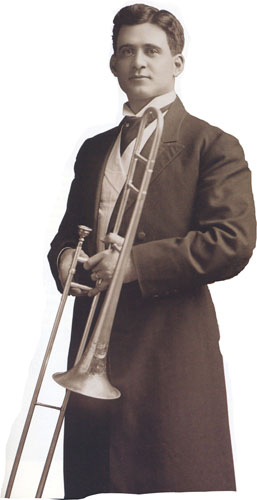
Homer Rodeheaver with his Lyon & Healy trombone, c. 1908.
Rodeheaver is an interesting subject for a biography. I began researching him in 2012 after I became aware of him and his connection to the trombone. After all, the man played the trombone in front of over 100 million people during his lifetime (1880-1955). I wanted to know more about him. As I learned more, I thought about writing an article about Rodeheaver for the Historic Brass Society Journal. In the course of my research—actually when I was trying to track down a copy of an endorsement Rodeheaver had made for Conn trombones—I contacted my friend, Margaret Downie Banks, Associate Director of the National Music Museum in Vermillion, South Dakota. With the museum’s large collection of Conn instruments and related materials, she was very helpful. But she also mentioned that I might want to contact someone who had been asking her some questions about Rodeheaver for a number of years. That led me to connect with Kevin Mungons who had been researching Rodeheaver for a long-planned book project. As we got to know each other, we learned that we had a lot of shared interests (Kevin is also a trombone player), and we thought we might put our heads together (using the old "two heads are better than one" idea) and co-author a biography of Homer Rodeheaver. Even before the publication of my peer-reviewed article about Rodeheaver in the Historic Brass Society Journal—the article focused on Rodeheaver’s work as a trombone player and trombone icon, although it touched on other aspects of his life and work—we began working write a book. Our book proposal was accepted by University of Illinois Press and several years and 130,000 words later, we had a manuscript to submit to the Press.
Here is our abstract for the book:
As I mentioned above, Rodeheaver is an interesting subject. He and Henry Fillmore were good friends; one can read a little about their friendship and activities together on a revival tour when the two of them were young men in Paul Bierley’s biography of Fillmore, Hallelujah Trombone! The Story of Henry Fillmore (Columbus: Integrity Press, 1982), 24-26. Fillmore later published an arrangement of gospel songs to which Rodeheaver owned the copyright, Billy Sunday’s Successful Songs (Cincinnati: Fillmore Brothers, 1916). Kevin interviewed Bierley in the course of our research for this book (Bierley died in 2016).
Rodeheaver’s life had complex intersections with African Americans and the subject of race. In the course of our research, I did a deep dive into this, collecting over 100 books that informed my knowledge of African American spirituals, black and white gospel music, race records, coon songs, minstrelsy, blackface, racial segregation, lynching, and the Ku Klux Klan. Add to that hundreds of newspaper articles, peer reviewed articles, journal articles (some dating back to the 1880s), recordings, and interviews. And many hundreds of hours in libraries and archives, digging through piles of papers and photographs. Kevin did the same, and together, we amassed a large library of materials. Why did I do this, you might ask? Because all of these subjects were tied up in Rodeheaver’s life. As we write in our abstract for two of the book’s chapters:
As you can see, I’ve been immersed in this for the last several years. It was in the course of my research about Fillmore, Rodeheaver, and various subjects relating to race that I uncovered the racist advertisements for Fillmore’s The Trombone Family. The subject is fraught with complexity, and Kevin and I worked to untangle some of it. This untangling led to conversations with leading voices—both academic and popular, both white and black—on the subjects, and the many sources we collected allowed us to address Rodeheaver’s intersection with race with an informed view. It became clear to us that many scholars who have made assumptions about some of these issues did not take into account important primary source materials that are in some cases over 150 years old. We are now living in a golden age of research tools, and so many materials are now available to us that were not available in the past. We learned that it is not enough to learn what “the experts” say about issues. It was important to dig deeply to discover previously overlooked sources and learn what had been said by voices that had been silenced.
When we completed our manuscript, the three peer referees did their work. We then worked to answer their questions, defend our research, gather new information, and engage in a rewrite that addressed their comments and those of our editor. The revised manuscript went back out for peer review once again, and after working through their comments, our manuscript was presented to the faculty review board for University of Illinois Press. With their approval, the book has now moved into production with a planned publication date of sometime in spring 2021.
I hope that our young readers, and perhaps some who are not so young, are seeing that the matter of research is a complex, time-consuming enterprise. One does not sit down and write about complicated, thorny subjects without first having done one’s homework. Writing a peer-reviewed article or book is not like writing a term paper on “My Summer Vacation.” Rigorous standards of research must be met; every source is checked, every assumption is challenged, every word is parsed. But at the end of the process, one hopefully has something that, once published, will inform the public with an accurate and, hopefully, an engaging portrayal of historical events and personalities.
My recent articles about Henry Fillmore’s The Trombone Family were informed by this research, these many years of immersion with primary source materials, individuals, and commentaries. My recent articles were not footnoted since I provided all of the sources for the materials I cited in the article itself. But the basis for my research is sound, having already been vetted previously.
When I was Professor of Trombone at Arizona State University (2012-2016), I had the pleasure of serving as advisor for several doctoral students who had to write dissertations/research papers. My commitment to academic rigor sometimes proved to be a challenge for them, as I always insisted that they quote primary sources, and I insisted they should NEVER quote a secondary source unless a primary source could not be found. Some of them were a little discouraged when they learned that the process of researching usually costs money. Sometimes you need to pay for access to materials, or to have an archive make scans (or, in the “old days,” microfilm) of manuscripts or letters. For instance, for my article about Haydn and the serpent (referenced above), I had to spend about $3000 to obtain music and letters from archives in England and Germany that not only informed my research, but added new insights to what we know about Haydn in England. For the Rodeheaver book, I’ve spent multiple thousands of dollars in the collection of source materials, trips to archives and libraries, and such. Not everything is on the internet. But when we want to become deeply informed about a subject, all of the cost is well worth it for the knowledge that we gain.
All of this is to say that the subject of research and who is qualified to speak on a subject is one that is very, very complex. I don’t think anyone is ever an “expert” on anything. There is always more to learn. But I think we can all be grateful for the work of researchers, historians, and authors who spend years learning about various subjects and then share those insights with others. Likewise, as our moderator has just wisely said, it is foolish to think anyone but a "recognized academic" can have useful insights about a host of subjects. One is not born knowledgable. Living life gives us knowledge. And knowledge can lead us—any of us—to learn more, dig more deeply, and share what we have learned. When that sharing is done with the background of a rigorous approach, the results can be especially informative and helpful. Every researcher—whether a "recognized academic" like me or a layman—lays the groundwork for the next researcher. The work is never done; nobody ever has the last word. Sometimes research brings up ugly truths. But when such ugly truths are exposed, they can lead to understanding and action as we learn from the lessons of history.
With kind regards to all,
-Douglas Yeo
So, I won't comment further on the issues that I brought up in my articles. But I thought, particularly for the benefit of our young members (and perhaps some others), I would add a few thoughts that might answer a question that some might have. That is:
“What qualifies Douglas Yeo to make statements about Henry Fillmore, Lassus Trombone, and the intersection of race/racism on music?”
That’s a really good question.
First, anyone can have an opinion about anything. One does not need to be an “expert” to have an opinion.
Having an opinion is fine. Having a well-considered, well-thought out, well-articulated opinion is even better. But having extensive knowledge that informs that opinion helps one offer a little more to any discussion. A little bit about how I came to learn what I know about The Trombone Family and the views I have expressed on race, racism, and minstrelsy might be helpful to others who, as they travel life’s path, find subjects that interest them that they may wish to comment upon with an informed view.
Some on this forum know about my long career as a trombonist and educator. Some may also know of my many years of work as an historian, researcher, and author. The ITA Journal has published many of my articles that have been the product of many years of research. Among them include (with a few links):
A Pictorial History of Low Brass Players in the Boston Symphony Orchestra, 1887-1986
International Trombone Association Journal, Volume XIV, Number 4, Fall 1986.
Edward Kleinhammer: A Life and Legacy Remembered
International Trombone Association Journal, Vol. 42, No. 2, April 2014.
Evolution: The Double-Valve Bass Trombone
International Trombone Association Journal, Vol. 23, No. 3, July 2015.
Take It, Big Chief: An Appreciation of Russell Moore
International Trombone Association Journal, Vol. 45, No. 3, July 2017.
Finding Marguerite Dufay
International Trombone Association Journal, Vol. 47, No. 1, January 2019
Keith Brown: Renaissance Man
International Trombone Association Journal, Vol. 47, No. 3, July 2019.
These articles all began because I had an interest in the subject. From interest came a motivation to learn more which lead to research. Not pawing through pages of Google search pages, but research in libraries and archives, conducting interviews with others, asking questions. None of these articles were what the academy refers to as “peer reviewed.” A peer reviewed article or book is one that is not published until the publisher convenes a panel of experts, known as “referees,” to review the author’s work. The selection of the referees is an important part of the process, and referees can and should be very tough on an author. They check an author’s sources, review the author’s presentation of factual material, and ensure the publication is factually accurate. The ITA Journal is not peer-reviewed, but in my research articles that it has published, I have conducted my research and writing in the same way I do for my peer-reviewed publications. A look at the articles mentioned above will show that I often have a long list of people to thank who informed my research and writing. Many of my articles are copiously footnoted to give my sourcing.
In addition to my many articles for the ITA Journal and many other journals and magazines, I have also had many peer reviewed articles, dictionary entries, and book chapters published. These have been rigorously vetted by peer referees. Each went through multiple revisions and were accepted for publication. These include:
Serpentists in Charles Wild’s Choir of the Cathedral of Amiens, c. 1826.
Historic Brass SocietyJournal, Volume 13, 2001.
A Good Old Note: The Serpent in Thomas Hardy’s World and Works.
The Hardy Review (Journal of the Thomas Hardy Association), Volume XIII, Number 1, Spring 2011. [This is the print version of a paper I presented at a conference at Yale University.]
Serpents in Boston: The Museum of Fine Arts and Boston Symphony Orchestra Collections
Galpin Society Journal, Volume LXV, March 2012.
Book chapters: The Serpent in England: Evolution and Design, and The Serpent in England, Context, Decline and Revival
Florence Gétreau, editor, Le serpent: itinéaires passés et présents. CNRS Editions, 2013. [This is the print version of a paper I presented at a conference in Paris.]
Serpent
Grove Dictionary of Musical Instruments, Second edition. Oxford University Press, 2014.
Buccin
Grove Dictionary of Musical Instruments, Second edition. Oxford University Press, 2014.
Homer Rodeheaver: Reverend Trombone
Historic Brass Society Journal. Vol. 27, 2015.
Book chapter: Marches and Divertimenti: Haydn and the Serpent
Monica Lustig, editor, Der Zink – Geschichte, Instrumente und Bauweise. Michaelsteiner Konferenzberichte Band 79, 2015. [This is the print version of a paper I presented at a conference in Michaelstein, Germany.]
Concurrent with these kinds of research projects has been my work on several book projects for major publishers. Two are in progress:
The Trombone Book
Oxford University Press
An Illustrated Dictionary for the Modern Trombone, Euphonium, and Tuba Player
Rowman & Littlefield
Another book is now in production for publication in spring 2021:
Homer Rodeheaver and the Rise of the Gospel Music Industry (coauthored with Kevin Mungons)
University of Illinois Press
And it is my work on this book on Homer Rodeheaver that informed, in large part, my recent articles about Henry Fillmore, The Trombone Family, minstrelsy, and race.
Homer Rodeheaver with his Lyon & Healy trombone, c. 1908.
Rodeheaver is an interesting subject for a biography. I began researching him in 2012 after I became aware of him and his connection to the trombone. After all, the man played the trombone in front of over 100 million people during his lifetime (1880-1955). I wanted to know more about him. As I learned more, I thought about writing an article about Rodeheaver for the Historic Brass Society Journal. In the course of my research—actually when I was trying to track down a copy of an endorsement Rodeheaver had made for Conn trombones—I contacted my friend, Margaret Downie Banks, Associate Director of the National Music Museum in Vermillion, South Dakota. With the museum’s large collection of Conn instruments and related materials, she was very helpful. But she also mentioned that I might want to contact someone who had been asking her some questions about Rodeheaver for a number of years. That led me to connect with Kevin Mungons who had been researching Rodeheaver for a long-planned book project. As we got to know each other, we learned that we had a lot of shared interests (Kevin is also a trombone player), and we thought we might put our heads together (using the old "two heads are better than one" idea) and co-author a biography of Homer Rodeheaver. Even before the publication of my peer-reviewed article about Rodeheaver in the Historic Brass Society Journal—the article focused on Rodeheaver’s work as a trombone player and trombone icon, although it touched on other aspects of his life and work—we began working write a book. Our book proposal was accepted by University of Illinois Press and several years and 130,000 words later, we had a manuscript to submit to the Press.
Here is our abstract for the book:
Homer Rodeheaver rose to national prominence in the early 20th century as the trombone-playing songleader for Billy Sunday. For twenty years they captured attention with city-wide revival meetings, a mix of sincere devotion, popular religion, and modern marketing methods. In an era when music styles were emerging as marketable genres, Rodeheaver created a brand of gospel music that cast an enormous influence on popular music. Borrowing from evangelical hymns, African American spirituals, and popular music, he built a publishing empire in Chicago, selling hymnals as a way to encourage community singing. When tabernacle revivalism declined after World War I, Rodeheaver shifted to other ventures, bolstered by his personal popularity in a growing celebrity culture. He started the first gospel record label in 1920, then shifted to radio, where his community sing programs ran on three national networks. Near the end of his life, he strongly influenced Billy Graham and Cliff Barrows, the next generation of evangelical revivalists.
The authors explore the birth of the commercial Christian music industry and its roots in congregational singing—its early rise as a communal, populist form that would later divide into racial and regional distinctions known as southern gospel and black gospel. As the first major biography of Homer Rodeheaver, the book explores the impact of racial segregation, the influence of technology, and the consequences of commercial Christian music.
As I mentioned above, Rodeheaver is an interesting subject. He and Henry Fillmore were good friends; one can read a little about their friendship and activities together on a revival tour when the two of them were young men in Paul Bierley’s biography of Fillmore, Hallelujah Trombone! The Story of Henry Fillmore (Columbus: Integrity Press, 1982), 24-26. Fillmore later published an arrangement of gospel songs to which Rodeheaver owned the copyright, Billy Sunday’s Successful Songs (Cincinnati: Fillmore Brothers, 1916). Kevin interviewed Bierley in the course of our research for this book (Bierley died in 2016).
Rodeheaver’s life had complex intersections with African Americans and the subject of race. In the course of our research, I did a deep dive into this, collecting over 100 books that informed my knowledge of African American spirituals, black and white gospel music, race records, coon songs, minstrelsy, blackface, racial segregation, lynching, and the Ku Klux Klan. Add to that hundreds of newspaper articles, peer reviewed articles, journal articles (some dating back to the 1880s), recordings, and interviews. And many hundreds of hours in libraries and archives, digging through piles of papers and photographs. Kevin did the same, and together, we amassed a large library of materials. Why did I do this, you might ask? Because all of these subjects were tied up in Rodeheaver’s life. As we write in our abstract for two of the book’s chapters:
Chapter 7: Spirituals and Minstrelsy
The African American spiritual emerged as a devotional and performance idiom in the early twentieth century, promoted in black and white communities and churches through the work of Jubilee Singers, and in secular and sacred contexts. Homer Rodeheaver played an important role in their early commercial history by transcribing performances of spirituals for publication in his hymnals, championing them in evangelistic meetings, and recording them with black gospel singing groups. The authors explore Rodeheaver’s quest for authenticity in spirituals, their transformative religious meaning, their connection to minstrelsy, and their influence on their development American popular music, Rodeheaver’s personal interest in black culture is also examined through his performances of the poetry of Paul Laurence Dunbar, presented in dialect and blackface.
Chapter 8: Jim Crow Revivalism Meets the Klan
Racial segregation and Jim Crow affected nearly every aspect of American life in the 1920s, including revivalism. When southern audiences demanded segregated tabernacle meetings, Billy Sunday and Homer Rodeheaver tried to ameliorate the situation by meeting with black ministers and organizing choirs from black churches. But despite Sunday and Rodeheaver’s fame for preaching against every form of sin, they were noticeably silent on racism. Their policy of welcoming every group to the tabernacle sometimes included delegations from the Ku Klux Klan, who gave Sunday donations that he never refused. Despite Rodeheaver’s genuinely harmonious relationships with African Americans and his lifelong promotion of the spirituals, his far-flung business interests created awkward contradictions. His Chicago studio made custom recordings for the Klan, including a parody of Rodeheaver’s “The Old Rugged Cross” with KKK lyrics, “The Bright Fiery Cross.”
As you can see, I’ve been immersed in this for the last several years. It was in the course of my research about Fillmore, Rodeheaver, and various subjects relating to race that I uncovered the racist advertisements for Fillmore’s The Trombone Family. The subject is fraught with complexity, and Kevin and I worked to untangle some of it. This untangling led to conversations with leading voices—both academic and popular, both white and black—on the subjects, and the many sources we collected allowed us to address Rodeheaver’s intersection with race with an informed view. It became clear to us that many scholars who have made assumptions about some of these issues did not take into account important primary source materials that are in some cases over 150 years old. We are now living in a golden age of research tools, and so many materials are now available to us that were not available in the past. We learned that it is not enough to learn what “the experts” say about issues. It was important to dig deeply to discover previously overlooked sources and learn what had been said by voices that had been silenced.
When we completed our manuscript, the three peer referees did their work. We then worked to answer their questions, defend our research, gather new information, and engage in a rewrite that addressed their comments and those of our editor. The revised manuscript went back out for peer review once again, and after working through their comments, our manuscript was presented to the faculty review board for University of Illinois Press. With their approval, the book has now moved into production with a planned publication date of sometime in spring 2021.
I hope that our young readers, and perhaps some who are not so young, are seeing that the matter of research is a complex, time-consuming enterprise. One does not sit down and write about complicated, thorny subjects without first having done one’s homework. Writing a peer-reviewed article or book is not like writing a term paper on “My Summer Vacation.” Rigorous standards of research must be met; every source is checked, every assumption is challenged, every word is parsed. But at the end of the process, one hopefully has something that, once published, will inform the public with an accurate and, hopefully, an engaging portrayal of historical events and personalities.
My recent articles about Henry Fillmore’s The Trombone Family were informed by this research, these many years of immersion with primary source materials, individuals, and commentaries. My recent articles were not footnoted since I provided all of the sources for the materials I cited in the article itself. But the basis for my research is sound, having already been vetted previously.
When I was Professor of Trombone at Arizona State University (2012-2016), I had the pleasure of serving as advisor for several doctoral students who had to write dissertations/research papers. My commitment to academic rigor sometimes proved to be a challenge for them, as I always insisted that they quote primary sources, and I insisted they should NEVER quote a secondary source unless a primary source could not be found. Some of them were a little discouraged when they learned that the process of researching usually costs money. Sometimes you need to pay for access to materials, or to have an archive make scans (or, in the “old days,” microfilm) of manuscripts or letters. For instance, for my article about Haydn and the serpent (referenced above), I had to spend about $3000 to obtain music and letters from archives in England and Germany that not only informed my research, but added new insights to what we know about Haydn in England. For the Rodeheaver book, I’ve spent multiple thousands of dollars in the collection of source materials, trips to archives and libraries, and such. Not everything is on the internet. But when we want to become deeply informed about a subject, all of the cost is well worth it for the knowledge that we gain.
All of this is to say that the subject of research and who is qualified to speak on a subject is one that is very, very complex. I don’t think anyone is ever an “expert” on anything. There is always more to learn. But I think we can all be grateful for the work of researchers, historians, and authors who spend years learning about various subjects and then share those insights with others. Likewise, as our moderator has just wisely said, it is foolish to think anyone but a "recognized academic" can have useful insights about a host of subjects. One is not born knowledgable. Living life gives us knowledge. And knowledge can lead us—any of us—to learn more, dig more deeply, and share what we have learned. When that sharing is done with the background of a rigorous approach, the results can be especially informative and helpful. Every researcher—whether a "recognized academic" like me or a layman—lays the groundwork for the next researcher. The work is never done; nobody ever has the last word. Sometimes research brings up ugly truths. But when such ugly truths are exposed, they can lead to understanding and action as we learn from the lessons of history.
With kind regards to all,
-Douglas Yeo
- Doug_Elliott
- Posts: 4155
- Joined: Mar 22, 2018
Excellent, thank you.
- Vegasbound
- Posts: 1328
- Joined: Jul 06, 2019
Doug
Don't know about anyone else, but I will be buying the book on Rodeheaver having read your previous post
Thanks
Don't know about anyone else, but I will be buying the book on Rodeheaver having read your previous post
Thanks
- Savio
- Posts: 688
- Joined: Apr 26, 2018
[quote="yeodoug"]As readers of trombonechat.com know, I post to this forum very infrequently. This is post number 21 from me in over two years since I joined the club. My life is full and happily busy with performances, teaching, writing, travel, and the joy of living near our grandchildren. I don’t use social media. Most of my posts to trombonechat.com have been to ask questions of the community to help inform some of my research projects. I have not joined in on this discussion about Henry Fillmore’s The Trombone Family since what I have to say on the subject has already been said in the several articles I have recently published on my blog. Others have been directing the conversation here.
So, I won't comment further on the issues that I brought up in my articles. But I thought, particularly for the benefit of our young members (and perhaps some others), I would add a few thoughts that might answer a question that some might have. That is:
<QUOTE>“What qualifies Douglas Yeo to make statements about Henry Fillmore, Lassus Trombone, and the intersection of race/racism on music?”[/quote]
That’s a really good question.
First, anyone can have an opinion about anything. One does not need to be an “expert” to have an opinion.
Having an opinion is fine. Having a well-considered, well-thought out, well-articulated opinion is even better. But having extensive knowledge that informs that opinion helps one offer a little more to any discussion. A little bit about how I came to learn what I know about The Trombone Family and the views I have expressed on race, racism, and minstrelsy might be helpful to others who, as they travel life’s path, find subjects that interest them that they may wish to comment upon with an informed view.
Some on this forum know about my long career as a trombonist and educator. Some may also know of my many years of work as an historian, researcher, and author. The ITA Journal has published many of my articles that have been the product of many years of research. Among them include (with a few links):
A Pictorial History of Low Brass Players in the Boston Symphony Orchestra, 1887-1986
International Trombone Association Journal, Volume XIV, Number 4, Fall 1986.
[url]<LINK_TEXT text="http://www.yeodoug.com/articles/Yeo_ITA ... s_1986.pdf">http://www.yeodoug.com/articles/Yeo_ITAJ_BSO_trombones_1986.pdf</LINK_TEXT>
Edward Kleinhammer: A Life and Legacy Remembered
International Trombone Association Journal, Vol. 42, No. 2, April 2014.
[url]<LINK_TEXT text="http://www.yeodoug.com/articles/Yeo_ITA ... ribute.pdf">http://www.yeodoug.com/articles/Yeo_ITAJ_April_2014__Edward_Kleinhammer_tribute.pdf</LINK_TEXT>
Evolution: The Double-Valve Bass Trombone
International Trombone Association Journal, Vol. 23, No. 3, July 2015.
[url]<LINK_TEXT text="http://www.yeodoug.com/articles/Yeo_ITA ... ombone.pdf">http://www.yeodoug.com/articles/Yeo_ITAJ_July_2015_Double_Valve_Bass_Trombone.pdf</LINK_TEXT>
Take It, Big Chief: An Appreciation of Russell Moore
International Trombone Association Journal, Vol. 45, No. 3, July 2017.
[url]<LINK_TEXT text="http://www.yeodoug.com/articles/Yeo_ITA ... _Moore.pdf">http://www.yeodoug.com/articles/Yeo_ITAJ_July_2017_Russell_Moore.pdf</LINK_TEXT>
Finding Marguerite Dufay
International Trombone Association Journal, Vol. 47, No. 1, January 2019
Keith Brown: Renaissance Man
International Trombone Association Journal, Vol. 47, No. 3, July 2019.
[url]<LINK_TEXT text="http://www.yeodoug.com/articles/Yeo_ITA ... ribute.pdf">http://www.yeodoug.com/articles/Yeo_ITAJ_July_2019_Keith_Brown_tribute.pdf</LINK_TEXT>
These articles all began because I had an interest in the subject. From interest came a motivation to learn more which lead to research. Not pawing through pages of Google search pages, but research in libraries and archives, conducting interviews with others, asking questions. None of these articles were what the academy refers to as “peer reviewed.” A peer reviewed article or book is one that is not published until the publisher convenes a panel of experts, known as “referees,” to review the author’s work. The selection of the referees is an important part of the process, and referees can and should be very tough on an author. They check an author’s sources, review the author’s presentation of factual material, and ensure the publication is factually accurate. The ITA Journal is not peer-reviewed, but in my research articles that it has published, I have conducted my research and writing in the same way I do for my peer-reviewed publications. A look at the articles mentioned above will show that I often have a long list of people to thank who informed my research and writing. Many of my articles are copiously footnoted to give my sourcing.
In addition to my many articles for the ITA Journal and many other journals and magazines, I have also had many peer reviewed articles, dictionary entries, and book chapters published. These have been rigorously vetted by peer referees. Each went through multiple revisions and were accepted for publication. These include:
Serpentists in Charles Wild’s Choir of the Cathedral of Amiens, c. 1826.
Historic Brass SocietyJournal, Volume 13, 2001.
[url]<LINK_TEXT text="http://www.yeodoug.com/articles/Yeo_HBS ... s_2001.pdf">http://www.yeodoug.com/articles/Yeo_HBSJ_Amiens_serpents_2001.pdf</LINK_TEXT>
A Good Old Note: The Serpent in Thomas Hardy’s World and Works.
The Hardy Review (Journal of the Thomas Hardy Association), Volume XIII, Number 1, Spring 2011. [This is the print version of a paper I presented at a conference at Yale University.]
[url]<LINK_TEXT text="http://www.yeodoug.com/articles/Yeo_Ser ... w_2011.pdf">http://www.yeodoug.com/articles/Yeo_Serpent_Hardy_Review_2011.pdf</LINK_TEXT>
Serpents in Boston: The Museum of Fine Arts and Boston Symphony Orchestra Collections
Galpin Society Journal, Volume LXV, March 2012.
Book chapters: The Serpent in England: Evolution and Design, and The Serpent in England, Context, Decline and Revival
Florence Gétreau, editor, Le serpent: itinéaires passés et présents. CNRS Editions, 2013. [This is the print version of a paper I presented at a conference in Paris.]
Serpent
Grove Dictionary of Musical Instruments, Second edition. Oxford University Press, 2014.
Buccin
Grove Dictionary of Musical Instruments, Second edition. Oxford University Press, 2014.
Homer Rodeheaver: Reverend Trombone
Historic Brass Society Journal. Vol. 27, 2015.
[url]<LINK_TEXT text="http://www.yeodoug.com/articles/Yeo_HBS ... r_2015.pdf">http://www.yeodoug.com/articles/Yeo_HBSJ_Homer_Rodeheaver_2015.pdf</LINK_TEXT>
Book chapter: Marches and Divertimenti: Haydn and the Serpent
Monica Lustig, editor, Der Zink – Geschichte, Instrumente und Bauweise. Michaelsteiner Konferenzberichte Band 79, 2015. [This is the print version of a paper I presented at a conference in Michaelstein, Germany.]
Concurrent with these kinds of research projects has been my work on several book projects for major publishers. Two are in progress:
The Trombone Book
Oxford University Press
An Illustrated Dictionary for the Modern Trombone, Euphonium, and Tuba Player
Rowman & Littlefield
Another book is now in production for publication in spring 2021:
Homer Rodeheaver and the Rise of the Gospel Music Industry (coauthored with Kevin Mungons)
University of Illinois Press
And it is my work on this book on Homer Rodeheaver that informed, in large part, my recent articles about Henry Fillmore, The Trombone Family, minstrelsy, and race.
Homer Rodeheaver with his Lyon & Healy trombone, c. 1908.
Rodeheaver is an interesting subject for a biography. I began researching him in 2012 after I became aware of him and his connection to the trombone. After all, the man played the trombone in front of over 100 million people during his lifetime (1880-1955). I wanted to know more about him. As I learned more, I thought about writing an article about Rodeheaver for the Historic Brass Society Journal. In the course of my research—actually when I was trying to track down a copy of an endorsement Rodeheaver had made for Conn trombones—I contacted my friend, Margaret Downie Banks, Associate Director of the National Music Museum in Vermillion, South Dakota. With the museum’s large collection of Conn instruments and related materials, she was very helpful. But she also mentioned that I might want to contact someone who had been asking her some questions about Rodeheaver for a number of years. That led me to connect with Kevin Mungons who had been researching Rodeheaver for a long-planned book project. As we got to know each other, we learned that we had a lot of shared interests (Kevin is also a trombone player), and we thought we might put our heads together (using the old "two heads are better than one" idea) and co-author a biography of Homer Rodeheaver. Even before the publication of my peer-reviewed article about Rodeheaver in the Historic Brass Society Journal—the article focused on Rodeheaver’s work as a trombone player and trombone icon, although it touched on other aspects of his life and work—we began working write a book. Our book proposal was accepted by University of Illinois Press and several years and 130,000 words later, we had a manuscript to submit to the Press.
Here is our abstract for the book:
As I mentioned above, Rodeheaver is an interesting subject. He and Henry Fillmore were good friends; one can read a little about their friendship and activities together on a revival tour when the two of them were young men in Paul Bierley’s biography of Fillmore, Hallelujah Trombone! The Story of Henry Fillmore (Columbus: Integrity Press, 1982), 24-26. Fillmore later published an arrangement of gospel songs to which Rodeheaver owned the copyright, Billy Sunday’s Successful Songs (Cincinnati: Fillmore Brothers, 1916). Kevin interviewed Bierley in the course of our research for this book (Bierley died in 2016).
Rodeheaver’s life had complex intersections with African Americans and the subject of race. In the course of our research, I did a deep dive into this, collecting over 100 books that informed my knowledge of African American spirituals, black and white gospel music, race records, coon songs, minstrelsy, blackface, racial segregation, lynching, and the Ku Klux Klan. Add to that hundreds of newspaper articles, peer reviewed articles, journal articles (some dating back to the 1880s), recordings, and interviews. And many hundreds of hours in libraries and archives, digging through piles of papers and photographs. Kevin did the same, and together, we amassed a large library of materials. Why did I do this, you might ask? Because all of these subjects were tied up in Rodeheaver’s life. As we write in our abstract for two of the book’s chapters:
As you can see, I’ve been immersed in this for the last several years. It was in the course of my research about Fillmore, Rodeheaver, and various subjects relating to race that I uncovered the racist advertisements for Fillmore’s The Trombone Family. The subject is fraught with complexity, and Kevin and I worked to untangle some of it. This untangling led to conversations with leading voices—both academic and popular, both white and black—on the subjects, and the many sources we collected allowed us to address Rodeheaver’s intersection with race with an informed view. It became clear to us that many scholars who have made assumptions about some of these issues did not take into account important primary source materials that are in some cases over 150 years old. We are now living in a golden age of research tools, and so many materials are now available to us that were not available in the past. We learned that it is not enough to learn what “the experts” say about issues. It was important to dig deeply to discover previously overlooked sources and learn what had been said by voices that had been silenced.
When we completed our manuscript, the three peer referees did their work. We then worked to answer their questions, defend our research, gather new information, and engage in a rewrite that addressed their comments and those of our editor. The revised manuscript went back out for peer review once again, and after working through their comments, our manuscript was presented to the faculty review board for University of Illinois Press. With their approval, the book has now moved into production with a planned publication date of sometime in spring 2021.
I hope that our young readers, and perhaps some who are not so young, are seeing that the matter of research is a complex, time-consuming enterprise. One does not sit down and write about complicated, thorny subjects without first having done one’s homework. Writing a peer-reviewed article or book is not like writing a term paper on “My Summer Vacation.” Rigorous standards of research must be met; every source is checked, every assumption is challenged, every word is parsed. But at the end of the process, one hopefully has something that, once published, will inform the public with an accurate and, hopefully, an engaging portrayal of historical events and personalities.
My recent articles about Henry Fillmore’s The Trombone Family were informed by this research, these many years of immersion with primary source materials, individuals, and commentaries. My recent articles were not footnoted since I provided all of the sources for the materials I cited in the article itself. But the basis for my research is sound, having already been vetted previously.
When I was Professor of Trombone at Arizona State University (2012-2016), I had the pleasure of serving as advisor for several doctoral students who had to write dissertations/research papers. My commitment to academic rigor sometimes proved to be a challenge for them, as I always insisted that they quote primary sources, and I insisted they should NEVER quote a secondary source unless a primary source could not be found. Some of them were a little discouraged when they learned that the process of researching usually costs money. Sometimes you need to pay for access to materials, or to have an archive make scans (or, in the “old days,” microfilm) of manuscripts or letters. For instance, for my article about Haydn and the serpent (referenced above), I had to spend about $3000 to obtain music and letters from archives in England and Germany that not only informed my research, but added new insights to what we know about Haydn in England. For the Rodeheaver book, I’ve spent multiple thousands of dollars in the collection of source materials, trips to archives and libraries, and such. Not everything is on the internet. But when we want to become deeply informed about a subject, all of the cost is well worth it for the knowledge that we gain.
All of this is to say that the subject of research and who is qualified to speak on a subject is one that is very, very complex. I don’t think anyone is ever an “expert” on anything. There is always more to learn. But I think we can all be grateful for the work of researchers, historians, and authors who spend years learning about various subjects and then share those insights with others. Likewise, as our moderator has just wisely said, it is foolish to think anyone but a "recognized academic" can have useful insights about a host of subjects. One is not born knowledgable. Living life gives us knowledge. And knowledge can lead us—any of us—to learn more, dig more deeply, and share what we have learned. When that sharing is done with the background of a rigorous approach, the results can be especially informative and helpful. Every researcher—whether a "recognized academic" like me or a layman—lays the groundwork for the next researcher. The work is never done; nobody ever has the last word. Sometimes research brings up ugly truths. But when such ugly truths are exposed, they can lead to understanding and action as we learn from the lessons of history.
With kind regards to all,
-Douglas Yeo
</QUOTE>
So, I won't comment further on the issues that I brought up in my articles. But I thought, particularly for the benefit of our young members (and perhaps some others), I would add a few thoughts that might answer a question that some might have. That is:
<QUOTE>“What qualifies Douglas Yeo to make statements about Henry Fillmore, Lassus Trombone, and the intersection of race/racism on music?”[/quote]
That’s a really good question.
First, anyone can have an opinion about anything. One does not need to be an “expert” to have an opinion.
Having an opinion is fine. Having a well-considered, well-thought out, well-articulated opinion is even better. But having extensive knowledge that informs that opinion helps one offer a little more to any discussion. A little bit about how I came to learn what I know about The Trombone Family and the views I have expressed on race, racism, and minstrelsy might be helpful to others who, as they travel life’s path, find subjects that interest them that they may wish to comment upon with an informed view.
Some on this forum know about my long career as a trombonist and educator. Some may also know of my many years of work as an historian, researcher, and author. The ITA Journal has published many of my articles that have been the product of many years of research. Among them include (with a few links):
A Pictorial History of Low Brass Players in the Boston Symphony Orchestra, 1887-1986
International Trombone Association Journal, Volume XIV, Number 4, Fall 1986.
Edward Kleinhammer: A Life and Legacy Remembered
International Trombone Association Journal, Vol. 42, No. 2, April 2014.
Evolution: The Double-Valve Bass Trombone
International Trombone Association Journal, Vol. 23, No. 3, July 2015.
Take It, Big Chief: An Appreciation of Russell Moore
International Trombone Association Journal, Vol. 45, No. 3, July 2017.
Finding Marguerite Dufay
International Trombone Association Journal, Vol. 47, No. 1, January 2019
Keith Brown: Renaissance Man
International Trombone Association Journal, Vol. 47, No. 3, July 2019.
These articles all began because I had an interest in the subject. From interest came a motivation to learn more which lead to research. Not pawing through pages of Google search pages, but research in libraries and archives, conducting interviews with others, asking questions. None of these articles were what the academy refers to as “peer reviewed.” A peer reviewed article or book is one that is not published until the publisher convenes a panel of experts, known as “referees,” to review the author’s work. The selection of the referees is an important part of the process, and referees can and should be very tough on an author. They check an author’s sources, review the author’s presentation of factual material, and ensure the publication is factually accurate. The ITA Journal is not peer-reviewed, but in my research articles that it has published, I have conducted my research and writing in the same way I do for my peer-reviewed publications. A look at the articles mentioned above will show that I often have a long list of people to thank who informed my research and writing. Many of my articles are copiously footnoted to give my sourcing.
In addition to my many articles for the ITA Journal and many other journals and magazines, I have also had many peer reviewed articles, dictionary entries, and book chapters published. These have been rigorously vetted by peer referees. Each went through multiple revisions and were accepted for publication. These include:
Serpentists in Charles Wild’s Choir of the Cathedral of Amiens, c. 1826.
Historic Brass SocietyJournal, Volume 13, 2001.
A Good Old Note: The Serpent in Thomas Hardy’s World and Works.
The Hardy Review (Journal of the Thomas Hardy Association), Volume XIII, Number 1, Spring 2011. [This is the print version of a paper I presented at a conference at Yale University.]
Serpents in Boston: The Museum of Fine Arts and Boston Symphony Orchestra Collections
Galpin Society Journal, Volume LXV, March 2012.
Book chapters: The Serpent in England: Evolution and Design, and The Serpent in England, Context, Decline and Revival
Florence Gétreau, editor, Le serpent: itinéaires passés et présents. CNRS Editions, 2013. [This is the print version of a paper I presented at a conference in Paris.]
Serpent
Grove Dictionary of Musical Instruments, Second edition. Oxford University Press, 2014.
Buccin
Grove Dictionary of Musical Instruments, Second edition. Oxford University Press, 2014.
Homer Rodeheaver: Reverend Trombone
Historic Brass Society Journal. Vol. 27, 2015.
Book chapter: Marches and Divertimenti: Haydn and the Serpent
Monica Lustig, editor, Der Zink – Geschichte, Instrumente und Bauweise. Michaelsteiner Konferenzberichte Band 79, 2015. [This is the print version of a paper I presented at a conference in Michaelstein, Germany.]
Concurrent with these kinds of research projects has been my work on several book projects for major publishers. Two are in progress:
The Trombone Book
Oxford University Press
An Illustrated Dictionary for the Modern Trombone, Euphonium, and Tuba Player
Rowman & Littlefield
Another book is now in production for publication in spring 2021:
Homer Rodeheaver and the Rise of the Gospel Music Industry (coauthored with Kevin Mungons)
University of Illinois Press
And it is my work on this book on Homer Rodeheaver that informed, in large part, my recent articles about Henry Fillmore, The Trombone Family, minstrelsy, and race.
Homer Rodeheaver with his Lyon & Healy trombone, c. 1908.
Rodeheaver is an interesting subject for a biography. I began researching him in 2012 after I became aware of him and his connection to the trombone. After all, the man played the trombone in front of over 100 million people during his lifetime (1880-1955). I wanted to know more about him. As I learned more, I thought about writing an article about Rodeheaver for the Historic Brass Society Journal. In the course of my research—actually when I was trying to track down a copy of an endorsement Rodeheaver had made for Conn trombones—I contacted my friend, Margaret Downie Banks, Associate Director of the National Music Museum in Vermillion, South Dakota. With the museum’s large collection of Conn instruments and related materials, she was very helpful. But she also mentioned that I might want to contact someone who had been asking her some questions about Rodeheaver for a number of years. That led me to connect with Kevin Mungons who had been researching Rodeheaver for a long-planned book project. As we got to know each other, we learned that we had a lot of shared interests (Kevin is also a trombone player), and we thought we might put our heads together (using the old "two heads are better than one" idea) and co-author a biography of Homer Rodeheaver. Even before the publication of my peer-reviewed article about Rodeheaver in the Historic Brass Society Journal—the article focused on Rodeheaver’s work as a trombone player and trombone icon, although it touched on other aspects of his life and work—we began working write a book. Our book proposal was accepted by University of Illinois Press and several years and 130,000 words later, we had a manuscript to submit to the Press.
Here is our abstract for the book:
Homer Rodeheaver rose to national prominence in the early 20th century as the trombone-playing songleader for Billy Sunday. For twenty years they captured attention with city-wide revival meetings, a mix of sincere devotion, popular religion, and modern marketing methods. In an era when music styles were emerging as marketable genres, Rodeheaver created a brand of gospel music that cast an enormous influence on popular music. Borrowing from evangelical hymns, African American spirituals, and popular music, he built a publishing empire in Chicago, selling hymnals as a way to encourage community singing. When tabernacle revivalism declined after World War I, Rodeheaver shifted to other ventures, bolstered by his personal popularity in a growing celebrity culture. He started the first gospel record label in 1920, then shifted to radio, where his community sing programs ran on three national networks. Near the end of his life, he strongly influenced Billy Graham and Cliff Barrows, the next generation of evangelical revivalists.
The authors explore the birth of the commercial Christian music industry and its roots in congregational singing—its early rise as a communal, populist form that would later divide into racial and regional distinctions known as southern gospel and black gospel. As the first major biography of Homer Rodeheaver, the book explores the impact of racial segregation, the influence of technology, and the consequences of commercial Christian music.
As I mentioned above, Rodeheaver is an interesting subject. He and Henry Fillmore were good friends; one can read a little about their friendship and activities together on a revival tour when the two of them were young men in Paul Bierley’s biography of Fillmore, Hallelujah Trombone! The Story of Henry Fillmore (Columbus: Integrity Press, 1982), 24-26. Fillmore later published an arrangement of gospel songs to which Rodeheaver owned the copyright, Billy Sunday’s Successful Songs (Cincinnati: Fillmore Brothers, 1916). Kevin interviewed Bierley in the course of our research for this book (Bierley died in 2016).
Rodeheaver’s life had complex intersections with African Americans and the subject of race. In the course of our research, I did a deep dive into this, collecting over 100 books that informed my knowledge of African American spirituals, black and white gospel music, race records, coon songs, minstrelsy, blackface, racial segregation, lynching, and the Ku Klux Klan. Add to that hundreds of newspaper articles, peer reviewed articles, journal articles (some dating back to the 1880s), recordings, and interviews. And many hundreds of hours in libraries and archives, digging through piles of papers and photographs. Kevin did the same, and together, we amassed a large library of materials. Why did I do this, you might ask? Because all of these subjects were tied up in Rodeheaver’s life. As we write in our abstract for two of the book’s chapters:
Chapter 7: Spirituals and Minstrelsy
The African American spiritual emerged as a devotional and performance idiom in the early twentieth century, promoted in black and white communities and churches through the work of Jubilee Singers, and in secular and sacred contexts. Homer Rodeheaver played an important role in their early commercial history by transcribing performances of spirituals for publication in his hymnals, championing them in evangelistic meetings, and recording them with black gospel singing groups. The authors explore Rodeheaver’s quest for authenticity in spirituals, their transformative religious meaning, their connection to minstrelsy, and their influence on their development American popular music, Rodeheaver’s personal interest in black culture is also examined through his performances of the poetry of Paul Laurence Dunbar, presented in dialect and blackface.
Chapter 8: Jim Crow Revivalism Meets the Klan
Racial segregation and Jim Crow affected nearly every aspect of American life in the 1920s, including revivalism. When southern audiences demanded segregated tabernacle meetings, Billy Sunday and Homer Rodeheaver tried to ameliorate the situation by meeting with black ministers and organizing choirs from black churches. But despite Sunday and Rodeheaver’s fame for preaching against every form of sin, they were noticeably silent on racism. Their policy of welcoming every group to the tabernacle sometimes included delegations from the Ku Klux Klan, who gave Sunday donations that he never refused. Despite Rodeheaver’s genuinely harmonious relationships with African Americans and his lifelong promotion of the spirituals, his far-flung business interests created awkward contradictions. His Chicago studio made custom recordings for the Klan, including a parody of Rodeheaver’s “The Old Rugged Cross” with KKK lyrics, “The Bright Fiery Cross.”
As you can see, I’ve been immersed in this for the last several years. It was in the course of my research about Fillmore, Rodeheaver, and various subjects relating to race that I uncovered the racist advertisements for Fillmore’s The Trombone Family. The subject is fraught with complexity, and Kevin and I worked to untangle some of it. This untangling led to conversations with leading voices—both academic and popular, both white and black—on the subjects, and the many sources we collected allowed us to address Rodeheaver’s intersection with race with an informed view. It became clear to us that many scholars who have made assumptions about some of these issues did not take into account important primary source materials that are in some cases over 150 years old. We are now living in a golden age of research tools, and so many materials are now available to us that were not available in the past. We learned that it is not enough to learn what “the experts” say about issues. It was important to dig deeply to discover previously overlooked sources and learn what had been said by voices that had been silenced.
When we completed our manuscript, the three peer referees did their work. We then worked to answer their questions, defend our research, gather new information, and engage in a rewrite that addressed their comments and those of our editor. The revised manuscript went back out for peer review once again, and after working through their comments, our manuscript was presented to the faculty review board for University of Illinois Press. With their approval, the book has now moved into production with a planned publication date of sometime in spring 2021.
I hope that our young readers, and perhaps some who are not so young, are seeing that the matter of research is a complex, time-consuming enterprise. One does not sit down and write about complicated, thorny subjects without first having done one’s homework. Writing a peer-reviewed article or book is not like writing a term paper on “My Summer Vacation.” Rigorous standards of research must be met; every source is checked, every assumption is challenged, every word is parsed. But at the end of the process, one hopefully has something that, once published, will inform the public with an accurate and, hopefully, an engaging portrayal of historical events and personalities.
My recent articles about Henry Fillmore’s The Trombone Family were informed by this research, these many years of immersion with primary source materials, individuals, and commentaries. My recent articles were not footnoted since I provided all of the sources for the materials I cited in the article itself. But the basis for my research is sound, having already been vetted previously.
When I was Professor of Trombone at Arizona State University (2012-2016), I had the pleasure of serving as advisor for several doctoral students who had to write dissertations/research papers. My commitment to academic rigor sometimes proved to be a challenge for them, as I always insisted that they quote primary sources, and I insisted they should NEVER quote a secondary source unless a primary source could not be found. Some of them were a little discouraged when they learned that the process of researching usually costs money. Sometimes you need to pay for access to materials, or to have an archive make scans (or, in the “old days,” microfilm) of manuscripts or letters. For instance, for my article about Haydn and the serpent (referenced above), I had to spend about $3000 to obtain music and letters from archives in England and Germany that not only informed my research, but added new insights to what we know about Haydn in England. For the Rodeheaver book, I’ve spent multiple thousands of dollars in the collection of source materials, trips to archives and libraries, and such. Not everything is on the internet. But when we want to become deeply informed about a subject, all of the cost is well worth it for the knowledge that we gain.
All of this is to say that the subject of research and who is qualified to speak on a subject is one that is very, very complex. I don’t think anyone is ever an “expert” on anything. There is always more to learn. But I think we can all be grateful for the work of researchers, historians, and authors who spend years learning about various subjects and then share those insights with others. Likewise, as our moderator has just wisely said, it is foolish to think anyone but a "recognized academic" can have useful insights about a host of subjects. One is not born knowledgable. Living life gives us knowledge. And knowledge can lead us—any of us—to learn more, dig more deeply, and share what we have learned. When that sharing is done with the background of a rigorous approach, the results can be especially informative and helpful. Every researcher—whether a "recognized academic" like me or a layman—lays the groundwork for the next researcher. The work is never done; nobody ever has the last word. Sometimes research brings up ugly truths. But when such ugly truths are exposed, they can lead to understanding and action as we learn from the lessons of history.
With kind regards to all,
-Douglas Yeo
</QUOTE>
- DougHulme
- Posts: 558
- Joined: Apr 27, 2018
Doug Yeo - I thank you for such a thorough and flawless post. I know how long these posts and communications take to formulate, so much better than 'firing from the hip' its one of the reasons I also dont use social media.
Doug Elliot - well said, I add my voice to your commendation.
Kind regards to you all
Doug Hulme
Doug Elliot - well said, I add my voice to your commendation.
Kind regards to you all
Doug Hulme
- u_8parktoollover
- Posts: 206
- Joined: Jul 06, 2018
[quote="yeodoug"]As readers of trombonechat.com know, I post to this forum very infrequently. This is post number 21 from me in over two years since I joined the club. My life is full and happily busy with performances, teaching, writing, travel, and the joy of living near our grandchildren. I don’t use social media. Most of my posts to trombonechat.com have been to ask questions of the community to help inform some of my research projects. I have not joined in on this discussion about Henry Fillmore’s The Trombone Family since what I have to say on the subject has already been said in the several articles I have recently published on my blog. Others have been directing the conversation here.
So, I won't comment further on the issues that I brought up in my articles. But I thought, particularly for the benefit of our young members (and perhaps some others), I would add a few thoughts that might answer a question that some might have. That is:
<QUOTE>“What qualifies Douglas Yeo to make statements about Henry Fillmore, Lassus Trombone, and the intersection of race/racism on music?”[/quote]
That’s a really good question.
First, anyone can have an opinion about anything. One does not need to be an “expert” to have an opinion.
Having an opinion is fine. Having a well-considered, well-thought out, well-articulated opinion is even better. But having extensive knowledge that informs that opinion helps one offer a little more to any discussion. A little bit about how I came to learn what I know about The Trombone Family and the views I have expressed on race, racism, and minstrelsy might be helpful to others who, as they travel life’s path, find subjects that interest them that they may wish to comment upon with an informed view.
Some on this forum know about my long career as a trombonist and educator. Some may also know of my many years of work as an historian, researcher, and author. The ITA Journal has published many of my articles that have been the product of many years of research. Among them include (with a few links):
A Pictorial History of Low Brass Players in the Boston Symphony Orchestra, 1887-1986
International Trombone Association Journal, Volume XIV, Number 4, Fall 1986.
[url]<LINK_TEXT text="http://www.yeodoug.com/articles/Yeo_ITA ... s_1986.pdf">http://www.yeodoug.com/articles/Yeo_ITAJ_BSO_trombones_1986.pdf</LINK_TEXT>
Edward Kleinhammer: A Life and Legacy Remembered
International Trombone Association Journal, Vol. 42, No. 2, April 2014.
[url]<LINK_TEXT text="http://www.yeodoug.com/articles/Yeo_ITA ... ribute.pdf">http://www.yeodoug.com/articles/Yeo_ITAJ_April_2014__Edward_Kleinhammer_tribute.pdf</LINK_TEXT>
Evolution: The Double-Valve Bass Trombone
International Trombone Association Journal, Vol. 23, No. 3, July 2015.
[url]<LINK_TEXT text="http://www.yeodoug.com/articles/Yeo_ITA ... ombone.pdf">http://www.yeodoug.com/articles/Yeo_ITAJ_July_2015_Double_Valve_Bass_Trombone.pdf</LINK_TEXT>
Take It, Big Chief: An Appreciation of Russell Moore
International Trombone Association Journal, Vol. 45, No. 3, July 2017.
[url]<LINK_TEXT text="http://www.yeodoug.com/articles/Yeo_ITA ... _Moore.pdf">http://www.yeodoug.com/articles/Yeo_ITAJ_July_2017_Russell_Moore.pdf</LINK_TEXT>
Finding Marguerite Dufay
International Trombone Association Journal, Vol. 47, No. 1, January 2019
Keith Brown: Renaissance Man
International Trombone Association Journal, Vol. 47, No. 3, July 2019.
[url]<LINK_TEXT text="http://www.yeodoug.com/articles/Yeo_ITA ... ribute.pdf">http://www.yeodoug.com/articles/Yeo_ITAJ_July_2019_Keith_Brown_tribute.pdf</LINK_TEXT>
These articles all began because I had an interest in the subject. From interest came a motivation to learn more which lead to research. Not pawing through pages of Google search pages, but research in libraries and archives, conducting interviews with others, asking questions. None of these articles were what the academy refers to as “peer reviewed.” A peer reviewed article or book is one that is not published until the publisher convenes a panel of experts, known as “referees,” to review the author’s work. The selection of the referees is an important part of the process, and referees can and should be very tough on an author. They check an author’s sources, review the author’s presentation of factual material, and ensure the publication is factually accurate. The ITA Journal is not peer-reviewed, but in my research articles that it has published, I have conducted my research and writing in the same way I do for my peer-reviewed publications. A look at the articles mentioned above will show that I often have a long list of people to thank who informed my research and writing. Many of my articles are copiously footnoted to give my sourcing.
In addition to my many articles for the ITA Journal and many other journals and magazines, I have also had many peer reviewed articles, dictionary entries, and book chapters published. These have been rigorously vetted by peer referees. Each went through multiple revisions and were accepted for publication. These include:
Serpentists in Charles Wild’s Choir of the Cathedral of Amiens, c. 1826.
Historic Brass SocietyJournal, Volume 13, 2001.
[url]<LINK_TEXT text="http://www.yeodoug.com/articles/Yeo_HBS ... s_2001.pdf">http://www.yeodoug.com/articles/Yeo_HBSJ_Amiens_serpents_2001.pdf</LINK_TEXT>
A Good Old Note: The Serpent in Thomas Hardy’s World and Works.
The Hardy Review (Journal of the Thomas Hardy Association), Volume XIII, Number 1, Spring 2011. [This is the print version of a paper I presented at a conference at Yale University.]
[url]<LINK_TEXT text="http://www.yeodoug.com/articles/Yeo_Ser ... w_2011.pdf">http://www.yeodoug.com/articles/Yeo_Serpent_Hardy_Review_2011.pdf</LINK_TEXT>
Serpents in Boston: The Museum of Fine Arts and Boston Symphony Orchestra Collections
Galpin Society Journal, Volume LXV, March 2012.
Book chapters: The Serpent in England: Evolution and Design, and The Serpent in England, Context, Decline and Revival
Florence Gétreau, editor, Le serpent: itinéaires passés et présents. CNRS Editions, 2013. [This is the print version of a paper I presented at a conference in Paris.]
Serpent
Grove Dictionary of Musical Instruments, Second edition. Oxford University Press, 2014.
Buccin
Grove Dictionary of Musical Instruments, Second edition. Oxford University Press, 2014.
Homer Rodeheaver: Reverend Trombone
Historic Brass Society Journal. Vol. 27, 2015.
[url]<LINK_TEXT text="http://www.yeodoug.com/articles/Yeo_HBS ... r_2015.pdf">http://www.yeodoug.com/articles/Yeo_HBSJ_Homer_Rodeheaver_2015.pdf</LINK_TEXT>
Book chapter: Marches and Divertimenti: Haydn and the Serpent
Monica Lustig, editor, Der Zink – Geschichte, Instrumente und Bauweise. Michaelsteiner Konferenzberichte Band 79, 2015. [This is the print version of a paper I presented at a conference in Michaelstein, Germany.]
Concurrent with these kinds of research projects has been my work on several book projects for major publishers. Two are in progress:
The Trombone Book
Oxford University Press
An Illustrated Dictionary for the Modern Trombone, Euphonium, and Tuba Player
Rowman & Littlefield
Another book is now in production for publication in spring 2021:
Homer Rodeheaver and the Rise of the Gospel Music Industry (coauthored with Kevin Mungons)
University of Illinois Press
And it is my work on this book on Homer Rodeheaver that informed, in large part, my recent articles about Henry Fillmore, The Trombone Family, minstrelsy, and race.
Homer Rodeheaver with his Lyon & Healy trombone, c. 1908.
Rodeheaver is an interesting subject for a biography. I began researching him in 2012 after I became aware of him and his connection to the trombone. After all, the man played the trombone in front of over 100 million people during his lifetime (1880-1955). I wanted to know more about him. As I learned more, I thought about writing an article about Rodeheaver for the Historic Brass Society Journal. In the course of my research—actually when I was trying to track down a copy of an endorsement Rodeheaver had made for Conn trombones—I contacted my friend, Margaret Downie Banks, Associate Director of the National Music Museum in Vermillion, South Dakota. With the museum’s large collection of Conn instruments and related materials, she was very helpful. But she also mentioned that I might want to contact someone who had been asking her some questions about Rodeheaver for a number of years. That led me to connect with Kevin Mungons who had been researching Rodeheaver for a long-planned book project. As we got to know each other, we learned that we had a lot of shared interests (Kevin is also a trombone player), and we thought we might put our heads together (using the old "two heads are better than one" idea) and co-author a biography of Homer Rodeheaver. Even before the publication of my peer-reviewed article about Rodeheaver in the Historic Brass Society Journal—the article focused on Rodeheaver’s work as a trombone player and trombone icon, although it touched on other aspects of his life and work—we began working write a book. Our book proposal was accepted by University of Illinois Press and several years and 130,000 words later, we had a manuscript to submit to the Press.
Here is our abstract for the book:
As I mentioned above, Rodeheaver is an interesting subject. He and Henry Fillmore were good friends; one can read a little about their friendship and activities together on a revival tour when the two of them were young men in Paul Bierley’s biography of Fillmore, Hallelujah Trombone! The Story of Henry Fillmore (Columbus: Integrity Press, 1982), 24-26. Fillmore later published an arrangement of gospel songs to which Rodeheaver owned the copyright, Billy Sunday’s Successful Songs (Cincinnati: Fillmore Brothers, 1916). Kevin interviewed Bierley in the course of our research for this book (Bierley died in 2016).
Rodeheaver’s life had complex intersections with African Americans and the subject of race. In the course of our research, I did a deep dive into this, collecting over 100 books that informed my knowledge of African American spirituals, black and white gospel music, race records, coon songs, minstrelsy, blackface, racial segregation, lynching, and the Ku Klux Klan. Add to that hundreds of newspaper articles, peer reviewed articles, journal articles (some dating back to the 1880s), recordings, and interviews. And many hundreds of hours in libraries and archives, digging through piles of papers and photographs. Kevin did the same, and together, we amassed a large library of materials. Why did I do this, you might ask? Because all of these subjects were tied up in Rodeheaver’s life. As we write in our abstract for two of the book’s chapters:
As you can see, I’ve been immersed in this for the last several years. It was in the course of my research about Fillmore, Rodeheaver, and various subjects relating to race that I uncovered the racist advertisements for Fillmore’s The Trombone Family. The subject is fraught with complexity, and Kevin and I worked to untangle some of it. This untangling led to conversations with leading voices—both academic and popular, both white and black—on the subjects, and the many sources we collected allowed us to address Rodeheaver’s intersection with race with an informed view. It became clear to us that many scholars who have made assumptions about some of these issues did not take into account important primary source materials that are in some cases over 150 years old. We are now living in a golden age of research tools, and so many materials are now available to us that were not available in the past. We learned that it is not enough to learn what “the experts” say about issues. It was important to dig deeply to discover previously overlooked sources and learn what had been said by voices that had been silenced.
When we completed our manuscript, the three peer referees did their work. We then worked to answer their questions, defend our research, gather new information, and engage in a rewrite that addressed their comments and those of our editor. The revised manuscript went back out for peer review once again, and after working through their comments, our manuscript was presented to the faculty review board for University of Illinois Press. With their approval, the book has now moved into production with a planned publication date of sometime in spring 2021.
I hope that our young readers, and perhaps some who are not so young, are seeing that the matter of research is a complex, time-consuming enterprise. One does not sit down and write about complicated, thorny subjects without first having done one’s homework. Writing a peer-reviewed article or book is not like writing a term paper on “My Summer Vacation.” Rigorous standards of research must be met; every source is checked, every assumption is challenged, every word is parsed. But at the end of the process, one hopefully has something that, once published, will inform the public with an accurate and, hopefully, an engaging portrayal of historical events and personalities.
My recent articles about Henry Fillmore’s The Trombone Family were informed by this research, these many years of immersion with primary source materials, individuals, and commentaries. My recent articles were not footnoted since I provided all of the sources for the materials I cited in the article itself. But the basis for my research is sound, having already been vetted previously.
When I was Professor of Trombone at Arizona State University (2012-2016), I had the pleasure of serving as advisor for several doctoral students who had to write dissertations/research papers. My commitment to academic rigor sometimes proved to be a challenge for them, as I always insisted that they quote primary sources, and I insisted they should NEVER quote a secondary source unless a primary source could not be found. Some of them were a little discouraged when they learned that the process of researching usually costs money. Sometimes you need to pay for access to materials, or to have an archive make scans (or, in the “old days,” microfilm) of manuscripts or letters. For instance, for my article about Haydn and the serpent (referenced above), I had to spend about $3000 to obtain music and letters from archives in England and Germany that not only informed my research, but added new insights to what we know about Haydn in England. For the Rodeheaver book, I’ve spent multiple thousands of dollars in the collection of source materials, trips to archives and libraries, and such. Not everything is on the internet. But when we want to become deeply informed about a subject, all of the cost is well worth it for the knowledge that we gain.
All of this is to say that the subject of research and who is qualified to speak on a subject is one that is very, very complex. I don’t think anyone is ever an “expert” on anything. There is always more to learn. But I think we can all be grateful for the work of researchers, historians, and authors who spend years learning about various subjects and then share those insights with others. Likewise, as our moderator has just wisely said, it is foolish to think anyone but a "recognized academic" can have useful insights about a host of subjects. One is not born knowledgable. Living life gives us knowledge. And knowledge can lead us—any of us—to learn more, dig more deeply, and share what we have learned. When that sharing is done with the background of a rigorous approach, the results can be especially informative and helpful. Every researcher—whether a "recognized academic" like me or a layman—lays the groundwork for the next researcher. The work is never done; nobody ever has the last word. Sometimes research brings up ugly truths. But when such ugly truths are exposed, they can lead to understanding and action as we learn from the lessons of history.
With kind regards to all,
-Douglas Yeo
</QUOTE>
Personal opinions aside, I have to say that your articles are very well thought out and well researched.
So, I won't comment further on the issues that I brought up in my articles. But I thought, particularly for the benefit of our young members (and perhaps some others), I would add a few thoughts that might answer a question that some might have. That is:
<QUOTE>“What qualifies Douglas Yeo to make statements about Henry Fillmore, Lassus Trombone, and the intersection of race/racism on music?”[/quote]
That’s a really good question.
First, anyone can have an opinion about anything. One does not need to be an “expert” to have an opinion.
Having an opinion is fine. Having a well-considered, well-thought out, well-articulated opinion is even better. But having extensive knowledge that informs that opinion helps one offer a little more to any discussion. A little bit about how I came to learn what I know about The Trombone Family and the views I have expressed on race, racism, and minstrelsy might be helpful to others who, as they travel life’s path, find subjects that interest them that they may wish to comment upon with an informed view.
Some on this forum know about my long career as a trombonist and educator. Some may also know of my many years of work as an historian, researcher, and author. The ITA Journal has published many of my articles that have been the product of many years of research. Among them include (with a few links):
A Pictorial History of Low Brass Players in the Boston Symphony Orchestra, 1887-1986
International Trombone Association Journal, Volume XIV, Number 4, Fall 1986.
Edward Kleinhammer: A Life and Legacy Remembered
International Trombone Association Journal, Vol. 42, No. 2, April 2014.
Evolution: The Double-Valve Bass Trombone
International Trombone Association Journal, Vol. 23, No. 3, July 2015.
Take It, Big Chief: An Appreciation of Russell Moore
International Trombone Association Journal, Vol. 45, No. 3, July 2017.
Finding Marguerite Dufay
International Trombone Association Journal, Vol. 47, No. 1, January 2019
Keith Brown: Renaissance Man
International Trombone Association Journal, Vol. 47, No. 3, July 2019.
These articles all began because I had an interest in the subject. From interest came a motivation to learn more which lead to research. Not pawing through pages of Google search pages, but research in libraries and archives, conducting interviews with others, asking questions. None of these articles were what the academy refers to as “peer reviewed.” A peer reviewed article or book is one that is not published until the publisher convenes a panel of experts, known as “referees,” to review the author’s work. The selection of the referees is an important part of the process, and referees can and should be very tough on an author. They check an author’s sources, review the author’s presentation of factual material, and ensure the publication is factually accurate. The ITA Journal is not peer-reviewed, but in my research articles that it has published, I have conducted my research and writing in the same way I do for my peer-reviewed publications. A look at the articles mentioned above will show that I often have a long list of people to thank who informed my research and writing. Many of my articles are copiously footnoted to give my sourcing.
In addition to my many articles for the ITA Journal and many other journals and magazines, I have also had many peer reviewed articles, dictionary entries, and book chapters published. These have been rigorously vetted by peer referees. Each went through multiple revisions and were accepted for publication. These include:
Serpentists in Charles Wild’s Choir of the Cathedral of Amiens, c. 1826.
Historic Brass SocietyJournal, Volume 13, 2001.
A Good Old Note: The Serpent in Thomas Hardy’s World and Works.
The Hardy Review (Journal of the Thomas Hardy Association), Volume XIII, Number 1, Spring 2011. [This is the print version of a paper I presented at a conference at Yale University.]
Serpents in Boston: The Museum of Fine Arts and Boston Symphony Orchestra Collections
Galpin Society Journal, Volume LXV, March 2012.
Book chapters: The Serpent in England: Evolution and Design, and The Serpent in England, Context, Decline and Revival
Florence Gétreau, editor, Le serpent: itinéaires passés et présents. CNRS Editions, 2013. [This is the print version of a paper I presented at a conference in Paris.]
Serpent
Grove Dictionary of Musical Instruments, Second edition. Oxford University Press, 2014.
Buccin
Grove Dictionary of Musical Instruments, Second edition. Oxford University Press, 2014.
Homer Rodeheaver: Reverend Trombone
Historic Brass Society Journal. Vol. 27, 2015.
Book chapter: Marches and Divertimenti: Haydn and the Serpent
Monica Lustig, editor, Der Zink – Geschichte, Instrumente und Bauweise. Michaelsteiner Konferenzberichte Band 79, 2015. [This is the print version of a paper I presented at a conference in Michaelstein, Germany.]
Concurrent with these kinds of research projects has been my work on several book projects for major publishers. Two are in progress:
The Trombone Book
Oxford University Press
An Illustrated Dictionary for the Modern Trombone, Euphonium, and Tuba Player
Rowman & Littlefield
Another book is now in production for publication in spring 2021:
Homer Rodeheaver and the Rise of the Gospel Music Industry (coauthored with Kevin Mungons)
University of Illinois Press
And it is my work on this book on Homer Rodeheaver that informed, in large part, my recent articles about Henry Fillmore, The Trombone Family, minstrelsy, and race.
Homer Rodeheaver with his Lyon & Healy trombone, c. 1908.
Rodeheaver is an interesting subject for a biography. I began researching him in 2012 after I became aware of him and his connection to the trombone. After all, the man played the trombone in front of over 100 million people during his lifetime (1880-1955). I wanted to know more about him. As I learned more, I thought about writing an article about Rodeheaver for the Historic Brass Society Journal. In the course of my research—actually when I was trying to track down a copy of an endorsement Rodeheaver had made for Conn trombones—I contacted my friend, Margaret Downie Banks, Associate Director of the National Music Museum in Vermillion, South Dakota. With the museum’s large collection of Conn instruments and related materials, she was very helpful. But she also mentioned that I might want to contact someone who had been asking her some questions about Rodeheaver for a number of years. That led me to connect with Kevin Mungons who had been researching Rodeheaver for a long-planned book project. As we got to know each other, we learned that we had a lot of shared interests (Kevin is also a trombone player), and we thought we might put our heads together (using the old "two heads are better than one" idea) and co-author a biography of Homer Rodeheaver. Even before the publication of my peer-reviewed article about Rodeheaver in the Historic Brass Society Journal—the article focused on Rodeheaver’s work as a trombone player and trombone icon, although it touched on other aspects of his life and work—we began working write a book. Our book proposal was accepted by University of Illinois Press and several years and 130,000 words later, we had a manuscript to submit to the Press.
Here is our abstract for the book:
Homer Rodeheaver rose to national prominence in the early 20th century as the trombone-playing songleader for Billy Sunday. For twenty years they captured attention with city-wide revival meetings, a mix of sincere devotion, popular religion, and modern marketing methods. In an era when music styles were emerging as marketable genres, Rodeheaver created a brand of gospel music that cast an enormous influence on popular music. Borrowing from evangelical hymns, African American spirituals, and popular music, he built a publishing empire in Chicago, selling hymnals as a way to encourage community singing. When tabernacle revivalism declined after World War I, Rodeheaver shifted to other ventures, bolstered by his personal popularity in a growing celebrity culture. He started the first gospel record label in 1920, then shifted to radio, where his community sing programs ran on three national networks. Near the end of his life, he strongly influenced Billy Graham and Cliff Barrows, the next generation of evangelical revivalists.
The authors explore the birth of the commercial Christian music industry and its roots in congregational singing—its early rise as a communal, populist form that would later divide into racial and regional distinctions known as southern gospel and black gospel. As the first major biography of Homer Rodeheaver, the book explores the impact of racial segregation, the influence of technology, and the consequences of commercial Christian music.
As I mentioned above, Rodeheaver is an interesting subject. He and Henry Fillmore were good friends; one can read a little about their friendship and activities together on a revival tour when the two of them were young men in Paul Bierley’s biography of Fillmore, Hallelujah Trombone! The Story of Henry Fillmore (Columbus: Integrity Press, 1982), 24-26. Fillmore later published an arrangement of gospel songs to which Rodeheaver owned the copyright, Billy Sunday’s Successful Songs (Cincinnati: Fillmore Brothers, 1916). Kevin interviewed Bierley in the course of our research for this book (Bierley died in 2016).
Rodeheaver’s life had complex intersections with African Americans and the subject of race. In the course of our research, I did a deep dive into this, collecting over 100 books that informed my knowledge of African American spirituals, black and white gospel music, race records, coon songs, minstrelsy, blackface, racial segregation, lynching, and the Ku Klux Klan. Add to that hundreds of newspaper articles, peer reviewed articles, journal articles (some dating back to the 1880s), recordings, and interviews. And many hundreds of hours in libraries and archives, digging through piles of papers and photographs. Kevin did the same, and together, we amassed a large library of materials. Why did I do this, you might ask? Because all of these subjects were tied up in Rodeheaver’s life. As we write in our abstract for two of the book’s chapters:
Chapter 7: Spirituals and Minstrelsy
The African American spiritual emerged as a devotional and performance idiom in the early twentieth century, promoted in black and white communities and churches through the work of Jubilee Singers, and in secular and sacred contexts. Homer Rodeheaver played an important role in their early commercial history by transcribing performances of spirituals for publication in his hymnals, championing them in evangelistic meetings, and recording them with black gospel singing groups. The authors explore Rodeheaver’s quest for authenticity in spirituals, their transformative religious meaning, their connection to minstrelsy, and their influence on their development American popular music, Rodeheaver’s personal interest in black culture is also examined through his performances of the poetry of Paul Laurence Dunbar, presented in dialect and blackface.
Chapter 8: Jim Crow Revivalism Meets the Klan
Racial segregation and Jim Crow affected nearly every aspect of American life in the 1920s, including revivalism. When southern audiences demanded segregated tabernacle meetings, Billy Sunday and Homer Rodeheaver tried to ameliorate the situation by meeting with black ministers and organizing choirs from black churches. But despite Sunday and Rodeheaver’s fame for preaching against every form of sin, they were noticeably silent on racism. Their policy of welcoming every group to the tabernacle sometimes included delegations from the Ku Klux Klan, who gave Sunday donations that he never refused. Despite Rodeheaver’s genuinely harmonious relationships with African Americans and his lifelong promotion of the spirituals, his far-flung business interests created awkward contradictions. His Chicago studio made custom recordings for the Klan, including a parody of Rodeheaver’s “The Old Rugged Cross” with KKK lyrics, “The Bright Fiery Cross.”
As you can see, I’ve been immersed in this for the last several years. It was in the course of my research about Fillmore, Rodeheaver, and various subjects relating to race that I uncovered the racist advertisements for Fillmore’s The Trombone Family. The subject is fraught with complexity, and Kevin and I worked to untangle some of it. This untangling led to conversations with leading voices—both academic and popular, both white and black—on the subjects, and the many sources we collected allowed us to address Rodeheaver’s intersection with race with an informed view. It became clear to us that many scholars who have made assumptions about some of these issues did not take into account important primary source materials that are in some cases over 150 years old. We are now living in a golden age of research tools, and so many materials are now available to us that were not available in the past. We learned that it is not enough to learn what “the experts” say about issues. It was important to dig deeply to discover previously overlooked sources and learn what had been said by voices that had been silenced.
When we completed our manuscript, the three peer referees did their work. We then worked to answer their questions, defend our research, gather new information, and engage in a rewrite that addressed their comments and those of our editor. The revised manuscript went back out for peer review once again, and after working through their comments, our manuscript was presented to the faculty review board for University of Illinois Press. With their approval, the book has now moved into production with a planned publication date of sometime in spring 2021.
I hope that our young readers, and perhaps some who are not so young, are seeing that the matter of research is a complex, time-consuming enterprise. One does not sit down and write about complicated, thorny subjects without first having done one’s homework. Writing a peer-reviewed article or book is not like writing a term paper on “My Summer Vacation.” Rigorous standards of research must be met; every source is checked, every assumption is challenged, every word is parsed. But at the end of the process, one hopefully has something that, once published, will inform the public with an accurate and, hopefully, an engaging portrayal of historical events and personalities.
My recent articles about Henry Fillmore’s The Trombone Family were informed by this research, these many years of immersion with primary source materials, individuals, and commentaries. My recent articles were not footnoted since I provided all of the sources for the materials I cited in the article itself. But the basis for my research is sound, having already been vetted previously.
When I was Professor of Trombone at Arizona State University (2012-2016), I had the pleasure of serving as advisor for several doctoral students who had to write dissertations/research papers. My commitment to academic rigor sometimes proved to be a challenge for them, as I always insisted that they quote primary sources, and I insisted they should NEVER quote a secondary source unless a primary source could not be found. Some of them were a little discouraged when they learned that the process of researching usually costs money. Sometimes you need to pay for access to materials, or to have an archive make scans (or, in the “old days,” microfilm) of manuscripts or letters. For instance, for my article about Haydn and the serpent (referenced above), I had to spend about $3000 to obtain music and letters from archives in England and Germany that not only informed my research, but added new insights to what we know about Haydn in England. For the Rodeheaver book, I’ve spent multiple thousands of dollars in the collection of source materials, trips to archives and libraries, and such. Not everything is on the internet. But when we want to become deeply informed about a subject, all of the cost is well worth it for the knowledge that we gain.
All of this is to say that the subject of research and who is qualified to speak on a subject is one that is very, very complex. I don’t think anyone is ever an “expert” on anything. There is always more to learn. But I think we can all be grateful for the work of researchers, historians, and authors who spend years learning about various subjects and then share those insights with others. Likewise, as our moderator has just wisely said, it is foolish to think anyone but a "recognized academic" can have useful insights about a host of subjects. One is not born knowledgable. Living life gives us knowledge. And knowledge can lead us—any of us—to learn more, dig more deeply, and share what we have learned. When that sharing is done with the background of a rigorous approach, the results can be especially informative and helpful. Every researcher—whether a "recognized academic" like me or a layman—lays the groundwork for the next researcher. The work is never done; nobody ever has the last word. Sometimes research brings up ugly truths. But when such ugly truths are exposed, they can lead to understanding and action as we learn from the lessons of history.
With kind regards to all,
-Douglas Yeo
</QUOTE>
Personal opinions aside, I have to say that your articles are very well thought out and well researched.
- andym
- Posts: 127
- Joined: Dec 23, 2018
Based on reading your writing over many years (back to trombone-l email days), when I posted your article on Facebook, I called you a careful scholar. Clearly, you do that at the highest level.
- King2bPlus
- Posts: 49
- Joined: Apr 01, 2018
Does this include all arrangements of Lassus Trombone or just the original? I don't think I've ever played the original. I can't recall ever playing it. Just arrangements by Wolpe and Camarata.
- BGuttman
- Posts: 7368
- Joined: Mar 22, 2018
[quote="King2bPlus"]Does this include all arrangements of Lassus Trombone or just the original? I don't think I've ever played the original. I can't recall ever playing it. Just arrangements by Wolpe and Camarata.[/quote]
I'm pretty sure Doug refers to any arrangement of the tune, regardless of who did it.
I'm pretty sure Doug refers to any arrangement of the tune, regardless of who did it.
- PhilE
- Posts: 97
- Joined: Apr 26, 2018
Thanks Doug Yeo for your first post to this thread that kicked it off and for your most recent post.
Like many others I've played Lassus without knowing anything of its origin but now I do.
Be sure to let us know when your Rodeheaver book is available.
Thanks
Phil
Like many others I've played Lassus without knowing anything of its origin but now I do.
Be sure to let us know when your Rodeheaver book is available.
Thanks
Phil
- ChadA
- Posts: 150
- Joined: Dec 04, 2018
I play a lot of educational brass quintet concerts, many in inner city schools. We’re trying to get young people interested in learning about music. We’ve done Lassus before, but usually opt for Shoutin LIza. Knowing what I know now, I don’t want a student to hear us play, get excited about music, go home and Google what we played, and see the background of those pieces. It’s just not worth it.
For those wondering about Doug’s suggested replacement, here’s a quintet version, arranged by a friend of mine: https://somusic.com/product_info.php?products_id=763 . The website’s shopping cart is down, but you can contact the site’s owner to purchase it.
For those wondering about Doug’s suggested replacement, here’s a quintet version, arranged by a friend of mine: https://somusic.com/product_info.php?products_id=763 . The website’s shopping cart is down, but you can contact the site’s owner to purchase it.
- Posaunus
- Posts: 5018
- Joined: Mar 23, 2018
Pretty amusing that the computer rendition of Slidus Trombonus cannot simulate the glissandi! :shuffle:
- conical
- Posts: 13
- Joined: Nov 08, 2018
[quote="bigbandbone"]Burgerbob wrote "Again, this is not about the slippery slope! This is about Fillmore and his pieces."
In the short view you are correct. The editorial was about Filmore. But in the long view it's about the precedent that it sets throughout all of the arts.[/quote] Exactly! That is the larger and ultimate question. And should we cease to perform Jazz because of its roots in slavery? Without slavery in this country, Jazz would would not have developed.
In the short view you are correct. The editorial was about Filmore. But in the long view it's about the precedent that it sets throughout all of the arts.[/quote] Exactly! That is the larger and ultimate question. And should we cease to perform Jazz because of its roots in slavery? Without slavery in this country, Jazz would would not have developed.
- Burgerbob
- Posts: 6327
- Joined: Apr 23, 2018
[quote="conical"]<QUOTE author="bigbandbone" post_id="117994" time="1593430775" user_id="4328">
Burgerbob wrote "Again, this is not about the slippery slope! This is about Fillmore and his pieces."
In the short view you are correct. The editorial was about Filmore. But in the long view it's about the precedent that it sets throughout all of the arts.[/quote] Exactly! That is the larger and ultimate question. And should we cease to perform Jazz because of its roots in slavery? Without slavery in this country, Jazz would would not have develpoed.
</QUOTE>
Whoa. That's a pretty gigantic stretch.
Burgerbob wrote "Again, this is not about the slippery slope! This is about Fillmore and his pieces."
In the short view you are correct. The editorial was about Filmore. But in the long view it's about the precedent that it sets throughout all of the arts.[/quote] Exactly! That is the larger and ultimate question. And should we cease to perform Jazz because of its roots in slavery? Without slavery in this country, Jazz would would not have develpoed.
</QUOTE>
Whoa. That's a pretty gigantic stretch.
- Burgerbob
- Posts: 6327
- Joined: Apr 23, 2018
[quote="conical"]The evolution of Jazz is well documented.[/quote]
And what about it means we shouldn't play it? I get the feeling you haven't read any of this thread...
And what about it means we shouldn't play it? I get the feeling you haven't read any of this thread...
- Posaunus
- Posts: 5018
- Joined: Mar 23, 2018
[quote="conical"]The evolution of Jazz is well documented.[/quote]
So? :idk:
Please read the entire thread, or at least Doug Yeo's thorough and illuminating posts before you comment again.
There is no benefit to going off onto such a direction (I was going to write "tangent," but the evolution of jazz is not tangent to Lassus Trombone).
So? :idk:
Please read the entire thread, or at least Doug Yeo's thorough and illuminating posts before you comment again.
There is no benefit to going off onto such a direction (I was going to write "tangent," but the evolution of jazz is not tangent to Lassus Trombone).
- Digidog
- Posts: 483
- Joined: Dec 13, 2018
I guess this whole thread is about moving on; without loosing the connections to the bad and good of the past.
There is a clear distinction between <I>individual phenomenons</I> that are fairly easy to determine whether they are bad or good, and <I>general ditos </I>that sometimes cannot be deemed to be either.
Some examples would be that most of our medical and technical inventions and methods, have been developed solely for the purpose of war and warfare. Wrist watches, blood transfusions, anaesthesia and transplant surgery (f.ex.), are direct results from general trends from the bad individual phenomenon war. We won't stop using these things for the sake of preventing war, because they are general and have a use in an equal, civil society.
The weapons themselves, like (f.ex.) mustard gas or a 6" shell, have no use outside the bad individual phenomenon, and can thus be deemed bad in a civil, equal society.
It may seem nitpicking, but I think it's worth the thought that jazz can be seen as a general product of a bad individual phenomenon (slavery) since jazz has a use outside that phenomenon (I know some will disagree ;) ), whereas racism has no function outside its harboring phenomena (f.ex. slavery or nazism), and thus can be deemed bad in this equal and civil society.
If, then, a piece of music has strong connections to stereotyped, condemning, demeaning and belittling views of a specific group of people (be they black, asian, gay, female) it can be said that that music contains, in this case, multiple individual phenomenons that are not useful outside their context(s), and thus can be deemed bad. With contexts for music, I mean racism, fun making on the expense of others et.c.
Of course the world isn't as schematic as I reason above, but I think it's important that we distinguish between the individual phenomenons and what they contain and generate as general outcomes. Most often it's not those affected by the phenomenons that benefit from their generalistic outcomes, but rather us living a safe distance behind, afterwards. As an example of this, it can be said that there was a significant economic and civil boost to Europe some thirty to fifty years after the Black Death.
I only briefly played "Trombone Lassus" many, many years ago, and found the music to be lacking and uninspiring, but my general opinion is that if it is alluding to racist views of black people, it should not be played. Most likely it will, consciously or not, be seen as useless outside it's individual phenomenon and be abandoned as such.
There is a clear distinction between <I>individual phenomenons</I> that are fairly easy to determine whether they are bad or good, and <I>general ditos </I>that sometimes cannot be deemed to be either.
Some examples would be that most of our medical and technical inventions and methods, have been developed solely for the purpose of war and warfare. Wrist watches, blood transfusions, anaesthesia and transplant surgery (f.ex.), are direct results from general trends from the bad individual phenomenon war. We won't stop using these things for the sake of preventing war, because they are general and have a use in an equal, civil society.
The weapons themselves, like (f.ex.) mustard gas or a 6" shell, have no use outside the bad individual phenomenon, and can thus be deemed bad in a civil, equal society.
It may seem nitpicking, but I think it's worth the thought that jazz can be seen as a general product of a bad individual phenomenon (slavery) since jazz has a use outside that phenomenon (I know some will disagree ;) ), whereas racism has no function outside its harboring phenomena (f.ex. slavery or nazism), and thus can be deemed bad in this equal and civil society.
If, then, a piece of music has strong connections to stereotyped, condemning, demeaning and belittling views of a specific group of people (be they black, asian, gay, female) it can be said that that music contains, in this case, multiple individual phenomenons that are not useful outside their context(s), and thus can be deemed bad. With contexts for music, I mean racism, fun making on the expense of others et.c.
Of course the world isn't as schematic as I reason above, but I think it's important that we distinguish between the individual phenomenons and what they contain and generate as general outcomes. Most often it's not those affected by the phenomenons that benefit from their generalistic outcomes, but rather us living a safe distance behind, afterwards. As an example of this, it can be said that there was a significant economic and civil boost to Europe some thirty to fifty years after the Black Death.
I only briefly played "Trombone Lassus" many, many years ago, and found the music to be lacking and uninspiring, but my general opinion is that if it is alluding to racist views of black people, it should not be played. Most likely it will, consciously or not, be seen as useless outside it's individual phenomenon and be abandoned as such.
- andym
- Posts: 127
- Joined: Dec 23, 2018
Interesting, Digidog. I would make a different distinction between jazz and Lassus and its ilk. There is a difference between art made by the oppressed, often in response to oppression, and art made by the oppressor as part of oppression, including disrespectful appropriation of art that was created by the oppressed. Taken purely as art without context both could have equal utility. But oppression creates inequality, a context that should not be ignored, and hence an unequal acceptability for art that comes from the two sides of the oppression.
- Digidog
- Posts: 483
- Joined: Dec 13, 2018
[quote="andym"]Interesting, Digidog. I would make a different distinction between jazz and Lassus and its ilk. There is a difference between art made by the oppressed, often in response to oppression, and art made by the oppressor as part of oppression, including disrespectful appropriation of art that was created by the oppressed. Taken purely as art without context both could have equal utility. But oppression creates inequality, a context that should not be ignored, and hence an unequal acceptability for art that comes from the two sides of the oppression.[/quote]
I fully agree. In my reasoning above, the unequality is a specific phenomenon that is useless without its context, and thus can be deemed bad.
Cultural appropriation from oppressed and/or lower ranking groups is, to me, the evidence that it takes so much cultural, intellectual and physical force to oppress others, that there isn't much left to create something own from the oppressor. One example here, is that the (mainly) white population that upheld the South African apartheid system, never produced any lasting cultural creations in any amount, nor of any significance, whereas the black community created a lot - albeit some in exile and some with outside help.
I fully agree. In my reasoning above, the unequality is a specific phenomenon that is useless without its context, and thus can be deemed bad.
Cultural appropriation from oppressed and/or lower ranking groups is, to me, the evidence that it takes so much cultural, intellectual and physical force to oppress others, that there isn't much left to create something own from the oppressor. One example here, is that the (mainly) white population that upheld the South African apartheid system, never produced any lasting cultural creations in any amount, nor of any significance, whereas the black community created a lot - albeit some in exile and some with outside help.
- MoominDave
- Posts: 102
- Joined: Mar 24, 2018
Having read through it, much of this thread was as I expected it to be. Doug Yeo turning up as a Deus ex Machina and righteously setting it back on its axis was a very welcome rescue, thank you Doug.
I have little to add to the conversation at this point. Perhaps a couple of thoughts:
1) In an age where we try to do better, consider the message sent out by objecting to trying to do better to those who have suffered racist problems. One might be able to logically and/or emotionally wriggle around in defence of these pieces, but the wriggling in itself will be perceived as telling by those who have experienced the sharp end of race dynamics.
2) Just play J. A. Greenwood's "The Acrobat" instead, which has been the staple UK glissando trombone feature since it was penned in 1918. It's just as catchy in its corny glissiness, but it's not freighted with cultural problems. Personally, I think it's better music, too, though neither piece exactly shines.
I have little to add to the conversation at this point. Perhaps a couple of thoughts:
1) In an age where we try to do better, consider the message sent out by objecting to trying to do better to those who have suffered racist problems. One might be able to logically and/or emotionally wriggle around in defence of these pieces, but the wriggling in itself will be perceived as telling by those who have experienced the sharp end of race dynamics.
2) Just play J. A. Greenwood's "The Acrobat" instead, which has been the staple UK glissando trombone feature since it was penned in 1918. It's just as catchy in its corny glissiness, but it's not freighted with cultural problems. Personally, I think it's better music, too, though neither piece exactly shines.
- timothy42b
- Posts: 1812
- Joined: Mar 27, 2018
[quote="MoominDave"]I have little to add to the conversation at this point. Perhaps a couple of thoughts:[/quote]
I ducked out when it became clear only one opinion without nuances was allowed, and was harassed publicly AND privately.
I don't disagree with not playing Lassus but there are many pieces and composers more egregious that we will not give up.
I ducked out when it became clear only one opinion without nuances was allowed, and was harassed publicly AND privately.
I don't disagree with not playing Lassus but there are many pieces and composers more egregious that we will not give up.
- Digidog
- Posts: 483
- Joined: Dec 13, 2018
[quote="timothy42b"]I ducked out when it became clear only one opinion without nuances was allowed, and was harassed publicly AND privately.[/quote]
To be opposed in a discussion, and maybe sometimes attacked, is one thing in the heat of the dispute. It's only acceptable if it's done objectively and to the point of the discourse.
To be attacked personally, by PM or mail, from a discussion here on a small internet forum, is totally unacceptable and the person (persons?) that did that should be hung out to dry. Or better yet: Be reported to an admin and suspended - indefinitely if the transgression was bad and extensive.
In my opinion it should be a violation of forum rules to use PM's to lash out at those who oppose you in a public discussion here - if it isn't already.
[quote="timothy42b"]I don't disagree with not playing Lassus but there are many pieces and composers more egregious that we will not give up.[/quote]
I somewhat agree; but we have to start where we can and where we are, at any time there is a possibility to start. It's not always useful to root out bigger structures, until the weeding has cleared the path up to them.
To be opposed in a discussion, and maybe sometimes attacked, is one thing in the heat of the dispute. It's only acceptable if it's done objectively and to the point of the discourse.
To be attacked personally, by PM or mail, from a discussion here on a small internet forum, is totally unacceptable and the person (persons?) that did that should be hung out to dry. Or better yet: Be reported to an admin and suspended - indefinitely if the transgression was bad and extensive.
In my opinion it should be a violation of forum rules to use PM's to lash out at those who oppose you in a public discussion here - if it isn't already.
[quote="timothy42b"]I don't disagree with not playing Lassus but there are many pieces and composers more egregious that we will not give up.[/quote]
I somewhat agree; but we have to start where we can and where we are, at any time there is a possibility to start. It's not always useful to root out bigger structures, until the weeding has cleared the path up to them.
- Reedman1
- Posts: 310
- Joined: Apr 14, 2018
[quote="BGuttman"]Thanks for the suggestions, Doug. I think they are as good as the Fillmore pieces in terms of simplicity and entertainment value.
My disagreement stems from the rejection of Minstrelsy. It's a part of our musical heritage and suffuses through late 19th and early 20th Century music. Too much very popular music would be purged from the repertoire. Including the State song of Kentucky. Do we need a rebirth of the genre? No. We might eve be able to "whitewash" some of it provided we can find a way to separate its past. Most people don't seem to know what the Darktown in "Darktown Strutters' Ball" is.
We should purge things intended to downgrade any ethnic or racial group. The use of the Confederate battle flag, Nazi Swastika flag, or statues erected in the late 19th Century honoring Confederate generals are all possible candidates. Renaming military bases honoring [sometimes incompetent] Confederate generals is appropriate -- we have plenty of honorable and heroic military leaders from other wars who deserve remembrance.
I'd bet that if Fillmore were writing today he would have given the Trombone Family different titles and probably used the subtitle "Characteristic".[/quote]
For what it’s worth, “Darktown Strutters’ Ball” was written by Shelton Brooks, a black songwriter, who also wrote “Some Of These Days”. Both of these songs were premiered by Sophie Tucker, an openly Jewish performer, and became hits that are still played today. Darktown’s lyrics, by the way, make no reference to ghettos, poverty, or race.
For what else it’s worth, this conversation is also held in traditional/Dixieland/hot jazz forums, but on steroids. The thing with jazz is that, up to at least 1940, there was very often a racial component. The art of Jazz transcends that, but can never be fully separated from it. We learn to live with ambiguity.
My disagreement stems from the rejection of Minstrelsy. It's a part of our musical heritage and suffuses through late 19th and early 20th Century music. Too much very popular music would be purged from the repertoire. Including the State song of Kentucky. Do we need a rebirth of the genre? No. We might eve be able to "whitewash" some of it provided we can find a way to separate its past. Most people don't seem to know what the Darktown in "Darktown Strutters' Ball" is.
We should purge things intended to downgrade any ethnic or racial group. The use of the Confederate battle flag, Nazi Swastika flag, or statues erected in the late 19th Century honoring Confederate generals are all possible candidates. Renaming military bases honoring [sometimes incompetent] Confederate generals is appropriate -- we have plenty of honorable and heroic military leaders from other wars who deserve remembrance.
I'd bet that if Fillmore were writing today he would have given the Trombone Family different titles and probably used the subtitle "Characteristic".[/quote]
For what it’s worth, “Darktown Strutters’ Ball” was written by Shelton Brooks, a black songwriter, who also wrote “Some Of These Days”. Both of these songs were premiered by Sophie Tucker, an openly Jewish performer, and became hits that are still played today. Darktown’s lyrics, by the way, make no reference to ghettos, poverty, or race.
For what else it’s worth, this conversation is also held in traditional/Dixieland/hot jazz forums, but on steroids. The thing with jazz is that, up to at least 1940, there was very often a racial component. The art of Jazz transcends that, but can never be fully separated from it. We learn to live with ambiguity.
- BGuttman
- Posts: 7368
- Joined: Mar 22, 2018
Reedman, Black ghettos were referred to as "Darktowns".
There are no racial lyrics to any of the Fillmore Trombone Rags, just racist titles.
I don't feel that the titles alone are a reason to dump music. Otherwise we'd need to stop playing most of Stephen Foster
There are no racial lyrics to any of the Fillmore Trombone Rags, just racist titles.
I don't feel that the titles alone are a reason to dump music. Otherwise we'd need to stop playing most of Stephen Foster
- droffilcal
- Posts: 76
- Joined: Aug 08, 2018
Yet the old copy surfaces and people take umbrage. Seems mostly people who are more worried about image.
This may sound crazy, but why not ask some actual black people?
Try this before your next concert where you play Lassus Trombone: gather up a room full of black people and show them the original materials. Feel free to explain to them that although this piece was racist in content and conception, it has been redeemed because some people like it; make sure you explain to them that though the piece was explicitly intended to depict black people as subhuman caricatures for the amusement of white folks, and for the composer to cash in on the popularity of that type of racist entertainment, you're not offended (nor should they be) because all that bad stuff was scrubbed away by time. Plus, you know, post racial society and all that.
Or how about I bring my kids to your concert and you can explain to them how it's okay to play a piece that depicts one entire side of their family as subhuman? Make sure you show them the original materials; I want to be there when you explain to them that the original conception of the piece doesn't matter anymore because it's not offensive to you.
- henrikbe
- Posts: 33
- Joined: Apr 04, 2018
I won't comment on the play Lassus/don't play Lassus question, as I probably don't understand all of the arguments well enough (and everything related to racism, woke, etc is very different in the USA than here in Europe, I suspect, so it's hard for us Europeans to really understand these issues).
But I was thinking about one thing. If people don't want to play this particular piece, it should be as simple as that: don't play the piece. But I think you could go further. I mean, not playing a piece won't erase it. You may be able to convince a lot of players not to play it, but the piece will still exist, and as long as large parts of the audience enjoy it, it will still be played.
So wouldn't it be better to try to do something to the piece itself? Try to "reclaim it" as a non-racist piece? According to IMSLP, the piece is "very likely to be public domain in the USA". If it is, it could be renamed to something non-racist (e.g. "The Slide Trombone Rag" or whatever), edited, and republished as a completely different piece. I mean, the music would obviously be the same, and the name of the composer will be the same (but as I understand it that's not the main issue here), but with a different title, and without any racist subtitles, annotations, marketing etc. I'm sure there must be someone here with connections capable of doing something like this?
Granted, such a republishing would keep this piece alive, which I suppose some of you might find a bad thing. But on the other hand, the republished version, new name etc, might within a decade or two be able to more or less completely replace the old version. As a consequence, it might be the case that in 20 years from now, no one will know what "Lassus Trombone" is, but everyone will know this cool piece "The Slide Trombone Rag". If anyone does this, instead of just not playing the piece, he will then have actually achieved a real change, making a real difference.
As a side note, I'm writing this sitting in a building built by the nazi occupation of Norway. After the war, the Norwegians "reclaimed it", that is, we put it to use in other purposes than the nazis had built it for. And now, no one cares if I tell them this building was built by nazis. It's not currently being used for nazi purposes, and that's all that counts. IMHO it's the same with music: If someone writes a piece of music specifically to promote racist ideas, the music can still be used to promote other ideas. Or just to entertain. But it may require some work to "reclaim it". If no one does that, the music will still be there, with it's racist title, annotations etc. And in 20 years, someone will rediscover it and start playing it again.
But I was thinking about one thing. If people don't want to play this particular piece, it should be as simple as that: don't play the piece. But I think you could go further. I mean, not playing a piece won't erase it. You may be able to convince a lot of players not to play it, but the piece will still exist, and as long as large parts of the audience enjoy it, it will still be played.
So wouldn't it be better to try to do something to the piece itself? Try to "reclaim it" as a non-racist piece? According to IMSLP, the piece is "very likely to be public domain in the USA". If it is, it could be renamed to something non-racist (e.g. "The Slide Trombone Rag" or whatever), edited, and republished as a completely different piece. I mean, the music would obviously be the same, and the name of the composer will be the same (but as I understand it that's not the main issue here), but with a different title, and without any racist subtitles, annotations, marketing etc. I'm sure there must be someone here with connections capable of doing something like this?
Granted, such a republishing would keep this piece alive, which I suppose some of you might find a bad thing. But on the other hand, the republished version, new name etc, might within a decade or two be able to more or less completely replace the old version. As a consequence, it might be the case that in 20 years from now, no one will know what "Lassus Trombone" is, but everyone will know this cool piece "The Slide Trombone Rag". If anyone does this, instead of just not playing the piece, he will then have actually achieved a real change, making a real difference.
As a side note, I'm writing this sitting in a building built by the nazi occupation of Norway. After the war, the Norwegians "reclaimed it", that is, we put it to use in other purposes than the nazis had built it for. And now, no one cares if I tell them this building was built by nazis. It's not currently being used for nazi purposes, and that's all that counts. IMHO it's the same with music: If someone writes a piece of music specifically to promote racist ideas, the music can still be used to promote other ideas. Or just to entertain. But it may require some work to "reclaim it". If no one does that, the music will still be there, with it's racist title, annotations etc. And in 20 years, someone will rediscover it and start playing it again.
- henrikbe
- Posts: 33
- Joined: Apr 04, 2018
[quote="droffilcal"]Try this before your next concert where you play Lassus Trombone: gather up a room full of black people and show them the original materials. Feel free to explain to them that although this piece was racist in content and conception, it has been redeemed because some people like it; make sure you explain to them that though the piece was explicitly intended to depict black people as subhuman caricatures for the amusement of white folks, and for the composer to cash in on the popularity of that type of racist entertainment, you're not offended (nor should they be) because all that bad stuff was scrubbed away by time. Plus, you know, post racial society and all that.[/quote]
Problem is, of course, that this is indeed a slippery slope. You could say this about a lot if things. The VW company was founded by nazis, have a look at this picture:
Now, try this before your next ride with a VW (if you ever drive VW, that is). Gather up a room full of jews and show them this picture, and similar early VW ads with swastikas etc. Feel free to explain to them that although this company was anti-semitic in content and conception, it has been redeemed because some people like it; make sure you explain to them that though the piece was explicitly intended to boost the economy of the nazi regime, thus allowing them to exterminate a large part of the jewish population of Europe, you're not offended (nor should they be) because all that bad stuff was scrubbed away by time. Plus, you know, post nazi society and all that.
Problem is, of course, that this is indeed a slippery slope. You could say this about a lot if things. The VW company was founded by nazis, have a look at this picture:
Now, try this before your next ride with a VW (if you ever drive VW, that is). Gather up a room full of jews and show them this picture, and similar early VW ads with swastikas etc. Feel free to explain to them that although this company was anti-semitic in content and conception, it has been redeemed because some people like it; make sure you explain to them that though the piece was explicitly intended to boost the economy of the nazi regime, thus allowing them to exterminate a large part of the jewish population of Europe, you're not offended (nor should they be) because all that bad stuff was scrubbed away by time. Plus, you know, post nazi society and all that.
- LeTromboniste
- Posts: 1634
- Joined: Apr 11, 2018
People from the oppressed community get to reclaim things that were meant to hurt them, not people from the oppressor class.
- henrikbe
- Posts: 33
- Joined: Apr 04, 2018
[quote="LeTromboniste"]People from the oppressed community get to reclaim things that were meant to hurt them, not people from the oppressor class.[/quote]
Problem with this is, people of colour today do not belong to those communities that were oppressed, since those communities are no longer oppressed at the same scale (and in many cases, I would hope, not oppressed at all). And not one of use were alive a hundred years ago, so no one here can be blamed for the oppression discussed here, thus a term like "the oppressor class" refers to no one alive today.
I simply do not subscribe to the idea that because some white people did horrible things in the past, I as a white person has any responsibility whatsoever. And that because lots of black people were suppressed in the most horrible ways, black people living today are to be regarded as oppressed.
That's not to say that black people are not oppressed today, of course some are, and some are not. But in any case the oppression today is far less than the oppression a hundred years ago, so talk about "oppressed community" and "oppressor class" today is quite meaningless when we talk about this concrete case of historical oppression. If I understand this correctly (and I'm not sure that I do), the oppression in this case was in the form of minstrel shows. And no one (as far as I know) are oppressed in minstrel shows today. Thus the "oppressed community", which in this case would be "people being oppressed by minstrel shows", no longer exist.
Problem with this is, people of colour today do not belong to those communities that were oppressed, since those communities are no longer oppressed at the same scale (and in many cases, I would hope, not oppressed at all). And not one of use were alive a hundred years ago, so no one here can be blamed for the oppression discussed here, thus a term like "the oppressor class" refers to no one alive today.
I simply do not subscribe to the idea that because some white people did horrible things in the past, I as a white person has any responsibility whatsoever. And that because lots of black people were suppressed in the most horrible ways, black people living today are to be regarded as oppressed.
That's not to say that black people are not oppressed today, of course some are, and some are not. But in any case the oppression today is far less than the oppression a hundred years ago, so talk about "oppressed community" and "oppressor class" today is quite meaningless when we talk about this concrete case of historical oppression. If I understand this correctly (and I'm not sure that I do), the oppression in this case was in the form of minstrel shows. And no one (as far as I know) are oppressed in minstrel shows today. Thus the "oppressed community", which in this case would be "people being oppressed by minstrel shows", no longer exist.
- BGuttman
- Posts: 7368
- Joined: Mar 22, 2018
Henrikbe, the problem is that there is still racism here in the US. And our President is stoking this hatred. I don't know if the reports of demonstrations against Police preferentially killing Black suspects over White suspects is on your newscasts. There is most definitely a class of Americans who are treated as sub-human by some of the people.
I personally like the idea of reclaiming Fillmore's rags (and other works that had racist themes). Music isn't inherently racist -- it's the associations that create the racism. Wagner and Hitler didn't do much to ingratiate Wagner's music with Jews, although the music itself doesn't portray Jews in a bad light (except for pillorying Sixtus Beckmesser in Die Meistersinger).
I personally like the idea of reclaiming Fillmore's rags (and other works that had racist themes). Music isn't inherently racist -- it's the associations that create the racism. Wagner and Hitler didn't do much to ingratiate Wagner's music with Jews, although the music itself doesn't portray Jews in a bad light (except for pillorying Sixtus Beckmesser in Die Meistersinger).
- EdwardSolomon
- Posts: 130
- Joined: Mar 23, 2018
[quote="BGuttman"]Wagner and Hitler didn't do much to ingratiate Wagner's music with Jews, although the music itself doesn't portray Jews in a bad light (except for pillorying Sixtus Beckmesser in Die Meistersinger).[/quote]
As I have already amply demonstrated previously, Wagner is a case apart. Only Richard Wagner penned a screed entitled Das Judentum in der Musik, expressing his innermost thoughts on Jews in music. His music does not merely portray Jews in a bad light, it is positively dripping with antisemitism of the very worst sort. The character of Alberich in Das Rheingold is an archetypal caricature of a scheming, money-grubbing Jew out to gain control and wield power over everyone else. Mime in Siegfried tries to control Siegfried through subterfuge and is also a caricature of a whining Jew, while Hagen in Götterdämmerung is his illegitimate son and does the same as his father, wielding control over the Gibichungs. Whilst Beckmesser may be pilloried in Die Meistersinger, Wagner pulls no punches when it comes to Der Ring des Nibelungen. He firmly equates the dwarfs with the Jews, portraying them as snivelling, subterranean subhumans who are desperate to gain control over the rest of the world.
Tread extremely carefully when dealing with the subject of Richard Wagner, Bruce. His antisemitism is very well documented and there is absolutely no room for speculation or doubt about his feelings towards Jews.
As I have already amply demonstrated previously, Wagner is a case apart. Only Richard Wagner penned a screed entitled Das Judentum in der Musik, expressing his innermost thoughts on Jews in music. His music does not merely portray Jews in a bad light, it is positively dripping with antisemitism of the very worst sort. The character of Alberich in Das Rheingold is an archetypal caricature of a scheming, money-grubbing Jew out to gain control and wield power over everyone else. Mime in Siegfried tries to control Siegfried through subterfuge and is also a caricature of a whining Jew, while Hagen in Götterdämmerung is his illegitimate son and does the same as his father, wielding control over the Gibichungs. Whilst Beckmesser may be pilloried in Die Meistersinger, Wagner pulls no punches when it comes to Der Ring des Nibelungen. He firmly equates the dwarfs with the Jews, portraying them as snivelling, subterranean subhumans who are desperate to gain control over the rest of the world.
Tread extremely carefully when dealing with the subject of Richard Wagner, Bruce. His antisemitism is very well documented and there is absolutely no room for speculation or doubt about his feelings towards Jews.
- Kbiggs
- Posts: 1768
- Joined: Mar 24, 2018
“Reclaiming” something sounds very similar to “revisionist history.” The history behind the piece will always be there for people to read and come to their own conclusions. (Although fewer and fewer people read, appreciate or understand history anymore...) But the history of these pieces, along with Fillmore’s chosen depictions, labels, and marketing of the piece, are certainly racist by the standards of Fillmore’s time and our own.
In keeping with Maximilien’s post:
“People from the oppressed community get to reclaim things that were meant to hurt them, not people from the oppressor class.”
I would add that suggesting we somehow “reclaim” a piece such as Lassus trombone is like putting lipstick on a pig. It’s still a pig. It just has lipstick on it.
In keeping with Maximilien’s post:
“People from the oppressed community get to reclaim things that were meant to hurt them, not people from the oppressor class.”
I would add that suggesting we somehow “reclaim” a piece such as Lassus trombone is like putting lipstick on a pig. It’s still a pig. It just has lipstick on it.
- timothy42b
- Posts: 1812
- Joined: Mar 27, 2018
I think there are probably two kinds of harm in racist art (as opposed to more direct harm like not being hired, not being able to rent, not getting access to justice system, etc.)
One is the effect of offending members of the group.
The other is the effect of encouraging racism on the part of others. Remember the effect of our peer culture is powerful, and what seems normal doesn't seem wrong.
These are my own ideas, I have no idea if anyone else would agree.
Lassus is relatively insignificant on both counts. On the first, it's rarely played and it's even more rare that a listener would be aware of the past. Not impossible, but rare. On the second, I see no impact at all.
Wagner is a totally different case. It is hugely powerful for both reasons.
I went to Doug Yeo's web site to see if he is considering removing his links to Wagner excerpts but I got 404 File not found on all his links.
One is the effect of offending members of the group.
The other is the effect of encouraging racism on the part of others. Remember the effect of our peer culture is powerful, and what seems normal doesn't seem wrong.
These are my own ideas, I have no idea if anyone else would agree.
Lassus is relatively insignificant on both counts. On the first, it's rarely played and it's even more rare that a listener would be aware of the past. Not impossible, but rare. On the second, I see no impact at all.
Wagner is a totally different case. It is hugely powerful for both reasons.
I went to Doug Yeo's web site to see if he is considering removing his links to Wagner excerpts but I got 404 File not found on all his links.
- patrickosmith
- Posts: 114
- Joined: Mar 28, 2018
I'm very late to the party here. But I find the polite discussion of such sensitive topics an apple cart too irrestible.
Yes, VW has a history with Hitler.
So what? My VW Golf R is an amazing daily commuter car.
And I'm going to drive it.
That doesn't make me a supporter of Hitler.
Yes, Wagner was a "racist" back in the late 1800's (decades before I was born).
So what? Wagner's music is genius.
And I'm going to play it and listen to it.
That doesn't make me antisemetic.
Yes, VW has a history with Hitler.
So what? My VW Golf R is an amazing daily commuter car.
And I'm going to drive it.
That doesn't make me a supporter of Hitler.
Yes, Wagner was a "racist" back in the late 1800's (decades before I was born).
So what? Wagner's music is genius.
And I'm going to play it and listen to it.
That doesn't make me antisemetic.
- Peacemate
- Posts: 125
- Joined: Apr 07, 2020
[quote="patrickosmith"]I'm very late to the party here. But I find the polite discussion of such sensitive topics an apple cart too irrestible to approach.
Yes, VW has a history with Hitler.
So what? My VW Golf R is an amazing daily commuter car.
And I'm going to drive it.
That doesn't make me a supporter of Hitler.
Yes, Wagner was a "racist" back in the late 1800's (decades before I was born).
So what? Wagner's music is genius.
And I'm going to play it and listen to it.
That doesn't make me antisemetic.[/quote]
There's a difference between playing something written by someone who was a "bad" person and playing something that was written because they were a "bad" person.
Not saying anybody's playing it because they like the bad person, only saying that it was written because they were a "bad" person.
Bad is in quotation marks because reasons.
To put it in a better context, if I play something by a composer who supports healthcare workers, it is different than if I play a piece written because they support healthcare workers. Get my point?
P.S. I have no memory of what this thread is really about
Yes, VW has a history with Hitler.
So what? My VW Golf R is an amazing daily commuter car.
And I'm going to drive it.
That doesn't make me a supporter of Hitler.
Yes, Wagner was a "racist" back in the late 1800's (decades before I was born).
So what? Wagner's music is genius.
And I'm going to play it and listen to it.
That doesn't make me antisemetic.[/quote]
There's a difference between playing something written by someone who was a "bad" person and playing something that was written because they were a "bad" person.
Not saying anybody's playing it because they like the bad person, only saying that it was written because they were a "bad" person.
Bad is in quotation marks because reasons.
To put it in a better context, if I play something by a composer who supports healthcare workers, it is different than if I play a piece written because they support healthcare workers. Get my point?
P.S. I have no memory of what this thread is really about
- timothy42b
- Posts: 1812
- Joined: Mar 27, 2018
I have formally left this thread (and several forums where it became too abusive) and will not comment on the content.
i will only say that to me, (and YMMV,) one of the recent posts has a "troll" feel. I think moderators might consider locking the thread.
i will only say that to me, (and YMMV,) one of the recent posts has a "troll" feel. I think moderators might consider locking the thread.
- timbone
- Posts: 240
- Joined: Apr 30, 2018
Such a heavy topic. Too bad the cancel culture got inside the trombone world. I can guess 90% of those who condemn the music have never played it. Generations of trombone players will not know how to interpret the music. What was once the music that made the trombone the rock star is no more. I have all the first parts of the series. I really learned on the job with ringling brothers. There you barely have time to look at a title (or subtitle) when you are playing 2/4 marches in one.
- Burgerbob
- Posts: 6327
- Joined: Apr 23, 2018
[quote="timbone"]Such a heavy topic. Too bad the cancel culture got inside the trombone world. I can guess 90% of those who condemn the music have never played it.[/quote]
Tim, I have a lot of respect for you and this comment is disappointing. I played Lassus probably 100+ times at work. I'm perfectly happy to set it aside forever, knowing the context in which it was born and the current state of the culture. Trombone and the music we play on it moves on- there's no reason we have to cease growing with it.
Tim, I have a lot of respect for you and this comment is disappointing. I played Lassus probably 100+ times at work. I'm perfectly happy to set it aside forever, knowing the context in which it was born and the current state of the culture. Trombone and the music we play on it moves on- there's no reason we have to cease growing with it.
- timbone
- Posts: 240
- Joined: Apr 30, 2018
Bob, I respect your opinion with many others who would consider my approach wrong here but I said, this is a difficult topic, no question. Maybe some can’t look past the jargon, I get it. I look at the musical contribution, thats how I got here. If this is picking sides it’s politics racism, or music. I think it is also reflective of the times, and thats another discussion, and whether we agree or not.
- harrisonreed
- Posts: 6479
- Joined: Aug 17, 2018
[quote="timbone"]Such a heavy topic. Too bad the cancel culture got inside the trombone world. [/quote]
It's okay to cancel racist music. Are you lamenting the loss of minstrel music and shows?
That's probably not true. Most of the people on this forum have probably performed it.
Good
This isn't true either. There are tons of solo trombone pieces.
What about second and third?
Not relevant really to this discussion. It's not like this is music that was taken by someone bad and perverted into their theme song without regard to the composer. This is music that was written on purpose to be racist. Just because we have a history of performing it doesn't mean you can't learn about the history of the piece and realize what it is that you're performing and choose to stop playing it.
Your argument is basically like saying "oh well, 90% of the women and men saying this is wrong have never lived in a world where women couldn't vote. End women's suffrage"
It's okay to cancel racist music. Are you lamenting the loss of minstrel music and shows?
I can guess 90% of those who condemn the music have never played it.
That's probably not true. Most of the people on this forum have probably performed it.
Generations of trombone players will not know how to interpret the music.
Good
What was once the music that made the trombone the rock star is no more.
This isn't true either. There are tons of solo trombone pieces.
I have all the first parts of the series.
What about second and third?
I really learned on the job with ringling brothers. There you barely have time to look at a title (or subtitle) when you are playing 2/4 marches in one.
Not relevant really to this discussion. It's not like this is music that was taken by someone bad and perverted into their theme song without regard to the composer. This is music that was written on purpose to be racist. Just because we have a history of performing it doesn't mean you can't learn about the history of the piece and realize what it is that you're performing and choose to stop playing it.
Your argument is basically like saying "oh well, 90% of the women and men saying this is wrong have never lived in a world where women couldn't vote. End women's suffrage"
- brassmedic
- Posts: 1447
- Joined: Dec 14, 2018
Gotta love these folks who are "late to the party", who don't have a god damn clue what's going on.
- BGuttman
- Posts: 7368
- Joined: Mar 22, 2018
Actually, it seems that Timbone and I are coming from the same direction. We both abhor the subtitles of the Fillmore Trombone Rags, but like the music. If you want to be truly anal, in the new Ken Burns movie about Ben Franklin, it seems he owned slaves. This from a guy who later created an Abolitionist Society in Philadelphia. There are lots of contradictions in history. Wagner was a vicious anti-Semite. Does that mean we should stop playing his music? I don't lament the lack of popularity of Minstrel shows -- tastes change. I'll bet the folks in 1900 probably would hate AC/DC if they could have heard it. Also, if you are ditching Minstrel shows, do you also ditch the music of Stephen Foster, who wrote music for them?
I will agree that the Fillmore Trombone Rags are not of the same musical quality as Wagner. Not much music is. But the attitude toward "Race Music" has changed in the last 100 plus years. You wouldn't write a trombone solo called "Coon Band Revue" as Arthur Pryor did. Nor would you write a tune and call it "Darktown Strutters' Ball". The Fillmore Rags, as well as a lot of the great marches from Karl King and others were all used in the circus to back acts. You want a fast tune for acrobats and horses because it supports the speed and agility of the performers. At one time the marches we love to play ere called "One Steps" and "Two Steps" -- i.e. dance music. We don't do the dances any more but we sure play the music for them.
You don't want to play the Fillmore rags? Fine. I don't want to play Walter Piston. Or Procol Harem. But I have to say, playing Lassus Trombone on an open air band concert makes the audience smile. And I think we could change it to "Drunken [insert ethnic group here] Rag" and it won't change the feeling at all.
I will agree that the Fillmore Trombone Rags are not of the same musical quality as Wagner. Not much music is. But the attitude toward "Race Music" has changed in the last 100 plus years. You wouldn't write a trombone solo called "Coon Band Revue" as Arthur Pryor did. Nor would you write a tune and call it "Darktown Strutters' Ball". The Fillmore Rags, as well as a lot of the great marches from Karl King and others were all used in the circus to back acts. You want a fast tune for acrobats and horses because it supports the speed and agility of the performers. At one time the marches we love to play ere called "One Steps" and "Two Steps" -- i.e. dance music. We don't do the dances any more but we sure play the music for them.
You don't want to play the Fillmore rags? Fine. I don't want to play Walter Piston. Or Procol Harem. But I have to say, playing Lassus Trombone on an open air band concert makes the audience smile. And I think we could change it to "Drunken [insert ethnic group here] Rag" and it won't change the feeling at all.
- MrHCinDE
- Posts: 1039
- Joined: Jul 01, 2018
[quote="BGuttman"]I'll bet the folks in 1900 probably would hate AC/DC if they could have heard it.[/quote]
Bruce, whilst I have the greatest respect for you and appreciate the reasoned argument you are trying to put forward, I don’t think this point strengthens your position. There’s a difference between changing tastes or fashions and music which was specifically written to be racist. It’s not about liking or disliking the music itself. I think there’s room for more nuanced debate about some other examples you mentioned but Lassus Trombone, really?
[quote="BGuttman"]You don't want to play the Fillmore rags? Fine. I don't want to play Walter Piston. Or Procol Harem. But I have to say, playing Lassus Trombone on an open air band concert makes the audience smile. And I think we could change it to "Drunken [insert ethnic group here] Rag" and it won't change the feeling at all.[/quote]
Would you be prepared to stand up and explain the racist background to Lassus Trombone before you play it? Perhaps you could look a Black person in the audience right in the face and tell them you are fully aware of the disgusting, racist nature of the tune but are happy to play it to them as it makes some of the audience smile. I sure couldn’t.
Bruce, whilst I have the greatest respect for you and appreciate the reasoned argument you are trying to put forward, I don’t think this point strengthens your position. There’s a difference between changing tastes or fashions and music which was specifically written to be racist. It’s not about liking or disliking the music itself. I think there’s room for more nuanced debate about some other examples you mentioned but Lassus Trombone, really?
[quote="BGuttman"]You don't want to play the Fillmore rags? Fine. I don't want to play Walter Piston. Or Procol Harem. But I have to say, playing Lassus Trombone on an open air band concert makes the audience smile. And I think we could change it to "Drunken [insert ethnic group here] Rag" and it won't change the feeling at all.[/quote]
Would you be prepared to stand up and explain the racist background to Lassus Trombone before you play it? Perhaps you could look a Black person in the audience right in the face and tell them you are fully aware of the disgusting, racist nature of the tune but are happy to play it to them as it makes some of the audience smile. I sure couldn’t.
- brassmedic
- Posts: 1447
- Joined: Dec 14, 2018
Changing the name of the song doesn't "fix" racism. You are assuming nobody would recognize the tune and be aware of its racist history, which is an ignorant assumption.
- harrisonreed
- Posts: 6479
- Joined: Aug 17, 2018
I can easily see certain orchestras or conductors choosing to never program Wagner because of his history -- I doubt the Israeli symphonies play his stuff much, who knows, maybe they do. I don't think he named any of his pieces racist or anti-Semitic titles or learned his music to be anti-Semitic or have anything to do with race.
It is harder to apply this logic to the Fillmore music.
It is harder to apply this logic to the Fillmore music.
- Jimprindle
- Posts: 103
- Joined: Apr 16, 2018
The history of racism in music is much beyond trombone titles. My parents had a collection of Edison cylinders that included titles like “Yaller Gal” and “If You’d Have A Coon For A Beau” and worse. The lyrics were horrible. Jim Crow was alive and healthy in the arts in the late 1800’s and early 1900’s. Should we look at it as a history or ignore and abhor it?
- BGuttman
- Posts: 7368
- Joined: Mar 22, 2018
@Harrison: The Israel Philharmonic did ban Wagner at some time, mostly because he was Hitler's favorite composer. But times change and they now perform Wagner. No mention of Hitler in any program notes, though. Incidentally, Sixtus Beckmesser in "Die Meistersinger" was supposed to be a parody of a Jew. He's certainly not a pleasant individual and gets his comeuppance in the opera.
@Jim: My feeling is that this music is a product of its time. I feel that we have to understand the situation of the day. We can then choose to deal with the products or not. I saw an Antiques Roadshow where there was a Black who collected these obscene artifacts -- Lawn Jockeys, ash trays, etc. He claimed that it's a part of history regardless of how offensive it might be to him. The collection he showed was actually pretty laughable.
@Jim: My feeling is that this music is a product of its time. I feel that we have to understand the situation of the day. We can then choose to deal with the products or not. I saw an Antiques Roadshow where there was a Black who collected these obscene artifacts -- Lawn Jockeys, ash trays, etc. He claimed that it's a part of history regardless of how offensive it might be to him. The collection he showed was actually pretty laughable.
- hyperbolica
- Posts: 3990
- Joined: Mar 23, 2018
It's hypocritical to ban one representative tune without banning generations of music that fulfill the same role. Hell, the English language has been used to perpetrate all sorts of evil, yet we still use it. Judge people as individuals, not by the evil that has touched them tangentially. By "educating" people about the malice that surrounded Lassus, you're perpetuating the evil without actually fixing anything. This entire argument is giving new life to the very thing it claims to want to eradicate. Can't see the forest for the trees...
- Redthunder
- Posts: 294
- Joined: Mar 29, 2018
[quote="BGuttman"]I saw an Antiques Roadshow where there was a Black who collected these obscene artifacts -- Lawn Jockeys, ash trays, etc.[/quote]
Calling a black person "a black" is a shitty thing to do Bruce, and this is not the first time it's been pointed out to you either.
Calling a black person "a black" is a shitty thing to do Bruce, and this is not the first time it's been pointed out to you either.
- Bach5G
- Posts: 2874
- Joined: Apr 07, 2018
This strikes me as such an odd thread. Defending Lassus is just not a hill on which I’d be prepared to die. Tristan and Isolde, maybe.
- BGuttman
- Posts: 7368
- Joined: Mar 22, 2018
[quote="Redthunder"]<QUOTE author="BGuttman" post_id="176295" time="1649897528" user_id="53">
I saw an Antiques Roadshow where there was a Black who collected these obscene artifacts -- Lawn Jockeys, ash trays, etc.[/quote]
Calling a black person "a black" is a shitty thing to do Bruce, and this is not the first time it's been pointed out to you either.
</QUOTE>
Sorry. When I was in college, and new awareness was emerging among African-Americans, they wanted to be called Black (as opposed to Negro, and some less complementary names). What is the PC term now?
I saw an Antiques Roadshow where there was a Black who collected these obscene artifacts -- Lawn Jockeys, ash trays, etc.[/quote]
Calling a black person "a black" is a shitty thing to do Bruce, and this is not the first time it's been pointed out to you either.
</QUOTE>
Sorry. When I was in college, and new awareness was emerging among African-Americans, they wanted to be called Black (as opposed to Negro, and some less complementary names). What is the PC term now?
- MrHCinDE
- Posts: 1039
- Joined: Jul 01, 2018
The point is there’s a difference between calling someone “a Black” or “a black person” (or perhaps “a Black person”).
Skipping the word person makes a big difference.
Skipping the word person makes a big difference.
- timothy42b
- Posts: 1812
- Joined: Mar 27, 2018
[quote="harrisonreed"]<QUOTE author="timbone" post_id="176101" time="1649738953" user_id="3176">
Such a heavy topic. Too bad the cancel culture got inside the trombone world. [/quote]
It's okay to cancel racist music. Are you lamenting the loss of minstrel music and shows?
</QUOTE>
I think the challenge (and one that we haven't always met very well) is to avoid cancelling our fellow musicians during the discussion.
Such a heavy topic. Too bad the cancel culture got inside the trombone world. [/quote]
It's okay to cancel racist music. Are you lamenting the loss of minstrel music and shows?
</QUOTE>
I think the challenge (and one that we haven't always met very well) is to avoid cancelling our fellow musicians during the discussion.
- conical
- Posts: 13
- Joined: Nov 08, 2018
[quote="8parktoollover"]I think music means what you want it to mean. If you interperet it as racist then it's racist, if you don't it's not. I think lassus is a recognizable piece that has lost it's original meaning long ago. I don't think it's racist but I wouldn't play it to avoid complications.[/quote]
EXACTLY!
EXACTLY!
- Burgerbob
- Posts: 6327
- Joined: Apr 23, 2018
[quote="conical"]<QUOTE author="8parktoollover" post_id="118821" time="1593952703" user_id="3494">
I think music means what you want it to mean. If you interperet it as racist then it's racist, if you don't it's not. I think lassus is a recognizable piece that has lost it's original meaning long ago. I don't think it's racist but I wouldn't play it to avoid complications.[/quote]
EXACTLY!
</QUOTE>
Please don't.
I think music means what you want it to mean. If you interperet it as racist then it's racist, if you don't it's not. I think lassus is a recognizable piece that has lost it's original meaning long ago. I don't think it's racist but I wouldn't play it to avoid complications.[/quote]
EXACTLY!
</QUOTE>
Please don't.
- brassmedic
- Posts: 1447
- Joined: Dec 14, 2018
It's racist. Why do we have to keep resurrecting this thread for people to say Lassus Trombone is not racist? It's racist as F***. Let it go, folks.
- EdwardSolomon
- Posts: 130
- Joined: Mar 23, 2018
[quote="BGuttman"]@Harrison: The Israel Philharmonic did ban Wagner at some time, mostly because he was Hitler's favorite composer. But times change and they now perform Wagner. No mention of Hitler in any program notes, though. Incidentally, Sixtus Beckmesser in "Die Meistersinger" was supposed to be a parody of a Jew. He's certainly not a pleasant individual and gets his comeuppance in the opera.[/quote]
The Israel Philharmonic Orchestra categorically does not perform Wagner and nor did its predecessor, the Palestine Symphony Orchestra. Even visiting orchestras are subject to the unofficial ban on Wagner's music. Any time an orchestra attempts to perform the music of Richard Wagner, it results in public uproar and widespread condemnation from political leaders in local and central government.
The Israel Philharmonic Orchestra categorically does not perform Wagner and nor did its predecessor, the Palestine Symphony Orchestra. Even visiting orchestras are subject to the unofficial ban on Wagner's music. Any time an orchestra attempts to perform the music of Richard Wagner, it results in public uproar and widespread condemnation from political leaders in local and central government.