Innovations you'd like to see
- skeletal
- Posts: 51
- Joined: Nov 19, 2020
First post, not entirely sure anybody can see this but whatever :idk:
Anyways what innovations, gimmicks, or other little tweaks do you wish existed?
I'd love a sliding counterweight to balance with mutes, slide it on back to balance out that cup mute.
Anyways what innovations, gimmicks, or other little tweaks do you wish existed?
I'd love a sliding counterweight to balance with mutes, slide it on back to balance out that cup mute.
- Elow
- Posts: 1924
- Joined: Mar 02, 2020
I think modular slide crooks would be cool and not that hard to make reality.
- skeletal
- Posts: 51
- Joined: Nov 19, 2020
Modular crooks would make cleaning your outer slide a breeze!
- Kingfan
- Posts: 1371
- Joined: Apr 11, 2018
Remote control water key. Button somewhere near the mouthpiece/slide tenon area that can be pushed without taking your hand off the horn. Self-healing brass so the dents just pop right out. Hell, how about a music reading device that reminds you when the 108 bars of rest are about over!
- Burgerbob
- Posts: 6327
- Joined: Apr 23, 2018
[quote="Kingfan"]Remote control water key. Button somewhere near the mouthpiece/slide tenon area that can be pushed without taking your hand off the horn.[/quote]
Already done! Germans did this starting at least 60 years ago, probably more.
Already done! Germans did this starting at least 60 years ago, probably more.
- harrisonreed
- Posts: 6479
- Joined: Aug 17, 2018
[quote="skeletal"]First post, not entirely sure anybody can see this but whatever :idk:
Anyways what innovations, gimmicks, or other little tweaks do you wish existed?
I'd love a sliding counterweight to balance with mutes, slide it on back to balance out that cup mute.[/quote]
That already exists. At least one forum member has his counterweight on a stick that goes out behind the tuning slide.
Anyways what innovations, gimmicks, or other little tweaks do you wish existed?
I'd love a sliding counterweight to balance with mutes, slide it on back to balance out that cup mute.[/quote]
That already exists. At least one forum member has his counterweight on a stick that goes out behind the tuning slide.
- Anonymous
- Posts: 184
- Joined: Mar 22, 2026
[quote="Burgerbob"]<QUOTE author="Kingfan" post_id="130968" time="1605824589" user_id="3053">
Remote control water key. Button somewhere near the mouthpiece/slide tenon area that can be pushed without taking your hand off the horn.[/quote]
Already done! Germans did this starting at least 60 years ago, probably more.
</QUOTE>
Could this be possibly made electronic and the button would send a signal to the waterkey? Imagine having to charge your trombone :lol:
Remote control water key. Button somewhere near the mouthpiece/slide tenon area that can be pushed without taking your hand off the horn.[/quote]
Already done! Germans did this starting at least 60 years ago, probably more.
</QUOTE>
Could this be possibly made electronic and the button would send a signal to the waterkey? Imagine having to charge your trombone :lol:
- harrisonreed
- Posts: 6479
- Joined: Aug 17, 2018
[quote="Elow"]I think modular slide crooks would be cool and not that hard to make reality.[/quote]
You could incorporate TIS into this concept, too. TIS in the crook has already been done, but interchangeable crooks that are TIS capable would be tricky.
You could incorporate TIS into this concept, too. TIS in the crook has already been done, but interchangeable crooks that are TIS capable would be tricky.
- Elow
- Posts: 1924
- Joined: Mar 02, 2020
[quote="Kingfan"]Hell, how about a music reading device that reminds you when the 108 bars of rest are about over![/quote]
Me and my friends use the TE Tuner app and use the metronome feature to count our rests because it shows how many times it’s repeated the measure. Super useful for people who have trouble counting past 10 (me)
Me and my friends use the TE Tuner app and use the metronome feature to count our rests because it shows how many times it’s repeated the measure. Super useful for people who have trouble counting past 10 (me)
- harrisonreed
- Posts: 6479
- Joined: Aug 17, 2018
I'd like to see affordable mouthpiece prototypes. It would be truly something if you could go on a mouthpiece maker's website and be met with embedded software that let you tweak the entire shape of the mouthpiece. You could set some points (like shank outer shape and end point, or rim contour and cup width) that stay locked, and then tweak the rest of the mouthpiece. There would be an analytics box telling you the mass (for brass), cup volume, throat volume, shank volume, etc, as well as how much you've deviated from known a known design that you choose as a control. Maybe it could even do a calculation that tells you how the volumes and overall length would change pitch vs the control mouthpiece you chose, so you could tweak the length or insertion depth to compensate. In this way, you could keep the parts of your mouthpiece you know work, like cup width and rim shape, and experiment with cup shapes, depths, and blank shapes. Hit "buy" and you get a mouthpiece. Prototypes done this way from a CNC file are relatively expensive, so the real innovation would be a company that could deliver your mouthpiece for $150.
Of course most people would be sent a complete paperweight, myself included, but you might have many satisfied customers who just choose a mouthpiece they already use and only change the blank shape, or slightly tweak only the cup shape.
Of course most people would be sent a complete paperweight, myself included, but you might have many satisfied customers who just choose a mouthpiece they already use and only change the blank shape, or slightly tweak only the cup shape.
- bigbandbone
- Posts: 602
- Joined: Jan 17, 2019
I'd like to see a production single rotor bass trombone (not boutique) that can be pulled to E with a long enough slide for an in tune low B! Not everybody needs or wants a double rotor!
- BGuttman
- Posts: 7368
- Joined: Mar 22, 2018
[quote="bigbandbone"]I'd like to see a production single rotor bass trombone (not boutique) that can be pulled to E with a long enough slide for an in tune low B! Not everybody needs or wants a double rotor![/quote]
There is one. I think it's called the Bartok Trombone (based on the need in Miraculous Mandarin and Concerto for Orchestra). It has a second lever that extends the attachment tuning slide to E.
There is one. I think it's called the Bartok Trombone (based on the need in Miraculous Mandarin and Concerto for Orchestra). It has a second lever that extends the attachment tuning slide to E.
- Burgerbob
- Posts: 6327
- Joined: Apr 23, 2018
[quote="BGuttman"]<QUOTE author="bigbandbone" post_id="130981" time="1605828969" user_id="4328">
I'd like to see a production single rotor bass trombone (not boutique) that can be pulled to E with a long enough slide for an in tune low B! Not everybody needs or wants a double rotor![/quote]
There is one. I think it's called the Bartok Trombone (based on the need in Miraculous Mandarin and Concerto for Orchestra). It has a second lever that extends the attachment tuning slide to E.
</QUOTE>
<LINK_TEXT text="https://thein-blechblasinstrumente.de/0 ... rtok-v.php">https://thein-blechblasinstrumente.de/07-26-bassposaunen-bartok-v.php</LINK_TEXT>
I'd like to see a production single rotor bass trombone (not boutique) that can be pulled to E with a long enough slide for an in tune low B! Not everybody needs or wants a double rotor![/quote]
There is one. I think it's called the Bartok Trombone (based on the need in Miraculous Mandarin and Concerto for Orchestra). It has a second lever that extends the attachment tuning slide to E.
</QUOTE>
<LINK_TEXT text="https://thein-blechblasinstrumente.de/0 ... rtok-v.php">https://thein-blechblasinstrumente.de/07-26-bassposaunen-bartok-v.php</LINK_TEXT>
- harrisonreed
- Posts: 6479
- Joined: Aug 17, 2018
[quote="Burgerbob"]<QUOTE author="BGuttman" post_id="130984" time="1605833334" user_id="53">
There is one. I think it's called the Bartok Trombone (based on the need in Miraculous Mandarin and Concerto for Orchestra). It has a second lever that extends the attachment tuning slide to E.[/quote]
<LINK_TEXT text="https://thein-blechblasinstrumente.de/0 ... rtok-v.php">https://thein-blechblasinstrumente.de/07-26-bassposaunen-bartok-v.php</LINK_TEXT>
</QUOTE>
That isn't pull through.... :lol:
There is one. I think it's called the Bartok Trombone (based on the need in Miraculous Mandarin and Concerto for Orchestra). It has a second lever that extends the attachment tuning slide to E.[/quote]
<LINK_TEXT text="https://thein-blechblasinstrumente.de/0 ... rtok-v.php">https://thein-blechblasinstrumente.de/07-26-bassposaunen-bartok-v.php</LINK_TEXT>
</QUOTE>
That isn't pull through.... :lol:
- Burgerbob
- Posts: 6327
- Joined: Apr 23, 2018
[quote="harrisonreed"]
That isn't pull through....[/quote]
It's one of the couple single basses ever made with a real low B. Good enough! Almost no singles have that anyway.
That isn't pull through....[/quote]
It's one of the couple single basses ever made with a real low B. Good enough! Almost no singles have that anyway.
- harrisonreed
- Posts: 6479
- Joined: Aug 17, 2018
[quote="Burgerbob"]<QUOTE author="harrisonreed" post_id="130987" time="1605834033" user_id="3642">
That isn't pull through....[/quote]
It's one of the couple single basses ever made with a real low B. Good enough! Almost no singles have that anyway.
</QUOTE>
Totally trollin lol
That isn't pull through....[/quote]
It's one of the couple single basses ever made with a real low B. Good enough! Almost no singles have that anyway.
</QUOTE>
Totally trollin lol
- tombone21
- Posts: 208
- Joined: Nov 14, 2018
[quote="harrisonreed"]I'd like to see affordable mouthpiece prototypes. It would be truly something if you could go on a mouthpiece maker's website and be met with embedded software that let you tweak the entire shape of the mouthpiece. You could set some points (like shank outer shape and end point, or rim contour and cup width) that stay locked, and then tweak the rest of the mouthpiece. There would be an analytics box telling you the mass (for brass), cup volume, throat volume, shank volume, etc, as well as how much you've deviated from known a known design that you choose as a control. Maybe it could even do a calculation that tells you how the volumes and overall length would change pitch vs the control mouthpiece you chose, so you could tweak the length or insertion depth to compensate. In this way, you could keep the parts of your mouthpiece you know work, like cup width and rim shape, and experiment with cup shapes, depths, and blank shapes. Hit "buy" and you get a mouthpiece. Prototypes done this way from a CNC file are relatively expensive, so the real innovation would be a company that could deliver your mouthpiece for $150.
Of course most people would be sent a complete paperweight, myself included, but you might have many satisfied customers who just choose a mouthpiece they already use and only change the blank shape, or slightly tweak only the cup shape.[/quote]
I think you should reach out to James R. New. He's doing pretty much exactly what you're describing, just over email. I've tried a couple of pieces my friend had made and they feel and sound like the real deal. Give it a shot!
Of course most people would be sent a complete paperweight, myself included, but you might have many satisfied customers who just choose a mouthpiece they already use and only change the blank shape, or slightly tweak only the cup shape.[/quote]
I think you should reach out to James R. New. He's doing pretty much exactly what you're describing, just over email. I've tried a couple of pieces my friend had made and they feel and sound like the real deal. Give it a shot!
- LeTromboniste
- Posts: 1634
- Joined: Apr 11, 2018
[quote="harrisonreed"]<QUOTE author="Elow" post_id="130955" time="1605819337" user_id="8680">
I think modular slide crooks would be cool and not that hard to make reality.[/quote]
You could incorporate TIS into this concept, too. TIS in the crook has already been done, but interchangeable crooks that are TIS capable would be tricky.
</QUOTE>
Yeah, TIS at the bottom of the slide is not uncommon in some German instruments, but I doubt they ever used that as a way to swap between interchangeable parts.
Fun fact, one of the earliest extant trombones (late 16th century, Italian) has two interchangeable slide crooks, one of which has a "pigtail" loop in it that puts the instrument at a lower pitch (I assume by a half step, but I didn't get a chance to actually try swapping them...have to go back and measure it properly to see exactly how much length it adds). Then again back then no joints were soldered, everything was friction fit and horns could just be taken apart into a bunch of crooks and tubes...
I think modular slide crooks would be cool and not that hard to make reality.[/quote]
You could incorporate TIS into this concept, too. TIS in the crook has already been done, but interchangeable crooks that are TIS capable would be tricky.
</QUOTE>
Yeah, TIS at the bottom of the slide is not uncommon in some German instruments, but I doubt they ever used that as a way to swap between interchangeable parts.
Fun fact, one of the earliest extant trombones (late 16th century, Italian) has two interchangeable slide crooks, one of which has a "pigtail" loop in it that puts the instrument at a lower pitch (I assume by a half step, but I didn't get a chance to actually try swapping them...have to go back and measure it properly to see exactly how much length it adds). Then again back then no joints were soldered, everything was friction fit and horns could just be taken apart into a bunch of crooks and tubes...
- LeoInFL
- Posts: 252
- Joined: Apr 19, 2018
1. TIS handslide with carbon fiber parts so it's same weight as a 'standard' handslide
2. motorized bass trombone valves using batteries recharged by the movement of the handslide, actuated by 2 super short-throw thumb/finger paddles (no linkages needed).
3. modular slide tenons secured by set screws so swapping slides between manufacturers is simple.
4. handslides built from super-low coefficient of friction materials so no lube is ever needed
5. tungsten counterweights (much higher density than brass = lower profile)
2. motorized bass trombone valves using batteries recharged by the movement of the handslide, actuated by 2 super short-throw thumb/finger paddles (no linkages needed).
3. modular slide tenons secured by set screws so swapping slides between manufacturers is simple.
4. handslides built from super-low coefficient of friction materials so no lube is ever needed
5. tungsten counterweights (much higher density than brass = lower profile)
- bbocaner
- Posts: 315
- Joined: Mar 26, 2018
I have a trombone with modular slide crooks. I think I bought it here on the forum? It’s an 1880s higham peashooter. It was modified by a previous owner to make the crooks interchangeable. I have one that puts it at a440, one at A454, one at a430. It uses like a little lyre screw to tighten them on.
- slipmo
- Posts: 295
- Joined: Apr 13, 2018
[quote="Kingfan"]Remote control water key. Button somewhere near the mouthpiece/slide tenon area that can be pushed without taking your hand off the horn. Self-healing brass so the dents just pop right out. Hell, how about a music reading device that reminds you when the 108 bars of rest are about over![/quote]
It exists!


It exists!
- AndrewMeronek
- Posts: 1487
- Joined: Mar 30, 2018
Left-handed F triggers as part of regular production!
- Kingfan
- Posts: 1371
- Joined: Apr 11, 2018
[quote="Burgerbob"]<QUOTE author="Kingfan" post_id="130968" time="1605824589" user_id="3053">
Remote control water key. Button somewhere near the mouthpiece/slide tenon area that can be pushed without taking your hand off the horn.[/quote]
Already done! Germans did this starting at least 60 years ago, probably more.
</QUOTE>
I haven't seen one on any modern production horn. Was it bad implementation of a good idea, or was the technology of the time not up to the challenge? I envision a watch battery powered valve with thin wires going to a button on the top of the slide. Gotta have a failsafe, though, so you don't trip it when playing.
Remote control water key. Button somewhere near the mouthpiece/slide tenon area that can be pushed without taking your hand off the horn.[/quote]
Already done! Germans did this starting at least 60 years ago, probably more.
</QUOTE>
I haven't seen one on any modern production horn. Was it bad implementation of a good idea, or was the technology of the time not up to the challenge? I envision a watch battery powered valve with thin wires going to a button on the top of the slide. Gotta have a failsafe, though, so you don't trip it when playing.
- Burgerbob
- Posts: 6327
- Joined: Apr 23, 2018
[quote="Kingfan"]<QUOTE author="Burgerbob" post_id="130969" time="1605825653" user_id="3131">
Already done! Germans did this starting at least 60 years ago, probably more.[/quote]
I haven't seen one on any modern production horn. Was it bad implementation of a good idea, or was the technology of the time not up to the challenge? I envision a watch battery powered valve with thin wires going to a button on the top of the slide. Gotta have a failsafe, though, so you don't trip it when playing.
</QUOTE>
See above! Noah posted one on a horn he commissioned. Shires was also going to incorporate this into the Lone Star model, I'm not sure if that ever came to fruition though. It's on many modern German instruments.
Already done! Germans did this starting at least 60 years ago, probably more.[/quote]
I haven't seen one on any modern production horn. Was it bad implementation of a good idea, or was the technology of the time not up to the challenge? I envision a watch battery powered valve with thin wires going to a button on the top of the slide. Gotta have a failsafe, though, so you don't trip it when playing.
</QUOTE>
See above! Noah posted one on a horn he commissioned. Shires was also going to incorporate this into the Lone Star model, I'm not sure if that ever came to fruition though. It's on many modern German instruments.
- Finetales
- Posts: 1482
- Joined: Mar 23, 2018
- Every trombone should have the Conn-style springs at the top of the handslide so you can pull in from 1st if necessary and not destroy your face by pulling the slide in too quickly.
- The German-style remote water key (already mentioned here) being a standard feature on all but the most lightweight trombones. It's such a nice thing to have.
- A nice, high-quality modern Solo-Tone mute. Something that measures up to the Shastocks. Including a bigger one for bass trombone!
- Small tenors built specifically for legit work. They exist and are fabulous things, like the Romeo Adaci .500 bore I played at DJs. You can of course play normal small tenors in classical settings just fine with the right concept, mouthpiece choice, and repertoire, but an instrument specifically designed for orchestral use that you could pick off the rack and play would be really cool to see.
- You know those little clip-on Snark tuners? One of those, but it's a decibel meter. :pant:
- More colors. Denis Wick has a few different limited edition colors of their trumpet straight mute (red, blue, and 50th anniversary gold) out right now and they look great. Why can't they always be available? I bet if your standard utility mutes were always available in multiple finishes like that, the colors would sell just as much if not more than the standard silver. The H&B metal mutes that are black or red/gold look great.
- Ascending valves being more common. A dependent F/ascending C tenor trombone is the perfect system for modern orchestral tenor players having to play modern rep. Gives you all the normal Bb/F notes, plus low C and B in an easy 1st and 2nd. Dead simple to understand, plus if you feel like it there are some other nice alternates in the middle high registers you can use too. It's dependent, so you're not changing the open horn any more than one valve does. Would work great as a bass as well, somewhere in between a single and a double. An INDEPENDENT F/ascending C bass trombone has an amazing set of possible slide positions and is lighter than a traditional double. Plus, with a screw bell and shortened slide, it is very compact for travel (as a forum member here proved a while ago).
- harrisonreed
- Posts: 6479
- Joined: Aug 17, 2018
[quote="LeoInFL"]1. TIS handslide with carbon fiber parts so it's same weight as a 'standard' handslide
2. motorized bass trombone valves using batteries recharged by the movement of the handslide, actuated by 2 super short-throw thumb/finger paddles (no linkages needed).
3. modular slide tenons secured by set screws so swapping slides between manufacturers is simple.
4. handslides built from super-low coefficient of friction materials so no lube is ever needed
5. tungsten counterweights (much higher density than brass = lower profile)[/quote]
These all sound great but valves are already too complicated and prone to all sorts of sounds and clicks, and alignment problems. I wouldn't trust a battery operated remote controlled rotor in any performance.
#4 a thousand times though. Please someone.
2. motorized bass trombone valves using batteries recharged by the movement of the handslide, actuated by 2 super short-throw thumb/finger paddles (no linkages needed).
3. modular slide tenons secured by set screws so swapping slides between manufacturers is simple.
4. handslides built from super-low coefficient of friction materials so no lube is ever needed
5. tungsten counterweights (much higher density than brass = lower profile)[/quote]
These all sound great but valves are already too complicated and prone to all sorts of sounds and clicks, and alignment problems. I wouldn't trust a battery operated remote controlled rotor in any performance.
#4 a thousand times though. Please someone.
- mbarbier
- Posts: 367
- Joined: May 17, 2018
[quote="Finetales"]
I'm forgetting the maker's name, but there's a Japanese mute company that makes one, if memory serves, that looks very nice. a friend has their trumpet version and it's really excellent.
- A nice, high-quality modern Solo-Tone mute. Something that measures up to the Shastocks. Including a bigger one for bass trombone!
I'm forgetting the maker's name, but there's a Japanese mute company that makes one, if memory serves, that looks very nice. a friend has their trumpet version and it's really excellent.
- LeTromboniste
- Posts: 1634
- Joined: Apr 11, 2018
[quote="Finetales"]
Yes, love the idea of having both F and C valves on a tenor! I'm not sure I get how you make a dependent ascending valve though. If the ascending valve is in the F valve wrap, that will actually give you Bb/F/G, so it would need to be the opposite, F valve in the small ascending valve wrap, but that seems like a design nightmare, fitting a valve in such a small wrap, and would take out any possibility of having a tuning slide in the ascending valve wrap. It also still has the air go through both valves when playing on the Bb side, so there's no real advantage to having it be dependent (i.e. the only side of the horn that would involve only one valve would be the C side). Or am I missing something?
With independent you could have it either as Bb/F/C/G or Bb/C/Eb/F, both sound like really practical options (the second might be a bit heavy and less useful for tenor but sounds like lovely a lovely idea for bass).
To avoid having to make the slide shorter than a normal Bb instrument, it would have to be TIS.
- Ascending valves being more common. A dependent F/ascending C tenor trombone is the perfect system for modern orchestral tenor players having to play modern rep. Gives you all the normal Bb/F notes, plus low C and B in an easy 1st and 2nd. Dead simple to understand, plus if you feel like it there are some other nice alternates in the middle high registers you can use too. It's dependent, so you're not changing the open horn any more than one valve does. Would work great as a bass as well, somewhere in between a single and a double. An INDEPENDENT F/ascending C bass trombone has an amazing set of possible slide positions and is lighter than a traditional double. Plus, with a screw bell and shortened slide, it is very compact for travel (as a forum member here proved a while ago).
Yes, love the idea of having both F and C valves on a tenor! I'm not sure I get how you make a dependent ascending valve though. If the ascending valve is in the F valve wrap, that will actually give you Bb/F/G, so it would need to be the opposite, F valve in the small ascending valve wrap, but that seems like a design nightmare, fitting a valve in such a small wrap, and would take out any possibility of having a tuning slide in the ascending valve wrap. It also still has the air go through both valves when playing on the Bb side, so there's no real advantage to having it be dependent (i.e. the only side of the horn that would involve only one valve would be the C side). Or am I missing something?
With independent you could have it either as Bb/F/C/G or Bb/C/Eb/F, both sound like really practical options (the second might be a bit heavy and less useful for tenor but sounds like lovely a lovely idea for bass).
To avoid having to make the slide shorter than a normal Bb instrument, it would have to be TIS.
- ithinknot
- Posts: 1339
- Joined: Jul 24, 2020
[quote="LeTromboniste"]With <I>in</I>dependent you could have it either as Bb/F/C/G or Bb/C/Eb/F, both sound like really practical options (the second might be a bit heavy and less useful for tenor but sounds like lovely a lovely idea for bass).[/quote]
Except the ascending valve can't be a properly tuned major second in both cases, so wouldn't you end up with something more like Bb/F/C/~Gb, or Bb/C/Eb/~E (...or Bb/~Db/Eb/F) in the bass version?
Except the ascending valve can't be a properly tuned major second in both cases, so wouldn't you end up with something more like Bb/F/C/~Gb, or Bb/C/Eb/~E (...or Bb/~Db/Eb/F) in the bass version?
- LeoInFL
- Posts: 252
- Joined: Apr 19, 2018
[quote="harrisonreed"]These all sound great but valves are already too complicated and prone to all sorts of sounds and clicks, and alignment problems. I wouldn't trust a battery operated remote controlled rotor in any performance.[/quote]
I was thinking way out of the box on the valves. Too much mass on a standard rotary or axial valve. Possibly something like a camera shutter (the old mechanical SLR type). Still clicks but you could probably make the enclosure sound tight. It's a pipe dream, I know.
I was thinking way out of the box on the valves. Too much mass on a standard rotary or axial valve. Possibly something like a camera shutter (the old mechanical SLR type). Still clicks but you could probably make the enclosure sound tight. It's a pipe dream, I know.
- LeTromboniste
- Posts: 1634
- Joined: Apr 11, 2018
[quote="ithinknot"]<QUOTE author="LeTromboniste" post_id="131017" time="1605871286" user_id="3038">
With <I>in</I>dependent you could have it either as Bb/F/C/G or Bb/C/Eb/F, both sound like really practical options (the second might be a bit heavy and less useful for tenor but sounds like lovely a lovely idea for bass).[/quote]
Except the ascending valve can't be a properly tuned major second in both cases, so wouldn't you end up with something more like Bb/F/C/~Gb, or Bb/C/Eb/~E (...or Bb/~Db/Eb/F) in the bass version?
</QUOTE>
(you're right, I meant independent, I corrected above)
The tuning of one of the valve combinations won't be perfect, but that is the same problem any independent system has (i.e. you can't have F, Gb and D all perfectly in tune in the same 1st position, something's gotta give). In this case though it's not the major second that will not be exact between Bb and C, but the fourth or fifth down from either of them. In the first case either the G would be a bit low or the F a bit high (I'd favor the slightly high F because now that you have a low C and B in 1st and 2nd position, it doesn't matter as much to lose them on the F side). With a 5th valve, you would get a low F (not good) or a high Eb.
With <I>in</I>dependent you could have it either as Bb/F/C/G or Bb/C/Eb/F, both sound like really practical options (the second might be a bit heavy and less useful for tenor but sounds like lovely a lovely idea for bass).[/quote]
Except the ascending valve can't be a properly tuned major second in both cases, so wouldn't you end up with something more like Bb/F/C/~Gb, or Bb/C/Eb/~E (...or Bb/~Db/Eb/F) in the bass version?
</QUOTE>
(you're right, I meant independent, I corrected above)
The tuning of one of the valve combinations won't be perfect, but that is the same problem any independent system has (i.e. you can't have F, Gb and D all perfectly in tune in the same 1st position, something's gotta give). In this case though it's not the major second that will not be exact between Bb and C, but the fourth or fifth down from either of them. In the first case either the G would be a bit low or the F a bit high (I'd favor the slightly high F because now that you have a low C and B in 1st and 2nd position, it doesn't matter as much to lose them on the F side). With a 5th valve, you would get a low F (not good) or a high Eb.
- RoscoTrombone
- Posts: 251
- Joined: Oct 17, 2018
- More colors. Denis Wick has a few different limited edition colors of their trumpet straight mute (red, blue, and 50th anniversary gold) out right now and they look great. Why can't they always be available? I bet if your standard utility mutes were always available in multiple finishes like that, the colors would sell just as much if not more than the standard silver. The H&B metal mutes that are black or red/gold look great.
[/quote]
I'm positive there was a pink Wallace straight trombone mute for sale on Ebay at some point this year.
Imagine being in the audience and the whole brass section is armed with them <EMOJI seq="1f609" tseq="1f609">😉</EMOJI>
- whitbey
- Posts: 654
- Joined: Mar 23, 2018
[quote="slipmo"]<QUOTE author="Kingfan" post_id="130968" time="1605824589" user_id="3053">
Remote control water key. Button somewhere near the mouthpiece/slide tenon area that can be pushed without taking your hand off the horn. Self-healing brass so the dents just pop right out. Hell, how about a music reading device that reminds you when the 108 bars of rest are about over![/quote]
It exists!
</QUOTE>
I want an easy way to add this to my Edwards.
Remote control water key. Button somewhere near the mouthpiece/slide tenon area that can be pushed without taking your hand off the horn. Self-healing brass so the dents just pop right out. Hell, how about a music reading device that reminds you when the 108 bars of rest are about over![/quote]
It exists!
</QUOTE>
I want an easy way to add this to my Edwards.
- Crazy4Tbone86
- Posts: 1654
- Joined: Jan 14, 2020
LeoinFl stated....
"I was thinking way out of the box on the valves. Too much mass on a standard rotary or axial valve. Possibly something like a camera shutter (the old mechanical SLR type). Still clicks but you could probably make the enclosure sound tight. It's a pipe dream, I know."
You might want to find the Yamaha "V" valve models. I think they are mostly distributed in Japan. The "V" valve is very small compared to many of the other valves. I have never played on one, but I know people who have tried it and liked it.
The F and C (ascending) valve trombone does exist, but very few have been made. There is a thread somewhere in TromboneChat about it. Fascinating stuff. Making a trombone with independent F and ascending C valve is on my bucket list. Someday, when I retire, I hope to make one!
Some great ideas on this thread. One in particular.....modular slide crooks, I think is very doable. It is also on my bucket list. Great care would need to be taken with finding a way to keep the outer slide tubes parallel.
On notion that I have had for years is making a reverse hand slide. It would look strange because the lower outside slide would be stationary. The construction would require having a brace come down from the upper outer slide that has a small platform for your right thumb and fingers. The platform would levitate about 1/8 to 1/4 inch above the stationary lower outer slide. Making the slide parallel would likely be a nightmare!
"I was thinking way out of the box on the valves. Too much mass on a standard rotary or axial valve. Possibly something like a camera shutter (the old mechanical SLR type). Still clicks but you could probably make the enclosure sound tight. It's a pipe dream, I know."
You might want to find the Yamaha "V" valve models. I think they are mostly distributed in Japan. The "V" valve is very small compared to many of the other valves. I have never played on one, but I know people who have tried it and liked it.
The F and C (ascending) valve trombone does exist, but very few have been made. There is a thread somewhere in TromboneChat about it. Fascinating stuff. Making a trombone with independent F and ascending C valve is on my bucket list. Someday, when I retire, I hope to make one!
Some great ideas on this thread. One in particular.....modular slide crooks, I think is very doable. It is also on my bucket list. Great care would need to be taken with finding a way to keep the outer slide tubes parallel.
On notion that I have had for years is making a reverse hand slide. It would look strange because the lower outside slide would be stationary. The construction would require having a brace come down from the upper outer slide that has a small platform for your right thumb and fingers. The platform would levitate about 1/8 to 1/4 inch above the stationary lower outer slide. Making the slide parallel would likely be a nightmare!
- hornbuilder
- Posts: 1384
- Joined: May 02, 2018
Bigbandbone.
Why not a "Boutique" maker? Why not a Small Business manufacturer?
M&W make a single basses, in either open or traditional wrap, with a full E pull, in either TIS or TIB construction, with choice of bell construction, materials etc etc.
Why not a "Boutique" maker? Why not a Small Business manufacturer?
M&W make a single basses, in either open or traditional wrap, with a full E pull, in either TIS or TIB construction, with choice of bell construction, materials etc etc.
- hornbuilder
- Posts: 1384
- Joined: May 02, 2018
Brian,
There was such a slide made many years ago. Can't recall the maker, but it was really not a very successful idea. Sorry to say.
There was such a slide made many years ago. Can't recall the maker, but it was really not a very successful idea. Sorry to say.
- Vegastokc
- Posts: 211
- Joined: Jun 15, 2018
[quote="skeletal"]First post, not entirely sure anybody can see this but whatever :idk:[/quote]
Your first post turned out to be an excellent discussion grenade. :lol:
Well done, sir. :good:
Some great creative and potentially viable ideas flowing out.
Your first post turned out to be an excellent discussion grenade. :lol:
Well done, sir. :good:
Some great creative and potentially viable ideas flowing out.
- LeTromboniste
- Posts: 1634
- Joined: Apr 11, 2018
[quote="Crazy4Tbone86"]On notion that I have had for years is making a reverse hand slide. It would look strange because the lower outside slide would be stationary. The construction would require having a brace come down from the upper outer slide that has a small platform for your right thumb and fingers. The platform would levitate about 1/8 to 1/4 inch above the stationary lower outer slide. Making the slide parallel would likely be a nightmare![/quote]
This has also been done actually! (except the inner tubes were even tapered!) Couturier was the maker's name. Instead of a platform for your thumb and fingers, it was a concentric sleeve around the tube, with enough space in-between the two for the outer tube to slide.
[url]<LINK_TEXT text="http://www.mimo-db.eu/MIMO/infodoc/ged/ ... 0683_17194">http://www.mimo-db.eu/MIMO/infodoc/ged/view.aspx?eid=OAI_IMAGE_PROJECTS_LIB_ED_AC_UK_10683_17194</LINK_TEXT>
This has also been done actually! (except the inner tubes were even tapered!) Couturier was the maker's name. Instead of a platform for your thumb and fingers, it was a concentric sleeve around the tube, with enough space in-between the two for the outer tube to slide.
- glenp
- Posts: 161
- Joined: Oct 31, 2020
[quote="LeTromboniste"]<QUOTE author="Crazy4Tbone86" post_id="131026" time="1605881115" user_id="8392">
On notion that I have had for years is making a reverse hand slide. It would look strange because the lower outside slide would be stationary. ...[/quote]
This has also been done actually! ...
[url]<LINK_TEXT text="http://www.mimo-db.eu/MIMO/infodoc/ged/ ... 0683_17194">http://www.mimo-db.eu/MIMO/infodoc/ged/view.aspx?eid=OAI_IMAGE_PROJECTS_LIB_ED_AC_UK_10683_17194</LINK_TEXT>
</QUOTE>
Very interesting. What is the benefit of this design? It might be obvious, but I'm not seeing it.
On notion that I have had for years is making a reverse hand slide. It would look strange because the lower outside slide would be stationary. ...[/quote]
This has also been done actually! ...
</QUOTE>
Very interesting. What is the benefit of this design? It might be obvious, but I'm not seeing it.
- hornbuilder
- Posts: 1384
- Joined: May 02, 2018
It is the same concept as the "reversed tuning slide". Basically, the inner profile of the sound path is only going increasing in size as it progresses through the horn. Where-as a regular handslide actually gets smaller again when the path transitions from the lower outer tube to the lower inner tube.
- glenp
- Posts: 161
- Joined: Oct 31, 2020
[quote="hornbuilder"]It is the same concept as the "reversed tuning slide". Basically, the inner profile of the sound path is only going increasing in size as it progresses through the horn.[/quote]
Ohhh...that makes perfect sense. I would love to play some horns with some innovations like that. Unfortunately, Tucson doesn’t have much inventory. I’ll have to try to make it to an ITF one year.
Ohhh...that makes perfect sense. I would love to play some horns with some innovations like that. Unfortunately, Tucson doesn’t have much inventory. I’ll have to try to make it to an ITF one year.
- slipmo
- Posts: 295
- Joined: Apr 13, 2018
[quote="Tbarh"]A way to make Thin wall sterling bells...[/quote]
I had one made from sheet sterling. It's still has some heft to it because sterling is 25% denser than brass, but it measures around .014 thickness which is pretty thin.<ATTACHMENT filename="ngminicktenor_4.jpg" index="0">[attachment=0]ngminicktenor_4.jpg</ATTACHMENT>
I had one made from sheet sterling. It's still has some heft to it because sterling is 25% denser than brass, but it measures around .014 thickness which is pretty thin.<ATTACHMENT filename="ngminicktenor_4.jpg" index="0">
- bigbandbone
- Posts: 602
- Joined: Jan 17, 2019
[quote="Burgerbob"]<QUOTE author="harrisonreed" post_id="130987" time="1605834033" user_id="3642">
That isn't pull through....[/quote]
It's one of the couple single basses ever made with a real low B. Good enough! Almost no singles have that anyway.
</QUOTE>
Hey Burgerbob,
I know you've played some vintage Conns. Didn't you find they had solid low C's when tuned to F and solid low B's when pulled to E.
After a good warmup today I got out my tuner out and nailed an in tune low C. Then pulled to E and nailed an in tune low B. I use a vintage Conn Strobotuner which is calibrated correctly.
I'd love Conn to dust off the old bell mandrels and assembly jigs and re-issue the 70 series basses.
That isn't pull through....[/quote]
It's one of the couple single basses ever made with a real low B. Good enough! Almost no singles have that anyway.
</QUOTE>
Hey Burgerbob,
I know you've played some vintage Conns. Didn't you find they had solid low C's when tuned to F and solid low B's when pulled to E.
After a good warmup today I got out my tuner out and nailed an in tune low C. Then pulled to E and nailed an in tune low B. I use a vintage Conn Strobotuner which is calibrated correctly.
I'd love Conn to dust off the old bell mandrels and assembly jigs and re-issue the 70 series basses.
- skeletal
- Posts: 51
- Joined: Nov 19, 2020
After reading this thread I want a tenor with a TIS carbon fiber REVERSED slide and the German remote water key thing; then a valve sections with an ascending valve to C, and abother valve to Gb in the C/Bb wrap.
- tombone21
- Posts: 208
- Joined: Nov 14, 2018
Someone already touched on it, but I think the handslide is just too complicated to keep running well. You either learn to put up with poor action, or come up with a lubricant system that works for you after spending hours reading about the chemical properties of Trombotine and distilled water on this website.
I know Willson inner tubes are chromium-coated, but I really don't know much more than that. If there was a way to manufacture slide tubes that seal well while needing no extra lubricant, I can't see how everyone wouldn't jump on that.
Carbon tubes could be an answer, but the stigma around playing something that different would take a long time to shake off and normalize, not to mention costs being way higher and a definite change to the sound and feel of the entire instrument. There must be a better way.
I know Willson inner tubes are chromium-coated, but I really don't know much more than that. If there was a way to manufacture slide tubes that seal well while needing no extra lubricant, I can't see how everyone wouldn't jump on that.
Carbon tubes could be an answer, but the stigma around playing something that different would take a long time to shake off and normalize, not to mention costs being way higher and a definite change to the sound and feel of the entire instrument. There must be a better way.
- Posaunus
- Posts: 5018
- Joined: Mar 23, 2018
[quote="hornbuilder"]It is the same concept as the "reversed tuning slide". Basically, the inner profile of the sound path is only going increasing in size as it progresses through the horn .[/quote]
"Reversed" tuning slides (à la many Conn & King trombones) are actually FORWARD tuning slides, in that they (appropriately) increase the inner diameter in the direction of air flow. I think they're only called "reversed" because they are opposite to the design of the dominant manufacturer (Bach?).
"Reversed" tuning slides (à la many Conn & King trombones) are actually FORWARD tuning slides, in that they (appropriately) increase the inner diameter in the direction of air flow. I think they're only called "reversed" because they are opposite to the design of the dominant manufacturer (Bach?).
- BGuttman
- Posts: 7368
- Joined: Mar 22, 2018
[quote="skeletal"]What about ball bearings?[/quote]
Not sure you could make that work. A ball bearing would allow the tubes to rotate around each other but that's not the type of motion you want.
A ball bearing without an inner race might work, but you may run into sealing problems.
FWIW, most inner slides are chrome plated now since it provides the best sliding surface at reasonable cost.
Not sure you could make that work. A ball bearing would allow the tubes to rotate around each other but that's not the type of motion you want.
A ball bearing without an inner race might work, but you may run into sealing problems.
FWIW, most inner slides are chrome plated now since it provides the best sliding surface at reasonable cost.
- hornbuilder
- Posts: 1384
- Joined: May 02, 2018
BigBandBone.
Here is the M&W single TIS. The same horn can be made as TIB. This bell is similar to the large bell 62H, but we can also do the smaller flare of the 70 series.
Here is the M&W single TIS. The same horn can be made as TIB. This bell is similar to the large bell 62H, but we can also do the smaller flare of the 70 series.
- sacfxdx
- Posts: 406
- Joined: Apr 11, 2018
Foot operated plunger mute. Then I can hold my bass while wah-wahing. ;-)
- Burgerbob
- Posts: 6327
- Joined: Apr 23, 2018
[quote="bigbandbone"]<QUOTE author="Burgerbob" post_id="130988" time="1605834656" user_id="3131">
It's one of the couple single basses ever made with a real low B. Good enough! Almost no singles have that anyway.[/quote]
Hey Burgerbob,
I know you've played some vintage Conns. Didn't you find they had solid low C's when tuned to F and solid low B's when pulled to E.
After a good warmup today I got out my tuner out and nailed an in tune low C. Then pulled to E and nailed an in tune low B. I use a vintage Conn Strobotuner which is calibrated correctly.
I'd love Conn to dust off the old bell mandrels and assembly jigs and re-issue the 70 series basses.
</QUOTE>
I have! Even those are marginal, and just about the only ones. Takes quite a short bell section, long slide, and long pull on the F attachment.
It's one of the couple single basses ever made with a real low B. Good enough! Almost no singles have that anyway.[/quote]
Hey Burgerbob,
I know you've played some vintage Conns. Didn't you find they had solid low C's when tuned to F and solid low B's when pulled to E.
After a good warmup today I got out my tuner out and nailed an in tune low C. Then pulled to E and nailed an in tune low B. I use a vintage Conn Strobotuner which is calibrated correctly.
I'd love Conn to dust off the old bell mandrels and assembly jigs and re-issue the 70 series basses.
</QUOTE>
I have! Even those are marginal, and just about the only ones. Takes quite a short bell section, long slide, and long pull on the F attachment.
- imsevimse
- Posts: 1765
- Joined: Apr 29, 2018
I would like to see a modern well built seven position
C-Trombone. Not the Yamaha Child-trombone with five positions but a modernized "Preacher-model". It could come with an optional whole tone trigger section. Maybe they are made by someone already, but in that case I have not heard of them.
/Tom
C-Trombone. Not the Yamaha Child-trombone with five positions but a modernized "Preacher-model". It could come with an optional whole tone trigger section. Maybe they are made by someone already, but in that case I have not heard of them.
/Tom
- modelerdc
- Posts: 352
- Joined: May 03, 2018
Alto trombone with valve with optional crooks so the valve could be set up for 1/2 step, whole step or for a fourth.
A really good double slide contra in B flat, easy to play and with a great sound.
A double slide contra in E flat with a 8 position slide, the when the B flat valve is pressed you would still have 6 positions. a removable second valve for when low E is required.
As noted in an earlier post the ability to custom design a mouthpiece online and have it rapid prototyped and shipped to you for a reasonable price.
A really good double slide contra in B flat, easy to play and with a great sound.
A double slide contra in E flat with a 8 position slide, the when the B flat valve is pressed you would still have 6 positions. a removable second valve for when low E is required.
As noted in an earlier post the ability to custom design a mouthpiece online and have it rapid prototyped and shipped to you for a reasonable price.
- hornbuilder
- Posts: 1384
- Joined: May 02, 2018
Imsevimse, you have given me another project!!
<EMOJI seq="1f642" tseq="1f642">🙂</EMOJI>
<EMOJI seq="1f642" tseq="1f642">🙂</EMOJI>
- LeTromboniste
- Posts: 1634
- Joined: Apr 11, 2018
Hardly innovations but bringing back things that were once common and were left behind.
-Basses in Eb or F with the long slide and handle, but in modern bass trombone bore and bell size, with modern construction (not to play everything, but to be used for repertoire originally written for "true" bass trombones and/or substituting for contra)
-More options of rim styles aside from french bead (soldered or not), and particularly things like Nuremberg-style rims with the wide garland and thick rim wire soldered on the outside of the rim.
-Basses in Eb or F with the long slide and handle, but in modern bass trombone bore and bell size, with modern construction (not to play everything, but to be used for repertoire originally written for "true" bass trombones and/or substituting for contra)
-More options of rim styles aside from french bead (soldered or not), and particularly things like Nuremberg-style rims with the wide garland and thick rim wire soldered on the outside of the rim.
- Vegastokc
- Posts: 211
- Joined: Jun 15, 2018
[quote="sacfxdx"]Foot operated plunger mute. Then I can hold my bass while wah-wahing. ;-)[/quote]
Or how about foot operated mute insertion device for any mute? :P
Or how about foot operated mute insertion device for any mute? :P
- BGuttman
- Posts: 7368
- Joined: Mar 22, 2018
[quote="Vegastokc"]
Or how about foot operated mute insertion device for any mute? :P[/quote]
Nah. With my luck it would be a foot in mouth operation. :tongue:
Or how about foot operated mute insertion device for any mute? :P[/quote]
Nah. With my luck it would be a foot in mouth operation. :tongue:
- Doug_Elliott
- Posts: 4155
- Joined: Mar 22, 2018
On the reverse hand slide idea:
I number of years ago a guy came through my shop with a Bach 42B that had been modified that way. The cross brace was attached to the top tube only, and had a ring around the lower tube. I don't remember his name and I don't know whatever happened with that horn, but I had a chance to play it. I can say that it was different, but not remarkable.
I number of years ago a guy came through my shop with a Bach 42B that had been modified that way. The cross brace was attached to the top tube only, and had a ring around the lower tube. I don't remember his name and I don't know whatever happened with that horn, but I had a chance to play it. I can say that it was different, but not remarkable.
- harrisonreed
- Posts: 6479
- Joined: Aug 17, 2018
[quote="modelerdc"]Alto trombone with valve with optional crooks so the valve could be set up for 1/2 step, whole step or for a fourth.
[/quote]
Rath makes exactly this alto ^
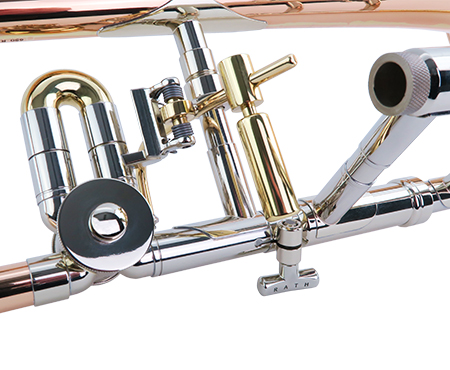
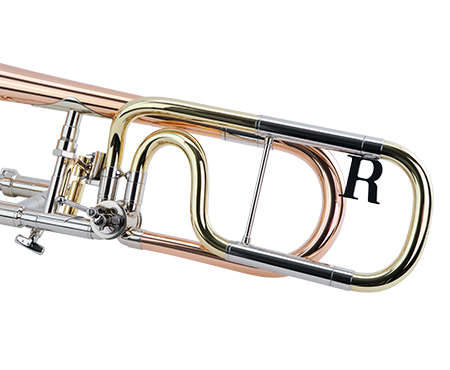
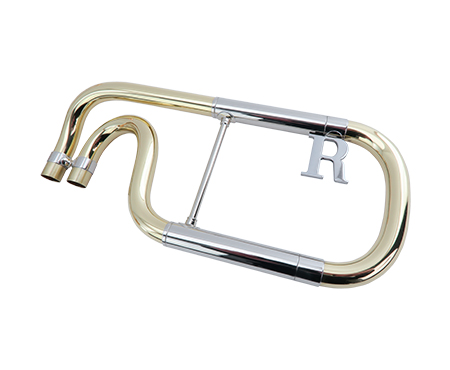
[/quote]
Rath makes exactly this alto ^
- Kevbach33
- Posts: 295
- Joined: May 29, 2018
[quote="LeTromboniste"]Hardly innovations but bringing back things that were once common and were left behind.
-Basses in Eb or F with the long slide and handle, but in modern bass trombone bore and bell size, with modern construction (not to play everything, but to be used for repertoire originally written for "true" bass trombones and/or substituting for contra)[/quote]
Nearly agree with this. Better make sure that slide has 7 positions!
I'd like to hear what an F bass with modern bass trombone proportions and construction would sound like. I would bet it's a better bridge to the tuba than what we currently have. This should definitely come back to the orchestra.
Valve pitches could be C and Db/D. It does not need to be .562/.578 for the slide, either. For me, I'd keep the bell section compact like some German contrabasses.
The thing is, I'd keep the Eb as a contrabass with a double slide. That's one heck of a long slide if it weren't doubled over itself. And as a bass I think it'd be pretty raspy. So it should stay as a contra. It should make a comeback and be further improved, like...
Two valves, in C and Bb. The slide should be long enough to give a solid 6th position for the Bb valve. Maybe give the bell section a compact wrap? (And then screw bell it, just because, to see how small we can get the case for such a beast. :biggrin: )
-Basses in Eb or F with the long slide and handle, but in modern bass trombone bore and bell size, with modern construction (not to play everything, but to be used for repertoire originally written for "true" bass trombones and/or substituting for contra)[/quote]
Nearly agree with this. Better make sure that slide has 7 positions!
I'd like to hear what an F bass with modern bass trombone proportions and construction would sound like. I would bet it's a better bridge to the tuba than what we currently have. This should definitely come back to the orchestra.
Valve pitches could be C and Db/D. It does not need to be .562/.578 for the slide, either. For me, I'd keep the bell section compact like some German contrabasses.
The thing is, I'd keep the Eb as a contrabass with a double slide. That's one heck of a long slide if it weren't doubled over itself. And as a bass I think it'd be pretty raspy. So it should stay as a contra. It should make a comeback and be further improved, like...
Two valves, in C and Bb. The slide should be long enough to give a solid 6th position for the Bb valve. Maybe give the bell section a compact wrap? (And then screw bell it, just because, to see how small we can get the case for such a beast. :biggrin: )
- MTbassbone
- Posts: 558
- Joined: Apr 21, 2018
Quality controls for all manufacturers has increased over the years, but I think it could still get better. Not going to name brands, but if all of the mechanical functions of the horn don't work its hard for me to justify playing it. Even if it can be fixed or improved by a local tech.
- BGuttman
- Posts: 7368
- Joined: Mar 22, 2018
[quote="MTbassbone"]Quality controls for all manufacturers has increased over the years, but I think it could still get better. Not going to name brands, but if all of the mechanical functions of the horn don't work its hard for me to justify playing it. Even if it can be fixed or improved by a local tech.[/quote]
QC costs money. You are paying somebody to make sure it's made right or fix any errors. There are people at the end of the auto manufacturing lines who drive the cars a few feet either to a shipping station (if it works OK) or to a repair lot (if it doesn't). Your purchase price has to pay these guys' salaries. Same thing with a musical instrument.
Some companies spend a lot of money trying to make manufacturing stable enough that the guys checking at the end of the line have less work to do (and maybe you can pay fewer of them). Some companies don't give a **** and it goes from the line to the box. Low price, and you are buying a lottery ticket. Maybe you win and it works, and maybe you don't and it's lamp grade.
QC costs money. You are paying somebody to make sure it's made right or fix any errors. There are people at the end of the auto manufacturing lines who drive the cars a few feet either to a shipping station (if it works OK) or to a repair lot (if it doesn't). Your purchase price has to pay these guys' salaries. Same thing with a musical instrument.
Some companies spend a lot of money trying to make manufacturing stable enough that the guys checking at the end of the line have less work to do (and maybe you can pay fewer of them). Some companies don't give a **** and it goes from the line to the box. Low price, and you are buying a lottery ticket. Maybe you win and it works, and maybe you don't and it's lamp grade.
- BrianAn
- Posts: 89
- Joined: Apr 15, 2020
Making it easier to get a modular G/Gb attachment in place of an F-attachment.
Also, some way to get a real Eb2 on a straight horn without false tones, or just a way to have a reachable 8th position in general.
Also, some way to get a real Eb2 on a straight horn without false tones, or just a way to have a reachable 8th position in general.
- TheBoneRanger
- Posts: 225
- Joined: Apr 04, 2018
I want wireless triggers, like top end bicycles have wireless shifting.
If you use small buttons like sprint shifters, you could mount them anywhere. On the slide, foot pedals, wherever.
It could revolutionise bass trombone ergonomics.
Andrew
If you use small buttons like sprint shifters, you could mount them anywhere. On the slide, foot pedals, wherever.
It could revolutionise bass trombone ergonomics.
Andrew
- harrisonreed
- Posts: 6479
- Joined: Aug 17, 2018
[quote="biggestbrain"]
Also, some way to get a real Eb2 on a straight horn without false tones, or just a way to have a reachable 8th position in general.[/quote]
I think the solution to the straight horn Eb2 is to play a trombone pitched in A, or Eb (which exists).
Also, some way to get a real Eb2 on a straight horn without false tones, or just a way to have a reachable 8th position in general.[/quote]
I think the solution to the straight horn Eb2 is to play a trombone pitched in A, or Eb (which exists).
- Hobart
- Posts: 126
- Joined: Sep 15, 2019
[quote="biggestbrain"]Making it easier to get a modular G/Gb attachment in place of an F-attachment.
Also, some way to get a real Eb2 on a straight horn without false tones, or just a way to have a reachable 8th position in general.[/quote]
I feel like certain trombone models, like the 42BO, could literally just sell cut down slides for G and Gb, given the way they're put together.
Also, in a pinch, depending on your tuning slide, you can get an Eb2 out without false tones.
Also, some way to get a real Eb2 on a straight horn without false tones, or just a way to have a reachable 8th position in general.[/quote]
I feel like certain trombone models, like the 42BO, could literally just sell cut down slides for G and Gb, given the way they're put together.
Also, in a pinch, depending on your tuning slide, you can get an Eb2 out without false tones.
- Finetales
- Posts: 1482
- Joined: Mar 23, 2018
[quote="LeTromboniste"]I'm not sure I get how you make a dependent ascending valve though. If the ascending valve is in the F valve wrap, that will actually give you Bb/F/G, so it would need to be the opposite, F valve in the small ascending valve wrap, but that seems like a design nightmare, fitting a valve in such a small wrap, and would take out any possibility of having a tuning slide in the ascending valve wrap. It also still has the air go through both valves when playing on the Bb side, so there's no real advantage to having it be dependent (i.e. the only side of the horn that would involve only one valve would be the C side). Or am I missing something?[/quote]
I guess I wrote it backwards. The ascending C valve is the first valve, and then the F valve is nested inside the C valve. This means you cannot use both valves at once as when the ascending valve is engaged, the air does not go through it and thus also not the F valve.
This didn't come out of thin air; Voigt did make orchestral tenors in this configuration and at least one has shown up on the forum in the past.
The independent version didn't come out of thin air either. In addition to the compact Bb/F/C/G bass a forum member made, Thein offers (or at least offered?) a trombone with an ascending C valve, with the option for adding an independent F valve. The Thein website focused mostly on the fact that with a full-length Bb slide, the trombone has 8 positions on the C side. This would make perfect 5th glisses possible, among other things. But I focused on the possible positions with such a configuration, as well as Bb/asc. C/E/Gb, and they both have a really intriguing set of positions. The one disadvantage for both is there's no short position for low D and Db.
I hadn't thought of Bb/C/Eb/F actually, I'll have to add that to the spreadsheet.
[quote="LeTromboniste"]-Basses in Eb or F with the long slide and handle, but in modern bass trombone bore and bell size, with modern construction (not to play everything, but to be used for repertoire originally written for "true" bass trombones and/or substituting for contra)[/quote]
Agreed, and also in G! Personally, I'd like to see/hear/play how they feel in modern .562 bass trombone bore, as well as modern .547 tenor bore, as the old true basses were often the same bore as the tenors.
I guess I wrote it backwards. The ascending C valve is the first valve, and then the F valve is nested inside the C valve. This means you cannot use both valves at once as when the ascending valve is engaged, the air does not go through it and thus also not the F valve.
This didn't come out of thin air; Voigt did make orchestral tenors in this configuration and at least one has shown up on the forum in the past.
With independent you could have it either as Bb/F/C/G or Bb/C/Eb/F, both sound like really practical options (the second might be a bit heavy and less useful for tenor but sounds like lovely a lovely idea for bass).
The independent version didn't come out of thin air either. In addition to the compact Bb/F/C/G bass a forum member made, Thein offers (or at least offered?) a trombone with an ascending C valve, with the option for adding an independent F valve. The Thein website focused mostly on the fact that with a full-length Bb slide, the trombone has 8 positions on the C side. This would make perfect 5th glisses possible, among other things. But I focused on the possible positions with such a configuration, as well as Bb/asc. C/E/Gb, and they both have a really intriguing set of positions. The one disadvantage for both is there's no short position for low D and Db.
I hadn't thought of Bb/C/Eb/F actually, I'll have to add that to the spreadsheet.
[quote="LeTromboniste"]-Basses in Eb or F with the long slide and handle, but in modern bass trombone bore and bell size, with modern construction (not to play everything, but to be used for repertoire originally written for "true" bass trombones and/or substituting for contra)[/quote]
Agreed, and also in G! Personally, I'd like to see/hear/play how they feel in modern .562 bass trombone bore, as well as modern .547 tenor bore, as the old true basses were often the same bore as the tenors.
- BGuttman
- Posts: 7368
- Joined: Mar 22, 2018
An attachment that will allow a gliss from D (middle line) to G (4th space). This was actually written into a part I was given -- and it was not written for a G bass.
- MTbassbone
- Posts: 558
- Joined: Apr 21, 2018
[quote="BGuttman"]<QUOTE author="MTbassbone" post_id="131113" time="1605928371" user_id="3107">
Quality controls for all manufacturers has increased over the years, but I think it could still get better. Not going to name brands, but if all of the mechanical functions of the horn don't work its hard for me to justify playing it. Even if it can be fixed or improved by a local tech.[/quote]
QC costs money. You are paying somebody to make sure it's made right or fix any errors. There are people at the end of the auto manufacturing lines who drive the cars a few feet either to a shipping station (if it works OK) or to a repair lot (if it doesn't). Your purchase price has to pay these guys' salaries. Same thing with a musical instrument.
Some companies spend a lot of money trying to make manufacturing stable enough that the guys checking at the end of the line have less work to do (and maybe you can pay fewer of them). Some companies don't give a **** and it goes from the line to the box. Low price, and you are buying a lottery ticket. Maybe you win and it works, and maybe you don't and it's lamp grade.
</QUOTE>
I don't mind paying more money for a product that works and plays well.
Quality controls for all manufacturers has increased over the years, but I think it could still get better. Not going to name brands, but if all of the mechanical functions of the horn don't work its hard for me to justify playing it. Even if it can be fixed or improved by a local tech.[/quote]
QC costs money. You are paying somebody to make sure it's made right or fix any errors. There are people at the end of the auto manufacturing lines who drive the cars a few feet either to a shipping station (if it works OK) or to a repair lot (if it doesn't). Your purchase price has to pay these guys' salaries. Same thing with a musical instrument.
Some companies spend a lot of money trying to make manufacturing stable enough that the guys checking at the end of the line have less work to do (and maybe you can pay fewer of them). Some companies don't give a **** and it goes from the line to the box. Low price, and you are buying a lottery ticket. Maybe you win and it works, and maybe you don't and it's lamp grade.
</QUOTE>
I don't mind paying more money for a product that works and plays well.
- baileyman
- Posts: 1169
- Joined: Mar 24, 2018
A five leg stand so sax players can't tip it over.
Oh, wait, got that already.
Oh, wait, got that already.
- BGuttman
- Posts: 7368
- Joined: Mar 22, 2018
[quote="baileyman"]A five leg stand so sax players can't tip it over.
Oh, wait, got that already.[/quote]
Well, you've got one.
Oh, wait, got that already.[/quote]
Well, you've got one.
- Tbarh
- Posts: 505
- Joined: Aug 16, 2018
I would like to see a bass trombone in G like the one Larry Minnick built for Jeffrey Reynolds, but with specs more like a bass trombone ( tighter Bell taper)... Would be ser up to use standard Bb bass trombone slide of course....
- Elow
- Posts: 1924
- Joined: Mar 02, 2020
[quote="Tbarh"]I would like to see a bass trombone in G like the one Larry Minnick built for Jeffrey Reynolds, but with specs more like a bass trombone ( tighter Bell taper)... Would be ser up to use standard Bb bass trombone slide of course....[/quote]
Would using the same length slide work? I imagine you would need a longer slide to move a larger fraction of tubing.
Would using the same length slide work? I imagine you would need a longer slide to move a larger fraction of tubing.
- watasnake
- Posts: 29
- Joined: Nov 05, 2019
Some sort of inner coating that prevents any internal corrosion and keeps any grime from sticking.
- JohnL
- Posts: 2529
- Joined: Mar 23, 2018
[quote="Elow"]Would using the same length slide work? I imagine you would need a longer slide to move a larger fraction of tubing.[/quote]
You could use a Bb length slide, but you'd only have six positions. Any notes that would be in 7th position would be played on the valve.
You could use a Bb length slide, but you'd only have six positions. Any notes that would be in 7th position would be played on the valve.
- BGuttman
- Posts: 7368
- Joined: Mar 22, 2018
[quote="JohnL"]<QUOTE author="Elow" post_id="131186" time="1605998841" user_id="8680">Would using the same length slide work? I imagine you would need a longer slide to move a larger fraction of tubing.[/quote]
You could use a Bb length slide, but you'd only have six positions. Any notes that would be in 7th position would be played on the valve.
</QUOTE>
Assuming you have one...
You could use a Bb length slide, but you'd only have six positions. Any notes that would be in 7th position would be played on the valve.
</QUOTE>
Assuming you have one...
- Tbarh
- Posts: 505
- Joined: Aug 16, 2018
[quote="Elow"]<QUOTE author="Tbarh" post_id="131184" time="1605998252" user_id="3637">
I would like to see a bass trombone in G like the one Larry Minnick built for Jeffrey Reynolds, but with specs more like a bass trombone ( tighter Bell taper)... Would be ser up to use standard Bb bass trombone slide of course....[/quote]
Would using the same length slide work? I imagine you would need a longer slide to move a larger fraction of tubing.
</QUOTE> No, Just longer Bell section to put it in G... The outer positions are covered with the second Valve... Means that You Will not get any deeper, but thats not the point.. <EMOJI seq="1f609" tseq="1f609">😉</EMOJI><EMOJI seq="1f44d" tseq="1f44d">👍</EMOJI>
I would like to see a bass trombone in G like the one Larry Minnick built for Jeffrey Reynolds, but with specs more like a bass trombone ( tighter Bell taper)... Would be ser up to use standard Bb bass trombone slide of course....[/quote]
Would using the same length slide work? I imagine you would need a longer slide to move a larger fraction of tubing.
</QUOTE> No, Just longer Bell section to put it in G... The outer positions are covered with the second Valve... Means that You Will not get any deeper, but thats not the point.. <EMOJI seq="1f609" tseq="1f609">😉</EMOJI><EMOJI seq="1f44d" tseq="1f44d">👍</EMOJI>
- Lastbone
- Posts: 56
- Joined: May 15, 2019
Frankly, I'm still looking for the horn that plays itself...
More seriously, a more ergonomic independent bass.
Warren
More seriously, a more ergonomic independent bass.
Warren
- Crazy4Tbone86
- Posts: 1654
- Joined: Jan 14, 2020
[quote="Tbarh"]<QUOTE author="Elow" post_id="131186" time="1605998841" user_id="8680">
Would using the same length slide work? I imagine you would need a longer slide to move a larger fraction of tubing.[/quote] No, Just longer Bell section to put it in G... The outer positions are covered with the second Valve... Means that You Will not get any deeper, but thats not the point.. <EMOJI seq="1f609" tseq="1f609">😉</EMOJI><EMOJI seq="1f44d" tseq="1f44d">👍</EMOJI>
</QUOTE>
It’s not that simple. Making the bell section longer to create a bass trombone in G, does not keep the same seven slide positions. Each position must be longer and at least one position would be lost, possibly more. Can any of our math-whiz people out there calculate exactly how many positions (or fractions of positions) we would lose if a minor third was added only to the bell section?
Would using the same length slide work? I imagine you would need a longer slide to move a larger fraction of tubing.[/quote] No, Just longer Bell section to put it in G... The outer positions are covered with the second Valve... Means that You Will not get any deeper, but thats not the point.. <EMOJI seq="1f609" tseq="1f609">😉</EMOJI><EMOJI seq="1f44d" tseq="1f44d">👍</EMOJI>
</QUOTE>
It’s not that simple. Making the bell section longer to create a bass trombone in G, does not keep the same seven slide positions. Each position must be longer and at least one position would be lost, possibly more. Can any of our math-whiz people out there calculate exactly how many positions (or fractions of positions) we would lose if a minor third was added only to the bell section?
- BGuttman
- Posts: 7368
- Joined: Mar 22, 2018
[quote="Crazy4Tbone86"]... Can any of our math-whiz people out there calculate exactly how many positions (or fractions of positions) we would lose if a minor third was added only to the bell section?[/quote]
We know that adding a major 4th will result in a loss of one slide position on a Bb slide (only 6 F attachment positions, and on some shorter slides the 6th is lost as well). Most likely we will have 6 solid positions if the instrument is in G, but not a 7th.
We know that adding a major 4th will result in a loss of one slide position on a Bb slide (only 6 F attachment positions, and on some shorter slides the 6th is lost as well). Most likely we will have 6 solid positions if the instrument is in G, but not a 7th.
- Tbarh
- Posts: 505
- Joined: Aug 16, 2018
[quote="Crazy4Tbone86"]<QUOTE author="Tbarh" post_id="131222" time="1606039700" user_id="3637">
No, Just longer Bell section to put it in G... The outer positions are covered with the second Valve... Means that You Will not get any deeper, but thats not the point.. <EMOJI seq="1f609" tseq="1f609">😉</EMOJI><EMOJI seq="1f44d" tseq="1f44d">👍</EMOJI>[/quote]
It’s not that simple. Making the bell section longer to create a bass trombone in G, does not keep the same seven slide positions. Each position must be longer and at least one position would be lost, possibly more. Can any of our math-whiz people out there calculate exactly how many positions (or fractions of positions) we would lose if a minor third was added only to the bell section?
</QUOTE>
I did write that the outer positions would be covered by the Valves, right? :good:
No, Just longer Bell section to put it in G... The outer positions are covered with the second Valve... Means that You Will not get any deeper, but thats not the point.. <EMOJI seq="1f609" tseq="1f609">😉</EMOJI><EMOJI seq="1f44d" tseq="1f44d">👍</EMOJI>[/quote]
It’s not that simple. Making the bell section longer to create a bass trombone in G, does not keep the same seven slide positions. Each position must be longer and at least one position would be lost, possibly more. Can any of our math-whiz people out there calculate exactly how many positions (or fractions of positions) we would lose if a minor third was added only to the bell section?
</QUOTE>
I did write that the outer positions would be covered by the Valves, right? :good:
- Doug_Elliott
- Posts: 4155
- Joined: Mar 22, 2018
Arm length would be at least as important as slide length...
- paulyg
- Posts: 689
- Joined: May 17, 2018
I think the absolute biggest area for equipment improvement is with lubes.
There is NO lubrication system that works across all the temperatures and environments a reasonably busy trombone player encounters. Heck, most lubes from the same manufacturer don't play nice with each other.
I want slide lube that doesn't curdle from the heat, tuning slide grease that doesn't thin when it touches valve oil and gum up the whole horn, and some thin bearing oil that stays on for longer than 15 minutes. Don't get me started with body chemistry interactions.
There is NO lubrication system that works across all the temperatures and environments a reasonably busy trombone player encounters. Heck, most lubes from the same manufacturer don't play nice with each other.
I want slide lube that doesn't curdle from the heat, tuning slide grease that doesn't thin when it touches valve oil and gum up the whole horn, and some thin bearing oil that stays on for longer than 15 minutes. Don't get me started with body chemistry interactions.
- JohnL
- Posts: 2529
- Joined: Mar 23, 2018
[quote="tombone21"]I know Willson inner tubes are chromium-coated, but I really don't know much more than that.[/quote]
Pretty much all inner slide tubes are chromium-plated. Willson used something else (titanium nitride, if memory serves) for a while, but they went back to chromium.
Pretty much all inner slide tubes are chromium-plated. Willson used something else (titanium nitride, if memory serves) for a while, but they went back to chromium.
- ChadA
- Posts: 150
- Joined: Dec 04, 2018
If the inner and outer slides included materials with opposite magnetic polarities, would the slide ride like maglev trains? Not that I want iron/steel slides nor slides that slick magnetically to music stands/trombone stands/chairs/etc..... :) I doubt this hair-brained idea would ever work.
- imsevimse
- Posts: 1765
- Joined: Apr 29, 2018
[quote="hornbuilder"]Imsevimse, you have given me another project!!
<EMOJI seq="1f642" tseq="1f642">🙂</EMOJI>[/quote]
Hope to see that done. If you do, please share! :good:
/Tom
<EMOJI seq="1f642" tseq="1f642">🙂</EMOJI>[/quote]
Hope to see that done. If you do, please share! :good:
/Tom
- Hobart
- Posts: 126
- Joined: Sep 15, 2019
[quote="ChadA"]If the inner and outer slides included materials with opposite magnetic polarities, would the slide ride like maglev trains? Not that I want iron/steel slides nor slides that slick magnetically to music stands/trombone stands/chairs/etc..... :) I doubt this hair-brained idea would ever work.[/quote]
The point of maglev is to keep the slide from touching itself, you would still need to have stockings and the associated lubrication in order to have a good seal.
The point of maglev is to keep the slide from touching itself, you would still need to have stockings and the associated lubrication in order to have a good seal.
- timothy42b
- Posts: 1812
- Joined: Mar 27, 2018
[quote="Hobart"]<QUOTE author="ChadA" post_id="131283" time="1606089039" user_id="4058">
If the inner and outer slides included materials with opposite magnetic polarities, would the slide ride like maglev trains? Not that I want iron/steel slides nor slides that slick magnetically to music stands/trombone stands/chairs/etc..... :) I doubt this hair-brained idea would ever work.[/quote]
The point of maglev is to keep the slide from touching itself, you would still need to have stockings and the associated lubrication in order to have a good seal.
</QUOTE>
The stockings have two functions.
They are a low friction bearing surface that the outer slide rests on.
And they are the reduced clearance area that helps with the seal.
It's possible with some kind of maglev you could separate the two functions and optimize each separately.
If the inner and outer slides included materials with opposite magnetic polarities, would the slide ride like maglev trains? Not that I want iron/steel slides nor slides that slick magnetically to music stands/trombone stands/chairs/etc..... :) I doubt this hair-brained idea would ever work.[/quote]
The point of maglev is to keep the slide from touching itself, you would still need to have stockings and the associated lubrication in order to have a good seal.
</QUOTE>
The stockings have two functions.
They are a low friction bearing surface that the outer slide rests on.
And they are the reduced clearance area that helps with the seal.
It's possible with some kind of maglev you could separate the two functions and optimize each separately.
- spencercarran
- Posts: 689
- Joined: Oct 17, 2020
[quote="LeTromboniste"]Hardly innovations but bringing back things that were once common and were left behind.
-Basses in Eb or F with the long slide and handle, but in modern bass trombone bore and bell size, with modern construction (not to play everything, but to be used for repertoire originally written for "true" bass trombones and/or substituting for contra)[/quote]
Yes, but with double slides (in the style of that Miraphone BBb contra) so regular-size humans can reach everything in approximately alto trombone length positions. The long handled slides seem like they'd antagonize the woodwind section.
I don't at all understand the point of contrabass trombones with fewer than 7 slide positions.
-Basses in Eb or F with the long slide and handle, but in modern bass trombone bore and bell size, with modern construction (not to play everything, but to be used for repertoire originally written for "true" bass trombones and/or substituting for contra)[/quote]
Yes, but with double slides (in the style of that Miraphone BBb contra) so regular-size humans can reach everything in approximately alto trombone length positions. The long handled slides seem like they'd antagonize the woodwind section.
I don't at all understand the point of contrabass trombones with fewer than 7 slide positions.
- LeTromboniste
- Posts: 1634
- Joined: Apr 11, 2018
[quote="spencercarran"]<QUOTE author="LeTromboniste" post_id="131079" time="1605908839" user_id="3038">
Hardly innovations but bringing back things that were once common and were left behind.
-Basses in Eb or F with the long slide and handle, but in modern bass trombone bore and bell size, with modern construction (not to play everything, but to be used for repertoire originally written for "true" bass trombones and/or substituting for contra)[/quote]
Yes, but with double slides (in the style of that Miraphone BBb contra) so regular-size humans can reach everything in approximately alto trombone length positions. The long handled slides seem like they'd antagonize the woodwind section.
I don't at all understand the point of contrabass trombones with fewer than 7 slide positions.
</QUOTE>
Double slides are really hard to keep aligned and running well long term though. The long slide with the handle is more forgiving with tuning too.
In my experience the long slide actually helps force the hand of however decides on the stage set-up to give us more space, which ends up benefitting both us and the woodwinds. Of course it's not always possible when it's really tight though.
Hardly innovations but bringing back things that were once common and were left behind.
-Basses in Eb or F with the long slide and handle, but in modern bass trombone bore and bell size, with modern construction (not to play everything, but to be used for repertoire originally written for "true" bass trombones and/or substituting for contra)[/quote]
Yes, but with double slides (in the style of that Miraphone BBb contra) so regular-size humans can reach everything in approximately alto trombone length positions. The long handled slides seem like they'd antagonize the woodwind section.
I don't at all understand the point of contrabass trombones with fewer than 7 slide positions.
</QUOTE>
Double slides are really hard to keep aligned and running well long term though. The long slide with the handle is more forgiving with tuning too.
In my experience the long slide actually helps force the hand of however decides on the stage set-up to give us more space, which ends up benefitting both us and the woodwinds. Of course it's not always possible when it's really tight though.
- Burgerbob
- Posts: 6327
- Joined: Apr 23, 2018
[quote="spencercarran"]
I don't at all understand the point of contrabass trombones with fewer than 7 slide positions.[/quote]
well, that's why they have valves. I don't need anything past 4th position on my contra.
I don't at all understand the point of contrabass trombones with fewer than 7 slide positions.[/quote]
well, that's why they have valves. I don't need anything past 4th position on my contra.
- spencercarran
- Posts: 689
- Joined: Oct 17, 2020
[quote="Burgerbob"]<QUOTE author="spencercarran" post_id="131409" time="1606167061" user_id="10390">
I don't at all understand the point of contrabass trombones with fewer than 7 slide positions.[/quote]
well, that's why they have valves. I don't need anything past 4th position on my contra.
</QUOTE>
Fair enough, but it'd be nice to have access to the long glisses...
I don't at all understand the point of contrabass trombones with fewer than 7 slide positions.[/quote]
well, that's why they have valves. I don't need anything past 4th position on my contra.
</QUOTE>
Fair enough, but it'd be nice to have access to the long glisses...
- Burgerbob
- Posts: 6327
- Joined: Apr 23, 2018
[quote="spencercarran"]<QUOTE author="Burgerbob" post_id="131412" time="1606167785" user_id="3131">
well, that's why they have valves. I don't need anything past 4th position on my contra.[/quote]
Fair enough, but it'd be nice to have access to the long glisses...
</QUOTE>
Well, I'd say there's a reason we don't see widely-used double slides or long slides with handles. They both suck in different ways. My slide would have to be a foot longer with a handle to get 7th (as well as my bell section being radically shorter). And double slides are generally awful. It's a big trade off to play the couple glisses that might come up, instead of being able to play all the written music more easily.
well, that's why they have valves. I don't need anything past 4th position on my contra.[/quote]
Fair enough, but it'd be nice to have access to the long glisses...
</QUOTE>
Well, I'd say there's a reason we don't see widely-used double slides or long slides with handles. They both suck in different ways. My slide would have to be a foot longer with a handle to get 7th (as well as my bell section being radically shorter). And double slides are generally awful. It's a big trade off to play the couple glisses that might come up, instead of being able to play all the written music more easily.
- LeTromboniste
- Posts: 1634
- Joined: Apr 11, 2018
[quote="Burgerbob"]<QUOTE author="spencercarran" post_id="131413" time="1606168020" user_id="10390">
Fair enough, but it'd be nice to have access to the long glisses...[/quote]
Well, I'd say there's a reason we don't see widely-used double slides or long slides with handles. They both suck in different ways. My slide would have to be a foot longer with a handle to get 7th (as well as my bell section being radically shorter). And double slides are generally awful. It's a big trade off to play the couple glisses that might come up, instead of being able to play all the written music more easily.
</QUOTE>
Even staying in close positions, I personally find it much easier with the handle than without. The positions are so far away from each other, I find it needlessly strenuous without a handle. The handle is clumsy at first and took me a while to get used to, but assuming it's a good universal/ball/3-axis joint, I find it improves rather than impedes agility.
Fair enough, but it'd be nice to have access to the long glisses...[/quote]
Well, I'd say there's a reason we don't see widely-used double slides or long slides with handles. They both suck in different ways. My slide would have to be a foot longer with a handle to get 7th (as well as my bell section being radically shorter). And double slides are generally awful. It's a big trade off to play the couple glisses that might come up, instead of being able to play all the written music more easily.
</QUOTE>
Even staying in close positions, I personally find it much easier with the handle than without. The positions are so far away from each other, I find it needlessly strenuous without a handle. The handle is clumsy at first and took me a while to get used to, but assuming it's a good universal/ball/3-axis joint, I find it improves rather than impedes agility.
- baileyman
- Posts: 1169
- Joined: Mar 24, 2018
[quote="LeTromboniste"]<QUOTE author="Burgerbob" post_id="131414" time="1606170294" user_id="3131">
Well, I'd say there's a reason we don't see widely-used double slides or long slides with handles. They both suck in different ways. My slide would have to be a foot longer with a handle to get 7th (as well as my bell section being radically shorter). And double slides are generally awful. It's a big trade off to play the couple glisses that might come up, instead of being able to play all the written music more easily.[/quote]
Even staying in close positions, I personally find it much easier with the handle than without. The positions are so far away from each other, I find it needlessly strenuous without a handle. The handle is clumsy at first and took me a while to get used to, but assuming it's a good universal/ball/3-axis joint, I find it improves rather than impedes agility.
</QUOTE>
Well, there's another innovation needed: make the doubled slide tubes flexibly mounted so that they adjust to the alignment in use. It may be the rigid mounting that makes them awful.
Well, I'd say there's a reason we don't see widely-used double slides or long slides with handles. They both suck in different ways. My slide would have to be a foot longer with a handle to get 7th (as well as my bell section being radically shorter). And double slides are generally awful. It's a big trade off to play the couple glisses that might come up, instead of being able to play all the written music more easily.[/quote]
Even staying in close positions, I personally find it much easier with the handle than without. The positions are so far away from each other, I find it needlessly strenuous without a handle. The handle is clumsy at first and took me a while to get used to, but assuming it's a good universal/ball/3-axis joint, I find it improves rather than impedes agility.
</QUOTE>
Well, there's another innovation needed: make the doubled slide tubes flexibly mounted so that they adjust to the alignment in use. It may be the rigid mounting that makes them awful.
- elmsandr
- Posts: 1373
- Joined: Mar 23, 2018
[quote="baileyman"]<QUOTE author="LeTromboniste" post_id="131418" time="1606175948" user_id="3038">
Even staying in close positions, I personally find it much easier with the handle than without. The positions are so far away from each other, I find it needlessly strenuous without a handle. The handle is clumsy at first and took me a while to get used to, but assuming it's a good universal/ball/3-axis joint, I find it improves rather than impedes agility.[/quote]
Well, there's another innovation needed: make the doubled slide tubes flexibly mounted so that they adjust to the alignment in use. It may be the rigid mounting that makes them awful.
</QUOTE>
There was a guy that did this... did he call it the jazzbone or something? Had a spring mount on the second inner.
They were not positively reviewed.
Cheers,
Andy
Even staying in close positions, I personally find it much easier with the handle than without. The positions are so far away from each other, I find it needlessly strenuous without a handle. The handle is clumsy at first and took me a while to get used to, but assuming it's a good universal/ball/3-axis joint, I find it improves rather than impedes agility.[/quote]
Well, there's another innovation needed: make the doubled slide tubes flexibly mounted so that they adjust to the alignment in use. It may be the rigid mounting that makes them awful.
</QUOTE>
There was a guy that did this... did he call it the jazzbone or something? Had a spring mount on the second inner.
They were not positively reviewed.
Cheers,
Andy
- LeTromboniste
- Posts: 1634
- Joined: Apr 11, 2018
German slide stays from the late 17th to well into the 20th century were often "floating", where the top outer is not actually soldered to the stay and it can follow the top inner regardless of its alignment with the bottom tubes. It kind of works in that slides that aren't super well aligned still run okay and much better than if the outer was rigid, but it also makes them bever truly great either. My guess is on a double contra slide it would be pretty bad.
- AndrewMeronek
- Posts: 1487
- Joined: Mar 30, 2018
[quote="ChadA"]If the inner and outer slides included materials with opposite magnetic polarities, would the slide ride like maglev trains? Not that I want iron/steel slides nor slides that slick magnetically to music stands/trombone stands/chairs/etc..... :) I doubt this hair-brained idea would ever work.[/quote]
Ferromagnetic metals lose their polarity over time. Or, if it's driven by electricity, that requires wires and a battery which adds weight.
Ferromagnetic metals lose their polarity over time. Or, if it's driven by electricity, that requires wires and a battery which adds weight.
- AndrewMeronek
- Posts: 1487
- Joined: Mar 30, 2018
Another thing I wish were more common - even more than left-handed triggers for the oddballs like me - are options for consistent slide widths between horns of different bore sizes. Playing left-handed, I need a wide slide on jazz and alto 'bones due to having a wider than average neck and an embouchure occlusion that causes the horn angle to go to the right. I don't know of any good reason why "small bore" horns are always constructed with narrow slides except that is what people are used to.
- Vegastokc
- Posts: 211
- Joined: Jun 15, 2018
[quote="AndrewMeronek"]Playing left-handed...[/quote]
Left handed trombone player? That's just crazy talk.
What's next, a left handed guitar player? :D
Seriously though, when you were learning to play, did you naturally start on your left hand or did you start "normal" and eventually switch?
Also, I envision a band director standing next to you and hitting you on your knuckles with a baton every time you put the horn in your left hand. :lol:
Left handed trombone player? That's just crazy talk.
What's next, a left handed guitar player? :D
Seriously though, when you were learning to play, did you naturally start on your left hand or did you start "normal" and eventually switch?
Also, I envision a band director standing next to you and hitting you on your knuckles with a baton every time you put the horn in your left hand. :lol:
- BGuttman
- Posts: 7368
- Joined: Mar 22, 2018
[quote="Vegastokc"]...
Seriously though, when you were learning to play, did you naturally start on your left hand or did you start "normal" and eventually switch?
Also, I envision a band director standing next to you and hitting you on your knuckles with a baton every time you put the horn in your left hand. :lol:[/quote]
Only if the BD was wearing a nun's habit and it was St. Somethingorother School Band. :tongue:
Seriously though, when you were learning to play, did you naturally start on your left hand or did you start "normal" and eventually switch?
Also, I envision a band director standing next to you and hitting you on your knuckles with a baton every time you put the horn in your left hand. :lol:[/quote]
Only if the BD was wearing a nun's habit and it was St. Somethingorother School Band. :tongue:
- AndrewMeronek
- Posts: 1487
- Joined: Mar 30, 2018
[quote="Vegastokc"]Left handed trombone player? That's just crazy talk.
What's next, a left handed guitar player? :D
Seriously though, when you were learning to play, did you naturally start on your left hand or did you start "normal" and eventually switch?
Also, I envision a band director standing next to you and hitting you on your knuckles with a baton every time you put the horn in your left hand. :lol:[/quote]
My band director was left-handed, and he was fine with however I felt was comfortable.
What's next, a left handed guitar player? :D
Seriously though, when you were learning to play, did you naturally start on your left hand or did you start "normal" and eventually switch?
Also, I envision a band director standing next to you and hitting you on your knuckles with a baton every time you put the horn in your left hand. :lol:[/quote]
My band director was left-handed, and he was fine with however I felt was comfortable.
- PhilE
- Posts: 97
- Joined: Apr 26, 2018
'My band director was left-handed, and he was fine with however I felt was comfortable.'
I'm also a leftie. The MD of a band I payed in a while back was also left handed and a trombone player.
Slightly off topic but seeing as you mentioned it - I'd be interested to know if left handedness is more prevalent amongst trombone players than in the wider community. And how many of those play left handed.
Back to the topic - lubricating valves is a bit of a chore. The oil can go into places where its not needed like up into the F attachment tubing or down into the hand slide.
Would it be feasible to drill a small diameter bore into the valve shaft which connected with appropriately located drillings in the valve body.
To lubricate the valve you would undo the valve cap and inject oil into the hole in the shaft and the oil would end up exactly where it is needed.
I think it would reduce oil consumption quite a bit.
Thoughts?
I'm also a leftie. The MD of a band I payed in a while back was also left handed and a trombone player.
Slightly off topic but seeing as you mentioned it - I'd be interested to know if left handedness is more prevalent amongst trombone players than in the wider community. And how many of those play left handed.
Back to the topic - lubricating valves is a bit of a chore. The oil can go into places where its not needed like up into the F attachment tubing or down into the hand slide.
Would it be feasible to drill a small diameter bore into the valve shaft which connected with appropriately located drillings in the valve body.
To lubricate the valve you would undo the valve cap and inject oil into the hole in the shaft and the oil would end up exactly where it is needed.
I think it would reduce oil consumption quite a bit.
Thoughts?
- timothy42b
- Posts: 1812
- Joined: Mar 27, 2018
I suspect fewer lefties on trombone.
- BGuttman
- Posts: 7368
- Joined: Mar 22, 2018
[quote="PhilE"]...
Back to the topic - lubricating valves is a bit of a chore. The oil can go into places where its not needed like up into the F attachment tubing or down into the hand slide.
Would it be feasible to drill a small diameter bore into the valve shaft which connected with appropriately located drillings in the valve body.
To lubricate the valve you would undo the valve cap and inject oil into the hole in the shaft and the oil would end up exactly where it is needed.
I think it would reduce oil consumption quite a bit.
Thoughts?[/quote]
Olds actually did this 70 years ago. I don't know why the idea never caught on. Maybe JohnL knows.
Back to the topic - lubricating valves is a bit of a chore. The oil can go into places where its not needed like up into the F attachment tubing or down into the hand slide.
Would it be feasible to drill a small diameter bore into the valve shaft which connected with appropriately located drillings in the valve body.
To lubricate the valve you would undo the valve cap and inject oil into the hole in the shaft and the oil would end up exactly where it is needed.
I think it would reduce oil consumption quite a bit.
Thoughts?[/quote]
Olds actually did this 70 years ago. I don't know why the idea never caught on. Maybe JohnL knows.
- JohnL
- Posts: 2529
- Joined: Mar 23, 2018
[quote="BGuttman"]<QUOTE author="PhilE" post_id="131536" time="1606300703" user_id="3151">
...
Back to the topic - lubricating valves is a bit of a chore. The oil can go into places where its not needed like up into the F attachment tubing or down into the hand slide.
Would it be feasible to drill a small diameter bore into the valve shaft which connected with appropriately located drillings in the valve body.
To lubricate the valve you would undo the valve cap and inject oil into the hole in the shaft and the oil would end up exactly where it is needed.
I think it would reduce oil consumption quite a bit.
Thoughts?[/quote]
Olds actually did this 70 years ago. I don't know why the idea never caught on. Maybe JohnL knows.
</QUOTE>
I haven't pulled one apart in a while, but I seem to recall that the Olds system only put oil on the back bearing (i.e., the one that's part of the casing). It was probably originally developed so you could get oil to the back bearing on those Olds rotors with the "hidden" bumpers, though you'll find it on Olds valves with conventional stop arms, too.
Remember that it's common practice to use a different oil on the valve body than is used on the spindles. You'd need a separate oiling system for each. Not sure how that would work - maybe an oil port on the casing? Of course, that'd be a potential entry point for all kinds of crud.
...
Back to the topic - lubricating valves is a bit of a chore. The oil can go into places where its not needed like up into the F attachment tubing or down into the hand slide.
Would it be feasible to drill a small diameter bore into the valve shaft which connected with appropriately located drillings in the valve body.
To lubricate the valve you would undo the valve cap and inject oil into the hole in the shaft and the oil would end up exactly where it is needed.
I think it would reduce oil consumption quite a bit.
Thoughts?[/quote]
Olds actually did this 70 years ago. I don't know why the idea never caught on. Maybe JohnL knows.
</QUOTE>
I haven't pulled one apart in a while, but I seem to recall that the Olds system only put oil on the back bearing (i.e., the one that's part of the casing). It was probably originally developed so you could get oil to the back bearing on those Olds rotors with the "hidden" bumpers, though you'll find it on Olds valves with conventional stop arms, too.
Remember that it's common practice to use a different oil on the valve body than is used on the spindles. You'd need a separate oiling system for each. Not sure how that would work - maybe an oil port on the casing? Of course, that'd be a potential entry point for all kinds of crud.
- harrisonreed
- Posts: 6479
- Joined: Aug 17, 2018
[quote="timothy42b"]I suspect fewer lefties on trombone.[/quote]
Requiring almost no dexterity, most lefties play the trombone right handed.
Requiring almost no dexterity, most lefties play the trombone right handed.
- JCBone
- Posts: 373
- Joined: Jul 29, 2020
:mrgreen: [quote="Burgerbob"]<QUOTE author="Kingfan" post_id="130968" time="1605824589" user_id="3053">
Remote control water key. Button somewhere near the mouthpiece/slide tenon area that can be pushed without taking your hand off the horn.[/quote]
Already done! Germans did this starting at least 60 years ago, probably more.
</QUOTE>
How come these aren't more common. It would be very useful.
Remote control water key. Button somewhere near the mouthpiece/slide tenon area that can be pushed without taking your hand off the horn.[/quote]
Already done! Germans did this starting at least 60 years ago, probably more.
</QUOTE>
How come these aren't more common. It would be very useful.
- Burgerbob
- Posts: 6327
- Joined: Apr 23, 2018
[quote="JCBone"]:mrgreen: <QUOTE author="Burgerbob" post_id="130969" time="1605825653" user_id="3131">
Already done! Germans did this starting at least 60 years ago, probably more.[/quote]
How come these aren't more common. It would be very useful.
</QUOTE>
Weight, complexity, fragility. One actually came on my contra slide (from '60s Germany) but was removed because it was so finicky.
I can see the upsides in some applications, but I'd rather have something simple and light than something fancy any day of the week.
Already done! Germans did this starting at least 60 years ago, probably more.[/quote]
How come these aren't more common. It would be very useful.
</QUOTE>
Weight, complexity, fragility. One actually came on my contra slide (from '60s Germany) but was removed because it was so finicky.
I can see the upsides in some applications, but I'd rather have something simple and light than something fancy any day of the week.
- LeTromboniste
- Posts: 1634
- Joined: Apr 11, 2018
[quote="Burgerbob"]<QUOTE author="JCBone" post_id="131628" time="1606373001" user_id="9797">
:mrgreen:
How come these aren't more common. It would be very useful.[/quote]
Weight, complexity, fragility. One actually came on my contra slide (from '60s Germany) but was removed because it was so finicky.
I can see the upsides in some applications, but I'd rather have something simple and light than something fancy any day of the week.
</QUOTE>
Controversial opinion: no water key at all is better than a bad water key
:mrgreen:
How come these aren't more common. It would be very useful.[/quote]
Weight, complexity, fragility. One actually came on my contra slide (from '60s Germany) but was removed because it was so finicky.
I can see the upsides in some applications, but I'd rather have something simple and light than something fancy any day of the week.
</QUOTE>
Controversial opinion: no water key at all is better than a bad water key
- timothy42b
- Posts: 1812
- Joined: Mar 27, 2018
[quote="harrisonreed"]<QUOTE author="timothy42b" post_id="131558" time="1606321391" user_id="211">
I suspect fewer lefties on trombone.[/quote]
Requiring almost no dexterity, most lefties play the trombone right handed.
</QUOTE>
That is probably true for some, but I suspect another reason applies also.
We've had this discussion a number of times, and conventional wisdom is just force the lefties to play right handed. I think for a good share of them this is too frustrating and they quit. Depending on the reasons for left handedness, they may be more easily frustrated, though some of this is controversial.
I suspect fewer lefties on trombone.[/quote]
Requiring almost no dexterity, most lefties play the trombone right handed.
</QUOTE>
That is probably true for some, but I suspect another reason applies also.
We've had this discussion a number of times, and conventional wisdom is just force the lefties to play right handed. I think for a good share of them this is too frustrating and they quit. Depending on the reasons for left handedness, they may be more easily frustrated, though some of this is controversial.
- BurckhardtS
- Posts: 253
- Joined: Mar 25, 2018
[quote="paulyg"]I think the absolute biggest area for equipment improvement is with lubes.
There is NO lubrication system that works across all the temperatures and environments a reasonably busy trombone player encounters. Heck, most lubes from the same manufacturer don't play nice with each other.
I want slide lube that doesn't curdle from the heat, tuning slide grease that doesn't thin when it touches valve oil and gum up the whole horn, and some thin bearing oil that stays on for longer than 15 minutes. Don't get me started with body chemistry interactions.[/quote]
When I was younger, I used to have issues where when I would oil my valve, I would leave the horn put together, but then my slide would get really sticky and crappy. It seems a lot of valve oils do NOT mix well with the slide oils and can cause them to harden or thicken?
Taking the horn apart was an easy solution, but in the event I need to oil my valve really quickly on a gig or something...
There is NO lubrication system that works across all the temperatures and environments a reasonably busy trombone player encounters. Heck, most lubes from the same manufacturer don't play nice with each other.
I want slide lube that doesn't curdle from the heat, tuning slide grease that doesn't thin when it touches valve oil and gum up the whole horn, and some thin bearing oil that stays on for longer than 15 minutes. Don't get me started with body chemistry interactions.[/quote]
When I was younger, I used to have issues where when I would oil my valve, I would leave the horn put together, but then my slide would get really sticky and crappy. It seems a lot of valve oils do NOT mix well with the slide oils and can cause them to harden or thicken?
Taking the horn apart was an easy solution, but in the event I need to oil my valve really quickly on a gig or something...
- Finetales
- Posts: 1482
- Joined: Mar 23, 2018
I'm sure everyone here knows the anecdote about Slide Hampton playing lefty only because that's the way the trombone was handed to him when he started.
- imsevimse
- Posts: 1765
- Joined: Apr 29, 2018
[quote="Finetales"]I'm sure everyone here knows the anecdote about Slide Hampton playing lefty only because that's the way the trombone was handed to him when he started.[/quote]
He appears to have been right handed but played left handed. A bit odd :horror:
"They gave me the trombone left-handed and I played it that way. It's the only thing I do with my left hand."
/Tom
He appears to have been right handed but played left handed. A bit odd :horror:
"They gave me the trombone left-handed and I played it that way. It's the only thing I do with my left hand."
/Tom
- AndrewMeronek
- Posts: 1487
- Joined: Mar 30, 2018
[quote="timothy42b"]We've had this discussion a number of times[/quote]
Indeed!
But my observation about slide widths, wide necks, and embouchure occlusions has nothing to do with playing left-handed, except how the angles happen to line up for me. The same problems can happen to right-handed players.
Indeed!
But my observation about slide widths, wide necks, and embouchure occlusions has nothing to do with playing left-handed, except how the angles happen to line up for me. The same problems can happen to right-handed players.
- Elow
- Posts: 1924
- Joined: Mar 02, 2020
Okay, i might be going crazy, but i really have put some thought into modular slides and i really think it could work. If you just add one screw on part on each brace of the slide and have a tightening mechanism on the crook like saxes have for their necks, it’s a pretty simple idea. I mean, wouldnt having the option of changing between dual bore and single bore and different metals be so nice instead of buying a new slide.
- harrisonreed
- Posts: 6479
- Joined: Aug 17, 2018
[quote="Elow"]Okay, i might be going crazy, but i really have put some thought into modular slides and i really think it could work. If you just add one screw on part on each brace of the slide and have a tightening mechanism on the crook like saxes have for their necks, it’s a pretty simple idea. I mean, wouldnt having the option of changing between dual bore and single bore and different metals be so nice instead of buying a new slide.[/quote]
I feel like if this idea was cheaper than buying a new slide to the specifications that you want, or if the choice of slide materials wasn't already pretty much dictated by what the bell section is made of, this would already be a thing.
I feel like if this idea was cheaper than buying a new slide to the specifications that you want, or if the choice of slide materials wasn't already pretty much dictated by what the bell section is made of, this would already be a thing.
- Burgerbob
- Posts: 6327
- Joined: Apr 23, 2018
I'm not sure how you could keep everything in alignment with removable slide parts. It's hard enough with soldered slides! Not to mention the added weight and trying to keep it all from flying apart in use. Even TIS systems fail sometimes.
- Elow
- Posts: 1924
- Joined: Mar 02, 2020
Maybe my dreams are flawed :( I guess a lightweight slide could help, maybe a two piece brace instead of 3 piece. Crook would be a problem for alignment, so maybe having parts that have very tight tolerances like how edward bells had that flange that was threaded and had to be perfect to line up, but that would add more weight. Maybe on a rainy day ill order some parts and try some things
- spencercarran
- Posts: 689
- Joined: Oct 17, 2020
[quote="timothy42b"]<QUOTE author="harrisonreed" post_id="131620" time="1606357562" user_id="3642">
Requiring almost no dexterity, most lefties play the trombone right handed.[/quote]
That is probably true for some, but I suspect another reason applies also.
We've had this discussion a number of times, and conventional wisdom is just force the lefties to play right handed. I think for a good share of them this is too frustrating and they quit. Depending on the reasons for left handedness, they may be more easily frustrated, though some of this is controversial.
</QUOTE>
My dad's lefty and he's always played his instruments (trombone and dulcimer) like a normal person.
I do agree with @AndrewMeronek about the frustration of narrow slides on small bore horns. Uncomfortable, for me at least and apparently some others. A small bore tenor is still the same length of pipe as a large tenor or even bass, so I can't think of a particular reason why it has to have a narrower slide crook.
Requiring almost no dexterity, most lefties play the trombone right handed.[/quote]
That is probably true for some, but I suspect another reason applies also.
We've had this discussion a number of times, and conventional wisdom is just force the lefties to play right handed. I think for a good share of them this is too frustrating and they quit. Depending on the reasons for left handedness, they may be more easily frustrated, though some of this is controversial.
</QUOTE>
My dad's lefty and he's always played his instruments (trombone and dulcimer) like a normal person.
I do agree with @AndrewMeronek about the frustration of narrow slides on small bore horns. Uncomfortable, for me at least and apparently some others. A small bore tenor is still the same length of pipe as a large tenor or even bass, so I can't think of a particular reason why it has to have a narrower slide crook.
- Hobart
- Posts: 126
- Joined: Sep 15, 2019
I honestly have to say the opposite about wide slides- I'm one of the people who's fingers cannot comfortably get their finger to the mouthpiece with wide slides.
I wish they'd return to the age of pointer finger rings on trombones, if done well they work.
I wish they'd return to the age of pointer finger rings on trombones, if done well they work.
- harrisonreed
- Posts: 6479
- Joined: Aug 17, 2018
[quote="spencercarran"]<QUOTE author="timothy42b" post_id="131644" time="1606401964" user_id="211">
That is probably true for some, but I suspect another reason applies also.
We've had this discussion a number of times, and conventional wisdom is just force the lefties to play right handed. I think for a good share of them this is too frustrating and they quit. Depending on the reasons for left handedness, they may be more easily frustrated, though some of this is controversial.[/quote]
My dad's lefty and he's always played his instruments (trombone and dulcimer) like a normal person.
I do agree with @AndrewMeronek about the frustration of narrow slides on small bore horns. Uncomfortable, for me at least and apparently some others. A small bore tenor is still the same length of pipe as a large tenor or even bass, so I can't think of a particular reason why it has to have a narrower slide crook.
</QUOTE>
CL might be the most famous left handed trombonist. He did all right.
Small bores having a narrow crook changes the way it plays, of that I'm certain.
It also lets you have a longer overall slide (especially if the design also shortens the bell section), which might explain the slide vibrato you can get in first on a lot of small bore horns. I wonder if a Bb length slide with a 1 inch wide crook would get 8 positions?
That is probably true for some, but I suspect another reason applies also.
We've had this discussion a number of times, and conventional wisdom is just force the lefties to play right handed. I think for a good share of them this is too frustrating and they quit. Depending on the reasons for left handedness, they may be more easily frustrated, though some of this is controversial.[/quote]
My dad's lefty and he's always played his instruments (trombone and dulcimer) like a normal person.
I do agree with @AndrewMeronek about the frustration of narrow slides on small bore horns. Uncomfortable, for me at least and apparently some others. A small bore tenor is still the same length of pipe as a large tenor or even bass, so I can't think of a particular reason why it has to have a narrower slide crook.
</QUOTE>
CL might be the most famous left handed trombonist. He did all right.
Small bores having a narrow crook changes the way it plays, of that I'm certain.
It also lets you have a longer overall slide (especially if the design also shortens the bell section), which might explain the slide vibrato you can get in first on a lot of small bore horns. I wonder if a Bb length slide with a 1 inch wide crook would get 8 positions?
- BGuttman
- Posts: 7368
- Joined: Mar 22, 2018
[quote="harrisonreed"]...
It also lets you have a longer overall slide (especially if the design also shortens the bell section), which might explain the slide vibrato you can get in first on a lot of small bore horns. I wonder if a Bb length slide with a 1 inch wide crook would get 8 positions?[/quote]
The Getzen Slide Trumpet has a crook like that and it's a PITA to maneuver.
If you make the crook about 1 inch (2.5 cm) you still won't make 8 positions unless you shorten the bell quite a bit (and add that to the slide).
It also lets you have a longer overall slide (especially if the design also shortens the bell section), which might explain the slide vibrato you can get in first on a lot of small bore horns. I wonder if a Bb length slide with a 1 inch wide crook would get 8 positions?[/quote]
The Getzen Slide Trumpet has a crook like that and it's a PITA to maneuver.
If you make the crook about 1 inch (2.5 cm) you still won't make 8 positions unless you shorten the bell quite a bit (and add that to the slide).
- spencercarran
- Posts: 689
- Joined: Oct 17, 2020
[quote="harrisonreed"]Small bores having a narrow crook changes the way it plays, of that I'm certain.[/quote]
Changes the way it plays, sure. Changes it in a way that's uniformly bad for small tenor, but not for large tenor or bass? I guess I don't know, since I've never encountered a small tenor with wide crook. Maybe it would wreck the acoustics of the instrument somehow.
[quote="harrisonreed"]It also lets you have a longer overall slide (especially if the design also shortens the bell section), which might explain the slide vibrato you can get in first on a lot of small bore horns. I wonder if a Bb length slide with a 1 inch wide crook would get 8 positions?[/quote]
Wide Bach and Holton bass slides still have 7 positions with room to spare. IME they also have a usable 6th position on the F side, provided the player's arm is long enough. It's got to be a tiny number of trombonists who can physically use, much less feel any need for, a longer slide than is already standard on wider crook instruments.
Changes the way it plays, sure. Changes it in a way that's uniformly bad for small tenor, but not for large tenor or bass? I guess I don't know, since I've never encountered a small tenor with wide crook. Maybe it would wreck the acoustics of the instrument somehow.
[quote="harrisonreed"]It also lets you have a longer overall slide (especially if the design also shortens the bell section), which might explain the slide vibrato you can get in first on a lot of small bore horns. I wonder if a Bb length slide with a 1 inch wide crook would get 8 positions?[/quote]
Wide Bach and Holton bass slides still have 7 positions with room to spare. IME they also have a usable 6th position on the F side, provided the player's arm is long enough. It's got to be a tiny number of trombonists who can physically use, much less feel any need for, a longer slide than is already standard on wider crook instruments.
- AndrewMeronek
- Posts: 1487
- Joined: Mar 30, 2018
[quote="spencercarran"]Maybe it would wreck the acoustics of the instrument somehow.[/quote]
It doesn't. I have a wide-slide .508 Shires, and it plays great. In many ways, the best jazz horn I've ever seen. The only quirk that I've found so far is that the 13th partial up in trumpet land is a bit squirrelly. But on trombone, that's not an issue at all, as we're used to using the slide to dial things in anyway, pitch-wise. And I'm sure this is a solveable problem for someone who won't mind throwing a lot of $$$ at multiple prototypes.
It doesn't. I have a wide-slide .508 Shires, and it plays great. In many ways, the best jazz horn I've ever seen. The only quirk that I've found so far is that the 13th partial up in trumpet land is a bit squirrelly. But on trombone, that's not an issue at all, as we're used to using the slide to dial things in anyway, pitch-wise. And I'm sure this is a solveable problem for someone who won't mind throwing a lot of $$$ at multiple prototypes.
- Burgerbob
- Posts: 6327
- Joined: Apr 23, 2018
Changing crook width does change the sound and response of an instrument. I have a Bach 36 (which starts out... Medium wide?) which I had converted to wide with a Shires crook. Same .525 size, same material, and I think even the same overall length (so not longer). It now plays a bit larger and sounds more 42ish.
I know that the Wide Glide crook was quite popular, converting .508 horns to a much wider slide.
I know that the Wide Glide crook was quite popular, converting .508 horns to a much wider slide.
- Bach5G
- Posts: 2874
- Joined: Apr 07, 2018
Re: lefties, a leftie friend who is also an engineer converted his Holton bass so he could play it left-handed. The valves were the tricky part.
Re: innovations, I like to see a small case in which to keep my collection of Elliott mpc parts. I realized this morning that I’m up to about six combinations: C, E4 and E8, G, H, and K, along with a bunch of rims.
Re: innovations, I like to see a small case in which to keep my collection of Elliott mpc parts. I realized this morning that I’m up to about six combinations: C, E4 and E8, G, H, and K, along with a bunch of rims.
- AndrewMeronek
- Posts: 1487
- Joined: Mar 30, 2018
[quote="Burgerbob"]Changing crook width does change the sound and response of an instrument. I have a Bach 36 (which starts out... Medium wide?) which I had converted to wide with a Shires crook. Same .525 size, same material, and I think even the same overall length (so not longer). It now plays a bit larger and sounds more 42ish.
I know that the Wide Glide crook was quite popular, converting .508 horns to a much wider slide.[/quote]
Of course. "Change" does not necessarily mean "wreck" - that's what I was contextualizing.
Compared to a "narrow slide" trombone, my horn does play more open, with a bit of a warmer sound. But it retains characteristics of small-bore horns that people like, particularly the better high-range stability and endurance. And because it's more open, I feel it's easier to control dynamics.
I know that the Wide Glide crook was quite popular, converting .508 horns to a much wider slide.[/quote]
Of course. "Change" does not necessarily mean "wreck" - that's what I was contextualizing.
Compared to a "narrow slide" trombone, my horn does play more open, with a bit of a warmer sound. But it retains characteristics of small-bore horns that people like, particularly the better high-range stability and endurance. And because it's more open, I feel it's easier to control dynamics.
- spencercarran
- Posts: 689
- Joined: Oct 17, 2020
[quote="AndrewMeronek"]Of course. "Change" does not necessarily mean "wreck" - that's what I was contextualizing.[/quote]
I think we're all in agreement on that point. It will certainly change the instrument's response, but not necessarily for the worse, depending on what you want to use it for and the player's individual preferences. Which just gets back to the question of why wide slides on small tenors are so uncommon.
I think we're all in agreement on that point. It will certainly change the instrument's response, but not necessarily for the worse, depending on what you want to use it for and the player's individual preferences. Which just gets back to the question of why wide slides on small tenors are so uncommon.
- harrisonreed
- Posts: 6479
- Joined: Aug 17, 2018
[quote="spencercarran"]<QUOTE author="AndrewMeronek" post_id="132039" time="1606685948" user_id="268">Of course. "Change" does not necessarily mean "wreck" - that's what I was contextualizing.[/quote]
I think we're all in agreement on that point. It will certainly change the instrument's response, but not necessarily for the worse, depending on what you want to use it for and the player's individual preferences. Which just gets back to the question of why wide slides on small tenors are so uncommon.
</QUOTE>
Because there is almost no demand, and the designers must likely think the trade-off would not work as well. Even Shires/Edwards do not produce a trombone with this option, and if anyone could it would be them. For reference they make such weird options as extra large dual-bore bass slides, and bass bore tenor slides -- stuff that only works well for a few people on the whole earth.
I think we're all in agreement on that point. It will certainly change the instrument's response, but not necessarily for the worse, depending on what you want to use it for and the player's individual preferences. Which just gets back to the question of why wide slides on small tenors are so uncommon.
</QUOTE>
Because there is almost no demand, and the designers must likely think the trade-off would not work as well. Even Shires/Edwards do not produce a trombone with this option, and if anyone could it would be them. For reference they make such weird options as extra large dual-bore bass slides, and bass bore tenor slides -- stuff that only works well for a few people on the whole earth.
- spencercarran
- Posts: 689
- Joined: Oct 17, 2020
[quote="harrisonreed"]For reference they make such weird options as extra large dual-bore bass slides, and bass bore tenor slides -- stuff that only works well for a few people on the whole earth.[/quote]
I agree that those work well for very few people. Many more people choose to use them though, so guess it's all about market demand.
I agree that those work well for very few people. Many more people choose to use them though, so guess it's all about market demand.
- ithinknot
- Posts: 1339
- Joined: Jul 24, 2020
[quote="harrisonreed"]Even Shires/Edwards do not produce a trombone with this option, and if anyone could it would be them.[/quote]
...
[quote="AndrewMeronek"]I have a wide-slide .508 Shires, and it plays great.[/quote]
Anyway, it's certainly a bit of a pain to tool up for a different crook width, but no more so than any tuning slide or valve wrap curve. I imagine most custom builders would do so if asked, but they aren't asked all that often, and some of those requests are then probably set aside when a price is mentioned.
...
[quote="AndrewMeronek"]I have a wide-slide .508 Shires, and it plays great.[/quote]
Anyway, it's certainly a bit of a pain to tool up for a different crook width, but no more so than any tuning slide or valve wrap curve. I imagine most custom builders would do so if asked, but they aren't asked all that often, and some of those requests are then probably set aside when a price is mentioned.
- harrisonreed
- Posts: 6479
- Joined: Aug 17, 2018
[quote="ithinknot"]<QUOTE author="harrisonreed" post_id="132050" time="1606691811" user_id="3642">
Even Shires/Edwards do not produce a trombone with this option, and if anyone could it would be them.[/quote]
...
[quote="AndrewMeronek"]I have a wide-slide .508 Shires, and it plays great.[/quote]
Anyway, it's certainly a bit of a pain to tool up for a different crook width, but no more so than any tuning slide or valve wrap curve. I imagine most custom builders would do so if asked, but they aren't asked all that often, and some of those requests are then probably set aside when a price is mentioned.
</QUOTE>
I mean, I have a 36H with a mechanical linkage . Doesn't mean that is on the menu lol.
Even Shires/Edwards do not produce a trombone with this option, and if anyone could it would be them.[/quote]
...
[quote="AndrewMeronek"]I have a wide-slide .508 Shires, and it plays great.[/quote]
Anyway, it's certainly a bit of a pain to tool up for a different crook width, but no more so than any tuning slide or valve wrap curve. I imagine most custom builders would do so if asked, but they aren't asked all that often, and some of those requests are then probably set aside when a price is mentioned.
</QUOTE>
I mean, I have a 36H with a mechanical linkage . Doesn't mean that is on the menu lol.
- Posaunus
- Posts: 5018
- Joined: Mar 23, 2018
[quote="Bach5G"]Re: innovations, I like to see a small case in which to keep my collection of Elliott mpc parts. I realized this morning that I’m up to about six combinations: C, E4 and E8, G, H, and K, along with a bunch of rims.[/quote]
I thought one of the attractions of the Elliott system was that it would get you off the mouthpiece merry-go-round, and that you'd be playing everything on a similar rim, with perhaps varying cup depths, thus vastly reducing your collection? :idk:
I thought one of the attractions of the Elliott system was that it would get you off the mouthpiece merry-go-round, and that you'd be playing everything on a similar rim, with perhaps varying cup depths, thus vastly reducing your collection? :idk:
- Doug_Elliott
- Posts: 4155
- Joined: Mar 22, 2018
Just keep the appropriate mouthpiece with each horn.
- Bach5G
- Posts: 2874
- Joined: Apr 07, 2018
[quote="Posaunus"]<QUOTE author="Bach5G" post_id="132026" time="1606681910" user_id="2999">
Re: innovations, I like to see a small case in which to keep my collection of Elliott mpc parts. I realized this morning that I’m up to about six combinations: C, E4 and E8, G, H, and K, along with a bunch of rims.[/quote]
I thought one of the attractions of the Elliott system was that it would get you off the mouthpiece merry-go-round, and that you'd be playing everything on a similar rim, with perhaps varying cup depths, thus vastly reducing your collection? :idk:
</QUOTE>
Well, I’m mulling over ordering a LB 113 rim because, you know, that 2/10ths of a millimetre might be the answer. :)
Re: innovations, I like to see a small case in which to keep my collection of Elliott mpc parts. I realized this morning that I’m up to about six combinations: C, E4 and E8, G, H, and K, along with a bunch of rims.[/quote]
I thought one of the attractions of the Elliott system was that it would get you off the mouthpiece merry-go-round, and that you'd be playing everything on a similar rim, with perhaps varying cup depths, thus vastly reducing your collection? :idk:
</QUOTE>
Well, I’m mulling over ordering a LB 113 rim because, you know, that 2/10ths of a millimetre might be the answer. :)
- Posaunus
- Posts: 5018
- Joined: Mar 23, 2018
[quote="Doug Elliott"]Just keep the appropriate mouthpiece with each horn.[/quote]
Makes sense!
Makes sense!
- Bach5G
- Posts: 2874
- Joined: Apr 07, 2018
It’s not quite that simple. The C can go in my alto, and small and medium tenors, the Es can go in my medium and large tenor, the F and G can fit into my medium and large tenors and the K into either of two basses. 101, 102 and 104 rims.
Maybe I misunderstood the concept?
Maybe I misunderstood the concept?
- BGuttman
- Posts: 7368
- Joined: Mar 22, 2018
Doug's suggestion is that you have one combination that works best with each horn and you keep that one with the horn.
I find that a LT E cup works best on most of my small and medium bore horns, so I have a pouch with a 102N rim on an E cup with E2, E4, and EI6 shanks (the latter one works on a Chino-Bone that has a Medium receiver -- neither small nor large).
I find that a LT E cup works best on most of my small and medium bore horns, so I have a pouch with a 102N rim on an E cup with E2, E4, and EI6 shanks (the latter one works on a Chino-Bone that has a Medium receiver -- neither small nor large).
- andym
- Posts: 127
- Joined: Dec 23, 2018
I’m with Doug. I have enough parts that I keep a full mouthpiece with each horn. Except some of them have silver rather than Lexan rims. In case I manage to get somewhere and discover that I borrowed the rim for another horn, I also have a spare non-Elliott mouthpiece in each case. But maybe that works because I only have one alto (c), small bore (c), medium bore (e), and large bore (g). Clearly I’m a slacker on owning trombones. I also have a small, solo alto horn (a) and a bass trumpet. The latter does not have an Elliott mouthpiece dedicated to it because it is only used for traveling when I want a compact, beater to keep up my chops. To me the concept was staying on the same rim for all of them.
However, if you want to minimize buying parts and maximize the chance of leaving all your mouthpieces at home, take a look at pelican or other foamed lined cases for cameras or astronomy eyepieces. They are easily customized. I suggest a lining that can be cut with a box knife rather than the pick and pluck foam. Those choices might be too coarse for rims and shanks.
However, if you want to minimize buying parts and maximize the chance of leaving all your mouthpieces at home, take a look at pelican or other foamed lined cases for cameras or astronomy eyepieces. They are easily customized. I suggest a lining that can be cut with a box knife rather than the pick and pluck foam. Those choices might be too coarse for rims and shanks.
- Arrowhead
- Posts: 123
- Joined: Jun 07, 2018
Bring back the fluted slides.
Stop fooling around with so many lead pipe options. (Just one is enough).
Stop naming trombone materials after famous people, in hope that it's going to sell the product ("This is the new Frank Rosolino slide spray!!")
Stop fooling around with so many lead pipe options. (Just one is enough).
Stop naming trombone materials after famous people, in hope that it's going to sell the product ("This is the new Frank Rosolino slide spray!!")
- hyperbolica
- Posts: 3990
- Joined: Mar 23, 2018
I'd like to see quarter turn mechanism for valve caps and mouthpieces, or other places you might cross-thread really fine threads.
- harrisonreed
- Posts: 6479
- Joined: Aug 17, 2018
Lol, here's what I want, before another valve type or bell material comes on the market:
Bumper pads that are silent, not squishy, and don't compress even after 100 years of non-stop valve activation.
Witness marks that actually work. Seriously, I don't even know why they bother on a lot of the horns. The witness mark itself must be actually in the right place, and then also thinner than the acceptable margin of error. Even on a really expensive well built trombone the mark is in the wrong spot and is a millimeter wide.
Bumper pads that are silent, not squishy, and don't compress even after 100 years of non-stop valve activation.
Witness marks that actually work. Seriously, I don't even know why they bother on a lot of the horns. The witness mark itself must be actually in the right place, and then also thinner than the acceptable margin of error. Even on a really expensive well built trombone the mark is in the wrong spot and is a millimeter wide.
- baileyman
- Posts: 1169
- Joined: Mar 24, 2018
[quote="harrisonreed"]...
Bumper pads that are silent, not squishy, and don't compress even after 100 years of non-stop valve activation.
...[/quote]
Sounds like you may want polyurethane. Lots of hardnesses available to get what you want it to feel like.
What's a "witness mark"?
Bumper pads that are silent, not squishy, and don't compress even after 100 years of non-stop valve activation.
...[/quote]
Sounds like you may want polyurethane. Lots of hardnesses available to get what you want it to feel like.
What's a "witness mark"?
- harrisonreed
- Posts: 6479
- Joined: Aug 17, 2018
Witness marks, which are on the rotor bearing plate and casing, supposedly help you figure out how much to shave off the bumpers in order to align your valve. But they don't work, at least not within a reasonable margin of error.
I don't want even a single atom of the rotor out of alignment, blocking the pathway, let alone +/- a millimeter wide sliver of it, so the witness mark should be hairline thin.
I don't want even a single atom of the rotor out of alignment, blocking the pathway, let alone +/- a millimeter wide sliver of it, so the witness mark should be hairline thin.
- BGuttman
- Posts: 7368
- Joined: Mar 22, 2018
[quote="baileyman"]...
What's a "witness mark"?[/quote]
Witness marks are engraved lines on the rotor to help with the alignment. You can see them if you remove the large cap on a rotary valve. The bearing plate has a notch on the edge and a scribed line on the end of the bearing that takes the valve stem. The notch has to line up with a notch on the casing. The rotor stem has two scribed lines on a 90 degree angle. When the scribed line on the valve stem lines up with the scribed line on the bearing plate (and everything else is lined up) the valve should fit perfectly aligning the rotor to the ports.
Witness marks are often used to shave bumpers to fix alignment, although with the advent of inexpensive borescopes it is better to adjust the valve by looking inside at the ports themselves.
What's a "witness mark"?[/quote]
Witness marks are engraved lines on the rotor to help with the alignment. You can see them if you remove the large cap on a rotary valve. The bearing plate has a notch on the edge and a scribed line on the end of the bearing that takes the valve stem. The notch has to line up with a notch on the casing. The rotor stem has two scribed lines on a 90 degree angle. When the scribed line on the valve stem lines up with the scribed line on the bearing plate (and everything else is lined up) the valve should fit perfectly aligning the rotor to the ports.
Witness marks are often used to shave bumpers to fix alignment, although with the advent of inexpensive borescopes it is better to adjust the valve by looking inside at the ports themselves.
- Anonymous
- Posts: 184
- Joined: Mar 22, 2026
[quote="baileyman"]<QUOTE author="harrisonreed" post_id="132515" time="1607046335" user_id="3642">
...
Bumper pads that are silent, not squishy, and don't compress even after 100 years of non-stop valve activation.
...[/quote]
Sounds like you may want polyurethane. Lots of hardnesses available to get what you want it to feel like.
What's a "witness mark"?
</QUOTE>
The little notches under the rotor cap on the bearing plate that show you whether the rotor is aligned or not
...
Bumper pads that are silent, not squishy, and don't compress even after 100 years of non-stop valve activation.
...[/quote]
Sounds like you may want polyurethane. Lots of hardnesses available to get what you want it to feel like.
What's a "witness mark"?
</QUOTE>
The little notches under the rotor cap on the bearing plate that show you whether the rotor is aligned or not
- whitbey
- Posts: 654
- Joined: Mar 23, 2018
Yes on the bumper pads!
Yes, I can make my bumpers work and last for several years, but it is a pain because the system is a bad design and has to be horsed to work.
Yes, I can make my bumpers work and last for several years, but it is a pain because the system is a bad design and has to be horsed to work.
- baileyman
- Posts: 1169
- Joined: Mar 24, 2018
A mechanic I think would look at a rotor and think it needs a couple of high and low limit set screws with locking nuts. Further, perhaps an alignment drilling where a specific bit size would pass through the casing into each of two holes in the rotor indicating best alignment. And cinch up the set screws, which would operate limits padded by polyurethane.
- BGuttman
- Posts: 7368
- Joined: Mar 22, 2018
The system we have now is VERY old. I have played Civil War era instruments with rotary valves using the same system (but cork bumpers instead of rubber). The system you describe is going to be more expensive to implement even though it might be better.
- harrisonreed
- Posts: 6479
- Joined: Aug 17, 2018
So is this a thing? I want exactly that. If that is too expensive I at least want quiet bumpers that won't begin to compress before The rotor core itself actually disintegrates, long after I am dead.
- JohnL
- Posts: 2529
- Joined: Mar 23, 2018
Harrison, how about rotor valves that are consistent enough from unit to unit that replacing a bumper consists of just pulling the old one and plugging the new one in - no need to trim. That might be easier to achieve. Rather than "forever" bumpers, you just need bumpers that are cheap and easily replaced.
- tombone21
- Posts: 208
- Joined: Nov 14, 2018
A valve bumper mechanism with limit screws could be a really, really good idea.
- u_2bobone
- Posts: 474
- Joined: Mar 25, 2018
I proposed that very thing a couple of years ago and even provided a diagram. There was no interest.
- hornbuilder
- Posts: 1384
- Joined: May 02, 2018
2bobone.
Shoot me an email.
<EMAIL email="matthew@customtrombones.com">matthew@customtrombones.com</EMAIL>
Interested to see your thinking.
Cheers
M
Shoot me an email.
<EMAIL email="matthew@customtrombones.com">matthew@customtrombones.com</EMAIL>
Interested to see your thinking.
Cheers
M
- ithinknot
- Posts: 1339
- Joined: Jul 24, 2020
[quote="2bobone"]I proposed that very thing a couple of years ago and even provided a diagram. There was no interest.[/quote]
I always wondered why rotors didn't have set screws for alignment. From a mechanical perspective, this would obviously be superior, and the implementation would be extremely straightforward.
Once I became seriously involved in the making/restoration/servicing of musical instruments (not brass, but that's another story) I soon learned why. Anything that can be fiddled with will be; any screw will eventually be turned. Rubber bumpers lose accuracy over time, but in a gradual and predictable way. A loose screw, or a user with some loose screws of their own, can wreck the alignment immediately.
Adjustability is great news for those who demand the highest level of mechanical performance AND have the time and interest to learn to calibrate equipment accordingly. Charitably, let's say this is 10% of users. Of the remainder, a small but honourable number recognise the limits of their own skill and understanding, and leave well alone. The vast majority of semi-informed knob twiddlers will dive straight in with a poorly fitting screwdriver, chewing up the screw head in the process, and improving nothing. In time, some will learn, but plenty of instruments will be left playing in a way that will be assumed to reflect poorly on the maker/local tech/anyone else. As such, making adjustment a moderate PITA is a reputational insurance policy for manufacturers.
If you're a high level user and tolerably dextrous, then you could very easily learn to align your own rotors, especially now that the Amazon is lush with $10 borescopes. But the minimal investment in time, razor blades and spare bumpers deters a lot of potential disaster artists.
The noise/vibration absorbing properties of the bumper material also matter: a less compressible material than rubber/polyurethane would obviously hold perfect alignment for longer, but with decreased squish comes increased clonk, so there's always going to be a balance of factors... and it may be that the current solution is the least worst.
I always wondered why rotors didn't have set screws for alignment. From a mechanical perspective, this would obviously be superior, and the implementation would be extremely straightforward.
Once I became seriously involved in the making/restoration/servicing of musical instruments (not brass, but that's another story) I soon learned why. Anything that can be fiddled with will be; any screw will eventually be turned. Rubber bumpers lose accuracy over time, but in a gradual and predictable way. A loose screw, or a user with some loose screws of their own, can wreck the alignment immediately.
Adjustability is great news for those who demand the highest level of mechanical performance AND have the time and interest to learn to calibrate equipment accordingly. Charitably, let's say this is 10% of users. Of the remainder, a small but honourable number recognise the limits of their own skill and understanding, and leave well alone. The vast majority of semi-informed knob twiddlers will dive straight in with a poorly fitting screwdriver, chewing up the screw head in the process, and improving nothing. In time, some will learn, but plenty of instruments will be left playing in a way that will be assumed to reflect poorly on the maker/local tech/anyone else. As such, making adjustment a moderate PITA is a reputational insurance policy for manufacturers.
If you're a high level user and tolerably dextrous, then you could very easily learn to align your own rotors, especially now that the Amazon is lush with $10 borescopes. But the minimal investment in time, razor blades and spare bumpers deters a lot of potential disaster artists.
The noise/vibration absorbing properties of the bumper material also matter: a less compressible material than rubber/polyurethane would obviously hold perfect alignment for longer, but with decreased squish comes increased clonk, so there's always going to be a balance of factors... and it may be that the current solution is the least worst.
- hornbuilder
- Posts: 1384
- Joined: May 02, 2018
Consider there are those who, when losing a bumper from their rotor, will tear off the corner of their music, scrunch it up, insert, and call it "good"!! Yes. Those people do exist.
- skeletal
- Posts: 51
- Joined: Nov 19, 2020
[quote="hornbuilder"]Consider there are those who, when losing a bumper from their rotor, will tear off the corner of their music, scrunch it up, insert, and call it "good"!! Yes. Those people do exist.[/quote]
I feel personally attacked
I feel personally attacked
- BGuttman
- Posts: 7368
- Joined: Mar 22, 2018
[quote="hornbuilder"]Consider there are those who, when losing a bumper from their rotor, will tear off the corner of their music, scrunch it up, insert, and call it "good"!! Yes. Those people do exist.[/quote]
I'd do that in a performance situation as a temporary fix until I could install a proper bumper. Bumpers aren't hard to make if you have an O-ring of the right diameter.
As to the setscrew idea, you could make a replacement for the bumper holder with two bent "ears" tapped for setscrews. The screws have a threaded piece of polyurethane (probably 90 durometer) and a lock nut to allow for adjustment. I'd draw it, but would need some time (my CAD skills are pretty rusty).
I'd do that in a performance situation as a temporary fix until I could install a proper bumper. Bumpers aren't hard to make if you have an O-ring of the right diameter.
As to the setscrew idea, you could make a replacement for the bumper holder with two bent "ears" tapped for setscrews. The screws have a threaded piece of polyurethane (probably 90 durometer) and a lock nut to allow for adjustment. I'd draw it, but would need some time (my CAD skills are pretty rusty).
- u_2bobone
- Posts: 474
- Joined: Mar 25, 2018
OK --- I rescind that statement about there being no interest in an adjustable valve bumper stop. Here is the original sketch that I drew free-handed. Sorry -- I have no CAD skills. It is a far better solution to accurate valve settings than the current "Slice & Dice" method with which we seem to be stuck.<ATTACHMENT filename="Valve Bumper Plate.PNG" index="0">[attachment=0]Valve Bumper Plate.PNG</ATTACHMENT>.
- hornbuilder
- Posts: 1384
- Joined: May 02, 2018
There would need to be something to hold them in place, as the vibration from the stop arm hitting the bumpers "will" make them loose. Thoughts??
- harrisonreed
- Posts: 6479
- Joined: Aug 17, 2018
[quote="2bobone"]OK --- I rescind that statement about there being no interest in an adjustable valve bumper stop. Here is the original sketch that I drew free-handed. Sorry -- I have no CAD skills. It is a far better solution to accurate valve settings than the current "Slice & Dice" method with which we seem to be stuck.Valve Bumper Plate.PNG.[/quote]
Oh please someone make this
Oh please someone make this
- tombone21
- Posts: 208
- Joined: Nov 14, 2018
[quote="hornbuilder"]There would need to be something to hold them in place, as the vibration from the stop arm hitting the bumpers "will" make them loose. Thoughts??[/quote]
Maybe a teeny tiny o-ring, between the screw head and the bumper plate? If it's squished a bit, the pressure from the o-ring wanting o return to its shape could be enough to keep the screws from unseating themselves as the stop arm strikes. I might be way off.
Thanks for drawing this, 2bobone! This idea's got some legs now!
Maybe a teeny tiny o-ring, between the screw head and the bumper plate? If it's squished a bit, the pressure from the o-ring wanting o return to its shape could be enough to keep the screws from unseating themselves as the stop arm strikes. I might be way off.
Thanks for drawing this, 2bobone! This idea's got some legs now!
- ithinknot
- Posts: 1339
- Joined: Jul 24, 2020
[quote="tombone21"]the pressure from the o-ring wanting o return to its shape could be enough to keep the screws from unseating themselves as the stop arm strikes. I might be way off.[/quote]
No, for reliability you'd need a minimum of one lock nut on the bumper side of the tapped plate. You'd adjust the screw to position, then tighten down the lock nut while holding the screw in place. In reality, tightening the lock nut will tend to advance the screw somewhat further, so it's not necessarily a single-stage process.
You're still going to need rubber on the face of the adjustable bumper to cushion the impact and reduce noise. This material will still compress over time and require replacement, but possibly sooner than the conventional design because you'll be dealing with a rather thinner piece. When you replace (reglue?) this cover, you'll need to re-regulate anyway.
The bumper is always going to be an compromise between shock absorption and positional accuracy, and you can't have screws that are both single-handedly adjustable and immune to sudden loosening.
Anyway, as devil's advocate, trimming rubber bumpers really isn't that demanding. Compared to other players'-own cutting and scraping tasks (oboe or bassoon reedmaking, voicing harpsichord plectra) this isn't a big deal, and it's not required nearly as often :good:
No, for reliability you'd need a minimum of one lock nut on the bumper side of the tapped plate. You'd adjust the screw to position, then tighten down the lock nut while holding the screw in place. In reality, tightening the lock nut will tend to advance the screw somewhat further, so it's not necessarily a single-stage process.
You're still going to need rubber on the face of the adjustable bumper to cushion the impact and reduce noise. This material will still compress over time and require replacement, but possibly sooner than the conventional design because you'll be dealing with a rather thinner piece. When you replace (reglue?) this cover, you'll need to re-regulate anyway.
The bumper is always going to be an compromise between shock absorption and positional accuracy, and you can't have screws that are both single-handedly adjustable and immune to sudden loosening.
Anyway, as devil's advocate, trimming rubber bumpers really isn't that demanding. Compared to other players'-own cutting and scraping tasks (oboe or bassoon reedmaking, voicing harpsichord plectra) this isn't a big deal, and it's not required nearly as often :good:
- baileyman
- Posts: 1169
- Joined: Mar 24, 2018
On a gig, a ripped corner from a twenty dollar bill stuffed into the bumper void may work better... <span class="emoji" title=":wink:">😉</span>
The bumper set screw need not set the limit. It can snug down a purpose built limit stop. And if the proper alignment is recorded in the structure with an alignment drilling, setting the stop would be an guess-free process of aligning the holes, snugging up the stop, and then go play.
And there's no need for a better valve mechanism to look like an older one with a screw stop bit swinging around as pictured. Likely there is a much better idea out there for a talented person to find.
The bumper set screw need not set the limit. It can snug down a purpose built limit stop. And if the proper alignment is recorded in the structure with an alignment drilling, setting the stop would be an guess-free process of aligning the holes, snugging up the stop, and then go play.
And there's no need for a better valve mechanism to look like an older one with a screw stop bit swinging around as pictured. Likely there is a much better idea out there for a talented person to find.
- u_2bobone
- Posts: 474
- Joined: Mar 25, 2018
Goodness ! There really IS some interest in this after all. My original idea was that they could easily be built with proper spacing for the screws that hold the bumper plate to the main valve body so that one could be added to any valve with ease. Either a locknut or even a "Nylock" screw could be used to keep the adjustment that is chosen. I guess one of our "tech" guys might know if there is a standard spacing for the bumper plate screws. As long as there is no groove worn into the face of the bumper pad, the pad can be adjusted in very small increments. I'm sure that there can be other ways of achieving my aim, but I thought this to be as simple as could be while not requiring any fancy milling operations. I once owned a 1929 Ford Model "A". Legend has it that when the engineers brought Henry the first carburetor design it had 12 bolts holding the bottom float bowl onto the main carburetor body. Henry, knowing that the poor quality of gasoline available at the time would require the owner to be able to dump the float bowl at any time and any place, insisted that there be fewer bolts. Twelve bolts down to six bolts and even to two bolts and Henry still said "Too many bolts" ! That is why the Model "A" carburetor has only ONE bolt that goes straight up the middle of the now-rib-reinforced float bowl. Simplicity ! It made sense then and it still makes sense today.
One last thought : I've never encountered a rotary valve, the "witness" marks of which were properly placed to directly correspond to the actual position of the valve portals internally. Never ! Let's relegate razor blades to the task for which they were designed.
One last thought : I've never encountered a rotary valve, the "witness" marks of which were properly placed to directly correspond to the actual position of the valve portals internally. Never ! Let's relegate razor blades to the task for which they were designed.
- harrisonreed
- Posts: 6479
- Joined: Aug 17, 2018
If the rubber compresses a bit with this new system though, couldn't you just adjust it with the screw back into alignment? Then the compression is mostly over, and your rotors are aligned. Or, again, use a material that barely compresses.
- BGuttman
- Posts: 7368
- Joined: Mar 22, 2018
[quote="harrisonreed"]If the rubber compresses a bit with this new system though, couldn't you just adjust it with the screw back into alignment? Then the compression is mostly over, and your rotors are aligned. Or, again, use a material that barely compresses.[/quote]
If we go for little compression we get more clanking as the stop arm hits the stop. Softer stops mean less noise. We could find a material that doesn't compress permanently but is soft and that might be the ticket. I think of polyurethane rubber of about 90 durometer (I had some screen printing squeegees of this material and they retain shape pretty well).
If we go for little compression we get more clanking as the stop arm hits the stop. Softer stops mean less noise. We could find a material that doesn't compress permanently but is soft and that might be the ticket. I think of polyurethane rubber of about 90 durometer (I had some screen printing squeegees of this material and they retain shape pretty well).
- harrisonreed
- Posts: 6479
- Joined: Aug 17, 2018
I'll leave the science to the scientists. It sounds like this is all possible, and would be practical if consumers refused to compromise on this.
- u_2bobone
- Posts: 474
- Joined: Mar 25, 2018
I learned during a period when I worked as a piano technician, that rotary adjustments can acquire a "groove" over a period of use so that when you make what you think to be a slight adjustment, it is really a big adjustment. Visualize a flathead screw and then imagine what happens when a part of the mechanism that usually falls directly into the slotted portion of the screw, is required to fit into the surface presented to it when the screw is turned even so little as 1/32nd of a turn. Now, that part is hitting the flat surface of the screw face and is no longer in the grooved portion as before. You've only made a 1/32nd turn but you've got a huge difference in point of reference. It would work perfectly for initial calibration, and should the rubber bumper acquire a deep groove, one need only glue on a new bumper. A 180 degree turn of the screw would place the part of a mechanism back in the previous groove but a bit higher or lower to the point of reference. Simple and cheap. I hope my explanation is clear.
- hornbuilder
- Posts: 1384
- Joined: May 02, 2018
I'm afraid there is no standardized bumper plate hole spacing between manufacturers. Also the holes themselves, and the size of the bearing "chimney", as well as the radius of the stop arm come into play.
- Dennis
- Posts: 404
- Joined: Mar 24, 2018
[quote="2bobone"]One last thought : I've never encountered a rotary valve, the "witness" marks of which were properly placed to directly correspond to the actual position of the valve portals internally. Never ! Let's relegate razor blades to the task for which they were designed.[/quote]
I have one, but they are only aligned because one was 90 degrees out. When I had the horn overhauled, Jim Patterson aligned things with a borescope. He used one of the existing witness marks, and used a file to make a new witness mark.
I have one, but they are only aligned because one was 90 degrees out. When I had the horn overhauled, Jim Patterson aligned things with a borescope. He used one of the existing witness marks, and used a file to make a new witness mark.
- u_2bobone
- Posts: 474
- Joined: Mar 25, 2018
I would like to have been one of the "witnesses" who "witnessed" Jim Patterson "witnessing" the filing of a new "witness" mark !
- Kevbach33
- Posts: 295
- Joined: May 29, 2018
With regards to the tuning slide area, ferrules should not interrupt the tubing. Granted, this makes more sense on traditional (Bach style) tuning slides, but I think it could be useful on reverse (pardon, FORWARD, like Conn) slides as well. Why should the air and vibrations have to go through tubing, then a ferrule, then tuning slide legs, then another ferrule, and then the bow (...and then another ferrule, then tuning slide legs, then ANOTHER ferrule, and then the bell)? It should be tubing, then tuning slide legs into bow into tuning slide legs, then a ferrule, and then the bell (since turning a conical bell with a cylindrical tuning slide leg might be fairly difficult, also modularity...). The ferrules on the tuning slide would be there to prevent jams.
Edwards had explained this concept on their now discontinued gen II trumpets.
Of course, this does mean the slide legs would be the same material as the bow instead of the common yellow brass or nickel silver (i.e. rose brass bow? Also rose brass legs), and one can only guess what effect, positive or negative, that will have on the sound.
I know at least one small maker does this general idea for Bach tuning slides, but maybe truly one piece tuning slides should be more widespread for those seeking less turbulence.
Edwards had explained this concept on their now discontinued gen II trumpets.
Of course, this does mean the slide legs would be the same material as the bow instead of the common yellow brass or nickel silver (i.e. rose brass bow? Also rose brass legs), and one can only guess what effect, positive or negative, that will have on the sound.
I know at least one small maker does this general idea for Bach tuning slides, but maybe truly one piece tuning slides should be more widespread for those seeking less turbulence.
- BGuttman
- Posts: 7368
- Joined: Mar 22, 2018
Small comment: Rose brass is not nickel silver. Nickel silver is an alloy of copper and nickel which is not yellowish in color. Rose brass is an alloy of 80% copper and 20% zinc.
- hornbuilder
- Posts: 1384
- Joined: May 02, 2018
Kevbach33.
You're assuming that designers don't consider what is happening underneath the ferrules. Now admittedly some designs do not seem to take that into consideration a great deal, but rest assured there are some that do!!
You're assuming that designers don't consider what is happening underneath the ferrules. Now admittedly some designs do not seem to take that into consideration a great deal, but rest assured there are some that do!!